Abstract— Lithium-ion batteries become one of battery technology with the best energy-to-weight ratio and it has a self-discharge which relatively low when used. The development of lithium-ion battery technology continues to be made to maximize the utilization of these technologies. One of the developments of this type of lithium-ion battery technology for motorcycles that existed at this time in Indonesia uses lithium-ion batteries as a motorcycle battery. In an effort to assess the decision making commercialization of lithium-ion batteries for motorcycles, technology development is conducted by reviewing the technical aspects, market aspects, and aspects of the business. The purpose of this paper is to analyze the feasibility of lithium-ion batteries for motorcycles based on market aspects, technical aspects and financial aspects. The financial analysis that used in this paper are the analysis of NPV, PP, and IRR. In addition, this paper also uses sensitivity analysis to recommend this project.
Index Terms—Lithium-ion battery, feasibility study, motorcycle battery, sensitivity analysis, techno-economic analysis
I. INTRODUCTION
ndonesia is one of the country who developed technology n various aspects. That action is done to promote Indonesia in the global market. In addition, increasing technological innovation in Indonesia due to the lagging Indonesia in global competition [15].
One of technology aspect that is becoming a hot issue in Indonesia is the battery industry [18]. A battery is a tool that can change its stored chemical energy into electrical energy to run various electronics. The lithium battery is a battery development is being highlighted in the battery industry around the world. Battery technology continues to evolve as the development of the times. Lead-acid battery is the oldest
Manuscript received Dec, 2015; revised Jan. 18, 2016..
Indah Kurniyati is with the Logistics System and Business Laboratory, Dept. Of Industrial Engineering, Sebelas Maret University, Surakarta, 57126, INDONESIA (corresponding author to provide phone: +6282135715672; e-mail: [email protected]).
Wahyudi Sutopo is with the Research & Dev. for Indonesia Electric
Vehicle Consortium Team Sebelas Maret University and with the Laboratory of Logistics System and Business, Department of Industrial Engineering, Sebelas Maret University, Surakarta, 57126, INDONESIA (e- mail: [email protected]).Muhammad Hisjam is with Department of Industrial Engineering, Sebelas Maret University, Surakarta, 57126, INDONESIA (e- mail: [email protected]).
Rina Wiji Astuti is with the Tenant PIT of Lithium Battery Sebelas
Maret University, Dept. of Industrial Engineering, Sebelas Maret University, Surakarta, 57126, INDONESIA. (corresponding author to provide phone: +6285725414444; e-mail: [email protected]).type of rechargeable battery. It has been the battery of choice around the world for so long [12].
Lithium-ion batteries become one of battery technology with the best energy-to-weight ratio [13] and it has a self-discharge which relatively low when used [16]. Lithium based batteries are able to store as much as three times more energy than other materials, giving it a competitive advantage and making it the key ingredient for batteries. The other benefits of lithium–ion batteries include a higher energy density to weight ratio, longer life, and no memory effects [6]. In addition, the factor that causes the Li-ion battery potential to be commercialized is the huge market potential. Li-ion batteries demand in the future is predicted to a significant increase in line with the government's vigorous program to develop environmentally friendly vehicles [11].
The development of lithium-ion battery technology continue to be made to maximize the utilization of these technologies. Today it is expected that the energy storage system over the near term will be a lithium-based battery system [9]. The lithium ion battery in the world market is supplied for the majority of electronics such as mobile phones, computers, and digital cameras [10].
Utilization of lithium-ion batteries in Indonesia has been applied to solar panels, Micro BTS, and submarines [14]. The lithium-ion battery is being adapted for use in motor vehicles [24]. One of the development of this type of lithium battery technology for motorcycles that existed at this time in Indonesia uses lithium-ion batteries as a motorcycle battery. The business of lithium-ion batteries for motorcycles more appealing supported by increasing sales of motorcycles in Indonesia. This is supported by Badan Pusat Statistika (BPS) Indonesia’s data that motorcycle sales in Indonesia reached seven million per year.
According to make an investment that every company will generally be sought so that expansion can be developed in accordance with the company's goal is to get the maximum profit to the company's survival [17]. Therefore, before making an investment, we need to make an analysis of the feasibility of an investment [19]. In an effort to assess the decision making commercialization of lithium-ion batteries for motorcycles, this paper review about the technical aspect, market aspect, and financial aspect. This study intends to undertake the feasibility of commercialization of the technology consisting of three steps, namely technical feasibility, market studies, and financial feasibility. Results of business feasibility analysis are performed to determine whether lithium-ion batteries for motorcycles is feasible to be marketed in Indonesia to compete with lead acid batteries.
Techno-Economic Analysis Of Lithium-Ion
Battery For Motorcycle Development
Indah Kurniyati, Wahyudi Sutopo, Muhammad Hisjam, Rina W. Astuti
II. METHODOLOGY
The subject of this study is the commercialization of lithium-ion battery for motorcycle. The Lithium type of motorcycle which used is LiFePO4. The first step in this
research is to characterize the battery business process. The business process gives a description of how the process is done.
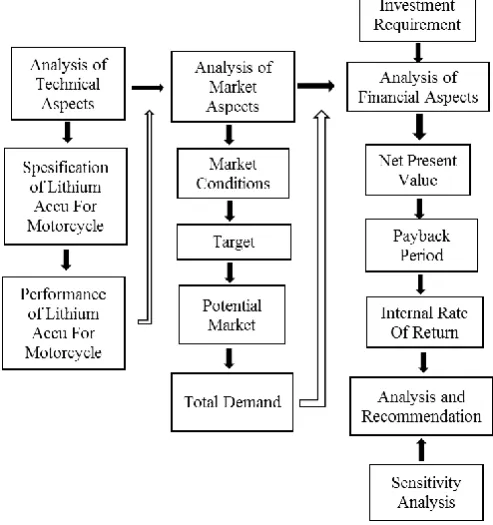
[image:2.595.305.551.255.380.2]This research was conducted with approaches as shown by Fig. 2. Early stage of this research is started from collecting data, i.e. the specification of lithium-ion batteries for motorcycle and the investment requirements. Based on the specifications of the product, it is important to analysis about the technicality of product. After a technical analysis created, The market analysis is done to know how the market conditions of lithium-ion batteries, and then define target markets and potential market, after that total demand is identified.
Fig. 1. Business Process of Lithium Battery
The cost of good and determining the requirement of investment to formulate the financial statements. After financial statement created, the net present value (NPV), internal rate of return (IRR), and payback period is calculated. The analysis and recommendation also consider sensitivity analysis.
Fig. 2. Research Approaches
III. BATTERY
Battery technologies have two fundamental characteristics, consist of power density and energy density [12]. Power density is the amount of energy that can be delivered in a given period of time, affecting how fast a vehicle accelerates. Energy density is the capacity to store energy, affecting the range a vehicle can travel [5].
There are some types of battery. First, lead acid battery is the oldest type of rechargeable battery. It has been the battery of choice around the world for many years. Lead acid battery is simple, inexpensive, and easy to manufacture. But its low density. In addition, 98 % of lead acid batteries are recycled, among the highest recycling rates for any manufactured product, thus minimizing the environmental of disposal [4]. Then the improvement of lead acid batteries was done by giving research grant to two US lead acid battery manufacturers to advance the use of lead-carbon in batteries with a more efficient, lower cost alternative [21].
New battery technology is based on lithium. Lithium-ion batteries give high energy, lighter and smaller than other battery type [13]. Here is the comparison performance between lead acid battery and lithium-ion battery.
TABLE I
COMPARISON BETWEEN LEAD ACID BATTERY AND LITHIUM BATTERY Battery Lead acid Battery LiFePO4 Battery / Capacity Lead acid / 12 V 3,5Ah LiFePO4 / 12 V 3,5Ah Fully Charged
Capacity
12,1 V 14,4 V
Battery Cell 6 Cell 4 Cell
Life Time (year) 1 – 1,5 4 – 5
Charging Time (HR)
5 1,5
Weight (kg) 1,7 0,5
Size (L X W X H) (mm)
Comparison
150 x 87 x 93
Contains heavy lead and release poison gas
114 x 71 x 94 No heavy metal population and completely closed
IV. LITHIUM-ION BATTERY
Lithium-ion batteries cover a group of battery chemistries that employ various combinations of anode and cathode materials [12]. Lithium based batteries are able to store as much as three times more energy than other materials, giving it a competitive advantage and making it the key ingredient for batteries. Other benefits of lithium–ion batteries include a higher energy density to weight ratio, longer life, and no memory effects. Lithium is also considered more environmentally friendly due to lithium recovery having virtually no waste when mining, in comparison to existinglead-acid technologies [6].
In this study, the lithium for lithium-ion batteries for motorcycle is LiFePO4. On the technical side, competing
lithium-ion technologies can be compared about power density, battery capacity, overcharged and discharged, and lifetime. The performance of lithium-ion battery for motorcycle is shown in Table 2.
TABLE 2
THE RESULT OF PERFORMANCE OF LITHIUM BATTERY FOR MOTORCYCLE Num Testing Prerequirement Performance’s
results
Explanation
1 Open circuit voltage
± 12 V 14,4 V Passed
2 Minimum
capacity
± 3 Ah 3,5 Ah Passed
3 Overcharged ≥ 2 C 3 C Passed
4 Over
Discharge
≥ 2 C 4 C Passed
[image:2.595.46.293.400.663.2] [image:2.595.300.554.649.745.2]V. MARKET ANALYSIS
Market study is the process to identify the magnitude of a market segment that is willing to buy the product and to identify the target market reasons to choose products for competition in the market takes place [22].
Lithium battery technology in the world has been developed since 1979 [25]. The demand for the use of lithium in the world is increasing from year to year. This is supported by the results of forecasting based on data usage by consumer lithium from 2000 until 2008 increased by 10%. Lithium Market Outlook forecast on demand for lithium increased to 11% from 2012 until 2017.
[image:3.595.305.549.62.235.2]
Fig. 3. World Consumption of Lithium by End-Use
Source : [7], [8]
Demand for rechargeable lithium-ion batteries are lithium highest demand. It can be seen in Fig. 3.
The demand for lithium always increases, especially in lithium battery application that makes the business of lithium battery has a good prospect. In addition, motorcycle demand in Indonesia is increasing from year to year. It can be seen from the BPS Indonesia. Increased sales of motorcycles in Indonesia resulted motorcycle battery demand is increasing. With the increasing demand for motorcycle batteries and the advantages possessed lithium batteries compared to lead acid batteries make lithium battery business for motorcycles in Indonesia wide open. And then there is no supplier of lithium-ion batteries for motorcycles in Indonesia.
Lithium-ion battery for motorcycles which will be marketed in Indonesia is a LiFePO4 battery with a voltage of
12V 3AH. In the price segment, the price of lithium-ion batteries are more expensive than the lead acid battery. It is a weakness that is owned by a lithium battery for motorcycles. Lead acid battery prices in the Indonesian market are approximately IDR 200,000.00.
The production cost can be divided into the manufacturing cost and other cost [26]. The manufacturing cost is composed of raw material cost, utilities cost, operating and maintenance cost, and depreciation cost. The cost is made up of plant overhead cost, administrative cost, and distribution cost [27]. Here is the cost of production of lithium batteries for motorcycles in Indonesia.
Depreciation cost is estimated through straight line depreciation [27] of 8 year life time.
TABLE 3
COST OF AKI LITHIUM FOR MOTORCYCLE
Purchase cost of lithium module from
supplier Rp 11.447.600.000
Direct labor cost Rp 51.800.000
Packaging Cost Rp 200.000.000
Distribution Cost Rp 10.000
11.699.410.000 Rp
Factory overhead fabric
Machinery depreciation costs Rp 148.500.000
Research costs Rp 3.000.000
Engineering costs Rp 96.000.000
Electricity cost Rp 79.232.589
326.732.589 Rp
T otal Cost Rp 12.026.142.589
Cost per product Rp 300.654
C O ST O F GO O DS SO LD
From the cost of the product obtained, the selling price of products targeted at Rp 330.719,00. Lithium-ion batteries having life time as doubled as lead acid batteries.
This is expected that the price of lithium-ion batteries less than doubled of lead acid batteries. From the result of target price, it is intended that the lithium-ion battery is able to compete with lead acid batteries in the Indonesian market.
TABLE 4
TARGET MARKET OF LITHIUM BATTERY FOR MOTORCYCLE
Brand of Motorcycle Sales
Honda beat CW 110 1.900.000
Honda CB 150 R 86.808
Honda Scoopy Sport 110 240.000
Yamaha Jupiter MX 135 204.000
Honda Supra X 125 427.068
Yamaha Vixion 150 318.000
Yamaha Mio Sport 110 384.000
Suzuki Satria F 150 253.149
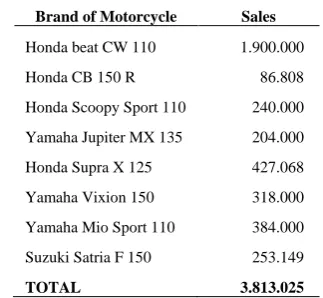
TOTAL 3.813.025
Target markets lithium-ion batteries for motorcycles, motorcycle aimed at consumers, where the motorcycle is appropriate to use a lithium battery 12V 3AH. Brands of motorcycles in Indonesia matching using lithium-ion batteries 12V 3AH shown in Table 4.
Lithium-ion battery products for motorcycles in Indonesia is in the introduction stage. Because of that, sales of lithium-ion batteries for motorcycles target of 1% of the amount of sales of the motorcycle shown in Table 4.
VI. FINANCIAL ANALYSIS
Testing the feasibility of the financial aspects aimed at developing the financial model of the business which saw periods of financial breakeven point to be received from a business development. Financial feasibility studies carried out in this study include the calculation of Net Present Value (NPV), Payback Period (PP), and Internal Rate Of Return (IRR).
Total investment of lithium battery for motorcycle consist the cost of machine’s procurement and research cost.
[image:3.595.46.291.207.375.2] [image:3.595.343.505.349.498.2]TABLE 5 TOTAL INVESTMENT
Type of Cost Quantity Cost Total Cost
Cost of machine's procurement
Cell Testes 4 Rp 162.000.000 Rp 648.000.000
Module Tester 1 Rp 540.000.000 Rp 540.000.000
Research Cost 1 Rp 15.000.000 Rp 15.000.000
Total Investment Rp 1.203.000.000
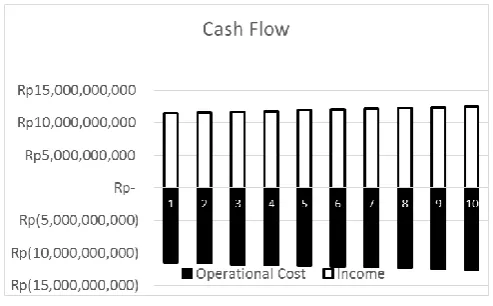
[image:4.595.45.555.51.166.2]Other input variables used are the sales price is Rp 330.719,00/unit, 13,5% discount rate, percents of bank inflation is 7,26%, over the 8-years planning horizon, which is include debt payments to debt holders. The discount rate is assumed by Mandiri bank rate. The planning horizon is assumed from Bank Indonesia inflation rate.
Fig. 4. Cash Flow for 10 Years Period
A. Net Present Value
Net Present Value consists in discounting all future cash flows include inflow and outflow resulting from the innovation project with a given discount rate and then summing them together [2]. Here is the equation of net present value :
(1) NPV = net present value;
Nest = net cash flow generated by innovation projects in year t;
r = discount rate B. Internal Rate Of Return
Internal Rate Of Return (IRR) is a method for calculating the interest rate to be received (Proceeds Future PV) is equal to the present value of capital expenditure (PV Capital Outlays). This method is useful for finding the interest rate used for discounting the net cash flow to be received in the future, so that number is equal to the initial investment (NPV = 0).
(2) IRR : Internal Rate of Return (%)
NPV1 : Present Value from investment value NPV2 : Present value from the value of net profit i1: discount rate, which produces NPV1
i2: discount rate, which produces NPV2
C.Payback Period
The payback period is calculated based on cash flow
analysis, which is the study of the cycle of cash inflows and outflows [3]. Payback Period (PP) aims to determine how long (period) investment will be returned when the break even point [20].
PP =
(3) PP : Payback periods
Ci : Profit
C0 : Investment Value
D : Depreciation
The calculation of feasibility analysis of investment has been done, and then the results have shown in Table 6.
A summary of the results of the three criteria, it was found that the investments on lithium batteries for motorcycles is feasible. NPV can be seen from the results that the business value benefits of Rp 4,332,796,049.00 and is feasible because of the value of benefits is positive.
TABLE 6
THE RESULT OF FEASIBILITY ANALYSIS OF INVESTMENT
Criteria Comparison Result Decision
Net Present
Value > IDR 0 Rp 4.332.796.049 Accepted
Payback Period < 8years 1 year 23 days Accepted
IRR MARR = 20,67% 90% Accepted
Based on the NPV, we can see that the NPV is higher than zero. Based on the payback period, it was found that the payback period is less than the planning horizon. Based on the value obtained IRR of 90%, which indicates that the company can survive above the minimum interest rate (MARR) of 27% which MARR has to accommodate the risk factors and inflation. So, based on all of the criteria, this investent is proper.
VII. SENSITIVITY ANALYSIS
In this section, the effect of changing model input parameters on the economic performance is evaluated. The sensitivity analysis is a useful procedure in evaluating the model input parameters. This can then direct us to where the uncertainties lay, thus identifying the most influential parameters and testing the robustness of the assumptions made [23].
This study creates a sensitivity analysis for projecting the change of some parameters that influence it. In this study sensitivity about the quantity of sales parameter and cost changing parameter is discussed.
The first table of Table 7 are sensitivity analysis about cost parameter. This analysis explains about how cost of product influence the NPV, PBP, and IRR. The second table is sensitivity analysis about sales parameter.
Given the result from the table, we can see that the model is sensitive to fluctuations in the assumptions used. From the cost scenario result that increasing the cost will make the investment is not propered. We can see from the 10% of percentation, the result of NPV is below zero.
[image:4.595.45.292.245.398.2]TABLE 7 SENSITIVITY ANALYSIS
Scenario
(Cost) NPV PBP IRR
-20% Rp 8.681.309.351 11 Months >100%
-10% Rp 4.731.884.467 1 year 6 month 78%
10% Rp(3.166.965.300) 6 years <0%
Scenario
(Sales) NPV PBP IRR
-20% Rp (90.204.590)
7 years 6
months 6%
-10% Rp 346.127.497
5 years 3
months 16%
10% Rp 1.218.791.671
3 years 7
months 28%
20% Rp 1.655.123.757 3 years a month 28%
VIII. CONCLUSION
This paper develops techno economic analysis regarding lithium-ion batteries for motorcycles in Indonesia, which includes feasibility technical analysis, market analysis, and economic analysis. Results showed that the lithium-ion battery business for motorcycles in Indonesia is technically feasible, market, and economic.
In aspects of this lithium-ion battery business market has considerable business opportunities as seen from the availability of lithium-ion battery supply in Indonesia and demand for motorcycles is increasing. Then, seen from the technical aspects, lithium-ion batteries for motorcycles has many advantages compared to conventional battery such that the application easier and more, package more convenient and practical, requires no maintenance , lighter, smaller size, and longer durability. With these advantages, business prospects lithium-ion batteries for motorcycles bigger.
Economic feasibility analysis in this paper uses three methods: NPV, PP, and, IRR. Business lithium-ion batteries for motorcycles is feasible based on the three methods of analysis of the feasibility of the investment.
Further research can be conducted will be more about market strategy to realize commercialization of lithium-ion battery for motorcycle in Indonesia.
REFERENCES
[1] O. Zizlavskya, “Net present value approach: method for economic assessment of innovation projects ,” 19th International Scientific Conference, 2014.
[2] Y. Zhaoa, H. Honga, H. Jina ,“Thecno-economic optimization of Solar–Coal Hybrid Systems,” The 7th International Conferenceon Applied Energy – ICAE2015, 2015, p 457-461.
[3] Battery Council International. “Lead Acid Batteries” 2006. [Online]. Available : http://www.leadacidbatteryinfo.org/
[4] B. Canis. “Battery Manufacturing for Hybrid and Electric Vehicles: Policy Issues” in Congressional Research Service. 2013
[5] Fox Davies, “The LITHIUM Market ,” September 2013.
[6] Lithium Market Outlook 2017, in Fox Davies, “The LITHIUM Market ,” September 2013.
[7] Roskill Information, in Fox Davies, “The LITHIUM Market ,” September 2013.
[8] Deutsche Bank.“Autos & Auto parts Electric Cars: Plugged in 2”, 2009. Online. Available : http://www.db.com/
[9] NEDO. “Next Generation Automobile Battery Technologies, Road Map”, 2008. [Online]. Available : http://app3.infoc.nedo.go.jp/ [10] W. Sutopo, R.W. Astuti, A. Purwanto and M.
Nizam,“Commercialization model of new technology lithium ion battery: a case study for SmarT electric vehicle,” Proceedings of the 2013 Joint International Conference on Rural Information and Communication Technology and Electric-Vehicle Technology, rICT and ICEV-T 2013
[11] W. Sutopo, I. Mariyanie, A. Purwanto, M. Nizam, “A Comparative Value Chain Analysis of Battery Technologies for Electrical Vehicles,” Proceedings of the 2013 Joint International Conference on Rural Information and Communication Technology and Electric-Vehicle Technology, rICT and ICEV-T 2013
[12] M. Lowe, S.Takuoka, T. Trigg, and G. Gereffi. “Lithium-Ion Batteries for Electric Vehicles: The US Value Chain. Center on Globalization, Gov. & Competitiveness, Duke University, 2010.
[13] Nipress. “The explanation from Research and Development department of PT Nipress tbk”. Bogor, August 2015.
[14] B. Hermana, “Mendorong Daya Saing di Era Globalisasi: Pemanfaatan Modal Intelektual dan Teknologi Informasi sebagai basis Inovasi di Perusahaan,” [Online]. Available: http://bhermana.staff.gunadarma.ac.id. [Accessed September 2015]. [15] G. R. F. Suwandi, M. Haaekal, F. Iskandar, “Optimasi Resistansi
Ohmik Baterai Li-ion Melalui Kombinasi Bahan Elektroda Berpori dan Elektrolit. Seminar Nasional Material,” Seminar Nasional Material Bandung, 2013.
[16] Sumiati, Sugiharto ,” Studi Kelayakan Proyek Pengembangan Perkebunan Pisang Abaca Dengan Menggunakan Analisis Peranggaran Modal,” Jutnal Eknomi dan Bisnis, Jilid 7, 2002, p 145 – 150.
[17] L. D. Laraswati, W. Sutopo, N. Atikah, “Simulasi Model Analisis Kelayakan Alternatif Bentuk Komersialisasi Perusahaan Mini Plant Baterai Lithium-Ion Di Indonesia,” Seminar Nasional IDEC, 2014. [18] Kasmir, Jakfar,” Studi Kelayakan Bisnis ,” Jakarta: Prenada Media
Group, 2007.
[19] Wirasutama, “Analisis Kelayakan Finansial Angkutan Pariwisata Di Provinsi Bali (Studi Kasus Pada PT. GD Bali Transport Dan PT. Amadnda Legian Tours),” Teknik Sipili, Bali : Universitas Udayana, 2014.
[20] International Lead and Zinc Study Group. “The Potential Impact of Hybrid and Electric Vehicles on Lead Demand”, March 2010. [Online]. Available : http://www.eurometaux.eu/
[21] Atikah, N., Ghabid, A.H.A., Sutopo, W., Purwanto, A., Nizam, M., “Document Technical feasibility for technology commercialization of battery lithium ion,” Proceedings of 2014 International Conference on Electrical Engineering and Computer Science, ICEECS 2014, pp. 308-314.
[22] C. Patels, P. Lettieri, S.J.R. Simons, A. Germana,” Techno-economic performance analysis of energy production from biomass at different scales in the UK context,” Chemical Engineering Journal 171, 2011, pp. 986-996.
[23] R. Astuti, Yuniaristanto, W. Sutopo, A. Purwanto, M.Nizam ,”Timing Model to Launch Spin-off Company: The Case Study of Mini Manufacturing Plant of 10kWH Li-Ion Batteries,” Lecture Notes in Engineering and Computer Science, 2210, 2014., pp. 1060-1064. [24] CITI ,” Lithum-ion Batteries A Japanese Tech Growths
Story,”[Online]. Available from
http://pg.jrj.com.cn/acc/Res/CN_RES/INDUS/2012/7/20/6eafe981-bdeb-45ac-a56c-be734abb9fd7.pdf, 6 Mei 2014.
[25] P. Pecas Ribeiro, E. Henriques,” Incorporating tool design into a comprehensive life cycle cost framework using the case of injection molding,” J.Clean. Prod. 53, 297e309.