Recognizing People by Their Gait
Ping S. Huang, Chris. J. Harris and Mark S. Nixon
Department of Electronics and Computer Science
University of Southampton, Southampton SO17 1BJ, UK
[psh95r|cjh|msn]@ecs.soton.ac.uk
Abstract
To recognize people by their gait from a sequence of images, we have proposed a statistical approach which combined eigenspace transformation (EST) with canonical space transformation (CST) for feature transformation of spatial templates. This approach is used to reduce data dimensionality and to optimize the class separability of different gait sequences simultane-ously. Good recognition rates have been achieved. Here, we incorporate temporal information from optical flows into three kinds of temporal tem-plates and use them as features for gait recognition in addition to the spa-tial templates. The recognition performance for four kinds of template fea-tures has been evaluated in this paper. Experimental results show that spatial templates, horizontal-flow templates and the combined horizontal-flow and vertical-flow templates are better than vertical-flow templates for gait recog-nition.
1
Introduction
formation (EST) with canonical space transformation (CST) based on Canonical
Anal-ysis for feature extraction of spatial templates to recognize humans by their gait. This approach can be used to reduce data dimensionality and to optimize the class separability of different gait sequences simultaneously. By using spatial templates of human silhou-ettes as features, each image template is projected from high-dimensional image space to a single point in low-dimensional canonical space. A walking sequence becomes a trajec-tory in this new space and the recognition of human gait becomes much simpler and more accurate.
In this paper we incorporate temporal information from optical-flow changes between two consecutive spatial templates into three kinds of temporal templates and use them as additional features for gait recognition. Firstly, spatial and temporal templates are ex-tracted from each sequence. Secondly, training template sequences are projected into individual canonical space by EST and CST after training. Thirdly, recognition of test sequences is achieved in canonical space after projection. Finally, the recognition perfor-mance of the four kinds of template features is shown in experimental results.
2
Feature Template Extraction
Intuitively, recognizing humans by gait depends on how the silhouette changes for in-dividual subjects. According to this hypothesis, here we use spatial templates in [6] and three kinds of temporal templates to recognize humans by gait. Before training and recog-nition, each gait sequence is separately converted into four template sequences in which spatial templates and three kinds of temporal templates are extracted from each original sequence.
2.1
Spatial Templates
For the extraction of spatial templates, we choose the preliminary process from Murase’s approach [10] in which the silhouette is fitted in a6464image template by normalizing
its position and size with constant aspect ratio. Naturally, to isolate the human silhouette, we can simply subtract the background from each image. However, the difference image thus obtained is not binarized. To simplify the representation, a binary image is obtained by region growing [4]. Figure 1(a) shows an image from a gait sequence and Figure 1(b) is a binary(thresholded) version.
The centroid and silhouette window of each template in the original image can be ob-tained simultaneously and are used later for the extraction of temporal templates. Sample spatial templates are illustrated in Figure 2 from a gait sequence.
2.2
Temporal Templates
(a) A walking person (b) thresholded version
Figure 1: Sample images of a walking person
[image:3.612.155.441.239.313.2](a) (b) (c) (d) (e) (f)
Figure 2: Sample spatial templates of a walking person
extract each temporal template which contains the flow within a moving window. Fig-ures 3(a) and 3(b) show two consecutive images from a gait sequence.
Unlike other methods, Little and Boyd [8] used dense optical flow fields, generated by minimizing the sum of absolute differences between image patches [2]. However, this algorithm is sensitive to brightness change caused by reflections, shadows, and changes of illumination. Therefore, the images are firstly processed by computing the logarithm of brightness and converting the multiplicative effect of illumination change into an ad-ditive one. Secondly, each processed image is filtered by a bandpass filter (Laplacian of Gaussian) to remove the additive effects.
Basically, the algorithm [2] searches for the displacement of each pixel among a lim-ited set of discrete displacements by minimizing the sum of absolute differences between
(a) Current image (b) Next image
[image:3.612.150.444.524.595.2](a) (b) (c) (d) (e) (f)
(g) (h) (i) (j) (k) (l)
[image:4.612.157.440.88.342.2](m) (n) (o) (p) (q) (r)
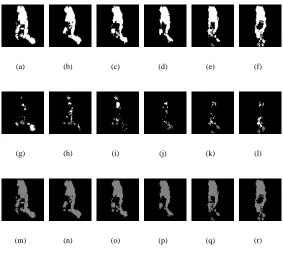
Figure 4: Sample temporal templates of a walking person
a patch in one image and the corresponding displaced patch in the other image. After a best matching patch in the second image is found for each patch in the first, the algorithm is run a second time and the roles of the the two images are switched. For a correct match, the results will likely agree. In order to remove invalid matches, Little and Boyd compare the results at each point in the first image with the result at the corresponding point in the second. The second point should match to the first: the sum of displacement vec-tors should be approximately zero. Only those matches that pass this validation test are retained. The results could be interpolated to provide sub-pixel displacements but only integral values are used here. In effect, the minimum displacement is1:0pixels per frame;
points that are assigned non-zero displacements form a set of moving points.
Three kinds of temporal templates are adopted in this paper and they areu-flow
tem-plates which are horizontal components of flow,v-flow templates which are vertical
com-ponents of flow andj(u;v)j-flow templates which are the magnitudes of(u;v). They are
shown in Figures 4. Figure 4(a)-(f) areu-flow templates, Figure 4(g)-(l) arev-flow
tem-plates and Figure 4(m)-(r) arej(u;v)j-flow templates from a gait sequence, respectively.
image vectors (x(1),x(2),...,x(n)) (x(1),x(2),...,x(n)) (x(1),x(2),...,x(n)) (x(1),x(2),...,x(n)) (x(1),x(2),...,x(n))
eigen feature vectors
(y(1),y(2),...,y(k)) (y(1),y(2),...,y(k))
(y(1),y(2),...,y(k)) (y(1),y(2),...,y(k))
(y(1),y(2),...,y(k))
canonical feature
vectors (z(1),...,z(c-1)) (z(1),...,z(c-1)) (z(1),...,z(c-1)) (z(1),...,z(c-1)) (z(1),...,z(c-1))
eigenspace transformation
canonical space transformation
. . .
[image:5.612.183.411.80.208.2]sequence template image
Figure 5: Projection of template images
3
Transformation and Training
Four kinds of basic feature templates from each training sequence are used during train-ing, they are spatial templates,u-flow templates,v-flow templates andj(u;v)j-flow
tem-plates, respectively. They will be individually projected into four different canonical spaces by for further recognition after training stage. Figure 5 illustrates the projec-tion steps that generate feature vectors by eigenspace transformaprojec-tion and canonical space transformation for different kinds of template images.
Adopted from previous work [6], we use the transformation which combined EST and CST for feature extraction. Template images in high-dimensional image space are con-verted to low-dimensional eigenspace using EST. Obtained vectors thus are further pro-jected to a smaller canonical space using CST. Recognition is accomplished in canonical space. Patently, the reduced dimensionality results in concomitant decrease in computa-tion cost.
Givencclasses for training and each class represents a template sequence of a single
person.x i;jis the
j-th template in classi, andN
iis the number of templates in
i-th class,
the total number of training templates isN T
=N 1
+N 2
++N
c. This training set is
represented by
[x 1;1
;;x 1;N1
;x 2;1
;;x c;Nc
] (1)
where each samplex
i;jis an template image with
npixels. By subtracting the meanm x
of full image set from each image, the image set can be described by anN
Tmatrix X,
with each imagex
i;jforming one column of
X, that is
X=[x 1;1
m x
;;x 1;N
1 m
x ;;x
c;N c
m x
]: (2)
3.1
Eigenspace Transformation
LetRbe annmatrix and represented by
R=XX T
: (3)
Based on singular value decomposition theory [9], eigenvalues and associated eigen-vectors ofRcan be recovered from a much smaller matrix,
~ R=X
T
i = ~ i e i = ~ i 1 2 X~e i ; (5)
where i = 1;:::;K, ~ 1 ;:::; ~ K and ~ e i
;:::;~e
K are eigenvalues and eigenvectors of ~
R. Suppose obtained eigenvalues and associated eigenvectors ofRare 1
;:::; K and e
i ;:::;e
K. According to the theory of PCA, each image can be approximated by taking
only thekKlargest eigenvaluesj 1
jj 2
jj k
jand associated
eigenvec-torse 1
;:::;e
k. This partial set of
keigenvectors spans an eigenspace in whichy i;jare
the points that are the projections of the original imagesx
i;jby the equation
y i;j
=[e 1
;;e k ] T x i;j ; (6)
wherei=1;:::;candj=1;:::;N c.
3.2
Canonical Space Transformation
Based on the theory of canonical analysis [5], CST is presented as follows. Suppose
f 1 ; 2 ;; c
grepresents the classes of transformed vectors by eigenspace
transfor-mation andy
i;j is the
j-th vector in classi. The mean vector of the entire set is given
by m y = 1 N T c X i=1 Ni X j=1 y i;j ; (7)
and the mean vector of thei-th class is represented by
m i = 1 N i X y i;j 2 i y i;j : (8) LetS
wdenote within-class matrix and S
bdenote between-class matrix, then
S w = 1 N T c X i=1 X y i;j 2 i (y i;j m i )(y i;j m i ) T S b = 1 N T c X i=1 N i (m i m y )(m i m y ) T
The objective is to minimizeS
w and maximize S
bsimultaneously, that is to solve the
generalized eigenvalue equation
S b w i = i S w w i : (9)
After equation (9) is solved, we will obtain(c 1) nonzero eigenvalues and their
cor-responding eigenvectors[v 1
;:::;v c 1
]that create another orthogonal basis and span a (c 1)-dimensional canonical space. By using this basis, each point in eigenspace can be
further projected to another point in this canonical space by
z i;j
=[v 1
wherez
i;jrepresents the new point and [z
i;1 ;:::;z
i;Ni
]is the new trajectory in canonical
space. By merging equation (6) and equation (10), each image can be projected into one point in the new(c 1)-dimensional space by
z i;j
=[v 1
;:::;v c 1
] T
[e 1
;:::;e k
] T
x i;j
: (11)
The centroid of each training sequence in canonical space is given by
C i
= 1 N i
Ni X
j=1 z
i;j (12)
4
Recognition
Let a test gait sequence beg(t), in whicht = 1;:::;T. Before recognition, four
differ-ent kinds of templates are extracted from this test sequence and projected into individual trained canonical space by equation (11), given four vector sequences after projection,
h 1
(t),h 2
(t),h 3
(t)andh 4
(t), representing spatial,u-flow,v-flow andj(u;v)j-flow
tem-plates, respectively.
To recognize a human walking sequence from a trained database in each canonical space, the accumulated distance to each centroid is used. This will eliminate matching problems caused by velocity changes and phase shifts. The accumulated distance between test vector sequences, h
k
(t), in which k = 1;:::;4and six centroids, C
i;k, in which i=1;:::;6is
d 2 i;k
= T X
t=1 kh
k (t) C
i;k k
2
; (13)
whereC
i;k is the centroid of class
iin canonical space k. To match a test sequence h
k
(t)to a training sequenceiin canonical spacekcan be accomplished by choosing the
minimumd
2 i;k
.
5
Experimental Results
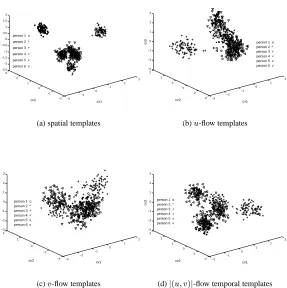
The sample human gait data came from the Visual Computing Group, University of Cali-fornia, San Diego. There are 6 people and 7 sequences of each. One walking sequence is selected from each person as the training sequence and remaining 36 sequences served as test sequences. Results in Figures 6(a), 6(b), 6(c) and 6(d) show that six classes of train-ing sequences ustrain-ing spatial templates, u-flow templates,v-flow templates andj(u;v)j
-flow templates are greatly separated in each canonical space. For visualization purposes, we only show the first three of five dimensions. Linear re-scaling [1] has been applied to each vector to set the average of each data set to zero and to normalize the standard deviation to unity.
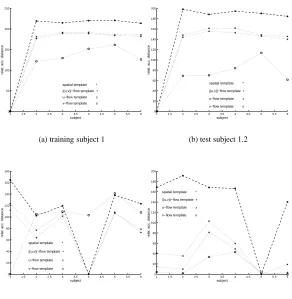
Figures 7(a) and 7(b) show relative accumulated distances of one training and one test sequences from subject 1. Here, thev-flow template has lower distance and hence
−2 −1 0 1 2 3 −2 −1 0 1 2 3 −2.5 −2 −1.5 −1 −0.5 0 0.5 1 1.5 2 cv1 cv2
person 6 v person 5 x person 4 < person 3 + person 2 * person 1 o
cv3
(a) spatial templates
−3 −2 −1 0 1 2 −3 −2 −1 0 1 2 −3 −2 −1 0 1 2 3
person 6 v person 5 x person 4 < person 3 + person 2 * person 1 o
cv1 cv2
cv3
(b)u-flow templates
−3 −2 −1 0 1 2 −4 −2 0 2 4 −3 −2 −1 0 1 2 3 cv1 cv2
person 6 v person 5 x person 4 < person 3 + person 2 * person 1 o
cv3
(c)v-flow templates
−2 −1 0 1 2 3 −2 −1 0 1 2 3 −3 −2 −1 0 1 2 3 cv1 cv2
person 6 v person 5 x person 4 < person 3 + person 2 * person 1 o
cv3
[image:8.612.154.441.105.393.2](d)j(u;v)j-flow temporal templates
Figure 6: Distributions of 6 training sequences in four canonical spaces
the distance by thev-flow template leads to confusion in classification, in Figure 7(c),
where the fifth sequence of subject 4 can be classified as subject 1 and, in Figure 7(d), subjects 1 and 2 appear close to the target subject 5. Conversely, the spatial template again offers best performance, again there is little difference between thej(u;v)j-flow template
and theu-flow template and both perform better than thev-flow template measures.
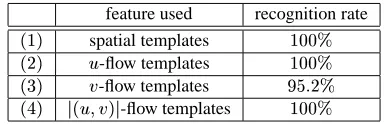
The comparison of recognition performance using four different templates is shown in Table 1. Clearly, the feature vectors generated by the combination of EST and CST yield high recognition rates. Using template matching, the poor performance achieved by
v-flow templates can be explained by the reduced information of optical flow from the
extracted templates in Figure 4(g)-(l). Vertical movements of gait usually have smaller changes than horizontal movements, thus have less discriminatory power in distinguish-ing different gaits. Spatial templates,u-flow templates andj(u;v)j-flow templates make
1 1.5 2 2.5 3 3.5 4 4.5 5 5.5 6 0
50 100 150 200 250
subject
relat. acc. distance
[image:9.612.151.443.91.390.2]spatial template * |(u,v)|−flow template + u−flow template x v−flow template o
(a) training subject 1
1 1.5 2 2.5 3 3.5 4 4.5 5 5.5 6 0
20 40 60 80 100 120 140 160 180 200
subject
relat. acc. distance
spatial template *
|(u,v)|−flow template +
u−flow template x
v−flow template o
(b) test subject 1.2
1 1.5 2 2.5 3 3.5 4 4.5 5 5.5 6 0
20 40 60 80 100 120 140 160 180
subject
relat. acc. distance
spatial template *
|(u,v)|−flow template +
u−flow template x
v−flow template o
(c) test subject 4.5
1 1.5 2 2.5 3 3.5 4 4.5 5 5.5 6 0
20 40 60 80 100 120 140 160 180 200
subject
relat. acc. distance
spatial template *
|(u,v)|−flow template +
u−flow template x
v−flow template o
(d) test subject 5.6
Figure 7: Relative accumulated distance of training and test sequences
6
Conclusions
In this paper we use our previous approach which combined EST with CST for feature extraction with new motion data. EST ans CST can be used to reduce data dimension-ality and to optimize the class separability of different classes simultaneously, greatly improving the performance of eigenspace approach. Apart from the feature of spatial templates used in previous work, we propose three more features by temporal templates. These new features incorporate temporal information into each template. The analysis and comparison of recognition performance for each individual feature shows that the spatial templates, the horizontalu-flow templates and the magnitudej(u;v)j-flow templates are
better than the verticalv-flow templates for gait recognition. We are currently working on
feature used recognition rate
[image:10.612.199.392.91.153.2](1) spatial templates 100% (2) u-flow templates 100% (3) v-flow templates 95:2% (4) j(u;v)j-flow templates 100%
Table 1: recognition using different template features
concentrate on looking for more precise and robust features, whilst aiming to develop the technique still further.
7
Acknowledgements
We would like to thank Dr. Jeffrey Boyd at the Visual Computing Laboratory, University of California, San Diego, USA for providing gait data and giving invaluable advice.
References
[1] C. M. Bishop. Neural Networks for Pattern Recognition. Oxford University Press, 1996. [2] H. Bulthoff, J. Little, and T. Poggio. A parallel algorithm for real-time computation of optical
flow. Nature, 337:549–553, February 1989.
[3] D. Cunado, M.S. Nixon, and J.N. Carter. Using gait as a biometric, via phase-weighted mag-nitude spectra. In First Int. Conf., AVBPA’97, pages 95–102, Crans-Montana, Switzerland, March 1997.
[4] M-P Dubuisson and A.K. Jain. Contour extraction of moving objects in complex outdoor scenes. International Journal of Computer Vision, 14(6):83–105, 1995.
[5] K. Fukunaga. Introduction to Statistical Pattern Recognition. Academic Press, 2nd edition, 1990.
[6] P.S. Huang, C.J. Harris, and M.S. Nixon. Canonical space representation for recognizing hu-mans by gait and face. In Proc. of Southwest Symposium on Image Analysis and Interpretation, pages 180–185, Tucson, Arizona, USA, April 1998. IEEE.
[7] X. Jia and M.S. Nixon. Extending the feature vector for automatic face recognition. IEEE Trans. Pattern Anal. Machine Intell., 17(12):1167–1176, 1995.
[8] J. Little and J. Boyd. Recognizing people by their gait: the shape of motion. MIT Press Journal - Videre, 1997. Accepted for publication.
[9] H. Murakami and V. Kumar. Efficent calculation of primary images from a set of images. IEEE Trans. on Pattern Anal. Machine Intell., 4(5):511–515, 1982.
[10] H. Murase and R. Sakai. Moving object recognition in eigenspace representation: gait analysis and lip reading. Pattern Recognition Letters, 17:155–162, 1996.
[11] S.A. Niyogi and E.H. Adelson. Analysis and recognizing walking figures in xyt. In Proc. IEEE Conf. on Computer Vision and Pattern Recognition, pages 469–474, Seattle, WA, USA, June 1994.