To the Minister for Enterprise & Employment
Pursuant to the Industrial Development Act, 1993, Forfás herewith presents its report and accounts for the year ended December 31, 1996
Do Aire Fiontar & Fostaíochta
De bhun an Achta um Fhorbairt Tionscail, 1993, tá a thuarscáil agus a chuntais don bhliain dar chríoch 31 Nollaig, 1996, a dtíolacadh leis seo ag Forfás.
Tom Toner Chairman
CHAIRMAN'S STATEMENT
The Irish Economy - an excellent performance
A very positive picture can be painted of Ireland's economy at the end of 1996. Our economic progress has been remarkable, combining strong economic growth, low inflation, unprecedented levels of job creation, falling unemployment levels and low interest rates.
Today Ireland enjoys the fastest growing economy in the European Union. Much has been achieved in social and economic progress and Ireland can look forward with confidence to a continuation of growth during 1997 and beyond.
A number of factors are acting in favour of the Irish economy. Prudent Government economic policies over the last ten years with a National Partnership approach to development
strategies, moderate wage increases, and relatively low interest rates and inflation have created an environment that has boosted competitiveness and both business and consumer confidence. It also has contributed to strong foreign investment flows into the country.
In addition to these, the impact of EU support funds, particularly in the areas of science and technology initiatives and infrastructural development has had a positive impact in promoting the development of many sectors of the economy and provides potential for further growth. Participation in a single currency bloc under EMU will further enhance overall growth prospects for Ireland in future years, provided that good preparations are made by both the public sector and by individual firms.
All of these factors have contributed to record employment creation, falling unemployment and rising living standards. At the same time, income from taxation is at record levels, creating opportunities for reduced taxation rates.
Finally, the international perception of Ireland as a country with a young, well-educated and flexible workforce, modern infrastructure and technology, together with a highly stable political and economic environment, has boosted confidence in investment and encouraged job creation. The result has been an unprecedented level of sustained growth in Ireland’s economy over past years, achieved without giving rise to widespread inflationary pressures.
Partnership 2000: a welcome
National agreements between the social partners have a vital role in Ireland’s competitiveness and economic progress. Forfás greatly welcomes the launch of Partnership 2000 in 1996. It should, as its predecessors did, contribute significantly to maintaining the positive and stable business environment Ireland has enjoyed for some years.
This agreement was drawn up with the overall aims of strengthening the ability to generate economic growth and employment, raising living standards and making further progress on improving social inclusion. Partnership 2000 sets out specific objectives in areas such as tax reduction, moderate and co-ordinated wage agreements, reductions in Government debt, control of public finances, and a specific programme aimed at social inclusion and equality. The achievement of these objectives will greatly contribute to Ireland’s future international competitiveness and social cohesiveness.
The agreement aims to keep wage inflation in the region of 2.5% per annum over the 31/4 year duration of the agreement within an agreed programme of PAYE tax reductions. It is crucial that these commitments are fully met by all sides in order to maintain competitiveness and contain inflation in a fast growing economy that could, otherwise, give rise to strong growth in wage demands, resulting in higher inflation and reduced competitiveness.
Forfás also supports the move towards ensuring that the negotiations for National Partnership Programmes be conducted within a longer term framework for social and economic advance. Forfás made a contribution to that process in the case of the Partnership 2000 negotiations through a number of reports and other inputs.
Shaping our Future: a long-term strategy for promoting enterprise in
Ireland
The sustained economic progress achieved in Ireland over the past decade under a series of social partnership agreements indicate a strong national potential to drive forward towards further increases in employment and further improvements in the quality of life of Ireland’s people. However, advances in employment creation and living standards will only be sustained by wise policy decisions that take into account the global competitive environment and the new technological changes that are underway and that will intensify as Ireland crosses the
threshold of a new century. Such decisions can be facilitated by establishing a strategic frame of reference that takes a 10-15 year perspective on developments, and likely trends in the forces that shape social and economic progress at both national and international levels.
During 1996, Forfás made an important contribution to this process by publishing, at the request of the Government, a report entitled ‘Shaping Our Future: A Strategy for Enterprise in Ireland in the 21st Century’. The Shaping Our Future Report represents the first attempt in Ireland to establish a long-term strategic public policy framework for promoting the
development of the enterprise sector. In doing so, it sets ambitious goals for public policy, encompassing employment, raising of standards of living and improvement of quality of life.
The underlying thrust of the report is that a dynamic and expanding enterprise sector, in particular the services sector, is an essential foundation in achieving a level of social and economic progress in Ireland that has not previously been attained. The report sets out a strategy for the development of both Irish-owned and overseas-owned industry. It places the services sector at the heart of enterprise strategy, along with manufacturing. A wide range of proposals are made in critical support areas such as taxation, skills, infrastructure, science and technology and competition policy.
Action is underway on the implementation of these proposals. To take some examples:
The need to reduce both personal and business taxation in Ireland was pinpointed. The recent downward direction of taxation rates on both counts is encouraging in this respect and is welcomed by Forfás. The recently announced changes in the Corporation Tax regime for the Post 2006 and Post 2010 periods follow from the analyses and options set out in the Report.
Human resource developmentwas identified as a central issue in maintaining and enhancing the competitiveness of Ireland’s economy and Forfás has since established an expert group to identify the actions that need to be taken to avoid future skills shortages. This group has already identified software, computer technicians and languages as priority areas for skills development. These are key disciplines where demand is growing very quickly and where the existence of significant shortages in the near future is a strong likelihood unless action is taken. In response to the work of the group the Government announced immediate plans to provide 1,000 extra third level places in languages, 1,000 places in software and 750 places for electronic technicians.
In the context of upgrading general skills levels, ‘Shaping our Future’ recommended increasing the school leaving age to seventeen. Forfás welcomes the decision to raise the leaving age to sixteen, with the aspiration of further increasing it in the future.
The Report recommended the development of a strategy for an Information Society. This Strategy would embrace the huge potential of developments in information and
telecommunications technology to improve the competitiveness of the Irish economy and to advance living standards and social cohesion. This strategy has since been developed by an
Employment. The Committee included the Chief Executive of Forfás, John Travers, and Forfás also provided the Secretariat for the Committee. The Government have broadly endorsed the recommendations of the Committee and established an Information Society Commission to report to the Taoiseach on the implementation of the strategy.
‘Shaping our Future’ emphasised the critical importance of Science and Technology and the need for strong links between Industry and third level institutions. The new advisory council on science, technology and innovation, representative of wide-ranging interests, has since been established under the Forfás legislation to provide independent expert advice on S&T matters to Government.
Logistics was another important area identified in ‘Shaping Our Future’ as a means by which Ireland could address critical disadvantages in location. A recommendation was made that a national Logistics Institute be established, providing practical training, education and research services for industry in this increasingly important area. The recommendation has been accepted and plans are well underway for the establishment of such an Institute.
The promise of the Future: what can be achieved
Ten years ago few would have predicted the level of social and economic progress that has been achieved in recent years in Ireland. That progress has not been the result of any single factor or restricted group of factors. Its roots lie deep
• in the lessons learned from the process of policy formulation and implementation in the past and present.
• in supporting the potential of the labour force to create and take advantage of international trading opportunities and
• in developing a range of consistent policies responsive to a changing global trading environment.
There is now a unique opportunity to build on what has been achieved. With the right
Government policies and a reasonably favourable economic environment at international level Ireland can over the next 10-15 years:
• more than halve the overall level of unemployment to less than 6 per cent of the workforce;
• achieve a greater level of reduction in long-term unemployment which remains at unacceptably high levels;
• increase the average standards of living in Ireland as measured by GNP per person to achieve the average for the present 15 member states of the EU;
• improve the quality of life in Ireland by reference to:
• lower unemployment levels especially for the long-term unemployed; • improved access to health, educational and training facilities;
• sensible conservation of the natural and built environment; • achieving a reasonable balance in regional development; • greater access to improved cultural and heritage facilities;
• increased resources to tackle the fundamental issues of social deprivation; • ensuring that every individual has the opportunity to achieve a basic level of
income which allows a decent standard of living.
The Way Forward
One of the functions of Forfás is to advise the Minister for Enterprise and Employment on these issues. It has done so in a comprehensive series of reports, memoranda and
discussions during 1996, which are outlined in more detail elsewhere in this Annual Report. I will exercise a Chairman’s privilege to highlight some of these:
The continuation of taxation and public finance reform, is essential. This should involve a substantial reduction in the overall level of taxation and, in particular, in taxation at the lower levels of personal income. Tight control of government spending and reduced Government borrowing are the prerequisites of reducing the burden of taxation on people and on business. An important issue is the future of the 10% corporation tax regime when it expires in 2010 for general manufacturing and in 2006 for the IFSC. The recent decision announced by the government to introduce a single low rate of corporation tax is welcome. It is important that the required legislative changes are prepared as soon as possible.
Ireland’s international competitiveness is another key issue. Policies aimed at keeping inflation, wage increases and interest rates low are essential, as are continued efforts to enhance social cohesion. The establishment of a National Competitiveness Council reporting to the Taoiseach was recently announced. Forfás will provide the research and secretariat services for the Council in consultation with the Department of Enterprise and Employment and other Government departments and State agencies.
The availability of people with appropriate skills is critical to the achievement of success. In that regard, a major drive is required to raise the skills profile of people, both through
education and the achievement of higher investment by firms in training and human resources development. It is important that a substantial proportion of the extra third level places in software, computer technicians and languages, referred to earlier, are provided in the 1997 - 1998 academic year.
The services sector has become the main source of new employment creation and this is set to continue. A proactive and co-ordinated policy towards the development of the Irish services sector is required, built on the clear growth potential of international and local services. The policy guidelines for services sector promotion announced by the Minister for Enterprise and Employment are welcome in that context. There is a need to improve competition policy to ensure that all services are subject to fair competition and intelligent regulation.
Investment in telecommunications infrastructure is critically important if Ireland is to establish a niche in advanced telecommunications services. Rapid advances in the provision of such services are being made in other countries. Increased investments must quickly be put in place in Ireland if a technology gap with other countries is not to become a barrier to
economic growth and development.
This can best be achieved through promoting competition and encouraging investment in telecom infrastructure. To facilitate this the powers of the Regulator established under recent legislation should be strengthened. Furthermore, strong consideration should be given to the reallocation of EU structural funds to support strategic investment in telecom facilities that offer fully open access to service providers.
Finally I would like to say that I am greatly encouraged by, and appreciative of, the support of the Minister for Enterprise and Employment, other Ministers and the Government for the work of Forfás in 1996. That work has been well acknowledged in a range of Government
publications, policy decisions and actions which are of significant importance to the development of the enterprise sector in Ireland.
Acknowledgments
As Chairman, I extend my thanks and appreciation to my fellow Board Members and to the many organisations and individuals who have contributed to the work of Forfás in 1996.
I wish to thank in particular the Minister for Enterprise and Employment, the Department of Enterprise and Employment and other government departments for their support and co-operation. I also wish to acknowledge the significant financial support provided by the EU for industrial development and the support of Science and Technology in Ireland through the Operational Programme for Industry and through a range of other programmes which have a large impact on the environment for enterprise.
I also extend my thanks to the State development agencies and other organisations with whom we worked closely throughout the year for their co-operation - in particular to Forbairt and IDA Ireland, an Bord Tráchtála and FÁS, the third level education sector, employer bodies and business organisations, trade unions and the media. All of these have been supportive of our work and that support is acknowledged and appreciated.
Finally, I want to thank sincerely the staff of Forfás for their continued dedication, hard work and professionalism throughout the year.
CHIEF EXECUTIVE'S REPORT
Review of 1996 - a remarkable year
1996 was another record year for output and employment growth in the enterprise sector. The outlook for the years immediately ahead continue to be positive - provided that sensible polices continue to be effectively developed, clearly articulated and efficiently implemented.
1996 Overview
1996 was another remarkable year for employment growth in Ireland. The total estimated average net increase in employment in 1996 came to over 50,000 jobs. In the three years from 1993-1996, more additional jobs have been created in Ireland than in the previous 30 years. Increased employment in industry and international services promoted by the development agencies made an important contribution to this growth.
New organisational arrangements for industrial promotion have operated since 1st January 1994 and over that period more than 52,000 new first-time jobs have been created in companies supported by Forbairt and IDA Ireland. In 1996 alone job gains in companies supported by Forbairt and IDA Ireland exceeded 25,000 jobs - the highest level ever attained in firms supported by the promotional agencies. At the same time job losses are at historically low levels so that significant reductions in the numbers unemployed are beginning to occur
The record growth in manufacturing output and employment is being accompanied by significant increases in investment in R&D by the business sector. This investment is both a cause and effect of increases in output and investment generally in the enterprise sector. Business sector R&D investment has increased to 1% of GDP for the first time ever - a level comparable with that of other small European economies but still below the 1.2% of GDP level for the EU as a whole and the 1.5% average for OECD countries.
The outlook for growth and employment in the enterprise sector, in the years immediately ahead, continues to be positive but it is not a foregone conclusion. It is essential that sensible policies continue to be effectively developed, clearly articulated and efficiently implemented.
During 1996 Forfás effectively discharged its statutory role of advising the Minister for Enterprise and Employment on matters relating to the development of industry in the State. It did this through direct contact and through a series of reports and direct participation in the preparation of a number of policy statements issued by the government in 1996. These included:
• Growing and Sharing our Employment; A Strategy Paper on the Labour Market • A Government Strategy for Services
• The White Paper on Science, Technology and Innovation; (published by the Minister for Commerce, Science & Technology)
• The White Paper on Human Resource Development, (published in 1997) • Growing Our Employment - Sharing Our Growth (published in 1997)
Forfás also finalised or published itself a number of important statements and reports in 1996 as an input into the formulation of Government policies. These included:
• Shaping Our Future; A Strategy for Enterprise in the 21st Century.
• Information Society Ireland: A Strategy for Action (prepared by Forfás under the aegis of a Steering Committee established by the Minister for Enterprise and Employment • at the request of Forfás).
In 1996 also Forfás continued to coordinate the work of An Bord Tráchtála, FÁS, Forbairt and IDA Ireland, to evaluate the programmes administered by these bodies and to undertake a range of surveys and analyses of performance essential to policy formulation and
development. Work on the development and certification of standards was undertaken
effectively through the National Standards Authority of Ireland (NSAI) operating as a division of Forfás in 1996. The executive functions involved in the accreditation of laboratories and certification bodies was also effectively discharged through another division of Forfás - the National Accreditation Board (NAB).
The reports prepared by Forfás were followed through by substantive discussions with the Government Departments and agencies responsible for the recommendations contained in them. They formed the basis for a range of Government decisions important to the
development of the enterprise sector. Forás also provided inputs into the process of
negotiation between the social partners on the new national Partnership 2000 agreement. It worked with the Ministers of Enterprise and Employment and Commerce, Science and
Technology and their Departments on EU Presidency issues during 1996. In the context of EU Heads of Government Summit in Dublin in December 1996 an EMU Business Awareness Campaign was launched. This campaign is being managed by Forfás at the request of the Government and under the aegis of the Ministers for Enterprise and Employment, Finance and Tourism and Trade.
Ireland in Transition: opportunities and challenges
Ireland at a turning-point: Ireland is now at a major turning point in the evolution of its economic and social development. Remarkable progress has been made over the recent past. Irish living standards have greatly improved and are moving steadily towards the EU average, putting them among the highest in the world. Significant strides have been made in the expansion of educational facilities, greatly improving access to education and training. Progress in the fields of science and technology has accelerated in recent years.
However, a number of social and economic imbalances persist which have, paradoxically, been highlighted by the very good economic performance of recent years. Unemployment, relative poverty and deprivation still represent significant issues which remain to be overcome in many communities. External challenges include increased international competition and the profound effects of technological change. Ireland still has some distance to go to achieve the general and widespread level of prosperity to which most people aspire.
The importance of social cohesion: The kind of society which develops in Ireland in the future is substantially determined by the choices that citizens and society make now. Economic growth and development is a necessary but not a sufficient condition in providing equality of opportunity to advances in living standards and quality of life for people throughout the country.
Experience in Ireland and elsewhere demonstrates clearly that a successful and thriving enterprise sector is the foundation for advances in social and economic progress for all citizens.
A favourable foundation: At present, Ireland has a favourable economic climate, macro- economic stability and low interest rates, a young population and a well-educated and flexible workforce. Strengths also include a falling proportion of people in the dependent age groups. Ireland has an increasing openness to world trade and a growing integration with the global economy, a demonstrated attractive location for foreign direct investment, social consensus on the broad thrust of social and economic policy and a growing opportunity for the services sector to become a source of wealth creation and employment.
investment in an efficient transport and logistics infrastructure and in telecommunications is essential together with improvements in the regulatory framework to facilitate this.
Public finances: Government expenditure also remains high, although the ratio of general government debt to GNP is decreasing. A fundamental change is needed in the approach to planning public finances. To a considerable extent the approach to date has been expenditure driven: new and existing programmes and projects of expenditure are first put forward for financing as the primary approach in the budgetary process followed by an examination of how these will be financed. The approach must shift towards agreeing targets for the overall level of taxation and the national debt, and then fixing Government expenditure in the context of these targets and the funds generated by economic growth. At present, the levels and incidence of taxation greatly affect the competitive position of firms, in particular those competing with UK firms. While good headway has been made in recent years further progress is required in ensuring that the incentive to work at lower levels of income is not undermined by the interaction of the taxation and social welfare systems.
Education and skills - the response required: The quality and productivity of Ireland’s labour-force has been a major factor underlying the strong growth in output and employment of recent years. This is a strongly positive endorsement of the fundamental excellence of
Ireland’s educational system that is not always fully acknowledged. The very success achieved in promoting development inevitably brings with it certain pressures in matching skills supply and demand in particular areas of activity. Forfás, for example, has recently circulated to every school-leaver in the country a brochure on the opportunities for well-paid satisfying
employment in the areas of teleservices, software graduates and computer technicians and on how to acquire the qualification and skills needed to secure these jobs. The brochure was prepared in consultation with the educational authorities and the development agencies.
The Importance of Human Resource Development.
In recent years, Ireland has enjoyed significant success in employment creation in the industrial and services sectors. As indicated this success owes a great deal to the quality and skills of the labour-force. In order to capitalise on what has been achieved and to provide a launching pad for further economic and social progress, it is important that new demands for skills are effectively anticipated and adequate provision made to meet this demand.
Investment in the development of human resources is immensely important in securing competitive advantage for both firms and nations in the knowledge-driven global economy of the present day. For Ireland, as for other countries, the skills and knowledge of the labour-force will remain central to the capacity of firms to adapt to this new world.
Characteristics of the Irish labour market include the very large numbers of young people entering the labour force; the return to Ireland of many former emigrants; the growing participation of women returning to the labour market; a changing occupational mix towards those with higher skills levels; and the emergence of new patterns of work, in particular the growth of part-time working. These changes place significant new demands on the educational and training systems in Ireland. In addition, in order to compete successfully, Irish firms are increasingly moving to the production of higher value-added products requiring higher levels of skills. The increasing importance of the services sector for job growth and wealth creation brings significant new demands for skills and training.
The effective development of Ireland’s human resources is crucial, not just for meeting the needs for certain skills, but also for creating a positive disposition on the part of individuals and firms to the continuing renewal of these skills. For each firm, the aim must be to become a ‘learning organisation’ that continuously acquires the knowledge and skills needed to compete effectively by establishing the capability to innovate and to adapt to a changing competitive environment.
training on the part of individuals and their employers and developing a strong quality assurance system for human resource development and training activities.
There is an immediate need to provide a substantive increase in places in both the training and educational sectors to meet immediate requirements in the areas of language skills, computer technicians and graduates in computer and software skills. Forfás, in consultation with FÁS, Forbairt, IDA Ireland, HEA and the Departments of Education, Enterprise & Employment and Finance has identified the immediate requirement for places. Government commitment to meeting these requirements, in a substantive way, has been announced. It is particularly important that this commitment is translated into the provision of the places required from September 1997. Forfás has given particular priority to putting in place a system to anticipate future skill requirements and to make adequate educational and training
provisions for them. An expert group with full participation from the state development and training agencies, from the HEA and from the Departments of Education, Enterprise & Employment and Finance was established for this purpose in 1996. The approach adopted has been endorsed in the recent Governmental White Paper on Human Resource
Development and the work and composition of the group in being extended.
EMU: an opportunity and a challenge
European Monetary Union is a major competitiveness issue for Ireland. The way that both the public and private sectors respond is of huge strategic importance for the eEMU: an
opportunity and a challenge European Monetary Union is a major competitiveness issue for Ireland. The way that both the public and private sectors respond is of huge strategic
importance for the economic future of the country. EMU represents a significant step towards the completion of the European single market and will have an impact on every enterprise in the country. Work undertaken and published by the ESRI indicates that the overall economic impact for Ireland is positive. But EMU will affect different sectors and sub-sectors of the economy in different ways. The challenge and opportunities which will face individual
companies will vary. It is, therefore, essential that every enterprise in the country prepares well for the introduction of EMU and that these preparations start on time.
The most significant impact of EMU will be on the stability of exchange rates, the level of interest rates and the cost of foreign trade transactions. EMU will create significant new market opportunities for Irish firms, making it easier to export goods. It will also impact, in a
fundamental way, on the way goods and services are marketed as price transparency increases. As well as increasing export potential EMU will also facilitate the import of goods and services into Ireland, resulting in increased competition for Irish firms.The preparations which firms undertake must, therefore, encompass strategic as well as day-to- day operational issues. Ireland is on course to qualify as one of the first group of countries to join the EMU. As the expected date for the introduction of the euro approaches, a number of important policy issues must be effectively addressed, as well as implications for firms at the strategic and operational level. The operational implications for firms of Ireland’s participation in EMU while the UK remains outside requires to be considered in detail. Entering EMU demonstrates clear confidence on the part of Government in Ireland’s economy and commitment to European development. This, in turn, encourages foreign direct investment, a vital component in national economic strategies. In the present positive economic climate, it is important that Ireland responds to the challenges positively and with confidence in its future.
Competitiveness: the key to economic growth
Competitiveness in its broadest sense, has been identified in the Forfás ‘Shaping our Future’ strategy as the key to economic growth. Policies to improve competitiveness are increasingly important in a global competitive environment and will be critical in the context of EMU membership. Competitiveness is not just about costs and pay increases although these are important. It encompasses a wide range of issues, including innovation, quality, flexibility, responsiveness to market changes, and the fiscal and regulatory regime within which business operates. Competitiveness in the context of the global marketplace is of crucial importance; there is no part of our enterprise sector - domestic or international, services or manufacturing - that will not come under increasing pressure from international competitors.
Ireland is in competition with many other countries seeking trade and inward investment. Jobs are increasingly mobile and will go to the places that are most competitive. Internationally mobile investment - both foreign-owned and Irish-owned - will locate in Ireland only to the extent that Ireland provides an environment in which a skilled, well qualified, technologically-adept labour-force is available and supported by good infrastructure and a regulatory environment conducive to business competing in a global market-place.
Technological innovation has a vital role to play and it must be underpinned by increasing investment in R&D. A vital part of this is the capability to capitalise on basic and applied research. Encouraging signs are present as Irish-owned industries are now investing
proportionally at the same level as foreign-owned companies. Business R&D spend is growing by 17% per annum since 1988 and is now approaching the EU average. However, in a small economy, competing in a world where national competitive advantage is determined by knowledge and skills rather than by natural resource endowment, investment in science and technology becomes increasingly important. It is, therefore, important that the progress made in this area in recent years, with the support of EU funding, is maintained and developed as a national priority.
In order to facilitate policy decisions which strengthen the competitiveness of the enterprise sector, Ireland’s competitive position across a wide range of factors requires to be bench-marked on a regular basis against the position in countries with which we compete. Forfás has published a number of analyses which contribute to this approach. A more comprehensive analysis which will form the basis of regular reviews of Ireland’s overall competitiveness position was initiated in 1996. This will provide an important input into the work of the National Competitiveness Council recently established by the government and for which Forfás will provide administrative support.
The Information Society: a new era
The revolutionary technological changes that are taking place in electronics and
telecommunications are already changing fundamentally the way people work and live. These changes have profound social as well as economic consequences. A new Information Society is emerging.
In the Information Society, information is produced, communicated and used intensively; the constraints of time, distance and location are considerably reduced; transactions of all sorts are processed electronically; and life and work are dramatically altered by the use of information and communications technologies (ICTs). This is happening here and now - the Information Society is not a society far away in the future.
In 1996 Forfás completed a report on the policy implications of these changes and the actions that are required to benefit from them. The report was prepared under the direction of an Information Society Steering Committee established by the Minister for Enterprise and Employment. That report has since been published as Information Society Ireland: A Strategy For Action.
Commission will have the task of shaping and managing the strategic framework for the Information Society in Ireland. Other measures being taken, arising from the recommendations of the report include: investment in technology for schools and training of teachers in ICTs; promotion of the use of computers in homes; and the selection of 22 areas throughout the country for guaranteed broadband service access.
Science and Technology.
The first ever Government White Paper on Science, Technology and Innovation (STI) was launched in November 1996 by the Minister for Commerce Science & Technology. It drew on the report and advice of the Science Technology and Innovation Advisory Council (STIAC) and on the task force chaired by the chief executive of Forfás to advise on the implementation of that report. The White Paper marks a new beginning in the national approach and aims to locate science and technology firmly within the framework of wider industrial, economic and national development policies. Science and technology are global issues of competitive importance. If Ireland is to capitalise on even a tiny fraction of the advances made each year, the capability to tap into and to absorb this resource must be developed and nurtured through investment in people and in equipment. Developing an effective capacity to undertake high-quality R&D is critical, as are associated international collaboration and linkages.
A number of decisions in the White Paper were identified for priority action. These include:
• The establishment of a cabinet sub-committee on S&T;
• The establishment of a new interdepartmental committee to ensure a coherent and comprehensive approach to national expenditures on science and technology; • The establishment of an advisory council on science, technology and innovation with
representatives of industry, universities, research organisations and other interests, to provide advice to the Government;
• New structures for the Programmes in Advanced Technology.
• An on-going professional campaign to promote improved awareness of the importance of STI;
• An annual National Plan for Science and Technology and planning for the position that will emerge at the completion of the present Community Support Framework in 1999.
Forfás participated in the formulation of the White Paper and will have a substantial
involvement in the implementation of the decisions which it sets out. A new advisory council on science, technology and innovation has been established under the existing Forfás legislation, with Forfás providing the research support and secretariat. Forfás is also managing an
Awareness Campaign on Science and Technology issues.
Looking Ahead
Recent years have seen an unprecedented increase in the rate of economic development and employment creation in Ireland. The progress achieved is hugely impressive by international standards. The foundations for that performance have been laid over a long number of years and are based:
• on prudent macro-economic policies which have resulted in a low-inflation, low-interest regime conducive to investment,
• on a social partnership approach which has achieved a good balance between the social and economic determinants of growth, and
• on a range of policy measures supportive of the enterprise sector and which have been applied on a consistent basis over a long period of years. Improvements in the quality and skills of the labour force and the upgrading of infrastructure (transportation, energy, telecommunications) have been central to the progress that has been made.
These developments have greatly facilitated the work of the development agencies in
promoting investment by the enterprise sector from both home and overseas sources and the creation of additional productive capacity and of exports. The reorganisation of the
the state promotional effort in recent years and helped to establish a consistent and well-researched policy agenda supportive of the enterprise sector.
Inevitably, the success achieved has brought with it its own fundamental challenges. Among the most significant of these are emerging pressures on the supply and quality of
infrastructure, on the living environment and, importantly, on the quality, skills and availability of the labour-force. The immediate challenge in sustaining recent growth trends well into the future is how to effectively address these emerging pressures. In Shaping Our Future: A Strategy for Enterprise in the 21st Century, completed in 1996, Forfás has set out a longer-term framework and set of immediate practical recommendations that address these issues. Many of these recommendations have already been incorporated into Government policies and programmes.
Good progress has also been made in the area of education and skills with the publication of the White Paper on Human Resource Development and a range of new initiatives in the area of education. Actions to continue improving the skills and quality of the labour-force - for new entrants, for those already in employment and for unemployed people - are, perhaps, the most important and critical issues to be addressed in sustaining social and economic development in the years ahead. The training and educational implications will remain central to the work of Forfás and the development agencies in 1997 and subsequent years.
AN OVERVIEW OF 1996
1. INTRODUCTION
The Irish economy maintained the strong performance in 1996 which has been a feature of recent years. This combined high GNP growth, low inflation with a substantial strengthening in the public finances and moderate interest rates. Continued strong growth is forecast for 1997 and beyond.
This performance has ensured that Ireland continues to make rapid progress in reducing unemployment and in improving living standards towards the EU average.
2. EMPLOYMENT
Employment Growth
Ireland’s strong economic growth rate continues to generate very positive employment growth. Results from the annual Employment Survey carried out by Forfás show that full time
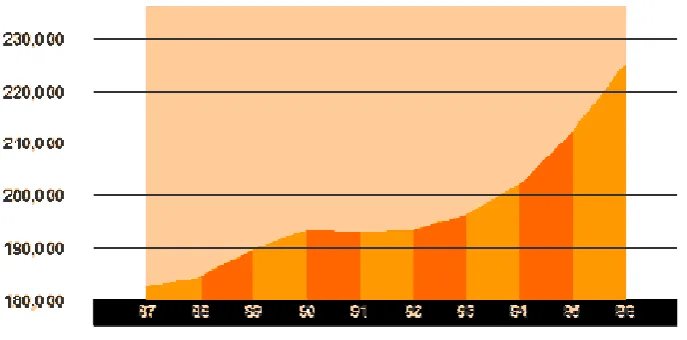
employment in IDA Ireland and Forbairt backed companies rose by around 12,100 (5.7%) in 1996, bringing the total employed to 223,800 (Figure 1). Job gains in companies supported by Forbairt and IDA Ireland amounted to around 25,300 in 1996, of which 20,700 were new first time jobs, the second year in a row of record growth. Job losses were around 13,200. Continuing the trend of recent years, international traded and international financial traded services are the fastest growing sectors.
The average level of employment in 1996, at 1,310,000, was 50,000 above the 1995 average. This growth is exceptionally strong and, since 1993, the total numbers employed have
[image:14.595.84.428.473.643.2]increased by 149,000 or almost 13%. This is almost double the increase achieved over the previous 30 year period, (1963-93) and indicates how strong and unprecedented the current employment growth is.
Figure 1
Trends in Full Time Employment 1987 - 1996
Manufacturing, Internationally Traded and International Services
Cost of Employment
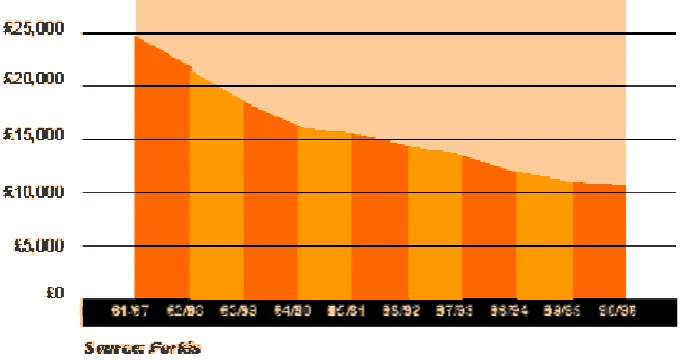
Figure 2
Cost per job sustained in Forbairt and IDA supported projects at 1996 prices
Services Sector
[image:15.595.84.425.402.582.2]The average level of employment rose by 39,000 in the services sector in 1996, compared with 15,000 in industry and a 4,000 decline in agriculture (Figure 3). These figures emphasise the growing importance of the services sector as a source of employment growth in the economy.
Figure 3
Increase/Decrease in Average Employment Levels 1995 to 1996
Growth in the labour force
Another factor having an impact on employment trends is the very strong growth in the overall labour force. This is the result of two key trends:
• A net inflow of people into the country in 1996 as the current strong economic growth both cuts emigration and encourages Irish people (and indeed other EU nationals) to come to Ireland for employment.
• The continuing high rate of growth in the female participation rate. Out of the increase of over 45,000 in the labour force in the year to April 1996 almost 37,000 were female. This represents a rise of over 7% in the number of females in the labour force in 1996 alone, compared with less than a 1% rise among males.
buoyant economy, allowing growth to continue, augmenting the skills pool and helping to contain wage inflation. However, it also makes it more difficult for those who are unemployed, particularly the long-term unemployed, to get a job, and thus share more fully in the growing prosperity of the country.
Employment in Manufacturing, International Traded Services & International Financial Services
At a national level, permanent full-time employment in manufacturing, international traded services including international financial services rose to almost 250,000 in 1996, an increase of 13,151 (5.5%) on 1995. The number of permanent full-time jobs created in 1996 in
companies supported by IDA Ireland, Forbairt, Shannon Development and Údarás Na Gaeltachta amounted to 28,533, an increase of 5.7% on 1995.
The number of jobs lost fell to 15,385, a decline of 1.3% on the figure recorded in 1995, which represents the lowest level of job losses recorded since 1987. This is the third year in a row that job creation has increased and the rate of job losses has declined.
Of the 13,151 net increase in permanent full-time employment in 1996, 5,811 (44%) were in Irish-owned companies and 7,340 (56%) in foreign-owned companies.
• Manufacturing employment accounted for 8,388 jobs (64%) of the total net increase of 13,151;
[image:16.595.87.426.394.572.2]• Internationally traded and international financial services sectors continued to grow strongly, accounting for 4,763 (36%) of the total increase.
Figure 4
International Trends in Manufacturing Employment 1987 - 1996
Statistics: Japan, - since 1990; Germany - since 1991 (re-unification); Ireland, UK, USA - since 1987
Source: OCED Main Economic Indicators and UK Office for National Statistics. Data for Ireland from Forfás Employment Survey
The increased significance of internationally traded services and international financial
services to job creation is clear from the numbers employed (26,221) in 1996 which has grown from a base of 7,738 jobs ten years ago. The biggest contributor to the growth was the
international financial services sector, where a 31% increase in permanent full-time
employment in 1996 is directly attributable to the continued development of the International Financial Services Centre (IFSC) in Dublin.
trading partner, manufacturing employment has fallen by 17%. In Ireland, by contrast, there has been a strong 13.8% growth in the period 1987 to 1996.
The latest data, collected during 1996, shows that full-time manufacturing employment in Ireland has grown by 10% since 1993. The growth in 1996 alone was 4%. The 1996 data indicates, therefore, that Ireland’s consistent development of its manufacturing base, which is increasingly focused on high technology industries, is continuing apace and well ahead of international trends.
Part-time, Temporary and Short-term Contract Employment
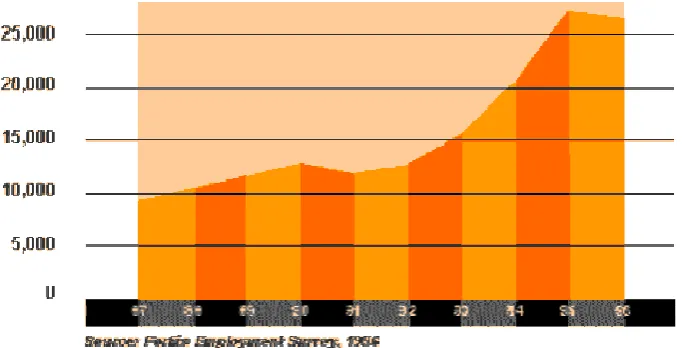
[image:17.595.85.428.300.474.2]Temporary, part-time and short-term contract employment fell by 1,150 to just under 23,000 in 1996 (Figure 5). The fall is mainly due to temporary employees moving into permanent employment in a number of companies (mainly foreign-owned) in the electronics sector, a positive development and an indication of the strength of output and employment growth in the sector.
Figure 5
Trends in Part-time, Temporary & Short-term Contract Employment 1987 - 1996
Unemployment and the Long-Term Unemployed
Unemployment figures continued to show a downward trend in 1996, although employment in the food production sector was adversely affected by the BSE crisis. Average unemployment fell from 188,000 in 1995 to 180,000 in 1996, a fall from 12.2 % to 11.4% of the labour force. This is still far too high but heading in the right direction.
However, long-term unemployment remained unchanged from 1995 figures at just over 100,000. This is a disturbing outcome in the present context of a buoyant economy, rapidly increasing employment and falling levels of overall unemployment.
It highlights the fact that long-term unemployment cannot be solved by policies aimed at stimulating broad-based economic growth and employment growth alone. Medium to long-term measures to improve general skills levels and re-skilling processes, coupled with strategic implementation of human and community resource development, are crucial elements of the solution to this problem
3. EXPENDITURE
Table 1
Estimated Irish Economy Expenditure (IEEs) of Manufacturing and International Traded Service Industry 1994-1995
1995 Irish-owned
£m
1995
Foreign-owned £m
1995 Total £m
1994 Total £m
% Change
Total Sales 13,709 21,963 35,672 31,353 13.8
Total Irish Economy Expenditures 10,669 8,670 19,339 17,188 12.5
Of Which
Wages & Salaries 2,076 2,259 4,335 4,134 4.9
Irish Raw Materials 6,090 2,524 8,614 7,866 9.5
Irish Services 1,653 3,515 5,168 4,131 25.1
IEE as a percentage of Total Sales 77.8% 39.5% 54.2% 54.8% -1.1%
Source: Forfás Annual Survey of Irish Economy Expenditures: Results for 1995
The Forfás Irish Economy Expenditures annual survey shows that there was a £2.1 billion spending increase by manufacturing and internationally traded service companies within the Irish economy in 1995. This represents an increase of 12.5% in total expenditure of £19.3 billion (Figure 6). Irish-owned companies contributed £10.7 billion (55%) of the total, an increase of 5.3% on 1994. The balance (£8.7 billion) was contributed by foreign- owned companies and was a rise of 22.9% on 1994.
Irish economy expenditures as a proportion of sales fell marginally, mainly reflecting
improvements in labour productivity and a lag between rapid increases in the output of industry and the sourcing of supplies in Ireland.
Figure 6
Manufacturing & International Traded Service Industry Irish Economy Expenditures 1994 - 1995
Corporate Tax
[image:18.595.86.426.465.638.2]Table 2
Corporation Tax Payments
1995 £ million
1996 £ million
Increase/ Decrease £ million
% Change
Total Payments (all sectors) 1,146.0 1,426.0 +280.0 +24.4
IDA/Forbairt supported manufacturing and
internationally traded services 361.3 469.0 +107.7 +29.8
International Financial Services Centre 133.0 190.0 +57.0 +42.9 Source: Forfás Corporation Tax Survey 1996
Table 2 shows that corporation tax payments by IDA Ireland and Forbairt supported
[image:19.595.86.421.275.484.2]manufacturing and internationally traded services companies surveyed in 1996 increased by 29.8% that year, bringing the total to £469.0 million.
Figure 7
Corporation Tax Payments
Looking back over the longer term, there has been an increase of 140% in the total corporation tax take during the period 1991 - 1996. (£593 million in 1991 rising to £1,426 million in 1996). The increase in the amount contributed by manufacturing and internationally traded service companies surveyed has been unprecedented, increasing from £124.4 million in 1991 to £469.0 million in 1996, a rise of 277.0%. When the International Financial Services Centre is included, the contribution from these three categories represented 46.2% of the total
corporation tax of £1,426 million paid in 1996.
A strong contribution by these companies to the overall tax take is also projected for 1997 and 1998.
R&D in the Business Sector
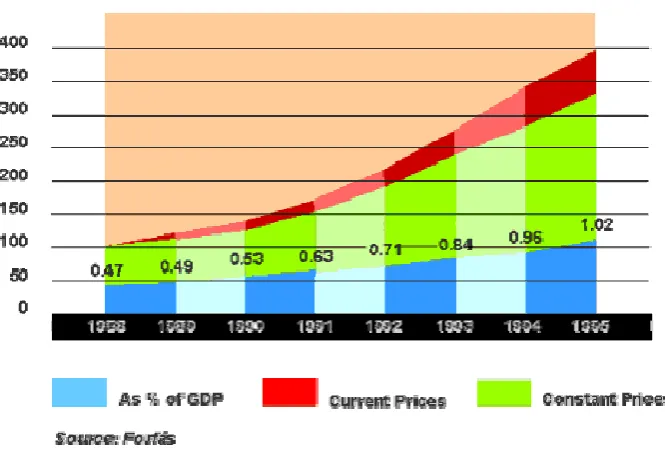
Monitoring undertaken by Forfás of R&D performance within the business sector showed that industry in Ireland spent £397 million in 1995 on in-house R&D. This represents a continuation of the strong 17% per annum real rate of growth witnessed since the late 1980s. Business sector R&D spend as a percentage of GDP rose to 1% for the first time in 1995, up from 0.84% in 1993. This level of expenditure is comparable to a number of other small European economies but is still short of the EU average of 1.2%.
Figure 8
Business Expenditure on Research & Development 1988 - 1995
Features of R&D spend include:
• The two groups, foreign-owned industry and Irish-owned industry, show similar rates of growth over the four year period from 1991 to 1995.
• Foreign-owned companies, however, account for two thirds of total R&D spend, a share which has held constant since the late 1980s.
• This is not considered surprising, however, given that R&D activity is concentrated mostly in the electronics, software, chemicals and pharmaceuticals sectors where a large share of output and employment is accounted for by foreign-owned companies.
The survey of business sector R&D activity in 1995 showed that:
• 52% of manufacturing and internationally-traded services companies with at least 10 employees had undertaken some R&D between 1993 and 1995.
• Half of this group (26%) spent money in each of these years on in-house R&D. • A similar share of Irish-owned and foreign-owned companies have some involvement
in R&D.
State Investment in Science & Technology
Figure 9
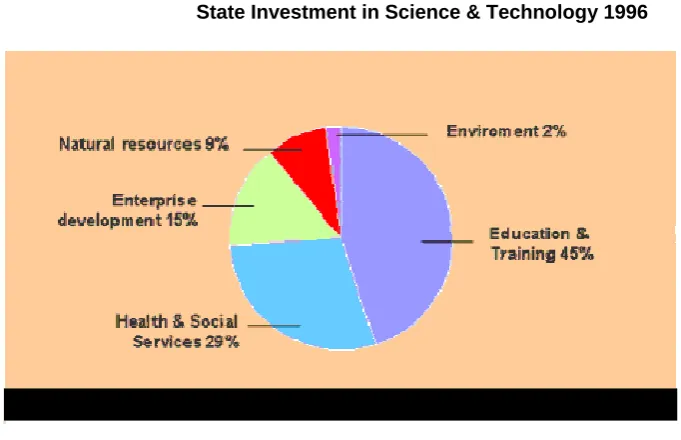
State Investment in Science & Technology 1996
The 1996 "State Investment in Science and Technology" report, published by Forfás, shows that the total public allocation of funds to science and technology in 1996 amounted to £659m and was supplemented by £124m earned income to reach a total of £783m, an increase of £82m over the 1995 level. In considering these figures it is important to recognise that a high proportion of the funds are allocated to salaries and associated expenses and that year-to-year discretionary expenditure is limited. The major expenditure increases in 1996 occurred in:
• Education and Training - £34m, mainly to compensate for fees abolition in third level institutions.
• Health and Social Services - £24m, extra funding for the health laboratories and Central Statistics Office,
• Enterprise Development - £20m, mainly for increased support for R&D in industry.
Survey of National Expenditure on the Promotion of Enterprise
Ireland has increased its direct commitment of resources to stimulate the development of enterprise by 25% in real terms since 1994. In 1996 over £500 million was spent on these resources.
These are the main findings of a new analysis undertaken by Forfás and outlined in the National Enterprise Budget which details resources expended to foster the development of the enterprise sector and to create employment. In addition the report reviews the European Union co-funding of these activities through ERDF, ESF, and FEOGA programmes. In 1996 an estimated 27.3% of the total expenditure was funded in this way.
The document also highlighted the following:
• Since 1993, with the aid of development support from the County Enterprise Boards, small Irish-owned companies secured a rising proportion of payments when compared with medium and large industry, increasing from 55.5% in 1992 to 58.4% in 1995. • There was an increase in staffing levels in the development agencies from 2,313 in
ACTIVITIES IN 1996
In 1994, Forfás was established as the Industrial Policy Advisory Board. In this capacity:
• Forfás advises the Minister for Enterprise and Employment on the development of State policies designed to stimulate and foster enterprise and employment; • It is responsible for co-ordinating key aspects of the activities of the promotional
agencies;
• It is also responsible for evaluating and monitoring programmes which promote enterprise development, science and technology.
In 1996 Forfás had overall responsibility for the work of the National Standards Authority of Ireland (NSAI) and of the National Accreditation Board (NAB) which provides internationally recognised accreditation for laboratories and standard certification bodies.
During 1996 Forfás also worked with a number of advisory groups which it established to help identify and address the issues that are critical to developing and sustaining Irish industry's competitive and comparative advantage. These included the 'Shaping our Future' steering committee, groups on Transport & Logistics, the Information Society, Education and Training, Taxation and Expenditure, Commercial Telecommunications, Trade and Market Development and Regional Policy.
1. POLICY
'Shaping Our Future'
Today, Ireland enjoys the fastest-growing economy in the European Union. Employment is growing rapidly and interest rates are low. The standard of living of people as measured by conventional indicators is rapidly improving. It is now an opportune time to develop long-term strategies to capitalise on this progress so that people in Ireland can attain higher levels of prosperity.
Forfás in 1996 published 'Shaping Our Future: A Strategy for Enterprise in Ireland in the 21st Century'. This work represents the first substantial attempt at the elaboration of a long-term strategic framework for the development of the enterprise sector in Ireland. In doing so:
• It identifies the key issues and trends that need to be taken into consideration to sustain, in the medium to long-term, the recent strong economic performance achieved;
• It sets out a number of ambitious but realistic objectives for employment creation and output growth and for tackling unemployment, reducing the number of long term unemployed and increasing the standard of living and quality of life of people living in Ireland;
• Specific policy recommendations are set out for manufacturing and services;
• Recommendations are also made for critical support areas such as training and skills, taxation, services, science and technology, telecommunications, transport, regional policy and public sector reform.
Skills
The Group initially addressed a number of issues where immediate action is required to address emerging pressures on the availability of skilled manpower resources. The government has responded to this initial work of the Group by the announcement of a commitment to:
• 1,250 extra places in one-year post graduate computer applications courses; • 1,000 extra places in third-level language courses and placement abroad of 1,000
students per annum;
• An intention to identify the most cost-effective way to increase the number of software and computer technician places per annum by 1,000 and 750 respectively.
The Group is also developing a systematic approach for identifying future skills needs and to formulate action proposals to address potential skills shortages before they arise. This work is well advanced.
Taxation
Forfás in 1996 put forward a number of proposals in taxation policy aimed at increasing competitiveness and promoting growth and employment in the enterprise sector. Work was undertaken during the year in developing reform proposals for Irish Capital Markets, including the role that taxation, particularly capital taxation, plays in enterprise development in Ireland. A joint Forfás and Forbairt study on Capital Markets and the long-term financing needs of Irish firms recommended the following:
i. Consistency of tax treatment of various forms of savings/investments.
The study
recommended the creation of a new 'eligible savings account' to simplify and rationalise the existing situation with regard to the taxation of savings. The 'eligible savings account' would have a special tax rate that would apply to the investment returns achieved on the account. In the long term, most forms of savings would be included in such an account. This account would substitute for the varying tax treatment of different forms of savings and investments and help to bring clarity and simplification to an existing complex plan of incentives for savings/investment purposes. It would also help to improve the relative return from investment in the enterprise sector compared with investment in areas such as property and savings accounts;ii. Capital gains tax. The standard rate of capital gains tax should be moved down towards the standard rate of income tax. Progress was made in the 1997 Budget with the reduction in the lower rate of capital gains tax from 27% to 26%. The report recommended that the capital acquisitions tax provision dealing with the transfer of shares in a business within a family should be amended to avoid claw-back of reliefs. The 1997 Finance Act further improved the capital acquisitions tax relief for business assets by increasing it from 75% to 90%, encouraging family businesses to grow;
iii.
Tax Incentive Schemes. The existing set of incentives such as the BusinessExpansion Scheme and Seed Capital Scheme should be refocused to favour investment in companies at an early stage of development.
Corporate Taxes. In the 'Shaping our Future' strategy report Forfás outlined the need to consider the reform of corporate taxes and set out three options for consideration:
i. The introduction of a single low rate for trading income, as close as possible to 10%, with a higher rate for non-trading income; or
ii. The extension of the 10% manufacturing rate beyond 2010 and a reduced standard rate; or
iii. A 'ruling system' to provide low effective corporation tax rates for preferred sectors of economic activity on a general or on a case-by-case basis.
On 13 May 1997, the Government announced the decision on the future corporation tax regime. It involves a single low rate on profits arising from trading activities until the year 2025, and a higher rate on profits from non-trading activity. The new regime will become effective from the beginning of the year 2011 for companies availing of the 10% manufacturing rate, and from 2006 for all other companies.
To ensure the continued high revenue base from business, the Government is committed to introducing new and strengthened anti-abuse measures coupled with compensating revenue raising measures. To ensure the continued high revenue base from business, the Government is committed to introducing new and strengthened anti-abuse measures coupled with
compensating revenue raising measures.
Subject to this, the new regime will boost after tax income and encourage the use of retained earnings as a means of funding the development of indigenous service companies.
This is the most important decision in the area of corporation tax since the introduction of the 10% rate.
Finance
The Capital Markets Study also proposes the integration of a number of strands of policy in a coherent way as follows:
• The provision of more effective access to seed and venture capital and promotion of competitive credit finance to smaller companies should be considered through measures such as mutual loan guarantee schemes of a kind that operate in some other EU member states and a credit rating agency for SMEs in Ireland, supported by the main financial institutions and the development agencies. Further evaluation work is currently underway in Forfás in conjunction with Forbairt and the Department of Enterprise & Employment into the loan guarantee schemes and the credit rating agency recommendation;
• The improvement of the flow of finance for investment in start-up and early stage developing enterprises, including the establishment of a viable Developing Companies Market;
• With the objective of assisting to overcome market failure in the provision of equity capital to early stage businesses, the state development agencies should increase their participation in the ordinary equity of firms through the establishment of equity investment funds which would share in the risks and rewards of enterprise; • Consideration should be given to providing access to a wider body of domestic
investors - institutional and private - to sections of economic activity currently conducted by businesses owned by the state;
• To promote a culture of direct share ownership and openness to having external shareholders involved in private business, the implementation of profit and share option schemes in certain State owned enterprises is recommended.
Science and Technology
The Forfás report on 'State Investment in Science and Technology 1996' showed an allocation of over £783 million on activities broadly defined as science and technology (S&T) related. EU contribution was over 11% of the total. The Exchequer funding element of overall S&T activity grew, in real terms, by 3.1% per annum between 1985 and 1995.
Some of the key issues identified in the Report include:
• The need to establish an improved system of co-ordination and prioritisation for the significant expenditures involved;
Evolving from the report of the Science Technology and Innovation Advisory Council (STIAC) and the work of the Task Force on the implementation of the STIAC Report, chaired by the Chief Executive of Forfás, the Government White Paper on Science, Technology and
Innovation (STI) was launched in November. The White Paper marked a new beginning in the national approach to science and technology issues. It aims to develop the National System of Innovation in Ireland and to locate science and technology firmly within the framework of wider industrial, economic and national development policy.
The White Paper outlines decisions in a number of priority areas including:
• The continuation of the cabinet sub-committee on S&T;
• An inter-departmental committee to ensure a coherent and comprehensive approach to science, technology and innovation policies and programmes;
• A permanent advisory council on science, technology and innovation under the Forfás legislation, representative of wide-ranging interests;
• An initiative on inter-firm collaboration that will encourage firms to co-operate in strategic activities, such as research and development, and help to overcome disadvantages of small scale;
• New structures to achieve more effective management of the important Programmes in Advanced Technology;
• A campaign to increase the level of awareness and greater appreciation of the importance of science, technology and innovation.
The new council has been established with Forfás providing the research support and secretariat. Forfás will assist in monitoring the implementation of the various Government decisions announced in the White Paper.
Ireland's Information Society
A fundamental transformation in economic and social life in Ireland is being brought about by the convergence, diffusion and pervasiveness of information and communications
technologies. The emerging "Information Society" is one that uses information intensively and in a way that significantly reduces the traditional constraints of time and space. Full adoption of the new technologies will be crucial to the competitiveness of the enterprise sector, to
increased employment, to Ireland's continued attractiveness as a location for inward investment and to its ability to capitalise on emerging opportunities.
In March 1996, the Minister for Enterprise and Employment announced the formation of the Information Society Steering Committee, which brought together representatives of industry, trade unions, telecommunications and relevant Government departments. Forfás provided the research and secretariat support for this Committee.
The Committee presented their report to the Minister for Enterprise and Employment in
December 1996, setting out a vision of what Ireland can achieve in the "Information Society". It also set out a comprehensive policy framework and recommendations on harnessing the benefits of new technologies to increase employment and living standards.
Its main recommendations include:
• An awareness campaign to ensure popular support for, and participation in, a future "Information Society";
• Provision of an advanced tele-communications infrastructure capable of supporting enterprise and citizen demands in the "Information Society";
• Ensure that Irish enterprises adopt and use new technologies and participate successfully in key growth markets in the Information Society. Information and communication technologies must permeate every aspect of the economic life of the country. A leadership position must be established in key growth areas such as the content industry;
• Deploy information and communication technologies in Government for the provision of citizen-centred services and develop and implement policies that support the transition to the Information Society. The government must play a leadership role in embracing the Information Society.
Since its completion and launch, there has been enormous interest in the Report, culminating in an announcement by An Taoiseach in April 1997 of a range of measures designed to address the issues raised in the report. An Information Society Commission is being established in the Department of An Taoiseach to report directly to the Taoiseach on the implementation of the measures recommended in the Report.
Telecommunications
Forfás has worked in recent years with Government Departments and Agencies to develop proposals in the area of telecommunications which support the development of the enterprise sector and published a report in 1996 on the outcome of this work. The report looks at the current and likely future trends in technologies and assesses their implications for Ireland.
A critical conclusion is that a broadband communications infrastructure, offering advanced multimedia services at competitive prices, requires to be provided ahead of demand and before competing countries if Ireland is to reap the full economic benefits of the major advances which are taking place in information and communications technologies.
In the enterprise sector, the types of services that will require broadband include:
• Multimedia Internet access;
• Corporate networking/Intranet, involving networks between buildings and offices at a distance;
• Videotelephony and business TV services, especially relevant to centres providing software support and training;
• Collaborative working, e.g., design, engineering and R&D; • High-speed file transfer, e.g., X-rays and software;
• Database access, and library and archived services, which are important in electronic publishing and corporate R&D, as well as in access of public services.
A rapid deployment of broadband, that could not be justified on normal commercial criteria, will show a national economic return in terms of increased competitiveness and more jobs. The Government's decision to request the Information Society Commission to select 22 areas throughout the country for guaranteed broadband service access is very welcome in this regard.
Fifth Framework Programme
The EU Framework Programme enables organisations in Ireland, in partnership with organisations in Europe and beyond, to compete for funding for specific research which the European Community considers important for its industrial competitiveness and quality of life.
The Fifth Framework Programme (FP5) will succeed the current Fourth Framework Programme in 1999. In preparation for this, early in 1996 the development of a national position for our negotiations with the EU in respect of FP5 was undertaken by Forfás in association with National Advisory Panels appointed by the Office of Science and Technology. The Irish position is that FP5 should build on the experience and success of previous