Introduction
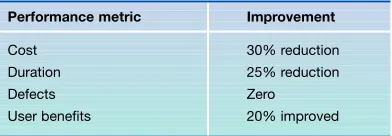
There is a world-wide effort to create significant improve-ments in the construction industry. To this end, ambi-tious but achievable targets and deadlines have been estab-lished to drive the process for-ward (Tables 1 and 2).
The emphasis has been on adopting processes which have proved successful in the manu-facturing industry. Technical methods such as just in time (JIT), business process re-engi-neering (BPR), pre-fabrication and standardization are begin-ning to produce benefits in the construction industry.
But though technical issues are important and need to be
improved, the real problem is that of culture. Quantum improvements in the construction industry, as required by the improvement targets, will not be attained purely by technology transfer from manufacturing. Significant improvements can only occur by a process change coming from within the construction industry and dedicated to encompassing the whole culture of construction.
The need for a new contract strategy is clearly evident when it is recognized that the profit mar-gins of construction lawyers specializing in
litiga-tion are far in excess of the construclitiga-tion compa-nies that they represent. Adversarial working is being replaced by new ways of working in other industries1and has shown great improvements.
The scenario for a paradigm shift in UK con-struction culture was proposed by Sir Michael Latham2in his report that proposed working in partnering arrangements. This proposed long-term partnering relationships with mutually agreed and measurable targets for productivity improvements.
Engrs,
Civ. Engng, 1998, 126, Nov., 163–170
Paper 11558
Written discussion closes 15 February 1999
Keywords: coastal engi-neering, management, tendering
David Brown is a senior research fellow in the business engi-neering group of the civil and environmen-tal engineering depart-ment at Southampton University
Michael Riley is chair-man of the business engineering group of the civil and environ-mental engineering department at Southampton University
Hurst Spit stabilization: a partnering
case study
D. C. Brown,
MEng
and M. J. Riley,
BSc
,
CEng
,
MICE
,
ACIArb
[image:1.595.167.441.336.626.2]The stabilization of a 2 km shingle spit in southern England was initially
planned as a traditional civil engineering contract. However, an unforseen
delay at the start meant there was a real danger of not completing the work
before winter storms, so a partnering approach was introduced—with
suc-cessful results. This paper starts off by investigating the potential of
partner-ing to achieve the UK’s construction improvement targets. Uspartner-ing Hurst Spit
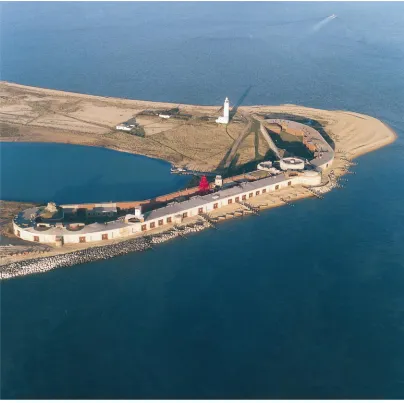
as a case study (Fig. 1), it demonstrates that partnering can provide
signifi-cant benefits for a one-off project without the need for formal agreements. It
analyses in particular the culture changes which are required to achieve the
full benefits of a partnering way of working.
The major drawback of the Latham approach to partnering is the creation of long-term relation-ships between partners, typically lasting 3–5 years and with a continuous stream of work being car-ried out during the lifetime of the partnering arrangement. Unfortunately, this does not address the majority of construction projects in this country where more than 85% are still single one-off projects, and the requirement, in the pub-lic sector, of a need to satisfy probity by competi-tive tendering.
In projects where the client and engineer have embraced the philosophy of non-confrontational working, the goal is then to create a partnering way of working after competitive selection of the contractor while still fulfilling three basic require-ments
• a method of contractor selection that achieves the lowest price
• a guarantee that the contractor selected will adopt the partnering philosophy
• a method of allocating risk and profit after the contract has been awarded.
Partnering structure
The advantages of working together have been strongly promoted by Latham2. Many clients are
now users of partnering arrangements, but this is primarily for building work rather than civil engi-neering. It is more feasible to develop long-term relationships in this sector of repetitive work loads but considerably more difficult for single one-off projects that predominate in the civil engi-neering sector. The earlier NEDC report3 Partnering: Contracting without Conflictalso pro-vides a good basis for partnering, but again this does not support single one-off projects.
Hellard4investigated partnering on a
world-wide basis and suggested that partnering is the
master key that will unlock the techniques and principles of total quality management (TQM) to improve customer satisfaction. He highlighted some of the problems of partnering, including the danger of no true commitment, those pre-condi-tioned to adversity, top management paying lip service, the myopic thinking of some to win every battle every day, not bringing all the key players in at an early stage, skimping the early activities or the workshops, culture change not being easy and the use of old standard approaches.
Weston5defined partnering as a long-term
com-mitment based on trust, dedication to common goals and an understanding of each other’s indi-vidual expectations and values. Weston5studied
139 contracts with the US Army Corps of
Engineers, 39 of which were partnered and 100 of which were not. They show clearly partnering producing significant improvements for all parties to the project.
Partnering projects of all sizes was reported by Bates6, who suggested the principles should
include shared goals arrived at through consen-sus, mutual trust and respect, new attitudes and behaviour, new means of communication and commitment from top to bottom. Weston’s 5view
is reinforced by Larson7, who states that
‘Whether the contract is awarded on a competi-tive basis or not, does not appear to affect the suc-cess of partnering efforts and is not a serious impediment to success’. Schmader8carried out a
major study of over 200 contracts awarded by the US Naval Facilities Engineering Command (NVAFEC), and again the results reinforce the general advantages of partnering. The paper by Rankin9confirms that pre-qualification remains a
key mechanism, and this should provide an initial source of variables for any partnering selection process.
Although long-term partnering is likely to pro-duce the largest benefits, there are a considerable number of projects where this approach is not possible. This is particularly true of either ‘one-off’ civil engineering contracts or where the client is a public body. Although recent government leg-islation has led to a large reduction in the amount of government-funded work, from about 90% to about 60%10, the figures are still large. The new Construction sector performance metric Year 2003 target improvement Ranking in importance*
Total project delivery time Reduce by 50% First
Operation, maintenance and energy lifetime costs Reduce by 50% Second Productivity and comfort levels of occupants Increase by 50% Fifth =
Occupant health and safety costs Reduce by 50% Sixth
Waste and pollution costs Reduce by 50% Fifth =
Durability and flexibility in use over lifetime Increase by 50% Third
Construction worker health and safety costs Reduce by 50% Fourth
*Ranking in industry importance obtained from White House construction industry report workshop participants representing
the residential, commercial, institutional, industrial, and public works construction sectors.
Performance metric Improvement
Cost 30% reduction
Duration 25% reduction
Defects Zero
User benefits 20% improved
[image:2.595.156.559.88.189.2]tion sector perfor-mance improvement targets to be achieved by year 200312
[image:2.595.154.350.235.303.2]enlarged private sector is more able to adopt new procurement methods and contract strategies and hence take advantage of the potential savings from partnering, but probity in the public sector means that they have considerably less freedom to do this. EC law can also prohibit long-term partnering. Thus a very large amount of construc-tion work will still be awarded by competiconstruc-tion. Latham2does little to address this problem.
A key document, The Royal Academy of Engineering A statement on the construction indus-try,11urges the construction industry to address
several factors including the following.
• Focus on customer satisfaction—it cannot be assumed they will know precisely what is wanted at the outset.
• Attention to process as well as to product— research must focus on user-friendly guides for clients.
• Meaningful involvement of the client requires mutual co-operation, recognition of objectives, willingness to be open and free agreement to share risks and rewards to produce a success-ful project.
• Alignment to a common goal to create a win–win environment.
The many advantages of partnering are accept-ed, but there are still fundamental key problem areas—such as partnering in the public sector— that have received little attention. An analysis of a public sector project on which partnering devel-oped spontaneously has thus been undertaken to assess the benefits of project-specific partnering and to determine a methodology for procuring partnering contractors in a publicly accountable way.
Case study
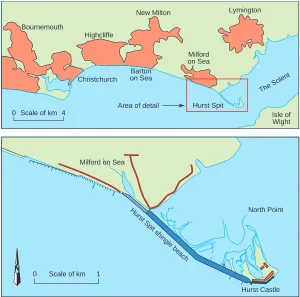
Hurst Spit is a shingle spit formed at the end of the Pleistocene period and located at the eastern end of Christchurch bay on the south coast of England (Fig. 2). It is approximately 2 km long and at its seaward end reaches a point approxi-mately 1250 m from the Isle of Wight. The spit protects the coastal areas of the Solent to the east, both on the mainland and the Isle of Wight from Atlantic storms. The spit also protects the salt marshes in its lee, a Site of Special Scientific Interest.
Historically, the spit was nourished by littoral drift from the west. However, as early as 1609 repairs became necessary due to storm damage. Coastal protection works to its west, which began some 100 years ago, severely reduced the shingle supply for re-nourishment of the spit. In 1974 New Forest District Council took over responsi-bility for coastal protection from the Borough of Lymington and in 1981 started a programme of annual re-nourishment.
Due to the threat of extensive damage to
prop-erty and the salt marshes that would occur as a result of the spit being breached, a more perma-nent stabilization scheme was developed (Fig. 3). New Forest District Council was the client for the stabilization works and the engineer was the assistant director of the council’s engineering ser-vices department. The resident engineer was also a member of the same department.
The main contractor appointed to undertake the works was Westminster Dredging Company Limited of Fareham in Hampshire. The contract was let under the ICE Conditions of Contract5th edition with amendments. The contract tender price was £5 million with a contract duration of 30 weeks.
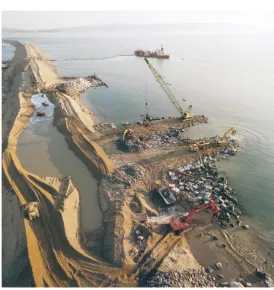
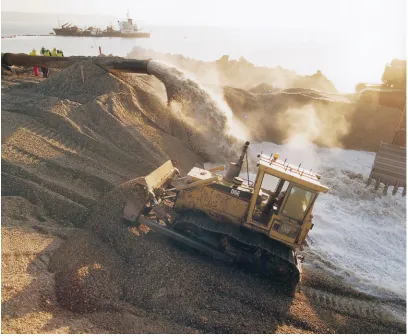
The project was expected to take the form of a traditional civil engineering contract, which often results in adversarial confrontations arising between the contractor, engineer and client. The project was both land-based and maritime, involv-ing marine dredginvolv-ing for gravel and placinvolv-ing it both on and offshore (Fig. 4). It was thus anticipated by the engineer that the main contractor would be either a marine contractor with a land-based sub-contractor or vice versa. In either case the sub-contract value was to be in the order of 50% of the tender sum. In order to give the engineer greater control over the selection of sub-contrac-tors, the ICE Conditions of contract5th edition was adopted, rather than the current 6th edition.
The project was further complicated as a result of being a new and untried design and it was not possible accurately to predict the standards of
[image:3.595.243.543.83.380.2]STABILIZATION
Fig. 2. Location and plan of Hurst Spit 0 Scale of km 4
Bournemouth
Christchurch
Hurst Spit
Isle of Wight
The Solent
Barton on Sea
Area of detail
Milford on Sea
Lymington
Highcliffe
New Milton
0 Scale of km 1
North Point Milford on Sea
work which could be reasonably expected from certain parts of the works. In addition, the project was in an environmentally sensitive area with a high public profile. Delays in completion before the onset of winter storms could have resulted in a serious breach of the spit and hence catastroph-ic consequences both to commerce and the envi-ronment. A breach in the spit would have led to flooding of the nearby low-lying areas with
conse-quent disruption to agriculture and business as well as damage to residential property.
The client was concerned with the outcome of the project and therefore asked for a pre-qualifica-tion statement from the contractors interested in tendering. Surprisingly, several large contractors failed to respond correctly to the request and were removed from the tender list.
In order for the employer to obtain a dredging
0 Scale of m 25
Geotextile length =34m/m run 1-3t (22t/m run)
Original profile
Typical section geotextile (varies)
15.05m
+6.5m 5m
1.5 1
Walkway width varies
Gravel surface access ramps to be located at 200m intervals
Blinded with gravel
Surplus rock
Average fill 55m2/m run (based on minimum excavation to geotextile levels)
Surplus excavated rock and tripods to be placed to form walkway on leeside of revetment
Material to be evenly distributed to provide elevated walkway along full length of revetment
Selected excavated rock in crest underlayer (7t/m run)
3-6t armour (107t/m run)
All tonnages assume bulk density of 1.7t/m3 5.22m
[image:4.595.156.559.84.293.2]+6m Approx 10m
Fig. 3. Typical section through stabilized spit
[image:4.595.152.560.437.773.2]licence from the UK government for the pre-ferred source of gravel, the cost of two alternative sources of sea-dredged gravel had to be com-pared. Tenderers were therefore asked to submit prices for each of the alternate sources. The con-tractor which was ultimately successful submitted the lowest prices for each of the alternative gravel sources and, in all tenders received, the client’s preferred source was the cheapest.
The contractors tendering for the project had, as is usual during the tendering process, asked the client for clarification of certain areas where it was thought that there was ambiguity or where errors or conflicting information occurred in the tender documents. The successful contractor had, however, sought clarification of substantially more points than the other tenderers.
The contractor was duly identified as being the preferred tenderer, with the tender price having a validity period of six months. The contractor was keen to commence the works but, due to delays in obtaining dredging licences, the start was delayed.
As a result, the contractor became involved with the design and advised the design team on changes which would improve buildability and reduce construction costs and duration all at no cost to the client, but purely due to the desire of the contractor to provide value engineering. The chance event of the delay led to a situation where a contractor had been selected by competitive ten-dering but was able to suggest changes to the design to enhance buildability.
When construction eventually started cautious optimism existed between the parties for a non-confrontational project which, over time, devel-oped into a high degree of trust which all parties strove to maintain throughout the contract. Evidence of the success of the partnering which evolved can be found in the fact that during the entire project no contractual letters were written by any of the parties. Furthermore, site meetings were not used for resolution of problems, as these were routinely sorted out on site, but principally for maintaining contact between all parties. As a result, meetings rarely lasted more than one hour.
Setting the stage
The contract was prepared with the expectation that it would be a traditional adversarial contract, but the individuals named in the contract were keen to work in a non-confrontational manner. The main contractor was of similar mind and had already adopted the philosophy of treating others in the way they would wish to be treated them-selves, and wished to tender on an equal basis. This philosophy was evident at tender stage when the main contractor raised 20 queries concerning the contract documents, a few being in connec-tion with errors or matters of interpretaconnec-tion, but most were directed at ensuring that no tenderers made incorrect assumptions on key
require-ments, for use perhaps for claims later. The result of these points being raised was the responses being circulated to all tenderers thereby ensuring a ‘level playing field’, which was the original inten-tion of raising the query.
One area in particular is worth mentioning is that the contract prohibited the use of local roads for delivery of materials, except for small quanti-ties. The main contractor was concerned that some tenderers would price on the basis of signif-icant quantities of rocks being delivered to site by road, likely to be a considerably less expensive option than delivery by sea. The response from the engineer to this query was circulation to all tenderers confirming the original specification. This example demonstrates two important points
• the tender price offered allowed for providing exactly what the client required
• the contractor, which wished to provide a gen-uine service to the client, wanted to tender on an equal basis.
The main contractor stated in comments relat-ing to the project
‘Our actions at tender stage, in respect of the queries raised, were to seek clarity in order to be able to price what the client actually wanted; to avoid disputes and misunderstandings should we win the contract; to create a ‘level playing field’.’
One further point demonstrates the motives of the contractor in the project. Due to delays in obtaining dredging licences, the tender validity period expired and the main contractor was asked if the validity period of the tender price could be extended. The contractor agreed to do this even though the tender sum could have been increased while still providing the lowest tender.
Before the start of the contract the client, engi-neer and contractor had all displayed openness and integrity and all were confident of a success-ful outcome to the project. The relationship devel-oped fully when all parties to the contract, includ-ing suppliers and sub-contractors, realized they could trust each other and work together. The fact that the main contractor’s culture and policy was not to act as a ‘traditional’ main contractor may have accelerated the development of a part-nering approach.
Building the team
The client and engineer had already established a good basis for the contract to work with the minimum confrontation and were keen to build on the approach demonstrated by the main con-tractor. The project had the benefit of well written amendments to the conditions of contract, which clearly expressed the degree of risk sharing. It had, for example, been recognized that a possible area for dispute could be sea conditions that
vented working; however, inclement conditions were unambiguously defined by using wave height, leaving no grounds for misunderstanding.
The attitude of the main contractor to its own sub-contractors was also investigated. The most fundamental difference from traditional adversari-al contracts was the policy adopted by the main contractor of paying its sub-contractors when pay-ment was due instead of the commonly adopted ‘pay when paid’ policy.
It was further stated in an interview with the project manager that company policy at all times was to assist sub-contractors whenever possible, and such measures could include increasing the frequency of payments, the provision of a quick and easily agreeable method of assessing interim payments and helping with engineering services, plant and labour where required.
Two other factors were considered to be impor-tant for the success of the contract. Site meetings were held with all interested parties present, including sub-contractors and suppliers. Second, it was agreed that the resident engineer could work with the sub-contractors, thus avoiding any defective work being continued while instructions were relayed through the main contractor.
The client also demonstrated the ability readily to adopt different procedures, such as with regard to re-measurement. The difficulties of pro-ducing test panels of rock in order to re-measure rock placement was recognized, and this method was discarded in favour of measuring the weight of rock delivered to site (Fig. 5). This was possi-ble because both contractor and client were pre-pared to agree the weight of rock delivered and the client was satisfied that the rock was placed in accordance with the contract. Interim valuations were agreed by considering the percentages of work complete.
The resident engineer stated during an inter-view that in his opinion the main contractor had always undervalued the amount of work done and, in one instance, the resident engineer sug-gested that the contractor should increase his application for payment. The overall result of this system was that valuations were agreed on the spot and because of the client’s accounting proce-dures the contractor was paid early in every case. The final observation made by both client and contractor concerns the issuing of instructions relating to unforeseen conditions and variations. There is often reluctance for engineers to issue instructions relating to unforeseeable conditions for fear of being thought of as negligent by the client. This frequently leads to disputes with attempts to cover the situation with variation orders. Where the situation is truly unforeseeable no stigma can be attached to an engineer treating it as such, since by definition it could not have been foreseeable. Where variations occur, instruc-tions should be issued promptly so that the con-tractor is not left with the dilemma of whether or not to proceed with the works at its own risk.
Contract analysis
Analysis of this project suggests a framework for partnering working using traditional forms of contract, as follows.
• Contractors need to be prepared to tender for a project with no hidden agenda and clients need to produce comprehensive and fair docu-ments for the contractors to work from. • The client needs to be vigilant in ensuring
that the tender prices received reflect the scope of the work expected and are not based on misunderstanding of the requirements of the contract, which may result in a claims situ-ation.
• There must be commitment from client, engi-neer, contractor and sub-contractors to work together as a team, agree interim valuations and ensure prompt payment. The old
approach of pay-when-paid has no place in the modern construction industry.
[image:6.595.54.354.86.462.2]• Care must be exercised in preparation of ten-der documents to ensure that the works are buildable and any onerous conditions are
highlighted at tender stage.
• All parties to the contract must be proactive and prepared to implement change for the benefit of the project.
• A project team must be built up based on mutual trust and elimination of the ‘us and them’ attitude.
The Hurst Spit project contained a large ele-ment of risk, which was increased by a delayed start. The contractor, at the start of the project, recognized the need for acceleration in order to complete the offshore works before winter.
Two barges were employed, rather than the planned one, to ship rocks at double the rate, which had two results (Fig. 6). First, the client may have incurred some re-handling charges and, second, the contractor’s plant was utilized at a level not originally envisaged.
The acceleration was achieved with no addi-tional costs to the client but with a large reduc-tion in the risk associated with failing to com-plete the offshore works during the good weath-er. The final result was a project completed on time, with high quality workmanship and to bud-get (Fig. 7).
Conclusions
The Hurst Spit project shows the step-change improvement in efficiency which can be achieved when the vision for partnering working is applied with sincerity and trust. Political brinkmanship and mutual distrust were entirely absent from the project management team, making the beneficia-ries the client, engineer and contractors.
All project team members have recognized the advantages of a partnering approach on the pro-ject and would actively attempt to emulate this type of working on future projects.
The motivation for a partnering way of working is a philosophy not an agreement. There is no need for special forms of contract or agreements, especially as these will not necessarily satisfy the requirements of public accountability. However, it is of absolute importance that the philosophy of co-operation be augmented by prompt and fair payment throughout the supply chain.
However, although the organizations involved provide support and a framework, it is not the organizations which set the agenda on site but the character and attitude of the individual mem-bers of the teams. Selecting the right people is the key.
[image:7.595.37.446.85.465.2]STABILIZATION
Partnering can provide a step improvement in construction even in single projects. In order to provide maximum benefits it is necessary to involve the contractor at the design stage. Partnering is a mechanism specifically developed for the construction industry and as such will pro-vide greater benefits than technology transfer from manufacturing.
Acknowledgements
The authors wish to acknowledge the assis-tance and encouragement given in preparing this paper by New Forest District Council and Westminster Dredging Company Limited.
References
1. TOWILLD.R., Supply chain dynamics—change engi-neering challenge of the mid-1990s Proceedings of the Institution of Mechanical Engineers, 1992, 206, 233-245.
2. LATHAMM. Constructing the Team.HMSO, London, 1994.
3. NEDC CONSTRUCTIONINDUSTRYSECTORGROUP.
Partnering: Contracting without Conflict. National Economic Development Office, London, 1991
4. HELLARDR. B.Project Partnering: Principle and Practice.Thomas Telford, London, 1995
5. WESTOND. and GIBSONG. Partnering project perfor-mance in US Army Corps of Engineers. ASCE Journal of Management Engineering,1993, 9, No. 4, Oct. 6. BATESG. Partnering in small packages, ASCE
Journal of Management Engineering, 1994, Nov./Dec., 22–23
7. LARSONE. Project partnering: results of study of 280 construction projects. ASCE Journal of Management Engineering, 1995, 11, No.2, 30–35
8. SCHMADERK. and GIBSONG. Partnered project perfor-mance in the US Naval Facilities Engineering Command. ASCEProject Management Journal, Sept, 1995.
9. Rankin,J.H., Champion,S.L. and Waugh,L.M. Contractor Selection: Qualification and Bid Evaluation. Canadian Journal of Civil Engineering, 1996, 23, No.1, 117–123. 10. FCEC. Survey of Civil Engineering Workload Mix
1991/92.
11. ROYALACADEMY OFENGINEERING. AStatement on the Construction Industry, Jan. 1996, London.
12. WRIGHTR. N., ROSENFIELDA. H. and FOWELLA. J.
National Science and Technology Council Report on Federal Research in Support of the US Construction Industry.Washington, 1995.
[image:8.595.153.557.84.487.2]