
Abstract—The South African sugar industry produces sugar and electricity and raw materials for ethanol production among other by-products. The cogeneration of electricity in the sugar industry is linked to energy security and avoided greenhouse gas emissions. Electrical energy and thermal energy are the primary energy types used for sugar processing. This paper identifies energy management best practices necessary to increase the efficiency of the cogeneration processes. Adoption of energy conservation and efficiency measures is imperative for the sugar industry to generate electricity for own use and for export to the national grid. More energy efficient practices save money and reduce coal consumption. Equipment and technological improvements coupled with process design improvements necessary to improve factory energy efficiency are identified. The paper further discusses the bio-energy role and potential in the South African sugar industry with a view to inform decision making and advise government policies.
Index Terms— bio-power and biofuel, cogeneration in the sugar industry, energy efficiency and management, government policy
I. INTRODUCTION
ugarcane is both a food and energy crop that is also a renewable source. The production of electrical energy from sugarcane fibre (bagasse) is assuming great importance. This is because of its energy security implications which are a result of its renewable nature and also the economic benefits it offers to the sugar industry [1]. Improvements in energy and process efficiency in the sugar mills can make the mills energy self-sufficient and make them capable of exporting excess electricity to the national grid [2]. The sugar industry has the potential to support ESKOM in its promotion of energy efficiency practices while implementing its own rehabilitation and modernisation program in addition to improved business opportunities through sustainable power generation for export. This helps Eskom to put in place specific immediate and long term measures to avoid future power outages. South Africa has seen significant levels of growth in electricity consumption and Eskom has resorted to increasing the amount of electricity imported from Cahora Bassa in Mozambique. The power utility has also come up with demand side
Manuscript received March 13, 2013; revised April 16, 2013. This work was supported in part by South African National Research Foundation and by the University of Johannesburg University Research Committee.
Charles Mbohwa is an Associate Professor, Department of Quality and Operations Management, University of Johannesburg, Auckland Park Bunting Road Campus, P. O. Box 524, Auckland Park 2006, Johannesburg, South Africa: phone: 5591202; fax: +27-11-5591307; e-mail: [email protected]
management practices set to save 3000 MW by 2012 [3]. There are also plans to build more thermal power plants. The fight against global warming has intensified efforts and emphasis on the use of renewable and clean energy sources as alternatives to the more polluting fossil energy sources. This paper shows the potential reduction on the greenhouse gas emission as a result of the use of bagasse to generate electricity in South Africa. The use of bagasse improves the amount of electricity generated in the country and reduces greenhouse gases. The idea is to encourage the adoption of renewable energy sources as alternatives to the conventional fossil fuels that are mainly used. The success of cogeneration schemes depends on maximizing the energy output and minimizing the energy expenditure in the sugar processes. With the advent of cogeneration in the sugar industry using high-pressure technologies and export to the national grid a lot of emphasis is being directed towards reducing the power inputs in all the areas of sugar and power production in the factory operations in order to maximize power to be exported. This paper highlights the benefits of improved energy management practices to enhance viability of the industry and to contribute positively towards the South African government’s drive for sustainable consumption.
The South African sugar industry is one of the world’s best producers of high quality sugar, producing an average of 2.5 million tons of sugar per annum. The industry combines the agricultural activities of growing sugarcane with industrial factory production of raw and refined sugar. The industry makes a significant contribution to the national economy [4]. Sugarcane is supplied to 14 mills where it is processed to sugar. Bagasse and molasses are also produced in the process. Bagasse is the fibrous biomass remaining after sugarcane stalks are crushed to extract the juice. Figure 1 shows a process flow chart for typical sugar mill.
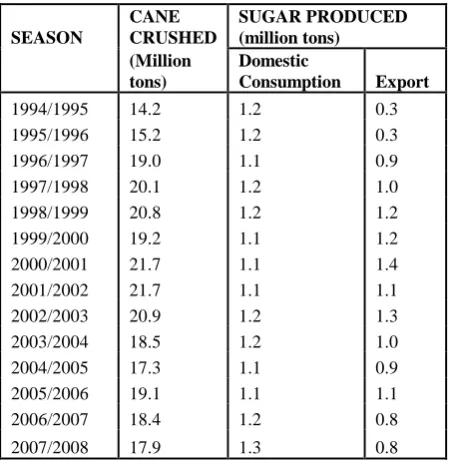
According to Tongaat Hullets Sugar Company every 100 tons of sugarcane harvested and milled produces 10 tons of sugar and 28 tons of bagasse [4]. Some of the sugar mills are undertaking cogeneration of electricity from bagasse but mainly for their own consumption and a small amount is exported to the national grid. Table 1 shows the sugar production levels for South Africa for the past 14 seasons. It is imperative for the sugar industry to become more energy efficient for it to improve its profitability and contribution to the government’s quest for energy security. The South African sugar industry has developed several innovative items for sugar manufacturing equipment in recent years. The installation of the equipment has been justified in terms of cost savings (labour costs) and improved recoveries, with very little consideration to their energy characteristics. [6]
Energy Management in the South African Sugar
Industry
Charles Mbohwa
S
Figure 1: Sugar – Process flow chart. Source: Rajshree Sugars and Chemicals, 2007
Table 1: Sugar Production in South Africa (Source [5])
SEASON
CANE CRUSHED
SUGAR PRODUCED (million tons) (Million
tons)
Domestic
Consumption Export
1994/1995 14.2 1.2 0.3
1995/1996 15.2 1.2 0.3
1996/1997 19.0 1.1 0.9
1997/1998 20.1 1.2 1.0
1998/1999 20.8 1.2 1.2
1999/2000 19.2 1.1 1.2
2000/2001 21.7 1.1 1.4
2001/2002 21.7 1.1 1.1
2002/2003 20.9 1.2 1.3
2003/2004 18.5 1.2 1.0
2004/2005 17.3 1.1 0.9
2005/2006 19.1 1.1 1.1
2006/2007 18.4 1.2 0.8
2007/2008 17.9 1.3 0.8
IIBIOENERGYROLEANDPOTENTIALOFTHE SUGARINDUSTRY
The bio energy produced in the sugar industry is mainly bio-ethanol and the generation of electricity from bagasse. Bagasse is used in a low efficiency steam cycle to produce electricity and steam for own use. For example, Tongaat Hullets own bagasse power generating facilities at Maidstone, Amatikulu and Flexiton mills. The boiler plants consists of standard thermal cycle steam boilers with turbo alternators operating in back pressure mode. The exhaust steam is then used for processing of sugar. The installed capacity for the Tongaat generating plants is 72MW. The plants export 8.5 MW to the national grid and this is 12% of
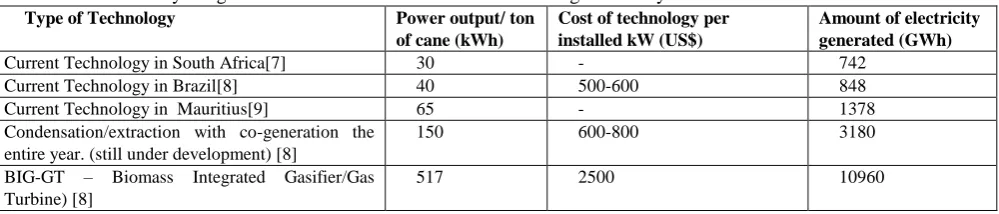
the installed capacity [4]. The bagasse cogeneration technology that is widely in use in the South African sugar industry is direct combustion. The fuel is fired into boilers to produce high pressure steam which drives a steam turbine and the turbine in turn drives the electric generator. In the direct combustion turbine system, power generation efficiency increases with increase in temperature and pressure. The power output in the South African industry per ton of sugar cane crushed is approximately 30 KWh [7]. There is high room for improvement of generating efficiency for the sugar industry in South Africa. This can be achieved through the application of more efficient and available cogeneration technologies.
[image:2.595.46.271.363.594.2]Table 2: Electricity Co-generation Potential of the South African Sugar Industry
Type of Technology Power output/ ton
of cane (kWh)
Cost of technology per installed kW (US$)
Amount of electricity generated (GWh)
Current Technology in South Africa[7] 30 - 742
Current Technology in Brazil[8] 40 500-600 848
Current Technology in Mauritius[9] 65 - 1378
Condensation/extraction with co-generation the entire year. (still under development) [8]
150 600-800 3180
BIG-GT – Biomass Integrated Gasifier/Gas Turbine) [8]
517 2500 10960
Electricity costs in cogeneration mode range from $0.04 to $0.09/kWh. Electricity cost from new gasification plants is around $0.10-$0.13/kWh [11]. Until recently South Africa had a very low price per unit of electricity which was far below the world average and this negatively affected investment in cogeneration plants. The National Energy Regulator of South Africa has now increased the feed in tariff to R1.18 per KWh [12]. This has resulted in interest in cogeneration within the sugar industry and most notable is the proposal by Tongaat Hullets to install a cogeneration plant at the Felixton mill that is expected to export 38MW to the national grid, in season and 17MW, out of season. In addition, feasibility studies are underway for cogeneration plants at the Amatikulu and Darnall Mills owned by Tongaat Huletts [4].
Ethanol is widely promoted as an octane-enhancing and clean-burning petrol additive. 70% of world production is consumed in fuel, with the remainder being used in beverages and industrial applications [13]. The USA is the leading bio ethanol producer followed by Brazil. South Africa’s bio fuel strategy recognises sugar cane as one of the feedstock for renewable energy but there has not been any investment for a bio ethanol plant from sugar cane [14]. The proposed plants are from maize. For every 100 ton cane crushed, 4 ton molasses is obtained [4]. Out of every 4kg of molasses one litre of ethanol is produced [15]. Based on these assumptions, the theoretical potential of ethanol from the sugar industry in South Africa is 220 million litres assuming that ethanol is produced from molasses only and not from sugar. This is a high figure compared to the fuel requirements of South Africa. Sugar production in South Africa is in excess to domestic market requirements and a controlled amount of sugar can be used to produce ethanol.
IIIENERGYMANAGEMENTINTHESUGAR INDUSTRY
Energy management is the collective term for all the systematic practices to minimise and control both the quantity and cost of energy used in providing a service [16]. Efficient energy management systems lead to reduced energy consumption which in turn results in reduced climate change impacts. Climate change caused by greenhouse gas emissions is at the heart of the various emissions targets agreed by countries around the world and set out in the Kyoto Protocol [17]. Governments worldwide, including South Africa have agreed to reductions in greenhouse gas emissions and have introduced policy and legislation aimed at achieving these targets. While many measures can be taken to reduce emissions, using energy efficiently is widely
accepted as the most cost effective way of ensuring the set targets are met.
Energy efficiency improvement means decreasing the use of energy per unit of activity. There are two indicators that can be used to evaluate change in energy efficiency, the energy intensity and specific energy consumption. Each energy-utilizing sector in the economy makes a value-added contribution to GDP. Energy intensity is the energy consumption per unit of value added for the sector. At the national level GDP is the sum over all sectors of the value added from each sector. The ratio of energy consumption at the national level to GDP is the energy intensity of the economy as a whole. Specific energy consumption (SEC) is the amount of energy per unit of human activity measured in physical terms, starting from the primary energy carriers. In the present analysis emphasis is given to specific energy consumption as an indicator of energy efficiency.
IVIMPROVINGENERGYEFFICIENCYINTHESUGAR MILLS
Traditional factory design focused on achieving a fuel balance that is minimizing the purchase of supplementary coal and avoiding generation of excess bagasse [18]. Active and efficient in-house energy management is a good way of improving energy efficiency at very low cost. The method consists of operational and behavioural changes among staff to institute energy efficiency. Some of the practices that can help achieve this are as follows; establishment of in-house energy management committees or groups, data collection for processes, improved maintenance practices, improved safety issues and review of operational efficiency.
The following are some of the process components that can be looked to in order to improve energy efficiency. However it should be noted that the suitability of the improvements depends on the industrial set up and other conditions existing in the factory. The following methods are not exhaustive; they are just some of the main improvements that can be done. There are many opportunities depending on factory set up and the capital that can be invested for the improvements.
Making Use of Lower Grade Vapours for Heating Purposes: The idea is to reduce steam consumption within the mill processes by making use of lower grade vapour for heating purposes. Figure 2 shows the use of lower grade vapours. This increases the number of evaporator effects - the higher the number of effects, the greater will be the steam economy. Typically, the present day mills can use a quintuple effect evaporator system.
Figure 2: Use of Lower Grade Vapours; Source [6]
Extensive vapour bleeding that is extensive use of vapour coming out of the different effects of the evaporators is used for juice heaters and vacuum pans. The later the effect, the better is the steam economy in the system. Moving vapour demand to a lower grade supply of vapour (e.g. from V1 to V2) reduces the amount of residual evaporation to be done downstream. In the modern sugar mills, efforts have been taken to reduce the steam consumption. The final effect is that there is a reduction in the amount of final effect vapour entering the condenser “X”. Reducing steam or vapour demand increases the process energy efficiency. This includes demand by the condenser and this is achieved by optimal design of the evaporator station and bleed configuration. Maximum efficiency is achieved when there is zero vapour to the condenser and this is achieved by over concentrating the juice by moving most of the heating to low grade vapour supplies (V2, V3 and V4).
Improving steam conditions: Increasing the steam conditions that is the temperature and the pressure, increases the energy efficiency resulting in more energy being exported to the grid. The effect of increasing steam temperature is that there is a decrease in the tons of steam per ton of bagasse but more power is produced for export.
For cogeneration, there is need for steam conditions to be increased to the 4500 kPa abs, 445oC, which are still the South African maximum design conditions. Higher pressure and temperature are already in use by sugar plants in Mauritius and other countries. The higher the boiler pressure and the steam temperatures, the more efficient the turbo-alternators become. Table 3 shows the different operation steam conditions indicating that as the boiler steam pressure and temperature rise, the amount of steam produced per ton of bagasse increases. At the same time the amount of steam and electrical power generated increases per ton of bagasse.
Modifying crystallization pans and Use of More Efficient Juice Extraction Methods: The crystallisation pan is one of
the major areas of steam consumption in the sugar mills. Crystallisation pans can use low grade “recycled steam” from elsewhere in the plant instead of exhaust steam from power generating turbines. Operating crystallisation pans with low grade steam enable more electricity to be produced for export to the grid [18]. Milling and diffusion are two processes that can be used for juice extraction. The choice of milling or diffusion will depend on various considerations for the particular factory, but experience shows that diffusion is significantly better, even with the higher imbibitions allowed. Milling extraction is high pressure (HP) steam intensive due to the power required for mill drives. Diffusion is process steam efficient due to the process steam required for the radiant heat losses from the diffuser, partly offset by less mixed juice heating (hot draught juice from the diffuser) [6].
The other advantages of diffusion over milling are: Low maintenance cost
Low operation costs Mechanical reliability
The process is even more energy efficient with mud recycling because evaporation load is reduced and heat losses from filter station are eliminated. Introducing mud recycling and a diffuser makes additional steam available and less exhaust required for process.
Table 3: Power from Bagasse for back pressure Turbo-alternator with increase in temperature and pressure (Source [6])
Steam pressure / Temperature Tons steam / Ton bagasse
Tons steam /MWh
power
MWh power/100t
bagasse
1800 kPa abs / 360oC 2.42 9.12 24.0
3100 kPa abs / 410oC 2.14 7.22 29.6
4500 kPa abs / 445oC 2.09 6.29 33.3
Continuous vacuum pans because of their low boiling head and high heating surface / volume ratios are able to boil on low pressure vapours – typically V2 or V3 – whereas batch pans require exhaust steam or Vapour 1. The result is more energy economy because the continuous pan makes use of low grade vapours for heating. The other benefits of continuous pans are the easy with which they can be automated; they also have good exhaustions and high time availability.
Improving Boiler Efficiency: The boiler efficiency can be increased through efficient heat recovery and excess air control in the boilers. Boiler efficiencies can usually be increased by adding heat recovery equipment such as economizer or more air heater surfaces. For every 10oC higher final gas temperature, the boiler will produce about 1% less steam per ton of bagasse [6]. Modern improvements to bagasse boilers makes it possible to achieve complete combustion with ± 27% excess air, thereby maintaining an oxygen level in flue gas at ± 4.0 %. Under these conditions, a boiler with 160oC final gas will be operating at > 85% lower calorific value (LCV) efficiency on bagasse of 50% moisture. For every 15 unit increase in % excess air, the boiler will produce 1% less steam per ton of bagasse [6]. One of the main thrust of energy efficiency in the sugar industries is to increase energy export. The amount of energy generated depends on the net calorific value of the bagasse (NCV). The NCV depends on the moisture content of the bagasse. The NCV of bagasse at around 48% moisture is 7670 KJ/kg [19].
Replacement of Steam Driven Mill Drives with Electric DC Motor: Conventionally, steam turbines are used as the prime movers for the mills, in a sugar industry. These steam turbines are typically, single stage impulse type turbines having about 25 - 30% efficiency. The current energy challenges have made the generation of excess power in a sugar mill, very attractive. One of the methods of increasing the cogeneration power in a sugar mill is to replace the smaller low efficiency mill turbines, with more efficient DC motors or hydraulic drives. The power turbines (multi-stage steam turbines) can operate at efficiencies of about 65 - 70% [20]. Hence, the equivalent quantity of steam saved by the installation of DC motors or hydraulic drives can be passed through the power turbine, to generate additional power. This replacement can aid in increasing net saleable power to the grid, resulting in additional revenue for the sugar plant.
The benefits of good energy management practices based on the discussed aspects are:
Enhancing energy supply security. Good energy
management practices will ensure that there is more energy available for other activities rather than it being wasted through inefficient practices. Cogeneration in the sugar industry will improve the industry’s energy security as well as increase energy supply to the national grid.
Reduced environmental impact of the sugar industry. Energy efficiency results in reduced greenhouse gas emissions per useful energy output, especially CO2 and this
can assist to reduce climatic change. This can also help the industry with additional financing for CO2 reduction projects
such as cogeneration through the CDM financing mechanism.
Increased competitiveness of the industry: Energy is one of the major operating costs in the sugar industry. Therefore reduced energy consumption means reduced operating costs for the company. This will improve the profit margin in the organization and help to protect the industry against energy price volatility. More energy being exported means the industry will cease to over rely on sugar prices but can earn more revenue from energy sells boosting their business performance in the process.
Improved Productivity and product quality: Energy management through efficient systems means improved productivity and quality of products. A good maintenance system increases energy efficiency and this also improves productivity and quality.
VBARRIERSTOGOODENERGYMANAGEMENT
PRACTICES
There are a number of barriers to good energy management practices in the South African sugar industry that were identified. These are discussed in the following paragraphs.
Energy pricing: South Africa’s historically low price of coal and electricity is perceived as a barrier to energy efficiency [12]. Low pricing makes medium and high cost energy interventions not justifiable due to lengthy payback periods. Lower energy prices also lead to under investment in energy efficiency.
Institutional barriers and resistance to change: There is a frequent misconception that energy efficiency improvements will disrupt production. Energy efficiency improvement through industrial manufacturing process modification may imply a temporary halt to production. Factory managers may prefer to avert such extra costs or complications by not engaging in the changes at all. To overcome this there is need for proper technical planning to minimise the impact of the stoppage whilst realizing the long term benefits incurred thereafter.
Lack of skilled personnel or energy managers: Lack of human resources development in the area of energy efficiency affects energy conservation related activities in the sugar industries. There might be need to engage full time energy managers who will be dedicated to energy issues. This will lead to better performances in terms of energy management.
Capital availability and Capital costs: Capital availability and capital costs are important factors, which directly determine the feasibility of energy efficiency investments. This is further affected by the industry which prioritises items that increase the quality of the product or increase productivity. The sugar industry also lack investment confidence leading to reluctance in terms of acquiring equipment to increase energy efficiency. The South African government has set aside some R2-billion over a three-year period to support programmes aimed at encouraging efficient use of electricity, generation from renewable resources, installation of electricity-saving devices and co-generation projects.[13] .
Lack of energy audits: Monitoring, measurement and verification of energy consumption within the sugar factories is very important for better energy management. If these variables are known, efficiency can be increased and recorded to monitor whether or not targets are being met.
IVCONCLUSION
The sugar industry has a significant potential to contribute towards the supply of bio-energy to the South African community especially bagasse powered electricity. Improvement in generating technologies is necessary for significant benefits to be realised. The potential bio ethanol that can be produced is relatively high when compared to the national gasoline requirements. A good energy management system for the sugar industry in South Africa is very beneficial as has been discussed. It will improve the competitiveness of the industry and also improve energy security among other benefits that can be derived. A lot of opportunities for energy saving exist in the sugar industry and there is need to exploit these for better energy performance.
Energy audits are very crucial for a successful energy management system. It is imperative for cogeneration to be adopted in the industry to increase electricity output and to make better use of process steam. Government policies also a play and important role in setting up good energy management practices. This study contributes to decision making efforts in South Africa and in other sugarcane producing countries on maximizing energy efficiency and bio-power production and use in the sugar industry. Future work can consider production of fuel ethanol from molasses and sugar and the environmental, economic and social sustainability impact assessment of sugarcane production and processing holistically.
REFERENCES
[1] Damodaran C., 2008. Energy audit in Sugar Industry. A Passport to Prosperity. Avante –Garde, Energy consultants. www.avantgarde-india.com/techpapers/Energy Last accessed 13 March 2013
[2] Rebecca M.., 2007. Philippines Case study: Energy efficiency improvement and cogeneration in the sugar milling industry. www.adb.org/Documents/Events/2002/ADB_ESCAP_Workshop. Last accessed 13 March 2013.
[3] South Africa.Info, 2012. Gateway to the nation, R2bn toward energy efficiency. 02 September 2008. www.southafrica.info.htm Accessed 02 February 2013.
[4] Huletts, 2008, Sugar Manufacture Process. http://www.huletts.co.za. Last accessed on 12 November 2012.
[5] Mashoko, Livison , Mbohwa, Charles and Thomas, Valerie M.(2010) 'LCA of the South African sugar industry', Journal of Environmental Planning and Management, 53: 6, 793 — 807
[6] Moor, B. 2008. Bosch Projects, South Africa., Modern Sugar Equipment Assisting Cogeneration, Factory workshop: The Future of Energy in a Cane Sugar Factory. . SASTA Congress 2008, 29-31 July ICC Durban, South Africa.
[7] Department of Minerals and Energy, Republic of South Africa., 2004. Assessment of Commercially Exploitable Biomass Resources: Bagasse, Wood & Sawmill Waste and Pulp, in South Africa. Pretoria. Capacity Building in Energy Efficiency and Renewable
Energy. Report No. – 2.3.4 – 29.
http://www.wcapeenergy.net/Downloads/final_report_biomass_full.p df Accessed on 14 January 2013.
[8] Marcovitch. J. Innovative Technologies from Brazil and the Challenge for South-South Co-operation. Universidade de São Paulo.Brazil.
[9] Ramjeawon, T.,2008. Life Cycle Assessment of Electricity Generation from Bagasse in Mauritius. Journal of Cleaner Production 16: 1727-1734, 2008.
[10] Tyrer, T., 2006. South Africa urged to take seriously cogeneration potential. http://www.engineeringnews.co.za/article/sa-urged-to-take-seriously-cogeneration-opportunities Last accessed on 03 March 2013.
[11] EIA, 2007. Energy Technology Essentials. Biomass for Power generation and CHP.
[12] Nersa, 2009, Decision on Renewable Energy Feed-in Tariffs (refits) Phase II. Media Statement: www.nersa.org.za Last accessed on 10 January 2013
[13] Brian, T., 2010 Requirements and viability for bio-fuels in South Africa. http://www.fssa.org.za/pebble.asp?relid=317 Last accessed 5 February 2013.
[14] Global Agricultural Research Network, 2009. Biofuels Annual Report: Republic of South Africa. Pretoria.
[15] SA Cane growers, 2008 South African sugarcane growers. http://www.sacanegrowers.co.za/ Last accessed 10 October 2012. [16] SEDO, 2008, Sustainable Energy Development Office, Government
of Western Australia. What is Energy Management? www.sedo.energy.wa.gov.au/. Last accessed 18 August 2012
[17] ENER.G., 2008, Energy Management.,
www.energ.co.uk/energy_management. Accessed 23 August 2012 [18] Peacock S., 2008, Process design for optimum energy efficiency,
SASTA Congress 2008, 29-31 July ICC Durban, South Africa [19] Murefu M.,2001 Steam Reticulation at Hippo valley sugar estates.
Department of Mechanical Engineering, University of Zimbabwe, Harare.
![Figure 2: Use of Lower Grade Vapours; Source [6]](https://thumb-us.123doks.com/thumbv2/123dok_us/474878.545793/4.595.46.527.74.297/figure-use-lower-grade-vapours-source.webp)
![Table 3: Power from Bagasse for back pressure Turbo-alternator with increase in temperature and pressure (Source [6])](https://thumb-us.123doks.com/thumbv2/123dok_us/474878.545793/5.595.47.528.88.155/table-bagasse-pressure-alternator-increase-temperature-pressure-source.webp)