A smoke image segmentation algorithm based on rough
set and region growing
Haitao Wang
*, Yanli Chen
School of Electrical and Information Engineering, Hunan International Economics University, Changsha, China
*Corresponding author: [email protected]
Citation: Wang H.T., Chen Y.L. (2019): A smoke image segmentation algorithm based on rough set and region growing. J. For. Sci., 65: 321–329.
Abstract:Because the image fire smoke segmentation algorithm can not extract white, gray and black smoke at the same time, a smoke image segmentation algorithm is proposed by combining rough set and region growth method. The R component of the image is extracted in the RGB colour space, the roughness histogram is constructed accord-ing to the statistical histogram of the R component, and the appropriate valley value in the roughness histogram is selected as the segmentation threshold, the image is roughly segmented. Relative to the background image, the smoke belongs to the motion information, and the motion region is extracted by the interframe difference method to elimi-nate static interference. Smoke has a unique colour feature, a smoke colour model is created in the RGB colour space, the motion disturbances of similar colour are removed and the suspected smoke areas are obtained. The seed point is selected in the region, and the region is grown on the result of rough segmentation, the smoke region is extracted. The experimental results show that the algorithm can segment white, gray and black smoke at the same time, and the irregular information of smoke edges is relatively complete. Compared with the existing algorithms, the average segmentation accuracy, recall rate and F-value are increased by 19%, 21.5% and 20%, respectively.
Keywords: forest fire prevention; roughness histogram
Supported by National Natural Science Foundation, Project No. 51304076 of China (it is supported by Natural Science Foundation Project No. 14JJ4064 of Hunan Province)
Fires seriously threaten the safety of human life and property, and the occurrence of fires is detected in a timely and accurate manner, it can provide valu-able time for fire fighting and evacuation, and it re-duces various hazards which are caused by fire. In the early stage of the fire, the smoke appeared earlier than the open flame, it was not easily blocked by the obstacles, and the early warning of the fire was real-ized. Video smoke detection is to determine whether a fire has occurred by analyzing the image character-istics of smoke, the segmentation of suspected smoke areas is the premise of feature extraction and recog-nition. At present, the motion characteristics, co-lour characteristics and energy analysis of smoke are mainly used to segment the suspected smoke region. There are commonly the frame difference method
was estimated to obtain the suspected smoke area. In the Lab colour mode, the smoke static feature is identified (Lin et al. 2013), and the motion region is extracted by the background difference method, the background is updated by the adaptive background which was generated by the adaptive threshold. The motion and energy characteristics of smoke were used (Zhao et al. 2015), the energy of the image is obtained by the movement of the smoke halo and the wavelet transform, and with reference to the co-lour characteristics of the smoke, the CS Adaboost algorithm is used to identify the smoke area.
When a fire occurs, the colour of the smoke is affected by the burning material, it is mainly white, grayish white and black. The above method can solve the problem of segmentation of white, grayish-white or black smoke, but it is impossible to simultaneously separate the smoke of different colours. It is obviously not comprehensive to study the segmentation of one of the colour smoke imag-es. To this end, in this paper, a smoke segmentation algorithm is proposed by combining rough set and region growth to achieve the purpose of simulta-neously splitting white, off-white and black smoke. The image is regarded as a knowledge system. The concept of upper and lower approximation is used in rough set theory, the rough segmentation of the smoke image is completed according to the rough-ness histogram of the image. At the same time, the motion difference region is detected by the frame difference method, and then the colour model of the smoke is established in the RGB colour space. The interference object is removed in the motion region, and the appropriate seed point is selected in the smoke region. The region is grown on the re-sult of the rough set segmentation, the final smoke segmentation result is obtained.
MATERIAL AND METHODS
Smoke image segmentation based on rough set
Rough sets theory is a data analysis theory to quantify inaccurate, inconsistent and incomplete information and knowledge, it was proposed by the Polish mathematician Pawlak in 1982 (Lizarra-ga-Morales et al. 2014). In this theory, the non-empty finite set of objects is called the universe, denoted U. Any subset X (X ⊆ U) in the domain U is called a concept or category in U. Any
concep-tual cluster in the domain U is called knowledge. Rough sets describe knowledge from the perspec-tive of pattern classification, knowledge is seen as the ability to classify objects without the need for any additional prior information, and the collec-tion of useful informacollec-tion can be accomplished by simply gathering itself information.
Rough set basic concept
Definition 1: Let the equivalence class of the equivalence relation R form a division on the do-main U as {X1, X2, ∙∙∙, Xn}, it is denoted as U/R, and the contained equivalence class is recorded as [x] R. R={R} is an equivalence relation cluster on the domain U, it constitutes the information system, such as the knowledge base K = (U, R). If P⊆ R and P ≠ ∅, then the intersection of all equivalence rela-tions in P is also an equivalence relation, it is called the indistinguishable relationship on P, it is denot-ed as ind (P), and there is the equation (1):
!
PR R
P P
ind x x
x U x
∈ = == ∈
∀ [, ] ( ) [ ] [ ] (1)
Definition 2: The lower approximation set rep-resents a set of objects that are definitely X, and X⊆ U is a subset on U, then the under approximate set of X’s R is the equation (2):
!
{[ ] / |[ ] })
(X x U R x X
R = R∈ R⊆ (2)
The upper approximation set represents a col-lection of objects that may belong to X, then the upper approximate set of X’s R is the equation (3):
!
{[ ] / [| ]"
})
(X = x ∈U R x X ≠φ
R R R (3)
Definition 3: The accuracy reflects the complete-ness of the knowledge cognition which is repre-sented by the set X. The precision is defined as the equation (4):
| ) ( |
| ) ( | ) (
X R
X R X
dR = (4)
Roughness is used to measure the inaccuracy degree of the set X, it reflects the degree of incom-pleteness of the knowledge which is expressed by the set X, roughness is defined as the equation (5):
| ) ( |
| ) ( | -1 ) ( -1 ) (
X R
X R X
d
X R
R = =
ρ
(5)!
P
R R
P P
ind x x
x U x
∈
= == ∈
∀ [, ] ( ) [ ] [ ]
R∈P
∈
As can be seen from the basic concept of the above rough set, the degree of uncertainty of the set can be calculated by the knowledge itself without any addi-tional prior information. In image segmentation, the whole image can be regarded as a knowledge base. The idea of rough set inseparable relationship, up-per and lower approximation is used to make image segmentation simple and more robust.
Roughness measure of colour images
The histogram of the image is used as the lower approximation, and the Histon histogram is used as the upper approximation, and the roughness is calculated to obtain the roughness histogram (Cai et al. 2011). Let I be an RGB image with a size of M × N, then the statistical histogram of I on the three primary colour components of R, G, and B, ie, the lower approximation, can be expressed as equation (6):
∑∑
= = − = M m N ni g I mn i g
H 1 1 ) ) , , ( ( )
( δ (6)
Where 0 ≤ g ≤ L–1 and i∈ {R, G, B}; δ (∙) rep-resents a pulse function; I (m, n, i) represents the grayscale value of the pixel I (m, n) on the i compo-nent; L is the maximum gray level.
P × Q is the neighborhood of the pixel I (m, n), and the sum of the distances between I (m, n) and all the pixels in the neighborhood is the equation (7):
∑∑
∈ ∈
× =
P p qQ Q
P m n d I mn I pq
d ( , ) ( ( , ), ( , )) (7)
Where d (I (n, n), I (p, q)) represents the Euclide-an distEuclide-ance between pixel I (m, n) and pixel I (p, q):
2 , , ) ) , , ( ) , , ( ( )) , ( ), , ( (
∑
= − = B G R i i q p I i n m I q p I n m Id (8)
A threshold is set, if the sum of the distances of the pixel and other pixels in the colour feature space in the neighborhood is less than the thresh-old, the pixels in the neighborhood are considered to be homogenous in colour. Homogeneity calcula-tion is equacalcula-tion (9):
⎩ ⎨ ⎧ < = × else T n m d n m
H PQ
, 0 ) , ( ,1 ) ,
( (9)
Where T is the given threshold. At this point, the Histon histogram is similarly defined as equation (10):
∑∑
= = − + = M m N ni g H m n I m ni g
H 1 1 ) ) , , ( ( )) , ( 1 ( )
( δ (10)
Where 0 ≤ g ≤ L–1 and i ∈ {R, G, B}.
According to the related concept of the rough set, combined with the basic histogram and the Histon histogram, the roughness of the corresponding gray level can be obtained, and the roughness histogram is obtained, and the roughness is the equation (11):
| ) ( | | ) ( | ) ( g H g H g i i i =
ρ (11)
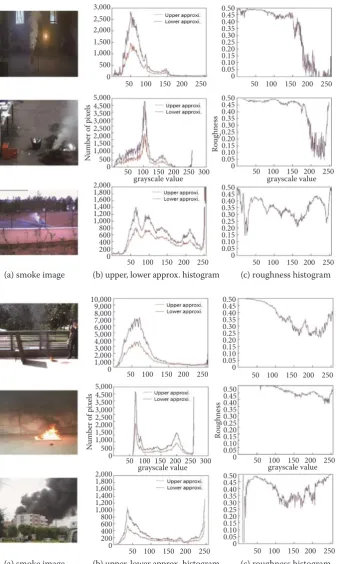
Where 0 ≤ g ≤ L–1 and i ∈ {R, G, B}. In the threshold segmentation algorithm, the peaks of the histogram represent different regions, and the valleys represent the boundaries between different regions. Similar to this idea, the roughness measure can be applied to the segmentation of the image, the pixel at the peak of the roughness histogram may be located in a region where the colour change is relatively small, that is the center of each region in the image, the pixels of the map valley in the roughness histogram may be located in a region where the colour changes relatively large, that is the boundary between the regions. Therefore, by selecting effective peaks, the bands are divided for the gray components of the respective colour com-ponents, an appropriate segmentation threshold is found, the image segmentation can be completed. The top and bottom approximations of white smoke and black smoke and roughness histogram are shown in Fig. 1(b) and Fig. 2(b).
Smoke image rough segmentation
For smoke images, due to the lack of colour tone of the smoke, whether it is white, off-white, or black smoke, the value of the R, G, and B components is not much different, ie, R≈G≈B. Therefore, in this paper, the single R component of the colour smoke image is used to measure the homogeneity between the neighborhood pixels, then the roughness histo-gram is constructed based on the R component, so that the calculation amount is greatly reduced.
According to the nature of the roughness func-tion, it is necessary to find the position of the ef-fective peak and the trough in the histogram of the roughness, and the band is divided for the gray of the red component. The threshold of the segment-ed image is found, the segmentation of the smoke image is completed.
In this paper, the distribution information of the peaks is used to adaptively select the segmentation threshold. The specific steps are as follows (Xie 2011):
Step 1: Calculate all peaks Pk: Pg1, Pg2, ∙∙∙, Pgk from the roughness statistical histogram, gi represent
p∈P q∈Q
i = R, G, B
m = 1 n = 1
Fig. 1. Rough representation of white smoke image
Fig. 2. Rough representation of black smoke image
the gray value of the pixel to which the peak Pgi be-longs, and g1 < g2 < ∙∙∙ < gk .
Step 2: Find the maximum value Pmax and the minimum value Pmin in Pk, and calculate the mean μ = (Pmax + Pmin)/2, then calculate the standard de-viatio n of the peak and the mean σ = √∑ (Pgi – μ)2/k .
Step 3: Set the height threshold Th= μ – σ, and eliminate some unimportant peaks according to this threshold to form a new peak sequence.
Step 4: Set the width threshold Tw, and obtain a suitable width threshold range by statistical analy-sis of a large number of smoke-containing images,
3,000 2,500 2,000 1,500 1,000 500 0
5,000 4,500 3,500 3,000 2,500 2,000 1,500 1,000 500 0
2,000 1,800 1,600 1,400 1,200 1,000 800 600 400 200 0
0.50 0.45 0.40 0.35 0.30 0.25 0.20 0.15 0.10 0.05 0
0.50 0.45 0.40 0.35 0.30 0.25 0.20 0.15 0.10 0.05
0 50 100 150 200 250 50 100 150 200 250 300
50 100 150 200 250 50 100 150 200 250 0.50
0.45 0.40 0.35 0.30 0.25 0.20 0.15 0.10 0.05 0
(a) smoke image (b) upper, lower approx. histogram (c) roughness histogram
(a) smoke image (b) upper, lower approx. histogram (c) roughness histogram grayscale value
50 100 150 200 250 50 100 150 200 250
grayscale value
N
umb
er of pi
xe
ls
Roug
hne
ss
0.50 0.45 0.40 0.35 0.30 0.25 0.20 0.15 0.10 0.05 0
0.50 0.45 0.40 0.35 0.30 0.25 0.20 0.15 0.10 0.05
0 50 100 150 200 250
50 100 150 200 250 0.50
0.45 0.40 0.35 0.30 0.25 0.20 0.15 0.10 0.05 0
50 100 150 200 250
grayscale value
5,000 4,500 3,500 3,000 2,500 2,000 1,500 1,000 500 0
N
umb
er of pi
xe
ls
50 100 150 200 250 300
50 100 150 200 250 50 100 150 200 250
2,000 1,800 1,600 1,400 1,200 1,000 800 600 400 200 0
Roug
hne
ss
10,000 9,000 8,000 7,000 6,000 5,000 4,000 3,000 2,000 1,000 0
the range of Tw is 50–70. When the width of the gray value adjacent to the two adjacent peaks is less than the set threshold, the larger one is retained and the other is eliminated, so that the final effec-tive peak is selected.
Step 5:Select the trough and take the minimum between each two peaks to get the trough.
Step 6: According to the selected trough, the gray level on the red component of the smoke image is divided into different bands, and the gray weight value in each band is used as the gray average value of the pixels in the band, thereby coarse segmenta-tion is completed for the image of the smoke.
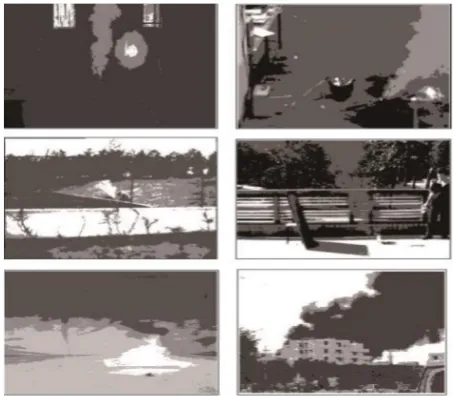
The rough image R component smoke image is roughly segmented for each image in Fig. 1(a) and Fig. 2 (a), the results are shown in Fig. 3.
Smoke image segmentation based on regional growth
After the R component of the image is roughly divided into rough sets, several R component co-lour classes can be obtained, and each coco-lour class has the same gray value. The basic idea of the re-gional growth method is to use seed pixels as a starting point for growth (Wu et al. 2008), pixels are combined with similar properties to form a region. Therefore, the region growth can be per-formed on the rough segmentation of the rough set, thereby the foreground image is extracted for the smoke image.
Select the seed point for growing in the area
According to the characteristics of the smoke area to be segmented, a method of automatically select-ing seed points is proposed based on the motion characteristics and colour characteristics of smoke. (1) Original image motion area detection
When a fire occurs, the smog is obviously af-fected by the heat. In the detection of the motion region, the motion target is extracted by analyzing the changed region in the image. The interframe difference method is not only simple in calculation, but also there is good in real-time, and it is less af-fected by environmental changes. Therefore, this method is used to extract the motion region, there is the equation (12):
⎩ ⎨
⎧ − >
= −
else
y x F y x F y
x
D i i
i 0,
1 | ) , ( ) , ( |, 1 ) ,
( 1 (12)
Where T is the set threshold, it is determined by OSTU (Maximum Inter-Class Variance Method) (OTSU 1979); Fi (x, y) represents the current frame image; Di (x, y) represents the motion extraction result, and the foreground image of the motion is marked as 1, The background is marked as 0. (2) Establish a smoke colour model
Due to the difference in combustion materi-als and combustion conditions, the colour of the smoke is mainly white, grayish white and black. By analyzing the video images of different colour smoke which is generated by different combus-tion materials in different environments, a colour model is established in the RGB colour space, it is suitable for different colour smokes, and the true colour images of the adjacent two frames of images are further processed. The smoke colour model is the equation (13) (Zhao 2015):
< <
< +
+ =
= =
3 2
1 min max min
max
: 1
| :|
1 3
) , , min (
) , , max(
T V T rule
T C C rule
B G R V
B G R C
B G R C
–
–
(13)
[image:5.595.63.290.97.295.2]In the equation, rule 1 and rule 2 represent the colour rule of smoke. According to the colour char-acteristics of smoke, T1 in rule1 generally takes 15~30; T2 and T3 in rule 2 are the brightness range Fig. 3. Smoke image coarse segmentation results based on
of smoke, and the range of gray (white) smoke is 80~220, the black smoke brightness range is 20~80, so T2 takes 20~80, T3 takes 80~220; if the pixel of the motion area satisfies rule 1 and rule 2, the pixel is marked as 1, otherwise it is marked as 0.
(3) Determine the seed point
After (1) and (2) treatment, a suspected smog area is obtained, and morphological corrosion treatment is performed to narrow the selection range of the seed point. In the binary image after corrosion, white is the smoke area, and a random point is selected in the white area as the seed point for the region growth. In this article, the first pixel is used in the white area as the seed point for region growth.
Regional growth
According to the coarse segmentation results of the smoke image, the growth criteria are formulated:
Step 1: In the result of coarse segmentation of the rough set, the seed points of the region growth are selected, and the pixel points are compared with the same or similar colour features in the surround-ing four neighborhoods. If the gray scale difference is less than a predetermined threshold, these pixel points are merged to the area where the seed point is located.
Step 2: Focusing on the newly merged pixel, re-turning to the previous step, checking the neigh-borhood of the new pixel until the region cannot be further expanded. When all the pixels have be-longed, the entire growth process is ended, and the region is marked as 1 where the seed point grows out, other areas are marked as 0.
Step 3:The binary segmentation result of the re-gion growth is subjected to morphological process-ing, and the open operation is used to remove scat-ter and burrs.
RESULTS
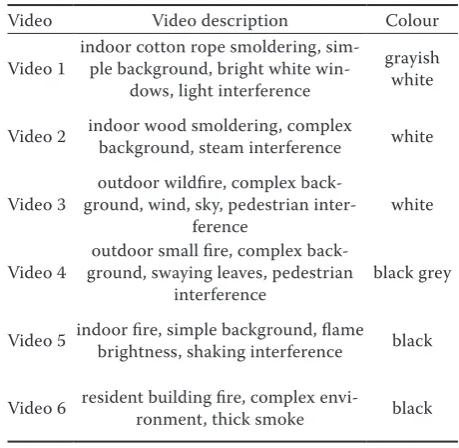
[image:6.595.301.531.111.335.2]MATLAB (Version 7.10, 2010) development environment is used in this paper, the simulation experiments of smoke video were carried out in 6 different environments to verify the effectiveness of the proposed algorithm. At present, there is no standard video database for fire video recognition. The video in this article is from the Internet and the video captured by the research team. The video environment is described in Table 1.
Table 1. Video environment description
Video Video description Colour
Video 1 indoor cotton rope smoldering, sim-ple background, bright white win-dows, light interference
grayish white
Video 2 indoor wood smoldering, complex background, steam interference white
Video 3 ground, wind, sky, pedestrian inter-outdoor wildfire, complex
back-ference white
Video 4 ground, swaying leaves, pedestrian outdoor small fire, complex
back-interference black grey
Video 5 indoor fire, simple background, flame brightness, shaking interference black
Video 6 resident building fire, complex envi-ronment, thick smoke black
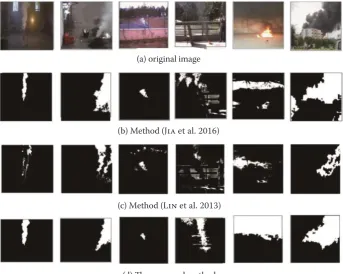
in Fig. 4(c). Combining the motion characteristics and colour characteristics of smoke, the frame dif-ference method and the smoke RGB colour model are applied in smoke segmentation, and one point is used in the segmented smoke region as a seed point, the seed point region is smaller, the proba-bility of the selected seed point being a smoke pixel is higher. Therefore, the smoke region is obtained by combining the smoke motion feature and the colour feature segmentation, it can be used as the seed point region. Finally, the region is grown on the rough segmentation result, and the segmenta-tion result is shown in Fig. 4(d).
DISCUSSION
It can be seen from the segmentation results that the proposed algorithm can segment relatively complete smoke regions, and the boundary irregu-lar information retention is also complete. It solves the problem that the complete white, grayish white, black smoke problem cannot be simultaneously separated relatively in the literature (Jia et al. 2016) and (Lin et al. 2013).
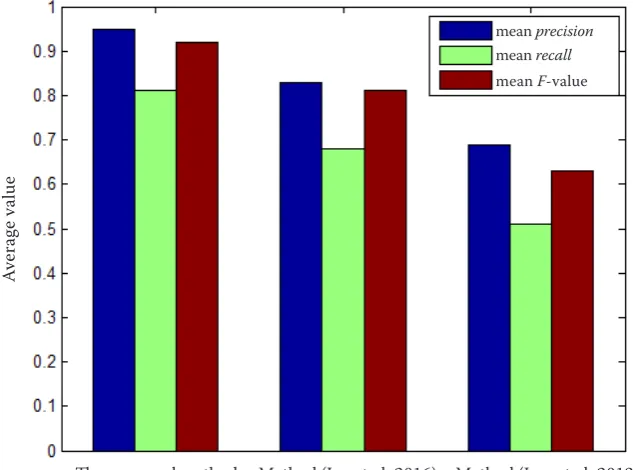
The average values of precision, recall, and F- val-ues were compared with those of the literature Jia
et al. 2016 and Lin et al. 2013. In the smoke image segmentation, the manually segmented binarized smoke region is taken as the real data set, it is de-noted as A, the smoke region is segmented by the algorithm, and the pixel set it belonging to A, it is denoted as B, if the pixel set is not belonging to A, it is denoted as C. Assuming that the number of pixels in sets A, B, and C are a, b, and c, respective-ly, the precision, recall, and F-values are equations (14), (15), and (16), respectively:
c b
b precision
+
= (14)
a b
recall= (15)
recall precision
recall precision F
+
×
× ×
+ = 2
2)
1 (
β
β (16)
[image:7.595.134.478.95.369.2]The F-value is a comprehensive evaluation index of combining the recall rate and the accuracy rate, taking β2 = 0.3 (Ren et al. 2014). Fig. 5 depicts a quantitative comparison of the accuracy, recall, and F-values of the six-segment video by using the algorithm and the literature (Jia et al. 2016) and (Lin et al. 2013). It can be seen from Fig. 5 and Ta-ble 2 that the accuracy, recall and F-value of the Fig. 4. Comparison of segmentation results by different methods
(a) original image
(b) Method (Jia et al. 2016)
(c) Method (Lin et al. 2013)
smoke image segmentation algorithm are higher than those in the literature (Jia 2016) and literature (Lin et al. 2013), it proves the effectiveness and ad-vancement of the proposed algorithm.
In terms of segmentation accuracy, recall rate and F-value, why the proposed algorithm is supe-rior to the literature (JiaY et al. 2016) and (Lin et al. 2013), the main reason is that the rough cen-tralized knowledge is used to classify objects. The „reunion“ white, grayish white, black smoke can be divided into one class more completely. The ac-curate frame difference method is used in smoke segmentation, and the RGB colour model of smoke is established. The smoke region can be segmented more accurately, and then the region growth algo-rithm is used. The appropriate seed points are se-lected in the region, and the region is grown on the result of the rough set segmentation to obtain the final smoke segmentation result. Rough set rough segmentation guarantees the integrity of the smoke
segmentation result. The method of seed point se-lection in the region growing method ensures the accuracy of the segmentation result. Therefore, combining the rough set with the area growing method results in an increase in the accuracy, re-call, and F-value of the smoke segmentation.
CONCLUSION
[image:8.595.64.292.127.205.2]In this paper, a smoke image segmentation al-gorithm is proposed by combining rough set and region growing method. The rough set segmenta-tion method can divide the image into several co-lour classes, then the frame difference method and the colour model are used to segment the smoke region. In this region, the seed points are selected, and the region growth is performed on the result map of the rough set segmentation. The result of the segmentation of the complete smoke area can be obtained. In this paper, the smoke segmentation algorithm can segment relatively complete white, gray and black smoke at the same time, and the accuracy and recall rate of the algorithm and the F-value are also improved. The experimental re-sults show that the proposed algorithm can effec-tively solve the segmentation problem of different colour smoke, and the segmented smoke area is more complete and accurate.
[image:8.595.138.455.492.727.2]Fig. 5. Comparison for mean precision, recall and F-value Table 2. Comparison of different methods for mean preci-sion, recall and F-value
Proposed method
Method
(Jia et al. 2016) (Lin et al. 2013)
Mean precision 0.95 0.83 0.69
Mean recall 0.81 0.68 0.51
Mean F-value 0.92 0.81 0.63
The proposed method Method (Jia et al. 2016) Method (Lin et al. 2013)
Average v
alue
References
Cai S.D., Yang F. (2011): Colour image segmentation based on HSV space and rough-set theory. Optoelectronic Tech-nology, 31: 5–9.
Ho C.C. (2009): Machine vision–based real–time early flame and smoke detection. Measurement Science and Technol-ogy, 20: 495–502.
Jia Y., Yuan J., Wang J.J., Zhang Y.M., Fang J., Zhang Q X. (2016): A Saliency–Based Method for Early Smoke Detec-tion in Video Sequences. Fire Technology, 52: 1271–1292. Lin H., Liu Z.G, Zhao T L., Zhang Y. (2013): Improved al-gorithm for smoking identification of the forest fire based on the video survey. Journal of Safety and Environment, 13: 210–214.
Lizarraga–Morales R.A., Sanchez–Yanez R.E., AyalaRamirez V., Correa–Tome F.E. (2014): Integration of colour and texture cues in a rough set–based segmentation method. Journal of Electronic Imaging, 23: 1709–1717.
OTSU N. (1979): A threshold selection method from gray level histograms. IEEE Trans on SMC, 9: 62–69.
Ouiem Bchir, Mohamed Maher Ben Ismail, Norah Asiri. (2019): Image Based Smoke Detection Using Source Sepa-ration. Spectroscopy and Spectral Analysis, 29: 982–989. Ren Z X, Gao S H, Chia LT, Ivor Wai–Hung Tsang. (2014):
Region-based saliency detection and its application in ob-ject recognition. IEEE Transactions on Circuits & Systems for Video Technology, 24: 769–779.
Shi Y.K, Zhong Z., Zhang D.X, Yang J.J. (2015): A study on smoke detection based on multi–feature. Journal of Signal Processing, 31: 1336–1341.
Wu A.G., Du C.Y., Li M. (2008): Smoke detection method based on mixed Gaussian model and wavelet transfor-mation. Chinese Journal of Scientific Instrument, 29: 1622–1626.
Wu J., Ye F., Ma J.L. (2008): The segmentation and visualiza-tion of human organs based on adaptive photo growing method. Proceedings of the 8th International Conference on Computer and Information Technology Workshops, Sydney, Australia, Jul 8–11, 2008. Washington: IEEE Com-puter Society: 439–443.
Xie Q. (2011): Research on Image Segmentation Based on Rough Set Theory. Changsha, Central South University. Yu C.Y., Mei Z.B., Zhang X. (2013): A real–time video fire
flame and smoke detection algorithm. Procedia Engineer-ing, 62: 891–898.
Zhang W.C., Li P., Gao C.Q. (2016): Smoke detection based on adaptive region growing method in forest background. Journal of Chongqing University of Posts and Telecommu-nications: Natural Science Edition, 28: 100–106.
Zhao Y.Q. (2015): Candidate smoke region segmentation of fire video based on rough set theory. Journal of Electrical and Computer Engineering, 3: 1–11.
Zhao Y.Q., Li Q.J., Zhou G. (2015): Early smoke detection of forest fire video using CS Adaboost algorithm. Internation-al JournInternation-al for Light and Electron Optics, 126: 2121–2124. Zen R.I.M., Widyanto M.R., Kiswanto G. (2013): Dangerous smoke classification using mathematical model of meaning. Procedia Engineering, 62: 963–971.