Study on the Ageing Method and Antioxidant Activity
of Black Garlic Residues
Feng XIONG 1, Chun-Hua DAI 1,2, Fu-Rong HOU 1, Pei-Pei ZHU 1, Rong-Hai HE 1,2* and Hai-Le MA1,2
1School of Food and Biological Engineering and 2Jiangsu Key Laboratory of Agricultural Product Physical Processing, Jiangsu University, Zhenjiang, P.R. China
*Corresponding author: [email protected]
Abstract
Xiong F., Dai Ch.-H., Hou F.-R., Zhu P.-P., He R.-H., Ma H.-L. (2018): A study on the ageing method and anti-oxidant activity of black garlic residues. Czech J. Food Sci., 36: 88–97.
Garlic residue (GR), a co-product of garlic oil extraction, contains most of the nutrients of raw garlic (RG). Prepara-tion of black garlic residue (BGR) is considered to be an effective method of processing GR. The main objective of this study was to optimise the ageing conditions of GR based on moisture, polyphenol and 5-hydroxymethyl-2-furaldehyde (HMF) levels. In addition, the antioxidant capacity of BGR was also evaluated in vitro and in vivo and compared with black garlic (BR) and RG. The results indicate that optimum ageing resulting in polyphenol and HMF contents of 25.80 mg/g and 3.84 mg/g, respectively, were achieved using a temperature of 90°C and humidity of 95% for four days. Both BGR and BR had stronger capacities to scavenge α,α-diphenyl-β-picrylhydrazyl (DPPH) than RG with half maximal inhibitory concentration (IC50) values of 0.454, 0.514 and 4.236 mg/ml, respectively. Experiments on mice demonstrated that there was no obvious difference in antioxidant activity between BGR and BR in vivo. BGR and BR consumption significantly decreased malondialdehyde (MDA) levels in serum and liver, in addition to markedly increasing superoxide dismutase (SOD) and glutathione peroxidase (GSH-Px) activities.
Keywords: ageing conditions; antioxidant ability; garlic residues product
Supported by the Primary Research & Development Plan of Jiangsu Province, Projects No. BE2017308 & 201635, Jiangsu Province Postdoctoral Science Foundation, Grant No. 1402001B, and Science and Technology Support Program (Agriculture) of Jiangsu Province, Project No. BE2016355.
Garlic is widely grown in Asia due to its nutritional and medicinal value, especially in China. Among all garlic products, garlic oil is the most prevalent and is mainly applied to processed meat and chicken products in the form of natural antimicrobials, fla-vourings and antioxidants (Halliwell et al. 1990; Sallam et al. 2004; Leong et al. 2010). Garlic residue (GR), a co-product after oil extraction, has long been considered as waste. The utilization of GR in food and animal feed is limited owing to its characteristic odour, taste and tendency to cause an upset stomach.
Most nutrients and bio-active components are re-tained in GR after garlic oil extraction. In order to
increased, after the feeding of GR for seven days, revealing its bio-activity in lowering blood lipids.
As another form of garlic, black garlic (BG) is a very popular functional food in Asia. In general, it is produced by heating the whole raw garlic (RG) bulbs at a high temperature and a controlled humidity for about one month. Physical-chemical characteristics such as colour, flavour, texture and nutrients compo-sitions are thus altered to greater or lesser extents, resulting in the production of aged BG (Nencini et al. 2011). In marked contrast to RG, the appearance of garlic turns dark brown during the production of BG due to the non-enzymatic browning (Maillard reaction) which occurs during the heating process. In addition, BG tastes sweeter and softer than RG, as much of the pungent and unpleasant odour has been eliminated (Kim et al. 2012). Furthermore, the levels of bio-active compounds like S-Allyl cysteine, phenolic acid and flavanols increase during the ageing process (Bae et al. 2012; Kim et al. 2013a; Li et al. 2015). Several reports have demonstrated that BG harbours hyperglycaemic, hypolipidaemic, anti-oxidative, immune-enhancing and anti-inflammatory effects, etc. (Wang et al. 2010; Angeles et al. 2016; Moustafa & Hussein 2016).
To date, only a small number of studies have de-scribed BG processing although many publications have reported its beneficial effects on health. In order to utilise GR effectively, black garlic residue (BGR) was produced in this study and ageing conditions were optimised with reference to total polyphenol and 5-hydroxymethyl-2-furaldehyde (HMF) levels. In addition, the antioxidant activity of BGR was also evaluated in vitro and in vivo.
MATERIAL AND METHODS
Garlic devoid of any diseases, insect injuries or mechanical damage was obtained from Luzhiye Co., Ltd. (China). The contents of moisture, crude protein and total ash of the whole garlic bulb were 67.5, 6.4, and 1.3%, respectively (AOAC 1990). Total sugar con-tent, determined with the 3,5-dinitrosalicyclic acid method, was 21.8% (Han & Zhang 2008). Garlic oil content (which contained some sulfur compounds) was 1.3% and was analysed according to the method of Huang and Zhuo (2008).
The following reagents were used in this study: gal-lic acid, Folin-Ciocalteu reagent, coumaric acid and 5-hydroxymethyl-2-furaldehyde (HMF) were from
Sigma-Aldrich, Inc. (USA). The malondialdehyde (MDA) kit (A001-1-1), superoxide dismutase (SOD) kit (A005), and glutathione peroxidase (GSH-Px) kit (A003-1) were from Jiancheng Bioengineering In-stitute (China). The other reagents were of analytical grade and were purchased from Sinopharm (China).
Ageing process of RG and GR. RG was peeled and washed using distilled water and then immersed in a 0.2% NaCl solution for 30 min. The garlic was aged under different temperatures (70, 80, and 90°C) and levels of humidity (85, 90, 95, and 100%) at constant humidity or temperature for several days.
RG was peeled and crushed in a high-speed smash-ing machine, then incubated at 40°C for 1 h in order to fully transform alliin into allicin. Garlic oil was ex-tracted using supercritical carbon dioxide extraction equipment with a pressure 35 MPa and temperature of 35°C for 200 minutes. After the separation of garlic oil, the GR was acquired. The subsequent GR ageing process was performed as above.
Determination of moisture. The moisture of the samples was determined with an oven method by drying to a constant weight at 105°C.
Determination of polyphenol content. Polyphenols were measured using the Folin-Ciocalteu method (Li et al. 2011), based on the reduction of polyphenols by oxidants. After mixing 10 g of samples with 10 ml of distilled water and homogenisation, the mixture was diluted to 100 ml with 50% acetone. Then, extraction of polyphenol was conducted at 30°C in an ultrasound water bath for 30 minutes. Filtration was performed before measuring polyphenol levels. Sample extracts (0.2 ml) and 0.5 ml of Folin-Ciocalteu reagent were mixed. After standing for 5 min, 1.5 ml of 20% so-dium carbonate were added followed by dilution with distilled water to 10 ml. After incubation at 50°C for an hour, the absorbance was measured at 765 nm and the total polyphenol levels were calculated from a calibration curve, using gallic acid as the standard. The phenolic content was reported as gallic acid equivalents (mg) using the following linear equation based on the calibration curve:
Y = 0.063X – 0.008, R2 = 0.9960 (1)
where: Y – absorbance at 765 nm; X – concentration of gallic acid equivalents (mg/ml)
polyphe-nol extraction) was mixed with 5 ml of 4-methylani-line solution (5 mg/ml) and 1 ml of barbituric acid (5 mg/ml). After mixing fully and standing for an hour, absorbance at 550 nm was measured against a blank that had been prepared using deionised water instead of the sample. HMF content was calculated from a calibration curve using 5-hydroxymethyl-2-furaldehyde as a standard:
Y = 0.00067X – 0.001440, R2 = 0.9979 (2)
where: Y – absorbance at 550 nm; X – HMF content (mg) The optimum temperature and humidity employed during the ageing procedure were determined based on the contents of moisture, polyphenol and HMF. BGR and BG prepared in this way were then further analysed for their phenolic compounds using HPLC and their antioxidant activities in vitro and in vivo were also determined.
HPLC analysis. The polyphenol extracts (prepared as above) were vacuum-concentrated and dissolved in ethyl acetate. After removing moisture with an-hydrous sodium sulphate, ethyl acetate solution was concentrated again up to dryness, the residue was redissolved in methanol and the phenolic ingredi-ents were analysed using HPLC LC-6A (Shimadzu Corporation, Japan).
After injection of 20 µl of sample solution, separa-tion was performed with a C18 column (4.6 × 250 mm, 5 µm) at 30°C with an elution of methanol/water/ glacial acetic acid (5 : 95 : 1, v/v/v) at a flow rate of 0.8 ml/min and detection at 280 nm. Phenolic ingre-dients were quantified by determining the peak area of their maximum absorption wavelength.
α,α-Diphenyl-β-picrylhydrazyl (DPPH) radical scavenging ability. DPPH radical scavenging ability was measured according to the method of Zhang et al. (2011) with some modifications. After mixing 200 g of ground samples and 3000 ml of distilled water, the extraction was conducted in a boiling water bath for 2 h and then centrifuged at 5000 g for 30 minutes. After that, the supernatant was vacuum-concentrated and lyophilised for the further analysis of antioxidant activities. Sample solutions (2 ml) with different concentrations were added to 2 ml of DPPH ethanol solution (0.1 mM). The mixture was shaken and left to stand for 30 min in the dark. The absorbance at 517 nm was measured using a spectrophotometer. Ascorbic acid was used as a positive control. DPPH radical scavenging activity was calculated according to the following equation:
DPPH radical scavenging activity (%) =
= [1 – (A1 – A2/A0)] × 100 where: A1 – absorbance of the mixture of sample and DPPH solution; A2 – absorbance of the mixture of sample and ethanol solution; A0 – absorbance of the mixture of distilled water and ethanol solution
The half inhibitory concentration (IC50) of samples for scavenging DPPH radicals represents the con-centration that caused a 50% inhibition of radical formation.
Design of the mice experiments. BRG (200 g) was extracted with 3 l of distilled water in a boiling water bath for 2 h; after centrifugation at 5000 g for 30 min, the supernatant was then vacuum-concentrated and lyophilized for the mice experiments. BG and RG extracts were produced in the same way.
One hundred and twenty Kunming female mice weighing 40 ± 2 g (six months old) were used (Jiangsu University Laboratory Animal Center). They were fed a standard laboratory diet purchased from Sebiona Biological Technology Co., Ltd. (China), consisting of more than 18.0% crude protein, 4.0% crude fat, less than 8.0% moisture, 5.0% coarse fibre, and 6.5% total ash, as well as an appropriate mineral mixture, and tap water was freely available. Mice were ran-domly divided into 12 groups (10 mice per group): a tap water control group, a model group (fed with the same volume of physiological saline), a Vc group in which vitamin C was administered at 100 mg/kg of body weight (BW), three BGR groups, three BG groups and three RG groups at dosages of 130, 520, and 1300 mg/kg BW, respectively. After overnight fasting, all groups were fed their respective diets by gavage once daily for 30 consecutive days.
Biochemical assays. On the last day, gavage was performed as before. One hour later, the mice (except for the control group) were administered bromoben-zene (dissolved in olive oil) at a concentration of 6 × 10⁻⁷ g/kg and a dosage of 0.01 ml/g BW. Eighteen hours after the administration, mice were euthanised. Blood samples were collected and centrifuged at 4000 g for 10 min at 4°C to produce the sera. The livers were quickly removed, washed and homogenised in ice-cold physiological saline to prepare a 10% (w/v) homogenate. The homogenate was centrifuged at 4000 g for 10 min at 4°C to remove cellular debris, and the supernatant was collected for analysis.
inhibition of hydroxylamine oxidation by the super-oxide radicals generated in the xanthine-xanthine oxidase system. GSH-Px activity was measured on the basis of the reaction of GSH and 5,5'-dithiobis-(2-nitrobenzoic acid). MDA content was determined with the 2-thiobarbituric acid method using 1,1,3,3-tetra-ethoxypropane as a standard.
Statistical analysis. The experiments were per-formed three times. The data were expressed as the mean ± standard deviation and were analysed using one-way analysis of variance (ANOVA) and Student’s t-test. All graphs were generated with Origin 9.0.
RESULTS AND DISCUSSION
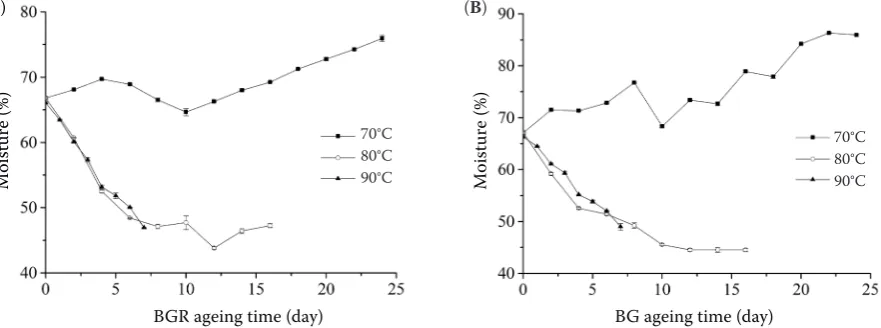
Effect of ageing temperature on moisture, poly-phenol and HMF content. The effect of ageing tem-perature on moisture of BGR and BG at the ageing humidity of 95% is shown in Figure 1. BGR and BG moisture content increased slightly at 70°C with increasing processing time with a non-significant difference between BGR and BG. This might be due to water permeating garlic tissue to achieve a humidity equilibrium between the inside and outside of a cell under conditions of high humidity and low temperature. At 80 and 90°C, meanwhile, the mois-ture content of BGR and BG both decreased slightly to about 50%. It has been reported that BG tastes soft and elastic when moisture is kept at levels of 50–70% (Zhang et al. 2016).
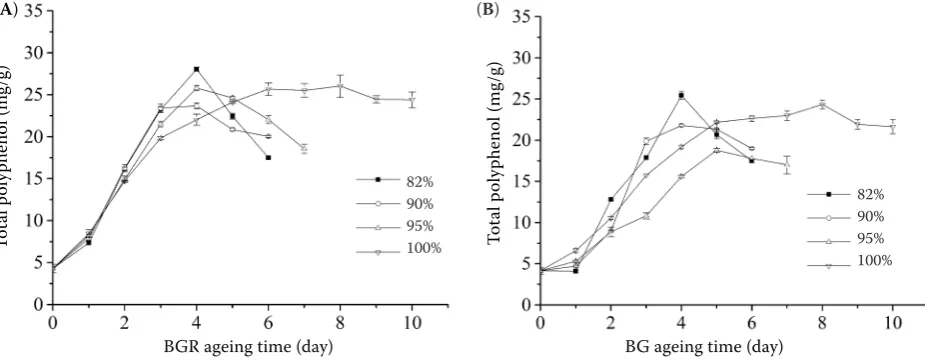
Polyphenol is an important indicator of the qual-ity of BG products. Figure 2 show that polyphenol levels in both BGR and BG increased during the
initial phase of ageing, but then decreased with in-creasing ageing time. The incremental increase in polyphenol levels in BGR was faster than in BG, potentially due to the bigger surface of the material promoting a faster ageing process. The polyphenol content of BGR reached a maximum of 25.80 mg/g when processed at 90°C for four days, 19.71 mg/g when processed at 80°C for 12 days, and 15.62 mg/g when processed at 70°C for 20 days, respectively. The maximal polyphenol content of BGR increased about five-fold compared with raw material, consistent with the results of Li et al. (2015), who discovered that total polyphenol levels were about 7.6-fold greater when raw garlic was converted into BG. Robards et al. (1999) considered that browning reactions could produce more complex polyphenols. Although the existence of other reductive ingredients could hamper the determination of polyphenols, the effect is not significant due to their low contents; ascorbic acid, as the main reductive ingredient, exhibits a concen-tration of 31.5 mg/100 g fresh garlic (Pokluda & Petrikova 2001).
[image:4.595.78.519.569.733.2]HMF is not only a product of the Maillard reaction that occurs between an amino acid and a reducing sugar during heat-processing but is also a product of degradation reactions of carbohydrates (with-out the participation of proteins or other nitrogen compounds), which are one of the main antioxidant ingredients in black garlic products. The accumula-tion of HMF was linked with the rate of formaaccumula-tion of black colour in the garlic sample (Durling et al. 2009). Therefore, changes in HMF content can serve as an important monitoring index for predicting the rate of black formation in garlic samples.
Figure 1. Effect of ageing temperature on the moisture of (A) black garlic residue (BGR) and (B) black garlic (BG) (values are mean ± SD)
BGR ageing time (day) BG ageing time (day)
M
oi
st
ur
e (%)
M
oi
st
ur
e (%)
70°C 80°C 90°C 70°C
80°C 90°C
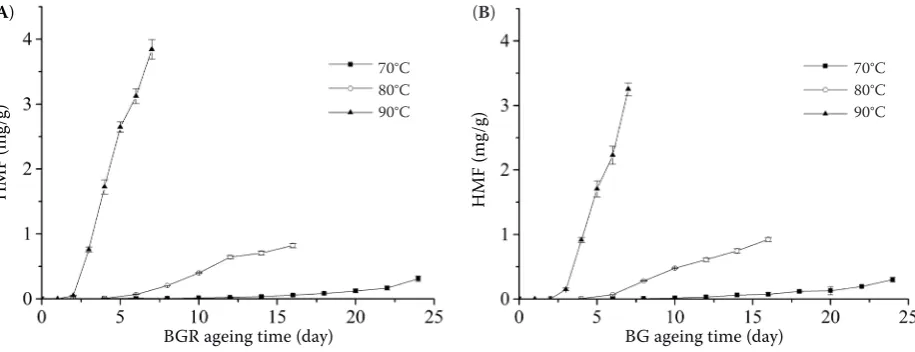
As seen in Figure 3, HMF content increased signifi-cantly in BGR and BG during ageing at a temperature of 90°C and humidity of 95% demonstrating that the rate of the Maillard reaction was fast; in contrast, it was slow at 70 and 80°C. Maximum HMF levels reached 3.84 mg/g in BGR and 3.25 mg/g in BG; both values were measured on the 7th day at 90°C. These observations are consistent with those of Zhang et al. (2016), who reported that garlic becomes black when the HMF content reaches about 4 g/kg.
Taken together, these results suggest that 90°C is the optimal ageing temperature for the preparation of BGR and BG.
Effect of ageing humidity on moisture, polyphe-nol and HMF content. The effect of humidity on the moisture content of BGR and BG at an ageing
temperature of 90°C is shown in Figure 4. The trends of the changes in moisture were similar for both BGR and BG. The moisture of BGR decreased with increased ageing time at humidity levels of 85, 90, and 95%; however, this parameter increased slightly at a humidity of 100%.
[image:5.595.64.529.97.285.2]The effect of humidity on the polyphenol content of BGR and BG is shown in Figure 5. The results showed that the maximum levels of polyphenol reached in BGR were 28.05, 23.67, 25.80 and 26.00 mg/g, respec-tively, at levels of humidity of 85, 90, 95, and 100% and at an ageing temperature of 90°C. It has been reported that garlic is rich in phenolic compounds and that the content of polyphenol is increased by about four- to ten-fold in black garlic compared with fresh garlic (Kim et al. 2013b).
Figure 2. Effect of ageing temperature on total polyphenol content of (A) black garlic residue (BGR) and (B) black garlic (BG) (values are mean ± SD)
Figure 3. Effect of ageing temperature on 5-hydroxymethyl-2-furaldehyde (HMF) levels of (A) black garlic residue (BGR) and (B) black garlic (BG) (values are mean ± SD)
BGR ageing time (day) BG ageing time (day)
Tot
al p
oly
phenol (mg/g)
70°C 80°C 90°C
(A) (B)
BGR ageing time (day) BG ageing time (day)
HMF (mg/g)
70°C 80°C 90°C
(A) (B)
Tot
al p
oly
phenol (mg/g)
70°C 80°C 90°C
HMF (mg/g)
[image:5.595.69.527.554.730.2]Figure 6A and B show that the changes of HMF in BGR and BG were similar. A lower level of humid-ity resulted in a faster accumulation of HMF. The maximum HMF content in BGR reached 3.84 mg/g on the 7th day at a humidity of 95%.
On the basis of the above results, 95% was de-termined as the optimal ageing humidity for garlic residue and raw garlic. Therefore, BGR and BG were prepared under the conditions of a temperature of 90°C, humidity of 95% and an ageing time of four days for further analysis.
HPLC analysis. Figure 7 indicates that BGR was rich in phenolic compounds. Gallic acid and coumaric acid were identified using HPLC by comparison with standard phenolics. The HPLC chromatogram indi-cated that coumaric acid was the main ingredient in BGR. Phenolic compounds are known to be powerful
chain-breaking antioxidants and have a strong scav-enging ability due to their hydroxyl groups. These results indicated that the pronounced in vitro and in vivo antioxidant activities of BGR and BG were possibly due to their high phenolic content.
[image:6.595.70.528.104.277.2] [image:6.595.67.530.552.731.2]DPPH radical scavenging ability. DPPH radi-cal scavenging activity is often used to evaluate the in vitro antioxidative property of a given sub-stance (MacDonald-Wicks et al. 2006). As seen from Figure 8, DPPH radical scavenging abilities increased with sample concentrations. The IC50 values of BGR, BG and RG for scavenging DPPH were 0.454, 0.514, and 4.236 mg/ml according to their regression equations, while it was 0.005 mg/ ml for ascorbic acid (data not shown). Both BGR and BG had stronger DPPH scavenging activities than RG, which is consistent with the studies of Figure 4. Effect of humidity level on the moisture of (A) black garlic residue (BGR) and (B) black garlic (BG) (values are mean ± SD)
Figure 5. Effect of humidity level on total polyphenol content of (A) black garlic residue (BGR) and (B) black garlic (BG) (values are mean ± SD)
BGR ageing time (day) BG ageing time (day)
(A) (B)
BGR ageing time (day) BG ageing time (day)
M
oi
st
ur
e (%)
82% 90% 95% 100%
(A) (B)
82% 90% 95% 100%
M
oi
st
ur
e (%)
Tot
al p
oly
phenol (mg/g)
Tot
al p
oly
phenol (mg/g)
82% 90% 95% 100%
Figure 6. Effect of humidity level on 5-hydroxymethyl-2-furaldehyde (HMF) levels of (A) black garlic residue (BGR) and (B) black garlic (BG) (values are mean ± SD)
Table 1. Antioxidative effects of black garlic residue (BGR) in rat serum and liver
Group Antioxidant activity
dosage (mg/kg) MDA (nmol/ml) SOD × 103 (U/g) GSH-Px (U/ml)
Serum
Control 0 8.95 ± 0.88 32.10 ± 7.52 492.32 ± 53.61
Model 0 10.13 ± 0.88 26.71 ± 8.63 485.62 ± 56.31
Vc 100 9.25 ± 0.67 27.95 ± 13.32 503.51 ± 74.79
RG-L 130 9.63 ± 0.90 35.98 ± 11.24 468.78 ± 32.45
RG-M 520 9.41 ± 0.37a,c 42.10 ± 9.46b 480.82 ± 35.38
RG-H 1300 9.28 ± 0.83b 32.62 ± 13.45b 506.84 ± 80.72
BR-L 130 8.82 ± 0.35a,c,e 27.75 ± 12.22 486.83 ± 37.16
BR-M 520 8.50 ± 1.00a,d,f 30.88 ± 6.24 511.24 ± 70.23
BR-H 1300 7.25 ± 1.20a,f 32.44 ± 8.34 536.71 ± 44.43b
BGR-L 130 8.91 ± 0.44a,c,e 28.16 ± 9.42 485.63 ± 33.42
BGR-M 520 8.44 ± 0.51a,d,f 30.53 ± 12.59 512.39 ± 78.50
BGR-H 1300 7.96 ± 0.76a,f 32.59 ± 9.82 537.15 ± 34.36b
Liver
Control 0 7.55 ± 2.09 196.48 ± 55.82 4050.92 ± 1197.02
Model 0 11.63 ± 3.91 174.75 ± 57.72 3361.73 ± 1318.95
Vc 100 10.68 ± 2.06 193.94 ± 48.62 4699.78 ± 1424.01
RG-L 130 10.40 ± 2.36 223.30 ± 50.66 3767.27 ± 1055.07
RG-M 520 10.06 ± 2.37 252.36 ± 66.25b 3895.69 ± 1061.99
RG-H 1300 9.94 ± 3.23 274.69 ± 82.69a 3917.08 ± 2071.86
BG-L 130 8.05 ± 1.61a,c,f 210.84 ± 36.22 4975.28 ± 1410.47
BG-M 520 7.87 ± 1.22a,d,f 286.25 ± 69.08a,d,e 6510.59 ± 1908.13a,d,f
BG-H 1300 7.03 ± 1.88a,d 291.46 ± 52.95a,d,e 6844.67 ± 1594.76a,c,e
BGR-L 130 7.98 ± 1.07a,c,f 212.16 ± 59.42 4977.30 ± 996.52
BGR-M 520 7.77 ± 1.46a,d,f 301.43 ± 59.02a,d,e 6127.27 ± 1562.07a,d,f
BGR-H 1300 6.96 ± 1.19a,d 306.58 ± 63.49a,d,e 6825.51 ± 1383.63a,c,e
MDA – malondialdehyde; SOD – superoxide dismutase; GSH-Px – glutathione peroxidase; values are mean ± SD; different letters indicate differences among samples: aP < 0.01, bP < 0.05, compared with the model group; cP < 0.01, dP < 0.05, compared with the raw group, eP < 0.01, fP < 0.05, compared with the Vc group
BGR ageing time (day) BG ageing time (day)
(A) (B)
82% 90% 95% 100%
82% 90% 95% 100%
[image:7.595.64.534.339.724.2]oxygen species (ROS) or free radicals can lead to cell and tissue damage or death (Ramalingam & Kim 2014; Sayin et al. 2014). It has been reported that SOD and GSH-Px are the key antioxidant enzymes that protect organisms against oxidative stress and tissue damage because SOD can catalyse superox-ide radicals into hydrogen peroxsuperox-ide and oxygen, while GSH-Px participates in the detoxification of hydrogen peroxide (Queguineur et al. 2012; Yang et al. 2013). Hence, enhanced activity of SOD and GSH-Px may provide an effective defence against the damaging effects of free radicals. In addition, MDA is a principal product of lipid oxidation and has been found to be elevated in various diseases related to free radical damage; for this reason, it has been widely used as an index of lipid peroxidation (Liao et al. 2014).
As shown in Table 1, SOD activities in both serum and liver were significantly increased by BGR, BR and RG at different dosages (P < 0.05), by 22.01% in serum and by 75.86% in liver in the BGR-H group compared with the model group, respectively. BG and BGR administration have been described to lead to dosage-dependent increases in SOD levels. Naderi et al. (2015) reported that the treatment of diabetic rats with garlic increased SOD levels in blood and heart homogenates.
[image:8.595.75.286.106.641.2]GSH-Px is the general name of an enzyme family with peroxidase activity whose main biological role is to protect the host organism from oxidative damage.
[image:8.595.305.529.502.709.2]Figure 8. α, α-Diphenyl-β-picrylhydrazyl (DPPH) radical scavenging activities of black garlic residue (BGR), raw garlic (RG), and black garlic (BG)
Figure 7. Phenolic compounds in black garlic residue (BGR) analysed using HPLC (280 nm): (1) gallic acid (9.967 min); (2) coumaric acid (16.217 min)
Kim et al. (2012) and Zhang et al. (2015). These authors showed that BG had a stronger capacity for scavenging free radicals than fresh garlic.
Antioxidant activity in vivo. The free radical theory of ageing states that the excessive generation of reactive
BGR and BGR concentration (mg/ml)
DPPH (%)
As illustrated in Table 1, there were no significant differences between BG and BGR groups in GSH-Px levels in the serum and liver and GSH-Px activities were increased significantly in both groups. Com-pared with the model group, GSH-Px activities in liver increased about two-fold after administration of 1300 mg/kg BW BG and BGR, indicating that highly concentrated BGR can protect molecules from free radical-mediated attack.
Serum and liver levels of MDA decreased with in-creasing BGR, BG and RG concentrations (Table 1). Both BGR and BG effectively decreased MDA levels. Compared with the model group, serum and liver levels of MDA in the BGR-L groups were decreased by 12.04 and 31.38%, respectively (P < 0.05), whereas MDA levels were decreased by 21.42 and 40.86%, respectively, in the BGR-H groups (P < 0.05). Na-deri et al. (2015) investigated the protective effects of garlic (Allium sativum) in the blood and heart of streptozotocin-induced diabetic rats, and demon-strated that homogenised garlic could decease MDA levels significantly. The reduction of MDA levels in all BGR-treated groups suggested that BGR might inhibit the generation of cytotoxic chemicals, such as MDA, during lipid peroxidation.
Although how exactly BG or RG affect the levels of SOD, GPX-Px, and MDA is still unclear, some studies have considered that many biologically active compounds might be produced during the ageing process. Rajani et al. (2008) considered that the probable protective mechanism of garlic against oxidative damage may be linked to its bio-active components which chelate metal ions (Cu, Zn, and Mn) thereby scavenging superoxide ions, subsequently inhibiting the oxidation of protein moieties and thus contributing to healthy cellular redox status.
CONCLUSIONS
This study showed that the optimal conditions for the production of BGR were a temperature of 90°C and a humidity level of 95% for four days. BGR was found to have a strong DPPH scavenging activity with an IC50 of 0.454 mg/ml. Our data clearly dem-onstrated that mice administered 1300 mg/kg BW BGR extract exhibited significant decreases in MDA content and marked increases in SOD and GPH-Px activities in both serum and liver. These results sug-gest that BGR has a potent antioxidant activity and
thus has potential as a novel natural antioxidant in food and therapeutics.
References
Angeles T.M.M., Jesús P.A., Rafael M., Tania M.A. (2016): Evolution of some physicochemical and antioxidant prop-erties of black garlic whole bulbs and peeled cloves. Food Chemistry, 199: 135–139.
Bae S.E., Cho S.Y., Won Y.D., Lee S.H., Park H.J. (2012): A comparative study of the different analytical methods for analysis of S-allyl cysteine in black garlic by HPLC. LWT-Food Science and Technology, 46: 532–535.
Durling L.J.K., Busk L., Hellman B.E. (2009): Evaluation of the DNA damaging effect of the heat-induced food toxicant 5-hydroxymethylfurfural (HMF) in various cell lines with different activities of sulfotrans-ferases. Food and Chemical Toxicology, 47: 880–884.
Halliwell B., Gutteridge J.M.C. (1990): Role of free radicals and catalytic metal irons in human disease: an overview, Method Enzymol. 186: 59–85.
Han D.Q., Zhang J.J. (2008): Application of DNS method to the determination of saccharide content in Pullulan fermentation broth. Science and Technology of Food Industry, 29: 285–290.
Huang L., Zhuo S.Z. (2008): Extraction of garlic oil and application of its by-product. Science and Technology of Food Industry, 29: 197–198, 232.
Kim S.H., Jung E.Y., Kang D.H., Chang U.J., Hong Y.H., Suh H.J. (2012): Physical stability, antioxidative properties, and photoprotective effects of a functionalized formu-lation containing black garlic extract. Journal of Photo-chemistry and Photobiology. B Biology, 117: 104–110. Kim J.S., Kang O.J., Gweon O.C. (2013a): Changes in the
content of fat-and water-soluble vitamins in black garlic at the different thermal processing steps. Food Science and Biotechnology, 22: 283–287.
Kim J.S., Kang O.J., Gweon O.C. (2013b): Comparison of phenolic acids and flavonoids in black garlic at different thermal processing steps. Journal of Functional Foods, 5: 80–86.
Leong J., Morel P., Purchas R., Wilkinson B. (2010): The production of pork with garlic flavor notes using garlic essential oil. Meat Science, 84: 699–705.
Li W.X., Yu D., Lin L., Sun J., Lan Z.W., Huo J.S. (2011): Study on the determination of total polyphenols content in vegetables and fruits by folin-ciocalteu colorimetry. Acta Nutrimenta Sinica, 3: 302–307.
Liao W.Z., Ning Z.X., Chen L.X., Wei Q.Y., Yuan E.D., Yang J.G., Ren J. (2014): Intracellular antioxidant detoxifying effects of diosmetin on 2,2-azobis(2-amidinopropane) di-hydrochloride (AAPH)-induced oxidative stress through inhibition of reactive oxygen species generation. Journal of Agricultural & Food Chemistry, 62: 8648–8654. MacDonald-Wicks L.K., Wood L.G., Garg M.L. (2006):
Methodology for the determination of biological antioxi-dant capacity in vitro: a review. Journal of the Science of Food and Agriculture, 86: 2046–2056.
Moustafa G.G., Hussein M.M.A. (2016). New insight on using aged garlic extract against toxic impacts of tita-nium dioxide bulk salt triggers inflammatory and fibrotic cascades in male rats. Biomedicine & Pharmacotherapy, 84: 687–697.
Naderi R., Mohaddes G., Mohammadi M., Alihemmati A., Badalzadeh R., Ghaznavi R., Ghiasi R., Mohammadi S. (2015): Preventive effects of garlic (Allium sativum) on oxidative stress and histopathology of cardiac tissue in streptozotocin-induced diabetic rats. Acta Physiologica Hungarica, 102: 380–390.
Nencini C., Menchiari A., Franchi G.G., Micheli L. (2011): In vitro antioxidant activity of aged extracts of some Italian Allium species. Plant Foods for Human Nutri-tion, 66: 11–16.
Pokluda R., Petrikova K. (2001): Using HPLC for rapid determination of vitamin C in garlic. Horticultural Sci-ence, 28: 112–115.
Queguineur B., Goya L., Ramos S., Angeles Martin M., Mateos R., Bravo L. (2012): Phloroglucinol: antioxidant properties and effects on cellular oxidative markers in human HepG2 cell line. Food and Chemical Toxicology, 50: 2886–2893.
Rajani K.V., Reddy U.M.P., Raju T.N. (2008). Attenuation of streptozotocin-induced oxidative stress in hepatic and intestinal tissues of Wistar rat by methanolic-garlic extract. Acta Diabetologica, 45: 243–251.
Ramalingam M., Kim S.J. (2014): Insulin on hydrogen per-oxide-induced oxidative stress involves ROS/Ca2+ and Akt/Bcl-2 signaling pathways. Free Radical Research, 48: 347–356.
Robards K., Prenzler P.D., Tucker G., Swatsitang P., Glover W. (1999): Phenolic compounds and their role in oxida-tive processes in fruits. Food Chemistry, 66: 401–436. Sallam K.I., Ishioroshi M., Samejima K. (2004): Antioxidant
and antimicrobial effects of garlic in chicken sausage. LWT-Food Science and Technology, 37: 849–855. Sayin V.I., Ibrahim M.X., Larsson E., Nilsson J.A., Lindahl P.,
Bergo M.O. (2014). Antioxidants accelerate lung cancer progression in mice. Science Translational Medicine, 6: 221ra15. doi: 10.1126/scitranslmed.3007653
Wang D.Y., Feng J., Liu, J., Yan M. (2010). Black garlic ( Al-lium sativum) extracts enhance the immune system. Medicinal and Aromatic Plant Science and Biotechnol-ogy, 4: 37–40.
Yang X., Yang S., Guo Y., Jiao Y., Zhao Y. (2013). Composi-tional characterisation of soluble apple polysaccharides, and their antioxidant and hepatoprotective effects on acute CCl4-caused liver damage in mice. Food Chemistry, 138: 1256–1264.
Zhang R.F., Zhang F.X., Zhang M.W., Wei Z.C., Yang C.Y., Zhang Y. (2011): Phenolic composition and antioxidant activity in seed coats of 60 Chinese black soybean ( Gly-cine max L. Merr.) varieties. Journal of Agricultural and Food Chemistry, 59: 5935–5944.
Zhang K.C., Ji Z.R., He G.L., Zheng J.F., Han W. (2014): Study on extraction of polysaccharides from garlic resi-due and the hypolipidemic and hypoglycemic function of the garlic residue. Journal of Anhui Agricultural Science and Technology University, 2014-22.
Zhang Z.S., Lei M.M., Liu R., Gao Y.F., Xu M.Y., Zhang M. (2015): Evaluation of alliin, saccharide contents and antioxidant activities of black garlic during thermal pro-cessing. Journal of Food Biochemistry, 39: 39–47. Zhang X.Y., Li N.Y., Lu X.M., Liu P.L., Qiao X.G. (2016):
Ef-fects of temperature on the quality of black garlic. Journal of the Science of Food and Agriculture, 96: 2366–2372. Zong W., Zhang W.W., Zhao G.Y., Zhang L.H. (2014):
Opti-mization of process conditions for polysaccharides from garlic residues by ultra-high pressure method. China Condiment, 39: 20–22.