Abstract— The content of the article develops the research methodology of complex systems in mathematical modeling of management processes based on efficiency and innovation development indices. Resource and energy conservation subsystems have been selected as the control object. The management system of efficiency of modernization subsystems and their high-tech innovation improvement has been determined as the subject of study. The research has revealed an essentially non-linear character of the cyclic changes of the studied property under imbalance of goals of efficiency and innovation development subsystems. To simulate the process the mathematical model of the Gibbs phenomenon is suggested to be modernized using parameters of efficiency for resource-saving technologies and products, which vary in levels of innovativeness. This allowed us to substantiate a hypothesis and concept of enhancement of managing efficiency of subsystems development by the criteria of stability of boundaries of the compromise zone of the stated purposes. The research has proven capabilities to simulate evolutionary processes of gradual modernization and stepwise changes of a high-tech innovation type by using mathematical step functions. This allowed us to ascertain advanced capabilities and objectivity of the proposed approach in comparison with the tools of O. Heaviside’s discontinuous functions. The identified features of the studied processes of resource-saving management enabled us to neutralize the negative manifestations of the Gibbs phenomenon. To eliminate them we propose a sequence of recursive periodic functions, which is grounded by numerical checks of studying the dynamic properties of the management mechanism of innovative resource-saving development. To do this, a substantially non-linear differential equation of the second order was selected. It is specified by the indexes of management quality, the speed of technologies and products implementation and others, enabling to differentiate processes. In the end, а numerical solution of the equation has been calculated and phase trajectories of the process have been constructed in comparison with the solutions of O. Heaviside’s model. Interpretation of the contours of the phase
Manuscript received January 26, 2017; revised March 03, 2017. The work was supported by Act 211 Government of the Russian Federation, contract № 02.A03.21.
A. A. Alabugin is with the South Ural State University, 76 Prospekt Lenina, Chelyabinsk, 454080, Russian Federation (e-mail: [email protected]).
S. V. Aliukov is with the South Ural State University, 76 Prospekt Lenina, Chelyabinsk, 454080, Russian Federation (corresponding author, home phone: +7-351-267-97-81; sell phone: 8-922-6350-198; e-mail: [email protected]).
K. V. Osintsev is with the South Ural State University, 76 Prospekt Lenina, Chelyabinsk, 454080, Russian Federation (e-mail: [email protected]).
portrait of the resource-saving system was realized. This enabled to justify the types of modernization strategies and high-tech innovation of resource and energy saving in compromise of purposes.
Index Terms— Efficiency, energy saving, modeling, approximating
I. INTRODUCTION
OMPLEX systems have been considered in many papers [1-5]. In this paper we use the systems from the point of view of management models to improve efficiency of development of resource and energy saving systems.
The need to improve the management efficiency of the process of development of complex systems is increasing under conditions of their high-tech modernization. At the same time there is an imbalance between efficiency goals and methods of innovation, resource and energy saving. A number of studies [6,7] revealed significant non-linear cyclic processes of change of result functional properties of the economy development with inconsistencies of modernization goals in the long run. This justifies the task of defining of permissible oscillation zone of index-properties in the assessment of economic loss in improving the quality of management of innovative development of resource- and energy-saving systems.
Statistical analysis showed that at the beginning of the development of resource-saving technology, innovation level of economic efficiency of enterprises is falling. Therefore, in this paper a hypothesis of possibility of improvement of quality control of high-tech modernization is proposed with the use of special techniques and models that provide for several cycles compromise zone of objectives and dynamics of reducing economic losses while ensuring the efficiency of the innovative resource.
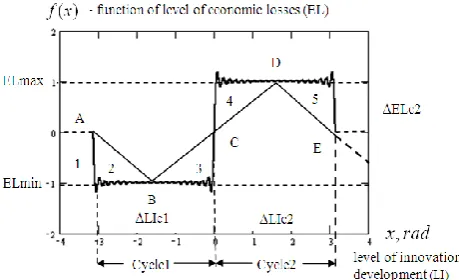
II. ECONOMIC-AND-MATHEMATICAL MODEL For implementation of this hypothesis, an economic-mathematical model of management based on well-known in mathematics Gibbs [8] effect is proposed. It allows revealing functional relationships of index-properties of level of economic losses depending on levels of innovation development of the systems (Fig. 1). In each cycle, we have identified specific zones of imbalance of purposes in estimations of variability with the increasing level of innovative technologies that define the zones of
Management Models of Efficiency of
Development of Resource and Energy Saving
Systems Using Methods of Approximation of
Step Functions
A. Alabugin, S. Aliukov and K. Osintsev
development in period of time for cycles 1 and 2. In the cycle and zone 1, management model of development with a minimum level of uncontrolled growth of innovation is used. In zone 2 modernizations or development of an innovative product begin, when economic losses and costs are reduced due to the use of short-term effects (segment AB of linear representation of the loss function). The object of the study can be resource-specific technologies of fuel preparation or innovative technologies to combustion the fuel in thermal power plants.
The zone 3 of the development process is characterized by growth of investment costs needed to develop high-tech innovation project in the negative zone (-1 ... 0), shown by a straight line BC. In this case, the increase of economic losses is due to the fact that each additional level of innovative growth during the development of new technologies reduces the severity of reaction of a consumer in assessment of their usefulness. In practice it is usually mastered a number of technologies and products with different levels of innovation. They show a range of estimates from the abrupt increasing levels of efficiency and innovation with usage of new energy-saving technology to gradual changes in the modernization of the combustion process in boilers devices. Low scores in cycle 1are interpreted by non-recognition of uniqueness, for example, of high-tech innovative product with original aerodynamics of the torch in the period
t
c1 . This is shown by negative assessments of its zones of growth of innovation and by a slight decrease in economic losses (EL).Fig. 1. Model of Gibbs' phenomenon in the parameters of levels of efficiency and innovation of processes of energy and resource saving
development
In cycle 2, which is characterized by a high level of innovative technologies and products, for similar reasons, the economic losses are growing in comparison with their value in the cycle 1. The nature of change of the losses in zones 4 and 5 is due to the similar nature of the dependence on the lines AB and DE, BC and CD in pairs respectively. Specifying the hypothesis of the study, it can be assumed that zone of compromise of the considered purposes must be determined by the variations in the properties of the resulting economic losses and costs in the pointed ranges of estimates (-1 ... 1). The stability of the zone boundaries should be adjusted by elements and functions in a special model.
The research allowed us to form the concept of management efficiency of energy and resource development as a complex of economic and mathematical models to identify and effectively control the stability of the boundaries of acceptable (normative) stable quality control zone in terms of minimizing the imbalance of efficiency objectives and innovation development. Unique innovative technologies and products, abolishing the existing analogs, claiming to be non-existent segments resource- and energy-saving market, define the need of organization of the hopping improvement of quality of management processes, radically reducing losses of resources. This can be modeled by mathematical functions of step type. In this case, evolutionary changes are described with help of a set of nested sine maps of these functions. Concept development justifies the method of successive approximations of the step functions of economic losses. They will describe the process of harmonizing the goals in the consecutive cycles of development of products with different levels of innovation.
III. USAGE OF STEP FUNCTIONS
The stepped nature of the investigated functions is useful to justify the choice of the strategy of development of resource-saving system. For this aim, estimation parameters named "quality management development in assessing of economic losses" and "level of innovative technologies and products» are proposed (
f x
( )
andx
in Figure 1).The developed method enhances the possibility of usage of tools of discontinuous Heaviside's functions. He suggested a characteristic of steepness of function that was defined by less accurate and subjective expert assessments. Our analytical approach reveals more choices of innovative development.
Systems with step parameters and functions are considered highly nonlinear structures (such as resource and energy efficient, economic and social ones). Despite the simplicity of step functions in segments, the construction of solutions in problems with step functions on the whole domain of definition requires using special mathematical methods, such as the alignment method with the coordination of the solution by segments and switching surfaces. Generally, application of the alignment method requires overcoming substantial mathematical difficulties, and intricate solutions represented by complex expressions are obtained rather often [9,10].
In many cases, researchers rely upon approximation methods using Fourier series
1
,
k kk
f
с
where
1,
2,
,
n,
is an orthogonal system in functional Hilbert spaceL
2[
,
]
of measurable functions with Lebesgue integrable squares,
f
L
2[
π,
π
],
c
k
(
f
k)
/
k 2. [image:2.595.51.281.424.564.2]system. In this case, the following is fulfilled in the vicinity of discontinuity points
O
(
x
0)
0
)
(
)
(
sup
} /{ ) ( 0 0
O x x
f
x
S
nx
nA
x,
where
S
n(
x
)
is the partial sum of the Fourier series. It is how Gibbs’ phenomenon shows itself [5]. Thus, in the case of a function)
x
(sin
sign
)
(
0
x
f
(1) the pointx
/
m
, wherem
2[(
n
1) / 2]
, and[ ]
A
is the integral part of the numberA
, is the maximum point of the partial sumS
n(
f
0)
of the trigonometric Fourier series [6] with0
0
2 sin
(
, / )
1.17898,
n n
t
S
f
m
dt
t
i.e., the absolute error value
0
( /
)
lim
n n(
0,
/
)
0.178.
f
m
S
f
m
It should benoted that
/
0
0
n
m
x
.The graph of the partial sum
S
20(
f
0)
of the trigonometric series on the interval[-
,
]
, which illustrates the presence of the Gibbs phenomenon is presented in Fig. 1.What is unpleasant in this case is that the Gibbs effect is generic and is present for any function
f
L
2[
a
,
b
]
, which has limited variation on the interval[
a
,
b
]
, with isolated discontinuity pointx
0
(
a
,
b
)
. The following condition is fulfilled for such functions [6] , 1 sin 2 2 ) 0 ( ) / , ( lim 0 00
t dt
t d x f m x f Sn n
where
d
f
(
x
0
0
)
f
(
x
0
0
)
.We show that absolute
(
x
)
and relative)
(
x
errors of approximation in the vicinity of discontinuity points may be as large as we please. In fact,0 0 0
0 0
0 0
0
0
lim ( / ) lim ( , / ) ( / )
lim ( / ) lim ( / )
2 sin
( 0) 1 ( 0)
2
2 sin
1 ( ). 2
n
n n
n
n n
x m S f x m f x m
S x m f x m
d t
f x dt f x
t d t dt d t
The function (d) is an infinitely large value, as
0
M
0 d
d (M)
0 d : d
d
(d )
d
2 sin t
dt 1
M
2
t
.Such expression as
2
/
2
sin
1
0
dt
t
t
M
,where
[
A
]
is the integral part of the numberA
, may be taken asd
.IV. ORGANIZATIONAL AND ECONOMIC RELATIONSHIPS OF COMPLEX SYSTEMS BASED ON APPROXIMATION OF STEP
FUNCTIONS
Features of the organizational and economic relationships of the complex systems can neutralize the negative manifestations of the Gibb's effect [8]. So, if we accept the levels of innovative technologies and products as members of the partial aggregate, their number in the developing system is much more than ten. Consequently, the fact that saving under the pointed condition of invariance of the maxima and minima of amplitudes of index-property can be interpreted as a relative stability of the amplitude of oscillation during a cycle. This corresponds to the improvement of the quality of management efficiency of resource-reduction under the criterion of imbalance of the goals in cycles 1 and 2.
The proof is identical for the relative error
)
(
/
)
(
)
(
x
x
f
x
. Moreover, even whend
R
)
0
(
d
is fixed for any M 0, the function]
,
[
)
(
x
L
2a
b
f
may be selected in such a way thatM
x
f
d
x
d
x
(
00
,
)
(
00
,
)
/
(
00
)
. The function with0
)
0
(
,
/
)
,
0
(
)
0
(
x
0
x
0
d
M
f
x
0
f
may be taken as an example for this case.
It should be noted that it is not necessary for the Fourier series to converge at each point even on the set of continuous functions
С
[
,
]
, which is commonly known.To take into account the set of levels of innovation of products, new methods for approximation of step functions are offered. These methods are based on the use of trigonometric expressions as recursive functions. For example, consider the step function (1) in more detail. This function is often used as an example of the application of Fourier series, and, therefore, it is convenient to take this function for comparative analysis of a traditional Fourier series expansion and the proposed hypothesis of implementation of the method of economic losses
EL
x
f
(
)
.Expansion of (1) into Fourier series has all the above mentioned disadvantages. In order to eliminate them, it is proposed to approximate the initial step function by a sequence of recursive periodic functions
1
( ) sin ( / 2) -1( ) ,
( ) С [ , ]
( ) sin ; -1
fn x fn x
f n x
f x x n N
(2)the approximating functions approximates the initial function (1) rather well. In addition, approximating functions obtained using the suggested method does not have any of the disadvantages of Fourier series expansion. There is absolutely no sign of the Gibbs phenomenon.
Let
f
n(
x
)
L
2[
0
,
/
2
]
andf
0(
x
)
L
2[
0
,
/
2
]
.As
sup
(
)
1
sup
] 2 / , 0 [
x
f
n xN n
(due to the boundedness
of functions fn(x)) and
1
sup
2
0 n
π/
N n
f
Var
(due to themonotonicity of functions fn(x) on the interval
]
2
/
,
0
[
), then, a subsequence converging at each point of[
0
,
/
2
]
to a certain functionf
withn n
f
Var
f
Var
2 / 0 ___ 2
/ 0
lim
may be extracted from the sequence
f
n(x
)
based on Helly’s theorem. It was shown that the initial function f0(x) can be as a such functionf
.Fig.2. Hypothesis of representation of function of economic losses and its five successive approximations on levels of innovation of energy and
resource saving technologies and products
The continuity of economic losses, determined by the level of innovation of products, allows us to set quantified zone boundaries of the compromise under consideration of purposes. For this purpose, the results of the differentiation of the function, according to equation (2), should be defined in terms of points of minimum B and maximum of economic losses D. Thus, boundaries of zone of oscillation of investigated property of the tested efficiency, controlled by management system, are mounted.
V. NUMERICAL VERIFICATION OF THE PROPOSED METHOD Numerical testing of the proposed approximating procedure will be carried out using the example of investigation of dynamics of management system of resource-efficiency development. It was established above that weak links can eliminate from the model of representation of the loss function in the regulation mechanism. These links are characterized by excessive growth of losses (the area where EL > 1) and by their not reasonable decline when EL < -1 with increasing release of the developed standard products. Then, the development process can be described by essentially non-linear second-order differential equation
, )
( 2 3 2
2
1 А А МС
А
where
1 1 1 2 2
3 3
cos ,
sin ,
sin ,
(
),
A
B
b
A
a
A
a
q
t
q
a
a
b
B
1,
1,
2,
3,
are constant coefficients of quality of control, influencing the choice of the above mentioned parameters of choice of strategies of resource-saving development;0 1 sign(β) M
M
MC
is assessment of resistance forces to recognize the uniqueness of the highly innovative technologies and products
(
M
0,
M
1
const
),
const
is the rate of implementation of an innovative project for the production of product or technology development,
is quality of control processes to improve efficiency of innovative development, which determines the decision to move to a new cycle; anddt
d
is the operator of differentiation with respect to timet
for the cycles 1 and 2 for implementation of products with different levels of innovation.The sign function sign( )
β is highly nonlinear, which complicates carrying out analytical investigations of the dynamics of the system. In addition, this function is not periodic. We approximate the sign function using the suggested methods (2) by, for example, an analytical function written as
• •
4
( )
(
/10).
sign
f
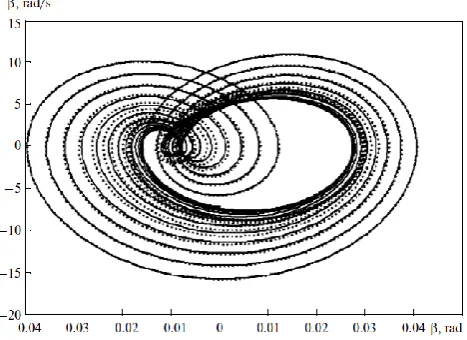
It should be noted that we take relatively small n4 for the approximation, leaving substantial opportunities for a reduction in the approximation error (practically, there is a much larger number of levels of innovation).For the sake of comparison, we carry out a numerical solution of the differential motion equation with the sign and the approximating functions for particular examples of the model of development according to the Runge–Kutta method. Phase trajectories on phase plane
(
,
)
with access to a periodic solution are presented in Fig. 3. Here, the solid line indicates the solution obtained with help of discontinuous sign function used in the mathematical model, while the dotted line represents the solution obtained using an analytical approximation. The thickened line in Fig. 3 corresponds to the periodic solution.Figure 3. Phase trajectory of approximation of the step function of quality control and resource efficiency of energy development of system
(
is rate of increase of quality of management, and is the actual quality of management).
V. CONCLUSION
1. The article describes the research methodology of complex systems in the field of mathematical modeling of control processes on the basis of efficiency and performance of innovative development. We upgraded the mathematical model with the efficiency parameters for resource-saving technologies and products, which differ in the level of innovation. This allowed us to substantiate the hypothesis and the concept of increasing the effectiveness of the control subsystem on the criterion of stability of boundaries of a compromise zone of pointed objectives. Objectiveness of the proposed approach is substantiated in comparison with the tools of Heaviside's discontinuous functions.
2. The described methods of approximation do not have any of the disadvantages of expansions of functions into Fourier series and may find wide use in the solution of applied problems of resource and energy saving. It should also be noted that the proposed approximating functions are continuous and analytical ones. They reflect actual processes to a larger extent than step functions, as even jump processes occur in reality within short, but not zero, time intervals.
3. The proposed model and methods for quantitative estimation of economy of cyclical development should be used to justify the choice of strategies for resource and energy conservation and social and economic systems in the conditions of imbalance purposes.
REFERENCES
[1] Bar-Yam, Yaneer (2002). “General Features of Complex Systems”. Encyclopedia of Life Support Systems (EOLSS UNESCO Publishers, Oxford, UK). Retrieved 16 September 2014.
[2] Ledford, H. (2015). “How to solve the world's biggest problems.” Nature, 525(7569), pp. 308-311.
[3] Chu, D.; Strand, R.; Fjelland, R. (2003). "Theories of complexity".
Complexity 8 (3): 19–30. doi:10.1002/cplx.10059.
[4] Kalmykov, Lev V.; Kalmykov, Vyacheslav L. (2013), "Verification and reformulation of the competitive exclusion principle", Chaos, Solitons & Fractals 56: 124–131, doi:10.1016/j.chaos.2013.07.006. [5] Alyukov, S.V. (2010). “Approximate solution of the differential equations of motion of inertial-pulsed transmissions.” ISSN 1068 798X, Russian Engineering Research, 2010, Vol. 30, No. 7, pp. 655–661.
[6] Alabugin, A.A. (2005). “Managing of balanced development of the enterprise in dynamic environment.” - Book 1. Methodology and the theory of the formation of adaptive management mechanism of development of enterprise: Monograph. Chelyabinsk: South Ural State University Publishing House, 362 p.
[7] Alabugin, A.A. (2005). “Managing of balanced development of the enterprise in dynamic environment.” - Book 2. Models and methods of effective management of development of enterprise: Monograph. - Chelyabinsk: South Ural State University Publishing House, 345 p.
[8] Helmberg, G. (1994). “The Gibbs Phenomenon for Fourier Interpolation,” J. Approx. Theory 78, pp. 41–63.
[9] Alyukov, S. V. (2011). “Approximation of step functions in problems of mathematical modeling”, Mathematical Modeling, 23:3, pp. 75–88.