doi:10.4236/njgc.2011.11003 Published Online April 2011 (http://www.SciRP.org/journal/njgc)
Optimizing the Glass Fiber Cutting Process Using
the Taguchi Methods and Grey Relational Analysis
Chao-Lieh Yang
Department of Industrial Engineering and Management Information, Huafan University, New Taipei City, Chinese Taipei. Email: [email protected]
Received March 10th, 2011; revised March 21st, 2011; accepted April 6th, 2011.
ABSTRACT
This paper mainly describes a new approach to optimizing of the cutting glass fiber with multiple performance charac-teristics, based on reliability analysis, Taguchi and Grey methods. During the cutting process, the speed, the volume and the cutting load are optimized cutting parameters when the performance characteristics, which include Weibull modulus and blade wear, are taken into consideration. In this paper, optimization with multiple performance charac-teristics is found to be the highest cutting speed and the smallest cutting volume, and the medium cutting load. An analysis of the variance of the blade wear indicates that the cutting speed (47.21%), the cutting volume (14.62%) and the cutting load (12.20%) are the most significant parameters in the cutting process of glass fibers. In summary, the most optimal cutting parameter should be A3B1C2. The results of experiments have shown that the multiple perform-ance characteristics of cutting glass fiber are improved effectively through this approach.
Keywords: Blade Wear, Cutting, Glass Fiber, Grey Relational Analysis, Optimizing, Taguchi Methods
1. Introduction
Composite materials are playing an important role in a wide range of fields and replacing many traditional en-gineering materials. Glass fiber reinforced composite materials are a class of materials used in various products including aerospace, automobile, sporting goods, marine bodies, plastic pipes, storage containers, etc. An et al. [1] glass fiber reinforced plastic (GFRP) is characterized by high strength and rigidity coupled with low weight and, in many respects, is superior to metals. However, for the practical cutting of glass fiber, optimal cutting parame-ters should be taken into consideration to achieve less blade wear, good cutting quality, etc. In order to achieve this objective, how to control the blade wear correctly is decisive.
During glass fiber cutting, the reduction of blade wear is a critical aspect. Long glass fibers were found to affect cutting quality significantly. Lau et al. [2] showed that the wear characteristics of blades were highly influenced by the geometry and thickness of the blade. Casto et al.
[3] discussed the lifetime according to different criteria, determined by using a profilometer and image processing, where the worn zone was observed using a scanning electron microscope (SEM). A Weibull distribution has
been applied to a variety of cutting processes. Yang et al.
[4] concluded that the effect of the cutting conditions, the cutting speed, the feed rate, and the depth of cut on the tool life and the cumulative probability of chipping could be presented as a Weibull distribution with three pa-rameters. Lin [5] has observed that the cutting tool life can be represented for the cases studied by the statistical normal distribution. Moreover, Klim et al. [6] conducted a two-parameter study on the effect of feed variation on the tool wear and tool life, and found that this followed a Weibull distribution.
with nowaday complex manufacturing process. There-fore, optimization of multiple performance characteris-tics is still interesting to researchers to do further study. Kang and Hadfield [8] designed a novel eccentric lap-ping machine, and in a systematic use of the Taguchi methods, they investigated the optimization of different lapping parameters. Lin [9]obtained optimal parameters using the Taguchi methods and analysis of the Weibull modulus through reliability engineering for the polishing of ceramic gauge blocks.
The Grey system theory proposed by Huang and Liao [10] has been proven to be useful for dealing with poor, incomplete, and unsure information. Chang et al. [11] presented a fast and effective methodology of Grey rela-tional analysis for the optimization of the injection molding process parameters of short glass fiber rein-forced polycarbonate composites. Lin and Lin [12] found the Grey relational analysis can be used to solve the elec-trical discharge machining (EDM) process with the mul-tiple performance characteristics. The Grey relational analysis based on the Grey system theory by Deng [13] can be used to solve complicated inter-relationships among the multiple performance characteristics effec-tively.
To optimize several responses or quality characteris-tics simultaneously, many researchers have tried to com-bine the Taguchi methods with other methods [14,15]. Through the Grey relational analysis, a Grey relational grade is obtained to evaluate the multiple performance characteristics. As a result, optimization of the compli-cated multiple performance characteristics can be con-verted into optimization of a single Grey relational grade. Lin [14] has shown optimal cutting parameters can then be determined by the Taguchi methods using the Grey relational grade as the performance index. The cutting parameters, the tool life, the cutting force, and the sur-face roughness are important characteristics in turning. Lin et al. [15] used reliability analysis, the Taguchi and the Grey methods in this paper. The speed and the load are optimized polishing parameters when the perform-ance characteristics, which include Weibull modulus and the removal rate, are taken into consideration.
In this paper, the reliability of the cutting process for glass fiber materials has been evaluated quantitatively in terms of a three-parameter Weibull distribution [4]. The effect of the cutting parameters, i.e. the cutting speed, the cutting volume, and the cutting load, on the blade wear, as determined by long glass fiber that would exceed a value of 1%, to meet the requirement of the customer acceptance standard TP-700 of the Owens Corning Company, was investigated. When using the Taguchi methods of parameter design, the experimental details were used for optimizing the single performance
teristics. Optimization of multiple performance charac-teristics with the Grey relational analysis was also con-sidered in this paper. The methodology used in the ex-periments was the same as that used by Lin [9], and was as the following:
1) Perform a Taguchi-based experiment.
2) Measure the material wear from 12 cuts by a cutter blade.
3) Calculate the Weibull modulus and the mean value of the wear.
4) Calculate the signal-to-noise (S/N) ratio.
5) Collect the data while preprocessing both the mean value of the wear and the Weibull modulus.
6) Perform an analysis of variance (ANOVA) using the Grey relational analysis.
7) Carry out the confirmation runs.
2. Reliability Analysis
The reliability, determined from a three-parameter Weibull distribution, was expressed by Shigley et al. [16] as:
0 0
exp b
R x x s x xx0 (1)
In it:
x is the thin-edge blade wear (m);
x0 is the guaranteed value of y (x0≥ 0); s is a characteristic or scale value (s≥x0); b is the Weibull modulus (b≥ 0).
The Weibull modulus is the most important parameter in a Weibull distribution. The increases of reliability de-pend on the increase of the Weibull modulus. The prob-ability of a failure, F 1 R, can be calculated as indi-cated by Shaw [17] according to:
0.3
0.4
F g h (2) In which:
g is the gth sample as the blade wear values are ranked
in order;
h is the total number of samples.
The detail for the relationship between the reliability and the wear rate has been derived by Yang et al. [4]. So, the guaranteed value x0 can be written as
3 2 2
1 0 23 2 2 1
x x x x
x x
x x x
(3)
The characteristic parameter s can be written as
0
ln 0
s inv x x x (4) The Weibull modulus b can be written as
b Y x (5)
3. Experiments
turned parts are the cutting blade parameters (blade ge-ometry and blade material), the workpiece-related pa-rameters (long fiber), the cutting papa-rameters (speed, load, and volume), and the environmental parameters (dry cut-ting and wet cutcut-ting). The ranges of the selected cutcut-ting process parameters (cutting speed V = 1.9 - 5.7 m/s, load F = 13 - 27 kgf/cm2, and volume150 - 250 piece) are
as-certained by conducting preliminary experiments. The details of the work material, the cutting machine, the cutting blade, and the cutting conditions are as the fol-lowing:
The work material: E-glass fiber, 9 m 66 (g / 1000 m).
The cutting machine: Parallel blade-cutting machine (Finn and Fram, USA) with a 0.75 HP spindle power.
The cutting blade: Lutz cutter (Lutz, Germany) made of high-carbon steel disposable blades
The cutting condition: Dry
The wear measure: Examined by using a SEM to measure blade wear.
Glass fiber that were 9 m in diameter and 66 (g / 1000 m) in weight and machined on a cutting machine with a carbon steel blade. The blade wear were measured by a SEM while each specimen was cut. The cutting blade samples were examined by a SEM to measure blade wear values at three points, and these were aver-aged to obtain an average blade wear value. Each cutting test of a blade wear was performed until the long glass fiber weight exceeded a value of 1%, as specified in the customer acceptance standard TP-700 of the Owens Corning Company.
4. The Single Performance Characteristic
4.1. The Taguchi Methods
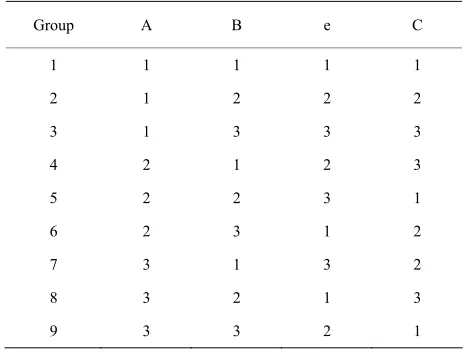
An orthogonal array gives a more reliable estimate of the factor effects with fewer tests compared to traditional methods. In this paper, based on the experiments de-signed by Kang and Hadfield [8], three levels of cutting parameters were selected and the three cutting parame-ters were used as control parameparame-ters, and each parameter was designed to have three levels, as shown in Table 1.
Three major control factors (cutting speed, load, and volume) were selected to conduct the tests. All three fac-tors are multilevel variables and their outcome effects have nonlinear relationships; hence, we used three-level tests for each factor. The number of degrees of freedom was calculated from the number of parameters identified and their number of levels of variation. Using the full factorial design (3 × 3 × 3 × 3) reduced a total of 81 sets of experiments down to 9, thereby decreasing the cost, the time, and the effort. 9 the array along with the factors assigned to the columns was presented in Table 2, which
consists of nine experiments corresponding to the nine rows and four columns. In this matrix, the chosen three parameters, the cutting speed, the cutting volume and the cutting load are assigned to the second, the third and the fifth columns. The fourth column was not assigned and used as an error term e. The nine experiments of the L9 array were carried out without the interaction effect.
4.2. Analysis of S/N ratio for the Smaller-the-Better Parameter
The Taguchi methods use the S/N ratio to analyze the average value of the test run data to derive values for evaluating the characteristic cutting parameters. This is because the S/N ratio represents both the average and the variation in quality characteristics. The units of the S/N
ratio are decimals. The Taguchi parameter design is used to determine the optimum conditions of the engineering parameters (the controllable parameters), and also to minimize any variation in the noise (the uncontrollable parameters). The S/N ratio provides a measure of the robustness. To find the optimal cutting conditions, the blade wear should be of lower order; hence, the S/N for “the smaller the better” type of response is used:
2
10log 1
STB i
[image:3.595.307.537.415.503.2]S N n
y (6)Table 1. Cutting parameters and levels.
Symbol Parameter Unit Level 1 Level 2 Level 3
A Cutting speed m/s 1.9 3.8 5.7
B Cutting volume piece 150 200 250
C Cutting load Kgf/cm2 27 20 13
Table 2. The L9 (34) orthogonal array used in Taguchi
methods.
Group A B e C
1 1 1 1 1
2 1 2 2 2
3 1 3 3 3
4 2 1 2 3
5 2 2 3 1
6 2 3 1 2
7 3 1 3 2
8 3 2 1 3
[image:3.595.306.539.544.720.2]where yi is the mean value of the wear or Weibull
modulus at the ith test and n is the number of trials. S/N STB
is the smaller-the-better S/N ratio.
To understand the blade wear during cutting, an ex-periment using S55C high-carbon steel blades to cut the glass fiber was carried out as shown in the schematic diagram in Figure 1. In a single experiment, 12 cutting
blades were used to cut simultaneously. Table 3 shows
the mean value of the wear and the corresponding S/N
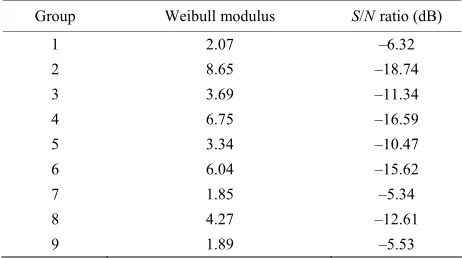
ratio calculated by using Equation (6). Table 4 shows the
[image:4.595.58.286.246.361.2]Weibull modulus and the corresponding S/N ratio calcu-lated by using Equation (6).
[image:4.595.335.537.358.396.2]Figure 1. Schematic of cutting machine.
Table 3. Experimental results for the mean value of the wear and the S/N ratio.
Group Mean value of wear (μm) S/N ratio (dB)
1 49.29 –33.93 2 40.03 –32.24 3 39.58 –32.04 4 63.05 36.05 5 59.01 –35.46 6 55.21 –34.93 7 39.78 –32.06 8 64.39 –36.22 9 48.17 –33.79
Table 4. Experimental results for the Weibull modulus and the S/N ratio.
Group Weibull modulus S/Nratio (dB)
1 2.07 –6.32 2 8.65 –18.74 3 3.69 –11.34 4 6.75 –16.59 5 3.34 –10.47 6 6.04 –15.62 7 1.85 –5.34 8 4.27 –12.61 9 1.89 –5.53
5. Multiple Performance Characteristics
5.1. Grey Relational Analysis
In the Grey relational analysis, a data preprocessing is first performed in order to normalize the raw data, and a linear normalization of the experimental results for the mean value of the wear and the Weibull modulus is per-formed in the range between zero and one, which is also called the Grey relational generating [13,18].
For the blade wear and weibull modulus, which are “the smaller the better”, the normalized S/N ratio zij for
the ith performance characteristic in the jth can be
ex-pressed as
max max min
ij ij ij
ij j ij j
y y z
y y
(7)
yijfor the ith experimental results in the jth experiment.
Next, the Grey relational coefficient is calculated to express the relationship between the ideal (best) and the actual normalized S/N ratio. The Grey relational coeffi-cient αij for the ith performance characteristic in the jth
experiment can be expressed as
0 0
0 0
min min max max
max max
ij ij
ij ij
i i
i j i j
ij
i i j i
z z z z
z z z z
(8)
where is the ideal normalized S/N ratio for the ith
performance characteristics and β distinguishing coeffi-cient which is setting as 0.5 in this article.
0 i z
Then, the Grey relational grade is computed by aver-aging the Grey relational coefficient corresponding to each performance characteristic. The overall evaluation of the multiple performance characteristics is based on the Grey relational grade, that is
1 1 k
ij j
i k
(9) In it:γj is the Grey relational grade for the jth experiment; k is the number of performance characteristics.
Table 5 shows the dada calculated by using Equation
(7), the normalized results for the mean value of the blade wear and the Weibull modulus. Basically, the lar-ger normalized results correspond to the better perform-ance and the best normalized results should be equal to one. The grey relational coefficient results for the ex-perimental layout are shown in Table 6.
Using the experimental combinations of Table 2, Ta-ble 7 shows the Grey relational grade for each
[image:4.595.56.287.419.552.2] [image:4.595.56.287.593.722.2]because it has the highest Grey relational grade shown in
Table 7. Since the experimental design is orthogonal, it
is then possible to separate out the effect of each cutting parameter in different levels.
Figure 2 shows the Grey relational grade graph, where
the dashed line in this figure is the value of the total mean of the Grey relational grade. Basically, the larger the Grey relational grade is, the better the multiple per-formance characteristics are. A3B1C2 is the optimal level of cutting parameters with the multiple performance characteristics.
Table 5. Data preprocessing of experimental result for each performance characteristic.
Group Mean value of wear (μm) Weibull modulus
1 0.4504 0.0729 2 0.0466 1.0000 3 0.0000 0.4476 4 0.9583 0.8392 5 0.8192 0.3830 6 0.6921 0.7671 7 0.0032 0.0000 8 1.0000 0.5423 9 0.4183 0.0139
Table 6. Grey relational coefficient of each performance characteristic.
Group Mean value of wear (μm) Weibull modulus
1 0.5261 0.8728 2 0.9147 0.3333 3 1.0000 0.5276 4 0.3429 0.3734 5 0.3790 0.5662 6 0.4194 0.3946 7 0.9936 1.0000 8 0.3333 0.4797 9 0.5445 0.9730
Table 7. Grey relational grade for each experiment.
Group Grey relational grade Order
1 0.6994 4
2 0.6240 5
3 0.7638 2
4 0.3581 9
5 0.4726 6
6 0.4070 7
7 0.9968 1
8 0.4065 8
9 0.7588 3
Figure 2. Grey relational grade graph.
5.2. Analysis of Variance
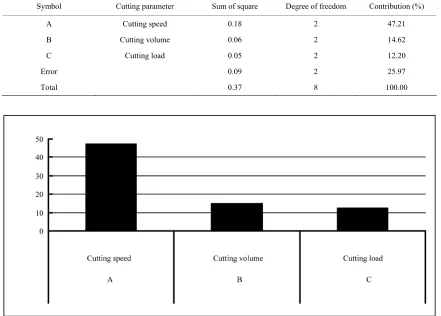
The ANOVA scheme was used to study the significance of the parameters affecting the quality characteristics of the interest. The scheme subdivides the total variation in the data into useful and meaningful components of varia-tion. The total variation contribution is shown in Table 8.
The ANOVA results in Table 8 clearly identify that the cutting speed and the volume severely affected the blade wear by 47.21% and 14.62%, respectively, while the load only affected the blade wear by 12.20%.
5.3. Confirmation Tests
A confirmation experiment is the final step in the design of experiment process. Once the optimum level of the design parameters is set, the final step can predict and verify the quality characteristic using the optimum level
opt of the design parameters, which can also be
esti-mated by using the equation
0
1
opt i
j
(10) In which: is the mean of the S/N ratio;
j is the S/N ratio at the optimum level;
o is the number of main design parameters that affects the optimum level of the cutting parameters.
From Equation (10), the estimated optimum design parameters can be obtained by using the optimum cutting parameters.
A pareto chart generated based on the contribution ra-tio is presented in Figure 3. This chart shows the
impor-tance of the significant parameters. Table 9 shows a
comparison among the initial, predicted, and confirma-tion experimental values of the wear, respectively, using the optimum cutting parameters. Table 9 shows the
re-sults of the confirmation experiment for the mean value of the wear. The results of the confirmation experiment of the predicted optimal conditions A3B1C2, which was better than the initial trial. As shown in Table 9, the
Table 8. Results of analysis of variance for multiple performance characteristic.
Symbol Cutting parameter Sum of square Degree of freedom Contribution (%)
A Cutting speed 0.18 2 47.21
B Cutting volume 0.06 2 14.62
C Cutting load 0.05 2 12.20
Error 0.09 2 25.97
Total 0.37 8 100.00
[image:6.595.83.512.475.597.2]Figure 3. Pareto chart.
Table 9. Results of the confirmation experiment.
Cutting parameter Initial Predicted Confirmation experiment
Level A2B2C2 A3B1C2 A3B1C2
Wear (μm) 64.73 - 39.43
Weibull modulus 1.90 - 1.85
Grey relational grade 0.4498 0.9332 0.9968
Improvement of grey relational grade - - 0.5470
Improvement in wear (%) - - 64.16
Weibull modulus is decreased from 1.9 to 1.85. In sum-mary, the most optimal cutting parameter should be A3B1C2, because the improvement is the greatest by using this parameter, and it is obvious that the optimum level of the cutting parameters in the cutting process is greatly improved.
Conducting a verification experiment is a crucial and the last step of the robust design procedure. Its aim is to verify the optimum conditions identified by the matrix
tests and it estimates how close the predictions are to actual conditions. Hence, a confirmation test was con-ducted with the optimum parameters, and came out in good result.
6. Conclusions
1) The multiple parameters for multiple performance characteristics are found to be the higest speed, the smaller cutting volume and the medium load.
2) To study further within the experimental range used, we found that the most significant cutting parameter for multiple performance characteristics are the cutting speed, which accounts for 47.21% of the total effect, followed by the cutting volume (14.62%), and the cutting load, which accounts for only 12.20% of the total effect.
3) In summary, the most optimal cutting parameter is A3B1C2.
4) In the cutting glass fiber, using reliability analysis with Grey-based Taguchi methods is a good way to im-prove the multiple performance characteristics.
REFERENCES
[1] S. O. An, E. S. Lee and S. L. Noh, “A Study on the Cut-ting Characteristics of Glass Fiber Reinforced Plastics with Respect to Tool Materials and Geometries,” Journal of Materials Processing Technology, Vol. 68, No. 1, 1997, pp. 60-67. doi:10.1016/S0924-0136(96)02534-4
[2] K. H. Lau, D. Mei, C. F. Yeung and H. C. Man, “Wear Characteristics and Mechanisms of a Thin Edge Cutting Blade, “Journal of Materials Processing Technology, Vol. 102, No. 1-3, 2000, pp. 203-207.
doi:10.1016/S0924-0136(99)00410-0
[3] S. L. Casto, E. L. Valvo, E. Lucchini, S. Maschio and V. F. Ruisi, “Wear Rates and Wear Mechanisms of Alu-mina-Based Tools Cutting Steel at a Low Cutting Speed,”
Wear, Vol. 208, No. 1-2, 1997, pp. 67-72. doi:10.1016/S0043-1648(96)07376-0
[4] C. L. Yang, S. H. Sheu and K.T. Yu, “The Reliability Analysis of a Thin-Edge Blade Wear in the Glass Fiber Cutting Process,” Journal of Materials Processing Tech-nology, Vol. 209, No. 4, 2009, pp. 1789-1795.
doi:10.1016/j.jmatprotec.2008.04.028
[5] W. S. Lin, “The Reliability Analysis of Cutting Tools in the HSM Processes,” Archives of Materials Science and Engineering, Vol. 30, No. 2, 2008, pp. 97-100.
[6] Z. Klim, E. Ennajimi, M. Balazinski and C. Fortin, “Cut-ting Tool Reliability Analysis for Variable Feed Milling of 17-4PH Stainless Steel,” Wear, Vol. 195, No. 1-2, 1996, pp. 206-213. doi:10.1016/0043-1648(95)06863-5 [7] P. J. Ross, “Taguchi Techniques for Quality
Engineer-ing,” McGraw-Hill Book Company Press, New York, 1996.
[8] J. Kang and M. Hadfield, “Parameter Optimization by Taguchi Methods for Finishing Advanced Ceramic Balls Using a Novel Eccentric Lapping Machine,” Proceedings of the Institution of Mechanical Engineers, Part B: Jour-nal of Engineering Manufacture, Vol. 215, No. 1, 2001, pp. 69-78. doi:10.1243/0954405011515145
[9] T. R. Lin, “The Use of Reliability in the Taguchi Method for the Optimization of the Polishing Ceramic Gauge Block,” The International Journal of Advanced
Manu-facturing Technology, Vol. 22, No. 3-4, 2003, pp.
237-242. doi:10.1007/s00170-002-1465-1
[10] J. T. Huang and Y. S. Liao, “Optimization of Machining Parameters of Wire-EDM Based on Grey Relational and Statistical Analyses,” International Journal of Production Research, Vol. 41, No. 8, 2003, pp. 1707-1720.
doi:10.1080/1352816031000074973
[11] S. H. Chang, J. R. Hwang and J. L. Doong, “Optimization of the Injection Molding Process of Short Glass Fiber Reinforced Polycarbonate Composites Using Grey Rela-tional Analysis,” Journal of Materials Processing Tech-nology, Vol. 97, No. 1-3, 2000, pp. 186-193.
doi:10.1016/S0924-0136(99)00375-1
[12] J. L. Lin and C. L. Lin, “The Use of the Orthogonal Array with Grey Relational Analysis to Optimize the Electrical Discharge Machining Process with Multiple Performance Characteristics,” International Journal of Machine Tools and Manufacture, Vol. 42, No. 2, 2002, pp. 237-244. doi:10.1016/S0890-6955(01)00107-9
[13] J. L. Deng, “Introduction to Grey System Theory,” Jour-nal of Grey System, Vol. 1, No. 1, 1989, pp.1-24. [14] C. L. Lin, “Use of the Taguchi Method and Grey
Rela-tional Analysis to Optimize Turning Operations with Multiple Performance Characteristics,” Materials and Manufacturing Processes, Vol. 19, No. 2, 2004, pp. 209- 220. doi:10.1081/AMP-120029852
[15] T. R. Lin, H. C. Chiu and M. F. Huang, “Optimizing Re-moval Rate and Reliability of Polishing of Ceramic Blocks Using a Combination of Taguchi and Grey Method,” Institute of Materials Minerals an Mining, Au-gust 2004.
[16] J. E. Shigley, C. R. Mischke and R. G. Budynas, “Me-chanical Engineering Design,” 7th Edition, McGraw-Hill Press, New York, 2003.
[17] M. C. Shaw, “Metal Cutting Principles,” Oxford Science Press, New York, 2004.