doi:10.4236/wsn.2010.27061 Published Online July 2010 (http://www.SciRP.org/journal/wsn)
Modelling and Analysis of TCP Performance in Wireless
Multihop Networks
Hannan Xiao1, Ying Zhang2, James Malcolm1, Bruce Christianson1, Kee Chaing Chua3 1School of Computer Science, University of Hertfordshire, Hatfield, UK
2Datalink Electronics Group, Loughborough, UK
3Department of Electrical and Computer Engineering, National University of Singapore, Buona Vista, Singapore
E-mail: [email protected]
Received February 23, 2010; revised March 18, 2010; accepted April 21,2010
Abstract
Researchers have used extensive simulation and experimental studies to understand TCP performance in wireless multihop networks. In contrast, the objective of this paper is to theoretically analyze TCP perform-ance in this environment. By examining the case of running one TCP session over a string topology, a sys-tem model for analyzing TCP performance in multihop wireless networks is proposed, which considers packet buffering, contention of nodes for access to the wireless channel, and spatial reuse of the wireless channel. Markov chain modelling is applied to analyze this system model. Analytical results show that when the number of hops that the TCP session crosses is fixed, the TCP throughput is independent of the TCP congestion window size. When the number of hops increases from one, the TCP throughput decreases first, and then stabilizes when the number of hops becomes large. The analysis is validated by comparing the nu-merical and simulation results.
Keywords: Wireless Multihop Networks, TCP Modelling, TCP, Ad Hoc Networks
1. Introduction
An adhoc network has no fixed infrastructure: data tran- smission depends on the temporary location of nodes and the transit distribution of traffic in the fly. Originally de-signed for the wired Internet, TCP exhibits anomalous performance features in adhoc wireless networks, such as mobility induced retransmission [1], capture effect and unfairness [2] over the IEEE 802.11 MAC layer protocol, and RED-like packet dropping behaviour from link layer contention [3]. TCP performance in multihop adhoc wir- eless networks has been an active research topic. Exten-sive simulations have been conducted to obtain a better understanding of TCP behaviour in adhoc wireless net-works and to find ways of enhancing TCP performance in that environment. There is not much effort, however, contributing to theoretical analysis of TCP performance in adhoc wireless networks.
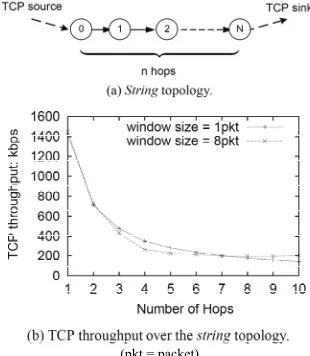
This research work was motivated by the interesting observations of TCP in adhoc wireless networks (in simulations) reported in [1,2,4]: when a TCP connection runs over a static string topology (Figure 1), the TCP throughput measured decreases rapidly when the number
of hops increases from one, and then stabilizes when the number of hops becomes large. Gerla gave an expression in [2] and predicted that the throughput would drop faster than exponentially with hop length, without giving fur-ther theoretical analysis.
[image:1.595.345.500.524.702.2](pkt = packet)
In this paper, a system model for analyzing TCP per-formance in adhoc wireless networks is proposed after examining the case of running one TCP session over a string topology. The system model considers the features of wireless multihop network such as contention of nodes for access to the wireless channel, packet buffering intermediate nodes, and spatial reuse of the wireless channel. A Markov chain modelling is applied to analyze this system model starting from a single hop case to mul-tiple hop cases. Analytical results show that when the number of hops that the TCP session crosses is fixed, the TCP throughput is independent of the TCP congestion window size. When the number of hops increases from one, the TCP throughput decreases first, and then stabi-lizes when the number of hops becomes large. The analysis is validated by comparing the numerical and simulation results.
The rest of the paper is organized as follows. Section 2 discusses related work in two areas, i.e., TCP perform-ance in multihop wireless networks and system models for TCP analysis in different networks. Section 3 pro-poses a system model for analyzing TCP performance in multihop wireless networks, following which Section 4 applies a Markov chain modelling of the system model. Section 5 presents the theoretical analysis of the TCP throughput over the string topology from specific cases to the general case and Section 6 evaluates the analysis by comparing the simulation and numerical results. Fi-nally Section 7 concludes the paper.
2. Related Work
2.1. TCP Performance in Wireless Multihop Networks
TCP was initially designed for wired networks to provide reliable data transmission by retransmitting lost packets due to network congestion that is detected at the sender by time-out or duplicated acknowledgments. Packet loss triggers TCP congestion control which reduces the cong- estion window size, effectively the sending rate, as a reaction to network congestion. TCP, however, has per-formed poorly in wireless multihop networks where packet loss may happen from various reasons other than network congestion, such as error-prone wireless link, link layer contention and routing failure or breakage. Many approaches have been proposed to improve TCP performance in the environment of wireless multihop networks from different aspects. Based on the nature of the approaches, they may be summarized into three groups as in [5]:
TCP with feedback [1,6-11] where feedbacks from networks are sent back to the sender to distinguish packet losses due to congestion from link error, link contention or routing breakage or failure.
TCP without feedback [12,13] where TCP conges-tion control strategy is modified according to the scenarios in multihop wireless networks.
TCP with lower layer enhancement [14-18]. This approach is more popular recently as more work have been done to understand the cross-layer in-teraction, especially lower layer impact on TCP performance in wireless multihop networks. The above work shares one similarity i.e., they all ob-serve TCP performance in multihop wireless networks by simulations and then propose improvements. Very few works, however, have been devoted on theoretical analysis of TCP performance in multihop wireless net-works. We proposed a system model for TCP analysis over one-hop string topology as early as in 2001 [19] and then extended the modelling to multihop cases in [20]. So far our analysis only applies when there is no packet loss in the multihop wireless TCP packet transmissions. Multiple lossy links are modelled in [21] which also consider different proportions between the interference range and transmission range in the spatial reuse prop-erty of the wireless channel.
2.2. System Models for TCP Analysis
There are various approaches to modelling TCP in the literature. Some papers have tried to capture the essential TCP dynamics through closed-form expressions. Lak- shman and Madhow [22] and Kumar [23] use Markovian analysis to develop a closed-form expression for the thr- oughput of TCP connections by observing the cyclical evolution of the TCP transmission window. The latter work introduces some extensions for several versions of TCP, incorporating such features as coarse timers, fast retransmit and fast recovery. Mathis et al. [24] focus on the stochastic behavior of the congestion avoidance mechanism, deriving an expression for the throughput that is then applied to study the behavior of several
495
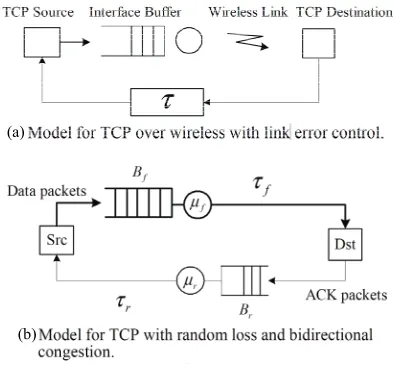
There are two system models in the literature most similar to our model. The first one is used by Chaskar, Lakshman and Madhow in [29] to analyze TCP per-formance over a wireless channel with link level error control. There, ACK packets are assumed to arrive in the source node after a constant delay and are never lost. Thus the path of ACKs is omitted (Figure 2(a)). The second one is proposed by Lakshman, Madhow and Suter in the same research group to analyze TCP per-formance with random loss and bidirectional congestion [30]. There, for the first time the path followed by ACKs is explicitly modeled (Figure 2(b)). These models, how-ever, cannot be used in our case of multihop wireless networks where the TCP packets and ACKs are con-tented to use the same wireless channel. Instead of start-ing with analyzstart-ing the TCP protocol with assumptions as in [22-26], our approach is to study the process of how TCP works between a source and destination pair by examining the simulation trace file. The resulting model considers the channel access probability of both the source and the destination (Figure 3).
3. System Model
Consider the simple adhoc wireless network scenario shown in Figure 1 nodes form a string with length N. Each node has the same transmission radius, the same carrier sense radius, and the same interference radius. One TCP connection is run from node 0 to node N crossing all the intermediate nodes in the string.
We model the communication process of the TCP connection as in Figure 3 after analyzing the trace files from simulations carefully. The source and destination nodes both have a First In First Out (FIFO) forward buffer of size. The source has infinite data to send, so that TCP packets are always of the maximum packet size. For each packet that is received by the destination, a cumula-
(a)
[image:3.595.319.526.69.193.2](b)
[image:3.595.73.270.523.708.2]Figure 2. Reference system models for TCP analysis.
Figure 3. System model of TCP in wireless ad-hoc networks.
tive acknowledgment (ACK) is generated which can be modeled as containing the next expected segment num-ber. TCP packet service rate is Ut, the typical number of TCP packets the system serves per unit time when it is constantly busy. ACK packet service rate is Ua, the typical number of ACK packets the system serves per unit time when it is constantly busy. The “unit time” in-cludes TCP/ACK packet transmission delay, propagation delays, processing delays at the nodes from layer to layer and the average MAC layer contention delays. The TCP/ACK packet service rates are affected by the spatial reuse of wireless channel in the string topology. As all nodes compete to use the channel, the chance for any node to send packet is determined by the underlying MAC protocol and traffic distribution. Generally, we denote the average probability of the source to send a TCP packet as q, and the average probability of the destination to send an ACK packet as p. The reason to use the average probability of the node accessing the channel is because the performance metric of interest is the average TCP throughput.
The system model captures the unique communication features of TCP in adhoc wireless networks including link layer channel contention and channel spatial reuse. It is similar to but different from system models used in analyzing TCP performance in other kind of networks [29,30].
4. Markov Chain Modelling
We use Markov chain modelling to analyze the proposed system model. Firstly, a discrete Markov chain is formed for the case when the source and the destination are sin-gle-hop away. The Markov chain is then extended to the general case when the source and the destination are multiple hops away. The assumptions made are as fol-lows:
The channel also appears collision-free to the up-per layer because the MAC layer protocol is colli-sion avoided, such as MACAW [31].
The maximum TCP congestion window size is less than the buffer size at each node.
There is no packet dropping due to buffer overflow, and no packet loss due to link layer contention. This assumption is supported by simulation results demonstrating that packet loss due to buffer over-
flow is rare and packet loss due to link contention is very low for single TCP over a string topology. The distribution of inter-service time of TCP pac-
kets and ACK packets are exponentially distrib-uted which include packet retransmissions. This assumption is based on the fact that exponential backoff during contention is commonly used in MAC protocols, e.g., IEEE 802.11.
4.1. Single-Hop Case
There are only TCP packets at the source and only ACK packets at the destination. Either the source or the desti-nation sending packets will change the number of the packets queued in their buffers. Ignoring the slow start phase which is a small part of the data transmission, the sum of the TCP packets at the source and the ACK pack-ets at the destination equals to the TCP congestion win-dow size in packets. As it is assumed that no packet loss exists due to channel error, buffer overflow, or link con-tention, the TCP connection thus increases its congestion window size to the maximum value and stabilizes there.
Discrete-time Markov chain is applied to analyze TCP performance here. Let us focus attention at times 0, ,
2 …, k ,… as in [32] (pages 162-173), where is a small positive number. Let Fdenote as the number of TCP packets in the source node buffer at time k . F
thus is a Markov chain on the state-space {m:W
0
m }, where W the maximum TCP congestion win-dow size. The transition diagram of the Markov chain is shown in Figure 4.
When there are W TCP packets in the source node, i.e., the first state in Figure 4, the destination node does not have ACK packets to send. Therefore, the source node catches the wireless channel for sure. The resulting
transition probability from the state of FW to F
1
W is Ut, where Ut is the service rate of TCP packets and the inter-service time is assumed to be ex-ponentially distributed. Similarly, the transition probabil-ity from the state of F0 to F1 is Ua Where
a
U is the service rate of ACK packets and the inter- service time is assumed to be exponentially distributed.
When there are F, where W 1 F 1 TCP packets in the source, there are WF ACK packets in the des-tination node. The source node and desdes-tination node compete with each other to use the channel. The source node has average probability of q to access the channel (Figure 3), the transition probability from the state of
i W
F to FWi1 is thus qUt , where
1
1iW . Similarly, the transition probability from the state of FWi to FWi1is pUa, where
p is the average probability of the destination to access the channel.
4.2. Multiple-Hop Case
When the source and destination are multiple hops away, an accurate Markov model at times k would be on the state space {(F0,A0),(F1,A1),...,(FN,AN)}, where (Fi,Ai)
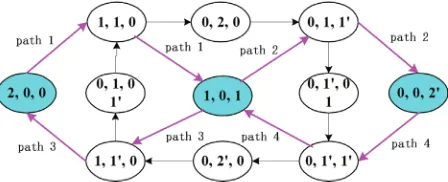
are the numbers of TCP and ACK packets at node i. This multi-dimensional Markov chain modelling consid-ers the number of TCP packets and ACK packets in the source, the destination and the intermediate nodes along the string topology. Unfortunately, such a modelling is difficult to tackle. For example, even when the string topology is 2-hops long, and the TCP maximum conges-tion window size is 2 packets, the Markov chain already has 11 states as shown in Figure 5, and the number of states increases quickly with the increase of the TCP maximum congestion window size and the length of the string. This happens due to the sharing of wireless chan-nel between nodes. When two nodes within interference range both have packets to send, there are two possible next states. The more states the Markov chain has, the more difficult it is to solve. A heuristic alternative is ap-plied as follows.
The more states the Markov chain has, the more paths are available in the transition diagram for a TCP packet
1 0 0 0
1 0 0
0 1 0 0
0 0 0 1
0 0 0 0 1
t t
a a t t
a a t t
a a t t
a a
U U
p U p U q U q U
p U p U q U q U
Q
p U p U q U q U
U U
497
[image:5.595.169.429.78.146.2]1 1 1 1 1
Figure 4.Transition diagram when the number of hop is 1 and TCP maximum congestion window size is W.
Figure 5. Transition diagram when the number of hop is 2 and the maximum TCP congestion window size is 2 packets. The number of TCP packets at nodes are shown as 1 or 2; the number of ACK packets are shown as 1’ or 2’. (1, 1’, 0) denotes that there is 1 TCP packet at the source node, 1 ACK packet at the middle node, and none packet at the destination node.
to be transmitted from the source to the destination, or for an ACK packet from the destination to the source. Whatever states the packet goes through in between, it finally passes all the nodes of the string. Let us denote the path for a TCP packet to be transmitted from the source to the destination as a forward path; and the path for an ACK packet to be transmitted from the destination to the source as a backward path. A transmission round of TCP is composed of one forward path and one back-ward path.
The average utilization of the string topology should be the average of all the transmission rounds. Intuitively, for each forward path, a corresponding complementary backward path exists which makes this round of trans-mission to be exactly the average value. With this un-derstanding, the analysis can be sought out based on a specific transmission round with a pair of complemen-tary forward and backward paths only. All the TCP packets go through the specific forward path, and all the ACK packets go through the specific backward path in such analysis.
A simple transmission round is chosen as follows: for the forward path, when the source node gets chance to start sending a TCP packet, the packet passes all the in-termediate nodes continuously until it reaches the desti-nation; the forward path can be path 1 or path 2 in Fig-ure 5. Likewise, for the backward path, when the desti-nation node gets chance to start sending an ACK packet, the ACK packet passes all the intermediate nodes con-tinuously until it reaches the source; the backward path can be path 3 or path 4 in Figure 5. These paths are
complementary.
In the above specific transmission round, once one pa- cket in the source node is sent out, the number of packets in the buffer of source node decreases by 1. After the packet goes continuously to the destination, the destina-tion absorbs the TCP packet and generates an ACK packet. The reverse process is the same. Consequently, the changing of number of packets in the source and the destination is the same as in the single-hop scenario. The Markov modelling of this complete transmission round is thus exactly the same as in Figure 4 when we only con-sider the marked paths and states in Figure 5.
In the following subsections, we are going to analyze the discrete Markov chain in Figure 4 for both the sing- le-hop and multiple-hop cases.
5. Analysis
5.1. TCP Throughput
The transition matrix Qof the Markov chain in Figure 4 is listed in (1). Let π(π πw, w 1,... )π0 denote the stationary probability distribution of the Markov chain, we have Qat steady state. From this it is derived that
2
w 1 w
w 2 w
w w
0 w
1
1
1
, 1 1
i
i
w
q
q p
q
q p
q
i W
q p
p q
q p
(2)
where is the ratio of Ut to Ua, i.e., a t
U U
.
From
W0 1i i , it is further derived that
w
1 1
1 1
1 W ( )i ( )W
i
q p q
q p q p
[image:5.595.61.285.179.270.2]From the transition diagram, we denote the TCP throughput of state i by i and the average through-put of TCP packets by . Thus
Wi 0ii
, where
,
w Ut i qUt
when W1i1, and 00. The- refore,
1 ( )
1 w
t w q p U
q p
(4)
The source and destination nodes are located at the two ends of the string topology with N1 intervening nodes. The positions of the source and destination are the same, and they also have the same number of packets to send since we assume that one ACK is generated for each TCP packet. Thus, the source and destination nodes have the same average probability to access the channel successfully, i.e., pq. (3) and (4) can then be simpli-fied as:
1 1
1 1
1 ( 1) (1 )
w
W W
q
(5)
) 1 ( ) 1 1 ( ) 1 (
1
1
1
W W
W
t
q U
(6)
is the ratio of TCP packet service rate to the ACK packet service rate. Since TCP packets and ACK packets are transmitted at the same channel, and they travel the same number of hops between the source and the desti-nation, is always approximately equal to the ratio of the TCP packet service rate to the ACK packet service rate in the case when there is only one hop between the source and the destination. This is further approximately equal to the ratio of the ACK packet size to the TCP packet size. The TCP packet (say, 1460 bytes) is nor-mally much larger than the ACK packet (say 40 bytes),
is thus much smaller than 1 (say, around 40/1460 = 0.027), i.e., 1. The maximum TCP congestion window size W pkts is an integer and when it is big enough, it is expected that
1 1 1
1
1
W
W
W (7) Thus from (6) and (7), the average TCP throughput is derived as:
) 1 1 ( 1
1
q
Ut (8)
In the above analysis, it is shown clearly that the ratio of ACK packet size to TCP packet size being much less than 1 is required to carry out the approximation.
5.2. TCP Service Rate
We have defined Ut as the service rate of TCP packets seen q as the average probability for the source node to access the wireless channel. Their values, however, change with the length of the string, i.e., the number of hops that the TCP session crosses from the source to the destination (Figure 1). This is because of the effect of global channel spatial reuse and local channel contention in adhoc wireless networks. By definition, service rate is the “typical number of customers the system serves per unit time when it is constantly busy” [32] (page 152). When the number of hops is N, let the average number of TCP packets being transmitted (served) in the system be IN and the service time to transmit a packet be TN, the definition of service rate gives:
N N tN
T I
U (9)
Let qN be the average probability that the source node accesses the wireless channel when the number of hops is N. As N changes, IN , TN , and qN also change. In the following, we evaluate the values of IN,
N
T , and qNas N changes.
5.2.1. N is 1, 2, 3 or 4 When N is 1, I11 pkt,
2 1
1
q . Let T1T , where
T is the service time to transmit a packet over one hop when the source and destination nodes are one hop away. When N is 2, each TCP packet travels two wireless links to reach the destination. Therefore, approximately
T
T22 . During the transmission from node 0 to node 1,
and then from node 1 to node 2, only 1 TCP packet can be transmitted in the system without collision. Therefore
pkt
I2 1 . In the string topology, the source node only
forwards TCP packet, the destination node only forwards ACK packets but the middle node forwards both TCP and ACK packets. Since one ACK packet is assumed for each TCP packet, the middle node sends out packets twice as much as the source and destination node. As a result, the average probability of the middle node to ac-cess the channel sucac-cessfully is twice as much as that of the source and destination node. In addition, the summa-tion of the average probability of all nodes to access the channel is 1. Derivation from these relationships gives
4 1 2
q . When Nis 3, by similar analysis we have
3 3 3
1 1 pkt, 3 ,
6 I T T q .
499
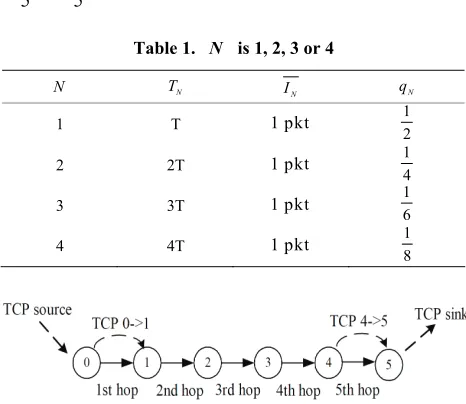
send packets concurrently without collision. However, although node 3 is outside of node 1’s transmission range, it is within the carrier sensing range and interference range of node 1. Node 3 is thus a potential hidden termi-nal of the transmission pair node 0 to node 3. Conse-quently, only 1 TCP packet can be transmitted in the system without collision. This analysis is consistent with that in [3]. Further derivation gives I4 1 pkt, T44T,
8 1 4 q .
[image:7.595.255.542.207.711.2] [image:7.595.307.540.223.509.2]We summarize the value for IN , qN as shown in Table 1.
5.2.2. N is 5, 6, 7, or 8
When N is 5, each TCP packet crosses five wireless hops to reach the destination. Among the five hops from node 0 to node 5, the 1st hop (i.e., from node 0 to node 1) and the 5th hop (i.e., from node 4 to node 5) can be util-ized at the same time as shown in Figure 6. But when the 2nd , 3rd or 4th hop isused, only that hop can be used without collision.
Assuming that the system is utilized fully, the number of packets in the system is:
st th
5 nd rd th
2 pkts when the 1 and 5 hops are used
1 pkt when the 2 , 3 or 4 hops
are used I
[image:7.595.55.288.493.695.2]
Since each hop has equal opportunity to be utilized, the average number of packets in the system is: I3 2
2 1 3 pkts
5 5
[image:7.595.308.546.582.696.2] .
Table 1. N is 1, 2, 3 or 4
N TN IN qN
1 T 1 pkt 21
2 2T 1 pkt 41
3 3T 1 pkt 16
4 4T 1 pkt 81
Figure 6. Two TCP packets are transmitted together when
N = 5.
Although there are six nodes, however, node 0 com-petes to use the channel locally with nodes 1, 2, 3 and 4 only. The probability for node 0 to access the channel can therefore be taken as the same as when there are 4 hops. Thus 5 5
1, 5
8
q T T.
When N is 6, each TCP packet crosses six wireless links to reach the destinatiopn. Figure 7 shows the sce-narios when two of the six wireless links are utilized at the same time. The number of packets in the system is:
st nd th th
6
rd th 2 pkts when the (1 or 2 ) and
(5 or 6 ) hops are used 1 pkt when the 3 or 4 hop is used I
The average number of packets in the system is: I6
4 2
2 1 pkts
6 6
. It is also easy to get ,
8 1 6
q T6 6T. Similarly, when N is 7, we get
st nd rd th th th
7
th
2 pkts when the (1 , 2 or 3 ) and (5 , 6 or 7 ) hops are used 1 pkt when the 4 hop is used I
7 7 7
6 1 1
2 1 pkts, , 7
7 7 8
I q T T
When N is 8, I8 I82 pkts, when the (1st, 2nd, 3rd or 4th) and (5th, 6th, 7th or 8th) hops are occupied, and
T T
q , 8
8 1
8
8 .
5.2.3. Generalization of TCP Service Rate
Let N 4M j, where M 1, j
1,2,3,4
, the generalization of the above analysis is as follows.When N is 4M , we have I4M I4M M pkts. When N is 4M 1,
Figure 7. Two TCP packets are transmitted together when
st th th
nd rd th
4 1 th th th
th th
1 pkts when the 1 and 5 and (4 1) hops are occupied
pkt when the (2 , 3 or 4 ) and (6 7 or 8 ) and
(4M-2 , (4 1) or M M M M I , M th
(4M) ) hops are occupied
4 1
1 (4 1) ( 1)
( 1) pkts
4 1 4 1
M
M M M
I M M
M M
Similar derivation gives: When N is 4M 2,
st nd
th th
th th
4 2 rd th
th th
1 pkts when the (1 or 2 ) and (5 or 6 )and and (4 3) or (4 2) hops are occupied
pkt when the ( 3 or 4 ) and (7 or 8 )
M M M M I M
th th
and and (4 -1) or (4 ) hops are occupied
M M 4 2 2( 1) ( 1) 4 2
(4 2) 2( 1)
pkts 4 2 M M I M M M M M M .
When N is 4M 3,
st nd rd th th th
th th
4 3 th
th
1 pkts when the (1 , 2 or 3 ) and (5 , 6 or 7 )and and (4 3) or (4 2) or (4 1) hops are occupied
pkts when the 4 M M M M I M M th th 8 and and (4 ) hops are occupied
and M 4 3 3( 1) ( 1) 4 3
(4 3) 3( 1)
pkts 4 3 M M I M M M M M M .
Finally, it is summarized that:
4
( 1) (4 ) ( 1)
( 1) pkts
4 4
M j
j M M j j M
I M M
M j M j
(10) Where M 1, j
1,2,3,4
.Combining (10) and the analysis when N is 1, 2, 3 or 4 in Table 1, we have the average number of packets in the system as:
j M M j M j
I M j
4 ) 4 ( ) 1
( 2 2
4 (11)
Where M 0, j
1,2,3,4
.The service time to transmit a packet is generalized as T
j M
T4Mj(4 ) . From (9), the TCP service rate is derived as: T j M M j M j Ut M j
1 ) 4 ( ) 4 ( ) 1 ( 2 2 2 ) 4 (
(12)
where M 0, j
1,2,3,4
.The average probability of the source to access the channel is:
4
1
when 0 and 1, 2,3, 4
2 1
when 1 and 1, 2,3, 4
8 M j M j j q M j (13)
5.3. Generalization of TCP Throughput
Substituting (12) and (13) into (8), the TCP throughput becomes:
4 , 3 , 2 , 1 1 1 7 1 1 ) 4 ( ) 4 ( ) 1 ( 4 , 3 , 2 , 1 0 1 ) ) 1 2 ( 1 ( 1 2 2 2 4 j and M when T j M M j M j j and M when T j j j M (14)
When M goes to infinity, N4M j goes to in-finity, we have
4
1 1 1
lim
4 1 7
M j
M T (15)
Equation (14) shows that the TCP throughput is inde-pendent of the maximum TCP congestion window size
W ; instead it is decided by (a) 4M j, the value of the number of hops of the string topology, (b) , the ratio of service rate of TCP packet to ACK packet, and (c) T, the time needed for a TCP packet to be transmitted over a single hop. Furthermore, (15) illustrates that as the number of hops increases and goes to infinity, TCP throughput converges to a constant value.
6. Evaluations
501
simulation results in ns2and numerial results in Matlab. In simulations, N1 nodes forma string (Figure 1) with adjacent nodes 200 mapart. All nodes communicate with identical, half-duplex wireless radios which have a bandwidth of 2 Mbpsand a nominal transmission radius of 250 m. Nodes have carrier sense radius of 550 mand interference radius of 550 m. They are configured with the Dynamic Source Routing (DSR) protocol. One TCP Reno session is introduced from node 0 (TCP source) to node N (TCP destination) to transfer FTP bulk data, crossing N hops. TCP and ACK packets size are of 1460 bytes and 40 bytes respectively. Simulations were run with various numbers of hops and various maximum TCP congestion window sizes. One simulation with the same number of hops and the same maximum TCP con-gestion window size was run for five times, each for 300 secs, and the overall throughput was measured from 50 secsto 250 secs. During the time the throughput is quite stable, but the average of five simulations was used as the simulation result.
To get the numerical results in Matlab, two parameters are needed:
: the ratio of service rate of TCP packet to ACK packet. Here 40 bytes 0.027
1460 bytes
, i.e., the ra-tio of ACK packet size to TCP packet size.
T
1 : the average transmission rate of one packet
over a single hop link, where T is defined as the average transmission time of one packet over one hop link. However,
T 1
cannot be easily assigned a value considering the bandwidth used on the channel contention, MAC control packets exch- ange, etc. Instead, we decide the value of
T 1 with
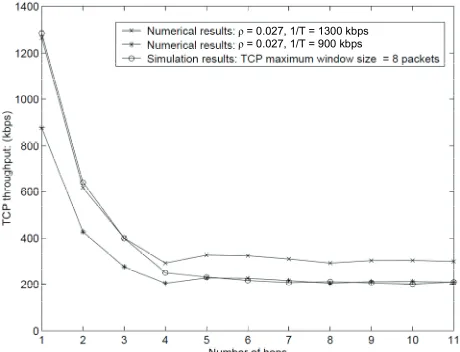
[image:9.595.308.538.503.679.2]the help of simulation results so that the numarical results could best match the simulation results Figure 8 shows the comparison of simulation and numerical results of the TCP throughput as the number of hops changes from 1 to 11. Simulation results are pre-sented when the maximum TCP congestion window size is 8 packets. Numerical results are presented with two values of
T 1
, so there are three curves in Figure 8: the simulation results, the numerical results when 1 1300
T kbps, and the numerical results when 1 900 kbps
T .
It is observed that the numerical results with
T 1
1300 kbps match the simulation results well at N1,
2,3 or 4 hops, and the numerical results with
T 1
900 kbps match the simulation results well at N5. The reason is as follows. When N1, 2,3 or 4 , no link is used simultaneously due to the hidden terminal prob-lem. When N 5, there are links used simultaneously because of channel spatial resue. However, although channel spatial reuse helps improve the overall system utilization, it has higher local contention overhead. This results in a lower payload transmission rate. Therefore,
T 1
is chosen as 900 kbpswhen N5 and 1300 kbps when N 1, 2,3 or 4 respectively. In Figure 8, TCP throughput is shown to decrease rapidly when the num-ber of hops increases from 1, and stabilizes when the number of hops becomes large. This is in line with the observation we described in the introduction and verifies the analysis in (13) and (14).
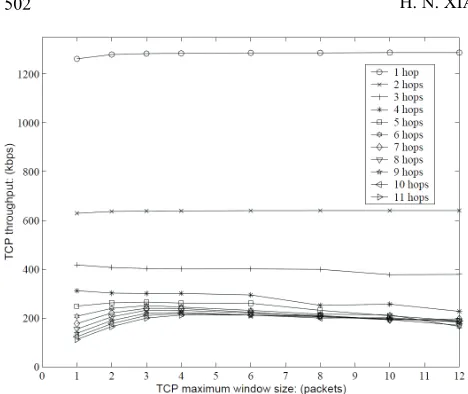
Next, we look at the trend of TCP throughput with varying maximum window size. Simulation results of TCP throughput is shown in Figure 9 with varying num-ber of hops (from 1 to 11 hops) and TCP maximum window size (from 1 to 12 packets). When the number of hops is fixed, TCP throughput is kept constant independ-ent of the maximum window size, i.e., the throughput curve is almost a straight line parallel to the x-axis. This is consistent with (14) where the TCP throughput ()is not a function of TCP maximum window size (W ). This result, however, looks inconsistent with the claim in [3] that “given a specific network topology and flow patterns, there exists a TCP window size W, at which TCP achieves best throughput via improved spatial channel
ρ= 0.027, 1/T = 1300 kbps ρ= 0.027, 1/T = 900 kbps
Figure 9. Simulation result: TCP throughput with varying number of hops and maximum window size, simulations run for 300 seconds.
reuse”. However, a close look at Figures 2(a) and (b) in [3] reveals that TCP throughput at the “optimal” TCP window size is not much higher than those at non-opti- mal TCP window sizes; furthermore, TCP throughput is a constant at most values of TCP window size. This ob-servation is consistent with our analysis here.
We notice a phenomenon in the left lower part of the figure. When the number of hops is greater than 5 and the maximum window size is 1 or 2 packets, TCP thr- oughput is less than the constant value when the maxi-mum window size is greater or equal to 3 packets. This is due to the fact that we assume the system is always busy, i.e., all the available links are fully used at every moment. However when the window size is 1 packet, the whole system goes into a stop-and-wait process and the source will only issue a TCP packet after it receives an ACK from the destination. Therefore the system is not fully occupied. The achieved throughput is thus less than the fully occupied value. The same reason explains the case when the maximum window size is 2 packets but the string topology can support a maximum of 3 packets when the number of hops is 9, 10, or 11.
The above analytical result is interesting as it shows that the setting of TCP congestion window size does not matter that much in wireless multihop networks, which is different from the scenario in wired networks where TCP performance is largely affected by its congestion window size. However, our analysis considers single a TCP con-nection over static chain without interfering background traffic. Further evaluations are necessary.
7. Conclusions
This study takes a step to theoretically analyze TCP per-formance in adhoc wireless networks. The analysis is
based on a string topology containing N hops. A sys-tem model for analyzing TCP performance in adhoc wireless networks is proposed, which considers packet buffering, contention of nodes for access to wireless channel and spatial reuse of wireless channel. Markov chain modelling is applied to analyze the system model. Analytical results are presented to show that when the number of hops that the TCP session crosses is fixed, the TCP throughput is independent of the TCP congestion window size. When the number of hops increases from one, the TCP throughput decreases first, and then stabi-lizes when the number of hops becomes large. The analysis is validated by comparing the numerical results with the simulation results.
8. References
[1] G. Holland and N. H. Vaidya, “Analysis of TCP Per-formance over Mobile Ad Hoc Networks,” Proceedings of IEEE/ACM MobiCom’99, Seattle, August 1999, pp. 219- 230.
[2] M. Gerla, R. Bagrodia, L. Zhang, K. Tang and L. Wang, “TCP over Wireless Multi-Hop Protocols: Simulation and Experiments,” Proceedings of IEEE ICC’99, Vancouver, Vol. 2, June 1999, pp. 1089-1094.
[3] Z. Fu, H. Luo, P. Zerfos, S. Lu, L. Zhang and M. Gerla, “The Impact of Multihop Wireless Channel on TCP Per-Formance,” IEEE Transactions on Mobile Computing, Vol. 4, No. 2, March 2005, pp. 209-221.
[4] H. Xiao, K. G. Seah, A. Lo and K. C. Chua, “On Service Differentiation in Multihop Wireless Networks,” ITC Specialist Seminar on Mobile Systems and Mobility, Lillehammer, March 2000, pp. 1-12.
[5] X. Chen, H. Zhai, J. Wang and Y. Fang, “TCP Perform-ance over Mobile Ad Hoc Networks,” Journal of Elec-trical & Computer Engineering, Vol. 29, No. 1/2, 2004, pp. 129-134.
[6] K. Chandran, S. Raghunathan, S. Venkatesan and R. Prakash, “A Feedback-Based Scheme for Improving TCP Performance in Ad Hoc Wireless Networks,” IEEE Per-sonal Communications, Vol. 8, No. 1, 2001, pp. 34-39. [7] Z. Fu, X. Meng and S. Lu, “A Transport Protocol for
Supporting Multimedia Streaming in Mobile Ad Hoc Networks,” IEEE Journal on Selected Areas in Commu-nications, Vol. 21, No. 10, 2003, pp. 1615-1626.
[8] Z. Fu, P. Zerfos, H. Luo, S. Lu, L. Zhang and M. Gerla, “The Impact of Multihop Wireless Channel on TCP Per-formance,” IEEE INFOCOM’03, San Francisco, Vol. 3, March 2003, pp. 1744-1753.
[9] X. Yu, “Improving TCP Performance over Mobile Ad Hoc Networks by Exploiting Cross-Layer Information Awareness,” Proceedings of IEEE/ACM MobiCom’04, Philadelphia,September 2004, pp. 231-244.
503
pp. 192-205.
[11] X. Li, P. Y. Kong and K. C. Chua, “DTPA: A Reliable Datagram Transport Protocol over Ad Hoc Networks,” IEEE Transactions on Mobile Computing, Vol. 7, No. 10, 2008, pp. 1285-1294.
[12] F. Wang and Y. Zhang, “Improving TCP Performance over Mobile Ad Hoc Networks with Out-Of-Order De-tection and Response,” Proceedings of IEEE/ACM Mo-biHoc’02, Lausanne,June 2002, pp. 217-225.
[13] K. Chen, Y. Xue and K. Nahrstedt, “On Setting TCP’s Congestion Window Limit in Mobile Ad Hoc Networks,” Proceedings of IEEE ICC’03, Anchorage, Vol. 2, May 2003, pp. 1080-1084.
[14] K. Xu, M. Gerla, L. Qi and Y. Shu, “Enhancing TCP Fairness in Ad Hoc Wireless Networks Using Neighbor-hood RED,” Proceedings of IEEE/ACM MobiCom’03, San Diego,September 2003, pp. 16-28.
[15] L. Yang, W. K. G. Seah and Q. Yin, “Improving fairness among TCP flows crossing wireless ad hoc and wired networks,” Proceedings of IEEE/ACM MobiHoc’03, New York, June 2003, pp. 57-63.
[16] V. Anantharaman, S. J. Park, K. Sundaresan and R. Sivakumar, “TCP Performance over Mobile Ad Hoc Networks: A Quantitative Study,” Wireless Communica-tions and Mobile Computing, Vol. 4, No. 2, 2004, pp. 203-222.
[17] K. Nahm, A. Helmy and C.-C. Jay Kuo, “TCP over Mul-tihop 802.11 Networks: Issues and Performance En-hancement,” Proceedings of MobiHoc’05, New York, 2005, pp. 277-287.
[18] F. Klemm, Z. Ye, S. V. Krishnamurthy and S. K. Tripathi, “Improving TCP performance in ad hoc networks using signal strength based link management,” Ad Hoc Net-works, Vol. 3, No. 2, 2005, pp. 175-191.
[19] H. Xiao, K. C. Chua, K. G. Seah and A. Lo, “A Quantita-tive Analysis of TCP Performance over Wireless Multi-hop Networks,” Proceedings of IEEE VTC2001-Fall, At-lantic, Vol. 2, May 2001, pp. 610-614.
[20] H. Xiao, K. C. Chua, J. A.Malcolm and Y. Zhang, “Theo-retical Analysis of TCP Throughput in Ad Hoc Wireless Networks,” IEEE Global Telecommunications Confer-ence, Atlanta,Vol. 5, 2005, pp. 2714-2719.
[21] X. Li, P. Y. Kong and K. C. Chua, “TCP Performance in IEEE 802.11-Based Ad Hoc Networks with Multiple
Wireless Lossy Links,” IEEE Transactions on Mobile Computing, Vol. 6, No. 12, 2007, pp. 1329-1342.
[22] T. V. Lakeshman and U. Madhow, “The Performance of TCP/IP for Networks with High Bandwidth-Delay Prod-ucts and Random Loss,” IEEE/ACM Transactions on Networking, Vol. 3, No. 3, June 1997, pp. 336-350. [23] A. Kumar, “Comparative Performance Analysis of
Ver-sions of TCP in a Local Network with a Lossy Link,” IEEE/ACM Transactions on Networking, Vol. 6, No. 4, August 1998, pp. 485-498.
[24] M. Mathis, J. Semske, J. Mahdavi and T. Ott, “The Mac-roscopic Behavior of the TCP Congestion Avoidance Algorithm,” Computer Communication Review, Vol. 27, No. 3, July 1997, pp. 67-82.
[25] J. Padhye, V. Firoiu, D. Towsley and J. Kurose, “Model-ing TCP Throughput: A Simple Model and its Empirical Validation,” ACM Computer Communication Review, Vol. 28, No. 4, September 1998, pp. 303-314.
[26] C. Casetti and M. Meo, “A New Approach To Model The Stationary Behavior of TCP Connections,” Proceedings of IEEE INFOCOM 2000, Tel-Aviv, Vol. 1, March 2000, pp. 367-375.
[27] V. Paxson and S. Floyd, “Empirically-Derived Analytic Models of Wide-Area TCP Connections,” IEEE/ACM Transactions on Networking, Vol. 2, No. 4, August 1994, pp. 316-336.
[28] V. Paxson and S. Floyd, “Wide-area Traffic: The Failure of Poisson Modeling,” ACM Computer Communication Review, Vol. 24, No. 4, October 1994, pp. 257-268. [29] H. M. Chaskar, T. V. Lakshman and U. Madhow, “TCP
over Wireless with Link Level Error Control: Analysis and Design Methodology,” IEEE/ACM Transactions on Networking, Vol. 7, No. 5, October 1999, pp. 605-615. [30] T. V. Lakshman, U. Madhow and B. Suter, “TCP/IP
Per-formance with Random Loss and Bidirectional Conges-tion,” IEEE/ACM Transactions on Networking, Vol. 8, No. 5, October 2000, pp. 541-555.
[31] V. Bharghavan, A. J. Demers, S. Shenker and L. Zhang, “MACAW: A Media Access Protocol for Wireless LANs,” ACM SIGCOMM, Vol. 24, No. 4, 1994, pp. 212- 225.