ISSN Online: 2162-2191 ISSN Print: 2162-2183
DOI: 10.4236/abc.2019.92004 Apr. 11, 2019 45 Advances in Biological Chemistry
The Hydrogen Energy Potential of Solid Waste:
A Case Study of Misrata City
Moutaz Benali, Tarek Hamad, Yousif Hamad, Ahmad Belkhair
Department of Sustainable and Renewable Energy Engineering, Omar Al-Mukhtar University, El-Beida, Libya
Abstract
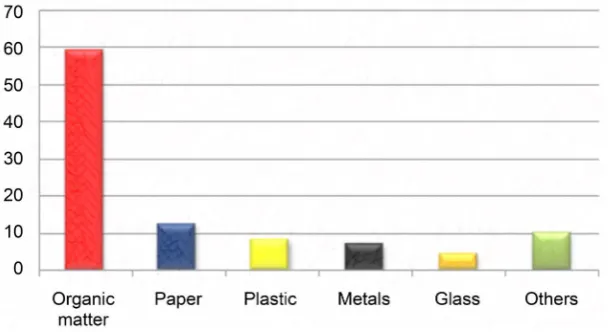
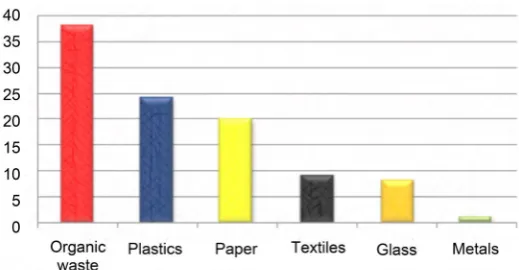
This study presents an overview on solid waste that can be used as a source of bioenergy in Misrata including municipal solid waste (MSW), industrial solid waste (ISW), and healthcare solid waste (HSW) as biomass sources. The management of solid waste and valorization is based on an understanding of MSW’s and HSW’s composition and physicochemical characteristics. Of MSW’s, the results show that organic matter represents 59% of waste, fol-lowed by paper-cardboard 12%, miscellaneous 10%, plastic 8%, metals 7% and glass 4%. While HSW comprised of 72% general healthcare waste (non-risk) and 28% hazardous waste. The average general waste composition was: 38% organic, 24% plastics, and 20% paper. The potential of hydrogen energy pro-duced from biogas in Misrata including MSW, and other organic feedstock such as food and kitchen waste, animal wastes, clover and reeds, wheat resi-dues, barley resiresi-dues, HSW and sewage waste as biomass sources. The total potential hydrogen output is estimated to be around 10,265 tons per year.
Keywords
Hydrogen, Solid Waste, Waste to Energy, Biomass Sources, Bioenergy
1. Introduction
Recent publications have shown that hydrogen derived from renewable energy sources is a practical solution for a substantial reduction of greenhouse gas emissions. Hydrogen can serve as a sustainable energy provider while leaving a zero-carbon footprint at the point of use and more recently, provide a design for the Combined Heat, Hydrogen, and Power (CHHP) system [1] [2]. Those stu-dies were based on utilizing the local organic resources to generate biogas using anaerobic digestion process. Those studies also provided a mass balance calcula-tion to estimate the amount of hydrogen delivered from the organic feedstock
How to cite this paper: Benali, M., Hamad, T., Hamad, Y. and Belkhair, A. (2019) The Hydrogen Energy Potential of Solid Waste: A Case Study of Misrata City. Advances in Biological Chemistry, 9, 45-53.
https://doi.org/10.4236/abc.2019.92004
Received: February 19, 2019 Accepted: April 8, 2019 Published: April 11, 2019
Copyright © 2019 by author(s) and Scientific Research Publishing Inc. This work is licensed under the Creative Commons Attribution International License (CC BY 4.0).
DOI: 10.4236/abc.2019.92004 46 Advances in Biological Chemistry
collection. The other studies investigated the energy potential of feedstock like maize stalks, dairy products and dry bread, discussed the effects of the organic and inorganic phase composition of biomass [3] [4] [5] [6] [7].
One of these researches provides comparisons between a wide-variety of bio-mass [5]. The results from other studies are expected to be utilized for the initial classification or prediction of the future advanced sustainable processing of biomass to biofuels [8] [9] [10]. It provides a comprehensive collection of poten-tial feedstock types for production of biogas through anaerobic digestion [9]. This paper also provides typical biogas yields and suggests that anaerobic diges-tion may be the optimum mode of biogas producdiges-tion, mainly due to the asso-ciated advantages, such as, the ability to treat high moisture content feedstock, a straight-forward process of biogas production, and the robustness of the me-thod, even at a small scale level. The final methane yields of substrates and the available experimental procedures are used to achieve the results. Other papers examined the influence of various parameters on the biochemical methane pro-duction determination, which allows demonstrating the lack of uniformity in the data reported [10] [11]. It suggests that the bioconversion of food waste into energy, in terms of, say, hydrogen, is economically viable [11]. It suggests that an effective mode of collection of food waste, coupled with these available technol-ogies would provide a practical mode of conversion of food waste to energy. One of the studies investigates the biogas yield of the anaerobic digester for a variety of feedstock types [12]. It considered liquid and solid-state anaerobic digester, mainly depending on the feedstock type. It also suggests that the anaerobic di-gestion process is robust in treating a variety of feedstock types, including indi-vidual feedstock and their mixtures. The feedstock considered by the author in-cludes MSW; forest and wood industry wastes including bark, chips, sawdust, hardboard dust, mud from paper industry and raw cork; agricultural waste, such as crop silage and livestock manure; industrial waste from coal mining, lumber mills, or other facilities; and even the gases that are naturally produced within landfills. The study also provides the equivalent energy content from these feedstock types.
This paper extends this initial effort and provides a comprehensive list of or-ganic feedstock types that are available in the Misrata city and achieved only through a ready availability of low cost biogas for the production of hydrogen, eventually used as a vehicular fuel providing a study that focuses on the energy potential of a variety of agricultural byproducts and organic wastes, which may be used in the anaerobic digestion plants to produce biogas.
2. Aim of the Study
DOI: 10.4236/abc.2019.92004 47 Advances in Biological Chemistry
3. Place of Study
Misrata city show in Figure 1 is located in the north-western corner of the mu-nicipality of Sirt in a plain bordered to the north by the Mediterranean Sea, to the east by Sirt Municipality, to the south by Bani-Walid, from the west to Zliten with a coast of 125 km, Tripoli to 210 km and Benghazi from 825 km, Located on the line of length 15.09 east and latitude 32.38 north, with an area of about 55.2 km2.
4. Background
[image:3.595.275.472.428.540.2]Temperatures for Misrata city in the summer can reach 51˚C during the day; through they are typically closer to 38˚C. The average annual temperature is ap-proximately 21.5˚C. The mean annual rainfall is 90 mm. Misrata’s population has nearly doubled over the last 10 years. Misrata youth represent more than 50% of the current population. This situation places a great deal of pressure on energy demands, food supplies, and even the environment by increasing the generation of waste and residues. For the last two decades, Misrata had de-pended on fossil fuels, petroleum, and natural gas for its income, energy, indu-strialization, and development. Although some efforts have been made to diver-sify the sources of income, to a large extent, fossil fuels have continued to play a major role in the country’s economy. Unfortunately, the fossil fuels available in this area are becoming depleted Figure 2. A total dependence on oil and gas can lead to serious consequences. Out of the renewable energy sources, such as solar, wind, and wastes, conversion of waste feedstocks to H2. Its useful products such
Figure 1. Misratah city (Source google map).
[image:3.595.249.499.568.708.2]DOI: 10.4236/abc.2019.92004 48 Advances in Biological Chemistry
as electricity, heat, reduce fossil fuel usage, and greenhouse gas emissions at the Misrata. Solid waste is one of most important sources of biomass potential in Misrata. Biomass is a by-product from human activities that is characterized by negative impacts that may affect man and the environment when disposed of in an inappropriate way. This paper investigates whether or not solid waste can be used as a source of bioenergy in Misrata.
5. Resource Assessment
Classifications of solid wastes are proposed here according to the origin wastes: MSW, ISW, and HSW.
5.1. Municipal Solid Waste
MSW is generally defined as waste collected by municipalities or other local au-thorities. It includes mainly household (domestic waste), commercial, and insti-tutional wastes (generated from shops and institutions). These wastes are gener-ally in solid or semi-solid form. It can be classified as biodegradable waste that includes food and kitchen waste, green waste, and paper (can also be recycled); recyclable materials such as paper, glass, bottles, cans, metals, certain plastics, etc.; inert waste such as construction and demolition wastes, dirt, rocks, and de-bris; composite waste which includes waste clothing, tetra packs, and waste plas-tics such as toys; domestic hazardous waste (also called “household hazardous waste”); and toxic waste like medication, e-waste, paints, chemicals, light bulbs, fluorescent tubes, spray cans, fertilizer and pesticide containers, batteries, and shoe polish.
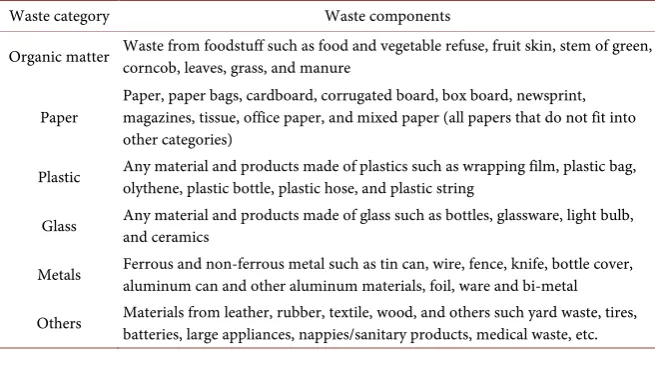
MSW will be different. In general, the composition of MSW in Misratah with six major categories of waste was identified: organic matter, paper-cardboard, plastics, glass, metals, and others Table 1.
[image:4.595.210.538.549.734.2]Organic matter was the predominant category and represented 59% of waste collected. The other categories were represented as follows: paper-cardboard (12%), plastic (8%), glass (4%), metals (7%), and others (10%) Figure 3.
Table 1. Waste composition category.
Waste category Waste components
Organic matter Waste from foodstuff such as food and vegetable refuse, fruit skin, stem of green, corncob, leaves, grass, and manure
Paper Paper, paper bags, cardboard, corrugated board, box board, newsprint, magazines, tissue, office paper, and mixed paper (all papers that do not fit into other categories)
Plastic Any material and products made of plastics such as wrapping film, plastic bag, olythene, plastic bottle, plastic hose, and plastic string
Glass Any material and products made of glass such as bottles, glassware, light bulb, and ceramics
Metals Ferrous and non-ferrous metal such as tin can, wire, fence, knife, bottle cover, aluminum can and other aluminum materials, foil, ware and bi-metal
DOI: 10.4236/abc.2019.92004 49 Advances in Biological Chemistry Figure 3. MSW composition survey in Misrata.
5.2. Industrial Solid Waste
The overall generation of industrial waste, including non-hazardous and inert industrial wastes in Misratah, is 748,800 tons per year. This type of waste is gen-erated from the following:
• Steel, metallurgical, mechanical, and electrical industries, which are the
pre-dominant sectors (50%);
• Building materials, ceramics, and glass industries (50%); • Chemicals, rubber, and plastic industries (2%);
• Food processing, tobacco, and match industries (29%); • Textiles, hosiery, and confection industries (10%); • Leather and shoes industries (1%); and
• Wood, paper, printing industries (3%).
The hazardous waste which includes waste oil, waste solvents, ash, cinder, and other wastes with hazardous nature (such as flammability, explosiveness, and causticity) generated amounts to 63,720 tons/year Figure 4.
5.3. Healthcare Solid Waste
HSW include plastic syringes, animal tissues, bandages, cloths, and so forth. This type of waste is produced by the treatment, diagnosis, and immunization of hu-mans and/or animals at hospitals, veterinary and health related research facili-ties, and substances medical laboratories. These HSWs contain infectious waste, toxic chemicals, and heavy metals. Several may contain that are radioactive. Mi-srata contains 5 hospitals (3 governmental hospitals and 2 private hospitals) with a total of 2000 beds. HSWs reach 2.6 ton/day, of which 72% is general waste and 28% is hazardous waste Figure 5.
DOI: 10.4236/abc.2019.92004 50 Advances in Biological Chemistry Figure 4. ISW composition survey in Misrata.
Figure 5. HSW composition survey in Misrata.
Figure 6. Average general healthcare waste composition in Misrata.
6. The Mechanism of Hydrogen Extraction
[image:6.595.243.503.431.566.2]al-DOI: 10.4236/abc.2019.92004 51 Advances in Biological Chemistry
so specifies that 1/4 of the 25% hydrogen produced is stored (Hydrogen is an energy carrier, not an energy source) Figure 7.
7. Feedstock Source Identification
They can be classified as biodegradable wastes that include the following: Ani-mal wastes, MSW, clover and reeds, wheat residues, barley residues, HSW, and sewage waste.
8. Energy Conversions
After identifying the potential organic feedstock types that are readily available in the area of Misrata, their equivalent methane production capacity of each feeds-tock types except sewage waste due to small factor (gas production/quantity) was determined. Previous published works proved to be of great resource in this part of the study. Using the equivalent methane production capacity of each feeds-tock types, with the anaerobic digestion process, the total methane capacity of feedstock was determined. Using the works the equivalent hydrogen production capacity of each feedstock type was determined. The summary of all the calcula-tions is presented in Table 2.
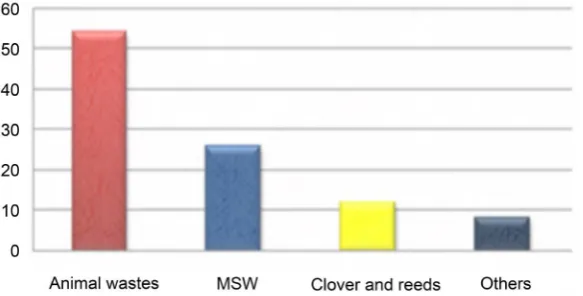
[image:7.595.235.513.377.460.2]The qualitative analysis of feedstock Figure 8 determined animal wastes as the
Figure 7. Mechanism of hydrogen extraction.
Table 2. Energy conversions at each potential facility.
Type of
feedstock Quantity ton/yr. production/quantity Gas
Equivalent methane productiona Production
of hydrogen ton/yr. m3/yr. ton/yr.
Animal wastes 54,198 0.62 mVS3 CH4/kg b 33,602,760 22,177.8 5,544.46
MSW 73,219 0.22 mODS3b/kg 16,108,180 10,631.4 2,657.8
Clover and
reeds 20,320.4 0.36 m
3 CH4/kg
VSb 7,315,344 4828.13 1207
Barley residues 9415.3 0.538 mVS3 CH4/kg b 5,065,431 3343.2 835.8
Wheat
residues 198.8 0.34 m
3 CH4/kg
VSb 67,592 44.6 11.15
HSW 219 0.22 mODS3b/kg 48,180 31.79 7.9
Total 62,208,404.46 41,057.588 10,264.397
[image:7.595.210.540.513.710.2]DOI: 10.4236/abc.2019.92004 52 Advances in Biological Chemistry Figure 8. Hydrogen yields of various feedstock types.
primary component (54.02%), followed by MSW (25.89%) and clover and reeds (11.76%). The high animal wastes content is due to the large quantity. The total estimated hydrogen production for the Misrata will be about 10,265 tons per year.
9. Conclusion
This study presents an overview on solid waste that can be used as a source of bioenergy in Misrata including MSW, ISW, and HSW as biomass sources. The management of solid waste and valorization is based on an understanding of MSW’s composition and physicochemical characteristics. The paper identified all of the sustainable indigenous feedstock types for the area of Misrata, along with their distribution and energy potential. Energy from waste is not a new concept, but it is a field that requires serious attention. The dependence of Mi-sratah on fossil fuels will be reduced, and significantly reducing both pollution and greenhouse gas emissions. Solid waste can be used as an energy source in Misrata. Finally, the total potential hydrogen output is estimated to be around 10,265 tons per year. The results generated in this paper provide a conclusive evidence of a sustainable hydrogen energy future.
Acknowledgements
The researches would like to thank the Department of Sustainable and Renewa-ble Energy Engineering, Omar Al-Mukhtar University, El-Beida Libya for their financial support.
Conflicts of Interest
The authors declare no conflicts of interest regarding the publication of this paper.
References
[1] Hamad, T.A., Agll, A.A., Hamad, Y.M., Bapat, S., Thomas, M., Martin, K.B., et al.
DOI: 10.4236/abc.2019.92004 53 Advances in Biological Chemistry [2] Hamad, T.A., Agll, A.A., Hamad, Y.M., Bapat, S., Thomas, M., Martin, K.B., et al.
(2013) Study of a Molten Carbonate Fuel Cell Combined Heat, Hydrogen and Pow-er System: End-Use Application. Case Studies in Thermal Engineering, 1, 45-50. https://doi.org/10.1016/j.csite.2013.09.001
[3] Wang, C., Dong, Y., Cheng, H., He, Y., Ye, J. and Zhou, H. (2013) Physicochemical Properties of Lacquer Berries and Decolorization of Lacquer Wax by Physical Ad-sorption and UV Irradiation. AdvancesinBiologicalChemistry, 3, 329-337. https://doi.org/10.4236/abc.2013.33037
[4] Hamad, T.A., Agll, A.A., Hamad, Y.M., Bapat, S., Thomas, M., Martin, K.B., et al.
(2014) Hydrogen Production and End-Uses from Combined Heat, Hydrogen and Power System by Using Local Resources. RenewableEnergy, 71, 381-386.
https://doi.org/10.1016/j.renene.2014.05.054
[5] Vera, D., Jurado, F., De Mena, B. and Schories, G. (2011) Comparison between Ex-ternally Fired Gas Turbine and Gasifier-Gas Turbine System for the Olive Oil In-dustry. Energy, 36, 6720-6730. https://doi.org/10.1016/j.energy.2011.10.036 [6] Hamad, T.A., Agll, A.A., Hamad, Y.M., Bapat, S., Thomas, M., Martin, K.B., et al.
(2014) Study of Combined Heat, Hydrogen and Power System Based on a Molten Carbonate Fuel Cell Fed by Biogas Produced by Anaerobic Digestion. Energy Con-versionandManagement, 81, 184-191.
https://doi.org/10.1016/j.enconman.2014.02.036
[7] Benali, M., Hamad, T., Belkhair, A. and Hamad, Y. (2019) Investigating the Use of Combined Hydrogen, Heat and Power System for Omar AL-Mukhtar University Campus. Advances in Biological Chemistry, 9, 31-44.
https://doi.org/10.4236/abc.2019.91003
[8] Demirbas, A. (2008) Importance of Biomass Energy Sources for Turkey. Energy Policy, 36, 834-842. https://doi.org/10.1016/j.enpol.2007.11.005
[9] Hamad, T.A., Agll, A.A., Hamad, Y.M. and Sheffield, J.W. (2014) Solid Waste as Renewable Source of Energy: Current and Future Possibility in Libya. CaseStudies inThermalEngineering, 4, 144-152. https://doi.org/10.1016/j.csite.2014.09.004 [10] Odlare, M., Arthurson, V., Pell, M., Svensson, K., Nehrenheim, E. and Abubaker, J.
(2011) Land Application of Organic Waste—Effects on the Soil Ecosystem. Applied Energy, 88, 2210-2218. https://doi.org/10.1016/j.apenergy.2010.12.043
[11] Yu, M., Muy, S., Quader, F., Bonifacio, A., Varghese, R., Clerigo, E., et al. (2013) Combined Hydrogen, Heat and Power (CHHP) Pilot Plant Design. International JournalofHydrogenEnergy, 38, 488-4888.
https://doi.org/10.1016/j.ijhydene.2013.02.006
[12] Bouckaert, S., Assoumou, E., Selosse, S. and Maïzi, N. (2014) A Prospective Analysis of Waste Heat Management at Power Plants and Water Conservation Issues Using a Global TIMES Model. Energy, 68, 80-91.
![Figure 2. Fossil fuel reserves and production of Libya vs. Time [9].](https://thumb-us.123doks.com/thumbv2/123dok_us/9077637.404417/3.595.275.472.428.540/figure-fossil-fuel-reserves-production-libya-vs-time.webp)