ISSN Online: 2156-8278 ISSN Print: 2156-8251
DOI: 10.4236/ajac.2019.109025 Sep. 5, 2019 367 American Journal of Analytical Chemistry
Single Laboratory Validation of Determination
of 13 Trace Elements in Rice by ICP-MS with an
Overview of Challenges Encountered
G. U. Chandrasiri
1*, M. N. A. Mubarak
1, K. Mahatantila
1, K. R. R. Mahanama
21Industrial Technology Institute, Bauddhaloka Mawatha, Colombo, Sri Lanka 2Faculty of Science, University of Colombo, Colombo, Sri Lanka
Abstract
With the emerging concern on trace element content in rice on both toxico-logical and nutritional standpoints, validation of analytical method to deter-mine both essential and toxic elements in rice is important in order to pro-duce reliable results. Therefore, this study was aimed to validate analytical method to determine As, Cd, Pb, Hg, Cr, Ni, Se, Cu, Mn, Mo, Fe, Co and Zn in rice while giving an overview of the challenges encountered and applica-tion of the method to analysis trace elements in selected tradiapplica-tional rice varie-ties available in Sri Lankan market. Sample digestion was carried out by mi-crowave digestion and analysed by ICP-MS. The analytical method was vali-dated by measuring precision, accuracy, limits of detection (LODs), limits of quantification (LOQs), working and linear range, recovery percentage and measurement uncertainty. They showed that the method is fit for its purpose as those complies with the standard method performance requirements of AOAC. Percentage of relative standard deviations (RSD) of repeatability was not greater than 9.9% and RSDs (%) of reproducibility were not greater than 10.1% for all elements. Mean recoveries varied from 81% to 110%. Limits of detections of elements were in the range of 0.04 - 0.8 mg/kg and LOQs were in the range of 0.05 - 1.2 mg/kg. Expanded uncertainties of trace elements lay between 1.1% and 6.0%. Good agreement with the certified values of Stan-dard Reference Material (SRM) 1568b—Rice Flour analysed by the proposed method with recovery percentages between 89.4% and 105.7% further con-firms the accuracy and traceability of the method. The distribution pattern of essential elements in all rice varieties analysed was Mn > Zn > Fe > Cu > Mo > Se > Co. Even though arsenic was detected in all varieties, only the mean concentration of lead of Kaluneenati exceeds the maximum level (FAO/WHO CODEX Alimentarius).
How to cite this paper: Chandrasiri, G.U., Mubarak, M.N.A., Mahatantila, K. and Mahanama, K.R.R. (2019) Single Labora-tory Validation of Determination of 13 Trace Elements in Rice by ICP-MS with an Overview of Challenges Encountered. American Journal of Analytical Chemistry, 10, 367-376.
https://doi.org/10.4236/ajac.2019.109025
Received: July 31, 2019 Accepted: September 2, 2019 Published: September 5, 2019
Copyright © 2019 by author(s) and Scientific Research Publishing Inc. This work is licensed under the Creative Commons Attribution International License (CC BY 4.0).
DOI: 10.4236/ajac.2019.109025 368 American Journal of Analytical Chemistry
Keywords
Validation Parameters, Trace Elements, Rice, Microwave Digestion, ICP-MS
1. Introduction
Rice being the staple food and main dietary source of trace elements, it plays a significant role in stabilizing food security in most Asian countries including Sri Lanka [1] [2][3]. Recently concern has been raised by consumers on potential toxic element contamination and essential element content in rice due to exces-sive usage of fertilizers and pesticides [1][4][5][6][7]. In previous studies, dif-ferent analytical methods including dry ashing/Inductively Coupled Plasma Op-tical Emission Spectrometer (ICP-OES), microwave digestion/Inductively Cou-pled Plasma Mass Spectrometer (ICP-MS), microwave digestion/ Graphite Fur-nace Atomic Spectrometer and instrumental neutron activation with k0
stan-dardization have been used to determine the content of several trace elements in rice. Dry ashing is a time-consuming digestion technique and losses of certain volatile elements such as arsenic, mercury and lead can be occurred during the digestion compared to microwave digestion which is less time consuming and reduces losses of volatile elements. Among the detection techniques used in pre-vious studies, ICP-OES, ICP-MS and instrumental neutron activation with k0
standardization have the ability to analysis multi elements simultaneously while Graphite Furnace Atomic Spectrometer has only mono elemental detection. Compared to ICP-OES and instrumental neutron activation with k0
standardiza-tion, ICP-MS has more advantages due to its ability to offer lower detection lim-its and a wider working range. However, most of the analytical methods includ-ing microwave digestion/ICP-MS used in those studies were validated for analy-sis of few toxic elements (As, Cd, Hg, Pb, etc.), performing selected method per-formance parameters such as accuracy, recovery, LOD and LOQ. Hence, estab-lishment of fully validated analytical method for analysis of both toxic and es-sential trace elements in rice covering the method performance parameters ac-cording to EUROCHEM [8], i.e. repeatability, reproducibility, accuracy, working and linear range, limit of detection, limit of quantification, recovery and meas-urement uncertainty is a necessity to generate reliable data on both toxicological and nutritional standpoints.
DOI: 10.4236/ajac.2019.109025 369 American Journal of Analytical Chemistry [11]. Even with a validated method, expounding the challenges in trace element analysis of rice is also very important for routine analysis as accuracy of results produced depends on several aspects such as purity of chemicals, sample han-dling, cleanliness of glassware and instrument maintenance.
Therefore, the aim of this study was to validate an analytical method including measurement uncertainty for determination of 13 trace elements including toxic (As, Cd, Cr, Hg, Pb and Ni) and essential (Cu, Co, Mn, Se, Fe, Mo and Zn) ele-ments in rice while expounding the challenges encountered and application of the method to analysis trace elements in selected traditional rice varieties avail-able in Sri Lankan market.
2. Materials and Methods
2.1. Reagents and Glassware
High purity deionized water (resistivity 18.2 MΩ∙cm−1) from water purification
system (Thermo Scientific Barnstead, USA) was used throughout the study. Ul-tra pure HNO3 (≥69%, Merck, Darmstadt, Germany) was used for microwave
digestion. Working calibration standards were prepared by diluting 10 mg/L multi-element calibration standard (Agilent, USA) containing As, Cd, Cu, Co, Cr, Mn, Ni, Pb, Fe, Zn, Mo and 10.0 µg/mL single element calibration standard (Agilent, USA) containing Hg. In the similar way, instrument tuning solution (100 μg/L) and internal Standard mix (100 μg/L) were prepared from 10 µg/mL instrument tuning stock solution (Agilent, USA) containing Li, Co, Ba, TI and 100 μg/mL internal standard mix (Agilent, USA) containing Bi, Ge, In, Li, Lu, Rb, Sc, Tb respectively. Rice samples were spiked with multi-element Certified Reference Materials (CRMs) (AccuStandard, USA) containing As, Cd, Cu, Co, Cr, Mn, Ni, Pb, Fe, Zn and Mo and single element CRM (AccuStandard, USA) containing Hg. Standard Reference Material (SRM) NIST 1568B rice flour was purchased (Merck, Germany). Glassware was kept overnight in 10% (v/v HNO3),
rinsed with deionized water before use.
2.2. Instruments and Apparatus
Microwave digestion oven (MAS 5, CEM, USA) was used for sample digestion. Inductively Coupled Plasma Mass Spectrometer (Agilent 7900, Japan) was used for determination of trace elements.
2.3. Rice Samples
Rice samples were collected from six brands of each variety available in super markets and retailers in Sri Lankan market.
2.4. Sample Preparation
DOI: 10.4236/ajac.2019.109025 370 American Journal of Analytical Chemistry
Table 1. Operating conditions for the microwave digestion oven.
Stage Power (W) Temperature (˚C) Ramp time (min) Hold time (min)
1. 800 180 30 30
2. Cooling 0 W, 30 min
The digested sample was transferred to a 25 mL volumetric flask through a No. 542 Whatman filter paper. Then the filter paper was washed with deionized wa-ter and made up to the mark with deionized wawa-ter.
For investigating repeatability and recovery of the analytical method samples were spiked with multi-element and single element CRMs in order to get final concentrations of 10%, 50% and 80% of the highest working calibration standard of each element. For each spiked level ten independent replicates were carried out. Reproducibility was performed using two independent replicated spiked sam-ples at each spiked level, i.e. 10%, 50% and 80% of the highest working calibra-tion standard of each element by two different analysts within the laboratory. Ten independent reagent blanks fortified at concentration of lowest working ca-libration standard of each element were performed to determine limits of detec-tion (LODs) and limits of quantificadetec-tion (LOQs).
2.5. Determination of Trace Elements in Rice
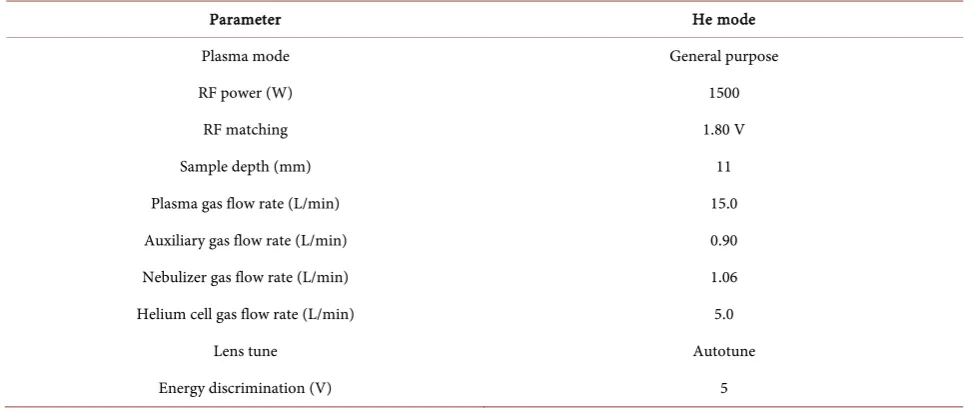
Inductively Coupled Plasma Mass Spectrometer was calibrated using five exter-nal working standards in the range of of 1.00 - 200 μg /L for As, Cd, Pb, Cr, Ni, Se, Cu, Mn, Fe, Mo, Co, 1.00 - 25 μg /L for Hg, 10 - 200 μg /L for Zinc and 10 - 500 μg/L for Fe. Concentrations of elements of spiked samples, fortified reagent blanks, blank samples, market samples and SRM were analyzed by ICP-MS un-der the operating conditions given in Table 2. All the measurements were car-ried out with the internal standard at the concentration of 100 μg/L.
Concentrations of elements in blank samples were deducted from all meas-urements. Repeatability and reproducibility were evaluated by calculating rela-tive standard deviations (RSDs) at each spiked level. Mean recovery percentage was calculated at each spiked level. Limits of detection were calculated as sum of mean and three times of standard deviations of fortified reagent blanks and the LOQs as sum of mean and five times of standard deviations of fortified reagent blanks. The linearity of the calibration curve was evaluated by the correlation coefficient (R2) of the calibration curves.
3. Results and Discussion
DOI: 10.4236/ajac.2019.109025 371 American Journal of Analytical Chemistry
Table 2. Inductively coupled plasma mass spectrometer operating conditions.
Parameter He mode
Plasma mode General purpose
RF power (W) 1500
RF matching 1.80 V
Sample depth (mm) 11
Plasma gas flow rate (L/min) 15.0
Auxiliary gas flow rate (L/min) 0.90
Nebulizer gas flow rate (L/min) 1.06
Helium cell gas flow rate (L/min) 5.0
Lens tune Autotune
Energy discrimination (V) 5
Table 3. Precision, recovery (%) LOD, LOQ, working range, correlation coefficient and expanded uncertainties of elements at
different spiked levels.
Element
Parameter (unit) Repeatability (RSD %) within laboratory
reproducibility (RSD %) Recovery (%)
LOD
(mg/kg) (mg/kg) LOQ
Working range (mg/kg)
Correlation coefficient
Expanded uncertainties (U(%) (k = 2)) Spiked level concentration (mg/kg)
1.00 5.00 8.00 1.00 5.00 8.00 1.00 5.00 8.00
As 5.3 2.2 1.8 6.1 2.8 2.5 105.7 96.4 87.6 0.052 0.054 0.05 - 10.00 0.9996 2.3
Cd 2.1 1.0 1.9 2.8 1.3 2.4 96.7 85.5 99.6 0.055 0.057 0.05 - 10.00 1.0000 1.1 Pb 3.9 2.1 1.7 4.3 2.7 1.9 90.4 93.1 92.2 0.068 0.074 0.05 - 10.00 0.9997 3.0 Cr 8.6 5.8 1.8 9.9 6.7 2.2 100.5 102.6 98.4 0.066 0.070 0.05 - 10.00 0.9999 3.7 Ni 9.9 4.5 3.6 10.1 5.0 3.8 90.4 83.8 96.6 0.076 0.080 0.05 - 10.00 0.9998 3.1 Se 4.8 4.0 5.9 6.9 4.8 7.7 99.5 100.6 101.0 0.076 0.090 0.05 - 10.00 0.9996 4.1 Cu 1.6 2.2 2.0 3.9 2.6 2.4 110.2 95.4 98.0 0.073 0.083 0.05 - 10.00 0.9997 1.4 Mn 7.2 6.7 5.0 8.8 7.4 6.3 97.5 93.2 95.7 0.065 0.075 0.05 - 10.00 0.9999 4.5 Mo 5.7 1.6 2.8 5.9 1.9 3.7 98.2 81.0 94.8 0.058 0.062 0.05 - 10.00 0.9999 2.1 Co 4.1 4.8 1.6 4.8 7.4 1.9 103.5 97.2 99.0 0.056 0.060 0.05 - 10.00 0.9997 3.4 Zn 5.1 3.1 4.9 5.5 3.6 5.2 100.4 94.1 94.7 0.716 0.985 0.5 - 10.00 0.9997 4.8
Spiked level concentration (mg/kg)
0.125 0.625 1.00 0.125 0.625 1.00 0.125 0.625 1.00
Hg 7.9 3.3 2.6 8.1 3.6 2.9 87.0 84.5 98.7 0.042 0.048 0.05 - 2.50 0.9999 2.4 2.5 12.5 20.0 2.5 12.5 20.0 2.5 12.5 20.0
[image:5.595.62.539.335.737.2]DOI: 10.4236/ajac.2019.109025 372 American Journal of Analytical Chemistry of all 13 elements analysed. These RSD % values are within the expected RSDs of AOAC Official Methods of Analysis, i.e. 11% for 1 mg/kg and 7.3% for 10 mg/kg [12]. Thus it shows a good agreement between the results of successive meas-urements performed. Relative standard deviations (%) of reproducibility was not greater than 10.1%, 7.4% and 7.7% for low, middle and high spiked concentra-tions of all 13 elements analysed. Reproducibility of the analytical method within the laboratory was satisfactory since the RSD values were within the Horwitz equation values (RSD Horwitz) for specific concentration that is 16% for 1.00 mg/kg and 11% for 10 mg/kg. Mean recoveries varied from 81% to 110%, indi-cating that results for all elements determined were within the recovery per-centages in the standard method performance requirements of AOAC Official Methods of Analysis [12], which comprise the range between 80% and 110% for analyte concentrations between 1 to 10 mg/kg.
Concentrated nitric acid being a powerful oxidizing acid and nitrating agent, it has the ability to dissolve most metals to form soluble metal nitrates. Hence it was the primary choice for microwave digestion in the proposed method.
However, in previous studies a mixture of nitric acid and hydrogen peroxide was used for digestion [5][11] [13], as oxidizing strength of nitric acid can be increased by the addition of hydrogen peroxide. However, results of those stud-ies have shown that mean recoverstud-ies of As and Cd were 114.2% and 127.3% re-spectively which were above the upper limit of satisfactory mean recovery range. Results of the proposed method show satisfactory mean recoveries for each ele-ment analysed when nitric acid is used as an oxidant alone for the digestion of rice under the operating conditions of the microwave digestion oven given in Table 1. Physical interferences due to differences in viscosity, surface tension and dissolved solids between samples and calibration standards were corrected with the use of internal standard mixture [14]. Memory interferences which oc-curs when analytes from a previous sample or standard are measured in the cur-rent sample were minimized by rinsing the sample introduction system with 2% HNO3 followed by deionized water between samples in the run sequence. In
trace element analysis, minimization of potential contamination of analytes of interest from reagents, glassware and equipment is important for the accuracy of the results produced. Therefore, ultra pure nitric acid and type 1 deionized water were used for throughout the study. Regular maintenance of ICP-MS according to manufacturer’s recommendation such as checking the argon, helium levels and peristaltic pump tubing for damage, cleaning sampling, skimmer cones and ion lenses, replacement of argon gas filters, plasma, auxiliary gas tubing when necessary etc. were carried out.
DOI: 10.4236/ajac.2019.109025 373 American Journal of Analytical Chemistry than >0.9996, as shown in Table 4. Hence linearity of calibration curves of each element was satisfactory [14]. Evaluation of linearity and working ranges of ele-ments analysed are useful to take decision on what degree of calibration is re-quired when using the proposed method on a day-to-day basis and its ability to provide results which are directly proportional to the concentrations of the ele-ments present in the samples.
Even with a state of the art instrument ICP-MS which reduces most of the in-terferences, accurate quantification of certain elements specially Fe and Zn is still very challenging. According to the previous study, Zn was being leached from their walls within 24 hours even stored in polypropylene containers [16]. There-fore, in order to minimize leaching, analysis was carried out immediately after sample digestion. The concentrations of Fe and Zn in rice are higher when compared to other essential elements present. Hence working ranges of Zn and Fe were selected between 10 - 200 μg/L and 10 - 500 μg/L which were higher compared to the working ranges of other essential elements analysed in order to obtain satisfactory mean recoveries. Estimation of the uncertainty of the meas-urement of 13 mentioned trace elements in rice lay between 1.1% and 6.0% based on the bottom-up (GUM) approach [17][18]. The highest uncertainty was obtained for Fe and lowest uncertainty was obtained for Cd.
Rice flour SRM which ideally matches the sample matrix of interest and traceable to NIST was also analysed with the market rice samples in order to as-sess the accuracy of the proposed method and maintain traceability. Results of analysis of SRM are given in Table 4. It shows that there was a good agreement with the certified values of SRM for As, Cu, Fe, Mn, Mo, Se and Zn analysed by the proposed method with recovery percentages between 89.4% and 105.7%. In comparison to current detection techniques ICP-OES, Flame Atomic Absorp-tion Spectrometry (FAAS) and Graphite Furnace Atomic AbsorpAbsorp-tion Spec-trometry (GFAAS), ICP-MS has the ability to detect larger number of elements in lower detection limits in wider dynamic linear range.
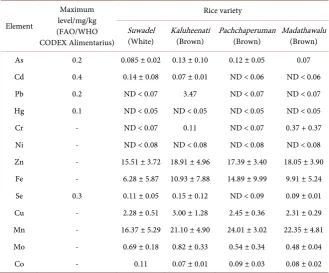
[image:7.595.209.539.550.709.2]Table 5 represents mean concentrations of trace elements in traditional rice
Table 4. Results of SRM with recovery percentage.
Element Certified value ± U (mg/kg) Obtained value ± SD (mg/kg) Recovery %
Hg 0.00591 ± 0.00036 0.00526 ± 0.00291a 89.0
Cd 0.0224 ± 0.0013 0.0223 ± 0.0044a 99.4
As 0.285 ± 0.014 0.256 ± 0.013 89.4
Cu 2.35 ± 0.16 2.33 ± 0.15 99.2
Fe 7.42 ± 0.44 7.84 ± 1.31 105.7
Mn 19.2 ± 1.8 19.0 ± 0.8 99.0
Mo 1.451 ± 0.048 1.26 ± 0.028 89.8
Se 0.365 ± 0.029 0.383 ± 0.052 105.0
Zn 19.42 ± 0.26 18.49 ± 1.79 95.2
Co 0.0177 ± 0.0005 0.0180 ± 0.0008a 101.7
Pb 0.008 ± 0.003 0.005 ± 0.002a 61.0
DOI: 10.4236/ajac.2019.109025 374 American Journal of Analytical Chemistry
Table 5. Mean concentrations of elements in traditional rice varieties.
Element
Maximum level/mg/kg (FAO/WHO CODEX Alimentarius)
Rice variety
Suwadel
(White) Kaluheenati (Brown) Pachchaperuman (Brown) Madathawalu (Brown)
As 0.2 0.085 ± 0.02 0.13 ± 0.10 0.12 ± 0.05 0.07
Cd 0.4 0.14 ± 0.08 0.07 ± 0.01 ND < 0.06 ND < 0.06
Pb 0.2 ND < 0.07 3.47 ND < 0.07 ND < 0.07
Hg 0.1 ND < 0.05 ND < 0.05 ND < 0.05 ND < 0.05
Cr - ND < 0.07 0.11 ND < 0.07 0.37 + 0.37
Ni - ND < 0.08 ND < 0.08 ND < 0.08 ND < 0.08
Zn - 15.51 ± 3.72 18.91 ± 4.96 17.39 ± 3.40 18.05 ± 3.90
Fe - 6.28 ± 5.87 10.93 ± 7.88 14.89 ± 9.99 9.91 ± 5.24
Se 0.3 0.11 ± 0.05 0.15 ± 0.12 ND < 0.09 0.09 ± 0.01
Cu - 2.28 ± 0.51 3.00 ± 1.28 2.45 ± 0.36 2.31 ± 0.29
Mn - 16.37 ± 5.29 21.10 ± 4.90 24.01 ± 3.02 22.35 ± 4.81
Mo - 0.69 ± 0.18 0.82 ± 0.33 0.54 ± 0.34 0.48 ± 0.04
Co - 0.11 0.07 ± 0.01 0.09 ± 0.03 0.08 ± 0.02
varieties. In all traditional rice varieties, Mn has the highest mean concentration in the range of 16.37 - 24.01 mg/kg followed by Zn > Fe > Cu > Mo > Se > Co in the ranges of 15.51 - 18.91, 6.28 - 14.89, 2.28 - 3.00, 0.48 - 0.82, <0.09 - 0.15 and 0.07 - 0.11 respectively. Even though arsenic was detected in all rice varieties, only the mean concentration of lead of Kaluneenati exceeds the maximum per-missible level.
4. Conclusion
DOI: 10.4236/ajac.2019.109025 375 American Journal of Analytical Chemistry
Acknowledgements
The authors wish to thank Industrial Technology Institute for financial support through treasury grant TG 18/163.
Ethical Approval
This article does not contain any studies with human participants or animals performed by any of the authors
Conflicts of Interest
G. U. Chandrasiri declares that she has no conflict of interest. M. N. A. Mubarak declares that he has no conflict of interest. K. Mahatantila declares that she has no conflict of interest. K. R. R. Mahanama declares that he has no conflict of in-terest.
References
[1] Navarathna, N.M.C.M., Parthipan, R., Pathiratne, K.A.S., De Silva, D.S.M. and Wickramasinghe, W.M.D.A.B. (2016) Content of Heavy Metals; Cadmium, Chro-mium and Lead in Selected Rice Varieties (Oryzasativa L.) Grown under Different Agricultural Management Systems. Chemistry in Sri Lanka, Institute of Chemistry Ceylon, Sri Lanka.
[2] Sebastian, A. and Prasad, M.N.V. (2015) Trace Elements Management in Rice. Agronomy, 5, 374-404.https://doi.org/10.3390/agronomy5030374
[3] Jayasekera, R. and Freitas, M.C. (2005) Concentration Levels of Major and Trace Elements in Rice from Sri Lanka as Determined by the k0 Standardization Method.
Biological Trace Element Research, 103, 83-96. https://doi.org/10.1385/BTER:103:1:083
[4] Chandrajith, R., Dissanayake, N. and Dissanayake, C.B. (2012) Arsenic and Other Heavy Metals in Rice from Sri Lanka—Preliminary Results with ICP-MS. Interna-tional Symposium on Water Quality and Human Health: Challengers Ahead, PGIS, Peradeniya, Sri Lanka.
[5] Diyabalanage, S., Navarathna, T., Abeysundara, H.T.K., Rajapakse, S. and Chandra-jith, R. (2016) Trace Elements in Native and Improved Paddy Rice from Different Climatic Regions of Sri Lanka: Implications for Public Health. SpringerPlus, 5, 1864. https://doi.org/10.1186/s40064-016-3547-9
[6] Satpathy, D., Reddy, M.V. and Dhal, S.P. (2014) Risk Assessment of Heavy Metals Contamination in Paddy Soil, Plants, and Grains (OryzasativaL.) at the East Coast of India. BioMedResearchInternational,2014, Article ID: 545473.
https://doi.org/10.1155/2014/545473
[7] Mataveli, L.R.V., Buzzo, M.L., Arauz, L.J.D., Carvalho, M.D., Arakaki, E.E.K., Ma-tsuzaki, R. and Tiglea, P. (2016) Total Arsenic, Cadmium and Lead Determination in Brazilian Rice Samples Using ICP-MS. Journal of Analytical Methods in Chemis-try, 2016, Article ID: 3968786. https://doi.org/10.1155/2016/3968786
[8] EUROCHEM (1998) The Fitness for Purpose of Analytical Methods—A Laboratory Guide to Method Validation and Related Topics.
DOI: 10.4236/ajac.2019.109025 376 American Journal of Analytical Chemistry Atomic Spectrometry, 19, 607-615. https://doi.org/10.1039/b312250f
[10] Bader, N.R. (2011) Sample Preparation for Trace Element Analysis by Graphite Furnace Atomic Absorption Spectroscopy (GFAAS): An Overview. Der Chemica Sinica, 2, 211-219.
[11] Jalbani, N., Aftab, A.K., Bhutto, S., Ahmed, F. and Mahroze, A.K. (2014) Evaluation of Toxic Elements in Rice (Oryzasativa) Commercially Available in Pakistan: Mul-tivariate Study. International Food Research Journal, 21, 255-261.
[12] Association of Official Agricultural Chemists (AOAC) (2016) Official Methods of Analysis Guidelines for Standard Method Performance Requirements.
[13] Perera, M.A.K.K.P. (2018) Determination of Arsenic and Cadmium in Sri Lankan rice Samples by Inductively Coupled Plasma Mass Spectrometry (ICP-MS). [14] Gottler, R.A. (2017) Standard Methods for the Examination of Water and Waste
Water. Quality Assurance/Quality Control, 23rd Edition, American Public Health Association, American Water Works Association, Water Environment Federation, 3-3-3-8.
[15] FAO/WHO (1995) CODEX General Standard Contaminants and Toxins in Food and Feed. CODEX STAN 193-1995, 31-36.
[16] Zywicki, R., Connelly, R. and Sullivan, D. (2014) Challenges of Ultra-Trace Ele-mental Analysis by ICP-MS. AOAC International, Rockville, MD, 23 September 2014.
https://www.covance.com/content/dam/covance/assetLibrary/posters/ZywickiAOA C14.pdf
[17] Tanase, I.G., Popa, E.D., Udristioiu, G.E., Bunaciu, A.A. and Enein, H.Y.A. (2015) Estimation of the Uncertainty of the Measurement Results of Some Trace Levels Elements in Document Paper Samples Using ICP-MS. RSC Advances, 5, 11445-11457. https://doi.org/10.1039/C4RA12645A