ANALYTICAL METHOD DEVELOPMENT AND VALIDATION FOR
RESIDUAL SOLVENT DICHLOROMETHANE IN VILAZODONE BY
GAS CHROMATOGRAPHY TECHNIQUE
Syed Hussain S. K., Imam Pasha S.* and Mohammed Abdul Farhan
Sultan -Ul-Uloom College of Pharmacy, Banjara Hills, Road No.3, Hyderabad-500 034,
Telangana, India.
ABSTRACT
This paper describes the analytical method for development and
validation for residual solvent Dichloromethane in
3-(4-Chlorobutyl)-1H-Indole-5-Carbonitrile by Gas chromatography technique. Proposed
method is proven to be sensitive, simple and accurate for quantification
of residual Dichloromethane in Vilazodone Hydrochloride. Retention
time of Dichloromethane was found to be 6.3 minutes with septum
purge flowrate of 3 mL/min by using Flame Ionization detector.The
test method is linear for Dichloromethane over the range of LOQ to
150% of target concentration for the analyte response with an
acceptable correlation coefficient values at 100% drug. The test
method is accurate over the range of LOQ to 150% of target concentration for the estimation
of residual solvent in 3-(chlorobutyl)-1H-indole-5-carbonitrile.The test method is rugged for
day to day and analyst to analyst variability.
KEYWORDS: Dichloromethane; Residual; Vilazofone Hydrochloride; GC method.
1. INTRODUCTION
Vilazofone is a seratogenic antidepressant[1,2], In some ways, its activity can be
conceptualized as a combination of an SSRI and Buspirone. Structure of Vilazodone is shown
in the Fig 1. Literature survey reveals that GC method validation has never been reported for
the estimation of residual solvent Dichloromethane in 3-(-4 chlorobutyl) - 1H- Indole- 5-
carbonitrile. Only few HPLC, LC-MS methods were developed for estimation of 3-(-4
chlorobutyl) - 1H- Indole- 5- carbonitrile in bulk, formulation and biological samples[4,5,6,7,8].
Volume 7, Issue 11, 1385-1405. Research Article ISSN 2277–7105
*Corresponding Author Imam Pasha S.
Sultan -Ul-Uloom College of
Pharmacy, Banjara Hills,
Road No.3, Hyderabad-500
034, Telangana, India. Article Received on 16 April 2018,
Revised on 07 May 2018, Accepted on 28 May 2018
DOI: 10.20959/wjpr201811-12557
So here an attempt has been made to develop GC method validation for the estimation of
residual solvent Dichloromethane in 3-(-4 chlorobutyl) - 1H- Indole- 5- carbonitrile. The
validation study for the parameters namely system suitability, specificity , system precision,
[image:2.595.225.373.170.218.2]method precision, limit of detection, limit of quantitation, linearity, accuracy and range.
Fig 1: Structure of 3-(-4 chlorobutyl) - 1H- Indole- 5- carbonitrile.
2. MATERIALS AND METHODS
2.1: Reagents and reference materials
All the reagents and chemicals used were of analytical grade
2.2: Apparatus and equipment
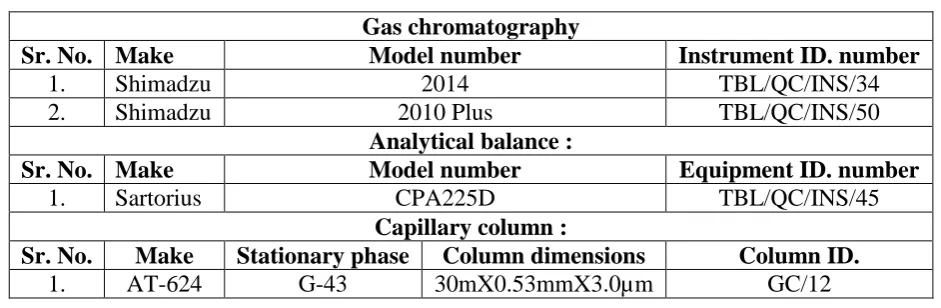
Table 1: Apparatus andEquipment.
Gas chromatography
Sr. No. Make Model number Instrument ID. number
1. Shimadzu 2014 TBL/QC/INS/34
2. Shimadzu 2010 Plus TBL/QC/INS/50
Analytical balance :
Sr. No. Make Model number Equipment ID. number
1. Sartorius CPA225D TBL/QC/INS/45
Capillary column :
Sr. No. Make Stationary phase Column dimensions Column ID.
1. AT-624 G-43 30mX0.53mmX3.0µm GC/12
2.4. Procedures
Preparation of Solutions
Preparation of dichloromethane standard stock solution
Transfer about 9µl of Dichloromethane, into a 10mL volumetric flask containing about 5mL
of diluent and dilute to volume with diluent.
Preparation of standard solution
Transfer 300µl of the standard stock solution into a 10mL volumetric flask containing 5mL
of diluents and make up to volume with the diluent. The above solution contains about
[image:2.595.62.533.372.526.2]Preparation of test solution
Weigh accurately about 600mg of the test sample transferred into a 10mL volumetric flask,
dissolve and make up to the volume with diluent.
Procedure
After equilibrating the column, inject the blank solution and apply blank correction in case of
any interference from the solution used a diluent. Separately inject standard solution for six
times and calculate the % RSD and record the chromatograms.
System Suitability acceptance criteria: The % RSD for dichloromethane calculated from
the area of 6 injections of standard solution is NMT 15.0.
Calculation
Calculate the content of the dichloromethane in ppm, using the following equation:
3. RESULTS AND DISCUSSION
3.1: Method development
The method developed for the estimation of residual solvent Dichloromethane in 3-(4-
CHLOROBUTYL)-1H- INDOLE-5-CARBONITRILE BY GC based on its physicochemical
properties. As MDC polar molecule and, therefore, a polar solvent dimethylsulfoxide
(DMSO) was used as the diluents because of its high boiling point. The capillary column
coated with 6-Cyanopropyl, l% Phenyl, 94% Dimethylpolysiloxane is a good choice for
separation of this analyte since they elute as symmetrical peaks at a wide range of
concentrations. The GC-FID parameters used in the method development were based on the
boiling point. The injection port and detector temperature were set to 140 ºC and 260 ºC
respectively. Different temperature programs were investigated for GC oven. The end of this
investigation, the best temperature program was selected for a good resolution. The
temperature programs of the GC oven with a run time of 39 min was as follows: initial
temperature 45ºC, held for 5 min, increased to 150ºC min at a rate of-1º C held for 5 min,
ensure a nitrogen flow of 2.5 psi. The split mode was chosen. The solvent, column and
acquisition parameters were chosen to be a starting point for the 3-(CHLOROBUTYL)-1H-
INDOLE-5-CARBONITRILE by GC and the retention time of 6.3 min with good peak
shape was found. No further optimization of the method was required. Additionally,
preliminary precision studies performed during the development of the method injection
volume were adjusted to 1µl showed the reproducible and the peak response was significant
at the analytical concentration chosen.
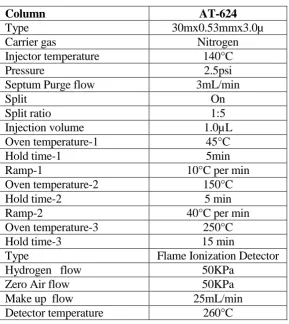
[image:4.595.154.444.280.605.2]The detailed Chromatographic conditions described in the Table.2.
Table 2: Chromatographic Conditions.
Column AT-624
Type 30mx0.53mmx3.0µ
Carrier gas Nitrogen
Injector temperature 140°C
Pressure 2.5psi
Septum Purge flow 3mL/min
Split On
Split ratio 1:5
Injection volume 1.0µL
Oven temperature-1 45°C
Hold time-1 5min
Ramp-1 10°C per min
Oven temperature-2 150°C
Hold time-2 5 min
Ramp-2 40°C per min
Oven temperature-3 250°C
Hold time-3 15 min
Type Flame Ionization Detector
Hydrogen flow 50KPa
Zero Air flow 50KPa
Make up flow 25mL/min
Detector temperature 260°C
3.2: Method validation parameters
Method Validation[3,9]
The following parameters were used to validate the method for the estimation of residual
System suitability
Preparation of Solutions
Preparation of dichloromethane standard stock solution
Transfer about 9 µL of Dichloromethane, into a 10 mL volumetric flask containing about 5
mL of diluent and dilute to volume with diluent.
Preparation of Standard solution
Transfer 300 µL of the standard stock solution into a 10 mL volumetric flask containing 5
mL of diluents and make up to volume with the diluent. The above solution contains about,
600 ppm of dichloromethane with respect to 60 mg/mL test concentration.
Procedure
Equilibrate the system for at least 30 min for stabilization.
System Suitability acceptance criteria: The % RSD for dichloromethane calculated from
the area of 6 injections of standard solution is NMT 15.0.
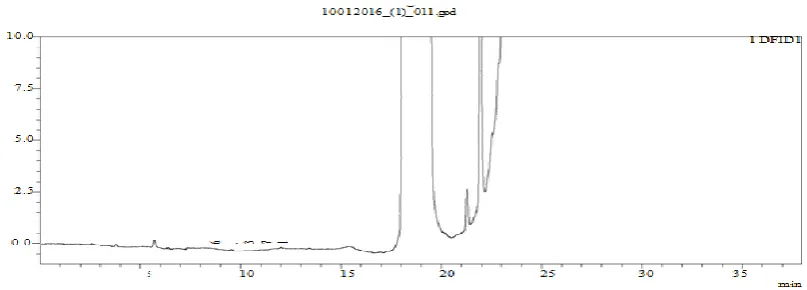
Sample name: 3-(4-chlorobutyl)-1H-indole-5-carbonitrile.
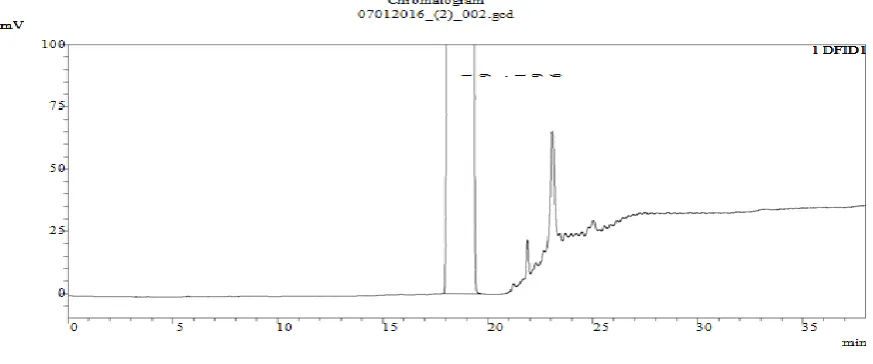
[image:5.595.77.514.439.621.2]Sample ID: Blank
Fig.2: Chromatogram (Blank)
Table 3: Peak data of blank.
Peak Name Ret. time Area %Area
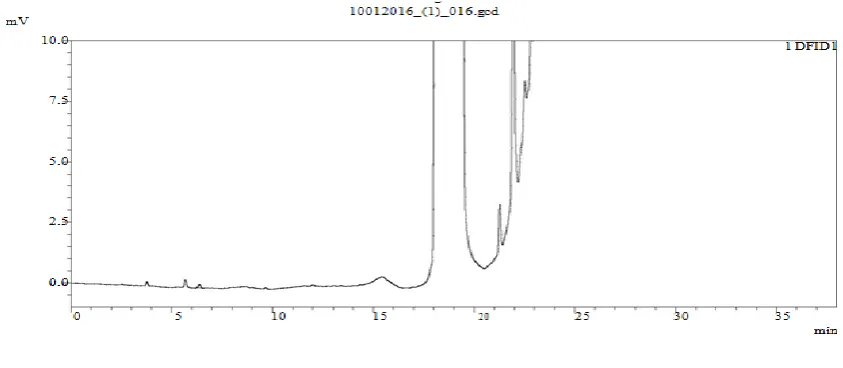
Sample name: 3-(4-chlorobutyl)-1H-indole-5-carbonitrile.
[image:6.595.114.507.133.310.2]Sample ID: standard solution 1
Fig 3: Chromatogram (Standard).
Table 3: Peak data of standard.
Peak Name Ret. time Area %Area
1 MDC 6.43 8700 100
Sample name: 3-(4-chlorobutyl)-1H-indole-5-carbonitrile.
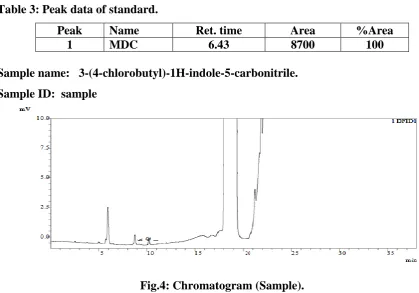
[image:6.595.75.495.359.652.2]Sample ID: sample
Fig.4: Chromatogram (Sample).
Table 3: Peak data of standard.
Peak Name Ret. time Area %Area
Sample name: 3-(4-chlorobutyl)-1H-indole-5-carbonitrile.
[image:7.595.115.499.121.270.2]Sample ID: sample spiked solution
Fig 5: Chromatogram of spiked sample.
Table 3: Peak data of standard.
Peak Name Ret. time Area %Area
1 MDC 6.425 2780 100
Specificity
Definition: Specificity is the ability of the method to measure accurately the analyte in
presence of components which are expected to be present. Prepare the Standard and Sample
solutions as mentioned below.
Preparation of Solutions
Preparation of dichloromethane standard stock solution
Transfer about 9 µL of Dichloromethane, into a 10 mL volumetric flask containing about 5
mL of diluent and dilute to volume with diluent.
Preparation of Standard solution
Transfer 300 µL of the standard stock solution into a 10 mL volumetric flask containing 5
mL of diluents and make up to volume with the diluent. The above solution contains about,
600 ppm of dichloromethane with respect to 60 mg/mL test concentration.
Preparation of test solution
Weigh accurately about 600 mg of the test sample transferred into a 10 mL volumetric flask,
Preparation of Spiked solution
Weigh accurately about 600 mg of the test sample transferred into a 10 mL volumetric flask,
add 5 mL of diluents and 0.075 mL of dichloromethane stock solution, dissolve and make up
to the volume with diluent.
Procedure
Equilibrate the system for at least 30 min for stabilization.
Acceptance criteria
1. System suitability criteria should meet the requirements.
2. There should be no interference due to blank at the retention time of residual solvent.
Precision
Precision is a measure of degree of reproducibility and of repeatability of the analytical
method and is usually expressed as the relative standard deviation.
System precision
Preparation of Solutions
Preparation of dichloromethane standard stock solution
Transfer about 9 µL of Dichloromethane, into a 10 mL volumetric flask containing about 5
mL of diluent and dilute to volume with diluent.
Preparation of Standard solution: Transfer 300 µL of the standard stock solution into a 10
mL volumetric flask containing 5 mL of diluents and make up to volume with the diluent.
The above solution contains about,600 ppm of dichloromethane with respect to 60 mg/mL
test concentration.
Preparation of test solution
Weigh accurately about 600 mg of the test sample transferred into a 10 mL volumetric flask,
dissolve and make up to the volume with diluent.
Preparation of Spiked solution
Weigh accurately about 600 mg of the test sample transferred into a 10 mL volumetric flask,
add 5 mL of diluents and 0.075 mL of dichloromethane stock solution, dissolve and make up
Procedure
Equilibrate the system for at least 30 min for stabilization.
Acceptance criteria
1. System suitability criteria should meet the requirements.
2. The % RSD for dichloromethane from the area of 6 injections of spiked solution is
NMT 15.0
3. The % RSD for dichloromethane content (in ppm) from 6 injections of spiked solution is
NMT 15.0
Method precision
Preparation of Solutions
Preparation of dichloromethane standard stock solution
Transfer about 9 µL of Dichloromethane, into a 10 mL volumetric flask containing about 5
mL of diluent and dilute to volume with diluent.
Preparation of Standard solution
Transfer 300 µL of the standard stock solution into a 10 mL volumetric flask containing 5
mL of diluents and make up to volume with the diluent. The above solution contains about,
600 ppm of dichloromethane with respect to 60 mg/mL test concentration.
Preparation of test solution
Weigh accurately about 600 mg of the test sample transferred into a 10 mL volumetric flask,
dissolve and make up to the volume with diluent.
Preparation of Spiked solution
Weigh accurately about 600 mg of the test sample transferred into a 10 mL volumetric flask,
add 5 mL of diluents and 0.075 mL of dichloromethane stock solution, dissolve and make up
to the volume with diluent.
Prepare the spiked solution in six different times and inject them individually.
Procedure
Acceptance criteria
1. System suitability criteria should meet the requirements.
2. The % RSD for dichloromethane from the area of 6 preparations of spiked solution is
NMT 15.0
3. The % RSD for dichloromethane content (in ppm) from 6 preparations of spiked solution
is NMT 15.0
LOD & LOQ
Limit of detection
Approach
The approach adopted for the determination of detection limit is based on signal-to-noise
ratio.
Preparation of Solutions
Preparation of dichloromethane standard stock solution
Transfer about 9 µL of Dichloromethane, into a 10 mL volumetric flask containing about 5
mL of diluent and dilute to volume with diluent.
Preparation of Standard solution
Transfer 300 µL of the standard stock solution into a 10 mL volumetric flask containing 5
mL of diluents and make up to volume with the diluent. The above solution contains about,
600 ppm of dichloromethane with respect to 60 mg/mL test concentration.
Preparation of LOD solution
Based on the signal to noise ratio obtained from the Standard Solution, prepare LOD Solution
for dichloromethane to obtain the signal to noise ratio about 3:1.
Procedure
Equilibrate the system for at least 30 min for stabilization.
Acceptance criteria
1. System suitability criteria should meet the requirements.
Sample name: 3-(4-chlorobutyl)-1H-indole-5-carbonitrile.
[image:11.595.93.497.111.256.2]Sample ID: LOD solution injection
Fig 6: Chromatogram of LOD solution.
Table 3: Peak data of standard.
Peak Name Ret. time Area %Area
1 MDC 6.371 492 100
Limit of quantitation
Approach
The approach adopted for the determination of Limit of Quantitation is based on
signal-to-noise ratio.
Preparation of LOQ solution
Consider the reference solution as LOD reference solution.
Based on the signal to noise ratio obtained from the Standard Solution, prepare LOQ Solution
for dichloromethane to obtain the signal to noise ratio about 10:1.
Procedure
Equilibrate the system for at least 30 min for stabilization.
Acceptance criteria
1. System suitability criteria should meet the requirements.
2. Signal to Noise ratio should be established to about 10.
LOQ Precision
Preparation of solutions
Procedure
Equilibrate the system for at least 30 min for stabilization.
Acceptance criteria
1. System suitability criteria should meet the requirements.
2. %RSD for precision at LOQ level for dichloromethane should be NMT 15.0
Sample name: 3-(4-chlorobutyl)-1H-indole-5-carbonitrile.
[image:12.595.80.502.244.428.2]Sample ID: LOQ solution injection
Fig 7: Chromatogram of LOQ solution.
Peak Name Ret. time Area %Area
1 MDC 6.365 1107 100
Linearity
Linearity is the ability of the method to elicit test contents that is directly proportional to
analyte concentration within a given range.
Preparation of Solutions
Preparation of dichloromethane standard stock solution
Transfer about 9 µL of Dichloromethane into a 10 mL volumetric flask containing about 5
mL of diluent and dilute to volume with diluent.
Preparation of Standard solution
Transfer 300 µL of the standard stock solution into a 10 mL volumetric flask containing 5
mL of diluents and make up to volume with the diluent. The above solution contains about,
Preparation of Linearity Solutions
Preparation of Linearity solution-1: [LOQ level]
Prepare the LOQ solution as mentioned in LOQ parameter.
Preparation of Linearity solution-2: [25% level]
Transfer 0.019 mL of dichloromethane standard stock into a 10.0 mL volumetric flask and
make up to the mark with diluent and mix well.
Preparation of Linearity solution-3: [50% level]
Transfer 0.038 mL of dichloromethane standard stock into a 10.0 mL volumetric flask and
make up to the mark with diluent and mix well.
Preparation of Linearity solution-4: [75% level]
Transfer 0.057 mL of dichloromethane standard stock into a 10.0 mL volumetric flask and
make up to the mark with diluent and mix well.
Preparation of Linearity solution-5: [100% level]
Transfer 0.075 mL of dichloromethane standard stock into a 10.0 mL volumetric flask and
make up to the mark with diluent and mix well.
Preparation of Linearity solution-6: [125% level]
Transfer 0.094 mL of dichloromethane standard stock into a 10.0 mL volumetric flask and
make up to the mark with diluent and mix well.
Preparation of Linearity solution-7: [150% level]
Transfer 0.113 mL of dichloromethane standard stock into a 10.0 mL volumetric flask and
make up to the mark with diluent and mix well.
Note
Solutions preparations can be scaled up or down based on the solution quantity requirement.
Procedure
Equilibrate the system for at least 30 min for stabilization.
Acceptance criteria
1. System suitability criteria should meet.
2. The regression coefficient for each component should not be less than 0.99.
3. %Y-intercept should be in between + 5.
4. Precision at higher level for dichloromethane peak area should be NMT 15.0
Sample name: 3-(4-chlorobutyl)-1H-indole-5-carbonitrile.
Sample ID: Linearity solution-1 [LOQ level]
Fig.8: Chromatogram LOQ solution.
Peak Name Ret. time Area %Area
1 MDC 6.374 861 100
Accuracy [%Recovery study]
The accuracy of an analytical method expresses the closeness of agreement between the value
that is accepted either as a conventional true value or an accepted value and the value found.
Preparation of Solutions
Preparation of dichloromethane standard stock solution
Transfer about 9 µL of Dichloromethane into a 10 mL volumetric flask containing about 5
mL of diluent and dilute to volume with diluent.
Preparation of Standard solution
Transfer 300 µL of the standard stock solution into a 10 mL volumetric flask containing 5
mL of diluents and make up to volume with the diluent. The above solution contains
Preparation of test solution
Weigh accurately about 600 mg of the test sample transferred into a 10 mL volumetric flask,
dissolve and make up to the volume with diluent.
Preparation of Spiked solution at LOQ level
Weigh accurately about 600 mg of the test sample transferred into a 10 mL volumetric flask,
dissolve and make up to the volume with LOQ level concentration solution.
Prepare the spiked solution in three different times and inject them individually.
Preparation of Spiked solution at 100% level
Weigh accurately about 600 mg of the test sample transferred into a 10 mL volumetric flask,
add 5 mL of diluents and 0.075 mL of dichloromethane stock solution, dissolve and make up
to the volume with diluent.
Prepare the spiked solution in three different times and inject them individually.
Preparation of Spiked solution at 150% level
Weigh accurately about 600 mg of the test sample transferred into a 10 mL volumetric flask,
add 5 mL of diluents and 0.113 mL of dichloromethane stock solution, dissolve and make up
to the volume with diluent.
Prepare the spiked solution in three different times and inject them individually.
Procedure
Equilibrate the system for at least 30 min for stabilization.
% of Impurity obtained [Corrected Content]
% of Recovery = --- X 100 % of Impurity spiked
Acceptance criteria
1. System suitability criteria should meet.
2. % of Recovery for LOQ level solution should be 100 ± 20.
3. % of Recovery for 100% level and 150% level solution should be 100 ± 15.
Range
Range is the interval between the upper and lower levels of impurities that has been
demonstrated to be determined with precision, Linearity and accuracy using the method.
Ruggedness: [Intermediate Precision]
Ruggedness is the degree of reproducibility of the contents obtained under variety of
conditions, expressed as % of relative standard deviation. These conditions include
differences in analysts, instruments, days and columns. If any abnormality observed in the
above condition, perform the Ruggedness parameter individually.
Conditions
1. System to System variation
2. Column to Column variation
3. Day to Day variation
4. Analyst to analyst variation
Follow the preparation of solutions, injection sequence and system suitability criteria as
mentioned in the Method precision and calculate the cumulative %RSD for dichloromethane
content (in ppm) obtained from the Ruggedness study and Method precision.
Acceptance criteria
1. System suitability criteria should meet.
2. The % RSD for dichloromethane from the area of 6 preparations of spiked solution is
NMT 15.0
3. The % RSD for dichloromethane content (in ppm) from 6 preparations of spiked solution is
NMT 15.0
4. The cumulative % RSD for dichloromethane in ppm obtained from the method precision
[image:16.595.165.434.572.756.2]and ruggedness should be NMT 15.0.
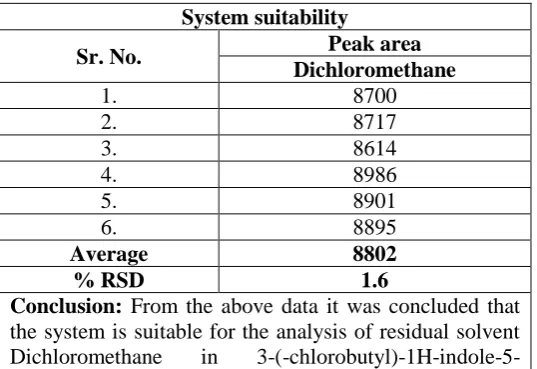
Table 3: System suitability.
System suitability
Sr. No. Peak area
Dichloromethane
1. 8700
2. 8717
3. 8614
4. 8986
5. 8901
6. 8895
Average 8802
% RSD 1.6
Table 4: System precision.
Acceptance criteria:
% RSD of peak area of individual solvents peaks from six standard injections of standard solution (system suitability solution) should not be more than 15.0 %.
System suitability:
Sr. No. Peak area
Dichloromethane
1 8297
2 8415
3 8208
4 8610
5 8445
6 8397
Average 8395
%RSD 1.6
[image:17.595.65.532.365.655.2]Observation: The %RSD for Dichloromethane calculated from area of 6 injections is 1.4%
Table 5: Method precision.
Acceptance criteria:
% RSD of peak area of all the solvents peaks from six standard injections of Standard solution should not be more than 15.0 %.
Method precision set peak areas:
Sr. No. Peak area
Dichloromethane
1 2030
2 2055
3 2008
4 2041
5 2063
6 2096
Average 2049
%RSD 1.5
Acceptance criteria:
% RSD for individual residual solvents of six preparations is not more than 15.0 %. Observation:
% RSD for individual residual solvents of six preparations is less than 15.0 %. Conclusion:
The contents of solvents were found in acceptable % RSD of less than 15.0 %.
Table 6: Limit of Detection.
Limit of Detection:
LOD solution S/N ratio
LOD solution preparation-1 4
LOD solution preparation-2 6
LOD solution preparation-3 5
Observation:
Signal to Noise ratio is established to about 3 Limit of Quantitation & LOQ Precision:
Sr. No. Peak area of Dichloromethane S/N Ratio
LOQ preaparation-1 1107 10
LOQ preaparation-2 1078 12
LOQ preaparation-3 943 10
LOQ preaparation-4 1057 13
LOQ preaparation-5 1191 10
LOQ preaparation-6 1101 10
Average 1080
%RSD 7.5
Observation: Signal to Noise ratio is established to about 10 %RSD for precision at LOQ level for dichloromethane is 7.5%
Table 7: Linearity study.
Results of Linearity study: Linearity Plot of Dichloromethane:
Linearity level Concentration (ppm) peak area
LOQ% 59.697 936
50% 75.616 1308
75% 113.424 1903
100% 149.243 2401
125% 187.051 2766
150% 224.859 3568
Correlation coefficient 0.995
Y-intercept 121.84
[image:18.595.90.503.388.744.2]Table 8: Accuracy data.
Control sample peak areas:
Control sample Peak area
Dichloromethane
Preparation-1 Not Detected
Preparation-2 Not Detected
Preparation-3 Not Detected
LOQ level peak areas:
LOQ level Peak area
Dichloromethane
Preparation-1 1278
Preparation-2 1108
Preparation-3 1293
Average 1226
100 % level peak areas:
100 % level Peak area
Dichloromethane
Preparation-1 3069
Preparation-2 3042
Preparation-3 3119
Average 3077
150 % level peak areas:
150 %level Peak area
Dichloromethane
Preparation-1 4363
Preparation-2 4537
Preparation-3 4467
Average 4456
%Recovery results :
Level LOQ Level 100% level 150% level
Preparation-1 108 104 98
Preparation-2 94 103 102
Preparation-3 110 106 101
Average 104 104 100
SD 8.72 1.53 2.08
% RSD 8.4 1.5 2.1
Acceptance criteria:
The recovery for each level should be as per table given below:
Sr. No Level Acceptable % recovery
1 LOQ Level Between 80.0 and 120.0
2 100 % Level Between 85.0 and 115.0
Table 9: Method Precision and Intermediate Precision.
Method precision and Intermediate Precision Results (ppm)
Method Precision Sets Dichloromethane
1 144.07
2 145.81
3 142.48
4 144.92
5 146.39
6 148.90
Intermediate Precision
Sets Dichloromethane
1 130.37
2 150.76
3 136.88
4 149.24
5 149.45
6 153.09
Overall Average 145.20
Overall SD 6.33
Overall %RSD 4.4
Observation:
% RSD for Dichloromethane from the area of six preparations is less than 15.0 %.
% RSD for Dichloromethane content (in ppm) from six preparations is less than 15.0 %. Cumulative %RSD for Dichloromethane in ppm obtained from method precision and ruggedness is less than 15.0%
5. CONCLUSIONS
Aanalytical method validation study for residual solvent by GC of
3-(-chlorobutyl)-1H-indole-5-carbonitrile drug substance is done as per the requirement of analytical R&D.
Precision and system suitability is established as mentioned in the test method. The test
method is specific for the estimation of residual solvent in
3-(-chlorobutyl)-1H-indole-5-carbonitrile drug substance. The test method is precise for the estimation of residual solvent
in 3-(-chlorobutyl)-1H-indole-5-carbonitrile drug substance, which was indicated from the
acceptable %RSD of six residual solvents test results obtained during method precision study.
The test method is linear for Dichloromethane over the range of LOQ to 150% of target
concentration for the analyte response with an acceptable correlation coefficient values at
100% drug. The test method is accurate over the range of LOQ to 150% of target
concentration for the estimation of residual solvent in
6. REFERENCES
1. Dawson LA, Watson JM. Vilazodone: A 5HT1a receptor agonist/ serotonin transporter
inhibitor for treatment of affective disorders. CNS Neurosci Ther. 2009; 15(2): 107-117.
2. Hughes ZA, Starr KR, Langmead CJ, Hill M, Bartoszyk GD, Hagan J, et al.
Neurochemical evaluation of the novel 5-HT1A receptor partial agonist/serotonin
reuptake inhibitor, vilazodone. Eur J Pharmacol. 2005; 510(1-2): 49-57.
3. Willard H, Merritt L, Dear J, Settle F, ed7, Instrumental method of analysis, CBS
Publishers and Distributors, New Delhi, pp 118-158.
4. B. Parameswara Reddy, N. Pramod, P. Venkateswararao, A.M.S. Sudhakarbabu; Method
developmentand validation for the assay of Vilazodone in bulk and formulation by using
RPHPLC technique, International Journal of Biological & Pharmaceutical Research,
2012; 3(6): 789-795.
5. Yasser A. Z, Farag R. S, Elnawawy M, Ahmed M. A, Alsalam S. R, Spectrophotometric
method for the determination of Trazodone hydrochloride in pharmaceutical
formulations, International Journal of Pharmaceutical Research, 2011; 2(11): 2798-2800.
6. Reddy B. P, Pramod N, VenkateswararaoP, Sudhakarbabu A. M. S, Method development
and validation for the assay of Vilazodone in bulk and formulation by using RP-HPLC
technique, International Journal of Biological & Pharmaceutical Research, 2012; 3(6):
789-795.
7. Ravi Prakash P. V. D. L. S, Sumadhuri B, Srikanth M, Validated HPLC-MS/MS Method
for Determination of Trazodone in Human Plasma, Open Access Scientific Reports,
2013; 2(2): 1-5.
8. Lovett L. J, Nygarda G. A, Khalil S. K, A Simple HPLC Method for the Determination of
Trazodone Human Serum, Journal of Liquid Chromatography, 1987; 10(5): 909-919.
9. International conference on harmonization (ICH), Q2B: Validation of analytical
procedure: Methodology, USFDA federal register. 1997.