and UNVER, Ertu
Available from Sheffield Hallam University Research Archive (SHURA) at:
http://shura.shu.ac.uk/8667/
This document is the author deposited version. You are advised to consult the
publisher's version if you wish to cite from it.
Published version
ATKINSON, Paul, DEAN, Lionel, T. and UNVER, Ertu (2003). ‘Future factories’:
teaching Techné. In: Techné: Design Wisdom: The 5th European Academy of Design
Conference, Universitat te Barcelona, April 2003. (Unpublished)
Copyright and re-use policy
See
http://shura.shu.ac.uk/information.html
Sheffield Hallam University Research Archive
'Future factories':
teaching techné
Paul Atkinson
and
Lionel Theodore Dean
INTRODUCTION: BACKGROUND TO THE PROJECT
,The phenomenon of the ‘Artist-in-Residence’ has a long-standing precedent in many areas of social and business activity where the imperative to present a different perspective on a number of aspects of everyday activity and to bring art into otherwise aesthetically impoverished environments has been seen to be of great benefit. Consequently, their appearance in corporations and state institutions is well known. Their place in an art education setting is perhaps less frequent, but by no means unusual, as the educational value of regular exposure to a ‘qualified’ or ‘experienced’ practitioner carrying out their own work has long been recognised. However, the use of a ‘Designer-in-Residence’ in a design for production education setting (as opposed to a designer-maker or craft environment) is perhaps even less well documented.
The School of Design Technology at the University of Huddersfield recently decided to allocate an amount of research funding to provide an ‘Artist-in-Residence’ to work alongside Fine Art students, and a ‘Designer-in-Residence’ to work alongside Product and Transport design students for a period of one year.
The detailed description of the role of the Designer-in-Residence in educational terms; the benefits to students in improving project management and time planning; and seeing the pace of professional design work in real time are substantial, but perhaps the subject of a slightly different paper to this one. Here, we wish instead to concentrate not so much on the process of using a Designer-in-Residence, but on the content of the particular project being undertaken, the far-reaching implications the work has for the practice of design and design education both on a theoretical and philosophical as well as a more pragmatic level.
The title of the project ‘Future Factories’ describes the exploration of the potential for direct digital manufacturing, using the latest CAD 3D modelling and rapid prototyping techniques, in which a random element of variance is introduced by the computer software. The outputs from this practice-based research project are expected to consist of a number of inspirational products produced as a result of the residency itself, which will be exhibited in a traditional gallery environment and later digitally – either on-line or by CD-ROM dissemination.
Alongside the practice-based research outputs, it is hoped there will be a publication describing the parallel Designer-in-Residence and Artist-in-Residence projects at Huddersfield in a pedagogic context, as well as a number of different academic papers (of which this is one) addressing the different theoretical and contextual issues raised by the content of the ‘Future Factories’ project.
THE 'FUTURE FACTORIES' PROJECT
artefact physically produced will be a one-off variant of an organic design that has been defined by the designer and maintained in a constant state of metamorphosis by the computer software. This variance may be over parameters such as the relative positioning of features, scale, proportion, surface texture, pattern, and the like. These variable factors may be multiple and interrelated. The intention is to achieve subtly different aesthetics based on a central theme rather than mere differentiation that might be achieved by say scale or colour change alone. This random variance would simulate the lack of uniformity in one-off craft production where the craftsperson may be guided by a design intent rather than a toleranced production drawing. In this way, ‘Future Factories’ aims to overcome the split between the technological and the aesthetic, between artistic creativity and machine production – addressing in essence, ‘Techné’ – the integration of beauty, technical knowledge, and industry.
WHY INDIVIDUAL PRODUCTION?
Mass production itself is a relatively recent concept. Prior to mass production artefacts would be produced by craftsmen whose individual skills would be reflected in the product. The artefacts produced would be individual interpretations of a design formula. Each artefact produced could be more or less faithful to the original ‘specification’. The design might be adapted to suit changes in stock material or to work around a fault or blemish. As well as variance introduced by the manufacturer the process itself might have an effect. The process used might not be fully controllable. Many craft processes are a balance between demands made of the process and the control of it, hand-blown glass for example. A craftsperson's mistake, rather than resulting in scrap, might produce an interesting twist on an old theme. The design formula itself might be organic, developing and mutating over time. This lack of uniformity, far from being seen as a negative by the consumer is often valued. Mass production depends on uniformity. Since the worldwide adoption of the mass production model the goal of manufacturing has been accurate repeatability. This has had a number of beneficial effects. Mass production has made desirable objects affordable. The size of the market allows levels of design development and the use of sophisticated processes not possible at lower volumes.
There is however a perception that something has been lost. In today’s consumer world we are surrounded by every conceivable product for every possible application, all at affordable prices. This availability and the omnipresence of mass-merchandise fosters within us a desire for something personal and unique, something we can imbue with a soul or character of its own. 'Future Factories' considers the automated production of one-off pieces from organic, ever changing designs, which promotes the notion of the unique and fosters the processes of personalisation.
MASS CUSTOMIZATION
It is perhaps pertinent here to specify what 'Future Factories' is not - and it is not 'Mass Customization'. 'Mass Customization' can be defined as 'a delivery process through which mass-market goods and services are individualised to satisfy a very specific customer need at an affordable price. Based on the public's growing desire for product personalisation, it serves as the ultimate combination of "custom made" and "mass produced"' (Fu 2002: 44). The term 'Mass Customization was coined by Stan Davies in his book Future Perfect(Davies 1987).
of body parts to enable the production of a ‘tailor made’ product. Consequently, examples of mass customized products range from genuine medical 'needs' such as perfectly fitting hearing aids (Fu 2002) to desired product differentiation in a kitchen stove or better-fitting bespoke jeans (Marsh 1997).
In contrast to mass customization, the 'Future Factories' model derives no input from the consumer. Where mass customization consists of consumer selection and specification, 'Future Factories' allows the consumer only to select the moment at which the process of form generation is arrested. Each artefact produced is therefore a one-off realization of the designer's formula. It is the automated one-one-off production of an ever changing organic design in a constant state of metamorphosis.
COMPUTER GENERATION OF FORM
We do not claim here that the notion of computer generation of random form is an original one in itself. The capability of computers to add an element of random selection to any mathematical function has been long appreciated. As computers have increased in power and speed, the capacity to randomly generate complex three-dimensional forms can be seen as a logical development of that capability. Perhaps some of the best-known computer generated forms are those resulting from the collaboration between the artist William Latham and the mathematician and computer graphics expert Stephen Todd. Latham had developed a hand-drawn system for generating abstract form called ‘form synth’ in which geometric forms could be added together, undergo a series of pre-determined deformations and then join with other forms to ‘marry’ and create ‘offspring’ consisting of complex forms bearing characteristics of both ‘parent’ forms. Using the extensive resources of IBM’s UK Scientific Centre at Winchester, in the late 1980s Todd developed this method and joined it with elements of Richard Dawkins' ‘Biomorph’ system (Dawkins 1993) that demonstrated the power of natural selection, in order to create a powerful piece of software called ‘Mutator’. The detailed explanation of the workings of this system is best left to those who created it (Todd & Latham 1992), but the end results are staggering. The system has developed a great deal since, most notably in its widely disseminated form as the ‘organic art’ software package [figures 1-3] (Computer Artworks 1995); yet its potential has not yet been fully realised. Hopefully the ‘Future Factories’ concept will explore a small part of this potential.
Basically ‘Mutator’ took Latham’s ‘form synth’ principle and expanded it exponentially. Incredibly complex forms would mutate and create eight different offspring. One ‘child’ could then be selected and a new series of mutations created from that selection. Mutations could then be judged as to how ‘good’ or ‘bad’ their forms were considered, and those judgements used to ‘steer’ the next generation of evolutionary mutation.
The similarities of the process to natural evolution have led to Latham being referred to as a ‘Digital Darwin’ (Cook 1996: 14-16). The driving force behind ‘Mutator’ was the creation of art. As the
Figures 1 - 3: Organic 3D forms generated (or created?) by Paul Atkinson using the 'Organic Art' software package.
authors stated, ‘some artists feel that it provides a genuinely new way of working, and it has certainly led to the creation of forms that would not have been created by other methods’ (Todd & Latham 1992: 105). Although the resulting ‘sculptures’ were only ever intended to be seen as 2D representations of complex 3D models presented as art in a gallery context, the principle behind it can just as easily be used to create variations on ‘usable’ forms to produce designs for ‘anything from buildings to shampoo bottles’ (Computer Artworks 2003).
DESIGN FORMULA
The creation of computer generated art has little in the way of physical constraints. The adaptation of these forms into functional products though, obviously requires stricter control. Advances in computer added design have brought a shift to parametric solutions as a methodology for the definition of computer models (3d designs). In parametric design, relationships between the degrees of freedom of a model, instead of the degrees of freedom themselves, are specified. Using parametric design software designs can be quickly manipulated, and alternate solutions considered, simply by changing the variables, or parameters that define the product.
The 'Future Factories' designs are defined by 3d parametric models. In these models, ranges are set for certain parameters within which values are assigned at random by the computer. The range limits, along with further interdependent parametric relationships are imposed by the designer to maintain function and the desired aesthetic. This leaves an organic model free to mutate within a series of interrelated parameter envelopes. Each organic design is defined by a production formula, which can yield an infinite range of equally valid outcomes. We are able to categorise objects in nature by the recognition of certain common patterns and proportional relationships in spite of significant variance. 'Future Factories' aims to achieve this same balance between order and chaos, between manufactured uniformity and individual sensibilities. It aims to develop a system for the automated production of one-off outcomes that are at once distinctly individual and at the same time of a recognizable design.
Two fundamental approaches to the concept of product variance in the 'Future Factories' model have been identified in the work to date; manipulation of the core 3d form and the application to the core 3d form of a variable feature.
The 'Twist' candlestick’s footprint [Figures 4, 5] is fixed, the legs being evenly spaced and at a fixed separation, for stability. The tops of the legs are also constrained but not fully. Each top is required to remain in the same radial plane as a foot, this is again is for stability. The height of each leg may vary, separately, between a maximum and a minimum value. A relationship is applied to ensure an even spread of heights between the legs. This
relationship prevents an outcome with two legs close to maximum height and one close to the minimum, or the reverse scenario. The only constraints on the form of the legs between top and bottom are the degree of interference required for a joint to be made, and that the legs spiral in the same sense and in a smooth curve.
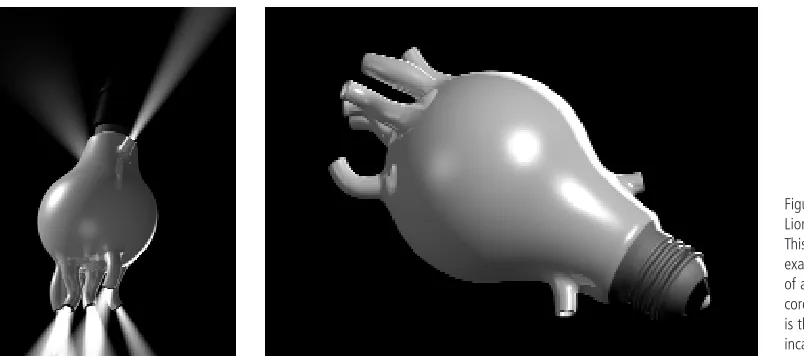
In the 'Mutant bulb' [Figure 56, 7], the light source is a series of high intensity white Light Emitting Diodes (LED's). The LED's are mounted in the ends of ‘tentacles’ which appear to grow at random from the bulb form. The end of each ‘tentacle’ is dimensionally constrained to accept an LED and the direction in which the LED points is restricted to certain angles from the vertical (to avoid glare). Three distinct characters of ‘tentacle’ have been designed;
• ‘Drops’ form like stalactites on the lower half of the bulb tapering as they ‘grow’ downwards as if under gravity.
• ‘Tentacles’ form like drops from the lower half of the bulb, these however are able to resist gravity to an extent, they have a tendency to curl and coil.
• ‘Risers’ form like stalagmites rising up from the upper half of the bulb. As they rise they lean out from the bulb body and begin to curl under gravity.
These ‘Tentacle’ types appear in varying proportion and random positions over the bulb form. Each can then vary in form based on its type.
THE 'FUTURE FACTORIES' SYSTEM
[image:6.596.77.479.99.278.2]In 'Future Factories', a production system is envisaged in which the consumer is presented with a 3d digital model of the artefact via a website. The consumer may access the website directly or through a sales outlet, at a gallery or in a department store for example. The web site, the ‘Future Factory’ itself, would have a series of ‘production lines’ corresponding to different products. When a particular production line is selected the user is presented with a computer animation showing that particular product design metamorphosis within a parameter envelope specified by the designer. At any given point the consumer may freeze the animation effectively creating a one-off design on screen. Should the consumer wish they might then proceed with an order, in which case the relevant digital production files (stl etc.) would be generated automatically and sent to the relevant RP production facility. An artefact, effectively a one-off, will then be manufactured using layer additive manufacturing (rapid prototyping) techniques. This may be achieved directly, via laser sintering in a suitable material for example, or
indirectly via the production of a single use tool or pattern. It should be pointed out that the intention is not for the consumer to use the animation to adjust design features to their liking. The animation is changing in real time and is outside their control (this would hopefully be part of the allure). A variant can be ‘designed’ for them and they can choose to order it or not.
WEPROGRESS SO FAR
A small series of organic product designs have been produced and defined parametrically. Domestic interior products, principally lighting and tableware have been considered for the project thus far. Domestic interior products is a market well used to paying a premium for design and materials technology. Lighting and tableware have been selected to keep the artefacts relatively small (though it should be noted that currently, the largest laser sintering machine commercially available in the UK is 700 Xx 500 x 350mm). The designs selected are for production in cast aluminium. They make use of the layer additive production methods to achieve complex forms almost impossible to achieve with multiple use tooling. This necessitates the use of investment casting with wax patterns for use in the process being produced by a layer additive process.
We are currently developing computer animations that illustrate the designs and the potential variance within them. A new computer program is being developed to enable the generation of digital production files direct from a selected animation frame. These STL files would then be used to directly produce wax patterns for investment casting in aluminium
TECHNÉ
It is clear to see from the detailed description of the ‘Future Factories’ project that it represents a true convergence of art and science; the aesthetic and the technological; between creativity and production. This integration of the human perception of beauty; the randomly mutated, computer generation of form; and purely neutral cutting-edge industrial production is a far more complex issue than it might at first appear. This is no simple human/machine interface or human/computer binary opposite we are dealing with, but the very nature of 'techné - art and science as one.
The adoption of such a design/production paradigm as the one being put forward by ‘Future Factories’ raises a whole series of complex issues about the role of the designer. If the user makes an aesthetic judgment on a form, the precise configuration of which has been generated by a piece of software, then who has ‘designed’ it? Is the designer’s role in setting up the algorithms to be employed, the variables and constraints within which the computer generates the form, and the parameter envelopes which limit the amount of variation a major contribution to the finished artefact, or a fairly arbitrary minor consideration? The same problems were encountered by Todd and Latham with respect to the sculptures created via the 'Mutator' code: 'Who owns the copyright? What is copyright? The generative system? The genetic code for a final form? The computer form? The computer image? The artwork on a gallery wall?' (Todd & Latham 1992: 210). The potential effects on the practice of design are considerable. Whatever the future holds for design practice, there is certain to be serious changes occuring. Obviously, the future role of the designer and where he or she fits into the design process is one that will need to be examined closely and perhaps readdressed.
concerned with the conception of form leading to the production of a specification for later large-scale manufacture by a third party, then the distinction between a craft-person and a designer is clear. Following this distinction, ‘Future Factories’ aims to allow the use of a designed system to select a form randomly generated by computer software for immediate one-off production by machine. Although such a system has the capacity to make an infinite variety of related forms, it also has the capacity to reproduce exactly the same form, to a massively high level of accuracy, for an unspecified number of repetitions.
The ‘Future Factories’ system, then, would be seen to fit both the definition of craft, in that it allows one-off variations in form; of design, in allowing repetitive production of the same form; or neither as the form is not generated or conceived by the person who selects it, or even by the designer who specified the parameters within which it was designed. In this context, the previously understood definitions of ‘craft’ and ‘design’ as discrete processes become hopelessly blurred, intertwined, inextricable, and as a result, meaningless. Perhaps a completely new terminology will be required to describe such a phenomenon to define its unique nature. The impact on the understanding of design and its practice is potentially huge.
TEACHING TECHNÉ
As far as the impact on design education is concerned, every aspect of the curriculum may need to be addressed. Working backwards from the proposed manufacturing concept, the element of taught CAD would be concerned less with its integration with tool production and the generation of a specification in the form of a solid model geometry or a set of tolerance drawings; and more concerned with its output as a producible entity by a direct digital manufacturing process such as (for example) layer additive rapid prototyping.
The teaching of materials and processes for manufacture premised on mass-production would, of course, also have to be reduced or replaced with a higher level of emphasis given to complex organic forms and correspondingly suitable content to support such new digital technologies.
It is possible that even the visualisation skills taught will be affected if, as is entirely plausible, the final production techniques employed influence the conception of forms in the design process. To what extent are our current designers’ forms for products influenced by the ease of manufacture in injection moulded components?
And perhaps, going right back to the starting point of project briefs – how many are based on the premise of a particular product to be produced in quantity for a certain age/gender/lifestyle or so on? There will almost certainly need to be a move from the ‘accepted wisdom’ of market research in its constant quest for a series of common denominators aiming to produce a product profile to fit the largest possible group of people. There will be a need, perhaps, to consider in far more depth the user needs of individuals – more attention paid to personal preference, the celebration of diversity over convergence. If the notion of the brand ethos were to continue in this scenario, surely it would have to move further into the realm of communicating individual meaning rather than ‘lifestyle’ or ‘brand values’ of a group of people, sharing some manufactured and marketed heterogeneity.
CONCLUSIONS
At the time of writing, the ‘Future Factories’ project can be seen to have been a resounding success both in terms of a practice-based research project, and as an exercise in design pedagogy. The next stage in the project will be to expand the range of different items produced, and create more examples of products arising from each design formula. These will be exhibited in a number of gallery settings as individual or touring exhibitions. Further dissemination of the work produced will initially be done through the creation of a virtual gallery within the research section of the School website, and the production of a CD-Rom of the work is a distinct possibility.
The project has demonstrated that the potential of computer-generated organic forms to produce viable artefacts for one-off production, hinted at by the creators of the original ‘mutator’ code is at last a realistic proposition. The outputs from ‘Future Factories’ will be used as evidence to support bids for external funding to develop the required software further, and to purchase the hardware required to realise and trial the production of finished artefacts in-house.
The ‘one design fits all’ paradigm of modernist mass production may well have been expanded through the use of interchangeable components to allow for more variation on finishes and textures of standard products. The sheer range of models produced of most consumer products points towards confirmation of the ‘myth’ of mass production where the number of identical products is minimal. However, in most cases, the differences are superficial, and limited to the surface features of products. The economy of scale in producing similar products still holds sway – for all the variety of any model of mobile phones for example, the internal components remain standardised, and manufacturing technology is such that at least some elements of the political ideologies of modernism remain. The phone may look different, but its capabilities as a functional product are dictated by the manufacturer.
Obviously, ‘Future Factories’ is not a suitable model for the production of complex technological objects (at least not yet). But the design thinking behind it, and the manufacturing system proposed fits far more comfortably within the tenets of post modernism, and the drive for individuality associated with that philosophy.
As a piece of pedagogic research, the experience of having a designer-in-residence in an educational setting needs to be analysed and reflected upon, and the benefits disseminated through publication in journal articles and conference papers, and possibly in book form. It is clear, however, that the impact on design education of teaching techné is potentially huge.
REFERENCES
Computer Artworks (1995) Organic Art software, GT Interactive http://www.artworks.co.uk
Computer Artworks (2003) http://www.artworks.co.uk/index2.htmaccessed 27 January 2003 Cook D (1996) ‘Digital Darwin’ in Creative Technology, Feb 1996 pp 14-19
Crayton, T (2001) 'The Design Implications of Mass Customisation' in Architectural Design, April 2001 pp 74-81 Davies, S (1987) Future Perfect, New York, Addison-Wesley
Dawkins, R (1993) Blind Watchmaker software,W.W.Norton And Co.
Fu, P (2002) 'Custom Manufacturing: from engineering evolution to manufacturing a revolution' in Time Compression Technologies, April 2002 10/2 pp 44-48
Marsh, P (1997) 'Making to Measure' in Design,Spring 1997 pp 32-37