Assigning Types to Processes
(Extended Abstract)
Nobuko Yoshida
ny11@mcs:le:ac:uk MCS, University of Leicester, UK
Matthew Hennessy
matthewh@cogs:susx:ac:uk COGS, University of Sussex, UK
Abstract
In wide area distributed systems it is now common for higher-order code to be transferred from one domain to an-other; the receiving host may initialise parameters and then execute the code in its local environment. In this paper we propose a fine-grained typing system for a higher-order π-calculus which can be used to control the effect of such mi-grating code on local environments. Processes may be as-signed different types depending on their intended use. This is in contrast to most of the previous work on typing pro-cesses where all propro-cesses are typed by a unique constant type, indicating essentially that they are well-typed relative to a particular environment.
Our process type takes a form of an interface limiting the resources to which it has access, and the types at which they may be used. Allowing resource names to appear both in process types and process terms, as interaction ports, complicates the typing system considerably. For the devel-opment of a coherent typing system, we use a kinding tech-nique, similar to that used by the subtyping of the system F , and order-theoretic properties of our subtyping relation.
Various examples of this paper illustrate the use of our fine-grained typing system for distributed systems. As a spe-cific application we define a new typed behavioural equiva-lence for the higher-orderπ-calculus. The expressiveness of our types enables us to state and prove interesting identities between typed processes.
1. Introduction
Background In the distributed computing environments nowadays, it is common for higher-order code to be trans-ferred from one domain to another [10, 23, 25]. This is recognised as dangerous and various schemes have been put forward to ensure the integrity of systems in the presence of such operations. In this paper we propose a new subtyping system which can be used to control the effect of migrating code on local environments. Our investigation is in terms of a higher-orderπ-calculus in which values, including pro-cess terms, can be exchanged along communication chan-nels [3, 29, 37]. We believe that our typing system can be readily adapted to related location based distributed calculi
such as [5, 8, 18, 12, 28, 34].
Higher-Order Processes The language we consider,λπv,
is essentially a call-by-valueλ-calculus [9] augmented with theπ-calculus primitives [22]. For example,
c?(x :τ)f x (1)
is a process which inputs a value of type τon channel c and applies to it the function f . This process will be well-typed only in an environment in which the channel c has the capability to input values of type τ, written c :(τ)
I , and f denotes a function of type(τ!proc); here, as in [26, 37], we useprocto denote the type of processes.
As usual we allow as values arbitrary abstractions, but much of the descriptive power ofλπvcomes from the ability
to form values by abstracting over processes. For example
(unit!proc)is the type of thunked processes; we use this type so frequently that we will abbreviate it tohproci. Values of this type, of the formλ(x :unit):P, will also be abbreviated tohPi. Such values can be exchanged between processes and subsequently executed, by applying the func-tionλy:y(); again for the sake of clarity we use run to de-note this function. So in (1) above, ifτis the thunked type
hprociand f is the function run, the process may input a thunked processhPion channel c and execute it.
In papers such as [3, 21, 26, 27, 33, 37] typing systems have been suggested which ensure that programs written in λπv-related languages are well-behaved. The main
judge-ments normally take the form
Γ`P :proc
indicating that the term P is a well-typed process relative to the typing environment Γ. Here Γ is a mapping from channel names or variables to input/output capabilities or value types;Γ(c)determines the type of values which chan-nel c may transmit/receive. Thus “c?(x :τ) f x” in (1), will be well-typed in any environmentΓwhich allows c the in-put capability hproci, assuming of course that f is also a well-typed expression of typehproci!proc, such as Γfc :hproci
I
;f :hproci!procg.
de-fine the abstraction
Fw
(called a forwarder in [16]) λxλy(x?(z :int)y!hzi)which repeatedly inputs some value of a typeinton chan-nel x and outputs it immediately on y. If the chanchan-nels a;b are assigned suitable types then both the valuesh
Fw
(ab)i andhFw
(ba)ihave typehprociand thus may be sent along channel c to a process such asc?(x :τ)run x (2)
But accepting these processes for execution confers on the incoming code different access rights. In the first case the incoming code is allowed to read from channel a and write to channel b while in the second case these rights are re-versed. Typing systems in which code can only be assigned the undifferentiated typeprocdo not provide any mecha-nism for limiting the effect of incoming code.
Typing processes In this paper we extend the typing sys-tems of [37, 26, 12] by allowing processes to have types which bound the resources which they may use. The basic idea is straightforward. For processes inλπvwe will allow
judgements of the form
Γ`P :[∆]
where∆ is a finite environment, mapping channel names to capabilities. Intuitively this means that relative toΓthe term P denotes a well-defined process which uses at most the resources in the domain of∆; moreover their use is in accordance with the capabilities given in∆. Thus the type
[∆]may be viewed as a process interface. For example let∆ab;∆
badenote the environments
fa :(int) I
;b :(int) O
g; fb :(int) I
;a :(int) O
g respectively where(int)
I
and(int) O
represent the input and output capabilities of a typeint. Then, for a suitableΓ we will be able to derive the judgements
Γ`
Fw
(ab): [∆ab] and Γ`Fw
(ba): [∆ba] These more discriminating types for processes allow pro-cesses to be, in turn, more discriminating in the type of val-ues which they will accept. Thusc?(x :h∆
abi)run x
indicates that it is only willing to accept processes for ex-ecution if they at most read from resource a and write to b. Let us denote c!hPifor an output process which sends a thunked processhPito a channel c. Thus, for example, a process
c!h
Fw
(ab)i j c?(x :h∆abi)run xis well-typed while
c!h
Fw
(ba)i j c?(x :h∆abi)run xis not; the (thunked) process h
Fw
(ba)i is not acceptable along c as it does not conform to the interface decreed by the host,∆ab.This ability to constrain the effect of imported code means that host processes can maintain the consistency of local resources. For example consider the following exam-ple: nesting process types give even further control over code behaviour.
req?(y :h∆ci)(run yjc?(x :h∆ai)(run xja?(z :int)P)) whereh∆aidenotes the typeha :(int)
O
iandh∆cidenotes hc :h∆ai
O
i. The annotated types ensure that (1) the code downloaded on the request channelreqcan only access the resource c, (2) c can only be used to transmit code which can at most access resource a, and (3) all communications to a will be serviced by a?(z :int)P.
Channel abstractions Inλπvprocesses are also allowed
to download abstracted code; code in which resource pa-rameters may be instantiated by the host process before the code is executed. A simple example is the abstraction
Fw
used above. Consider the servers?(z)z!h
Fw
iwhich continually supplies the abstraction
Fw
to requesting clients. A specific client, such as R defined bys!hci c?(y)(y a b);
can download
Fw
and instantiate it with particular channels, such as a;b. Thus in the presence of the server R will evolve to a process which should have a type of the form[a :(int) I
;b :(int) O
;::: ]
Other processes which instantiate
Fw
differently will evolve to processes with different types. For example S defined bys!hci c?(y)(y b a);
will evolve to a process with a type
[b :(int) I
;a :(int) O
;::: ]
However it is difficult to see how to give a type to the ab-straction
Fw
which ensures that R and S are assigned such types. Within our current system of types it would be natu-ral to assign toFw
a functional type of the form(int) I
!(int) O
!π
for some process type π. Ifπis the undifferentiated type
procthen both R and S would inherit this uninformative type. Otherwiseπmust assign some definite capabilities to a and b and assuming that typing is preserved under Subject Reduction these capabilities would be inherited by R and S. That is, they would have the same capabilities on the two resources a and b, contrary to our requirements.
Our solution is to introduce a new form of dependent functional type
(x :σ)!ρ
of x inρare bound occurrences in(x :σ)!ρ.) Thus the abstraction
Fw
will be assigned the type(x :(int) I
)!(y :(int) O
)![x :(int) I
;y :(int) O
] where the result type of the process depends on the type of the abstracted variables.
Results In this paper we formulate a fine-grained subtyp-ing system for the higher-orderπ-calculus following the ba-sic ideas mentioned above. This results in a simple, but non-trivial, extension of the IO-subtyping forπ-calculus [26] to the higher-order setting. The main technical results can be summarised as follows.
1. First, we design a novel notion of type for the higher-orderπ-calculus, in which process have types corre-sponding to interfaces. Because type variables appear both in program terms and in types (in particular the types of processes), the formal definition of what con-stitutes a valid term and a valid type are interdepen-dent and both in turn require a careful definition of even a valid typing environment. An analogous, al-beit somewhat simpler, situation arises in subtyping for the polymorphicλ-calculus [6]. We clarify tech-nical similarities and differences between the two typ-ing systems. Although some techniques developed for theλ-calculus are useful in the current setting, novel concepts are required for process types.
2. Second, we propose a typing system in which many higher-order π-calculus processes can be assigned non-trivial interface types. We prove its soundness (Subject Reduction Theorem) and also establish a Type Safety Theorem, which ensures that no well-typed pro-cess can input higher-order code which does not con-form the local interface of that process.
3. Finally we define a new typed behavioural equivalence for the higher-orderπ-calculus. Our fine-grained types enable us to establish general, and useful, process iden-tities. Their application is illustrated on an example distributed system.
Outline of the Paper Section 2 introduces the types, syn-tax and a reduction semantics ofλπv. Section 3 proposes the
new typing system ofλπvand demonstrates its
expressive-ness by typing the example in Section 2. In Section 4, we prove Subject Reduction and Type Safety Theorems. Sec-tion 5 briefly studies the typed behavioural equalities. Fi-nally Section 6 concludes the paper with further issues and related work. Due to space limitations, the proofs and many examples, including a further application to a distributed higher-orderπ-calculus, are left to the full version [38].
2. A Higher-order Process Language
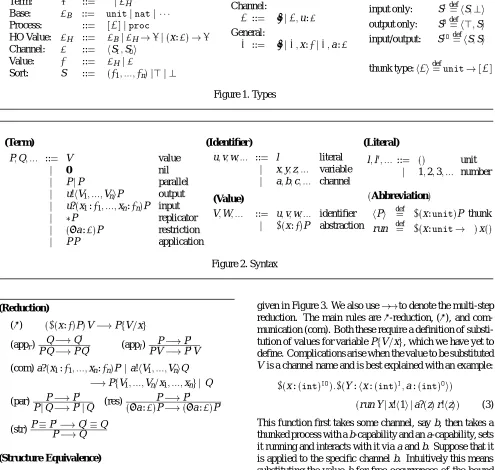
Types The collection of types is a straightforward exten-sion of that from [37]; The formal definition is given in Fig-ure 1; this assumes a set of base types such asunitandnat,
an infinite set of channel or names N, ranged over by a;b;:::, and an infinite set of variables V, ranged over by x;y;::. For the sake of clarity we will sometimes use X;Y;:::as vari-ables, whenever we intend them to be substituted specifi-cally by higher order values rather than channels.
Channel types are as in [37], in turn an elaboration of the IO-types of [12, 26]; they take the formhS
I ;S
O i, a pair consisting of an input sort SI and an output sort SO; these input/output sorts are in turn either a general value type or
>, denoting the highest capability, or?, denoting the low-est; as explained in [37] the representation of IO-types as a tuple [13, 12] makes the integration with the arrow types of theλ-calculus more natural. Moreover the IO-types of [26] can also be represented as a special case of our IO-types, using the abbreviations given in Figure 1.
There are three kinds of value types: base types, channel types as already explained or HO-value types, ranged over byσH. These can be formed using either of the functional
type constructors,σH!ρor(x :σ)!ρ, whereρin turn is either a HO-value type or a process type. Process types can either be the constantproc(also denotedin [26]), or a type environment[∆]where∆is a mapping from N[V to channel types; the formation rules for environments are also given in Figure 1.
Example 2.1 (Types)
(1) The nil process, with no capabilities, has the type[ ]. (2) A process which can outputnatat a and inputboolat
b has the type [a :(nat) O
;b :(bool) I
].
(3) A HO process which can output a thunked value of type (2) at c has the type[c :ha :(nat)
O
;b :(bool) I
i O
]. (4) A higher order identity function over thunked values
of type (2) has the type
ha :(nat) O
;b :(bool) I
i!ha :(nat) O
;b :(bool) I
i. (5) A dependent function which is applied to some name a
and constructs a process of type [b :(nat) I
;a :(nat) O
] has the type(x :(nat)
O
)![b :(nat) I
;x :(nat) O
].
Syntax The syntax for terms in the languageλπvis given
in Figure 2. It is essentially the same as that used in [37] except that we use the more expressive types, from Fig-ure 1. We use the standard notational conventions, for example ignoring trailing occurrences of the empty pro-cess 0 and omitting type annotations unless they are rele-vant. We also define the notions of free names fn(P)and free variablesfv(P)of terms which may appear in the an-notated types. The formal definitions are available in the Appendix of [38], but as an example fv(u?(x1:τ1;:::;xn: τn)P)=fv(u)[fv(τ1)[:::[fv(τn)[fv(P);fx1;:::;xng:
Reduction Semantics The term P is called a program if it contains no free variables, i.e.fv(P)=/0. The reduction semantics is given in terms of a binary relation
P;!Q
(Type) α;β;γ;::: (Environment) (Abbreviation) Term: ρ ::= π jσH
Base: σB ::= unitjnatj Process: π ::= [∆]jproc
HO Value: σH ::= σBjσH!ρj(x :σ)!ρ Channel: σ ::= hS
I ;S
O i Value: τ ::= σHjσ
Sort: S ::= (τ1;:::;τn)j>j?
Channel:
∆ ::= /0j∆;u :σ General:
Γ ::= /0jΓ;x :τjΓ;a :σ
input only: SI
def
=hS;?i output only: SO
def
=h>;Si input/output: SIO
def
=hS;Si
thunk type:h∆i
def
=unit![∆]
Figure 1. Types
(Term) (Identifier) (Literal)
P;Q;::: ::= V value
j 0 nil
j PjP parallel
j u!hV1;:::;VniP output j u?(x1:τ1;:::;xn:τn)P input
j P replicator
j (νa :σ)P restriction
j P P application
u;v;w;::: ::= l literal
j x;y;z;::: variable j a;b;c;::: channel
(Value)
V;W;::: ::= u;v;w;::: identifier
j λ(x :τ)P abstraction l;l
0
;::: ::= () unit j 1;2;3;::: number
(Abbreviation)
hPi
def
[image:4.612.52.547.88.558.2]= λ(x :unit)P thunk run def= λ(x :unit!π)x()
Figure 2. Syntax
(Reduction)
(β) (λ(x :τ)P)V;!PfV=xg
(appr) Q
;!Q 0 P Q;!P Q
0 (appl)
P;!P 0 PV ;!P
0 V
(com) a?(x1:τ1;:::;xn:τn)P ja!hV1;:::;VniQ
;!PfV1;:::;Vn=x1;:::;xngj Q (par) P;!P
0 PjQ;!P
0 jQ
(res) P;!P 0
(νa :σ)P;!(νa :σ)P 0
(str) PP 0
;!Q 0
Q P;!Q
(Structure Equivalence)
PQ if PαQ.
PjQQjP (PjQ)jRPj(QjR) Pj0P PPjP
(νa :σ)00
(νa :σ)PjQ(νa :σ)(PjQ) if a62fn(Q) (νa :σ)(νb :σ
0
)P (νb :σ 0
)(νa :σ)P if a62fn(σ 0
) and b62fn(σ)
Figure 3. Reduction
should be understandable to those familiar with either the π-calculus or theλ-calculus. It uses the standard structural equivalenceof theπ-calculus; the axioms foris also
given in Figure 3. We also use!!to denote the multi-step reduction. The main rules are β-reduction, (β), and com-munication (com). Both these require a definition of substi-tution of values for variable PfV=xg, which we have yet to define. Complications arise when the value to be substituted V is a channel name and is best explained with an example:
λ(x :(int) IO
):λ(Y :hx :(int) I
;a :(int) O
i)
(run Yjx!h1ija?(z)r!hzi ) (3) This function first takes some channel, say b, then takes a thunked process with a b-capability and an a-capability, sets it running and interacts with it via a and b. Suppose that it is applied to the specific channel b. Intuitively this means substituting the value b for free occurrences of the bound variable x in the body of the function. If the substitution ignores types in the body of the function, we get
λ(Y :hx :(int) I
;a :(int) O
i )(run Yjb!h1ija?(z)r!hzi ) which is not even a program; it contains an occurrence of the free variable x. The proper definition of reduction re-quires that b is also substituted into the types occurring in the body of the function, to give the program
λ(Y :hb :(int) I
;a :(int) O
i)(run Yjb!h1ija?(z)r!hzi ) This also makes sense as this now constrains the function to be only applied to processes which have a b-capability.
>fv=xg=> ?fv=xg=? σBfv=xg=σB procfv=xg=proc
hS I
;S O
ifv=xg = hS I
fv=xg;S O
fv=xgi, (τ1;:::;τn)fv=xg = (τ1fv=xg;:::;τnfv=xg) (σH!ρ)fv=xg = σHfv=xg!ρfv=xg
((y :σ)!ρ)fv=xg = (y :σfv=xg)!ρfv=xg (x6=y) [∆]fv=xg = t[wfv=xg:σfv=xg] (w :σ2∆) Figure 4. Name Substitution into Types
The following is one instance for an input process:
u?(x :τ)PfV=xg
def
=ufV=xg?(x :τfV=xg)PfV=xg However this instance uses the substitution of values into types,τfV=xg. If V is anything other than a channel name or variable this is the identity. So we need only define the substitutionτfv=xg, where v is a channel or channel vari-able; this is defined in Figure 4.
This definition of substitution into types is for the most part straightforward, with one exception which can be ex-plained using the example function (3) above. If this is ap-plied to the name a we would expect to get the result
λ(Y :ha :(int) IO
i)(run Yja!h1ija?(z)r!hzi ) since a is allowed to have an input/output capability(int)
IO in the body. In other words the substitution of the name a for x in the typehx :(int)
I
;a :(int) O
ishould beha :(int) IO
i. This is reflected in the final clause in Figure 4:
[∆]fv=xg=t[wfv=xg:σfv=xg] with w :σ2∆ Heret is an operator on types which intuitively acts like a (partial) least upper bound with respect to a yet to be defined subtyping order on types. The following are simple examples ofton process types, which may be sufficient to read this paper; roughly speaking, tcalculates the union of the accessibility rights of two processes. (The formal definition is available in the Appendix in [38].)
[a :(int) I
]t[b :(int) O
]=[a :(int) I
;b :(int) O
] and [a :(int)
I
]t[a :(int) O
]=[a :(int) IO
]
Now we can analyse the substitution on types in the above example by the following equations.
[x :(int) I
;a :(int) O
]fb=xg =[xfb=xg:(int)
I
]t[a :(int) O
]=[b :(int) I
;a :(int) O
]
[x :(int) I
;a :(int) O
]fa=xg =[xfa=xg:(int)
I
]t[a :(int) O
]=[a :(int) IO
] The properties oft will be discussed in the next section, when we consider well-typed programs. Note that in gen-eraltis a partial operator and therefore apriori substitution is not always defined. However we will see that in properly typed environments it is always well-defined.
Example 2.2 (Interface server and mobile client code)
A (specific) compute service is a process which given
B
Client Client
A
req Interface Server
pred succ service 1
service 2 I
[image:5.612.326.525.56.154.2]p s
Figure 5. Interface Server and Distributed Services
some data and a return address, applies some specified op-eration to the data and returns the result to the address. For some given name a, let Succ(a)represent the process
a?(y;z)z!hsucc(y) i, which we write as
Succ(a)(=a?(y;z)z!hsucc(y)i
This represents a service (forsucc) situated at a. A similar one for the predecessor function,pred, is defined as:
Pred(a)(=a?(y;z)z!hpred(y) i
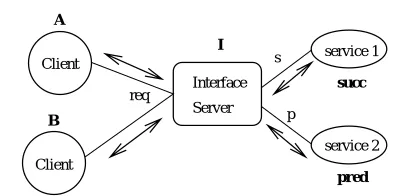
A client may wish a number of operations to be performed on given data, in a particular sequence, with some data for later operations depending on results produced by earlier operations. This situation is given diagrammatically in Fig-ure 5. Here there is an Interface (I) between clients and the collection of services or operations on offer. Now a higher-order script is sent to the interface. This script is executed locally by the interface, which interacts as necessary with the various services. This protocol puts the computational onus on the server and avoids repeated interactions between clients and services. The server at the interface I may then be defined by:
ServI(req;s;p) (= req?(X)X s p
It takes in a script X , a process parameterised on service ports, and applies it to the actual port names of the two lo-cal services, in this case s and p. Note that these actual names are not known to clients, thereby, in this case, af-fording some security protection to the server from clients; all interaction between clients and the server is through the interface req.
We give two examples of clients requesting services. Client (A) wants to increment a number k twice, whereas the Client (B) wants to evaluate the successor and the pre-decessor of two different numbers n and m in parallel.
CA(req)(=
req!hλ(s;p)( (νc)s!hk;cic?(z)s!hz;ciFw(crA))i
CB(req)(= req!hλ(s;p)(νcc
0
)(s!hn;ciFw(c r1B)jp!hm;c 0
iFw(c 0
r2B)) i
The forwarders in their bodies are used to relay the final results to each client on their result channels, rAfor Client
Putting the clients and server together we have the fol-lowing parallel composition (Figure 5):
CA(req)jCB(req)jServI(req;s;p)jSucc(s)jPred(p)
After a certain amount of reductions, k+2 is returned to Client (A) on rA, and n+1 and m;1 are returned to Client (B) on r1Band r2B, respectively.
3. The Fine-Grained Typing System
3.1. Well-formed Types and Environments
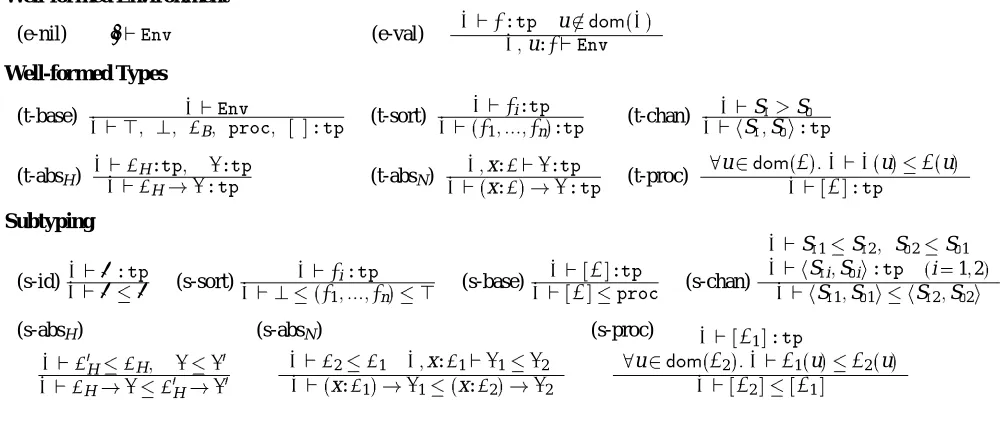
In Figure 6 we present a formal system with three forms of judgements, all interrelated:
Γ ` Env Γis a well-formed environment Γ ` α:tp αis a well-formed type inΓ
Γ ` αα
0
αis less thanα0 inΓ
For convenience we useΓ ` Jas a shorthand for any of the three allowed forms of judgement. The first is designed to ensure that an identifier can only be used in the construction of a type if it has already been declared in the environment. For example one can not deduce
y :hx :(nat) O
i;x :(nat) O
`Env
because the variable x is used in the type associated with y before being introduced. However if they are interchanged then this does constitute a valid environment:
x :(nat) O
; y :hx :(nat) O
i`Env
This emphasises the fact that our typing system will not have an interchange rule; in general being able to form a judgement of the form
Γ;x :τ;y :τ 0
;Γ 0
`J will not necessarily imply
Γ;y :τ 0
;x :τ;Γ 0
`J
When constructing well-formed environments only types which are currently well-formed may be used. This is the purpose of the second form of judgement. So for ex-ample we can not deduce
Γ;y :hy :(nat) O
i`Env To do so we would need to be able to deduce
Γ`hy :(nat) O
i:tp
This in turn is not possible, basically because y is not in the domain ofΓ.
In the rules forΓ` α:tpone is only constrained to use identifiers which are already declared in the current en-vironment. In (t-chan), the condition SI
S
O is necessary to ensure that readers of a channel receive at most the capa-bilities given by a sender. There are only two novelties. In the formation rule for dependent types, (t-absN) the bound
variable x is allowed in the construction of the result type ρ. Secondly the rule (t-proc) ensures a process always has a type∆which does not exceed the current environmentΓ.
Subtyping also plays a role in the formation of environ-ments. For example we can not deduce
a :(nat) O
; y :ha :(nat) IO
i `Env
because the capability associated with a when forming the type associated with y is not a subtype of that associated with a in the current environment. For noΓcan we deduce
Γ `(nat) O
(nat) IO
The rules for subtyping are a straightforward extension of those given in [37, 26, 12], apart from the necessity to only use identifiers declared in the current environment. Func-tion types are contravariant in their first arguments and co-variant in their second, while, in (s-chan), channel types are covariant in the input capability and contravariant in the out-put. Again the only real novelty is the subtyping rule for process types, (s-proc); this means the ordering of process types is contravariant w.r.t. the ordering of [37, 26].
A series of consistency lemmas about this system of judgements follows. They are invariably deduced by induc-tion on the derivainduc-tions in the standard manner. Remem-ber informally X;Y;Z;:::denote variables with higher-order types, as opposed to channel types.
Lemma 3.1 (1) (Renaming) Suppose u62 fv(Γ;v;τ;Γ 0
). Then Γ; u :τ; Γ
0
`J implies Γ; v :τ; Γ 0
fv=ug`
Jfv=ug.
(2) (Implied Judgement) Γ;Γ 0
`J implies Γ`Env and Γ;u :τ;Γ
0
`Env implies Γ`τ:tp. (3) (HO-bound Change) Γ;X :σH;Γ
0
`Jand Γ`σ 0
H:tp
implyΓ;X :σ 0
H;Γ 0
`J.
(4) (Weakening)AssumeΓ;x :τ`Envand u62
dom
(Γ 0). Then Γ;Γ
0
`J impliesΓ;u :τ;Γ 0
`J. (5) (Multiple Weakening) Assume Γ; Γ 00
` Env and
dom
(Γ 0)\
dom
(Γ 00)= /0. Then Γ; Γ 0
`J implies Γ;Γ
00 ;Γ
0 `J.
(6) (Bound Weakening) Assume Γ`τ 0
τ. Then Γ;u :τ;Γ
0
`J implies Γ;u :τ 0
;Γ 0
`J. (7) (Implied Judgement) Γ`αα
0
implies Γ`α:tp and Γ`α
0 :tp.
(8) (HO Narrowing) Γ;X :σH;Γ 0
`J implies Γ;Γ 0
`J. (9) (Exchange) AssumeΓ;u
0 :τ0
`Env. Then we have Γ;u :τ;u
0 :τ0
;Γ 0
`J implies Γ;u 0
:τ0 ;u :τ;Γ
0 `J. Note that in general we can not replace X :σHwith u :σin
the statements (3) and (8) above since the channel u may appear freely inΓ0
andJ. This underlines the major techni-cal difference between our system and the system F<:, [6]; several lemmas for type variables in F<:[6], do not hold for channels in our system.
We now turn our attention to the partial join operatort which plays a crucial role in our definition of substitution,
Definition 3.2 (FBC, cf. [12, 37]) We say that a partial or-der(S;v)is finite bounded complete (FBC) for every finite nonempty subset SS, if S has a lower bound then S has a
Well-formed Environment
(e-nil) /0`Env (e-val)
Γ`τ:tp u62
dom
(Γ) Γ;u :τ`EnvWell-formed Types
(t-base) Γ`Env
Γ`>; ?; σB; proc; [ ]:tp
(t-sort) Γ`τi:tp Γ`(τ1;:::;τn):tp
(t-chan) Γ`S I
S O Γ`hS
I ;S
O i:tp
(t-absH) Γ
`σH:tp; ρ:tp Γ`σH!ρ:tp
(t-absN) Γ
;x :σ`ρ:tp Γ`(x :σ)!ρ:tp
(t-proc) 8u2
dom
(∆):Γ`Γ(u)∆(u) Γ`[∆]:tpSubtyping
(s-id) Γ`α:tp Γ`αα
(s-sort) Γ`τi:tp Γ`?(τ1;:::;τn)>
(s-base) Γ`[∆]:tp Γ`[∆]proc
(s-chan) Γ`S
I1 S
I2 ; S
O2 S
O1 Γ`hS
Ii ;S
Oi
i:tp (i=1;2) Γ`hS
I1 ;S
O1 ihS
I2 ;S
O2 i
(s-absH) (s-absN) (s-proc)
Γ`σ 0
HσH; ρρ 0 Γ`σH!ρσ
0
H!ρ 0
Γ`σ2σ1 Γ;x :σ1`ρ1ρ2 Γ`(x :σ1)!ρ1(x :σ2)!ρ2
Γ`[∆1]:tp
[image:7.612.48.551.65.280.2]8u2
dom
(∆2):Γ`∆1(u)∆2(u) Γ`[∆2][∆1]Figure 6. Well-formed Types and Subtyping
Proposition 3.3 Under an arbitrary well-formed environ-ment, the subtyping relation over types is a partial order and finite bounded complete. 2
The proof of this proposition, available in [38], is construc-tive; we give an inductive definition of the required partial meet operationu; this requires a simultaneous definition of a partial join operation t, the operation we have already used above.
The next Lemma will be important in the proof of Sub-ject Reduction. It shows that, under certain circumstances, a variable can be replaced by an identifier throughout a judge-ment, although this replacement may also change the envi-ronment of the judgement.
Lemma 3.4 (Name substitution) SupposeΓ`Γ(u)σ. ThenΓ;x :σ;Γ
0
`Jimplies Γ;Γ 0
fu=xg`Jfu=xg. 2
Finally we conclude this section with the following prop-erty, which relates to the construction of an efficient algo-rithm of the typing system (cf. [26, 37]).
Proposition 3.5 (Decidability)Γ`J is decidable. More-over, if Γ`αi :tp (i=1;2), then Γ`α1tα2:tpand Γ`α1uα2:tpare decidable. 2
3.2. Type Inference
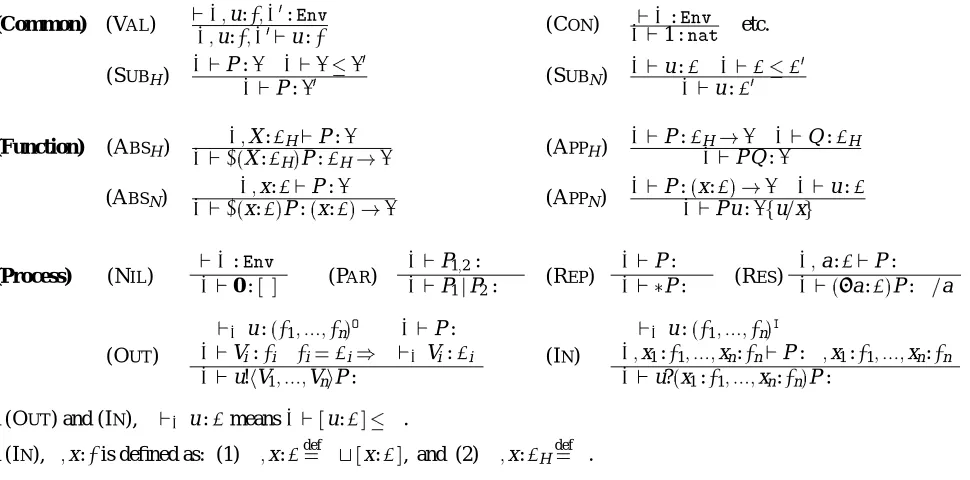
The typing system is given in Figure 7. The judgements are of the form:
Γ`P :α a term P has a type α under Γ
For convenience the inference rules in Figure 7 are divided into three groups. The first, (Common), are elementary, al-though the subsumption rules (SUBH) and (SUBN) will play
a major role in type inferences. The second, (Function),
are inherited from typing systems for the polymorphicλ -calculus. Here we have two forms of functional types, each with its introduction and elimination rules. The novelty oc-curs with abstraction over channel variables. Intuitively if a term P has a typeρ, then a channel abstractionλ(x :σ)P is a function which becomes Pfa=xgwhen it is applied to a name a with a typeσ. Therefore, we will bind free oc-currences of x in ρ in the abstraction rule (ABSN). The
corresponding elimination (APPN) allows dynamic channel
instantiation into types duringβ-reduction. If a term P has a type(x :σ)!ρ, we can apply it to a name a whose type is less thanσto P. Then a is substituted for x inρin (APPN).
The final group, (Process), are based on the IO-Typing systems from [26, 12, 37]. However many of the rules are sufficient novel to warrant detailed explanation.
The empty rule, (NIL): A process type[∆]of represents an upper bound on the interface or interaction points of a process. Since an empty process 0 has no interaction point, under any well-formed environmentΓit is typed as:
Γ`0 :[]
The parallel rule, (PAR): To inferΓ`P1jP2:πit is suffi-cient to inferΓ`P1:πandΓ`P2:πindividually. However, in the presence of subsumption, there is a more informative derived version of this rule, which will be frequently used:
Γ`P1:π1; Γ`P2:π2 Γ`P1jP2:π1tπ2
A meta-result of our system ensures that, relative to a par-ticular environment, the join of process types always exists.
The output rule, (OUT): Under what circumstances can we concludeΓ`a!hViP :π? We require the following:
(Common) (VAL) `Γ;u :τ;Γ 0
:Env
Γ;u :τ;Γ 0
`u :τ
(CON) `Γ:Env Γ`1 :nat
etc.
(SUBH) Γ
`P :ρ Γ`ρρ 0 Γ`P :ρ
0 (SUBN)
Γ`u :σ Γ`σσ 0 Γ`u :σ
0
(Function) (ABSH) Γ
;X :σH`P :ρ Γ`λ(X :σH)P :σH!ρ
(APPH) Γ
`P :σH!ρ Γ`Q :σH Γ`P Q :ρ
(ABSN) Γ
;x :σ`P :ρ Γ`λ(x :σ)P :(x :σ)!ρ
(APPN) Γ
`P :(x :σ)!ρ Γ`u :σ Γ`P u :ρfu=xg
(Process) (NIL)
`Γ:Env Γ`0 :[ ]
(PAR) Γ `P1
;2:π Γ`P1jP2:π
(REP) Γ `P :π Γ`P :π
(RES) Γ
;a :σ`P :π Γ`(νa :σ)P :π=a
(OUT)
π `Γu :(τ1;:::;τn) O
Γ`P :π Γ`Vi:τi τi=σi)π`ΓVi:σi Γ`u!hV1;:::;VniP :π
(IN)
π`Γ u :(τ1;:::;τn) I
Γ;x1:τ1;:::;xn:τn`P :π;x1:τ1;:::;xn:τn Γ`u?(x1:τ1;:::;xn:τn)P :π
In (OUT) and (IN),π`Γ u :σmeansΓ`[u :σ]π.
In (IN),π;x :τis defined as: (1) π;x :σ
def
=πt[x :σ], and (2) π;x :σH
def
[image:8.612.189.540.58.458.2]=π.
Figure 7. Typing System forλπv
The value V should have a type appropriate to the channel a. That is, there should be some value type τsuch thatΓ`V :τand
the channel a should have the output capability at the typeτ. However this capability on a should be avail-able from the overall interface of the process,π. This can be represented by the judgementΓ`[a:(τ)
O ]π. However there may be a further requirement. If the value being output is actually a channel, say b with a typeτ=σ, then the capability being exported must also be available from the process interface Γ`[b :σ]π.
[image:8.612.59.544.59.299.2]The general statement of the rule, for multiple output values, is given in Figure 7; it uses the notation defined in Figure 7
π `Γu :σ
to mean that, relative to the environmentΓthe interface, or process type,πcan provide at least the capabilityσat u.
As an example let∆ab be the environment which maps
b to the type(int) O
and a to the typeh∆
bi IO
, allowing it to transmit thunked values of type∆b, which maps b to the
same type(int) O
. Then with the output rule, together with (NIL), we can establish
∆ab`b!h1i0 :[∆b] and therefore
∆ab`a!hb!h1i0i0 :[a :h∆
bi O
]
The input rule, (IN): The rule for prefixing is a straight-forward generalisation of that in [37]:
π`Γ a :(τ) I
Γ;x :τ`P :π;x :τ Γ`a?(x :τ)P :π
>=a=>, ?=a=?,σB=a=σB, proc=a=proc hS
I ;S
O
i=a = hS I
=a;S O
=ai (τ1;:::;τn)=a = (τ1=a;:::;τn=a)
(σH!ρ)=a = σH=a!ρ=a ((x :σ)!ρ)=a = (x :σ=a)!ρ=a
[∆]=a = [fu :(σ=a)ju :σ2∆ ^u6=ag] Figure 8. Name Erasing on Types
To deduce that the process a?(x :τ)P has the interfaceπwe need to establish two facts:
The interfaceπcan provide the correct capability for the channel a; that isπ`Γa :(τ)
I .
The residual P, having input a value for the variable x, has the augmented interfaceπ;x :τ; however this can be established in the environmentΓaugmented by x; that isΓ;x :τ`P :π;x :τ.
Here we are using a notation “π;x :τ” defined in Figure 7. Note “π;x :τ” denotes “π” if τis not a channel type. In (IN), by the first sequence in the antecedent and (Implied judgement), Lemma 3.1, we knowπ is well-formed under Γ. Hence automatically x does not occur inπ. From this, if πtakes the form[∆]for some∆, then x62fv([∆]), and P has a type[∆];x :σ
def
=[∆;x :σ]in the second assumption. As an example let∆cbe the environment which maps c
to the capability((int) O
) IO
. Then one can easily check that ∆c`c?
;
z :(int) O
z!h1i:[∆c]
re-ceives an input on c it will immediately gain some other ca-pability. But this input will be sent by some other process, in the presence of which the interface will be increased appro-priately. For example let∆cd be the extension of∆cwhich
maps d to the output capability,(int) O
. Then we have ∆cd`c!hdi:[∆cd]
Now we can use the rule (PAR), or rather its derived variant, (together with a version of Multiple Weakening) to deduce
∆cd`(c? ;
z :(int) O
z!h1i jc!hdi):[∆
cd]
The restriction rule, (RES): The restriction operator
(νa);reduces the interface of a process. For example in an appropriate environment the process a!h1ican be as-signed the process type, or interface, [a :(nat)
O
]. When we restrict the channel a, to obtain the process (νa)a!h1i, all a capabilities will be removed from the interface; the restricted process has the empty interface[]. The general rule is formulated as (RES) where π=a denotes the result of erasing all occurrences of a fromπ. This erasure opera-tor on types is defined formally in Figure 8. For example,
[a :(nat) O
]=a=[ ], and[b :ha :(nat) O
i O
]=a=[b :hi O
]. Hence, in appropriate environments, (νa)a!h1ihas a type
[ ]and(νa)b!ha!h1iihas a type[b :hi O
].
Example 3.6 We revisit Example 2.2. First the successor
service is annotated as:
Succ(a)(=a?(y :int;z :(int) O
)z!hsucc(y)i where the types ensure that this process only receives the output capability on the return channel z. Let ∆r, be an
environment defining these return channels; in this case it maps rA;r1Band r2Bto the same type(int)
O
. Letσsbe a
type(int;(int) O
) O
andτscbe a type for scripts:
(s :σs)!(p :σs)![s :σs;p :σs;∆r]
So these are abstractions which, when applied to appropri-ate names, generappropri-ate processes which can at most use those names for output, together with the return channels, also for output only. Using subsumption we can form the judgement
s :σs;p :σs;∆r`PA:[s :σs;p :σs;∆r]
where PAdenotes the body of the script sent by CA, namely
(νc)s!hk;cic?(z)s!hz;ciFw(crA). By channel abstraction we therefore have
∆r`λ(s :σs;p :σs):PA:τsc
That is the value sent by the client is indeed typed as a script. Now let∆cl denote the environmentfreq :(τsc)
O ; ∆rg. Then we can form the judgement
∆cl`CA(req):[∆cl] and a similar judgement can be made for CB.
This judgement gives detailed information about the re-sources known to the clients. For example it says that the clients do not need to know the locations of the actual inter-faces of the various services; indeed it only needs to know that of the server, req, together with the return channels.
Typing the server is slightly different. Here we need to let∆serv befreq :(τsc)
I
; ∆r;s :σs; p :σsg:Then we can check that
∆serv`ServI(req;s;p):[∆serv]
Thus the server requires knowledge of the locations of the service points, but needs only to be able to send data to them. It also only sends capabilities on the return chan-nels. Note also that if we only have a constant process type
proc, as in the previous typing systems for the process cal-culi [3, 37, 26], then the interface server could input any functionλs:λp:Q, where Q an arbitrary process via “req”; such incoming code may harm local resources. 2
4. Type Soundness
4.1. Subject Reduction
The results in Lemma 3.1 have natural generalisations to our typing system, Γ`P :α. The details are available in [38], but here we show one instance, Channel Narrowing.
Lemma 4.1 Assume a62fn(P). ThenΓ;a :σ;Γ 0
`J:α implies Γ;Γ
0
=a`J:α=a, and Γ;a :σ;Γ 0
`P :α implies Γ;Γ
0
=a`P :α=a.
The following result which states, informally, that well-typedness is preserved by substitution of appropriate values for variables, is the key result underlying Subject Reduc-tion. This also guarantees that substitution, which usestin its definition, is always defined when applied to well-typed terms.
Lemma 4.2 (Substitution Lemma)AssumeΓ`V :τ. Then Γ;x :τ;Γ
0
`P :α implies Γ;Γ 0
fV=xg`PfV=xg:αfV=xg.
Theorem 4.3 (Subject Reduction)
Γ`P :π and PP 0
imply Γ`P 0
:π.
If Γ`P :ρ and P;!P 0
, thenΓ`P 0
:ρ. 2
4.2. Type Safety
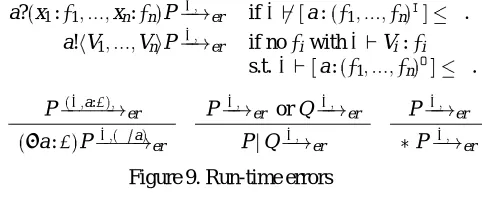
Our typing system is an extension of that for theλ-calculus from [9] and that for theπ-calculus from [26]; consequently it guarantees the absence of the typical run-time errors asso-ciated with these languages. Rather than duplicate the for-mulation of these kinds of errors, which involves the devel-opment complicated tagging notation, here we concentrate on the novel run-time type errors which our typing system can catch.
IntuitivelyΓ`P :πshould mean that, assuming the en-vironmentΓ, the process P satisfies the interfaceπ. Ifπis the undifferentiated typeprocthen, viewed as an interface, it provides no information. However if it has the form[∆] this means that P can use at most the resources mentioned in∆; moreover these resources can only be used according to the capabilities they are assigned in∆. A simple formal-isation of this intuitive idea is given in Figure 9, using a unary predicate P Γ;π
a?(x1:τ1;:::;xn:τn)P Γ;π
;;!er ifΓ6`[a :(τ1;:::;τn) I
]π. a!hV1;:::;VniP
Γ;π
;;!er if noτiwithΓ`Vi:τi s.t.Γ`[a :(τ1;:::;τn)
O ]π.
P (Γ;a:σ);π ;;;;;!er
(νa :σ)P Γ;(π=a) ;;;;!er
P Γ;π ;;!er or Q
Γ;π ;;!er PjQ
Γ;π ;;!er
P Γ;π ;;!er
[image:10.612.52.293.74.176.2]P Γ;π ;;!er Figure 9. Run-time errors
significant. The first says that, relative toΓ, P violates the interfaceπif it can input on the channel a but the interface π does not assign any input capability to a; the second is similar, but for output. Combining these rules, we can also derive the following communication runtime error between input and output:
a?(x1:τ1;:::;xn:τn)P ja!hV1;:::;VniQ Γ;π ;;!er if there is noτ0
i such thatΓ`τ 0
i τi andΓ`Vi:τ 0
i. The
meaning of the above error is easily understood when we consider the following example:
a?(x :h∆i)Pja!hRiQ Γ;π
;;!er if Γ6`R :[∆]. This says if the input process gets the process R which does not conform the interface “∆”, then a runtime error occurs.
Theorem 4.4 (Type Safety) IfΓ`P :π then P6 Γ;π ;;!er. 2
5. Typed Behavioural Semantics
Types constrain the behaviour of processes and their envi-ronments and consequently have an impact on when their behaviour should be deemed to be equivalent. Typed be-havioural equivalences have already been investigated for various process calculi in papers such as [19, 14, 26, 27, 36]. We contend that the existence of the fine-grained process types facilitates the development of typed behavioural theo-ries; more importantly they enable us to state and prove gen-eral theorems about these equivalences which are extremely useful for establishing identities. Due to space limitations in this section we merely outline our results in this area.
A family of relations R over process terms, ranged over by closed type environments and process types, is said to be a typed relation if P1RΓπP2, impliesΓ`P1:πandΓ`P2:π. Note that the relation is parameterised by not only environ-mentΓbut also interfaceπ. The following definition uses the notation from [17, 26, 36].
Definition 5.1 Let Γ
π denote the largest typed relation which:
is a typed congruence
is closed under reductions: whenever P R Γ
πQ, P!!P 0 implies, for some Q0
, Q!!Q 0
and P0
RΓπQ0 .
satisfies P1R Γ
π P2 implies P1 +
aI
, P2 +
aI and P1+
aO
, P2+
aOwhere P +
aI
def
,9P 0
:P!!P 0
^P 0
(νc˜)(a?(x)RjR
0
)with a62fc˜g. Similarly for P+
aO. Let
Γ
π denote the corresponding strong relation. 2 We can establish expected identities such as:
Proposition 5.2 (1) (Garbage collection) P Γ [] 0. (2) (Beta-reduction) (λx:P)V
Γ
π PfV=Xg. 2 Note (1) is a more general garbage collection law than the standard one defined with the conditionfn(P)=/0; for ex-ample, we can prove(νa)(a?(X)0ja!hb?(Y)Pi)is equiva-lent to 0.
Next we show our fine-grained types also allow us to give a simple, and clean, definition of triggers which have proven to be important in the theory of the higher-order pro-cesses, as well as theπ-calculus [26, 29].
Definition 5.3 We say a is (only) used as a trigger in P
underΓif there exists∆such thatΓ`P :[∆], and if a:σ2∆, thenσ=S
O
. 2
Note that the above definition is considerably simpler than that given in [26] (c.f. Definition 5.3.1, pp.433).
Proposition 5.4 (Higher-order replication) Assume a is only used as a trigger in P, Q and R underΓ. Then:
(νa :σ)(PjQja?(x1:τ1;:::;xn:τn):R)
Γ
π (νa :σ)(Pja?(x1:τ1;:::;xn:τn):R) j(νa :σ)(Qja?(x1:τ1;:::;xn:τn):R)
Again this is a non-trivial generalisation of the correspond-ing result in [29], Theorem 4.3.3; there “a” is only allowed to appear syntactically as output subjects. The following forwarder equality is one useful extension from [16] to the higher-order setting.
Proposition 5.5 (Forwarder [16]) Assume a is used as a trigger in P, b6=aandFwis the forwarder defined in Section 1. Then: (a :σ)(PjFw(ab))
Γ
π Pfb=ag. 2.
Finally we illustrate the usefulness of these general identities by applying them to the analysis of the system discussed in Example 3.6. Let Sys denote:
(νreq;s;p)(CA(req)jCB(req)jServI(req;s;p)jSucc(s)jPred(p)) Intuitively in this closed system the two clients make three specific requests of the distributed server. So we have:
Sys
Γ
π (νreq;s;p)(CA(req)jServI(req;s;p)jSucc(s)jPred(p)) j(νreq;s;p)(CB(req)jServI(req;s;p)jSucc(s)jPred(p))
Γ
π rA!hk+2ijrB1!hn+1ijrB2!hm;1i
our generalised version of this theorem is required. The second equation requires Proposition 5.2.
Further investigation of our typed equivalences is an in-teresting research topic, particularly in its application to the refinement of the context equality of [29].
6. Conclusion
This Section concludes the paper with extensions, further issues and related work. For more details, see [38].
Distributed Higher-order π-calculus Type Safety The-orem means that our typing system can be used to ensure various kinds of host security; that is, protecting hosts from untrusted imported code. In the full version of this paper, [38], we discuss this issue more explicitly, by extending our typing system to the distributed version ofλπv, given
in [37]. Once more the expressiveness of our fine-grained types means that, for example, channel locality, [37], can easily be enforced; specifically there is no requirement to annotate higher-order values as being sendable. A similar problem appears with type systems for theλ-calculus in-volving arrow and reference types, [24]. We hope that an extension of our scheme to higher-order functional shared variables (i.e. passing environments ascomtypes) will also be useful in this setting.
More type constructors One beneficial point of our typ-ing system is that it is relatively straightforward to ex-tend our set of types with many of the standard con-structs from the literature for both theλ-calculus and the π-calculus; these include recursive types [4, 21, 33, 26], record types [9, 32], polymorphic types [6, 27], linear/affine types [19, 5, 13, 36], and dynamic types [2, 28]. An ex-tension of our capability based typing systems to more ad-vanced distributed primitives, especially to constructs in-volving security [1, 11, 15, 35] would be more challenging.
Type limitations One limitation of our typing system is that, while name variables in types can be abstracted by channel dependency types (x :σ)!ρ of the channel λ -abstractionλ(x :σ)P, a similar abstraction is not allowed when we bound name variables by input prefix a?(x :σ)P. The result is that there is a loss of information in many of the types we can assign to processes. A typical example is the process a?(x)b!hx!hvi i. In the current system this can only be assigned a process type in which b has the capability to output values of the undifferentiated typehproci.
Clearly some form of channel abstraction would be needed to give a more informative type but it is difficult to see how this might be formulated. One problem here is that, unlikeβ-application, value reception is nondeterministic. In the composed term
a?(x)b!hx!hvii ja!hcij a!hdi
the particular channel, c or d which is bound to x depends on which message is delivered to the waiting process. Indeed the residual, after receiving an input, may take one of the (incomparable) types[b :hc :σi
O
]or[b :hd :σi O
].
There is a similar loss of information in typing restricted processes, (νa)P. For example the process (νa)b!ha!h1ii can be assigned, in an appropriate environment, the type
[b :hi O
] which intuitively says that b can output a (thun-ked) process which has the empty interface. This type is of limited interest when used in context. For example consider
(νa)b!ha!h1iijb?(X :τ)run X
Here essentially the only the possibility forτis the type
hproci. But we should be able to say that b can output a (thunked) process which contains some unknown channel name of type (nat)
O
, and the input type associated with b should be able to accommodate such constraints. Some form of existential quantification over types may be appro-priate but integrating such a construct into the type language is also a non-trivial task.
Related work We have already made reference to the ex-tensive literature on typing for the π-calculus and related processes. In developing our fine-grained type system we have been guided by the polymorphicλ-calculus [9, 6], where type variables play an important role; as with our channel names they may appear, and be bound, both in terms and types. However there is an essential technical difference: channel instantiation in our system can result in dynamic changes to the types annotating a term. Chan-nels are exchanged as values between processes but they also appear as interaction points in the types of processes. On the other hand, type variables of the polymorphicλ -calculus are instantiated by types (sayint) whereas in our case channel variables occurring in types are instantiated by channels, not by types. This feature necessitated the de-velopment of new concepts of well-formed type, subtyping, well-formed substitution, etc., independent of those devel-oped in the context of theλ-calculus.
Pierce and Sangiorgi [27] recently proposed a polymor-phicπ-calculus and used a refined typed behavioural equiv-alence to reason about concurrent abstract data types. Since their polymorphic types are based on those of the polymor-phicλ-calculus (that is they abstract over type variables via the operator9), they are quite different from ours. In partic-ular they do not address the issue of assigning fine-grained types to processes.
For sequential computations, Tofte and Talpin have de-veloped the effect typing system [31], and Tang and Jou-velot developed its subtyping system [30]. This was re-cently applied to Facile by Kirli [18].1 One may think our dependency types correspond to her region polymorphism. However, again her typing system is different from ours since she adds the original effect system to the functional types; hence all process has a constant type Unit and chan-nels cannot carry nested effects. More precisely, the effect types in [31, 30] are used to represent the region allocation or effects of values duringβ-reduction, while our process types are used to represent interaction effects between
con-1Kobayashi, Nakade and Yonezawa also applied the effect typing
current processes. Hence an integration of the effect typing system of the λ-calculus and the IO-subtyping system of theπ-calculus would have difficulty in expressing the kind of constraints guaranteed by our typing system.
De Nicola, Ferrari and Pugliese studied a subtyping sys-tem for a language based on Linda [7], and showed that it is used to control the mobility of agents. In their language, each located process is equipped with different capabilities (read, input, our, eval and newloc) rather than the unique process type, which is similar to our framework. However their calculus is based on CCS rather than theπ-calculus and our form of process types based on IO-subtyping and λ-subtyping are not considered in their formulation.
Acknowledgements We thank Kohei Honda, Dilsun Kirli, Naoki Kobayashi, Didier R´emy, Vasco Vasconcelos, and anonymous referees for their comments and discus-sions.
References
[1] Abadi, M., Secrecy by Typing in Security Protocols,
TACS’97, LNCS 1281, pp.611-638, Springer-Verlag, 1997.
[2] Abadi, M., Cardelli, L., Pierce, B. and Plotkin, G., Dynamic Typing in a Statically Typed Language. TOPLAS, 13(2), pp.237-268, 1991.
[3] Amadio, R., Translating Core Facile, ECRC Research Re-port 944-3, 1994.
[4] Amadio, R. and Cardelli, L., Subtyping Recursive Types,
TOPLAS, 15(4), pp.575–631, 1993.
[5] Cardelli, L. and Gordon, A., Typed Mobile Ambients,
POPL’99, pp.79–92, ACM Press, 1999.
[6] Cardelli, L., Martini, S., Mitchell, J. and Scedrov, A., An ex-tension of system F with subtyping, Info. & Comp., 109(1):4-56, February 1994.
[7] De Nicola, R., Ferrari, G. and Pugliese, R., Klaim: a Kernel Language for Agents Interaction and Mobility, IEEE Trans. on Software Engineering, Vol.24(5), 1998.
[8] Fournet, C., Gonthier, G., L´evy, J.-J., Maranget, L., and R´emy, D., A Calculus for Mobile Agents, CONCUR’96, LNCS 1119, pp.406–421, Springer-Verlag, 1996.
[9] Gunter, C., Semantics of Programming Languages:
Struc-tures and Techniques, MIT Press, 1992.
[10] Java, Sun Microsystems Inc., http://www.javasoft.com/.
[11] Heintze, N. and Riecke, J., The SLam Calculus: Program-ming with Secrecy and Integrity, POPL’98, pp.365-377. ACM Press, 1998.
[12] Hennessy, M. and Riely, J., Resource Access Control in Sys-tems of Mobile Agents, CS Report 02/98, University of Sus-sex, http://www.cogs.susx.ac.uk, 1998.
[13] Honda, K., Composing Processes, POPL’96, pp.344-357, ACM, 1996.
[14] Honda, K., A Theory of Types for the pi-calculus, pp.112, Typescript. November, 1998. Available at http://www.dcs.qmw.ac.uk/˜ kohei.
[15] Honda, K., Vasconcelos, V. and Yoshida, N, Secure
Infor-mation Flow as Typed Process Behaviour, ESOP’00, LNCS 1782, pp.180–199, Springer, 2000.
[16] Honda, K. and Yoshida, N., Combinatory Representation of Mobile Processes. POPL’94, pp.348–360, ACM Press, 1994. [17] Honda, K. and Yoshida, N., On Reduction-Based Process
Se-mantics. TCS, pp.437–486, No.151, North-Holland, 1995. [18] Kirli, D., A static type system for detecting potentially
trans-missible functions, ECOOP Workshop MOS’99, 1999. [19] Kobayashi, N., Pierce, B. and Turner, D., Linearity and the
pi-calculus, POPL’96, ACM Press, 1996.
[20] Kobayashi, K., Nakade, M. and Yonezawa, A., Static analy-sis of communication for asynchronous concurrent program-ming languages, SAS’95, LNCS 983, Springer, 1995. [21] Milner, R., Polyadicπ-Calculus, Logic and Algebra of
Spec-ification, Springer, 1992.
[22] Milner, R., Parrow, J.G. and Walker, D.J., A Calculus of Mo-bile Processes. Infor. & Comp., 100(1), pp.1–77, 1992. [23] Necula, G., Proof-carrying code. POPL’96, ACM, 1996. [24] O’Hearn, P., Power, J., Takeyama, M., and Tennent, D.,
Syn-tactic control of interference revised, MFPS’97, ENCS, El-sevier, 1997.
[25] ObjectSpace Inc. ObjectSpace Voyager home page, http://www.objectspace.com/voyager.
[26] Pierce, B.C. and Sangiorgi. D, Typing and subtyping for mo-bile processes. MSCS, 6(5):409–454, 1996.
[27] Pierce, B.C. and Sangiorgi. D, Behavioral Equivalence in the Polymorphic Pi-calculus. POPL’97, ACM Press, 1997.
[28] Riely, J. and Hennessy, M., Trust and partial typing in open systems of mobile agents. POPL’99, ACM Press, 1999.
[29] Sangiorgi, D., Expressing Mobility in Process Algebras:
First Order and Higher Order Paradigms. Ph.D. Thesis,
Uni-versity of Edinburgh, CST-99-93, 1993.
[30] Tang, Y.-M., and Jouvelot, P., Effect systems with subtyping,
PEPM’95, ACM Press, 1995.
[31] Tofte, M. and Talpin, J.-P., Region-based memory manage-ment, Info. & Comp., 132(2)109–176, 1997.
[32] Vasconcelos, V., Typed concurrent objects. ECOOP’94, LNCS 821, pp.100–117. Springer-Verlag, 1994.
[33] Vasconcelos, V. and Honda, K., Principal Typing Scheme for Polyadicπ-Calculus. CONCUR’93, LNCS 715, pp.524-538, Springer, 1993.
[34] Vasconcelos, V., Lopes, L. and Silva, F., Distribution and Mobility with Lexical Scoping in Process Calculi, 3rd HLCL, ENTCS 16(3), Elsevier, 1998.
[35] Volpano, D. and Smith, G., Secure information flow in a multi-threaded imperative language, pp.355–364, POPL’98, ACM, 1998.
[36] Yoshida, N., Graph Types for Monadic Mobile Processes,
FST/TCS’16, LNCS 1180, pp. 371–386, Springer, 1996.
[37] Yoshida, N. and Hennessy, M., Subtyping and Locality in Distributed Higher Order Processes. CONCUR’99, LNCS 1664, pp.557–573, Springer, 1999.