Table of Contents
Agile Software Development Ecosystems
By Jim Highsmith
Publisher : Addison Wesley Pub Date : May 26, 2002
ISBN : 0-201-76043-6 Pages : 448
In a highly volatile software development environment, developers must be nimble, responsive, and able to hit a moving target--in short, they must be agile. Agile software development is designed to address this need for speed and flexibility. Agility describes a holistic, collaborative environment in which you can both create and respond to change by focusing on adaptability over predictability, people over process. Agile software development incorporates proven software engineering techniques, but without the overhead and restrictions of traditional development methodologies. Above all, it fulfills its promise of delivering software that serves the client's business needs.
Written by one of the leaders of the Agile movement, and including interviews with Agile gurus Kent Beck, Robert Charette, Alistair Cockburn, Martin Fowler, Ken Schwaber, and Ward Cunningham, Agile Software Development Ecosystems crystallizes the current understanding of this flexible and highly successful approach to software development. It presents the key practices of all Agile development approaches, offers overviews of specific techniques, and shows how you can choose the approach that best suits your organization.
This book describes--in depth--the most important principles of Agile development: delivering value to the customer, focusing on individual developers and their skills, collaboration, an emphasis on producing working software, the critical contribution of technical excellence, and a willingness to change course when demands shift. All major Agile methods are presented:
• Scrum
• Dynamic Systems Development Method • Crystal Methods
• Feature-Driven Development • Lean Development
• Extreme Programming
• Adaptive Software Development
Table of Content
Table of Content...i
Copyright... v
Dedication... vi
Foreword... vi
Preface...vii
Finding a Balance...ix
Fundamental Questions... x
A Chaordic Perspective...xi
Collaborative Values and Principles...xii
A Barely Sufficient Methodology...xii
Changing Perspectives...xiii
Introduction... xiv
Book Organization and Conventions... xiv
The Major Agile Ecosystems and Leaders... xv
Acknowledgments...xvii
The Agile Software Development Series...xvii
Part I: Problems and Solutions
...1
Chapter 1. The Change-Driven Economy... 2
Turbulence: Bubbles versus Trends... 3
Exploration versus Optimization... 5
Exploratory Projects... 7
Command-Control versus Leadership-Collaboration Cultures... 8
Thriving at the Edge... 9
Chapter 2. IDX Systems Corporation... 10
The IDX Story... 10
An Agile Group in Action... 13
Chapter 3. Agility... 15
Agility... 16
“Agile” Studies... 18
Agile Software Development Ecosystems... 21
Part II: Principles and People
...23
Chapter 4. Kent Beck... 24
Reflections... 28
Chapter 5. Deliver Something Useful... 29
HAHT Commerce, Inc... 29
Customer Delivery Principles... 30
Practices That Deliver Useful Features... 36
Obviously It’s Not Obvious... 40
Chapter 6. Alistair Cockburn... 42
Reflections... 47
Chapter 7. Rely on People... 48
ThoughtWorks... 48
Who Are You Calling Average?... 49
Trust, Mistrust, and Communications... 50
Talent, Skill, and Process... 51
The Fall and Resurrection of Programming... 54
Software through People... 56
Chapter 8. Ken Schwaber... 57
Reflections... 61
Chapter 9. Encourage Collaboration... 62
The Modern Transport Team at ITL... 62
Practice versus Process... 65
Documentation Is Not Understanding... 66
The Dimensions of Collaboration... 68
Real Teams... 70
Chapter 10. Martin Fowler... 71
Reflections... 77
Chapter 11. Technical Excellence... 78
The PDFS Team at Generali Group... 78
Agile Is Not Ad Hoc... 81
Removal of Defects... 81
Focus on Code... 82
Simple Design... 83
Big Bang versus Incremental... 84
Modeling and Abstraction... 85
Domain Recognition... 86
Documentation versus Conversation... 87
Specialists versus Generalists... 87
Quality versus Speed... 88
Establishment versus Anti-establishment... 89
Values and Principles... 90
Reflections... 90
Chapter 12. Ward Cunningham... 91
Reflections... 94
Chapter 13. Do the Simplest Thing Possible... 96
The Survey Controller Team at Trimble Navigation... 96
Musashi... 97
The Three Faces of Simplicity... 98
A Final Note on Simplicity... 102
Chapter 14. Jim Highsmith... 103
Chapter 15. Be Adaptable... 108
The Mustang Team at Cellular, Inc... 108
The Great Divide: Predictability or Adaptability... 110
Our Changing Business Ecosystem... 112
Embracing Change... 113
Balancing Adaptation with Anticipation... 117
Putting Lipstick on a Bulldog... 118
The Cost of Change... 120
Conform to Actual: Measuring Success... 121
Adaptability Is a Mindset... 124
Chapter 16. Bob Charette... 125
Reflections... 130
Part III: Agile Software Development Ecosystems
...131
Chapter 17. Scrum... 132
The Scrum Process... 133
Scrum's Contributions... 136
Chapter 18. Dynamic Systems Development Method... 138
Arie van Bennekum... 138
DSDM Principles... 139
The DSDM Process... 140
DSDM's Contributions... 142
Chapter 19. Crystal Methods... 144
Methodology Design Principles... 144
The Crystal Framework... 145
Crystal's Contributions... 148
Chapter 20. Feature-Driven Development... 149
The Singapore Project... 150
The FDD Process Model... 151
Beyond the FDD Process Description... 154
Conceptual Similarities and Differences... 156
FDD's Contributions... 157
Chapter 21. Lean Development... 159
EuroTel... 159
The Strategic Foundation of Lean Development... 160
Lean Development's Origins... 161
What Is Lean Development?... 162
The Lean Development Environment... 164
Lean Development's Contributions... 165
Chapter 22. Extreme Programming... 166
XP: The Basics... 166
Values and Principles... 170
XP's Contributions... 171
Chapter 23. Adaptive Software Development... 173
A Change-Oriented Life Cycle[1]... 174
The Basic ASD Life Cycle... 175
Leadership-Collaboration Management... 178
ASD's Contributions... 179
Part IV: Developing an ASDE
...180
Chapter 24. Articulating Your Ecosystem... 181
Opportunity and Problem Domains... 181
Cultural Domain... 182
Matching Methodology to Opportunity and Culture... 184
Methodology Selection... 186
Articulate Values and Principles... 186
Chapter 25. Designing Your Agile Methodology... 188
Methodology Expectations... 188
Methodology Elements and the System of Practices... 189
Methodology Design Principles... 192
Frameworks, Templates, and Scenarios... 193
Collaborative Methodology Design Steps... 197
Customize Templates to the Team... 200
Scaling... 201
Agile Methodologies for the Enterprise... 206
Chapter 26. The Agile Metamorphosis... 208
Chaordic Perspective... 209
Collaborative Values and Principles... 211
Barely Sufficient Methodology... 213
The Agility Ratings... 214
Final Thoughts... 215
Copyright
Many of the designations used by manufacturers and sellers to distinguish their products are claimed as trademarks. Where those designations appear in this book, and Addison-Wesley was aware of a trademark claim, the designations have been printed with initial capital letters or in all capitals.
The author and publisher have taken care in the preparation of this book, but make no expressed or implied warranty of any kind and assume no responsibility for errors or omissions. No liability is assumed for incidental or consequential damages in connection with or arising out of the use of the information or programs contained herein.
The publisher offers discounts on this book when ordered in quantity for special sales. For more information, please contact:
Pearson Education Corporate Sales Division
201 W. 103rd Street
Indianapolis, IN 46290
(800) 428-5331
Visit Addison-Wesley on the Web: www.aw.com/cseng/
Library of Congress Cataloging-in-Publication Data
Highsmith, James A.
Agile software development ecosystems / Jim Highsmith.
p. cm.
Includes bibliographical references and index.
ISBN 0-201-76043-6
1. Computer software—Development. I. Title.
QA76.76.D47 H553 2002
005.1—dc21 2002018312
Copyright © 2002 by Pearson Education, Inc.
All rights reserved. No part of this publication may be reproduced, stored in a retrieval system, or
transmitted, in any form, or by any means, electronic, mechanical, photocopying, recording, or otherwise, without the prior consent of the publisher. Printed in the United States of America. Published
For information on obtaining permission for use of material from this work, please submit a written request to:
Pearson Education, Inc.
Rights and Contracts Department
75 Arlington Street, Suite 300
Boston, MA 02116
Fax: (617) 848-7047
Text printed on recycled paper
1 2 3 4 5 6 7 8 9 10—CRW—0605040302
First printing, March 2002
Dedication
To Wendie
Foreword
The 1990s were the Decade of Process for IT. We prostrated ourselves before the CMM and ISO. We sought not just perfection in the way we built software, but total predictability. We concluded that it wasn’t enough just to do things right; we also had to “call our shot”—to say in advance exactly what we intended to do, and then do exactly that. Nothing more and nothing less. We were determined (in CMM terms) to “plan the work and work the plan.”
A big part of our process focus in the 1990s had to do with our obsession with all things Japanese. Think back to 1990 and remember your own take on the subject at that time. There was a general malaise and a feeling that the West had lost its momentum and the Japanese had a lock on the future. After all, they worked harder, stayed later, had far more rigorous discipline, and were regularly achieving levels of quality that the rest of the world could only dream of. The Japanese phenomenon, the relentless advance of the “Pacific Tiger,” was all the talk that year. If we’re going to survive, we thought, we had better become more like the Japanese. And so we moved to a more Japanese kind of rigor and process.
But the 1990s were not kind to Japan. By the end of the decade, the Japanese economy had been in a slump that was as bad as, and had lasted as long as, the Great Depression. Somehow, hard work, discipline, efficiency, and rigor—the very qualities that had been essential in the 1980s—were not a winning combination for the 1990s. What mattered in the 1990s was being able to turn on a dime. The Internet changed everything, and only those who were ready to change quickly with it would prosper. Agility: 1, everything else: 0.
Predicting in advance what your every step would be ended up seeming like a dumb obsession. What sense does it make to predict your steps in advance when you’re not even sure where you’re headed?
Today the era of fat process is over. As Jim Highsmith has said, “Thin is in.” To optimize for speed and responsiveness, we need to put process on a diet. We need to shed paperwork and bureaucratic burden, eliminate endless code inspections, and invest in our people so they can steer themselves sensibly through the chaotic maze that is a modern-day IT project. This is the genesis of the Agile approaches to software development.
Jim Highsmith has put all this together into a kind of survey introduction to the Agile methodologies. He has had the good sense not just to present this as a discussion of a concept, but to tell it as a story. As in any good story, it is the people who matter most. And so he tells us about Agile approaches by telling us about their principal advocates and inventors, people like Kent Beck, Alistair Cockburn, Martin Fowler, and the other “light methodologists.” These are the minds that are changing how IT gets done. Their story is what Agile Software Development Ecosystems is all about.
Tom DeMarco Camden, Maine
Preface
From February 11 to 13, 2001, at the Lodge at Snowbird ski resort in the Wasatch Mountains of Utah, 17 people met to talk, ski, relax, and try to find common ground. What emerged was the Agile Software Development movement. Representatives from Extreme Programming (XP), Scrum, the Dynamic Systems Development Method (DSDM), Adaptive Software Development (ASD), Crystal Methods, Feature-Driven Development (FDD), Pragmatic Programming, and others sympathetic to the need for an alternative to document-driven, rigorous software development processes convened. What this meeting produced—The Manifesto for Agile Software Development, signed by all 17 of the participants—was symbolic. It declares that:
We are uncovering better ways of developing software by doing it and helping others do it. Through this work we have come to value:
• Individuals and interactions over processes and tools • Working software over comprehensive documentation • Customer collaboration over contract negotiation • Responding to change over following a plan.
That is, while there is value in the items on the right, we value the items on the left more.
This value statement has a number of fascinating aspects, not the least of which was getting 17 people to agree to it. Although this was a group of experienced and recognized software development “gurus,” the word uncovering was selected to indicate that the authors don’t have all the answers and don’t subscribe to the silver-bullet theory.
The value statements have a form. In each statement, the first segment indicates a preference, while the latter segment describes an item that, while important, is of lesser priority. This distinction lies at the heart of agility, but simply asking people to list what’s valuable doesn’t flesh out essential differences. Roy Singham, CEO of ThoughtWorks, put it well when he said that it’s the edge cases, the hard choices, that interest him. “Yes, we value planning, comprehensive documentation, processes, and tools. That’s easy to say. The hard thing is to ask, ‘What do you value more?’” When push comes to shove—and it usually does—something must give, and we need to be clear about what stays and what gives.
The first value statement recognizes the importance of processes and tools but stresses that the interaction of talented individuals is of far more importance. Rigorous methodologies and their business process reengineering brethren place more emphasis on process than people. Agile development reverses this trend. If individuals are unique, and we believe they are, then processes should be melded to individuals and teams, not the other way around.
Similarly, while comprehensive documentation is not necessarily harmful, the primary focus must remain on the final product—working software. This means that every project team needs to determine, for itself, what documentation is absolutely essential to delivering working software. Working software tells the developers and sponsors what they really have in front of them—as opposed to promises of what they
might have in front of them. Working software can be shipped, modified, or scrapped, but it is always real.
Contract negotiation, whether through an internal project charter or an external legal contract, isn’t a bad practice, just a seriously insufficient one. Customers want a product that conforms to their needs—at the time of delivery. “Contract negotiation encourages the addition of buffers [contingency],” says colleague Ron Holliday. “This makes projects take even longer, drives up costs, and reduces responsiveness to change. A collaborative arrangement is a team effort between customer and supplier to deliver the best possible solution.” Contracts and project charters provide boundary conditions within which the parties can work, but only through ongoing collaboration can a development team hope to understand and deliver what the client wants.
No one can argue that following a plan is a good idea—right? Well, yes and no. In a world of business and technology turbulence, scrupulously following a plan can have dire consequences, even if it’s executed faithfully. However carefully a plan is crafted, it becomes dangerous if it blinds you to change. As you will see in several of the case studies presented in this book, few, if any, of the projects delivered what was planned for in the beginning. And yet they were successful because the development team was Agile enough to respond again and again to external changes. In the Information Age, planning is important, but accepting that deviations from any plan are “normal” is even more important.
The meeting at Snowbird was incubated at a spring 2000 gathering of Extreme Programming leaders organized by Kent Beck. At that meeting in Oregon, a few “outsiders” but “sympathizers,” such as myself, were invited, and attendees voiced support for a variety of “light” methodologies. During 2000, a number of articles referenced the category of “light” or “lightweight” practices. In conversation, the soon to be “Agile” authors didn’t like the moniker “light,” but it stuck at that time.
In September 2000, “Uncle Bob” Martin of Object Mentor in Chicago started what was to become the Agile ball rolling with an email: “I’d like to convene a short (two-day) conference in the January to February 2001 time frame here in Chicago. The purpose of this conference is to get all the lightweight method leaders in one room. All of you are invited, and I’d be interested to know who else I should
approach.” Bob set up an online group site, and the discussions raged. Early on, Alistair Cockburn weighed in with an epistle that identified the general disgruntlement with the word “light”: “I don’t mind the methodology being called light in weight, but I’m not sure I want to be referred to as a lightweight
attending a lightweight methodologists meeting. It somehow sounds like a bunch of skinny, feeble-minded lightweight people trying to remember what day it is.”
ski on their heads, as Martin Fowler tried on the first day. Someone else mentioned Anguilla in the Caribbean—warm and fun, but time consuming to get to. In the end, Snowbird and skiing won out.
The Agile Manifesto value statements represent a deeper theme that drives many, but not all, of the Manifesto’s authors. At the close of the two-day meeting, Bob Martin joked that he was about to make a “mushy” statement. Although tinged with humor, no one disagreed with Bob’s sentiments—that we all felt privileged to work with a group of people who held a set of compatible values, based on trust and respect for each other, promotion of organizational models based on people, and the desire to build collaborative communities in which to work. At the core, I believe Agile developers are really about mushy stuff—about delivering products to customers while operating in a vibrant, sustaining workplace. So in the final analysis, the meteoric rise of interest in—and criticism of—Agile Software Development is about the mushy stuff of values and culture.
For example, I think that, ultimately, XP has mushroomed in use and interest not because of pair programming or refactoring but because, taken as a whole, the practices define a developer community freed from the baggage of Dilbertesque corporations. Kent Beck tells the story of an early job in which he estimated a programming effort to be six weeks for two people. After his manager reassigned the other programmer at the beginning of the project (effectively halving the resources), Kent completed the project in twelve weeks—and felt terrible! The boss, of course, harangued Kent throughout the second six weeks. Somewhat despondent because he was such a “failure” as a programmer, Kent finally realized that his original estimate of six weeks was extremely accurate—for two people—and that his “failure” was really his manager’s failure to take the responsibility for removing project resources. This type of situation goes on every day with individuals who don’t want to make hard tradeoff decisions, so they impose irrational demands.
The Agile movement is not anti-methodology; in fact, we seek to restore credibility to the concept of
methodology. We want to restore a balance. We accept modeling, but not in order to file some diagram in a dusty corporate repository. We accept documentation, but not hundreds of pages of never-maintained and rarely used tomes. We plan, but recognize the limits of planning in a turbulent environment. Those who would brand proponents of FDD or Scrum or any of the other Agile approaches as “hackers” are ignorant of both the approaches and the original definition of the term hacker—a programmer who enjoys solving complex programming problems, rather than one who practices either ad hoc development or “cracking.” Agile Software Development incorporates proven software engineering techniques, but without the overhead of traditional methodologies.
The Agile Alliance was born in early 2001, but the history of the various approaches and the people who developed them goes back 10 to 15 years. This book describes these practices and the principles behind them, but more important, it delves into the people—the people who are developing the practices and the people who use them to deliver business value to their customers.
Finding a Balance
The left side of the Agile Manifesto value statements indicates what Agilists consider more important than the items on the right side. This should not be construed as indicating that tools, process, documentation, or contracts are unimportant. There is a tremendous difference between one thing being more or less
important than another and being unimportant. Judicious use of tools is absolutely critical to speeding software development and reducing its costs. Contracts are one vital component to understanding developer-customer relationships. Documentation, in moderation, aids communication, enhances knowledge transfer, preserves historical information, and fulfills governmental and legal requirements.
But Agilists take a certain perspective on these topics. Try this exercise. For each of the Manifesto value statements, construct two questions along the lines of the following:
By looking at these two end points, we can better grasp relative importance. Although there has to be a balance—documentation and working software, contracts and collaboration, responsiveness and planning, people and process—we have to delineate the extremes, the end points, so that organizations, teams, and individuals can find their own balance points. If we start out trying to find the middle ground, we never will.
One of the great contributions of XP’s “extremoes”—Kent Beck, Ron Jeffries, and Ward Cunningham—is that they have staked out positions that have stirred debate in ways that taking moderate positions never would. When Ron says, “Great designs emerge from zero anticipatory design and continuous refactoring,” he is challenging himself, and us, to rethink our assumptions about software development. We have to understand the limits before we can understand the balance points.
So although I realize the value of documentation, contracts, plans, and processes, there are numerous sources of material about these subjects. My intention is to identify and define Agile Software
Development, to articulate its practices and principles, so you can make your own decision about where on the spectrum you, or your organization, need to be.
Fundamental Questions
There are three fundamental questions that this book answers: (1) What kinds of problems does agility solve best? (2) What is agility? and (3) What are Agile Software Development Ecosystems (ASDEs)?
What Kinds of Problems Does Agility Solve Best?
Problems characterized by change, speed, and turbulence are best solved by agility. Some people argue that good practices are good practices (pair programming, customer focus groups, or feature planning, for example) and therefore ASDEs should not be “limited” to a particular problem type. While true in part, the question asks what problems Agile practices best solve, not just solve. So, while XP, Crystal, or Scrum can surely be used for a wide range of projects, they are particularly relevant to extreme or complex projects— those that have an accelerated time schedule combined with significant risk and uncertainty that generate constant change during the project.
As the level of change caused by rapidly evolving technology, business models, and products increases and the need for delivery speed accelerates, ASDEs’ effectiveness increases quickly over rigorous
methodologies.
What Is Agility?
Agility, like any other complex concept, has a number of definitions, but for me, the most clearly focused definition is
Agility is the ability to both create and respond to change in order to profit in a turbulent business environment.
Rather than shrink from change, Agile organizations harness or embrace change by being better than competitors at responding to changing conditions and by creating change that competitors can’t respond to adequately. However, companies must determine what level of agility they require to remain competitive. Agility is only an advantage relative to competitors—a copper mining company doesn’t need to be as agile as a biotechnology firm.
problematic. Agile organizations understand that balancing on the edge between order and chaos determines success.
What Are Agile Software Development
Ecosystems
?
I began writing this book about Agile Software Development methodologies, but I kept worrying about the word “methodology” because it didn’t fit with the focal points of Agile development—people,
relationships, and uncertainty. Furthermore, by using the word “methodology,” Agile practices are instantly compared to traditional software development methodologies—thereby using the wrong
measuring stick for comparison. So I use the term “Agile Software Development Ecosystem” to describe a holistic environment that includes three interwoven components—a “chaordic” perspective, collaborative values and principles, and a barely sufficient methodology—and the term Agilists to identify those who are proponents of ASDEs.
Some people think that “Agile” means fewer processes, less ceremony, and briefer documents, but it has a much broader perspective, which is the primary reason for using the word ecosystem rather than
methodology. Although fewer processes and less formality might lower development costs, they are not enough to produce agility. Focusing on people and their interactions and giving individuals the power to make quick decisions and to self-adapt their own processes are key to Agile ecosystems.
The American Heritage Dictionary defines ecosystem as “organisms and their environment: a localized group of interdependent organisms together with the environment that they inhabit and depend on.” The
Oxford English Dictionary extends this definition to include a constant interchange within the system, including both organic and inorganic elements. The word methodology conjures up a vision of things— activities, processes, tools. These are not inconsequential elements, but incomplete ones. The word
ecosystem conjures up a vision of living things and their interactions with each other. Within an
organizational context, an ecosystem can then be thought of as a dynamic, ever-changing environment in which people and organizations constantly initiate actions and respond to each other’s actions. The word ecosystem focuses us on the dynamic interactions of individuals and teams rather than on the static lines on organization charts.
A Chaordic Perspective
To fully understand ASDEs, we need to understand each of the three components and how they relate to each other. First, Agilists share a view that organizations are chaordic—that every organization exhibits properties of both chaos and order that defy management through the use of linear, predictive planning and execution practices. Viewing organizations as chaordic means understanding that the predictability upon which traditional project management and development life cycle practices are built is a root cause of dysfunctionality between customer, management, and development organizations. A chaordic perspective impacts both how we respond to change and how we manage project teams and organizations.
In day-to-day project work, a chaordic perspective creates two outcomes that are 180 degrees out of sync with rigorous methodologies.
• Product goals are achievable, but they are not predictable. • Processes can aid consistency, but they are not repeatable.
Although ASDEs involve careful planning, the fundamental assumption remains that plans, in a turbulent environment, are not predictable, at least at the level of project scope, schedule, and cost. Plans are hypotheses to be tested rather than predictions to be realized. However, the product goals of the business
that are the result of knowledge gained during the project, knowledge not discernable early in the project, require processes that can respond to change, not ones that attempt to eliminate it.
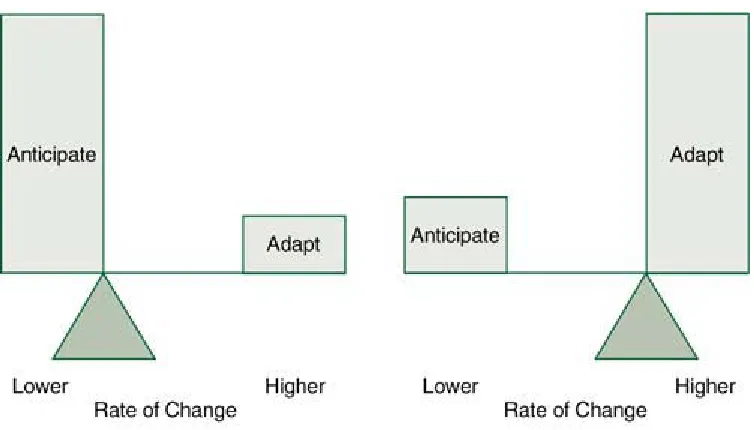
As Martin Fowler points out, the two fundamental characteristics of ASDEs are their focus on adaptability rather than predictability and on people rather than process (Fowler 2000). As you read through this book, you will see just how fundamental—and challenging to the status quo—these two principles really are. Being Agile means accepting that outcomes are not predictable and that processes are not repeatable. It even implies that as process repeatability increases, project predictability decreases.
Peter Senge uses the term “mental model” to identify the perspective, set of assumptions, stories, and beliefs that each of us carries in our mind that provide a context for thinking (Senge 1990). In
organizations, the collective set of mental models defines an overall cultural context. Companies that are heavily sales oriented differ from those that are heavily engineering oriented. Companies whose driving strategy is customer intimacy differ from those whose driving force is product innovation. Companies whose mental model includes linearity, cause and effect, hierarchy, predictability, and control will operate very differently from one whose mental model includes collaborative networks, emergence,
decentralization of power, and acceptance of unpredictability. One is Newtonian, the other chaordic.
A chaordic perspective draws on a complex adaptive systems model in which decentralized, independent agents (each of us) interact in self-organizing ways, guided by a set of simple, generative rules that create complex, emergent results. This perspective is examined in detail in my book Adaptive Software
Development (Highsmith 2000) and is explicitly embraced in the philosophies of Agilists Ken Schwaber, Bob Charette, and Kent Beck.
XP provides an example of how methodology and culture fit together. At one level, XP is defined by a system of practices—pair programming, test-first development, refactoring, coding standards. But the values and principles of XP define a collaborative culture—how developers work together with customers, how individuals interact and treat each other as human beings.
Collaborative Values and Principles
The second piece of the interconnected web that defines ASDEs is the statement of collaborative values and principles. While it is difficult to characterize the Agile Manifesto in one word, “collaborative” seems to be the best single adjective. Values and principles shape the ecosystem. Without a set of stated values and principles, an ecosystem is sterile, reflecting practices but not the people who interact within it.
A collaborative culture includes people and their relationships within a development team and with customers, management, and partnering teams within or external to their own company. Human dynamics, communications, and collaboration may be known as the “soft” sciences, but in practice, they may be the hardest to master. Principles and values help define a culture—the environment in which people want to work.
A Barely Sufficient Methodology
There are two reasons to pursue barely sufficient methodologies: value and innovation. Streamlined methodologies concentrate on those activities that create value and ruthlessly eliminate non-value-adding activities. Programming usually adds value; process management often adds overhead. Bare sufficiency means keeping the former and eliminating the latter. Second, innovation and creativity flourish in chaordic environments, not orderly ones. Barely sufficient methodologies are cauldrons for breeding innovation.
Methodology also relates to organizational model. Agile methodologies contain minimal processes and documentation and reduced ceremony (formality). Agile methodologies are labeled “barely sufficient” (Cockburn) or “a little bit less than just enough” (Highsmith), or “minimal” (Charette). However, this streamlining of methodology isn’t based just on reducing work effort but, more important, it is based on understanding the chaordic world view—one in which emergent (innovative) results are best generated at the “edge of chaos,” perched midway between chaos and order.
Practices (or techniques) are the lifeblood of methodology. Whether it’s pair programming, Scrum
meetings, customer focus groups, or automated testing, the practices of ASDEs, carried out by talented and skilled individuals, produce results.
Changing Perspectives
In the software profession, we’ve used the words “methodology” and “process” for so long that they roll off the tongue and the pen without trouble. “Ecosystem” will take getting used to, but then, that’s why I’m using the word—to foster a different perspective. “There is accumulating evidence that corporations fail because the prevailing thinking and language of management are too narrowly based on the prevailing thinking and language of economics,” says Arie De Geus (1997). “They forget that their organizations’ true nature is that of a community of humans.”
To change thinking, we must change the language we use, so I use the word “ecosystem” to change our thinking about how software projects should be viewed. A chaordic perspective, a collaborative set of values and principles, and a barely sufficient methodology all combine and interact to form an Agile ecosystem. We cannot separate the three, at least in my mind, and I think most Agilists would agree. One could have a streamlined methodology but a linear, Newtonian view of organizations, and the result would not be Agile. One could have a streamlined methodology but a hierarchical, control-based work culture, and it would not be Agile. One could have a collaborative, people-oriented work culture but a rigid,
predictive approach to planning and managing projects, and it would not be Agile. Agility requires all three.
The ultimate objective of this book is to describe new ways of working together to deliver business value to software customers. The heart of ASDEs is a core belief in people—their individuality and their interactions. It’s impossible to discuss people and their ways of working together (eco system) without discussing values and principles. It’s impossible to discuss values and principles without also discussing assumptions about how organizations do, or should, work. It’s impossible to compare Agile approaches with non-Agile approaches using “methodology” as the only mechanism for comparison.
In closing, I need to state that I don’t speak for anyone in the Agile community other than myself. I may interpret what Ken Schwaber says about Scrum, what Jeff De Luca says about FDD, or what Alistair Cockburn says about Crystal Methods, but they are my interpretations. In making generalizations about ASDEs, I’m sure I’ve made statements that would generate disagreement from 1 or more of the other 16 authors of the Agile Manifesto. However, I have talked to, corresponded with, or worked with all these authors, so although they are my own interpretations, they also reflect a deep sense of being part of, and contributor to, this community.
Jim Highsmith Salt Lake City, Utah January 2002
Introduction
Agile Software Development Ecosystems contains four parts.
Part I, Problems and Solutions, addresses the key characteristics of our change-driven, Information Age economy and discusses why traditional Rigorous Software Development approaches are insufficient for success in this environment. Chapter 1, The Change-Driven Economy, describes our turbulent economic conditions and explains that the future is unlikely to be less turbulent. Chapter 2 contains a case story about IDX Systems Corporation that illustrates both the turmoil companies face and the results that can be obtained using an Agile Software Development Ecosystem. Chapter 3 outlines in broad brush strokes the solution to the problems raised by speed and change—agility.
Part II, Principles and People, delves into the values and principles that characterize ASDEs and the people, authors, and key thought leaders who created the major ASDEs. Chapters on principles are interwoven with ones on the people who have articulated the principles. What better way to gain a depth of
understanding of the Agile values and principles than to discuss them with the key players? These chapters are not organized strictly along the principles of the Agile Manifesto, but by my own categorization. The interviews were not directed at explanations of each Agile approach, but at how the individual’s
experiences had shaped his understanding of software development.
Scratch below the surface, and you don’t need to scratch very far with Kent Beck or Alistair Cockburn or Ken Schwaber or other Agile leaders, and you find individuals committed to making the part of the world related to software development and information technology a satisfying and enjoyable place to work. One can’t really understand the Agile movement without understanding the originators’ views on working relationships and their deeply held cultural values. The interview chapters are intended to aid in that understanding.
Also in Part II, each principle chapter begins with a case story from an organization that has successfully used one of the ASDEs on a project. These case stories cover a wide range of project types from around the world—New Zealand, India, Singapore, Canada, the U.S., and Germany.
Part III portrays each individual Agile Software Development Ecosystem. The chapters describe the basics of a particular approach and identify key contributions of each one. There are chapters on Scrum, Dynamic Systems Development Method, Crystal Methods, Feature-Driven Development, Lean Development, Extreme Programming, and Adaptive Software Development.
Part IV, Developing an ASDE, discusses how an organization could proceed with analyzing its culture to determine how an ASDE might fit, and then how to design and customize a methodology framework and practices for itself.
Book Organization and Conventions
There are always a myriad of dilemmas in organizing a book. One such dilemma in this book was deciding whether chapters on individual Agile approaches should go first, or whether the chapters on principles should take precedence. I opted for the latter, because ultimately I believe values and principles are more important than practices. If curiosity gets the better of you, skip ahead and read a chapter, or chapters, on the individual ASDEs first. I have also included a paragraph introducing each ASDE, and its key
There are a couple of conventions that I have used throughout the book. First, I think that every software development project is a product development project. Over the years I have worked with IT organizations that are developing software for internal customers and software product companies that are developing software to sell in the marketplace. In both cases, the development staff is delivering a product to a
customer. Keeping this notion of customers and products in mind helps IT organizations as well as product companies.
Second, when I use the word developer, I am referring to all of the people who are directly involved in delivering a product to the customer—programmers, testers, documentation specialists, requirements analysts, and others. I didn’t want to refer to four or five roles every time I want to refer to those who deliver working software. Although delivering working software is a key value of Agile development, programming is not the only role required to accomplish that objective.
When I refer to software development or software development practices, I am usually implying some level of project management and collaboration practices in the sentence. Constantly using the phrase “software development, project management, and collaboration” practices takes up half the sentence before saying anything useful, so I will shorten the words, but hopefully not the intent.
I pondered what to call non-Agile approaches and finally decided on using the word “Rigorous,” in part because I view it as a nonjudgmental word. Agility means balancing between structure and flexibility, so rigor is a vital part of any development process. Agility focuses on the flexibility side of the definition and rigor focuses on the structure side—thus I’ve used the two words as contrasting styles of development. Too much structure, and Rigorous becomes rigid. Likewise, too much flexibility, and Agile becomes chaotic. I use the two words—Agile and Rigorous—as a contrast, to emphasize the fundamental characteristics of each. Although I try to be nonjudgmental about their use, my bias toward Agile should be obvious.
Rather than continually use terms like Agile Ecosystem Proponent or Agile Methodologist, I’ve elected to create the term “Agilist.” While far from perfect, using this term cuts down on words that would rapidly become repetitive.
Finally, all the case stories in the book come from my own experiences with clients or from the
experiences of other individuals that I interviewed. Some companies and individuals were reluctant to be identified, so I have used pseudo names in some cases. My thanks to all of those “unidentifiables” who provided these stories.
The Major Agile Ecosystems and Leaders
This section identifies each of the major ASDEs and their primary developers and provides a brief synopsis of each of the approaches.
Scrum
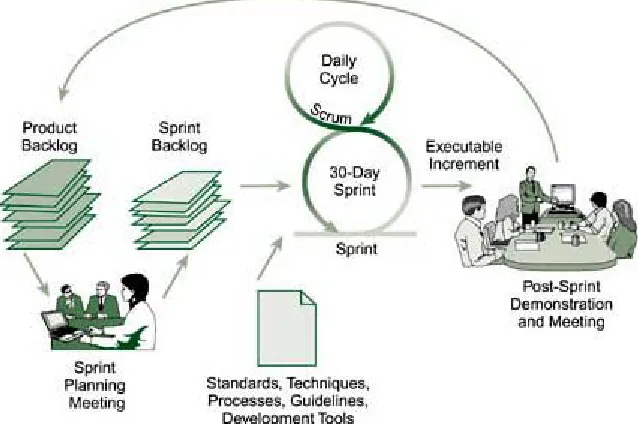
Scrum, named for the scrum in Rugby, was initially developed by Ken Schwaber and Jeff Sutherland, with later collaborations with Mike Beedle. Scrum provides a project management framework that focuses development into 30-day Sprint cycles in which a specified set of Backlog features are delivered. The core practice in Scrum is the use of daily 15-minute team meetings for coordination and integration. Scrum has been in use for nearly ten years and has been used to successfully deliver a wide range of products. Chapter 8 contains an interview with Ken Schwaber, and Chapter 17 describes Scrum. Ken, Jeff, and Mike were all coauthors of the Agile Manifesto.
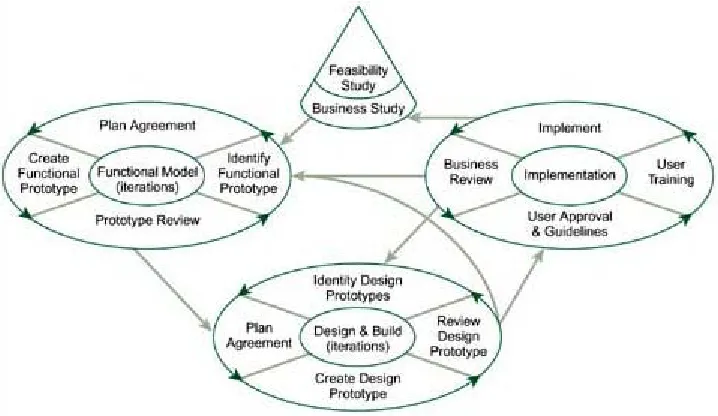
Dynamic Systems Development Method (DSDM)
active user involvement, frequent delivery, team decision making, integrated testing throughout the project life cycle, and reversible changes in development. The description of DSDM and an interview with Arie van Bennekum, a member of the DSDM consortium board of directors and a coauthor of the Agile Manifesto, are found in Chapter 18.
Crystal Methods
Alistair Cockburn is the author of the “Crystal” family of people-centered methods. Alistair is a
“methodology archaeologist” who has interviewed dozens of project teams worldwide trying to separate what actually works from what people say should work. Alistair, and Crystal, focuses on the people aspects of development—collaboration, good citizenship, and cooperation. Alistair uses project size, criticality, and objectives to craft appropriately configured practices for each member of the Crystal family of methodologies. Chapter 6 contains an interview with Alistair, and Chapter 19 describes Crystal. Alistair is also a coauthor of the Agile Manifesto.
Feature-Driven Development (FDD)
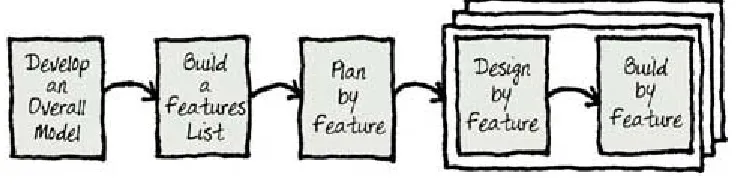
Jeff De Luca and Peter Coad collaborated on Feature-Driven Development. FDD consists of a minimalist, five-step process that focuses on developing an overall “shape” object model, building a features list, and then planning-by-feature followed by iterative design-by-feature and build-by-feature steps. FDD’s processes are brief (each is described on a single page), and two key roles in FDD are chief architect and chief programmer. FDD differs from XP in its “light” up-front architectural modeling. Jeff, an Australian, provides two case stories on very large (for Agile development) projects of more than 50 people, in
Chapter 20 on FDD. Jon Kern, director of product development for TogetherSoft, Peter Coad’s company, was a coauthor of the Agile Manifesto.
Lean Development (LD)
The most strategic-oriented ASDE is also the least known: Bob Charette’s Lean Development, which is derived from the principles of lean production, the restructuring of the Japanese automobile manufacturing industry that occurred in the 1980s. In LD, Bob extends traditional methodology’s view of change as a risk of loss to be controlled with restrictive management practices to a view of change as producing
“opportunities” to be pursued using “risk entrepreneurship.” LD has been used successfully on a number of large telecommunications projects in Europe. Chapter 16 contains an interview with Bob, and Chapter 21
describes Lean Development.
Extreme Programming (XP)
Extreme programming, or XP to most aficionados, was developed by Kent Beck, Ward Cunningham, and Ron Jeffries. XP preaches the values of community, simplicity, feedback, and courage. Important aspects of XP are its contribution to altering the view of the cost of change and its emphasis on technical
excellence through refactoring and test-first development. XP provides a system of dynamic practices, whose integrity as a holistic unit has been proven. XP has clearly garnered the most interest of any of the Agile approaches.
Chapters 4, 10, and 12 contain interviews with Kent, Ward, and Martin Fowler, another major contributor to XP and advocate of Agile development. Chapter 22 provides an overview of XP. Kent, Ward, Ron, and Martin were all coauthors of the Agile Manifesto.
Adaptive Software Development (ASD)
practices—iterative development, feature-based planning, customer focus group reviews—and an “Agile” management philosophy called Leadership-Collaboration management. Chapter 14 contains Alistair Cockburn’s interview with me, and ASD is described in Chapter 23. I was also a coauthor of the Agile Manifesto.
Acknowledgments
Any book is a collaborative effort, but this one was more so than most. A host of people contributed to
Agile Software Development Ecosystems, from those who were gracious enough to spend several hours being interviewed for key chapters to those who have influenced my thinking.
Alistair Cockburn and I have been talking about Agile development for several years. We have swapped ideas about how software gets developed, have coauthored several articles, are coediting the Agile Software Development series for Addison-Wesley, and constantly talk about an array of topics, occasionally as we ride up the ski lift together. It has been a great partnership, and I particularly thank Alistair for contributing the chapter on my ideas to this book.
Two people have had enormous long-term influence on my thinking: Tom DeMarco and Ken Orr. I’ve been colleagues and friends with both for nearly 20 years. They both contributed directly and indirectly to this book. Sam Bayer and I started working together in the early 1990s on rapid development practices and continue our ongoing collaborations. I just wish he would stop posing such hard questions!
I want to thank the people who endured long interviews for the profile chapters and other major stories in this book—Kent Beck, Arie van Bennekum, Bob Charette, Alistair Cockburn, Ward Cunningham, Jeff De Luca, Martin Fowler, and Ken Schwaber. Their involvement helped me bring a personal element to the discussion of Agile principles and values.
The Agile movement emerged from a meeting in February 2001, when a group got together to discuss what had been previously referred to as “light” methodologies. The collaborations of this group sparked the Agile movement. This group comprises the 17 authors of the Agile Manifesto—Kent Beck, Mike Beedle, Arie van Bennekum, Alistair Cockburn, Ward Cunningham, Martin Fowler, James Grenning, myself, Andrew Hunt, Ron Jeffries, Jon Kern, Brian Marick, Bob Martin, Steve Mellor, Ken Schwaber, Jeff Sutherland, and Dave Thomas. My thanks to all of them for their thoughts and deeply held convictions.
Rob Austin, Ken Orr, Tom DeMarco, Sam Bayer, Laurie Williams, Dirk Riehle, Ron Holliday, Jens Coldewey, and Lou Russell spent time reviewing the manuscript that evolved into this book. All their comments and questions were tremendously helpful.
Many people contributed in some way to the material in this book. They include Dane Falkner, Don Wells, Donna Fitzgerald, Ken Auer, Larry Constantine, Jason Leedy, Lise Hvatum, Lowell Lindstrom, Martyn Jones, Anne Mullaney, Michele Marchesi, Norm Kerth, Pete McBreen, Scott Ambler, Paul Szego, Sistla Purushotham, Michael O’Connor, Bruce Graham, Debra Stenner, Chris Pickering, Doug DeCarlo, Tom Bragg, Warren Keuffel, Ram Reddy, Bill Ulrich, Alan MacCormack, Barry Boehm, Barry Foster, Borys Stokalski, Ellen Gottesdiener, Geoff Cohen, Geoff Flamank, Peter O’Farrell, Ed Yourdon, Tim Lister, James Bach, Glen Alleman, Ivar Jacobson, David Garmus, Michael Mah, and Steve Palmer.
My special thanks goes to Karen Coburn, president of the Cutter Consortium, for her support of Agile ideas and permission to include material I wrote for various Cutter publications in this book.
And last, but (to use the cliché) not least, my thanks to Mike Hendrickson and Ross Venables at Addison-Wesley for their support and encouragement on this project, to Karen Pasley for her wit and wisdom in the editing process, and to Jennifer Kohnke for her wonderful sketches.
Among the people concerned with agility in software development over the last decade, Alistair Cockburn and I found so much in common that we joined efforts to bring to press an Agile Software Development Series based around relatively light, effective, human-powered software development techniques. We base the series on these two core ideas:
1. Different projects need different processes or methodologies.
2. Focusing on skills, communication, and community allows the project to be more effective and more agile than focusing on processes.
The series has the following main tracks:
• Techniques to improve the effectiveness of a person who is doing a particular sort of job. This might be a person who is designing a user interface, gathering requirements, planning a project, designing, or testing. Whoever is performing such a job will want to know how the best people in the world do their jobs. Writing Effective Use Cases (Cockburn 2001) and GUIs with Glue
(Hohmann, in preparation) are individual technique books.
• Techniques to improve the effectiveness of a group of people. These might include techniques for team building, project retrospectives, collaboration, decision making, and the like. Improving Software Organizations (Mathiassen et al. 2002) and Surviving Object-Oriented Projects
(Cockburn 1998) are group technique books.
• Examples of particular, successful Agile methodologies. Whoever is selecting a base methodology to tailor will want to find one that has already been used successfully in a similar situation. Modifying an existing methodology is easier than creating a new one and is more effective than using one that was designed for a different situation. Crystal Clear (Cockburn, in preparation) is an example of a methodology book.
Two books anchor the Agile Software Development Series:
1. This book, Agile Software Development Ecosystems, identifies the unique problems in today’s software development environment, describes the common principles behind Agile development as expressed in the Agile Manifesto, and reviews each of the six major Agile approaches. My previous book, Adaptive Software Development: A Collaboration Approach to Managing Complex Systems (Highsmith 2000), expresses my thoughts about Agile software development using the vocabulary of complex adaptive systems.
2. Alistair’s book, Agile Software Development (Cockburn 2002), expresses his thoughts about Agile development using several themes: software development as a cooperative game, methodologies as conventions about coordination, and families of methodologies.
You can find more about Crystal, Adaptive, and other Agile methodologies on these Web sites:
• www.crystalmethodologies.org
• www.jimhighsmith.com
Part I: Problems and Solutions
Chapter 1. The Change-Driven Economy
The digital age has its own uncertainty principle: Issues get fuzzier as their parts get more precise.
• Bart Kosko, Heaven in a Chip
The future of our Information Age economy belongs to the Agile, those companies that have the capacity to create change, and maybe even a little chaos, for their competitors. If you can innovate better and faster—you create change for your competitors. If you can respond quickly to competitive initiatives, new technology, and customers’ requirements—you create change for competitors. If you are slower, less innovative, less responsive—you are doomed to survival strategies in a sea of chaos imposed by others. Is your company going to set the pace of change, or are competitors going to set it? In our Information Age economy, a company’s ability to set the pace, to create change, lies in its ability to develop software. In a world of constant change, traditional rigorous software development methods are insufficient for success.
Agile Software Development Ecosystems will flourish for two reasons. First, they match the business need to deal with relentless speed and change, and second, they forge the workforce culture of the future. In recent years, software technology has moved from supporting business operations to becoming a critical component of business strategy. It drives new product development, from automobiles with hundreds of chips with embedded software to cellular phones and other wireless devices that are extending the definition of “distributed” systems.
ASDEs are tuned to innovation and response—to creating new knowledge that delivers value to businesses and to responding quickly to competitive challenges. Rigorous Software Methodologies (RSMs) are useful, but only for a set of problem domains that is shrinking. Many of the techniques from RSMs can be
effectively employed by ASDEs, but the framework and philosophy of the two are different. Agile approaches are best employed to explore new ground and to power teams for which innovation and creativity are paramount.
Agility is dynamic, context-specific, aggressively change-embracing, and growth-oriented. It is not about improving efficiency, cutting costs, or battening down the business hatches to ride out fearsome
competitive “storms.” It is about succeeding and about winning: about succeeding in emerging competitive arenas, and about winning profits, market share, and customers in the very center of the competitive storms many companies now fear (Goldman, Nagel, and Preiss 1995).
Forget the dotcom debacle; the Information Age economy remains alive and kicking. The new economy is not about the Internet, although the Internet certainly qualifies as a key driver. The new economy is about change—both the acceleration of change and the emergence of multiple types of change. One measure of this increasing change and turbulence is the attrition rate of companies from the Fortune 500 list over the past 25 years. From 1976 to 1985, only 10 percent of the Fortune 500 dropped off the list. From 1986 to 1990 the attrition rate rose to 30 percent, and it jumped again to 36 percent in the next 5-year period to 1996 (Pascale, Millemann, and Gioja 2000).[1] But while everyone admits to the increased pace of change, far fewer actually understand its implications.
[1]
Attrition includes (1) failure to grow and therefore falling below 500, (2) mergers and acquisitions, and (3) bankruptcy.
testing one’s own code, the strategic issue surrounding XP, and all other ASDEs, concerns embracing change.[2]
[2]
The term “embracing change” is a little much for some. Steve Mellor, one of the Agile Manifesto authors, made this comment in an email exchange: “While I understand the marketing value of embracing change (ugh! sounds like another one of those touchy-feely California things), what we’re really after is some notion of resilience, I think.” Steve has a great, wry sense of humor. In a series of emails on what to call non-Agile approaches, he came up with this one for Agile/XP approaches: “Supercalifr-agilistic-XP-alidocious.”
Agile organizations create chaos for their competitors, first by creating change so fast that competitors are left gasping for breath; and second, by responding quickly to competitors’ attempts to change the market. Just imagine what it feels like to have a competitor with a new product-development cycle of 12 months to your 18; furthermore, every time you introduce a breakthrough feature, they match it in their next product release. They are attacking, you are always on the defensive. That’s the essence of Agile organizations— create change that you can live with and your competition can’t. “The source of our competitiveness in this industry is our ability to manage in a chaotic environment,” says Silicon Graphics’ CEO Ed McCracken. “But it’s more proactive than that. We actually help create chaos in the first place—that’s what keeps a lot of potential competitors out” (Iansiti 1998). Agile organizations don’t just respond to change, they generate it!
Whether it’s rampant dotcom mania, the sharp business decline in the aftermath of that mania, or the economic aftermath of the horrendous attack on the World Trade Center, turbulent change will continue to dominate corporate economics. Furthermore, this change is emergent, complex, and messy. “Its
‘messiness’ lies not in disorder, but in an order that is unpredictable, spontaneous, and ever shifting, a pattern created by millions of uncoordinated, independent decisions,” writes Virginia Postrel (1998). The battle lines between proponents of ASDEs and RSMs are drawn from of deep-down, fundamentally different cultural assumptions, or perspectives, about how the world and organizations work.
“How we feel about the evolving future tells us about who we are as individuals and as a civilization: Do we search for stasis—a regulated, engineering world? Or do we embrace dynamism—a world of constant creation, discovery, and competition?” asks Postrel. “Do we crave predictability, or relish surprise? These two poles, stasis and dynamism, increasingly define our political, intellectual, and cultural landscape. The central question of our time is what to do about the future. And that question creates a deep divide” (Postrel 1998). While it may be stretching to equate software development ecosystems with wider cultural issues, my interviews with key ASDE authors indicate that their long-term visions are just that broad in scope.
ASDEs reflect a nontraditional set of ideas about organizational culture. The fundamental issue—related to Postrel’s notion of dynamism versus stasis—revolves around whether an organization has a Command-Control view of management or, as outlined in Adaptive Software Development, a “chaordic” Leadership-Collaboration view. I believe that ASDEs are brought into organizations for two reasons. These
organizations believe that ASDE principles and practices:
1. Support innovative product development.
2. Align with an organizational environment in which people want to work.
But perhaps, since the dotcom bubble burst, could turbulence be a phenomenon of the past, but not the future?
Turbulence: Bubbles versus Trends
Everyone predicted the demise of the dotcoms, so it’s somewhat of a mystery as to why these same people—on Wall Street in particular—were surprised when so many of them failed. A reasonable analysis of major organizations shows that the dotcoms intensified an eBusiness revolution that was already under way, and that the loss of a few (well, many) billions of dollars in stock market capitalization isn’t going to put the eBusiness genie back in the bottle.
But which part of dotcom mania was the bubble (the wild speculation on questionable business models) and which part was the trend (the longer-term implications of the Information Age)? Companies such as General Electric, General Motors, and Fidelity Investments—and many more—have extensive, long-term commitments to eBusiness. The pace may slow from blistering to merely brisk, but the ripple effects of dotcom mania will continue to create great opportunities.
We were in the eye of a hurricane during much of 2001; a lopsided hurricane for sure, but a hurricane nonetheless. On one side, during late 1999 and most of 2000, the hurricane was ferocious—full of tsunami-like waves and thunderous winds. The year 2001 was spent in the eye; the winds died down, and people made a quick assessment of the damage. Some, as always, not understanding the nature of hurricanes, thought the storm was over. Although the backside of the storm will be less ferocious, it will be considerably longer lasting.
Our metaphorical hurricane is, of course, the storm of the Internet economy, driven by the dotcom frenzy. Many companies think the storm tides are gone forever, but they have just begun. During the MSNBC Silicon Summit II in spring 2001, CEOs of major high-tech companies pointed to the difference between the speculations in the stock market and the basics of businesses: delivering products and satisfying customers. Part of the learning process will be separating the bubbles from the trends, the pure speculation from the real changes in delivering products and satisfying customers.
The pacesetters for the next wave are those companies that can blend the best of both worlds—bricks and clicks, technology and people, existing legacy systems with the B2s (B2B, B2C, etc.), and traditional corporate cultures with dotcom cultures. I am reminded of the comments by Lloyd Darlington of the Bank of Montreal, who observed that the new information economy defines the most pervasive change in banking in 300 years. He also offered keen insights into the strengths and weaknesses of traditional banks versus dotcom banks. “In the long run,” said Darlington, “we figure that while some people might be happy to accept a cheap loan from an unfamiliar provider on a Web site, few would be willing to hand over their life savings to such a provider” (Tapscott et al. 1998). His message was clear: Banks must adapt, but they don’t have to remake their entire structure overnight. Darlington’s comments were made at the height of the dotcom frenzy, during which a number of Internet-only banks were established. They are all gone. However, their legacy lives on in the “click” side of bricks-and-clicks banking.
A bubble-versus-trend example can be seen in analyzing Delta Airlines and Priceline.com. As mentioned earlier, from January 1999 to January 2001, the stock of Priceline.com went from $69 to $107.50 to $1.46 per share, while Delta Airlines’ stock traded in a narrow range of $45 to $60 per share. At one time during 1999, Priceline.com’s market capitalization surpassed that of Delta’s. The bubble in this situation was the greatly exaggerated stock price for Priceline.com. The Delta stock price trend reflects the nature of the airline business—high fixed costs for salaries and fuel, over capacity, and high capital investment for airplanes and facilities. Fancy ticket pricing didn’t overcome the basics of the airline business.
Although the backside of the dotcom storm will be less fierce, in the long run it will be fraught with more devastation and more opportunity: devastation for those who retreat to their traditional modes of operation, and opportunity for those who can blend the old and the new, champion the skills of innovation and improvisation, and build the culture required to sustain the ship through the ravages of the years ahead. The front side of the storm, the dotcom side, lasted two to three years, depending on one’s point of view. The backside will take considerably longer—another ten years at least.
Turbulence is here to stay. Whether reacting to the rise of the dotcoms, creating new products or business models, rapidly cutting costs in response to a business or industry downturn, or figuring out how to deal with cyber-terrorism, companies that want to survive must take to heart the pop-culture phrase—“deal with it!”
Exploration versus Optimization
At a presentation to senior executives at an oil services company, I asked the question, “What would you think of a oil exploration group that discovered a production-quality well 99.5 percent of the time?” The answer: “The company would go broke. They would not be taking enough risk.” Succeeding at oil exploration is a tricky business—take too many risks and the cost of dry holes skyrockets; however, take too few risks and the potential big field will never be found. Dealing with the turbulent economy means, first, understanding the differences between exploration and optimization.
Drilling production oil wells is an optimization, not an exploration, activity. Production drilling involves extracting the very last barrel from a known oil reservoir—it involves efficiency and cost control, getting better and better at something that is relatively well known. Exploration drilling, on the other hand, involves risk management: using well-known engineering practices, but ultimately trying to find the optimum balance between too much risk (costly dry holes) and too little risk (leaving potential revenue in the ground). Oil companies must do both—exploit known oil fields and explore for new ones. Other companies have to do both also, but the difference today is that the balance of exploration versus optimization has changed and companies are not geared to the degree of exploration required to survive and thrive in an Information Age economy.[3]
[3]
Thanks to my brother, Rick Highsmith, a 22-year veteran of Texaco’s exploration department for insights into the differences between exploration and production drilling.
Oil exploration and production organizations are quite different—they have different goals and reward systems. Exploration groups seek new reserves by going into new countries, new geographic areas, or thinking about how to use a new technology. Exploration departments require great creativity, attracting a high percentage of Ph.D. geologists and geophysicists who organize around skill teams. Exploration groups are often viewed as “strange” by the rest of the company.
Exploration and production people have different experiences because exploration decisions often have to be made with limited information. Most exploration drilling results in dry holes. A typical figure in exploration drilling would be a ten percent chance of discovering a viable oil field after spending $50 to $100 million. Although exploration groups use extensive statistical analysis to probe the risk of a project, in the end there is an element of “rolling the dice.” Other groups within oil companies are much less comfortable with dealing so explicitly with risk and uncertainty—they think deterministically.[4]
[4]
Uncertainty can be defined as unquantifiable risk. Both risk and uncertainty characterize oil exploration.
Market and technology turbulence creates opportunity, but one must have the right mindset to take full advantage of it. Exploring requires a very different perspective than optimizing. For example, optimizing focuses on reducing normal operating costs, in particular the cost of making frequent changes. Exploration, however, requires that we reduce the cost of change rather than reduce the amount of change itself.
path that works out of a myriad of potential paths. Rather than use the high cost of change as a deterrent, exploration geologists try to reduce the cost of change so that exploring multiple options will be cost effective.
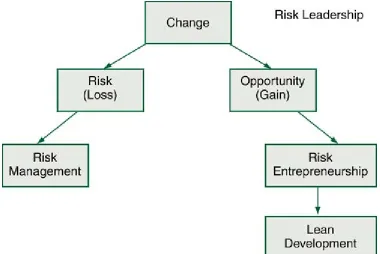
Change generates either the risk of loss or the opportunity of gain. Risk management helps mitigate risk; risk entrepreneurship (a term originated by Bob Charette) helps turn opportunity into profit; and failure to change causes, well, failure. Many companies view change as a necessary evil rather than as a competitive opportunity. Risk entrepreneurship means managing a portfolio of projects with varying degrees of market uncertainty (Is there a market? Is our timing right?), product uncertainty (Do we have the right product?), technology uncertainty (Did we pick the right technology for our product?), and business uncertainty (Can we make a profit on this product?).
Generally, the higher the uncertainty, the higher the probability of failure (or everyone else would be trying it) and the greater potential rewards. So we need both project portfolio management (product selection and funding) and Agile project management and software development practices that limit the cost of failures (there will always be losses if we are aggressively seeking new opportunities) while increasing the
probability of success. ASDEs are garnering increasing interest not because they attempt overturn 25 years of software engineering progress, as some critics contend, but because they address the issues germane to turbulence, risk, and uncertainty.
Recognizing the need to change or even the opportunities offered up by change is not enough, however. Companies and project teams must have appropriate practices in place to harness those changes, and therein lies a problem for many companies. Optimization processes—those traditional means of software development and project management—are fundamentally change-resistant processes, and rightfully so given the problem domain they address. Exploration practices, on the other hand, are fundamentally change-embracing—they are geared to encourage and harness change rather than tolerate only small increments of it. However, just as oil companies must explore for new oil reserves and then optimize production, companies need to explore technology and then optimize to improve performance and scalability.
It is not just development groups but also management that must undergo a change in perspective. A client asked me to speak to his senior executives about a new, leading-edge Web-based project. The folks in the IT department thought they had been successful in delivering a working application in the face of constant requirements changes that arose as their customers learned about the business issues of dealing with the Web. Senior executives were concerned only with the cost and schedule overrun. As we explore new business areas, measuring success from a traditional cost-schedule-scope perspective is only one of the cultural assumptions we need to reevaluate.
The move toward ASDEs reflects many of the same drivers that caused manufacturers to transition from mass production to lean production methods. In the 1980s, Japanese auto manufacturers used lean production techniques to simultaneously improve quality, lower costs, and increase speed to market. Success with lean production didn’t come from plant automation or rigid assembly processes, but from a focus on people.
The truly lean plant has two key organizational features: It transfers the maximum number of tasks and organizational responsibilities to those workers actually adding value to the car on the line, and it has in place a system for detecting defects that quickly traces every problem.
Lean production calls for learni