DEVELOPMENT AND VALIDATION OF VISIBLE METHOD FOR
ESTIMATION OF CILAZAPRIL IN BULK FORMULATION
Chavi Dagar, G. Rohit Reddy* and VVS. Rajendra Prasad
Department of Pharmaceutical Analysis and Quality Assurance, Vishnu Institute of
Pharmaceutical Education and Research, Vishnupur, Narsapur, Medak, Telangana, India.
ABSTRACT
A simple, sensitive, accurate, precise and economical visible
Spectrophotometric method was developed and validated for the
estimation of Cilazapril in Bulk form. The method is based on the
reaction of Cilazapril with vanillin in the presence of conc.Sulphuric
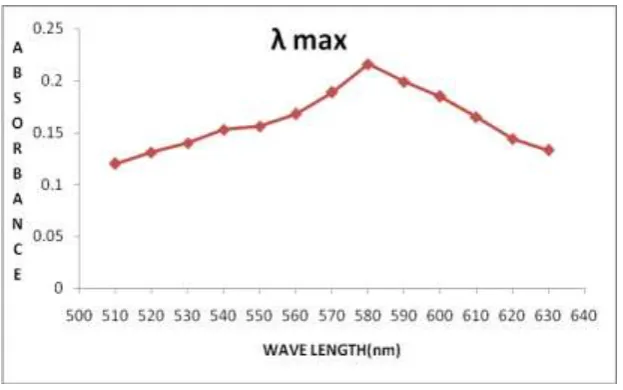
acid producing orange red colour chromogen which shows maximum
absorbance at 580nm against reagent blank. The Chromogen obeyed
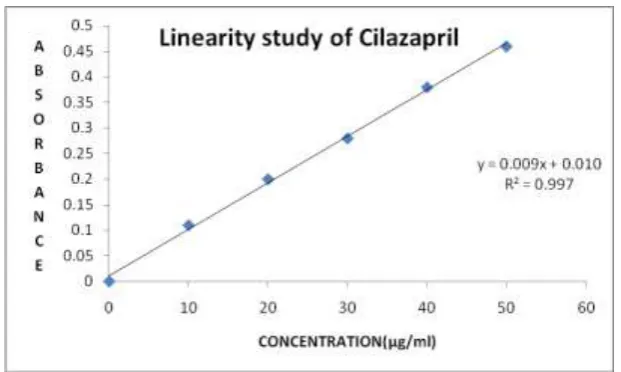
Beer’s law in the concentration range of 10-50 µg/ml for Cilazapril.
The results of the analysis have been validated statistically and
recovery studies.
KEYWORDS: Cilazapril, vanillin (4%), conc.Sulphuric acid, Visible Spectrophotometric.
INTRODUCTION
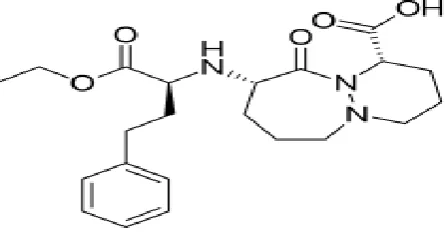
Cilazapril is chemically
(4S,7S)-7-[[(2S)-1-Ethoxy-1-oxo-4-phenylbutan-2-yl]amino]-6-oxo-1,2,3,4,7,8,9,10-octahydropyridazino[1,2-a]diazepine-4-carboxylic acid.[1] Cilazapril is an angiotensin-converting enzyme inhibitor (ACE inhibitor) used for the treatment
of hypertension and congestive heart failure.1 Literature survey reveals Septrophotometric2-3 methods for estimation of Cilazapril in biological fluids and in pharmaceutical formulations.
The present communication describes simple, sensitive, accurate, precise and economical
visible spectrophotometric method using vanillin (4%), conc.Sulphuric acid, for the
estimation of Cilazapril in bulk formulation.
Volume 6, Issue 1, 829-834. Research Article ISSN 2277– 7105
*Corresponding Author G. Rohit Reddy
Department of Pharmaceutical
Analysis and Quality
Assurance, Vishnu Institute of
Pharmaceutical Education and
Research, Vishnupur,
Narsapur, Medak, Telangana,
India.
Article Received on 04 Nov. 2016,
Revised on 25 Nov. 2016, Accepted on 16 Dec. 2016
Figure 1: Cilazapril structure
Mechanism of action: Cilazapril is an angiotensin-converting enzyme inhibitor used for the treatment of hypertension and congestive heart failure. Cilazapril suppress the
rennin-angiotensin-aldosterrone system and there by reduces both supine and standing systolic and
diastolic blood pressure.[1]
MATERIALS AND METHODS
Apparatus: A Shimadzu model T60 double beam UV/Vis Spectrophotometer with spectral width of 2nm wave length accuracy of 0.5 nm and a pair of 10mm matched quartz cells was
used to measure absorbance of the resulting solutions. Shimadzu analytical balance, an ultra
sonic cleaner were used in the study.
Reagents and Materials: Cilazapril drug was procured as a gift sample from Hetero drugs Ltd. Erragudda, Hyderabad, Telangana. Vanillin and conc.Sulphuric acid [A.R.Grade, SD
Fine Chemicals Ltd., Mumbai] were used in the study.
Preparation of Reagent and Working standard stock solution
4% Vanillin solution: - The solution was prepared by dissolving 4gms of vanillin in 100 ml of methanol.
Working Standard Stock Solution: Accurate weigh the 100mg of pure drug and transferred
in 100 ml of volumetric flask later diluted with distilled water upto100ml gives 1000µg/ml.
Methodology: Different aliquots of working standard solution containing 10-50 µg/ml concentration of Cilizapril was transferred into series of volumetric flask. To it 1ml of 4%
vanillin solution and 1ml of conc.Suphuric acid was added and volume was made up to 10 ml
with distilled water. The contents of the each flask was mixed well and allowed to stand at
nm against reagent blank. The amount of drug present in the sample solution was computed
from the calibration curve.[2, 3]
Reaction Mechanism: The results obtained in this method were based on the condensation of Cilizapril with vanillin in the presence conc.Sulphuric acid producing orange red coloured
species which is measured at 580 nm shown in the Figure 2.
Method Validation
Linearity: Five points calibration curve were obtained in a concentration range from 10-50 µg/ml for Cilazapril. The response of the drug was found to be linear in the investigation
concentration range and the linear regression equation was y = 0.009X+0.010 with
correlation coefficient 0.997 results are tabulated in table No.1 & Figure 3.
Precision: Precision of the analytical method is ascertained by carrying out the analysis as per the procedure and as per normal weight taken for analysis. Repeat the analysis six times.
Calculate the % assay, mean assay, % Deviation and % relative standard deviation and
%RSD. The developed method was found to be precise as the %RSD values for the
repeatability and intermediate precision studies were 2% and 1.095%, respectively shown
results are tabulated in table No.2.
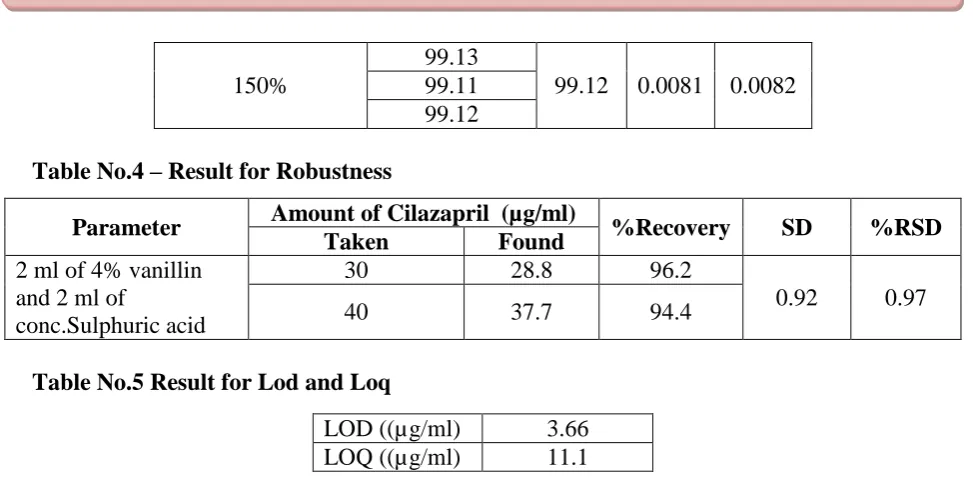
Accuracy: Accuracy of the method is ascertained by standard addition method at 3 levels. Standard quantity equivalent to 60%, 100% and 150% is to be added in sample. The result
shown that best recoveries (98.5-99.12%) of the spiked drug were obtained at each added
concentration, indicating that the method was accurate and results are tabulated in table No.3.
Robustness: Measure of the capacity of an analytical method to remain unaffected by small intentional variations in the operational parameters and provide an assurance of its reliability
during the normal usage. It may be determined by various parameters like ph, flow rate,
temperature etc. Robustness studies are performed during the method development stage.
Results are tabulated in table No.4.
Sensitivity
Limit of Detection and Quantitation (LOD and LOQ):- From the linearity data calculate the limit of detection and quantitation using the following formula.
LOD = 3.3σ / S
S = Slope of the calibration curve of the analyte.
LOQ = 10σ / S
σ = Standard deviation of response.
S = Slope of the calibration curve of the analyte.
The results are tabulated in Table No.5.
RESULTS AND DISCUSSION
The analytical method was developed by studying different parameters. The method was
validated for all validation parameters as per ICH guidelines. The lambda max of Cilazapril
was found to be 580 nm. Linearity was found with the concentration range 10-50 µg/ml and
correlation coefficients found to be 0.997 indicate good linearity between concentration and
slope area. Beer’s law was obeyed by the fundamental spectrum. This method was found to
be simple, sensitive, accurate, precise and economical for routine analysis for the estimation
of Cilazapril in Bulk form.
Recovery studies were found to be close 99% indicated the accuracy and precision of the
above two proposed methods. Values of LOD and LOQ were found to be 3.66 and 11.1
[image:4.595.143.455.456.651.2]respectively. The accuracy and robustness was calculated to be 99.12 and 96.2%.
Figure 3: Linearity graph
Table No.1 – Result for Linearity
Concentration (µg/ml) Absorbance
10 0.11
20 0.2
30 0.28
40 0.38
50 0.46
Correlation 0.997
Intercept 0.010
Slope 0.009
Table No.2 – Result for Precision
Sample No. % Assay Intra day Inter day
10 101 100
20 105.5 102
30 100 99
40 102.7 100
50 100 99
Mean 101.8 100
SD 2.07 1.095
% RSD 2.04 1.095
Table No.3 – Result for Accuracy
% Recovery Level % Recovery Mean SD %RSD 60%
98.62
98.62 0.0081 0.0082 98.63
98.61
100%
98.56
98.55 0.0124 0.0126 98.57
150%
99.13
99.12 0.0081 0.0082 99.11
99.12
Table No.4 – Result for Robustness
Parameter Amount of Cilazapril (µg/ml) %Recovery SD %RSD
Taken Found
2 ml of 4% vanillin and 2 ml of
conc.Sulphuric acid
30 28.8 96.2
0.92 0.97
[image:6.595.56.543.51.291.2]40 37.7 94.4
Table No.5 Result for Lod and Loq
CONCLUSION
The proposed visible spectrophotometric method was found to be simple, sensitive, accurate,
precise and economic for determination of Cilazapril in bulk formulation. Hence it can be
conveniently adopted for routine quality analysis of drug in pharmaceutical dosage form.
REFERENCES
1. Szucs, T. "Cilazapril. A review". Drugs. 1991; 41(1): 18–24.
2. Gumieniczeka A, Przyborowski L. Determination of benazepril and cilazapril in
pharmaceuticals by high performance liquid chromatography. Journal of Liquid
Chromatography, 1997; 20(13): 2135-2142.
3. Ch. Bhargavi, G. Rohit Reddy* and VVS. Rajendra Prasad-Development and Validation
of Visible Method for estimation of Cephalexin in bulk formulation, 5(11): 796-802 at
WJPPS.
LOD ((µg/ml) 3.66