Gorde et al. World Journal of Pharmaceutical Research
DEVELOPMENT OF A HIGHLY SENSITIVE METHOD FOR
QUANTITATIVE ESTIMATION OF POTENTIAL GENOTOXIC
O-BOC IMPURITY IN LACOSAMIDE DRUG SUBSTANCES USING
LC-MS
Dr. Amit Gosar, Amit Joglekar, Gulab Gorde*, Deepak Kadam and Lahu Shelar
Indoco Remedies Limited, Analytical Research and Development Department, Navimumbai,
Maharashtra, 400701, India.
ABSTRACT
A selective and highly sensitive liquid chromatography-mass
spectrometry (LC-MS) method is developed for the determination of
Sodium (tert-butoxycarbonyl)-D-serinate (O-Boc impurity) in
Lacosamide drug substance. The method was partially validated as per
International Council for Harmonisation (ICH) guidelines, for which
limit of detection and limit of quantitation obtained were 0.302 ppm
and 0.917 ppm respectively. The regression coefficient found for the
linearity study was 0.9976. The % recovery of the spiked Sodium
(tert-butoxycarbonyl)-D-serinate (O-Boc impurity) in drug substance
obtained was in the range of 80 to 120 which ensure the accuracy of
the method. The method can be adapted to determine Sodium (tert-
butoxycarbonyl)-D-serinate (O-Boc impurity ) in Lacosamide drug substance (API).
KEYWORD: Lacosamide, Sodium (tert-butoxycarbonyl)-D-serinate (O-Boc), development, validation, LCMS.
INTRODUCTION
Lacosamide is an anticonvulsant compound approved for the adjunctive treatment, as well as,
conversion to monotherapy and monotherapy treatment of partial-onset seizures and
neuropathic pain.[1] It is marketed under the trade name vimpat.[2] The chemical name for
Lacosamide is (R)-2-acetamido-N-benzyl-3-methoxypropanamide (Fig.1,a). Its molecular
formula is C13H18N2O3, which corresponds to a molecular weight of 250.294 g /mol
Volume 9, Issue 1, 1267-1272. Research Article ISSN 2277– 7105
*Corresponding Author
Gulab Gorde
Indoco Remedies Limited,
Analytical Research and
Development Department,
Navimumbai, Maharashtra,
400701, India.
Article Received on 05 Nov. 2019,
Revised on 26 Nov. 2019, Accepted on 17 Dec. 2019
(Fig.1,b),[3] Sodium (tert-butoxycarbonyl)-D-serinate or O-Boc impurity is one of the process
impurity that may be present in drug substance which is formed during the synthesis of
Lacosamide (Fig.1). Sodium (tert-butoxycarbonyl)-D-serinate structure also shows alert with
QSAR software[4], Hence Sodium (tert-butoxycarbonyl)-D-serinate (O-Boc) should be
controlled in drug substances to the threshold of toxicological concern (TTC) level 1.5
µg/day in drug substances.[5] A limit for the Sodium (tert-butoxycarbonyl)-D-serinate
(O-Boc) was set based on the maximum daily dose (MDD) of Lacosamide for which its limit
comes out to be 3.7 ppm.
Figure-1: a) Lacosamide and b) Sodium (Tert-Butoxycarbonyl)-D-Serinate, O-Boc Impurity (Free Acid Form).
EXPERIMENTAL Material
Lacosamide sample was obtained from chemical research and development department of
Indoco while Sodium (tert-butoxycarbonyl)-D-serinate i.e. O-Boc impurity standard was
qualified and characterised in-house in analytical research and development department.
Chemical and reagents
LCMS grade Methanol and Acetonitrile and Ammonium acetate (LCMS grade). Water used
for the preparation of solution was from Milli-Q water purification system.
Instrumentation
The LC instrument consists of UFLC (Ultrafast liquid chromatography) equipped with a
binary gradient pump, degasser, autosampler and a column oven. This LC system is
hyphenated with triple quadrupole mass spectrometer along with labsolution software. The
Chromatographic condition
HPLC column used for the analysis was of Inertsil ODS-3 (GL Science make) having 150
mm length, 4.6 mm internal diameter and 3.0 µm particles size. The mobile phase used for
elution was ammonium acetate buffer solution of 10 mM concentration and Methanol:
Acetonitrile in ratio 50:50 (v/v) using Binary gradient mode of elution. The flow rate and
column oven temperature were set to 1.0 mL/min and 25°C respectively. The injection
volume was optimized to 20 µL.
Mass condition
The mass spectrometer was equipped with Atmospheric pressure chemical ionization (APCI)
source and analysis was carried out in negative mode. Nitrogen was used as nebulizing as
well as drying gas and flow rate used was 3.0 L/min and 5.0 L/min respectively. Desolvation
line temperature and heat block temperature were maintained at 200°C. Quantification was
done by selected ion monitoring (SIM) mode using m/z ion 204.19 for Sodium
(tert-butoxycarbonyl)-D-serinate (O-Boc) is having mass 227.19 as sodium salt but in acid, for it is
having mass 205.2 and same is considered for quantification.
Preparation of solutions
A mixture of water and methanol was prepared in ratio 10:90 was used as a diluent for all the
preparations also taken as blank. The test sample solution was prepared of concentration 800
mg in 10 ml diluent. The standard solution of O-Boc impurity was prepared at 3.70 ppm with
respect to the test solution concentration.
RESULT AND DISCUSSION Method optimization
Several method and column were screened for the selection of technique for determination of
O-Boc impurity. Neither of the methods was capable of determining the O-Boc impurity upto
trace level, hence mass spectrophotometer detector was selected using liquid
chromatography. The different column was optimized to non-polar octadecyl (C18) columns.
O-Boc impurity gets retained on the stationary phase (C18) acetate buffer in the mobile
phase. The retention time for O-Boc impurity obtained was about 10.5 minute. Due to the low
concentration of O-Boc impurity, it is difficult to analyze on UV detector, hence mass
detector was used for its detection and quantification. First ionization was done on APCI
solvent methanol: acetonitrile(50:50) and found M/Z=204.10 at negative mode. After
ionization observed mass taken for SIM analysis with binary gradient elution. The divert
valve was kept at on from position 4.0 to 12.3 min which will allow the O-Boc impurity to
enter into the mass spectrometer. The divert valve was kept at off position from 0.01 to 4.0
min and 15.0 to 30.0 min which will not allow the higher concentration sample into the mass
spectrometer and hence it will go to waste. Chromatographic run time kept was 30 minutes.
Method validation
The partial analytical method validation work was conducted according to the ICH
(International Conference on Harmonization) guidelines.[6-8] The parameter with which
analytical method is validated is Specificity, Limit of detection, Limit of quantitation,
Linearity and Recovery.
Specificity
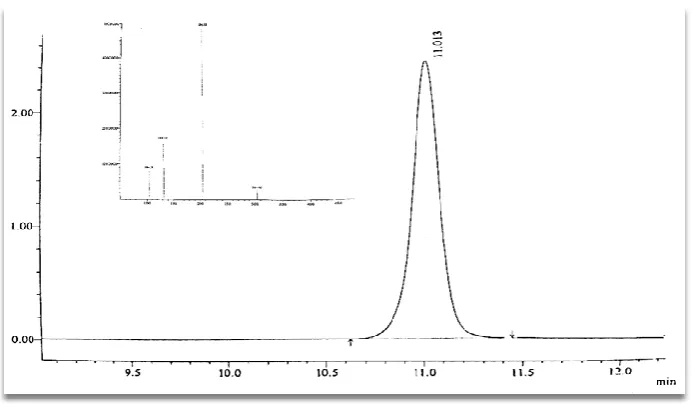
The specificity of the method was established by observing the
Sodium(tert-butoxycarbonyl)-D-serinate (O-BOC ) separated from Lacosamide peak. The method is specific for detection
of O-Boc impurity, as all peaks are well separated observed in UV mode. The retention time
of O-Boc impurity is about 11.013 min (Fig.2). Hence, the method has been demonstrated for
[image:4.595.125.472.463.665.2]specificity.
Figure 2: Linearity graph of O-Boc impurity.
Limit of detection and Limit of quantitation
Series of standard solutions of O-Boc impurity was prepared in a concentration ranging from
Limit of quantitation (LOQ) was calculated based on a standard deviation of the regression
line and slope method. Limit of detection obtained for O-Boc impurity was 0.302 ppm and
Limit of quantitation 0.917 ppm.
Linearity
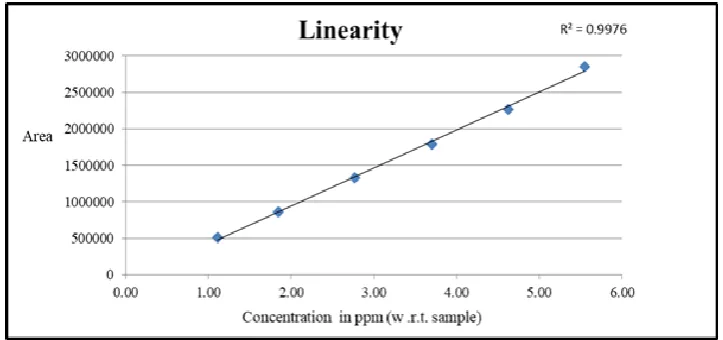
Series of linearity solution of O-Boc impurity was prepared from 30 to 150% of target
concentration (3.70 ppm w.r.t sample). Linearity curves were drawn by plotting the peak area
of O-Boc impurity against its corresponding concentration of linearity solution (Fig.3). The
[image:5.595.116.478.265.435.2]observed regression coefficient for linearity curve was 0.9976.
Figure 3: Linearity graph of O-Boc impurity.
Precision
System precision was established by injecting six replicate injections of standard solution
where percent Relative standard deviation (%RSD) for O-Boc impurity peak area was 7.12.
This proves that the method is highly precise for the detection of O-Boc impurity.
Recovery
The recovery of the method was determined for the related substances by spiking of known
amounts of O-Boc impurity in drug substances at level 100% of the specified limit. The
method was highly accurate for recovery of O-Boc impurity in the drug substances in the
range of 80 and 120%.
CONCLUSION
An optimized LC-MS method was developed to determine the potential genotoxic Sodium
Sodium (tert-butoxycarbonyl)-D-serinate (O-Boc impurity) determination due to other
impurities. An advantage of this method is, its LOD value is very low. The developed method
is simple and direct. This LC-MS method was partially validated which proves the method to
be simple, precise, linear and accurate. Hence, this method can be for routine low-level
Sodium (tert-butoxycarbonyl)-D-serinate (O-Boc impurity) analysis in pharmaceutical drug
substances.
ACKNOWLEDGEMENT
We truly acknowledge and appreciate the support of our Analytical research and development
team of Indoco in providing the standard and sample for the study.
REFERENCES
1. Halász P, Kälviäinen R, Mazurkiewicz‐Beldzińska M, Rosenow F, Doty P, Hebert D,
Sullivan T, SP755 Study Group. Adjunctive lacosamide for partial‐onset seizures:
efficacy and safety results from a randomized controlled trial. Epilepsia, Mar, 2009;
50(3): 443-53.
2. Tilz C, Resch R, Hofer T, Eggers C. Successful treatment for refractory convulsive status
epilepticus by non‐parenteral lacosamide. Epilepsia, Feb, 2010; 51(2): 316-7.
3. McCleane G. Lacosamide for pain. Expert opinion on investigational drugs, Sep 1, 2010;
19(9): 1129-34.
4. Lee H. Structural Alerts for Genotoxicity and Carcinogenicity. in pharmaceutical Industry
Practices on Genotoxic Impurities, Aug 29, 2014: 82-109. CRC Press.
5. Guideline, ICH Harmonized Tripartite. Assessment and Control of DNA Reactive
(Mutagenic) Impurities in Pharmaceuticals to Limit Potential Carcinogenic RISK M7.
International conference on harmonization of technical requirements for registration of
pharmaceuticals for human use (ICH): Geneva, 2014.
6. Guideline IH. Validation of analytical procedures: text and methodology Q2 (R1).
International conference on harmonization, Geneva, Switzerland, Nov, 2005: 11-12.
7. Swartz ME, Krull IS. Handbook of analytical validation. CRC Press, Apr 24, 2012.
8. CC, Lee YC, Lam H, Zhang XM, editors. Analytical method validation and instrument