FORMULATION AND EVALUATION OF CONTROLLED RELEASE
MATRIX TABLETS OF SIMVASTATIN
M.Ravali *1, K.Navaneetha2, B.Venkateswara Reddy2, N.Karthik3
1
Department of Pharmaceutics, Vaagdevi College of Pharmacy, Warangal, A.P, India.
2
Department of Pharmaceutics, St.Pauls College of Pharmacy, Turkayamjal (V), Hayathnagar (M), R.R, A.P, India.
3
Department of Pharmacology, Aurobindo College of pharmaceutical sciences, Warangal, A.P, India.
ABSTRACT
The purpose of this study is to formulate a controlled release matrix tablet of simvastatin a drug which is used in the treatment of dyslipidemia. Simvastatin has a short biological half life of 3 hours which necessitates multiple daily dosing hence a controlled release formulation of simvastatin is developed. Controlled release tablets of simvastatin are prepared by direct compression method by using various polymers such as Eudragit RLPO and Eudragit RSPO. FTIR studies revealed that drug and the excipients used were compatible with each other. The precompression studies revealed that the powder blend has good flow properties, and the post compression studies shows that the results were within the limits. Matrix tablet of Simvastatin that contained a blend of drug and Eudragit RLPO in 1:1.5 showed 99.41% of drug release in a period of 24 hours. The drug release mechanisms for formulationswere bestdescribed byHiguchi’sand Krosmeyer Peppas. The drug release of
optimised formula followed non fickian type of diffusion. Thus, concluded that the control release matrix tablets prepared by using Eudragit RLPO were more promising than the Eudragit RLPO.
KEYWORDS: Control Release; Simvastatin; Dyslipidemia; Eudragit RLPO; Eudragit RSPO; Non fickian Diffusion.
Volume 3, Issue 4, 1706-1721. Research Article ISSN 2277 – 7105
Article Received on 25 April 2014,
Revised on 20 May 2014, Accepted on 14 June 2014
*Author for Correspondence
Navaneetha Reddy
Department of Pharmaceutics,
St.Pauls college of
Pharmaceutics.
Turkayamjal (V) Hayathnagar
(M), R.R.Dist- 501510, A.P,
INTRODUCTION
Oral controlled release delivery systems are programmed to deliver the drug in predictable time frame that will increase the efficacy, minimize the adverse effects and increase the bioavailability of drugs. Oral drug delivery is the most widely utilized route of administration among all alternatives that have been explored for systemic delivery of drug via various pharmaceutical products of different dosage forms1.
Availability of wide variety of polymers and frequent dosing intervals help the formulation scientist to develop controlled /sustained release products. Popularity of the route may be ease of administration as well as due to traditional belief that by oral administration the drug is well absorbed into the food stuff ingested daily2. Oral controlled release (C. R ) / sustained release (S. R) products provide an advantage over conventional dosage forms by optimizing bio-pharmaceutical, pharmacokinetic and pharmacodynamic properties of drugs.
Controlled release (C.R) / Sustained release (S. R) pharmaceutical products have gradually gained medical acceptance and popularity. Regulatory approval for marketing and their pharmaceutics superiority and clinical benefits over immediate release pharmaceutical products have been increasingly recognized3, 4. Modified release oral dosage forms have brought new lease of life into drugs that have lost market potential due to requirement of frequent dosing, dose related toxic effects and gastrointestinal disturbances.
The term modified-release drug product is used to describe products that alter the timing and/or the rate of release of the drug substance. A modified-release dosage form is defined “asoneforwhichthedrug-release characteristics of time course and/or location are chosen to
accomplish therapeutic or convenience objectives not offered by conventional dosage forms such as solutions, ointments or promptly dissolving dosage forms as presently recognized5, 6.
The basic rationale for controlled drug delivery is to alter the pharmacokinetic and pharmacokinetics of pharmacologically active moieties by using novel drug delivery systems or by modifying the molecular structure and or physiological parameters inherent in a selected route of administration8. It is desirable that the duration of drug action become more to design properly. Rate controlled dosage form, and less, or not at all a property of the drug molecules inherent kinetic properties.
The aim of this present work is to formulate a controlled release matrix tablet of simvastatin using various polymers such as Eudragit RLPO and Eudragit RSPO. Simvastatin has a short biological half life of 3 hours which necessitates multiple daily dosing hence the present study was aimed to develop a controlled release formulation of simvastatin9.
To provide a drug delivery system for continuous release of drug at controlled rate which increases the patient compliance, effectiveness of therapy and reduces the chances of adverse effect by maintaining the plasma drug concentration at the same level within therapeutic range for the required period of time10, 11.
MATERIALS AND METHODOLOGY Materials
Simvastatin was obtained as a gift sample from Aurobindo Pharmaceuticals Hyderabad, India. Eudragit RLPO and Eudragit RSPO from Universal laboratories Hyderabad, India, Aerosil and Microcrystalline cellulose from Loba chemie Pvt. Ltd, Mumbai, PVPK30 and Magnesium stearate from Qualikems Fine chemicals Pvt. Ltd, New Delhi.
Methodology
Drug-Excipient Compatibility Studies
The compatibility studies were performed using Fourier Transform- Infra Red Spectroscopy. The drug and drug- polymer physical mixtures were scanned in the region of 4000-400 cm-1.
Formulation Development
Preparation of simvastatin matrix tablets
Method
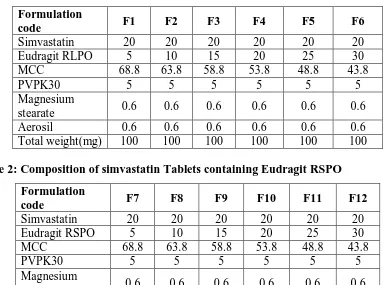
Accurately weighed amounts of drug, polymer and diluents were mixed geometrically in a mortar, this mixture was passed through 40 sieve and thoroughly mixed in a polythene bag for 15 minutes. The powder blend was then lubricated by the addition of magnesium stearate and talc and compressed into tablets on a rotary punching machine using 6mm round, flat faced punches. The total weight of the matrix tablets was 100 mg with different drug polymer ratios like 1:0.25, 1:0.5, 1:0.75, 1:1, 1:1.25 and 1:1.5. The polymers used were Eudragit RLPO and Eudragit RSPO. MCC (water-insoluble) was used as a diluent for the preparation of matrix tablets.
[image:4.595.100.488.307.592.2]Formulations
Table 1: Composition of simvastatin Tablets containing Eudragit RLPO Formulation
code F1 F2 F3 F4 F5 F6
Simvastatin 20 20 20 20 20 20
Eudragit RLPO 5 10 15 20 25 30
MCC 68.8 63.8 58.8 53.8 48.8 43.8
PVPK30 5 5 5 5 5 5
Magnesium
stearate 0.6 0.6 0.6 0.6 0.6 0.6
Aerosil 0.6 0.6 0.6 0.6 0.6 0.6
Total weight(mg) 100 100 100 100 100 100
Table 2: Composition of simvastatin Tablets containing Eudragit RSPO Formulation
code F7 F8 F9 F10 F11 F12
Simvastatin 20 20 20 20 20 20
Eudragit RSPO 5 10 15 20 25 30
MCC 68.8 63.8 58.8 53.8 48.8 43.8
PVPK30 5 5 5 5 5 5
Magnesium
stearate 0.6 0.6 0.6 0.6 0.6 0.6
Aerosil 0.6 0.6 0.6 0.6 0.6 0.6
Total weight(mg) 100 100 100 100 100 100
Characterisation Of Pre-Compression Blend Angle of repose12
was allowed to flow through the funnel freely on to the surface. The diameter of the powder cone was measured and angle of repose was calculated using the following equation.
Tan θ =h/r
Where, h and r are the height and radius of the powder cone.
Bulk density
A quantity of 2 gm of powder blend from each formula, previously shaken to break any agglomerates formed, was introduced in to 10 ml measuring cylinder. After that the initial volume was noted and the cylinder was allowed to fall under its own weight on continued until no further change in volume was noted. LBD and TDB were following equations.
LBD =
TBD=
Total Porosity
Total porosity was determined by measuring the volume occupied by a selected weight of a powder (Vbulk) and the true volume of the powder blend (The space occupied by the powder exclusive of spaces greater than the intermolecular spaces,v).
POROSITY =
Hausner’s Ratio
It indicates the flow properties of the granules and is measured by the ratio of tapped density to the bulk density.
Hausner’s Ratio =
Compressibility index (Carr’s Index): CI
Compressibility index is an important measure that can be obtained from the bulk and tapped densities. In theory, the less compressible a material is the more flow able it is. A material having values of less than 20% has good flow property.
Evaluation Of Simvastatin Tablets
The tablets were evaluated for in process and finished product quality control tests i.e. thickness, weight variation, hardness, friability, assay, drug content and in-vitro release studies.
Weight variation13
The weight of the tablet being made was routinely determined to ensure that a tablet contains the proper amount of drug. The USP weight variation test was done by weighing 20 tablets individually, calculating the average weight and comparing the individual weights to the average.
Table 3: Average weight of the Tablets with respect to the % deviation allowed Average Weight of
Tablets(I.P)
Maximum% deviation allowed
Average weight of tablets(U.S.P) Less than 80 mg 10 Less than 130 mg
80mg-250mg 7.5 130-324mg
More than 250mg 5 More than 324mg
Tablet hardness13
The hardness of each batch of tablet was checked by using Monsanto hardness tester. The hardness was measured in terms of kg/cm2. Six tablets were chosen randomly and tested for hardness. The average hardness of six determinations was recorded.
Friability13
20 tablets were weighed and the initial weight of these tablets was recorded and placed in Roche friabilator and rotated at the speed of 25 rpm for 100 revolutions. Then tablets were removed from the friabilator, dusted off to remove fines and again weighed and the weight was recorded.
% of Friability=
Where: w1= weight of the tablet before test; w2 = weight of the tablet after test
Thickness
Thickness of tablets were measured using vernier calipers.
Content uniformity14
dissolved in 100ml of pH 6.8 phosphate buffer followed by stirring for 10mins. The solution was filtered through a 0.45µ membrane filter, diluted suitably and the absorbance of resultant solution was measured by using UV-Visible spectrophotometer at 239nm using pH 6.8 phosphate buffer.
In-vitro Dissolution studies15
In-vitro dissolution study of Simvastatin was carried using USP dissolution test apparatus.
Dissolution was carried out for first two hours in 0.1N Hcl and then in 6.8 pH phosphate buffer upto 24 hours. 5 ml samples were withdrawn at pre-determined time intervals and replaced with fresh media. Samples withdrawn were analyzed by UV spectrophotometer at 239nm for estimation of amount of drug released.
Kinetic Analysis of Dissolution Data16
To analyze the In-vitro release data various kinetic models were used. zero order rate equation describes the systems where the drug release rate is independent of its concentration. The first order Eq. (2) describes the release from system where release rate is concentration dependent. Higuchi (1963) described the release of drugs from insoluble matrix as a square root of time dependent process based on Fickian diffusion Eq. (3). The Hixson- crowell cube root law Eq. (4) describes the release from systems where there is a change in surface area and diameter of particles or tablets.
Where, K0 is zero-order rate constant and t is the time.
Log C = LogC0 –Klt/2.303 (2)
Where, C0 is the initial concentration of drug and K1 is first order constant. Q=KHt1⁄2(3)
Where, KH is the constant reflecting the design variables of the system. Q0 (1⁄3)- Qt1⁄3=KHCt(4)
Where Qt is the amount of drug remained in time t, Q0 is the initial amount of the drug in
tablet and KHC is the rate constant for Hixson- crowell rate equation. The following plots were made from the in-vitro drug release data 1. Cumulative % drug release vs. time ( Zero order kinetic model);
RESULTS AND DISCUSSION Drug-Excipient Compatibility Studies
Fourier Transform Infrared Spectroscopic studies: The FTIR Spectra of pure simvastatin drug was compared with the FT-IR spectrum physical mixture of drug and polymer (simvastatin and Eudragit RLPO) and drug with the other excipients used in the optimized formulation.
There was no appearance or disappearance of any characteristics peak in the FTIR spectrum of drug and the polymers used. This shows that there is no chemical interaction between the, drug and the polymer used
Fig.No.1: FT-IR spectra of simvastatin pure drug
Fig.No.3: FT-IR spectra of simvastatin with PVP
Fig.No.4: FT-IR spectra of Simvastatin with Aerosil
Fig.No.6: FT-IR spectra of Simvastatin with MCC
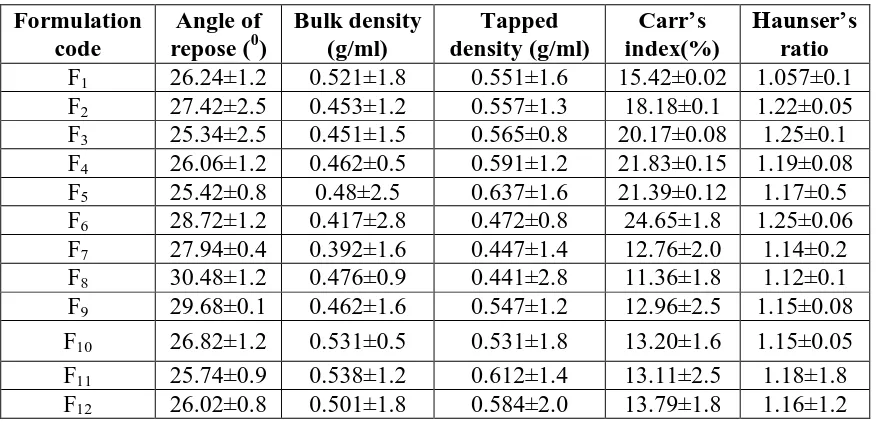
[image:10.595.80.518.315.529.2]Charaterisation Of Pre-Compression Blend Table No. 4: Pre compression parameters
Formulation code
Angle of repose (0)
Bulk density (g/ml) Tapped density (g/ml) Carr’s index(%) Haunser’s ratio F1 26.24±1.2 0.521±1.8 0.551±1.6 15.42±0.02 1.057±0.1
F2 27.42±2.5 0.453±1.2 0.557±1.3 18.18±0.1 1.22±0.05
F3 25.34±2.5 0.451±1.5 0.565±0.8 20.17±0.08 1.25±0.1
F4 26.06±1.2 0.462±0.5 0.591±1.2 21.83±0.15 1.19±0.08
F5 25.42±0.8 0.48±2.5 0.637±1.6 21.39±0.12 1.17±0.5
F6 28.72±1.2 0.417±2.8 0.472±0.8 24.65±1.8 1.25±0.06
F7 27.94±0.4 0.392±1.6 0.447±1.4 12.76±2.0 1.14±0.2
F8 30.48±1.2 0.476±0.9 0.441±2.8 11.36±1.8 1.12±0.1
F9 29.68±0.1 0.462±1.6 0.547±1.2 12.96±2.5 1.15±0.08
F10 26.82±1.2 0.531±0.5 0.531±1.8 13.20±1.6 1.15±0.05
F11 25.74±0.9 0.538±1.2 0.612±1.4 13.11±2.5 1.18±1.8
F12 26.02±0.8 0.501±1.8 0.584±2.0 13.79±1.8 1.16±1.2
The pre compression blend for matrix tablets were characterized with respect to angle of repose,bulkdensity,tappeddensity,carr’sindexanddrugcontent.Angleofreposewasless
than 310 andcarr’s index valueswere lessthan25 fortheprecompression blendofallthe batches indicating good to fair flowability and compressibility. Haunser’sratiowaslessthan 1.25 for all the batches indicating good flow properties.
Evaluation of Simvastatin Matrix Tablets
Table No. 5: Evaluation of matrix tablets of simvastatin Formulation
code
Weight variation(mg)
Hardness (kg/cm2)
Thickness (mm) Friability (%) Content uniformity(%) F1 98.9±1.49 3.12±0.43 1.76±0.17 0.23 99.65±1.35
F2 100.3±0.53 3.32±0.32 1.86±0.27 0.54 99.34±2.45
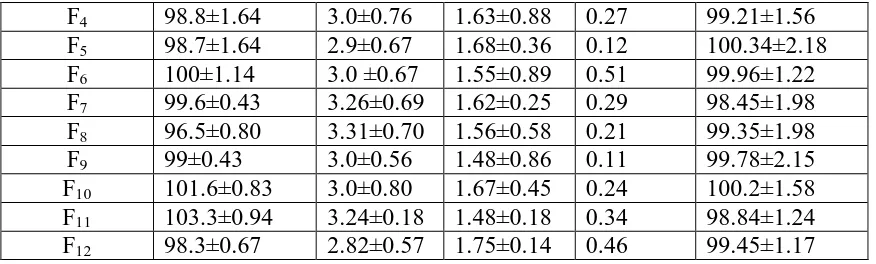
The results of the weight variation, hardness, thickness, friability, and drug content of the tablets are given in table 5. All the tablets of different batches complied with the official requirements of weight variation as their weight variation passes the limits. The hardness of the tablets ranged from 2.8 to 3.3kg/cm2 and the friability values were less than 0.6% indicating that the matrix tablets were compact and hard. The thickness of the tablets ranged from 1.48 to 1.86 mm. All the formulations satisfied the content of the drug as they contained 90 to 100% of simvastatin and good uniformity in drug content was observed. Thus all the quality control parameters of the prepared tablets were found to be practically within limits.
In-Vitro Drug Release Studies
Table No. 6: In-vitro Release Data of simvastatin matrix tablet containing Eudragit RLPO
Time
(hrs) F1 F2 F3 F4 F5 F6
1 41.19±1.036 37.16±1.036 32.25±1.656 24.22±0.552 19.23±0.439 14.44±0.335 2 63.27±1.114 52.33±1.015 47.25±1.224 46.18±0.557 27.18±0.662 23.44±0.130 4 77.21±1.047 64.17±1.218 58.17±1.137 58.17±0.385 42.26±0.586 34.34±0.219 6 84.23±1.295 83.18±1.137 64.19±1.257 62.32±0.555 57.13±0.585 46.54±0.333 8 93.28±0.803 87.37±1.000 87.46±0.564 73.24±1.131 63.18±0.586 57.6±0.579 10 98.39±1.255 94.22±1.090 92.26±1.896 88.22±1.107 72.18±0.585 63.1±0.774 12 98.28±1.106 98.22±1.552 91.15±1.136 85.22±1.374 71.15±1.255
14 98.29±1.137 87.49±1.017 76.11±1.259
16 91.22±1.218 82.14±1.108
18 95.34±1.001 88.49±1.438
20 98.89±1.656 93.14±2.479
22 96.7±1.756
24 99.41±1.279
F4 98.8±1.64 3.0±0.76 1.63±0.88 0.27 99.21±1.56
F5 98.7±1.64 2.9±0.67 1.68±0.36 0.12 100.34±2.18
F6 100±1.14 3.0 ±0.67 1.55±0.89 0.51 99.96±1.22
F7 99.6±0.43 3.26±0.69 1.62±0.25 0.29 98.45±1.98
F8 96.5±0.80 3.31±0.70 1.56±0.58 0.21 99.35±1.98
F9 99±0.43 3.0±0.56 1.48±0.86 0.11 99.78±2.15
F10 101.6±0.83 3.0±0.80 1.67±0.45 0.24 100.2±1.58
F11 103.3±0.94 3.24±0.18 1.48±0.18 0.34 98.84±1.24
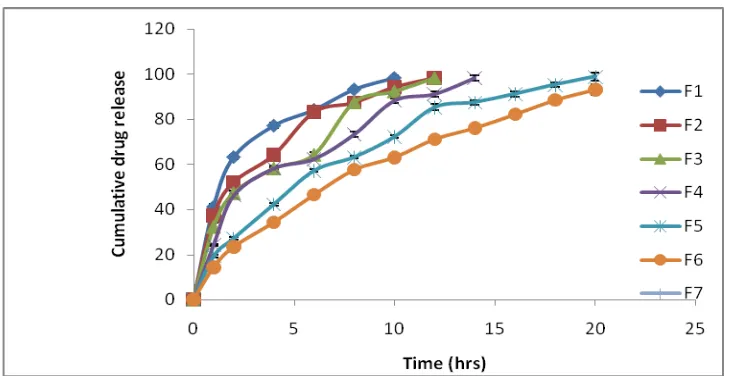
[image:11.595.66.504.71.203.2]Fig.No.7: In- vitro Release profile of simvastatin from matrix tablets containing Eudragit RLPO
The cumulative percent drug release for formulation, F1 with drug :Eudragit RLPO in 1:0.25 ratio was 98.39% after 10th hour and formulation F2 with drug:Eudragit RLPO in 1:0.5 was 98.28%after 12th hour.
The cumulative percent drug release for formulation F3 with drug:Eudragit RLPO in 1:0.75 ratio was 98.22% after 12th hr, and F4 with drug: Eudragit RLPO with was 91.15% after 12th hr. The F4 formulation could sustain the drug release up to 14th hour with 98.29% release.
The cumulative percent drug release for formulation F5 with drug :Eudragit RLPO was 98.89% after 20th hour (drug: polymer ratio1:1.25)and formulation F6 with drug:Eudragit RLPO was 99.41 after 24hrs,(drug :polymer in1:1.5 ratio).
Table No. 7: In-vitro Release Data of simvastatin matrix tablet containing Eudragit RSPO
Time
(hrs) F7 F8 F9 F10 F11 F12
1 43.18±1.036 39.44±1.036 35.3±1.656 27.19±0.552 18.19±0.439 16.36±0.335 2 62.29±1.114 57.46±1.015 53.57±1.224 42.15±0.557 30.3±0.662 26.55±0.130 4 74.39±1.047 72.39±1.218 72.25±1.137 57.22±0.385 43.84±0.586 37.16±0.219 6 85.31±1.295 83.5±1.137 82.35±1.257 69.86±0.555 57.14±0.585 49.14±0.333 8 92.48±0.803 89.54±1.000 89.53±0.564 83.14±1.131 65.11±0.586 56.21±0.579 10 98.48±1.255 94.38±1.090 92.41±1.896 88.42±1.107 76.23±0.585 62.37±0.774 12 98.31±1.106 96.67±1.552 93.26±1.136 83.26±1.374 69.17±1.255
14 98.31±1.412 95.54±1.137 88.32±1.017 75.2±1.259
18 95.38±1.001 87.15±1.438
20 98.34±1.656 92.11±2.479
22 98.13±1.721
Fig.No.8: In- vitro Release profiles of simvastatin from matrix tablets containing Eudragit RSPO.
The cumulative percent drug release for formulation, F7 with drug : Eudragit RSPO in 1:0.25 ratio was 98.48% after 10th hour and formulation F8 with drug: Eudragit RSPO in 1:0.5 was 98.31%after 12th hour.
The cumulative percent drug release for formulation F9 with drug : Eudragit RSPO in 1:0.75 ratio was 98.31 % after 14th hr, and F10 with drug: Eudragit RSPO with was 95.54% after 12th hr. The F10formulation could sustain the drug release up to 14th hour with 98.63% release.
The cumulative percent drug release for formulation F11 with drug : Eudragit RSPO was 98.34% after 20th hour (drug: polymer ratio1:1.25)and formulation F12 with drug:Eudragit RSPO was 98.13 after 24hrs,(drug :polymer in1:1.5 ratio).
Kinetic analysis of dissolution data
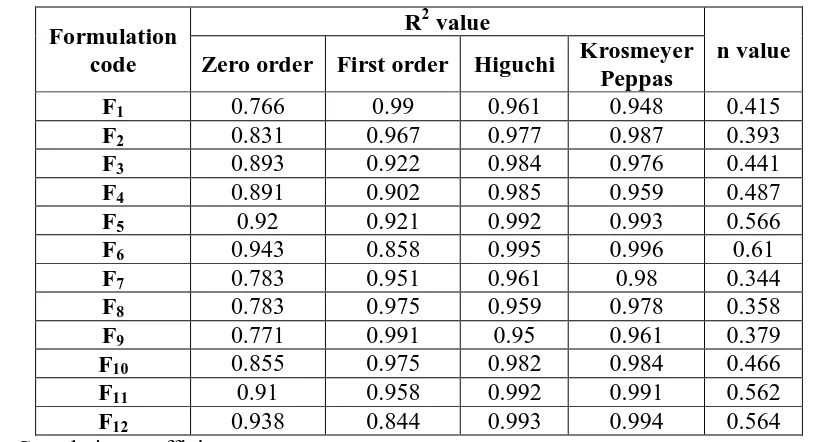
Table No.8: Drug release kinetics of simvastatin from matrix tablet formulations F1- F12
Formulation code
R2 value
n value Zero order First order Higuchi Krosmeyer
Peppas
F1 0.766 0.99 0.961 0.948 0.415
F2 0.831 0.967 0.977 0.987 0.393
F3 0.893 0.922 0.984 0.976 0.441
F4 0.891 0.902 0.985 0.959 0.487
F5 0.92 0.921 0.992 0.993 0.566
F6 0.943 0.858 0.995 0.996 0.61
F7 0.783 0.951 0.961 0.98 0.344
F8 0.783 0.975 0.959 0.978 0.358
F9 0.771 0.991 0.95 0.961 0.379
F10 0.855 0.975 0.982 0.984 0.466
F11 0.91 0.958 0.992 0.991 0.562
F12 0.938 0.844 0.993 0.994 0.564
R2 = Correlation coefficient
To analyze the drug release mechanism the in-vitro release data was fitted into various Release equations and kinetic models first order, zero order, Higuchi, and Krosmeyer Peppas. The release kinetics of formulation F6 is shown in table. Drug release data was best explained by Higuchi equation and Krosmeyer Peppas so it was chosen as the optimized formulation because it showed more linearity among all the formulations. As indicated by the value of R2 the n value of optimized formualtion was found to be 0.610. The release was found to be non fickian diffusion.
CONCLUSION
The FT-IR study indicates that there is no interaction of the drug with polymer used for the study. Precompression parameter indicated that granules prepared with binders were free flowing. Post compression parameters (hardness, friability, and weight variation) were within the acceptable limit. Formulation containing Eudragit RLPO in 1:0.25 ratio could retard drug release for 24 hours with drug release of 98.39%. Formulation containing Eudragit RSPO in 1:0.25 ratio could retard drug release for 24 hours with drug release of 98.48%. Matrix tablet of Simvastatin that contained a blend of Eudragit RLPO in 1:1.5 showed 99.41% of drug release in a period of 24 hours. The drug release mechanisms for formulations were best described by Higuchi’s and Krosmeyer Peppas. The drug release of optimised formula
Optimized Formulation F-6 containing Eudragit RLPO showed drug release for 24hours, emerging as best formulation. Mechanism of drug release of optimized formulation F-6 found to be Higuchi model and non-Fickian diffusion.
REFERENCES
1. Chien Yw. Novel drug delivery systems. 2nd ed. NY: Informa health care USA, Inc.; 2009, pp. 1-39.
2. Robinson JR, Lee VHL. Controlled drug delivery: Fundamentals and applications. 2nd ed. NY: Marcel Dekker Inc.; 2005, pp. 7-61.
3. Jain NK. Controlled and novel drug delivery. 1st ed. New Delhi: CBS publishers & Distributors Pvt. Ltd; 1997, pp. 236-51.
4. Modern pharmaceutics, revised and expanded, edited by Glibert S. banker, Christopher T. Rhodes. 2002.
5. BrahmankarDM.jaiswalSB.“Biopharmaceuticsandpharmacokineticsatreatise”1st ed. Vallabh prakashan; New Delhi: 1995, pp. 64-70.
6. Vyassp,kharRK“ControlleddrugdeliveryconceptsandAdvances,”ed-2002, pp.155-195.
7. Sansom Lloyd N. Oral extanded- release products. In: Therapeutic Guidelines Ltd, 1999; 22: 88-90.
8. Herbert.A.LibermanLeonLachmanandJosephB.Schwartz;“Pharmaceutical Dosage forms”;TabletsVol-3, 2nd
edition, pp.201-206.
9. RazaJA, Babb JD, Movahed A. optional management of hyperlipidemia in primary prevention of cardiovascular disease. International Journal of Cardiology, 2004; 355-66. 10.Grundy SM. Atherogenic Dyslipidemia Associated with metabolic syndrome and Insulin
Resistance. Clinical cornerstone, 2006; 8(1): S21-S27.
11.Robert w, Thomas P. Drug therapy for hypercholestemia and Dyslipidemia In: Goodmen and Glimans. The pharmacological basis of therapeutics. 11th ed. 2006: MC Graw-hill. Medical publishing divison, pp. 755-6.
12.Aulton M. E., pharmaceutics: The science of Dosage form Design. 2nd ed. Livingstone.2002, pp. 145-167.
13.Banker GS, Anderson NR.Tablets. In: Lachman L, Lieberman HA, kanig JL. The theory and practice of industrial pharmacy.3rd ed. 1987, pp. 182-84; 296-303, 311-12.
15.ShargelL,AndrewBC.Yu.In,“AppliedBiopharmaceuticsandpharmacokinetics”New York, 4th ed, prentice H all International; 1999, pp. 139-142.