SURFACE SOLID DISPERSION OF DOMPERIDONE FOR
DISSOLUTION RATE ENHANCEMENT
Tatapudi Naga Aparna* and Dr. Ambati Sambasiva Rao
Sri Indu Institute of Pharmacy, Sheriguda, Ibrahimpatnam, R.R. Dist.
ABSTRACT
The main objective of the study was to enhance the dissolution rate of
poorly water soluble drug Domperidone by Surface solid dispersion
(SSD) technique. Water-insoluble carriers like Sodium starch glycolate
(SSG), Crospovidone, Avicel PH 102, Pre-gelatinized starch, Cab – o-
sil M5 and Florite R were used in different ratios to prepare SSD by
solvent evaporation method. SSD prepared with Florite R as carrier in
the ratio of 1:10 showed the highest dissolution rate as compared to
pure drug. Increase in the dissolution rate may be attributed to the
reduced particle size of drug deposited on the surface of carrier and
enhanced wettability of the drug particles by the carrier. The optimized formulation was
evaluated by X-ray diffractometry (XRD), Differential scanning colorimetry (DSC) and
Fourier transform infrared spectroscopy (FTIR). These tablets, apart from fulfilling the
official and other specifications, exhibited higher rates of dissolution and dissolution
efficiency values compared to their commercial counter parts. Mathematical modeling of
dissolution data shows fitting into first order kinetics. Accelerated stability studies performed
on optimized formulation indicated no significant change in the drug content and dissolution
rate.
KEYWORDS: Domperidone, Sodium starch glycolate, Crospovidone, Surface Solid
Dispersion, In-vitro dissolution, Florite R.
INTRODUCTION
Formulation of poorly water soluble drugs for oral delivery is an ongoing challenge for
scientists.[1] Oral bioavailability of a drug depends on its solubility and dissolution rate which is the rate determining step for the onset of therapeutic activity. Several methods have been
introduced to increase dissolution rate and thereby oral absorption and bioavailability of such
Volume 6, Issue 7, 1204-1216. Research Article ISSN 2277– 7105
*Corresponding Author
Tatapudi Naga Aparna
Sri Indu Institute of
Pharmacy, Sheriguda,
Ibrahimpatnam, R.R.Dist. Article Received on 04 May 2017,
drugs. Among various approaches, solid dispersion has shown promising results in improving
the solubility, wettability, dissolution rate and subsequently its bioavailability. Only a few
commercial solid dispersion products are available inspite of the many advantages it offers.[2]
Surface solid dispersion (SSD) technique overcomes the shortcomings of solid dispersion
prepared like tackiness and difficulty in handling of the product.[3] This technique disperses one or more active ingredients on a water insoluble carrier of extremely high surface area to
achieve increased dissolution rates of practically insoluble drugs.[4] The carriers used in surface solid dispersion are hydrophilic, water insoluble, porous materials.[5] Common tablet excipients like sodium starch glycolate, crospovidone, croscarmellose sodium, kyron T-314,
cab-o-sil and silicified microcrystalline cellulose have been used as carriers for surface solid
dispersions.[6]
Deposition of drug on the surface of an inert carrier leads to reduction in the particle size of
the drug thereby providing a faster dissolution rate. Larger the surface area of carrier
available for adsorption of drug, better is the release rate.[7] This technique has been extensively used to increase the solubility, dissolution and bioavailability of many insoluble
or poorly water soluble drugs such as Piroxicam[8], Simvastatin[9], Meloxicam[10] and Itraconazole[11], Nifedipine[12], celecoxib[13], ketoprofen.[14]
Domperidone (DMP), the model drug of this research, is an antiemetic drug that has the
chemical structure of 5- Chloro-1-{1-[3-(2-oxobenzimidazolin-1-yl)propyl]-4- piperidyl}
benzimidazolin-2-one. It is described as a peripheral antidopaminergic drug that is mainly
used as an antiemetic for the treatment of nausea and vomiting of various etiologies. DMP
has low systemic bioavailability about 13-17% of the orally administrated dose due to the
extensive hepatic metabolism.[15]
The main objective of this study was to enhance the dissolution rate of poorly water soluble
drug Domperidone by using various hydrophilic carriers. SSDs were prepared by solvent
evaporation method using different drug to carrier ratios. The optimized SSD was formulated
into sublingual tablets to overcome the pre systemic metabolism and dissolution rate
compared to that of pure drug and marketed tablets.
MATERIALS AND METHODS
Materials: Domperidone was supplied as gift sample from Sri Krishna Pharmaceuticals,
Pre gelatinized starch, Cab – o- sil M5 were purchased from SD FINECHEM, Mumbai
(India). All the reagents used were of analytical grade.
Method
PREPARATION OF CALIBRATION CURVE
100 mg of drug was dissolved in methanol in a volumetric flask and volume made upto 100
ml with methanol (1000μg/ml). From this stock solution, solutions of different concentrations
were prepared with 0.1N HCl and absorbances measured at 283 nm using systronics UV-VIS
Spectrophotometer. Beer-Lambert law was obeyed in the concentration range of 5 to
30μg/ml.
PREPARATION OF DOMPERIDONE SURFACE SOLID DISPERSION (SSD)
Surface solid dispersion of Domperidone were prepared by solvent evaporation method using
different hydrophilic carriers such as Sodium starch glycolate(SSG), Crosspovidone, Avicel
PH 102, Pre-gelatinized starch, Florite R and Cab – o- sil M5. Surface solid dispersions were
prepared with drug to carrier ratios of 1:5, 1:10, 1:15 and 1:20. The required amount of drug
was dissolved in methanol to get a clear solution. Water insoluble carrier was added to this
clear drug solution and dispersed. The solvent was removed by continuous trituration until a
dry mass was obtained. The obtained mass was further dried at 500C for 2 hrs in an oven. This product was crushed, pulverized and sifted through a 60# sieve. The obtained product
was stored in desiccators containing CaCl2.
EVALUATION OF SURFACE SOLID DISPERSIONS
Flow properties: Flow properties must be optimum for the formulation and industrial
production of tablet dosage form. The flow properties of surface solid dispersion were
estimated by Tapped density, Bulk density, Angle of repose, Carr’s index and Hausner’s
ratio. Angle of repose (ɵ) was measured using fixed funnel method and tapped density was
determined using bulk density apparatus.
In-Vitro Dissolution Studies: In-vitro dissolution studies for drug Domperidone and
prepared SSDs were carried out using USP Apparatus 2 (Paddle type). Sample equivalent to
10 mg of Domperidone was placed in the dissolution vessel containing 900 ml of 0.1N HCl
(pH 1.2) at 37 ± 0.5° C and stirred at 50 rpm. Aliquots of 5 ml were withdrawn at specified
time intervals and replaced with an equal volume of dissolution medium. The filtered samples
minutes were calculated and tabulated as T5, T15 and T30 respectively. A model independent
parameter, the dissolution efficiency (DE) was employed to compare dissolution profiles of
different samples.
FTIR Spectroscopy: FTIR spectra of drug and SSD were obtained. About 5mg of sample
was mixed thoroughly with 100 mg potassium bromide IR powder and compacted under
vacuum at a pressure of about 12 psi for 3 minutes. The resultant disc was mounted in a
suitable holder in Perkin Elmer IR spectrophotometer and the IR spectrum was recorded from
4000 cm-1 to 625 cm-1 in a scan time of 12 minutes. The resultant spectra were compared for
any spectral changes.
DIFFERENTIAL THERMAL ANALYSIS (DSC)
DSC analysis of drug, Placebo and SSD prepared using methanol as solvent were obtained on
a PerkinElmer Thermal Analyzer equipped with a monitor and printer. The instrument was
calibrated with indium standard. Accurately weighed about 3.5mg of sample was placed in an
open, flat bottom, aluminum sample pans. Thermo grams were obtained by heating the
sample at a constant rate 10.000C/min. A dry purge of nitrogen gas (20 ml/min) was used for all runs.
POWDER X-RAY DIFFRACTION ANALYSIS (XRD)
X- ray diffraction of drug, Placebo and SSD prepared using methanol as solvent were
obtained on a D-5000 Siemens X-ray diffractometer, using Cu Ka radiation (wave
length=1.5406A0). The data were recorded over a scanning 2f range of 20 to 650 at step time of 0.045 steps/0.5 sec.
SOLVENT RESIDUE
The residual solvent; methanol was monitored by gas chromatography on a Agilent GC
6890N with 7694E Head space sampler, fitted with flame ionization detector. Packed column
was BD-624 capillary column. Carrier gas was nitrogen. Headspace GC is used to detect
solvent residues. Temperature of oven was 600C injection port 1400C and detector 2500 C. Oven was programmed at 50C/min for 10min., 150C/min upto 2500C.
PREPARATION AND EVALUATION OF TABLETS
Based on the dissolution profile, Domperidone SSD on Florite R (1:10) was selected as the
by direct compression method on a 10 station rotary tablet compression machine. The tablets
prepared were evaluated for parameters like weight variation, hardness, friability,
disintegration time, assay, content uniformity, drug release and compared with marketed
product. Results were confirmed on three independent batches. Dissolution data obtained was
fitted into zero order, first order, Hixson-Crowell cube root model to analyze the mechanism
of drug release rate kinetics from the prepared SSD and marketed product.
Stability studies: Stability studies for the tablets were carried out as per ICH guidelines. The
tablets (n=3) were kept for stability studies at 40 ± 2 0C and 75 ± 5% RH for a period of 3 months in environmental test chamber (HMG INDIA, Mumbai). The samples were kept in
glass vials sealed with rubber plugs. After 30, 60 and 90 days, the samples were taken out and
analyzed for appearance, drug content and dissolution study.
[image:5.595.175.423.360.469.2]RESULTS AND DISCUSSION
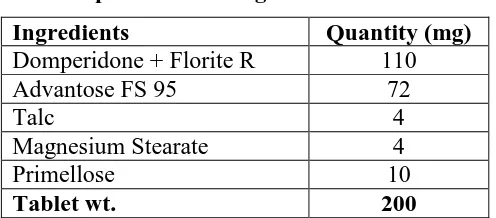
Table 1: Formulation of Domperidone sublingual tablets
Ingredients Quantity (mg)
Domperidone + Florite R 110
Advantose FS 95 72
Talc 4
Magnesium Stearate 4
Primellose 10
Tablet wt. 200
Calibration curve of Domperidone was obtained in 0.1N HCl with a slope of 0.0256 and was
shown in “Fig 1”. Water dispersible carriers like Sodium starch glycolate(SSG),
Crospovidone(CPV), Avicel PH 102, Pre-gelatinized starch, Florite R and Cab – o- sil M5
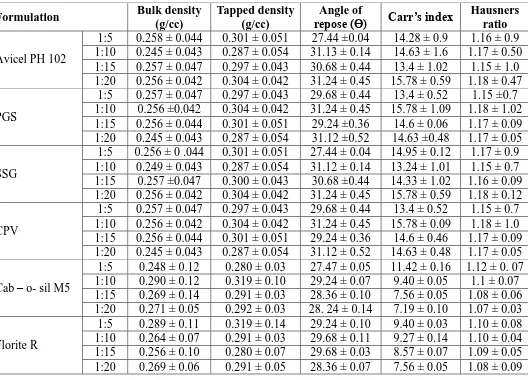
were selected for the study. All SSDs were found to be free flowing powders as shown in
[image:5.595.142.448.607.740.2]Table 2.
Invitro dissolution studies of SSD’s
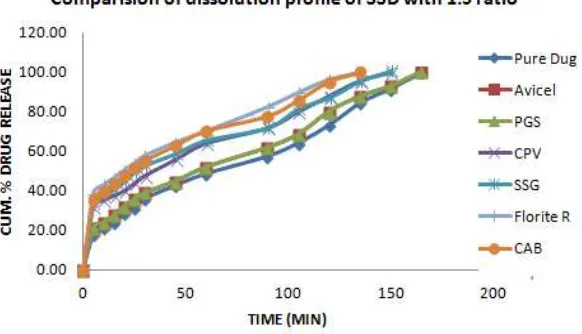
All the carriers selected showed rapid and higher dissolution of Domperidone as compared to
pure drug. Dissolution rate observed with various carriers were in following increasing order:
Florite R> Cab – o – sil M5> SSG> CPV> PGS> Avicel PH 102 as shown in “Fig 2” and
“Fig 3”. Table 3 shows the comparison of dissolution profile of different formulations of
surface solid dispersions. There is no remarkable increase in the dissolution rate of SSD’s
prepared with drug : Florite R in 1:15 and 1:20 ratios compared to 1:10 ratio. So drug :
Florite R of 1:10 ratio is considered as optimized formulation for preparation of sublingual
[image:6.595.38.566.290.670.2]tablets.
Table 2: Evaluation of flow properties of prepared SSD’s
Formulation Bulk density
(g/cc)
Tapped density (g/cc)
Angle of
repose (Ɵ) Carr’s index
Hausners ratio
Avicel PH 102
1:5 0.258 ± 0.044 0.301 ± 0.051 27.44 ±0.04 14.28 ± 0.9 1.16 ± 0.9 1:10 0.245 ± 0.043 0.287 ± 0.054 31.13 ± 0.14 14.63 ± 1.6 1.17 ± 0.50 1:15 0.257 ± 0.047 0.297 ± 0.043 30.68 ± 0.44 13.4 ± 1.02 1.15 ± 1.0 1:20 0.256 ± 0.042 0.304 ± 0.042 31.24 ± 0.45 15.78 ± 0.59 1.18 ± 0.47
PGS
1:5 0.257 ± 0.047 0.297 ± 0.043 29.68 ± 0.44 13.4 ± 0.52 1.15 ±0.7 1:10 0.256 ±0.042 0.304 ± 0.042 31.24 ± 0.45 15.78 ± 1.09 1.18 ± 1.02 1:15 0.256 ± 0.044 0.301 ± 0.051 29.24 ±0.36 14.6 ± 0.06 1.17 ± 0.09 1:20 0.245 ± 0.043 0.287 ± 0.054 31.12 ±0.52 14.63 ±0.48 1.17 ± 0.05
SSG
1:5 0.256 ± 0 .044 0.301 ± 0.051 27.44 ± 0.04 14.95 ± 0.12 1.17 ± 0.9 1:10 0.249 ± 0.043 0.287 ± 0.054 31.12 ± 0.14 13.24 ± 1.01 1.15 ± 0.7 1:15 0.257 ±0.047 0.300 ± 0.043 30.68 ±0.44 14.33 ± 1.02 1.16 ± 0.09 1:20 0.256 ± 0.042 0.304 ± 0.042 31.24 ± 0.45 15.78 ± 0.59 1.18 ± 0.12
CPV
1:5 0.257 ± 0.047 0.297 ± 0.043 29.68 ± 0.44 13.4 ± 0.52 1.15 ± 0.7 1:10 0.256 ± 0.042 0.304 ± 0.042 31.24 ± 0.45 15.78 ± 0.09 1.18 ± 1.0 1:15 0.256 ± 0.044 0.301 ± 0.051 29.24 ± 0.36 14.6 ± 0.46 1.17 ± 0.09 1:20 0.245 ± 0.043 0.287 ± 0.054 31.12 ± 0.52 14.63 ± 0.48 1.17 ± 0.05
Cab – o- sil M5
1:5 0.248 ± 0.12 0.280 ± 0.03 27.47 ± 0.05 11.42 ± 0.16 1.12 ± 0. 07 1:10 0.290 ± 0.12 0.319 ± 0.10 29.24 ± 0.07 9.40 ± 0.05 1.1 ± 0.07 1:15 0.269 ± 0.14 0.291 ± 0.03 28.36 ± 0.10 7.56 ± 0.05 1.08 ± 0.06 1:20 0.271 ± 0.05 0.292 ± 0.03 28. 24 ± 0.14 7.19 ± 0.10 1.07 ± 0.03
Florite R
Table 3: Dissolution profiles of prepared SSD’s
Formulation Ratio T5 T15 T30 DE30
Avicel PH 102
1:5 24.14 27.86 39.15 26.91
1:10 28.69 32.60 43.95 31.67
1:15 30.76 36.05 45.56 32.89
1:20 33.35 41.21 46.32 33.78
PGS
1:5 24.38 32.21 41.75 30.03
1:10 29.76 33.69 44.70 32.64
1:15 32.56 40.97 49.65 37.45
1:20 36.76 47.39 51.13 37.89
SSG
1:5 33.35 40.91 52.77 38.80
1:10 35.86 42.01 54.58 39.87
1:15 38.11 49.45 56.67 42.45
1:20 41.23 53.46 58.87 44.32
CPV
1:5 31.91 37.66 47.65 35.37
1:10 32.27 39.82 48.05 36.63
1:15 35.54 43.21 52.23 38.45
1:20 39.21 50.69 55.56 41.35
Cab – o- sil M5
1:5 35.86 43.45 55.34 40.95
1:10 38.37 46.70 57.20 43.10
1:15 40.76 52.34 58.08 44.79
1:20 44.44 57.76 60.98 46.75
Florite R
1:5 38.73 46.71 57.94 43.70
1:10 43.03 50.70 62.35 47.45
1:15 44.01 51.21 63.23 47.89
1:20 45.54 52.23 64.43 48.98
[image:7.595.150.441.490.657.2]Pure Drug 17.93 24.24 36.18 23.64
Fig 3: Dissolution profile of SSD’s with 1:10 ratio
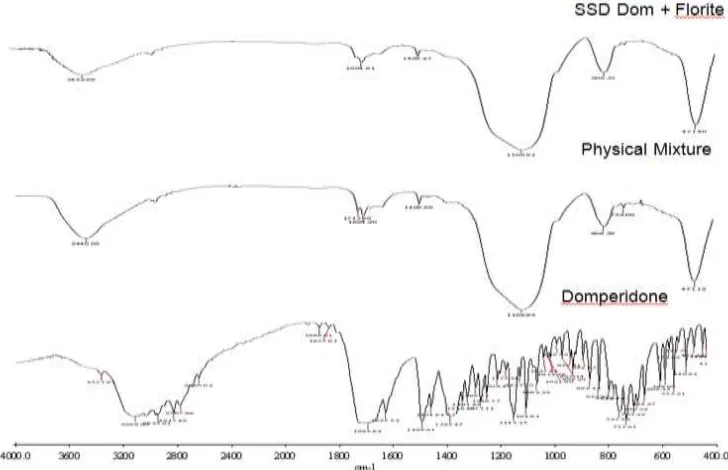
FT-IR spectroscopy: It was performed by KBR pellet method. The principal peaks of
domperidone were observed at 1685, 1102 and 481 cm-1.The characteristic peaks for SSD and physical mixture were found at 1693, 1106 and 471 cm-1 indicating no interaction between drug and the excipients therein. The results are shown in “Fig 4”.
Fig 4: FTIR Spectrum of Domperidone, physical mixture & Optimised formulation
Differential Scanning Colorimetry (DSC)
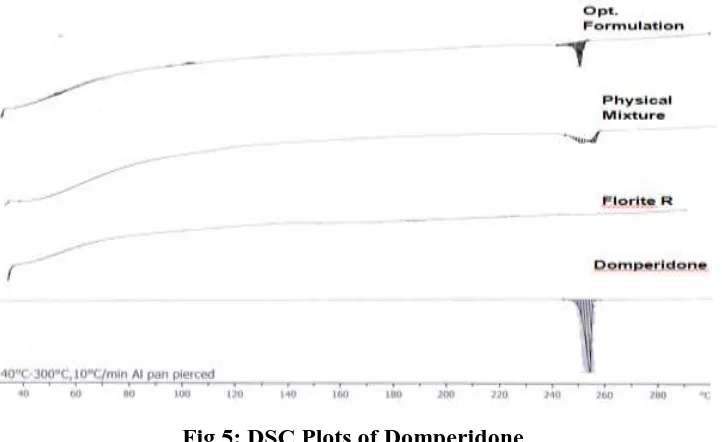
The DSC plot of pure domperidone “Fig. 5” shows a sharp endothermic peak near 255°C,
which is attributed to its melting temperature. The SSD and physical mixture also show the
[image:8.595.118.482.396.631.2]Fig 5: DSC Plots of Domperidone
Powder X-Ray Diffraction Analysis (XRD): XRD of SSD reveals a reduction in peak
intensity when compared with XRD of excipient and plain drug. The characteristic peaks
identified in the drug XRD were not detected in SSD. SSD showed reduced crystalline
properties, indicating of possible conversion into amorphous form as shown in “Fig 6”.
Fig 6: XRD graphs of SSD of domperidone
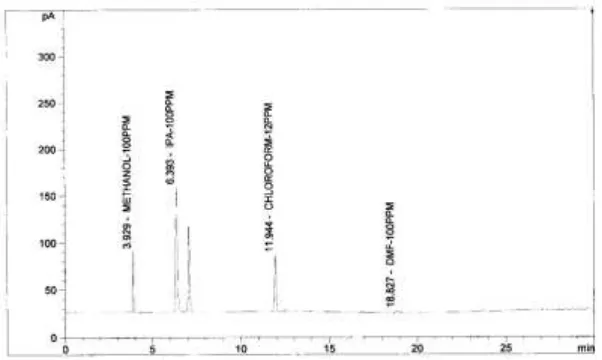
Residual solvents: Residual solvent concentration in surface solid dispersion of domperidone
prepared using methanol was performed by Gas chromatography. The levels of methanol
were below detectable limits. Hence, can be concluded that solvent deposition method was
efficient in removal of solvents from SSD well below permissible levels. “Fig 7” shows a
standard chromatogram for residual solvent obtained during the study. “Fig 8” the
[image:9.595.117.483.432.605.2]Fig 7: Standard chromatogram for residual solvents
Fig 8: Chromatogram of SSD for residual solvents
Evaluation of SSD Tablets: Domperidone tablets of drug with Florite R as carrier were
prepared by direct compression method. Table 4 reveals that all the prepared tablets have
acceptable physical properties according to the IP.
Table: 4 Evaluation of Surface solid dispersion tablets & Marketed product
S. No Evaluation Tests SSD Tablet Marketed Product
1 Weight Variation 199 ± 1.92 mg 199 ± 1.87 mg
2 Hardness 4.8 ±0.65 Kg/cm2 4.6 ±0.56 Kg/cm2
3 Friability 0.631% (0.5-1%) 0.615% (0.5-1%) 4 Disintegration Time 31 ± 0.79 sec 60 ± 0.56 min
5 Assay 99.03 ± 2.72% 99.01 ± 1.62%
6 Content uniformity 97.62 ± 1.67 98.99 ± 1.46
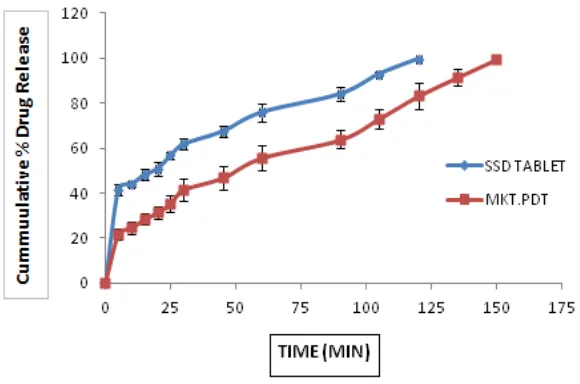
Tablets prepared from SSD having Florite R as the carrier exhibited higher dissolution rate as
whereas tablets prepared from SSD with Florite R as the carrier showed 99.54 % drug release
as shown in “Fig 9”. From Table 6 it is clear that the drug release followed first order
[image:11.595.143.433.146.338.2]kinetics.
Fig 9: Comparative Dissolution studies of prepared SSD’s & Marketed product
Table 5: Dissolution profile of SSD Tablet & Marketed product
Formulation T5 T15 T30 DE30
SSD Tablet 41.76 ± 2 48.2 ± 1.52 61.67 ± 1.73 47.34
Mkt. Pdt
(Motinorm 10mg) 21.59 ± 2.51 28.34 ± 2.51 41.5 ± 5.13 22.64
Table 6: Kinetic analysis of drug release data
Formulation Parameters Zero order First order Hixson Crowell
(Q
1/3
-Qt
1/3
)
SSD Tablet K 5.79 -0.08 0.813
r
2
0.67 0.868 0.787
MKT.PDT K 3.02 0.024 0.069
r
2
0.604 0.6922 0.659
Table 7: Accelerated stability studies data
Parameters Observation
Initial 30 Days 60 Days 90 Days
Drug content 99.03 98.97 98.97 98.94
T5 41.76 41.56 41.54 40.87
T15 48.2 48.09 47.89 47.86
T30 61.67 61.6 60.97 60.87
Stability Studies: The accelerated stability studies indicated that there were no visible and
physical changes observed in the tablets after storage. It was also observed that there was no
significant change in drug release from the tablets Table 7. The drug release characteristics of
the optimized tablets remained unaltered.
CONCLUSION
Surface solid dispersion technique was successful in improving the dissolution rate of poorly
water-soluble drug Domperidone. SSDs of drug with Florite R as carrier showed significantly
higher dissolution rate as compared to pure drug. The nature and amount of carrier used
played an important role in the enhancement of dissolution rate. FTIR and DSC studies
showed no evidence of interaction between the drug and carrier. XRD studies revealed that
there is a change in crystallinity of drug to amorphous form. SSD tablets prepared with
Florite R as carrier showed an enhancement of dissolution rate of drug as compared to
marketed tablets. Mathematical modeling of drug release data fitted into first order kinetics.
Accelerated stability studies indicated that there was no significant change in the drug content
and % drug release.
REFERENCES
1. Emara L.H., Badr R.M. (Improving the dissolution and bioavailability of nifedipine using
solid dispersion and solubilizers). Drug Dev. Ind. Pharm. 2002; 28: 795-807.
2. Patidar Kalpana, Soni Manish, Sharma K. D. (Solid dispersion: Approaches, Technology
involved, need & Challenges). Drug Invention Today 2010; 2(7): 13-20.
3. Y. Lalitha, P. K. Lakshmi (Enhancement of dissolution of nifedipine by surface solid
dispersion technique) Int J Pharm Pharm Sci. 2011; 3(3): 41-46.
4. Naga Aparna. T. (Studies on enhancement of dissolution rate of domperidone by surface
solid dispersion technology). International Journal of research in pharmacy and chemistry
IJRPC, 2011; 1(2): 133-142.
5. Adrian C. Williams, Peter Timins, Mingchu Lu, Robert T. Forbes, (Disorder and
Dissolution Enhancement: Deposition of Ibuprofen onto Insoluble Polymers). European
Journal of Pharmaceutical Sciences. 2005; 26: 288-294.
6. T. Kiran, Nalini Shastri. (Surface solid dispersion of glimepiride for enhancement of
dissolution rate). International Journal of Pharm Tech Research 2009; 1(3): 822-831.
7. K. Y. Yang, R. Glemza and C. I. Jarowski (Effects of amorphous silicon dioxides on drug
8. Barzegar-Jalali (Enhancement of dissolution rate and anti-inflammatory effects of
piroxicam using solvent deposition technique). Drug Dev. Ind Pharm. 2002; 28(6):
681-686.
9. Ahmed Essa and Dwaikat (Enhancement of Simvastatin dissolution by surface solid
dispersion: effect of carriers and wetting agents) Journal of Applied Pharmaceutical
Science 5 (Suppl 1); 2015: 046-053.
10.Sharma S., Sher P., Badve S., & Pawar A.P. (Adsorption of meloxicam on porous
calcium silicate: Characterization and tablet formulation) AAPS Pharm Sci Tech. 2005;
6(4): E618-E625.
11.Chowdary, K.P.R., & Rao, Sk. S. (Investigation of dissolution enhancement of
itraconazole by solid dispersion in superdisintegrants) Drug Dev. Ind. Pharm. 2000;
26(1): 1207- 1211.
12.Y. Lalitha. (Enhancement of dissolution of Nifidipine by surface solid dispersion
technique) Int J Pharm Pharm Sci, 2011; 3(3): 41- 46.
13.Dixit RP and Nagarsenker MS. (In vitro and in vivo advantage of celecoxib surface solid
dispersion and dosage form development). Indian Journal of Pharmaceutical Sciences.
2007; 370-377.
14.Chowdary KPR and Rama Krishna S. (Improvement of dissolution efficiency of
ketoprofen by solvent deposition technique). Indian Journal of Pharmaceutical Sciences.
1990; 269-271.
15.Rose S, Gastrointestinal and Hepatobiliary Pathophysiology, 2nd Ed. North Carolina: