
MOLECULAR DOCKING STUDIES OF CHROMENE ANALOGUES
ON TRYPANOTHIONE REDUCTASE FOR TARGETING
LEISHMANIASIS
Jeevan Patra*, Harshadeep Garewal1 and Nripendra Singh Sengar2
*Birla Institute of Technology & Science, Pilani, Rajasthan, India.
1
SPP SPTM NMIMS University, Mumbai, India.
2
SIRTP, RGPV, Bhopal, Madhya Pradesh, India.
ABSTRACT
Leishmaniasis parasitic disease is one of the neglected and are an
epidemic in various countries, and these parasites are developing
resistance against drugs available in market. Thus, discovery and
development of new potent drugs against Leishmaniasis is an open
area of investigation for a researcher. To perform these challenges, a
series of chromene analogues have been designed and docked into the
active site of Trypanothione Reductase (TryR) enzyme required to
balance redox of the parasite. The potent ligands were screened (hits)
based on the search algorithm MolDock score by docking and
subjected to ADMET test to identify the suitable lead compound against leishmaniasis. In
total 18 compounds out of which compounds 11, 12, 14 were found to be the most active
among the tested compounds. Although the compounds showing moderate antileishmanial
activity, they identifies a chemical space to design and develop drugs based on these
chromene derivatives against the Leishmania parasite. Toxicology studies revealed
compound 14 as a nontoxic compound. Molecular Docking studies showed that compound 14
showed greater affinity towards TryR due to presence of hydrogen bonding formation exactly
at aforementioned positions. In this study we reported the molecular interaction mechanism
between chromene analogues and TRP using molecular docking and identified the compound
14 as potential lead compound against leishmaniasis. Further study on compound 14
analogues, lead optimization and validation such as increasing in bond length or replacing
halogen to –NO2, addition of bis-chromene, naphthyl etc. may lead to novel drug as lead
compounds against Leishmaniasis.
Volume 8, Issue 8, 659-673. Research Article ISSN 2277– 7105
Article Received on 25 April 2019,
Revised on 15 May 2019, Accepted on 05 June 2019,
DOI: 10.20959/wjpr20198-15243
*Corresponding Author Jeevan Patra
Birla Institute of Technology
& Science, Pilani, Rajasthan,
KEYWORD: Trypanothione Reductase, Molegro Virtual Docker 4.0, ADMET Test, Drug
Likenesses, Protein Data Bank: 2JK6.
INTRODUCTION
Encompassing a complex group of diseases, leishmaniasis is one of the neglected disease
which is caused by unicellular eukaryotic obligatory intracellular protozoa of the genus spp.
Leishmania and primarily affects to the host’s reticuloendothelial system. Leishmaniasis is a
parasitic infectious disease which is spread by the bite of female sand flies (phlebotomine)
and it is caused by the genus Leishmania. Around 20 species of Leishmania parasites are
pathogenic for humans while 30 species of sand fly act as a vector.[1] Leishmania having
three clinical forms are present: cutaneous, mucocutaneous and visceral leishmaniasis.
Among these above three clinical forms cutaneous leishmaniasis is a major concern because
it occurs as a co infection with AIDS.[2] Leishmaniasis patients usually suffer from fever, low
RBC count, skin ulcer and an enlarged liver.[3]
As per WHO epidemiology more than 12 million people in around 88 countries are known to
be infected with leishmaniasis and expected to rise at a progressive rate, but still the true
burden remains largely hidden. Two million new cases 1.5 million of cutaneous
leishmaniasis, 500,000 of the visceral leishmaniasis occurs annually. The declaration of this
disease is only compulsory in 32 countries and a substantial number of cases are never
recorded.[4] Approximately 20,000-50,000 deaths occurs every year. The disease usually
common in most of the continents like Asia, Central America, southern Europe and Africa
and around 200 million people live in these regions.[5] Out of several forms, most severe form
of leishmaniasis is visceral Leishmaniasis (Kala Azar) which is caused by L. donovani
complex which includes three species – L.donovani, L.infactum and L.chagas. Visceral
leishmaniasis (Kala Azar) found in India is caused by Leishmania donovani. As of 2019, no
successful vaccine was developed for leishmaniasis.[6]
The chemotherapeutic treatments those are currently available in market have a number of
limitations due to poor efficacy, unacceptable host toxicity and drug resistance, and new drug
targets are required. Newer serological test for determining leishmaniasis infection (ELISA)
do not function as well in immune compromised patients who aren't making antibodies to
infections. In these situations, two or more test must be used making the diagnostic procedure
di-sulfide oxidoreductase family of enzymes that presents as an ideal target for structure based
inhibitor drug design.[8]
The aim of our work is to identify the lead compound against leishmaniasis by virtual
screening of ligands. These ligands may have the property of inhibiting the TryR enzyme
thereby reducing the symptoms caused by leishmaniasis. Virtual screening is usually carried
out in two ways viz., Ligand-based drug design and structure based drug design.
In this research study we have performed drug discovery by choosing structure-based drug
design to identify the lead compound. Molecular Docking or Molecular Modelling is a
structure based drug design which has the ability to predict protein-ligand interaction[9] which
is a key tool in structural molecular biology and computer assisted drug design. The ligands
selected are chromene analogues. The evaluation of ADME and toxicological properties of a
drug is vital for successful drug development. Along with ADMET test is done to ensure the
drug cause no harm to leishmaniasis patients.[10] Evaluation of ADME is based on Lipinski's
[image:3.595.74.521.400.735.2]rule of five (Pfizer's rule of five) and drug likeness score.
MATERIALS AND METHODS
Target Selection
Trypanothione Reductase (TryR) belongs to the di-sulfide oxidoreductase family of enzymes
and also identified as a NADPH dependent flavoprotein unique to protozoan parasites such as
Trypanosoma and Leishmania spp. As these protozoans doesn’t possess Glutathione
Reductase, so the enzymes such as Trypanothione, N – glutathionyl - spermidine and
auxiliary enzyme trypanothione reductase maintains the intracellular level of dihydro
trypanothione and eventually results in the maintenance of reducing environment in the
protozoan host.[11] The Trypanothione function was found to be essential for protozoan
survival because of the dithiol trypanothione play vital role in the synthesis of DNA
precursors, ascorbate homeostasis, hydroperoxides detoxification, and thiol conjugates
export. The major peroxidases that eliminates the reactive oxygen species (ROS) generated
during the aerobic metabolism are trypanothione dependent. So, Enzymes such as
Trypanothione, N – glutathionyl - spermidine and auxiliary enzyme trypanothione reductase
was identified as a potential target for developing drugs against Leishmaniasis, because these
enzymes are essential for the survival of protozoan parasites and it is absent in mammals. In
this study Trypanothione reductase (TryR) is used as a potential target for structure based
drug design.
Retrieval and preparation of receptor model
The three-dimensional structure of the Homology-Modelled Structure of Trypanothione
Reductase of Leishmania donovani was obtained from Protein Data Bank
(https://www.rcsb.org/). The protein preparation was automatically done by using protein
preparation tool that is Molegro Virtual Docker tool. During this preparation process it
automatically assigns the missing bonds, flexible torsions, bond orders, and charges to the
protein structure and make it available for the docking studies.
Retrieval and preparation of ligand
In this study, the screening of ligands is done by virtual screening. About 18 molecules were
finally selected for docking studies. From the reported research article Verma et al, 2012 we
retrieved most active chromene structure as ligand of our interest (Figure: 2). The ligands
used in this study are the three dimensional structure was retrieved from swisssimilarity
(www.swisssimilarity.ch/). The compounds were prepared by using same molecule module
assign bond order and hybridization, detect flexible torsions, create hydrogens explicity and
finally the minimized energy structures was obtained.
Molecular docking
The molecular docking was performed using Molegro Virtual Docker 4.0.0 (MVD), which
involves two major steps (1) the addition of molecular surface and (2) predicting of binding
sites. The molecular surface was added to the protein based on the default settings, which
results in the formation of a double colored surface according to electrostatic properties. The
potential binding sites for receptor protein was predicted using cavity prediction algorithm.[12]
This search algorithm predicts the exact location of cavities in receptor protein model and
makes it visualizes to the user in green color. The parameters were set by default to the
molecular surface with expanded Van der Waals and number of cavities to five. The
molecular docking further carried out which was based on MolDock Simplex Evolution
search algorithm with having a grid resolution at 30Å for grid generation and selects the
predicted cavities as the origin of the binding site. We used MolDock SE as a search
algorithm, many runs set to 10, maximum population 50 and maximum iteration 1500. The
energy minimization was carried out before docking process by using Chem3D professional
software as a designing tool for ligands. We docked all screened compounds using MVD 4.0
and binding efficiency is evaluated using the MolDock score. After docking the ADME,
Drug likeness test, Toxicity test was performed to check whether screened compounds (Hits)
with the good MolDock score are suitable to use as a lead compound.[13]
RESULTS AND DISCUSSIONS
After reviewing through the reported article chromene analogues those targeted with
trypanothione reductase we focused on an article reported by Rajiv et al, 2012 as ‘Molecular
Docking and in Vitro Antileishmanial Evaluation of Chromene-2-thione Analogues’. Below
Figure 2: Reported potent compounds retrieved from Rajiv et al, 2012.
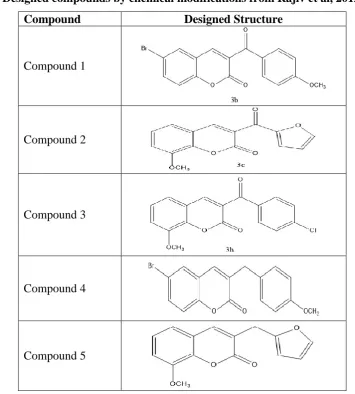
Now we designed 18 compounds (Table: 1) from the reported potent compounds by help of
chemical modification. Pharmacophore modelling such as bioisostere part of chemical
modification. We replaced sulphur atom with oxygen atom followed by side ring extension
and modification such as replacement of sulphur atom with oxygen atom (compound 1,2,3);
replacing carbonyl group to methylene group (compound 4,5,6); addition of methylene group
(compound 7,8,9); addition of two methylene groups (compound 10,11,12); addition of -NH-
and piperidine (compound 13,14,15); addition of –NH (compound 16,17,18).
Table 1: Designed compounds by chemical modifications from Rajiv et al, 2012.
Compound Designed Structure
Compound 1
Compound 2
Compound 3
Compound 4
Compound 6
Compound 7
Compound 8
Compound 9
Compound 10
Compound 11
Compound 12
Compound 13
Compound 15
Compound 16
Compound 17
Compound 18
Grid Validation was performed to get confirmed and be assure whether the reported PDB
having co-crystallized ligand matches with better pose for docking within RMSD 2.0 Å
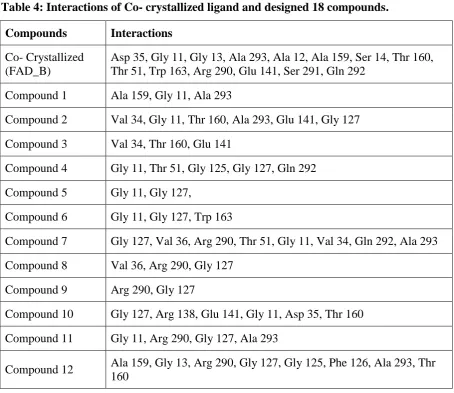
(Figure: 2). First of all we find the interactions of amino residues with co- crystallized ligand
(FAD_B) (Figure- 9). After docking the 18 compounds with our targeted protein (PDB:
2JK6), we found following MolDock score (Table: 3) and possible interactions (Table: 4).
Then we matched residues with our designed compounds with co - crystal ligand. We found
all 18 compounds matched with few amino residues that present in co- crystal ligand. Then
we focused on MolDock score. MolDock score of Co-crystal ligand was -141.115 kcal/mol.
Only three compound (compound 11, 12, 14) which having MolDock score more than that of
co- crystallized ligand.
ADME and Drug Likeness Prediction
The compounds with the good MolDock score (≥ -141.115) were identified as potential Hits.
In our study we found three hit compounds which were identified and subjected to ADME
test to compute drug likeness and to identify whether the identified compounds follow
Lipinski rule of five, which is considered as an important parameter for selection of any
compounds as a lead compound. The ADME test was performed using SwissADME
(www.swissadme.ch/) online tool. This tool predicts all molecular properties i.e. molecular
(HBA), partition coefficient (Log Po/w), polar surface area (PSA), , and Drug likeness score
(Table 5).
Toxicity Test
After docking identified ligands were further subjected to toxicity tests to identify whether
they possess any carcinogenic, skin sensitizing or hERG blocking properties. Toxicity test
was conducted for each property separately by using these specialized tools: Pred – Skin Web
1.0 (skin sensitizer predictor) and hERG – Pred 4.0 (hERG blockage predictor). Pred-hERG
is a predictive machine learning based QSAR models for prediction of hERG blockage which
contains around 16,932 associated bioactivity records for the hERG K+ channel. The
compound 11, 12 and 14 have the valid MolDock Score (-142.796, -142.336,-147.368
respectively) and Drug Likeness (0.55 with all three compounds) and was selected and
subjected to toxicity test. Compound 14 was found to be most effective as compared to rest
two compound (11 & 12). The strength of interaction in between the ligands and the protein
mostly depends on the number of H-bonds and the binding energy. When the analysing the
hydrogen bond interactions between the compound 14 and amino acids present on the active
site of the receptor protein i.e Ala 293, Leu 294, Thr 160, Leu 10, Val 36, Asp 35, Gly 11,
Arg 290, Thr 51 revealed that there are two hydrogen bonding interaction between them.
From analyzing the docking scores, hydrogen bond interaction data and toxicity test, it is
clearly evident that Compound 14 has the best binding affinity towards receptor protein with
least energy as compared to other ligands and doesn’t possess any toxicity and can be used as
lead compound against Leishmaniasis.
Table 2: Grid Validation of Co-Crystal ligand.
Name MolDock Score RMSD
Table 3: MolDock Score of designed 18 compounds.
Compounds MolDock Score (kcal/mol)
Compound 1 -125.241
Compound 2 -123.22
Compound 3 -124.336
Compound 4 -130.385
Compound 5 -126.12
Compound 6 -131.774
Compound 7 -132.132
Compound 8 -129.136
Compound 9 -136.621
Compound 10 -126.711
Compound 11 -142.796
Compound 12 -142.336
Compound 13 -137.881
Compound 14 -147.368
Compound 15 -136.019
Compound 16 -114.82
Compound 17 -130.523
[image:10.595.71.526.379.772.2]Compound 18 -126.522
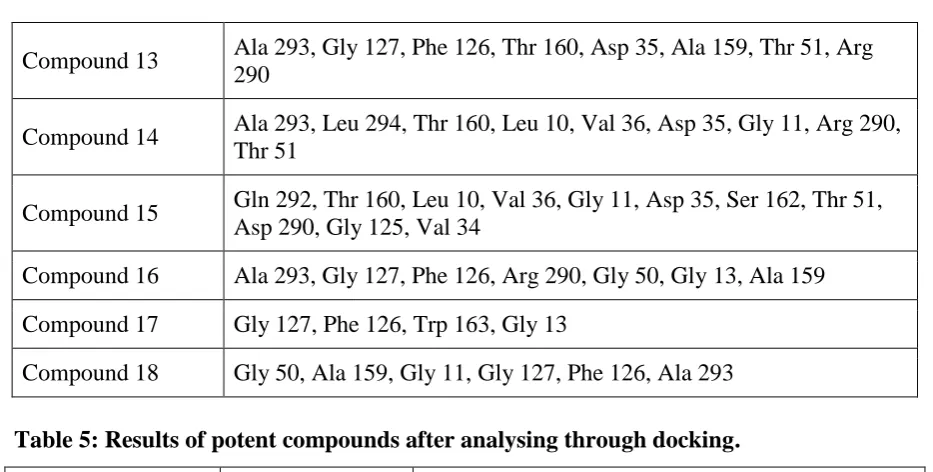
Table 4: Interactions of Co- crystallized ligand and designed 18 compounds.
Compounds Interactions
Co- Crystallized (FAD_B)
Asp 35, Gly 11, Gly 13, Ala 293, Ala 12, Ala 159, Ser 14, Thr 160, Thr 51, Trp 163, Arg 290, Glu 141, Ser 291, Gln 292
Compound 1 Ala 159, Gly 11, Ala 293
Compound 2 Val 34, Gly 11, Thr 160, Ala 293, Glu 141, Gly 127
Compound 3 Val 34, Thr 160, Glu 141
Compound 4 Gly 11, Thr 51, Gly 125, Gly 127, Gln 292
Compound 5 Gly 11, Gly 127,
Compound 6 Gly 11, Gly 127, Trp 163
Compound 7 Gly 127, Val 36, Arg 290, Thr 51, Gly 11, Val 34, Gln 292, Ala 293
Compound 8 Val 36, Arg 290, Gly 127
Compound 9 Arg 290, Gly 127
Compound 10 Gly 127, Arg 138, Glu 141, Gly 11, Asp 35, Thr 160
Compound 11 Gly 11, Arg 290, Gly 127, Ala 293
Compound 13 Ala 293, Gly 127, Phe 126, Thr 160, Asp 35, Ala 159, Thr 51, Arg 290
Compound 14 Ala 293, Leu 294, Thr 160, Leu 10, Val 36, Asp 35, Gly 11, Arg 290, Thr 51
Compound 15 Gln 292, Thr 160, Leu 10, Val 36, Gly 11, Asp 35, Ser 162, Thr 51, Asp 290, Gly 125, Val 34
Compound 16 Ala 293, Gly 127, Phe 126, Arg 290, Gly 50, Gly 13, Ala 159
Compound 17 Gly 127, Phe 126, Trp 163, Gly 13
Compound 18 Gly 50, Ala 159, Gly 11, Gly 127, Phe 126, Ala 293
[image:11.595.65.532.61.297.2]
Table 5: Results of potent compounds after analysing through docking.
Compounds MolDock Score
(kcal/mol) Interactions
Co- Crystal ligand
[00] FAD_1490 [B] -141.115
Asp 35, Gly 11, Gly 13, Ala 293, Ala 12, Ala 159, Ser 14, Thr 160, Thr 51, Trp 163, Pro 43, Arg 290, Glu 141, Ser 291, Gln 292
Compound 14 -147.368 Ala 293, Leu 294, Thr 160, Leu 10, Val 36, Asp 35, Gly 11, Arg 290, Thr 51
Compound 11 -142.796 Gly 11, Arg 290, Gly 127, Ala 293
[image:11.595.67.535.468.658.2]Compound 12 -142.336 Ala 159, Gly 13, Arg 290, Gly 127, Gly 125, Phe 126, Ala 293, Thr 160
Table 6: ADME and Drug Likeness properties of potent antileishmanial compounds.
Parameters Compound 11 Compound 12 Compound 14
Formula C18H18O4 C19H15ClO4 C19H19N3O5
Molecular Weight 298.33 g/mol 342.77 g/mol 369.37 g/mol
No. of rotatable bonds 6 5 5
No. of H-bond acceptors 4 4 6
No. of H-bond donors 0 0 1
Molar Refractivity 83.58 93.47 105.21
TPSA 48.67Å 56.51Å 88.16Å
Lipophilicity (Log Po/w) 2.99 3.98 1.97
Solubility (Log S) -3.17 (Soluble) -4.71 (Moderately Soluble) -3.84 (Soluble) Drug Likeness
(Bioavailability Score) 0.55 0.55 0.55
Figure 2: (A) PDB 2JK6; chain A magneta colour and chain B blue colour both depicts
the active site with red encircled; (B) Showing best pose of co crystal ligand [00]
FAD_1490 [B] of RMSD 0.561.
Figure 3: (A) Interactions of co crystal ligand; H-Bond (Blue), Electrostatic (Green),
Steric (Red); (B) Showing interactions of potent compound 14.
Figure 4: (A) The computational simulated model of hERG – ligand interaction for
compound 14; (B) The computational simulated model of murine local lymph node
assay for compound 14.
A
B
A
B
[image:12.595.76.525.71.255.2] [image:12.595.75.521.338.533.2] [image:12.595.87.515.595.702.2]CONCLUSION
As per our understanding from literature review we studied the basic of leishmania parasite
infection disease, its epidemiology, life cycle, currently available marketed drugs and
potential drug targets. We selected as trypanothione reductase protein as target of our interest.
From reported papers we sort out several PDBs such as 2JK6, 2WOH, 2X50. From them with
better resolution we targeted PDB- 2JK6. In search of ligands we focused on chromene
derivatives as it having a redox oxidant potential in which it can destabilize parasites during
transformation from promastigote to amstigotes in celluler level. From the reported paper
Rajiv K Verma et al chromene 2 thione analogues. By keeping in concern with those potent
compounds 3b, 3c, 3h reported in that paper. Then we did chemical modifications from that
and finally came with molecular docking studies. From our designed 18 compounds
compound 11, 12, 14 shown potent leishmanial activity through computational approach.
Further we can go for optimization of these three compounds by increasing in bond length or
replacing halogen to –NO2, addition of bis-chromene, naphthyl etc. so we can have better
therapeutic activity.
The enzyme trypanothione reductase plays a vital role in the thiol metabolism and therefore it
is considered one of the most important targeted protein in the life cycle of L. donovani. The
inhibition of this targeted protein with chemotherapeutic drugs found be the best way to treat
Leishmaniasis. The major drawback in the drug discovery and development is the longevity
of the process in lead identification. Virtual screening may act as a vital alternative in lead
identification, thereby speeding up the process involved in drug discovery. In future it may
involve bringing out a cost-effective drug into the commercial market.
ACKNOWLEDGEMENT
We cordially thankful to Birla Institute of Technology & Science, Pilani, Rajasthan, India for
providing us the research facilities.
ABBREVIATIONS USED
TRP: Trypanothione Reductase
ADMET: Adsorption, Distribution, Metabolism, Excretion and Toxicity
MVD: Molegro Virtual Docker
M.Wt: Molecular weight
PSA: Polar Surface Area
QSAR: Quantitative Structure Activity Relationship
REFERENCES
1. Desjeux P. Leishmaniasis: Current situation and new perspectives. Comp Immunol
Microbiol Infect Dis., 2004; 27(5): 305-318.
2. Cruz I, Chicharro C, Nieto J, et al. Comparison of New Diagnostic Tools for Management
of Pediatric Mediterranean Visceral Leishmaniasis Comparison of New Diagnostic Tools
for Management of Pediatric Mediterranean Visceral Leishmaniasis, 2006.
3. Barrett MP, Croft SL. Management of trypanosomiasis and leishmaniasis. Br Med Bull.,
2012; 104(1): 175-196.
4. Malla N, Mahajan RC. Pathophysiology of visceral leishmaniasis - Some recent concepts.
Indian J Med Res., 2006; 123(3): 267-274.
5. Ejazi SA, Ali N. Developments in diagnosis and treatment of visceral leishmaniasis
during the last decade and future prospects. Expert Rev Anti Infect Ther., 2013; 11(1):
79-98.
6. Srivastava S, Shankar P, Mishra J, Singh S. Possibilities and challenges for developing a
successful vaccine for leishmaniasis. Parasit Vectors., 2016; 9(1): 277.
7. Davies CR. Leishmaniasis: new approaches to disease control. Bmj., 2003; 326(7385):
377-382.
8. Singh BK, Sarkar N, Jagannadham M V, Dubey VK., Modeled structure of trypanothione
reductase of Leishmania infantum. BMB Rep., 2008; 41: 444-447.
9. Kitchen DB, Decornez H, Furr JR, Bajorath J. Docking and scoring in virtual screening
for drug discovery: methods and applications. Nat Rev Drug Discov., 2004; 3(11):
935-949.
10.Hodgson J. ADMET—turning chemicals into drugs. Rapidly resolving the
pharmacokinetic and toxicological properties of drug candidates remains a key challenge
for drug developers. Nat Biotechnol, 2001; 19: 722-726.
11.Ram K, Damodaran AP. Homology Modeling of Trypanothione Reductase of Leishmania
donovani. J Sci Technol, 2011; 1(7): 3-6.
12.Molegro APS. MVD 5.0 Molegro Virtual Docker. DK-8000, Aarhus C, Denmark. 2011.
13.Verma, R. K., Prajapati, V. K., Verma, G. K., Chakraborty, D., Sundar, S., Rai, M.,Singh,
M. S. (2012). Molecular Docking and in Vitro Antileishmanial Evaluation of
14.Saccoliti F, Anguilli G et al; Inhibition of leishmania infantum trypanothione reductase
by diaryl sulphide derivatives; Journal of enzyme Inhibition and Medicinal Chemistry,
2011; 32: 301-310.
15.Ulissai E, Fiorani G et al; rssifloreone that inhibit Trypanosome brucei glyceraldehyde-3
–phosphate dehydrogenase and trypanosome cruzi trypanothione reductase and display
trypanocidal activity; European Journal of Medicinal Chemistry, 2017; 141: 138-148.
16.Zhang L, Ai H, Chen W, et al. CarcinoPred-EL: Novel models for predicting the
carcinogenicity of chemicals using molecular fingerprints and ensemble learning
methods. Sci Rep., 2017; 7(1): 2118.
17.Alves VM, Braga RC, Silva MB, et al. Pred-hERG: A novel web-accessible
computational tool for predicting cardiac toxicity of drug candidates. In: abstracts of
papers of the american chemical society. Vol 248. Amer chemical soc 1155 16th street,
NW, Washington DC 20036 USA; 2014.
18.Braga RC, Alves VM, Muratov EN, et al. Pred-Skin: A Fast and Reliable Web
Application to Assess Skin Sensitization Effect of Chemicals. J Chem Inf Model, 2017;
![Figure 2: (A) PDB 2JK6; chain A magneta colour and chain B blue colour both depicts the active site with red encircled; (B) Showing best pose of co crystal ligand [00] FAD_1490 [B] of RMSD 0.561](https://thumb-us.123doks.com/thumbv2/123dok_us/877037.599833/12.595.87.515.595.702/figure-magneta-colour-depicts-encircled-showing-crystal-ligand.webp)