https://www.scirp.org/journal/am ISSN Online: 2152-7393 ISSN Print: 2152-7385
DOI: 10.4236/am.2019.1012073 Dec. 23, 2019 1048 Applied Mathematics
On the Contribution of the Stochastic
Integrals to Econometrics
Lewis N. K. Mambo
1,2, Rostin M. M. Mabela
3, Isaac K. Kanyama
1,4, Eugène M. Mbuyi
31Department of Economics, University of Kinshasa, Kinshasa, Congo
2Direction of Research and Statistics, Central Bank of Congo, Kinshasa, Congo
3Department of Mathematics and Computer Science, University of Kinshasa, Kinshasa, Congo
4Department of Economics and Econometrics, University of Johannesburg, Johannesburg, South Africa
Abstract
The purpose of this paper is to present the theorical connection between the Itô stochastic calculus and the Financial Econometrics. This paper has two contributions. First, we give the backgrounds on how the stochastic calculus is used to model the real data with the uncertainties. Finally, by using Con-sumer Price Index (CPI) from the Central Bank of Congo and combining the Itô stochastic calculus and the AR (1)-GARCH (1, 1) model, we estimate the stochastic volatility of inflation rate measuring efficency of monetary policy. Thus the stochastic integrals are the powerful tools of mathematical model-ling and econometric analysis.
Keywords
Stochastic Continuous-Time Models, Stochastic Volatility, AR (1)-GARCH (1, 1) Models, Inflation Rate
1. Introduction
In most dynamical systems which describe processes in economics, engineering, and physics, stochastic components and random noise are included. The sto-chastic aspects of the models are used to capture the uncertainty about the envi-ronment in which the systems are operating. For example, there are suggestions that increased uncertainty makes fiscal policy temporarily less effective [1]. Real life generates situations that require making a decision under uncertainty [2] [3] [4] [5]. By taking account of data uncertainty, the indiscriminate reduction of uncertaint observations to real numbers is avoided [5]. Uncertaint data implies
How to cite this paper: Mambo, L.N.K., Mabela, R.M.M., Kanyama, I.K. and Mbuyi, E.M. (2019) On the Contribution of the Stochastic Integrals to Econometrics. Ap-plied Mathematics, 10, 1048-1070.
https://doi.org/10.4236/am.2019.1012073 Received: October 11, 2019
Accepted: December 20, 2019 Published: December 23, 2019 Copyright © 2019 by author(s) and Scientific Research Publishing Inc. This work is licensed under the Creative Commons Attribution International License (CC BY 4.0).
http://creativecommons.org/licenses/by/4.0/
DOI: 10.4236/am.2019.1012073 1049 Applied Mathematics
information exhibiting inaccuracy, uncertainty and questionability [5]. The ma-thematical modeling of the uncertainty in economics and finance can be found in [2] [3] [5]-[12].
Therefore, the stochastic state space models and time series analysis have been both intensively and extensively developed during the past twenty years. A uni-fied theory has been constructed during this period and the concepts and me-thods have been widely applied to problems in the area of engineering and communication, economics and management. Because of these developments, interest in stochastic state space model and its applications has greatly increased in econometric research.
This paper presents the stochastic integrals and numerics which permit suc-cessful mathematical modelling not only in econometrics but also in many other fields such biometrics, psychometrics, environment science, and hydrology, as-suming of course that a suitable sequence of observed data is available.
For estimating the parameters of both stochastic continuous and discrete-time models, the methods of maximum likelihood are usually used by researchers be-cause of its capacity to give the best unbaised estimators [9] [13] [14] [15] [16] [17].
The purpose of this paper is to emphasize on the linkage between the theory of stochastic integrals and time series analysis used in the econometric analysis
[6] [16] [18] [19] [20] [21]. The stochastic integrals and numerics are considered as bridges that link the stochastic continuous-time models and the discrete time models [14] [18] [22] [23] [24] [25].
The structure of the paper is as follows. In Section 2 we will give the theory of stochastic integrals that is usefull to economic analysis. In Section 3 we give some stochastic differential equations used as econometric models that are used to express the economic theories. Section 4 gives some numerical methods to perform the empirical analysis. Section 5 illustrates the use of the stochastic in-tegrals to time series econometric by estimating the stochastic volatility from the Autoregressive-Generalized Autoregressive Concoditional Heteroskedasticity model, that is, AR (1)-GARCH (1, 1) model.
2. Stochastic Integrals
Since the works of Kuyosi Itô the field of stochastic integrals attract the attention of many mathematicians and researchers [19] [26]-[33].
Itô Stochastic Integrals developed here are from [28] [29] [34] [35].
Definition 2.0.1 A process X is called adapted to the filtration (t), if for all t,
( )
X t is t-measurable.
Proposition 2.0.1. (a) X =
( )
Xt , where Xt is a d-dimensional measurable,t
-adapted process is a continuous semimartingale if
X
t is continuous andhas the form
0
t = + t+ t
DOI: 10.4236/am.2019.1012073 1050 Applied Mathematics
for all t (a.s.), where E X0 < ∞, (1) M =
( )
Mt is a continuous2
L -t
-martinagle with M0=0 (a.s.) and (2)
( )
Bt ∈.(b) If in the decompostion 1, (Mt), is a continuous local martingale and (Bt)
belongs to
loc, then (Xt) will be called a continuous local semi-martingale.Theorem 2.1. [35] [36] Let X t
( )
be a regular adapted process such thatwith probability one 2
( )
0 d
T
X t t< ∞
∫
. Then Itô integral∫
0TX t( ) ( )
dB t isde-fined and has the following properties:
1) Linearity. If Ito integrals of X t
( )
and Y t( )
are defined and α and βare some constants then
( )
( )
(
)
( )
( ) ( )
( ) ( )
0 d 0 d 0 d .
T T T
X t Y t B t X t B t Y t B t
α +β =α +β
∫
∫
∫
(2)2) 0
( )
( ,]( ) ( )
d( ) ( )
dT b
a b a
X t I t B t = X t B t
∫
∫
. The following two properties hold when the process satisfies an additional assumption( )
(
2)
0 d .
T
E X t t< ∞
∫
(3) 3) Zero mean property. If condition 3 holds then( ) ( )
(
0 d)
0,T
E
∫
X t B t =(4) where E denotes expectation with respect to classical Wiener measure.
4) Isometry property. If condition 3 holds. Then
( ) ( )
(
)
2 2( ) ( )
0 d 0 d
T T
E
∫
X t B t =E∫
X t B t(5) Corollary 2.1.1. If X is a continuous adapted process then the Itô integral
( ) ( )
0 d
T
X t B t
∫
exists. In particular,∫
0Tf B t(
( )
)
dB t( )
where f is a continuousfunction on R is well defined.
A consequence of the isometry property is the expectation of the product of two Itô integrals as given in the following theorem.
Theorem 2.2. [36] Let X t
( )
and Y t( )
be regular adapted processes, suchthat
( )
20 d
T
X t t< ∞
∫
and( )
2 0T
Y t < ∞
∫
. Then( ) ( )
( ) ( )
(
0T d 0T d)
0T(
( ) ( )
)
d .E
∫
X t B t∫
Y t B t =∫
E X t Y t t(6) where E denotes mathematical expectation.
We denote by mn all real-valued
m n× matrices and by
( )
(
1( )
, , n( )
)
, 0. W t = W t W t ′ t≥Let
[ ] [ [
a b, ∈ 0,∞ and we put[ ]
(
,)
{
:[ ]
, mn| 1 , 1 :(
[ ]
,)
}
,W ij Wj
C a b = f a b × Ω → ∀ ≤ ≤i m∀ ≤ ≤j n f ∈C a b
[ ]
(
,)
{
:[ ]
, mn| 1 , 1 :(
[ ]
,)
}
IW ij IWj
C a b = f a b × Ω → ∀ ≤ ≤i m∀ ≤ ≤j n f ∈C a b
and CI
(
[ ]
a b,)
respectively.DOI: 10.4236/am.2019.1012073 1051 Applied Mathematics
the stochastic integral with respect to W is the m-dimensional vector defined by
( )
( )
( )
( )
1 1 d d n b b ij j a aj i m
f t W t f t W t
= ≤ ≤ ′ =
∑
∫
∫
(7)
where each of the integrals on the right-hand side is defined in the sense of Itô. Proposition 2.2.1. (Itô formula) [36] [38] Let Xt=X0+Mt+Bt be a
d-dimensional continuous semimartingale. Let 2
( )
d bF∈C , that is, let
: d
F → be bounded and continuous and have bounded, continuous
deriva-tives of orders 1 and 2. Then,
( )
( )
( )
( )
( )
0 0 0
0 0 2 0 0 d d 1 d , 2
d t d t
i i
t i s s i s s
i i
d t
i j
s
i j s
i
F F
F X F X X M X B
x x
F
X M M
x x = = = ∂ ∂ = + + ∂ ∂ ∂ + ∂ ∂
∑
∫
∑
∫
∑∫
(8)Stratonovich Stochastic Integrals. In [39], the multidimensional Stratono-vich integrals Sm
( )
f can be expressed by the following formula using Itôin-tegrals
( )
(
)
2(
)
2
!
. 2 ! 2
k
m k m k
k
m
S f I Tr f
k m k −
≤
=
−
∑
(9)
where Tr denoted the iterated traces that are defined formally starting with
(
1, , m 2)
(
1, , m 2, ,)
d .Trf s s − =
∫
f s s − s s sAnother approach to formula (9) using Hida’s theory of white noise. Working on m instead of m
+
and assuming that f is a test-function, the integral
( )
m
S f may indead be rewritten as
(
1, ,)
1( )
( )
d1 d,
m
m s s n
n
f s s X w X w s s
f X⊗
=
∫
where the derivative of Brownian motion is understood in the distribution sense. In the sense of Hu and Meyer [39], a Stratonovich integral is given in rigorous form as
( )
[ )(
1)
1( )
( )
1
, , d d ! S m m s sm m
S f f s s X w X w
m
=
∑ ∫
(10) where f is a finite sequence of coefficients 2
( )
mm s
f ∈L
and n!= × − × ×n
(
n 1)
1.Itô’s Formula for Functions of Two Variables. If two processes X and Y both possess a stochastic differential with respect to and f x y
(
,)
hasconti-nuous partial derivatives up to order two, then f X t Y t
(
( ) ( )
,)
also possesses astochastic differential.
Theorem 2.3. [36] Let f x y
(
,)
have continuous partial derivatives up toorder two (a 2
DOI: 10.4236/am.2019.1012073 1052 Applied Mathematics
( ) ( )
(
)
(
( ) ( )
)
( )
(
( ) ( )
)
( )
( ) ( )
(
)
(
( )
)
( ) ( )
(
)
(
( )
)
( ) ( )
(
)
(
( )
)
(
( )
)
2
2 2
2
2 2
2
d , , d , d
1
, d
2 1
, d
2
, d
X
Y
X Y
f f
f X t Y t X t Y t X t X t Y t Y t
x y
f
X t Y t X t t
x f
X t Y t Y t t
y
f
X t Y t X t Y t t
x y
σ
σ
σ σ
∂ ∂
= +
∂ ∂
∂ +
∂ ∂ +
∂ ∂ +
∂ ∂
(11)
An important case of Itô formula is for functions of the form f X t t
(
( )
,)
.Theorem 2.4. [29] [36] [40] Let f x t
( )
, be twice continuously differentiablein x, and continuously differentiable in t (a 2,1
C function) and x be an Itô
process, then
( ) ( )
(
)
(
( ) ( )
)
( )
( ) ( )
(
)
( )
(
)
2(
( )
)
2
2
d , , d , d
1
, , d 2 X
f f
f X t Y t X t Y t X t X t X t t t
x t
f
X t t X t t t x
σ
∂ ∂
= +
∂ ∂
∂ +
∂
(12)
Stochastic Calculus. Let
(
1 2)
2 , , , nf x x x ∈C and
(
1 2)
, , , n
X X X ∈Q
and
(
1 2)
, , , n
Y= f X X X ∈Q. We denote by Q the totality of
quasimartin-gales.
Definition 2.4.1. [36] For X Y, ∈Q, we say that X and Y are equivalent and
write X Y if, with probability one,
( )
( )
( )
( )
X t −X s =Y t −Y s for every
0
≤ ≤
s
t
.The equivalence class containing X is denoted by dX and is called the stochas-tic differential of X. As known, by definition,
( )
d
t
s X u
∫
is the process X t
( )
−X s( )
.Let dQ=
{
d ;X X∈Q}
, dM ={
dM M; ∈M}
and dA={
d ;A A∈A}
. Wein-troduce the following operations in dQ [36].
(1) Addition: dX+dY =d
(
X+Y)
for X Y, ∈Q.(2) Product: dX⋅dY =d M Mx, y for X Y, ∈Q where Mx and My are
the martingale parts of X and i respectively.
(3) B-multiplication: If Φ ∈B and X∈Q, then
(
Φ ⋅X)
= X( )
0 + Φ∫
0t(
s w,)
dMx( )
s + Φ∫
0t(
s w A,) ( )
x s t, ≥0is defined as an element in Q. Hence d
(
Φ ⋅X)
is defined from Φ and dX.We define an element Φ ⋅dX of dQ by Φ ⋅dX =d
(
Φ ⋅X)
.Theorem 2.5. [36] The space dQ with the operations (1), (2) and (3) is a commutative algebra over B, i.e., a commutative ring with the operations (1) and (2) satisfying the relations
(a) Φ ⋅
(
dX+dY)
= Φ ⋅dX + Φ ⋅dY ,(b) Φ ⋅
(
dX⋅dY) (
= Φ ⋅dX)
⋅dY ,DOI: 10.4236/am.2019.1012073 1053 Applied Mathematics
(d)
(
Φ ⋅ Ψ ⋅)
dX = Φ ⋅ Ψ ⋅( )
dX,for Φ Ψ ∈, B and d , dX Y∈Q. We also have that dQ⋅dQ∈dA, dQ⋅dA=0
and dQ⋅dQ⋅dQ=0.
If
(
1 2)
, , , nX X X ∈Q and 2
f ∈C , then Y = f X
(
1,X2,,Xn)
∈Q and(
)
(
)
1 , 1
1
d d d d .
2
d d
i i j
i i j
i i j
Y f X f X X
= =
=
∑
∂ ⋅ +∑
∂ ∂ ⋅ ⋅(13) where ∂if and ∂ ∂i jf are elements in B defined by
(
)
1 2 , , , d i
f
X X X
x
∂
∂
and
(
1 2)
, , , d
i j f
X X X
x x
∂
∂ ∂ , respectively. If
1 2
dX , dX ,, dXd∈dM and
dXi⋅dXj =
δ
ijdt, i j, =1, 2,,d then(
( )
( )
( )
)
1 2
, , , d
X t X t X t is a
d-dimensional Wiener process. Such a system of martingales
(
1 2)
, , , nX X X
is called a d-dimensional Wiener martingale. (4) Symmetric Q-Multiplication
1
d d d d
2
Y X = ⋅Y X+ X⋅ Y or dX∈dQ and Y∈Q
Theorem 2.6. [35] [36] The space dQ with the operations (1), (2), (3) and (4) is a commutative algebra over Q; we have for X Y Z, , ∈Q,
(
d d)
d d ,X Y+ Z =X Y+X Z
(
X+Y)
dX =XdZ+Yd ,Z(
d d) (
d)
d(
d d)
,X Y⋅ Z = X Y ⋅ Z =X⋅ Y⋅ Z
(
X Y⋅)
dZ =X (
Y dZ)
.where denotes Stratonovich product. Theorem 2.7. If
(
1 2)
, , , n
X X X ∈Q and 3
f ∈C , then for
(
1 2)
, , , n
Y = f X X X ∈Q we have
1
d d .
d
i i i
Y f X
=
=
∑
∂ (14) The stochastic integral
∫
0tYdX is called the Stratonovich integral or theFisk integral or sometimes the Fisk-Stratonovich symmetric integral. Indeed, we have the following theorem:
Theorem 2.8. [36] For every X and Y in Q,
( ) ( ) ( ) ( )
1(
)
1 0
1
d . . . , 0,
2
n
t i i
i i
i
Y t Y t
Y X l i p − X t X t−
=
−
=
∑
− ∆ →∫
(15) where ∆ denotes a partition 0= < <t0 t1 < =tn 0 and
(
1)
max ti ti−∆ = − ,
1
≤ ≤
i
n
.Skorokhod Integral. The Skorohod integral is an extension of the Itô integral to non-adapted processes and is the adjoint of the Malliavin derivative, which is fundamentals to the stochastic calculus of variations [41] [42].
DOI: 10.4236/am.2019.1012073 1054 Applied Mathematics
(
)
( )
12 0
ˆ
1 ! n n .
n
n f +
∞
=
+ < ∞
∑
(16) Then we define the Skorohod integral of Y t
( )
denoted by( ) ( )
,Y t
δ
B t∫
by
( ) ( )
(
)
( )(
)
1
1
1 1 1 1
0
, , d , , .
n
n
n n n
n
Y t δB t + f s s B s s
∞
⊗ +
+ +
=
=
∑∫
(17) where
⊗
represents the Kronecker product.Wick Product. The Wick product was introduced in Wick (1950) as a tool to renormalize certaint infinite quantities in quantum field theory. In stochastic analysis the Wick product was first introduced by Hida and Ikeda (1995). The Wick product is important in the study of stochastic differential equations. In general, one can say that the use of this product corresponds to and extends na-turally—the use of the Itô integrals. The Wick product can be defined in the fol-lowing way:
Definition 2.8.2. The Wick product F◊G of to elements
( )
:1
, m N
H
α α α α
α α −
=
∑
=∑
∈F a G b H S
(18) with a bα, α∈N is defined by
(
)
,
,
α β α β
α β +
◊ =
∑
F G a b H
(19) In the 2
( )
µ
L cas the basis independence of the Wick product can be seen from the following formulation of Wick multiplication in terms of multiple Itô integrals.
Proposition 2.8.1. Let N= = =m d 1. Assume that f g, ∈L2
( )
µ
have the following representation in terms of multiple Itô integrals:( )
( )
0 0
d , d ,
i j
i j
i j
i j
f w f B g w g B
∞ ∞
⊗ ⊗
= =
=
∑
∫
=∑
∫
(20) Suppose ◊ ∈ 2
( )
µ
F G L . Then
( )
0
ˆ d .
n
n
i j
i i j n
f w B
∞
⊗
= + =
=
∑ ∑
∫
⊗ f g
(21) For the relation between the Wick multiplication and The Itô-Skorohod Inte-gration we put N= = =m d 1 for simplicity. One of the most stricking features
of the Wick product is its relation to Itô-Skorokhod Integration. In short, this relation can be expressed as
( ) ( )
( )
( )
d .nY t
δ
B t = nY t ◊W t t∫
∫
(22)Here the left hand side denotes the Skorokhod integral of the Stochastic process Y t
( )
=Y t w( )
, (which coincides with the Itô integral if Y t( )
isadapted), while the right hand side is to be interpreted as an
( )
*S -valued (Pettis)
im-DOI: 10.4236/am.2019.1012073 1055 Applied Mathematics
portnat in stochastic calculus.
3. Stochastic Differential Equations Models
The objective of this section presents in short the two main types of stochastic differential equation models. The theory of stochastic differential equation is very vaste and well known by Engineers and other scientists but less known and understood among economists. For further reading the reader can see [36] [43]-[48].
Example 1: Stochastic Differential Equation Model. Let X
( )
t be adiffu-sion in n dimensions described by the multidimensional stochastic differential equation
( )
(
( )
)
(
( )
)
( )
dX t = Φ X t t, dt+ Ψ X t t, dB t ,
(23) where Ψ is n d× matrix valued function, B is d-dimensional Brownian
motion and and X and Φ are n-dimensional vector valued functions. The
vector Φ
( )
X,t and the matrix Ψ( )
X,t are the coefficients of the stochasticdifferential equation.
Theorem 3.1. [34] (Uniqueness and Existence of Solution) If the coeffi-cients are locally Lipschitz in X with a constant independent of t; that is, for every N, there is a constant K depending only on T and N such that for all
,
x y ≤N and all
0
≤ ≤
t
T
,( )
,t( )
,t( )
,t( )
,t K ,Φ x − Φ y + Ψ x − Ψ y ≤ x y−
(24) for any given X
( )
0 the strong solution to stochastic differentional Equation(27) is unique. If in addition to condition 24 the linear growth condition holds
( )
,t( )
,t Kτ(
1)
,Φ x + Ψ x ≤ +x
(25)
( )
0X is independent of B, and E X
( )
0 2 < ∞, then the strong solutionex-ists and is unique on
[ ]
0,T , moreover,( )
(
2)
(
( )
2)
sup t <C 1+E 0 ,
E X X
where the constant C depends only on K and T.
The following theorem gives the solution of stochastic differential equations as Markov processes.
Theorem 3.2. [34] (The solution of SDEs as Markov processes) If equation 27 satisfies the conditions of the existence and uniqueness theorem 3.1, the solu-tion Xt of the equation for arbitrary initial values is a Markov process on the
interval
[
t T0,]
whose initial probability distribution at the instant to is thedis-tribution of C and whose transition probabilities are given by
(
, ,t)
(
t | s)
(
t( )
,)
P s x B =P X ∈B X =x =P X s x ∈B
(26) where Xt
( )
s x, is the solution of equation.DOI: 10.4236/am.2019.1012073 1056 Applied Mathematics
( )
(
( )
)
(
( )
)
( )
0 0dX t = Φ X t t, dt+ Ψ X t t, dB t ,Xt =C,t ≤ ≤t T, (27)
where d t
X ∈R , Φ
( )
t x, ∈Rd, mB∈R and Ψ
( )
t x, is a d m× matrix. If inaddition, the functions Φ and Ψ are continuous with respect to t, the
solu-tion Xt is a d-dimensional diffusion process on
[
t T0,]
with drift vector anddiffusion matrix Π
( )
t x, = Ψ( ) ( )
t x; Ψ t x, ′. In particular, the solution of anau-tonomous SDE is always a homogeneous diffusion process on
[
t0,∞)
.Example 2: Differential Equation with Markovian Switching Model. For economists, the economic phenomena can be governed by uncertainties and cycles. This model was developped by [49] as hybrid models. Consider the Sto-chastic Differential Equation with Markovian Switching of the form
( )
(
( ) ( )
)
(
( ) ( )
)
( )
dY t = f Y t ,R t dt+g Y t ,R t dW t , t≥0.
(28) Here the state vector has two components: Y t
( )
and R t( )
. The first one isnormally referred to as the state while the second one is regarded as the mode. In its operation, the system will switch from one mode to another in random way, and the switching among the modes governed by the Markov chain R t
( )
.Example 3: Differential with Respect to Fractional Brownian Motion Model. Let B=
{
Bt,t≥0}
be a m-dimensional fractional Brownian motion ofHurst parameter H∈
(
1 2 ,1)
. This means that the components of B areinde-pendent fractional Brownian motions with the same Hurst parameter H. For further reading see [46] [50] [51].
Consider the equation on m
(
)
(
)
[ ]
0 0 0
1
, d , d , 0, ,
m
t j t
t j s s s
j
s B s s t T
σ φ
=
= +
∑∫
+∫
∈x x x x
(29) where x0 is an m-dimensional random variable.
Assumption 3.3.1. Let us introduce the following assumptions on the coeffi-cients:
A1. σ
( )
t,x is differentiable in x, and there exists some constants 0<β δ, ≤1and for every
N
≥
0
there exist MN >0 such that the following propertieshold:
( ) ( )
, , 0 , ,[ ]
0, ,m
t x t y M x y x t T
σ
−φ
≤ − ∀ ∈ ∀ ∈( )
,( )
, 0 , , ,[ ]
0, ,i i
m
x t x x t y M x y x y t T
δ
σ
φ
∂ − ∂ ≤ − ∀ ∈ ∀ ∈
( ) ( )
t x, t y, xi( )
t x, xi( )
t y, M t0 s ,β
σ
−φ
+ ∂σ
− ∂φ
≤ −A2. The coefficient φ
( )
t x, satisfies for everyN
≥
0
( ) ( )
t x, t y, L xN y, x y, N, t[ ]
0,T ,φ
−φ
≤ − ∀ ≤ ∀ ∈( )
, 0 0( )
, ,[ ]
0, ,m
t x L x t x t T
φ
≤ +φ
∀ ∈ ∀ ∈where 0
(
0, ;)
p m
L T
φ
∈ ), with ρ≥2 and for some constant LN >0.Consider the stochastic differential equation with respect to fBm (29) on m
DOI: 10.4236/am.2019.1012073 1057 Applied Mathematics
and X0 is an m-dimensional random variable.
Suppose that the coefficients
σ φ
j, i:Ω×[ ]
0,T ×m → are measurablefunctions satisfying conditions A1 and A2, where the constants MN and LN
may depend on
ω ∈Ω
, and β > −1 H , 1 1H
δ > − . Fix α such that
0
1 1 min , ,
2 1
H α α β δ
δ
− < < =
+
a uniue continuous solution such that
( )
, 0 0,
i
X ∈Wα ∞ T for all i=1, 2,,m. Moreover the solution is Holder
conti-nuous of order
1
−
α
.Example 4: Differential Equation with Jumps Models. In real world, some phenomena or economic policy decisions are governed under uncertainty with jumps. Therefore, stochastic differential equation with jumps modeling can be considered as a usefull econometric approach [32]. Consider a one-dimensional SDE, d = 1, in the form
(
)
(
)
(
) (
)
dXt a t X, t dt b t X, t dWt c t X, t ,v pϕ d , dv t
ε −
= + +
∫
(30) for t∈
[ ]
0,T , with X0∈ , and W={
W tt, ∈[ ]
0,T}
an t -adaptedone-dimensional Wiener process. We assume an an t-adapted Poisson
meas-ure pϕ
(
d , dv t)
with mark space ε ⊆\ 0{ }
and with intensity measure( )
dv dt F( )
dv dtϕ =λ , where F
( )
. is a given probability distribution functionfor the realizations of the marks. Consider a one-dimensional SDE with Jumps (30) in integral form, is of the form
(
)
(
)
( )(
)
0 0 0
1
, d , d , i
p t
t t
t s s s i
i
X X a s X s b s X W c X
ϕ
τ
τ
=
= +
∫
+∫
+∑
(31) Example 5: Partial Differential Equation Models. Stochastic Partial Diffe-rential Equation Models are used as power tools of mathematical modeling in many areas [52] [53] [54].
Consider the Itô Stochastic Partial Differential Equation of the form as men-tioned in [27]
( )
( )
dXt=AXt+F Xt dt+B Xt dWt, Xt∂ =0,X=
ξ
(32) for
t
≥
0
, where Wt, is an infinite dimensional Wiener process of the form(
)
( ) ( )
1
, j , 0,
t j t j
j
W x w C W w φ x t x
∞
=
=
∑
≥ ∈(33) with independent scalar Wiener processes j
t
W , j∈ and. Note that
A= ∆ (Laplacian with Dirichlet boundary conditions) and B U
( )
≡I in onespatial dimension has sample paths which are only 1
4 ε
−
-Hölder continuous.
Here the family
φ
j, j∈, is an orthonormal basis in,(
)
2 ,
L .
Assumption 3.3.2. [27] (1) Linear operator A. Let
be a finite or countable set. In addition, let( )
λ
i i∈ be a family of real numbers with infi∈ > −∞ andDOI: 10.4236/am.2019.1012073 1058 Applied Mathematics
is given by Aυ=
∑
i=−λ ϑ υ ϑi, i for all υ ∈( )
A with( )
{
2 2}
,
i i
A =
∑
=λ ϑ υ ∈H . (2) Drift term F. Let
α δ
, ∈ be realnum-bers with
δ α
− <
1
and let F H: δ →Hα be a globally Lipschitz continuousmapping. (3) Diffusion term B. Let
α δ
, ∈ be real numbers with 1 2δ β− <
and let F H: δ →HS
(
υ
0,Hβ)
be a globally Lipschitz continuous mapping. (4)Initial value ξ: Let
γ
∈δ
, min(
α
+1,β
+1 2)
and p∈[
2,∞)
be realnum-bers and let
ξ
:Ω →Hγ be an 0( )
Hγ -measurable mapping withp Hγ
ξ
< ∞
E .
The literature contains many existence and uniqueness theorems for mild so-lutions of SPDEs. Theorem below provides an existence, uniqueness, and regu-larity result for solutions of SPDEs with globally Lipschitz continuous coeffi-cients in the Equation (32).
Theorem 3.4. [27] Let Assumptions 3.3.2 (1)-(4) be fulfilled. Then there exists a unique of the Equation (32) that is predictable stochastic process
[ ]
: 0,T × Ω →Hγ
X satisfying sup p
Hγ
ξ
< ∞
E and
( )
( )
( )( )
0 0
e t te t s d te t s d
t ξ s s Xs s
− −
= A +
∫
A +∫
AX F X B W
(34)
. .
a s
−
for all t∈[ ]
0,T . In addition,( , ] min( ,1 2)
(
[ ]
0, ,(
,)
)
r p
r
r C T H
γ
γ −
∈ −∞
∈ Ω
X L .
4. Numerical Methods for Stochastic Differential Equations
In this section we give a brief review some numerical methods used in the sto-chastic analysis that can be usefull for economists and social scientists. These main books can help econometricians and economists to improve and under-stand the numerical methods for stochastic analysis [27] [45] [55]-[61]. The numerical methods for stochastic ordinary differential equations can be summa-rized as follows.
The Euler-Maruyama Scheme. We consider a scalar Itô stochastic ordinary differential equation (SODE) [27]
( )
( )
dxt = f t x, t dt+g t x, t dWt (35)
with a standard scalar Wiener process W tt, ≥0. The SODE (35) is in fact a
symbolic representation for the stochastic integral equation
(
)
(
)
0 0 , d 0 , d
t t
t t t t t t t
x =x +
∫
f t x t+∫
g t x W
(36)
The simplest numerical scheme for the SODE (35) is the Euler-Maruyama Scheme given by
(
)
1(
)
11 , d , d
n n
n n
t t
n n n n t n n t s
Y+ =Y + f t Y
∫
+ s+g t Y∫
+ WDOI: 10.4236/am.2019.1012073 1059 Applied Mathematics
where one usually writes
1 1
d , d ,
n n
n n
t t
n t s Wn t Ws
+ +
∆ =
∫
∆ =∫
for n=0,1,,MT −1 and where t0 < <t1 <tM =T with MT∈ is an
ar-bitrary partition of
[
t T0,]
.The Milstein Scheme [27]. The another useful numerical scheme for the SODE (35) is the Milstein Scheme given by
(
)
(
)
(
) (
)
1 1
1
1 , d , d
, , d d
n n
n n
n
n n
t t
n n n n t n n t s
t s
n n n n t t u s
Y Y f t Y s g t Y W
g
g t Y t Y W W
x + + + + = + + ∂ + ∂
∫
∫
∫ ∫
(38)Numerical Methods for Stochastic Differential Equations with Jumps. The Euler scheme for SDE with jumps (30), is given by the algorithm [32] [62] [63],
( ) (
)
1
1 d , d
n
n t
n n n n t
Y+ =y + ∆ + ∆a b W +
∫ ∫
+ εc v pϕ v z( ) ( )
( )
1 1 1 n p tn n n n i
i p t
Y Y a b W c
ϕ ϕ ξ + + = + = + ∆ + ∆ +
∑
(39)
for n∈
{
0,1,,N−1}
with initial value Y0 =X0. Here ∆ =n tn+1−tn is thelength of the time interval
[
t tn, n+1]
and ∆Wn=Wtn+1−Wtn is the nth Gaussian
(
0, n)
N ∆ distributed increment of the Wiener process W, n∈
{
0,1,,N−1}
,( )
(
, 0,[ ]
)
pϕ t = pϕ
ε
t represents the total number of jumps of Poisson randommeasure up to time t, which is Poisson distributed with mean
λ
t
.In the multidimensional case with mark-indepedent jump size we obtain the kth component of the Euler scheme
( ) ( 1)
, 1
1
n
p t
k k k k j k
n n n n n
i p t
p ϕ ϕ + + = + = + ∆ +
∑
∆ + ∆Y Y Y b W c
(40) Methods for Stochastic Partial Differential Equations. This material is from [64]
( ) (
) ( )
(
) (
(
) ( )
( )
(
)
(
( )
)
( )
)
(
) (
(
) ( )
( )
(
)
(
( )
)
( )
)
( )
1 11 1 1
1
d d d
d d d
n j n j n n j j n j n j n n j j t
n n n n n n n
j j j j t j j j
s s
t t
t n n n
j j j
t
s s
t t
X t S t t X t S t s B S s t x t
Bx r r S s r G x r M r s
S t s B S s t X t
BX r r S s r G x r M r M s
+ + + + + + = − + − − + + − + − − + + −
∫
∫
∫
∫
∫
∫
(41)Methods for SPDE with Multiplicative Noise. Two representative numerical schemes used in the literature for the Stochastic Partial Differential Equation (32) are the linear-implicit Euler and the linear-implicit Crank-Nicolson schemes
[27].
DOI: 10.4236/am.2019.1012073 1060 Applied Mathematics
(
)
(
(
)
)
(
)
(
)
1
, , , , , ,
1 1 1
1 , ,
, 1 , . .
N M L N M L N M L
k N k N k
N M L
N N L k k
Y I hA Y hF Y
I hA B Y W a s
−
+ + +
−
+
= − +
+ − ∆ −
(42)
The Crank-Nicolson scheme
(
)
(
)
1
, , , , , ,
1 1 1
1
, , ,
2 2
, . . 2
N M L N M L N M L
k N N k N k
N M L
N N L k k
h h
Y I A I A Y hF Y
h
I A B Y W a s
−
+ + +
−
= − + +
+ − ∆ −
(43)
for k∈
{
0,1,,M−1}
and N M L, , ∈. Here it is necessary to assume that0
λ ≥
for alli
∈
in Assumptions 2 in order to ensure that(
I−hA)
isin-versible for every h≥0.
Convergence of SPDE with Multiplicative Noise. The convergence of the exponential Euler scheme will proved under the following assumptions.
Assumption 4.0.1. (A5) (Linear operator A). there exist sequences of real ei-genvalues 0<λ1≤λ2< and orthonormal eigenfunctions
( )
en n≥1 of −Asuch that the linear operator A D A:
( )
∈H→H is given by1
, ,
n n n
Av λ e v
∞
=
=
∑
−for all v∈D A
( )
with( )
{
: 1 n2 n, 2}
n
D A = v∈H
∑
∞= λ e v < ∞ .(A6) (nonlinearity of F). The nonlinearity
F H
:
→
H
is two timesconti-nuously Fréchet differentiable and its derivatives satisfy the following conditions
( )
( )
H,F x′ −F′ y ≤L x−y
( )
( )( )( )
,
r r
H H
A − − F x′ A v L v
− − ≤
for all x y, ∈H, v∈D
(
( )
−A r)
, and r=0,1 2 ,1, and( )(
)
( )
1 2( )
1 21 , ,
H H
A F− ′′ x v w ≤L −A − v −A − w
for all x y, ∈H, where
L
>
0
is a positive constant.Let Q be a nonnegative definite symmetric trace-class operator on a separable Hilbert space K,
{ }
fj j1∞
= be an ONB in K diagonalizing Q, and let the
corres-poing eigenvalues be
{ }
1
j j
λ ∞
= . Let
{
w tj( )
}
t≥0, j=1, 2,, be a sequence ofinde-pendent Brownian motion defined on filtered probability space
(
Ω, ,{ }
t t,P)
.The process 1 2 1
t j j j j
w =
∑
∞=λ w f is called a Q-Wiener process in K.(A7) (Cylindrical Q-Wiener process Wt) There exist a sequence
( )
qn n≥1 ofpositive real numbers and a real number γ ∈
( )
0,1 such that2 1 1
n n
n
q
γ
λ ∞
−
=
< ∞
∑
and pairwise independent scalar t -adapted Wiener process
( )
Wt t≥0 for1
DOI: 10.4236/am.2019.1012073 1061 Applied Mathematics
1
.
n
t n t n
n
W q W e
∞
=
=
∑
(44) (A8) (Initial value). The random variable x0: D
(
( )
A)
γ
Ω → − satisfies
( )
4 0H
A γx
− < ∞
E , where γ >0 is given in A7.
The convergence theorem for SPDE model 32
Theorem 4.1. (Convergence Theorem [27]) Suppose that Assumptions 3 (A5)-(A8) are satisfied. Then there is a constant CT >0 such that
( )
( )
1 2 2 , 0, ,
log
sup ,
k
N M
t k T N
H
k M
M
X Y C
M
γ
λ− =
− ≤ +
(45)
holds for all N M, ∈, where Xt is the solution of SPDE 32, Yk(N M, ) is the
numerical solution given by 42, k k
t T
M
= for k=0,1,,M, and γ >0 is the
constant given in Assumption A8.
5. Application to Stochastic Volatility Estimation
Continuous-time models are central to financial econometrics, and mathemati-cal finance. Here we estimate the Unobserved Stochastic Volatility of Inflation Rate. The literature on discrete-time models and that on continuous-time mod-els were developed independently, but it is possible to establish connections be-tween the two approaches [22] [23] [65] [66] [67] [68] [69].
In time series analysis, autoregressive integrated moving average (ARIMA) models have found extensive use since the publications of Box and Jenkins (1976)
[25] [70] [71].
Maximum likelihood methods are widely used for estimating stochastic vola-tility [18].
To facilitate our discussion we will specialize the general continuous time model with zero drift, i.e.
( )
(
( )
)
( ) ( )
1dy t =
µ γ
−y t dt+σ
t dW t(46)
( )
2( )
2(
( )
2)
( )
2dσ t = −ψσ t dt+φ σ t dW t
(47) where the stochastic processes σ φt, t, and
ψ
are It[
; t]
σ τ
σ τ
= ≤ adapted. Here
( )
2t
σ
is a stationary process with nonnegative values and is called thestochastic volatility. The
µ
is the speed of adjustment of y to its long-run mean,γ
, and σ is a positive scalar. And also{
W t t( )
, >0}
is a standard Wienerprocess.
One should note that the constant elasticity variance process (CEV) in 47 im-plied an autoregressive model in discrete time for
( )
2t
σ
, namely:(
)
( )( )
11 e t e t e t t te u t d ,
t t t t t
y+∆ =γ − − ∆µ + − ∆µ y + − ∆µ
∫
+∆ µ − σ W t(48)
( )
( )
( )
22 2 2
e t t te u t d .
t t t t t W t
ψ ψ
σ − ∆σ +∆ − φ σ
+∆ = +
∫
DOI: 10.4236/am.2019.1012073 1062 Applied Mathematics
( ) 1
e t t te u t d
t t t Wt
ψ ψ
ε = − ∆ +∆ − σ
∫
and β =e−ψ ,∆ =
t
1
, we have this hybrid modelthat has the autoregssive model and the generalized autoregressive condintion-ally heteroscedastic models, i.e. the AR (1)-GARCH (1, 1) Model with the mean equation [13] [19] [25] [70] [72] [73],
1 ,
t t t
y = +ϑ ρy− +ε (50)
where ρ ≤1, εt =σ ηt t with ηt following a t-Student distribution and the
va-riance equation that can be presented as follows
2 2 2
1 1,
t t t
σ = +α βσ− +φε−
(51)
where
(
1 2)
,t t t
W = W W is a vector of two standard dimensional Brownian
mo-tions that are independent with zero mean and unit variance, and are defined on probability space
(
Ω, ,)
.In time series analysis, a process yt is called a GARCH(p,q) process if its first
two conditional moments exist and satisfy [13]
(1) E y
(
t |εu,u< =t)
0,t
∈
.(2) There exist constants ω, φ =i,i 1,,q and
β
j,j=1,,p such that(
)
2 2 2
1 1
var | , , .
q p
t t u i t i j t j
i j
y u t t
σ ε ω φ ε− β σ−
= =
= < = +
∑
+∑
∈Theorem 5.1. ([13] Strict stationarity of the strong GARCH (1, 1) process) if
{
2}
: log t 0,
γ
αη
β
−∞ ≤ =E + <
then the infinite sum
( )
( )
2
1 1 1
t t t i
i
a a w
σ ∞ η− η−
=
= +
∑
converges almost surely (a.s.) and the process (εt) defined by
ε
t = htη
t is theunique strictly stationary solution of the model εt =htηt. This solution is
non-anticipative and ergodic. If γ ≥0 and
w
>
0
, there exists no strictly stationarysolution.
Another important theorem for our analysis is the secon-order stationarity of the GARCH (1, 1) process.
Theorem 5.2. Let
w
>
0
. If φ β+ ≥1, a nonanticipative and second-orderstationary solution to the GARCH(1,1) model does not exist. If φ β+ <1, the
process (εt) defined by (2.13) is second-order stationary. More precisely (εt) is a
weak, white noise. Moreover, there exists no other second-order stationary and nonanticipative solution.
To estimate the parameters of these models we use the maximum likelihood me-thod. The maximum likelihood method provides the best estimators and efficient estimators [13] [73]-[78]. The density f of the strong write noise is assumed known. This assumption is obviously very strong. Conditionally on the σ-field t−1
generated by
{
εu:u<t}
, the variable εt has the density(
)
1
t t
x→
σ
− f xσ
. Itfollows that given the observations ε1,,εn, and the initial values
ε
0,,ε
1−q,2 2
0, , 1 p
DOI: 10.4236/am.2019.1012073 1063 Applied Mathematics
( )
1 1 n tt t t
f ε θ σ σ = =
∏
where the 2 1 p
σ
− are recursively, defined fort
≥
1
, by2 2 2
1 1
.
p q
t j t j i t i
j i
σ α β σ− φ ε−
= =
= +
∑
+∑
For the student’s t-distribution, the log-likelihood contributions are of the form
( )
(
) ( )
(
)
(
)
(
)
(
)
2 2 2 2 2 2 21 1 1
log log log 1 ,
2 2 1 2 2 2
t t
t
t
y X
v v v
v v θ π θ σ σ
− Γ + − ′
= − − − +
Γ + −
where the degree of freedom
v
>
2
controls the tail behavior and log denotesthe natural logarithm, that is, loge where
e
2.718281828459
. The t-distributionapproaches the normal as v→ ∞ and Γ
( )
... denotes the Gamma function.A maximum likelihood estimator (MLE) is obtained by maximizing the like-lihood on a compact subset
Θ
of the parameter space [13] [79] [80] [81] that is,( )
ˆ arg max . θ
θ= θ
(52) To select a fitted model, the Akaike (1973) information criterion (AIC), Schowrz (1978) information (SIC), the mean squared error criterion (SIC), Hannan-Quinn information criterion (HQC) are usually used, that is,
(
)
1
, 0, 1
AIC 2 | 2 ,
N
s T T i i i
N− L θ k
=
=
∑
Ω −(
)
( )
1
, 0, 1
SIC 2 | ln ,
N
s
T T i i
i
N− L θ T k
=
=
∑
Ω −where k≡dim
( )
θk refers to the number of estimated model parameters.( )
( )
21 1 2 2
, 0 , 0, 1 1
SIC 2 ,
N T
t i t i i
i t
N T− − σ θ θ θ
= = =
∑∑
− ( )
(
)
maxHQC= −2L +2 ln lnk n ,
where Lmax is the log-likelihood, k is the number of parameters, and n is the
number of observations. Among a finite set of models; the model with the lowest criteria is preferred.
6. Empirical Results
In this study we modelize the stochastic volatility of inflation rate observed by the Central Bank of Congo for the period from January 2004 to June 2018. We get the inflation rate by transforming the consumer price index (CPI) index by using log-difference transformation, that is, yt =log
(
CPIt)
−log(
CPIt−1)
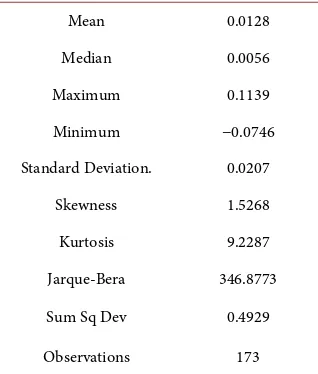
. TheDOI: 10.4236/am.2019.1012073 1064 Applied Mathematics [82]. For the period under analysis Table 1 shows that the mean, the maximum, and minimum inflation rates are 1.3, 11.4, −7.5 percentages respectively. (ii) With the Jarque-Bera statistic, 346.8773, it indicates that the inflation rate does not follow the normal distribution. It is well known that the fundamental task in many statistical analyses is to characterize the location and variability of a data set. A further characterization of the data includes skewness and kurtosis. The Skewness statistics is a measure of symmetry, or more precisely, the lack of symmetry. A distribution, or data set, is symmetric if it looks the same to the left and right of the center point. The Skewness of 1.52 indicates the moderate level.
In statistics, the Kurtosis is a measure of whether the data are heavy-tailed or light-tailed relative to a normal distribution. That is, data sets with high kurtosis tend to have heavy tails, or outliers. Data sets with low kurtosis tend to have light tails, or lack of outliers. Kurtosis statistics of the inflation rate 9.23 more large than 3, and Jarque-Bera statistics indicate that inflation rate does not follow the normal distribution. With high kurtosis statistic, 9.2287, there is an indication of inflation volatility.
We use a Student statistic test of statistical significance and find that parame-ters estimations are all statistically significant. Results confirm that the past vola-tilities affect the current volatility of inflation rate. Thus, we the dynmical beha-vior of volatility. We restrict the constant term to a function of the GARCH pa-rameters and the unconditional variance:
1 2
1 1
ˆ 1 ,
q p
j i
j i
w
σ
β
φ
−
= =
= − −
∑
∑
where 2 ˆ
σ is the unconditional variance of the residuals, that is,
ω
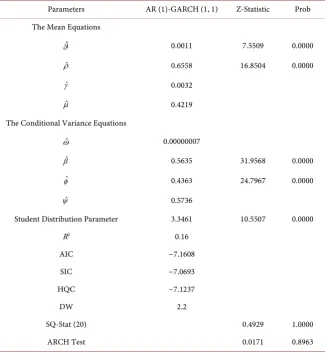
ˆ=0.00000007. Table 2 raises tree isues. First, in the mean equation, the coefficient θ =ˆ1 0.6558 [image:17.595.293.452.530.717.2]measuring the persistence of inflation rate is high. This means that the monthly last inflation contributes to current rate by 66 percents. Secondly, the stochastic
Table 1. Summary statistics.
Mean 0.0128
Median 0.0056
Maximum 0.1139
Minimum −0.0746
Standard Deviation. 0.0207
Skewness 1.5268
Kurtosis 9.2287
Jarque-Bera 346.8773 Sum Sq Dev 0.4929
DOI: 10.4236/am.2019.1012073 1065 Applied Mathematics
Table 2. Results of estimation.
Parameters AR (1)-GARCH (1, 1) Z-Statistic Prob The Mean Equations
ˆ
ϑ 0.0011 7.5509 0.0000
ˆ
ρ 0.6558 16.8504 0.0000
ˆ
γ 0.0032
ˆ
µ 0.4219
The Conditional Variance Equations ˆ
ω 0.00000007
ˆ
β 0.5635 31.9568 0.0000
ˆ
φ 0.4363 24.7967 0.0000
ˆ
ψ 0.5736
Student Distribution Parameter 3.3461 10.5507 0.0000
R2 0.16
AIC −7.1608
SIC −7.0693
HQC −7.1237
DW 2.2
SQ-Stat (20) 0.4929 1.0000
ARCH Test 0.0171 0.8963
volatility persistence of CPI-inflation rate is very high level,
0.5635 0.4363
+
=
0.9998
, this means that the past volatility informationcon-tributes to current volatility of inflation rate at 100 percents. Therefore the pur-chasing power of congolese householders is also volatile.
The postestmation tests of Ljung Box (1978), Q-Stat = 3.0639, and ARCH test, 0.0171, show that there are any remaining ARCH effects in the residuals.
7. Concluding Remarks
DOI: 10.4236/am.2019.1012073 1066 Applied Mathematics
Conflicts of Interest
The authors declare no conflicts of interest regarding the publication of this pa-per.
References
[1] Berg, T.O. (2017) Business Uncertainty and the Effectiveness of Fiscal Policy in Germany. MacroeconomicDynamics, 23, 1442-1470.
[2] Basu, S. and Bundick, B. (2017) Uncertainty Shocks in a Model of Effective De-mand. Econometrica, 85, 937-958.https://doi.org/10.3982/ECTA13960
[3] Basu, S. and Bundick, B. (2018) Uncertainty Shocks in a Model of Effective De-mand: Reply. Econometrica, 86.https://doi.org/10.2139/ssrn.3216683
[4] Kubzun, A.I. and Kan, Y.S. (1996) Stochastic Programming Problems with Proba-bility and Quantil Functions. John Wiley & Sons, New York.
[5] Möller, B. and Reuter, U. (2007) Uncertainty Forecasting in Engineering. Springer, New York.
[6] Sahalia, Y.A. (2002) Maximum Likelihood Estimation of Discretely Sampled Diffu-sions: A Closed-Form Approximation Approach. Econometrica, 70, 223-262.
https://doi.org/10.1111/1468-0262.00274
[7] Barndorff-Nielsen, O.E. and Shephard, N. (2004) Econometric Analysis of Realized Covariation: High Frequency Based Covariance, Regression, and Correlation in Fi-nancial Economics. Econometrica, 72, 885-925.
https://doi.org/10.1111/j.1468-0262.2004.00515.x
[8] Chernozhukov, V., Fernández-Val, I. and Luo, Y. (2018) The Sorted Effects Me-thod: Discovering Heterogeneous Effects beyond Their Averages. Econometrica, 86, 1911-1938. https://doi.org/10.3982/ECTA14415
[9] Hansen, L.P. (2012) Dynamic Valuation Decomposition within Stochastic Econo-mies. Econometrica, 80, 911-967.https://doi.org/10.3982/ECTA8070
[10] Hirano, K. and Wright, J.H. (2017) Forecasting with Model Uncertainty: Represen-tations and Risk Reduction. Econometrica, 85, 617-643.
https://doi.org/10.3982/ECTA13372
[11] Van Horne, J.C. and Wachowicz, J.M. (2008) Fundamentals of Financial Manage-ment. 13th Edition, Financial Times/Prentice Hall,Upper Saddle River, NJ.
[12] Stokey, N.L. (2009) The Economics of Inaction: Stochastic Control Models with Fixed Costs. Princeton University Press, Princeton, NJ.
https://doi.org/10.1515/9781400829811
[13] Francq, C. and Zakoian, J.M. (2010) GARCH Models Structure, Statistical inference and Financial Application. John Wiley and Sons, West Sussex.
https://doi.org/10.1002/9780470670057
[14] Lo, A.W. (1988) Maximum Likelihood Estimation of Generalized Itô Processes with Discretely Sampled Data. EconometricTheory, 4, 231-247.
https://doi.org/10.1017/S0266466600012044
[15] Prakasa Rao, B.L.S. (2010) Statistical Inference for Fractional Diffusion Processes. John Wiley and Sons, West Sussex.
[16] Ait Sahalia Y. and Jacod, J. (2014) High-Frequency Financial Econometrics. Prince-ton University Press, PrincePrince-ton, NJ.
https://doi.org/10.23943/princeton/9780691161433.001.0001