Preparation
via
a solution method of
La
0.2Sr
0.25Ca
0.45TiO
3and its characterization for anode
supported solid oxide fuel cells
Azra Yaqub,abCristian Savaniu,aNaveed K. Janjuaband John T. S. Irvine*a
La0.2Sr0.25Ca0.45TiO3 is a carefully selected composition to provide optimal ceramic and electrical characteristics for use as an anode support in solid oxide fuel cells. In this study we focus on the process optimization and characterization of A-site deficient perovskite, La0.2Sr0.25Ca0.45TiO3 (LSCTA-), powders preparedviaa solution method to be integrated into the SOFC anode supports. A Pechini method has been applied to successfully produce single phase perovskite at 900C. Processing conditions have been modified to yield a powder that displays a similar sintering profile to commercial yttria stabilised zirconia. The conductivity behavior of porous bodies under redox has been investigated showing a 2 stage process in both oxidation and reduction cycling that exhibits strong reversibility. For the reduction process, addition of impregnated ceria reduces the onset delay period and increases the apparent rate constant,kvalues, by 30–50% for both stages. The addition of ceria had less influence on the oxidation kinetics, although the conductivity values of both oxidised and reduced porous bodies were enhanced.
Introduction
The state of the art anode material for solid oxide fuel cells (SOFCs) is the Ni/YSZ cermet due to its low cost, good catalytic activity, high ionic and electronic conductivity and chemical and mechanical compatibility with other cell components.1 However, it has some inherent drawbacks: upon redox cycling, anode degradation occurs due to large and facile Ni to NiO volume change, low tolerance to sulphur limits the application of this anode in SOFC conditions and its high catalytic activity causes carbon deposition when hydrocarbons are used as fuels, without excess steam being present. Moreover, at high oper-ating temperatures, the catalytic active surface area decreases due to agglomeration and sintering of Ni.2All of these factors affect the performance and long term stability of SOFCs.
Therefore, there is a demand to design alternative anode systems to overcome the limitations of Ni/YSZ cermet without compromising the electrical conductivity and stability of the SOFC anode. In this context, perovskite oxides appear to be the suitable anode candidates as they offer suitable properties.3–5 Perovskite oxides have a general formula of ABO3where A and B
cations are 6-fold and 12-fold coordinated to the oxygen anions, respectively. The structure consists of BO6octahedra sharing
the corners of the cube containing an A cation at the centre. The A-site is usually occupied by alkaline earth and/or rare earth metal ions while small transition metal ions (usually from the
3d series) reside on the B site.6 Particular attention has been given to perovskite containing transition metals such as Ti, Cr, Mn or Mo due to the existence of multiple oxidation states which assist the electrocatalytic processes and facilitate elec-tronic conductivity.
Interesting defect chemistry is achieved in perovskites by partial or full substitution of A and/or B sites with aliovalent cations. The properties of perovskites can be tuned and tailored as desired defects can be introduced into the structure by careful selection of dopants. SrTiO3is a typical perovskite that
has been extensively studied. It exhibits n-type semiconducting behavior when the donor is doped or under reducing condi-tions. Therefore, special attention has been given to enhance its electrical conductivity by partial substitution of Sr2+ on the A-site or/and Ti4+on the B site to yield interesting compounds with oxygen substoichiometry or excess that strongly affects its properties.
The nature of B site dopants affects the structure, redox properties, conductivity and electrocatalytic properties of the parent compound.7In this respect, various B site dopants have been investigated such as Nb,8Mn,9Ga,10Sc,11Fe,12Al, Cr,13etc.A good conductivity value has been found for Nb doped SrTiO3. For
example, SrTi0.98Nb0.02O3dpresents a conductivity value of 339 S
cm1at 800C aer being reduced in hydrogen at 1400C.14 A-site substitution is effective in enhancing the electrical conductivity of SrTiO3. Donor doping SrTiO3 with trivalent
cations like La3+has been discussed in the literature where an increase in conductivity has been observed.15,16Moreover, there are reports about the high resistance to carbon deposition or sulphur poisoning.17,18Marina has found a pronounced effect of aSchool of Chemistry, University of St Andrews, KY16 9ST, St Andrews, UK. E-mail:
[email protected]; Fax: +44 (0)1334 463808; Tel: +44 (0)1334 463817 bDepartment of Chemistry, Quaid-i-Azam University, Islamabad, 45320, Pakistan
Cite this:J. Mater. Chem. A, 2013,1, 14189
Received 23rd July 2013 Accepted 22nd September 2013
DOI: 10.1039/c3ta12860a
www.rsc.org/MaterialsA
Materials Chemistry A
PAPER
Open Access Article. Published on 27 September 2013. Downloaded on 15/11/2013 10:29:14.
This article is licensed under a
Creative Commons Attribution 3.0 Unported Licence.
La3+ doping on the A-site of strontium titanate; among inves-tigated compositions, the maximum conductivity of 500 S cm1 has been observed in hydrogen at 800–1000C for La0.3Sr0.7TiO3
sintered at 1650 C in reducing atmosphere.19As reported in various papers, the charge compensation mechanism changes from ionic (under oxidized conditions) to electronic in reduced atmosphere.20Under reducing atmosphere, Ti4+ reduces to a
lower oxidation state, the process accompanied by the forma-tion of oxygen vacancies (see the equaforma-tion below), freeing electronic carriers that enhance the conductivity.21
2TiTiXþOOX/2Ti=
TiþV$$Oþ 1 2O2
Other than lanthanum, Y3+ has also been explored as an
A-site dopant.22Li et al have found that Y
0.09Sr0.91TiO3sintered
at 1300C in forming gas possesses an electrical conductivity of 73.7 S cm1at 800C measured in the same atmosphere.23
It can be observed in the examples above that high temper-atures and reducing atmospheres are employed to achieve high conductivity, a fact that drastically limits their practical appli-cation. Therefore, it is desirable to reduce these titanate anodes
in situ, under fuel cell operating conditions (e.g.850–900C), for higher compatibility with the existing fabrication technologies. In order to achieve comparable conductivity valuesvia in situ
reduction, A-site decient compositions can be employed, as they generally exhibit higher electronic conductivity values than the stoichiometric ones at the same oxygen partial pressure.24
Other benets that can be offered by A-site decient stoi-chiometries are enhanced sintering, thermal stability and good performance as SOFC anodes.25–27Previous investigations in our group have revealed A-site decient systems to have good conductivity, thermomechanical compatibility with yttria-stabilized zirconia (YSZ) and performance under fuel cell conditions.28–30
Recently, we reported that the conductivity of La0.2Sr0.7TiO3
(LSTA-) can be increased by Ca doping perhaps because Ca is
anticipated to decrease the unit cell volume and thus enhance the conductivity by making conduction orbitals of Ti closer to one another.31It was shown that a maximum value of conduc-tivity was achieved at a calcium dopant level ofx¼0.45. Ca2+ has smaller ionic radius than Sr2+ and similar to that of La3+ that favours its solubility into the system. Calcium doping also improves the sinterability of LSTA- prepared via solid-state
synthesis. The same optimal composition has also been shown to be an emerging anode candidate where very good perfor-mance was achieved in large cell testing under realistic fuel cell conditions.32
Since the microstructure and thus nal properties of the SOFC anode in particular are a function of processing meth-odology, the present paper addresses and discusses the process optimization of A-site decient, Ca2+doped lanthanum
stron-tium titanate, La0.2Sr0.25Ca0.45TiO3, hereaer called LSCTA-as
suggested in our earlier study.28In this study, the solution phase Pechini method33,34 was adopted for powder preparation and the effect of calcination temperature on its microstructural and thermal properties was investigated to search for an optimized
calcination temperature. The physical properties of resultant structures were evaluated particularly with reference to redox cycling tolerance.
Experimental procedure
A Pechini method has been adopted to synthesize LSCTA-. An
aqueous solution containing stoichiometric amounts of lanthanum nitrate (Aldrich, 99.999%), strontium nitrate (Aldrich, >99%), calcium nitrate (Aldrich, 99%) and titaniu-m(IV)-bis-(ammoniumlactato) dihydroxide, 50% w/w in water (Aldrich), was mixed with a solution of ethylene glycol and citric acid (both Sigma) to have anal molar ratio of metal ions to citric acid to ethylene glycol as 1 : 4 : 16. The resulting solution was heated on the hot plate at 80–100C. The evaporation of solvent led to the formation of a viscous gel. The gel was dried and the resulting residue was calcined in air (for 5 hours) at various temperatures (LSCTA-calcined at 900C, 950C, 1000C
and 1100C are abbreviated as S1, S2, S3 and S4, respectively in subsequent sections). YSZ powder (Pikem) was used as a stan-dard electrolyte composition for dilatometry experiments.
Thermogravimetric analysis (TGA) was performed on a Netzsch STA 449c equipped with Proteusthermal analysis soware in air at a heating rate of 3C min1. Phase formation was studied using a Philips XRD diffractometer using Cu-Ka1 radiation in the 2q
range of 20 to 80. Lattice parameters were tted with STOE WinXPOW soware. Particle size analysis was carried out on a Malvern Instruments Mastersizer 2000. For particle size analysis, the LSCTA-powder was dispersed in 20 wt% of Triton X-100 (Alfa
Aesar) in isopropyl alcohol. BET (Brunauer, Emmett and Teller) measurements were taken on a Micromeritics TriStar II 3020 instrument. The density of sintered pellets was calculated by measuring their mass and dimensions and compared to the theoretical density calculated using the unit cell parameters. The morphology of the calcined powders was studied using a JEOL 6700Feld emission microscope. Sinterability of the LSCT
A-powder was investigated using a Netzsch DIL 402C instrument. For dilatometry, powder was pressed into pellets of 13 mm diameter under pressure of 1 ton and heated in air in the dila-tometer to 1400C. For a.c. impedance, LSCTA-pellets were
sin-tered in air at 1400C for 6 hours and the surface of sintered pellets was polished and coated with Pt paste which was then consolidated at 900C for one hour. Impedance data were taken using a Solartron 1260 impedance/gain phase analyzer in the frequency range of 1 Hz to 13 MHz. The measured impedance data were analyzed by the Z view program and values of capacitances and resistances were extracted by tting and modeling the experimental data. D.c. conductivity was deter-mined by the van der Pauw method35on LSCT
A-pellets. For the
van der Pauw setup, four gold mesh contacts were attached at the periphery of the sample using gold paste. The contacts were consolidated byring at 900C for one hour. For redox cycling, aer a stable conductivity value was achieved at880C in aow of 5% H2/Ar, the gasow was cut offand air was allowed to leak
into the furnace. Aer achieving a constant conductivity value in oxidized atmosphere, 5% H2/Ar was againushed into the system
and above steps were repeated several times.
Open Access Article. Published on 27 September 2013. Downloaded on 15/11/2013 10:29:14.
This article is licensed under a
The slurries for tape casting were prepared by a ball milling process that included two steps. In therst step, the ceramic powder was milled in distilled water for 24 hours with dispersant D3005 (PAA,Mw¼5000, The Dow Chemical company) and pore
former (PMMA, 20 wt% to the weight of LSCTA-) to break down
agglomerates. In the second step, other organic additives, such as plasticizers, binder and defoamer, were added, followed by additional milling for 9–12 h. The recipe was adopted to formu-late porous LSCTA-tapes. The slurries were cast manually onto a
Mylar sheet and the height of the doctor blade was adjusted to give 100mm thick green tape. Aer drying, the green tapes were laminated by placing different layers onto one another and passing through the laminator. The laminated green tapes were cut into bars. The sintering was done in air at 1400C.
Aer sintering, a wet impregnation method was used to impregnate ceria. To improve the electrocatalytic activity of LSCTA-, catalytically active component CeO2 was inltrated
drop-wise into the porous bar from aqueous solutions of Ce(NO3)3$6H2O (99.99%, Alfa Aesar). Multiple impregnations with
heat treatments at 400C between inltrations were done in order to attain the desired weight loading as the pore volume of the LSCTA-backbone as well as the concentration of nitrate solution
limits the inltrated amount of catalysts in a single step. Finally, the sample was heated at 700C for 1 hour. The process was repeated until loading levels of CeO2reached 7.7 wt%.
Results and discussion
The general requirements for precursor powders for an SOFC component such as a dense electrolyte or porous electrode that can be produced by typical processing techniques such as tape casting, screen printing or spray deposition are phase purity as well as chemical and thermal compatibility with the adjacent SOFC components, important for the long term stability of the SOFC and more critical in therst stages of cell fabrication involving co-sintering of the components. In the following sections we will investigate the solution-derived LSCTA-powder
characteristics with the aim of their integration into the SOFC anode supports.
[image:3.595.316.537.49.213.2]Thermal analysis of the precursor gel
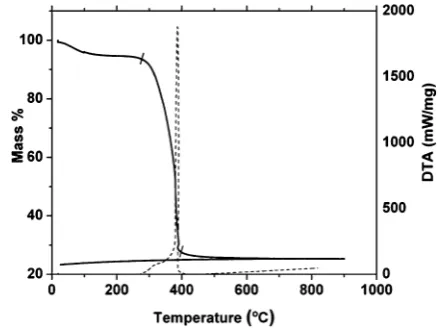
Fig. 1 shows thermo-gravimetric analysis on heating of the LSCTA-residue obtained aer drying the gel at 300C in air. TGA
reveals that the main mass loss (65%) occurs in the range of 280C to 410C and is attributed to the burnout of organic components, consistent with the formation of the oxide. Accordingly, a strong exothermic peak is observed in DTA indicative of the combustion of organic components. Aer
410 C, the removal of all organic matter is complete and further heat treatment does not cause any mass loss. No mass modication is observed on cooling down to room temperature.
XRD analysis
XRD patterns of LSCTA- samples that had been annealed at
various temperatures in air, S1–S4, are shown in Fig. 2. All the samples show single perovskite structure and no impurity peak
was detected in any of the XRD patterns. The XRD pattern was indexed and cell parameters were rened using WinXPOW soware. All the peaks were indexed in orthorhombic symmetry having a space group of Pbnm. The miller indices (h,kandl
values) of some of the peaks are also shown. The values of lattice parameters were found to bea¼5.4661(7)A,˚ b¼5.4638(6)˚A andc¼7.7343(6)˚A, respectively, for S3. This follows a relation close toO2apO2ap2apwhereapis the unit cell parameter of
the ideal cubic symmetry.
It has been reported that A-site decient La0.2Sr0.7TiO3has
cubic symmetry21 while CaTiO
3 exhibits orthorhombic
symmetry at room temperature.36Detailed discussion about the origin of different symmetries with calcium doping in this system could be found elsewhere.31Ca doping to lanthanum strontium titanate has been shown to decrease the symmetry from cubic through tetragonal to orthorhombic. Thus the symmetry of A-site decient lanthanum strontium titanate changes from cubic to orthorhombic with calcium doping, as the replacement of large Sr2+ (1.44 ˚A) with smaller size Ca2+
Fig. 1 TGA (dashed line) and DTA (solid line) curves of the La0.2Sr0.25Ca0.45TiO3 residue in air up to 900C.
Fig. 2 X-ray diffraction patterns of La0.2Sr0.25Ca0.45TiO3powders calcined in air at various temperatures: (a) 900C (S1); (b) 950C (S2); (c) 1000C (S3) and (d) 1100C (S4).
Open Access Article. Published on 27 September 2013. Downloaded on 15/11/2013 10:29:14.
This article is licensed under a
[image:3.595.308.551.517.692.2](1.35 ˚A) is likely to increase the distortion of the perovskite structure by decreasing the tolerance factor from 0.948 for cubic La0.2Sr0.7TiO3to 0.932 for orthorhombic LSCTA-assuming that
A-site vacancies have equivalent size to the occupied sites as a point of reference.
The average crystallite size of the powder calcined at various temperatures was also calculated using the Debye–Scherrer equation:
D¼ kl
bcosq
wherelis the incident X-ray wave length in angstroms,bis the full width half maximum of the peak (in radians) at diffraction angleqandkis the shape factor. The average crystallite size is given in Table 1 showing that increasing calcination tempera-ture increases the average crystallite size.
Particle size analysis and BET area
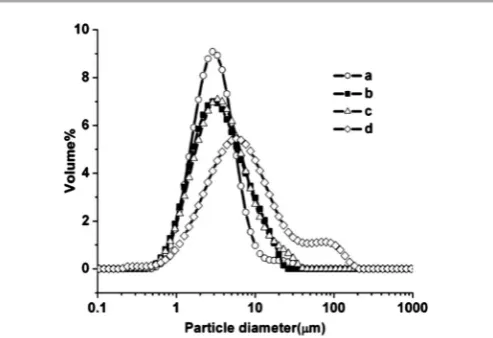
It is likely that the calcination process produces agglomerates of primary particles, thus we also determined the particle size of the powders (S1-S4) aer ultrasonication in a mixture of isopropanol and dispersant for 15 minutes. The results of particle size analysis are presented in Fig. 3 and conrmed the observed increase of mean crystallite size with the calcination temperature.
A narrower distribution is observed in the case of lower calcination temperature. The distribution of primary particles broadens with the corresponding decrease of volume fraction as the calcination temperature is increased. The shoulder observed for S4 is attributed to large agglomerates of LSCTA-or
air bubbles due to in situ ultrasonication in the apparatus. Table 1 shows variation of mean particle size, primary crystallite size and BET area with calcination temperature. Particle size analysis clearly correlated the mean particle size with the increase in the calcination temperature.
All of these parameters follow the general trend, the higher the calcination temperature, the larger the mean diameter and crystallite size and lower the BET area. BET area decreases with calcination temperature due to the inverse relationship between the BET area and particle size. Tuning these parameters is a key factor in both powder processing and sintering characteristics.
Powder morphology
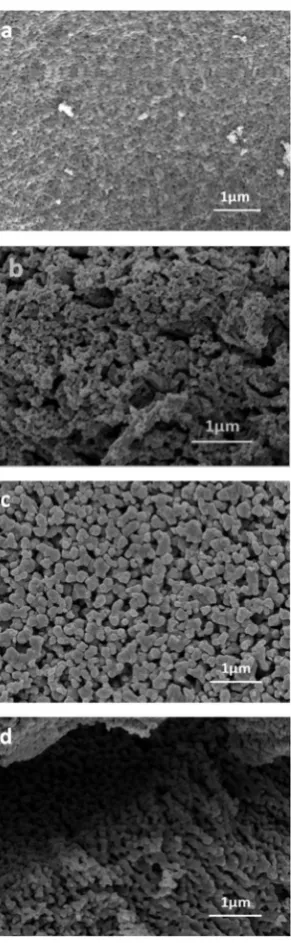
The effect of calcination temperature on particle growth and nucleation was investigated by analyzing the microstructure of these LSCTA-samples (Fig. 4) where it was also observed that the
particle size increased with the increase in the calcination temperature. From SEM micrographs, it can be noted that S1 sample consists of particles having average size between 100 and 150 nm whereas S4 shows considerably larger particles. One can observe that while S1 comprises of rather isolated particles, the powder calcined above 1000C exhibits particles necking and formation of clusters of larger submicronic parti-cles. There is some indication of elongation in particle agglomeration in the S4 sample which might be consistent with the possible bimodal particle size distribution observed in Fig. 3. This difference in microstructure affects the sintering process. Usually smaller size is benecial to sintering and results in higher density when the sintering process is complete. It is expected that thene particles produced from the solution method to have high sinterability which may be exploited favorably in processing the SOFC electrodes.
Sinterability
One of the basic requirements of an effective anode material is the thermal compatibility with the other cell components,i.e.
the electrolyte. In terms of sinterability, there should be a good match between these two SOFC components not only in shrinkage extent but also in the onset sintering temperature. Fig. 5 shows sintering behavior of pellets made of powders S1– S4, in air, on heating up to 1400C as compared to the usual choice of electrolyte, 8 mol% YSZ.
[image:4.595.41.293.73.148.2]The shrinkage is directly related to the particle size of the powdere.g., smaller size leads to more sinterability. It is obvious that S1 sinters much more and the sintering starts earlier in comparison to YSZ. This sinterability decreases as the calcina-tion temperature for the initial powder is increased. S3 sample shows an interesting behavior: its shrinkage matches very well with various electrolytes, YSZ, in terms of extent and onset (see Table 2). This feature makes it suitable for a co-sintering
Table 1 Crystallite size, mean particle size and BET area of La0.2Sr0.25Ca0.45TiO3 samples
Samples d(0.5)a(mm)
Crystallite size
from XRD (nm) BET area (m2g1)
S1 3.16 33 11.55
S2 3.56 47 8.34
S3 3.79 53 3.90
S4 6.94 60 1.53
aThed(0.5) is the average particle diameter where 50% particles of the
distribution have size below this value.
Fig. 3 Particle size distribution of La0.2Sr0.25Ca0.45TiO3 powders calcined at various temperatures: (a) 900C (S1); (b) 950C (S2); (c) 1000C (S3) and (d) 1100C (S4).
Open Access Article. Published on 27 September 2013. Downloaded on 15/11/2013 10:29:14.
This article is licensed under a
[image:4.595.44.291.522.691.2]process together with YSZ, a typical electrolyte choice in SOFC manufacturing.
The relative density was calculated from the determination of mass and dimensions of LSCTA- pellets sintered in air at
1400 C, which was found to decrease with initial powder calcination temperature. Smaller particle size helps in achieving greater densication thus S1 exhibited the highest density of all samples.
The powder characterization results presented here conrmed that single phase LSCTA- can be produced via a
solution combustion method that can be easily scaled up for larger quantities required for large anode supported SOFC production. Compared to traditional techniques such as
solid-state synthesis, this preparation method offers improved homogeneity, lower preparation temperatures and less prepa-ration steps, saving time, energy and minimizing powder contamination. A precursor powder calcination temperature of 1000 C is very promising in terms of further processing for anode fabrication via tape casting and anode-electrolyte co-sintering or screen printing.
Electrical properties
A.c. conductivity.The electrical properties of sintered LSCT
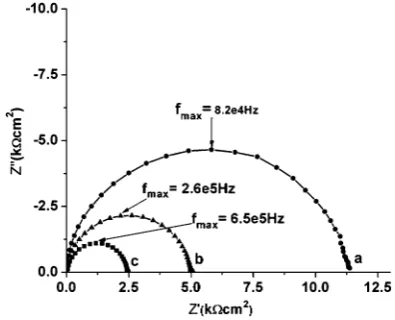
A-pellets (S1–S4) with Pt electrodes were investigated by a.c. impedance in air at various temperatures. The Cole–Cole plot (Fig. 6) of the optimum composition S3 shows only one well dened arc starting from origin for the temperatures mentioned. It is observed that increasing the temperature results in the decrease of resistance, as expected for an elec-tronic semiconductor.
Similar impedance proles are observed for all other samples. The corresponding capacitance values fall roughly in the range of1012F cm1which are typically attributed to the
contribution of intragranular or bulk phase.37From the values of bulk resistance, a.c. conductivity was calculated and results are shown in the form of Arrhenius plot in Fig. 7.
Variation in conductivity with temperature in air for all samples shows Arrhenius type behavior, as the conductivity increases linearly with temperature. The differences are not very
Fig. 4 Micrographs of La0.2Sr0.25Ca0.45TiO3powders after calcination at various temperatures: (a) 900C (S1); (b) 900C (S2); (c) 1000C (S3) and (c) 1100C (S4).
[image:5.595.96.242.46.519.2]Fig. 5 Dilatometric sintering curves of pellets from La0.2Sr0.25Ca0.45TiO3powders calcined at different temperatures in air,;900C (S1);-950C (S2);:1000C (S3);C1100C (S4) and*8-YSZ.
Table 2 Shrinkage percentages and relative density values of La0.2Sr0.25Ca0.45 -TiO3samplesa
Sample Shrinkage% Relative density%
S1 27.65 92.9
S2 24.84 91.7
S3 21.46 86.0
S4 19.69 84.6
YSZ 21.03 100
aUsing a theoretical density of 4.70 g cm3for LSCT A-.
Open Access Article. Published on 27 September 2013. Downloaded on 15/11/2013 10:29:14.
This article is licensed under a
[image:5.595.324.537.47.210.2] [image:5.595.302.555.297.375.2]signicant and relate to differences in microstructure and thermal history. The activation energy values can be calculated from the slope of Arrhenius conductivity plots and are pre-sented in Table 3. S3 sample also offered facile electron transfer kinetics as inferred from the smaller activation energy value in comparison to other samples (Table 3).
D.c. conductivity in reducing atmosphere.The d.c. conduc-tivity of a dense LSCTA- pellet (88% of the theoretical value)
sintered in air at 1400C was found to increase with tempera-ture as measured in air indicating semiconducting behavior. The initial conductivity value in air, at 880C, increases by three
orders of magnitude upon 24 hours in situ reduction in 5% H2/Ar to 1.30 S cm1 due to the reduction of Ti4+ to Ti3+ as
discussed previously19and the time dependence of conductivity graph is shown in Fig. 8. Aer an initial delay, the reduction proceeds in two stages, rapidly in therst two hours, followed by a much slower subsequent increase. It takes more than 18 hours for less than 10% increase in conductivity. These two stages might be related to the fast removal of oxygen from the surface of the perovskite that is followed by a slow diffusion into the bulk of the micron size grains.30
A dense LSCTA-pellet was prepared from powder calcined at
1000C (S3), sintered in air at 1400C and pre-reduced in 5% H2/Ar at 1050C for 72 hours. Fig. 9 shows the temperature
dependence of the electrical conductivity of pre-reduced LSCT
A-in 5% H2/Ar on heating and subsequent cooling.
Conductivity increases with the decrease in temperature showing metallic behavior until 350 K. Below this temperature, conductivity decreases with the decrease in temperature, showing a metal–insulator transition.28At 880C, a conductivity value of 38 S cm1 was obtained at logpO
2 ¼ 16.65 atm.
This value is comparable to the one reported for the sample prepared by solid-state synthesis (27.53 S cm1 at 900 C at
pO2 ¼ 1019 atm)31 and would be sufficient for using this
[image:6.595.68.266.50.210.2]Fig. 8 Conductivity profile of La0.2Sr0.25Ca0.45TiO3pellets in 5% H2/Ar at 880C.
Table 3 Activation energies calculated from a.c. impedance in air for La0.2Sr0.25Ca0.45TiO3pellets
Samples Ea/eV
S1 1.478
S2 1.423
S3 1.280
S4 1.404
Fig. 7 Arrhenius dependence of conductivity upon temperature in air for La0.2Sr0.25Ca0.45TiO3samples calcined at various temperatures.
Fig. 6 Cole–Cole plot of sintered S3 in the frequency range of 1 Hz to 13 MHz measured in air at different temperatures: (a) 650C, (b) 700C and (c) 750C.
Fig. 9 Thermal cycling of pre-reduced La0.2Sr0.25Ca0.45TiO3(S3) in 5% H2/Ar.
Open Access Article. Published on 27 September 2013. Downloaded on 15/11/2013 10:29:14.
This article is licensed under a
[image:6.595.63.266.251.433.2] [image:6.595.306.550.346.505.2] [image:6.595.303.545.539.712.2] [image:6.595.40.295.661.730.2]material as an anode current collector backbone in the anode supported SOFC conguration.
It is an important requirement of anode materials to be able to withstand reduction–oxidation and temperature cycles inherent to the SOFC stack maintenance. To determine the redox stability of this material, redox cycling was performed on a more porous LSCTA-bar (76% of the theoretical density). S3
sample was used for slurry preparation to fabricate porous LSCTA-barsviatape casting. The bar hadnal dimensions of
15 5 0.42 mm and was subjected to four probe d.c. conductivity measurements. Redox stability was tested by alternating the atmosphere from 5% H2/Ar to air upon
achieving a stable conductivity value at 880C.
The electrocatalytic activity of strontium titanate-based materials is typically enhanced by impregnating electrocatalysts such as ceria or ceria–metal couples into the porous anode backbone.32Here we performed some initial investigation on the role and stability of impregnated catalysts in a porous backbone of LSCTA-prepared by the solution phase method,
see Fig. 10.
In Fig. 11a (oxidation) and 11b (reduction) sections of the resistivity evolution are plotted on the same time scale for the native porous LSCTA-bar together with the ceria impregnated
sample at 880 C, for ve subsequent redox cycles. There is remarkable overlapping within cycles. Ceria addition clearly accelerates the onset of changes in observed conductivityvia
[image:7.595.62.275.48.215.2]redox. When the atmosphere is changed back to reducing atmosphere (see Fig. 11b) there is a sudden decrease in resis-tivity aer therst 0.5 hours that indicates that once a certain concentration of oxygen vacancies is achieved within the
[image:7.595.310.545.326.689.2]Fig. 11 Resistivity variationvs.time on 5 oxidation (a) and 5 reduction (b) cycles each for La0.2Sr0.25Ca0.45TiO3and CeO2-impregnated La0.2Sr0.25Ca0.45TiO3at 880C.
[image:7.595.44.290.407.704.2]Fig. 10 Redox cycling of a porous CeO2-impregnated La0.2Sr0.25Ca0.45TiO3bar as a function of time at 880C. Dashed lines show the change of partial pressure of oxygen over time.
Fig. 12 Resistivity/conductivity relaxation of LSCTA- and ceria impregnated LSCTA-upon oxidation (a) and reduction (b) at 880C. Two different kinetic processes are indicated by dotted intersecting lines with different slopes.
Open Access Article. Published on 27 September 2013. Downloaded on 15/11/2013 10:29:14.
This article is licensed under a
material during the initiation step, the reduction process tends to proceed faster. This delay was much smaller for oxidation, probably because of the higher vacancy content at the process onset. The addition of ceria also improves the conductivity in both the reduced and oxidized samples, possibly due to the improved conductivity at the grain boundary.
It can be noted that the oxidation occurs much faster than the (re)reduction. On closer analysis of the curves, we can note that upon the change in atmosphere and aer the time delay, the redox processes occurviatwo sequential main rate deter-mining steps, a fast initial one followed by a slower evolution in time and in addition there is also time delay before the conductivity is seen to respond to changes in atmosphere.
A more detailed analysis is obtained using the diffusion equation which assumes the surface reaction to berst order with the rate constantkproposed by Song and Yoo38and plot-ting ln(1((sts0)/(sNs0))) against time for the reduction
process. In this equation,stis the mean conductivity at timet whereass0andsNdenote the initial conductivity att¼0 and
thenal conductivity at the new equilibrium att /N. If we consider the surface diffusion as the rate determining step, the slope of the curve2k/ais given by:
ln
1 sts0
sNs0
¼2akt
herea/2is the half grain size of the material, as this is the best estimate for the minimum diffusion distance in a porous material. For a dense sample or crystal this value would come from the smallest dimension of the body. By analogy the diffusion process on oxidation can be considered in terms of resistivity rather than conductivity.
Fig. 12 shows the relative resistivity/conductivity change in the semi-logarithmic scale with time for oxidation and reduc-tion cycles of LSCTA-and CeO2-impregnated LSCTA-at 880C.
Two distinguishable slopes can be clearly seen indicating two-fold relaxation kinetics. Such two two-fold relaxation kinetics has been attributed to fast relaxation in the oxygen sublattice fol-lowed by slow relaxation in a cation sublattice for TiO2.39
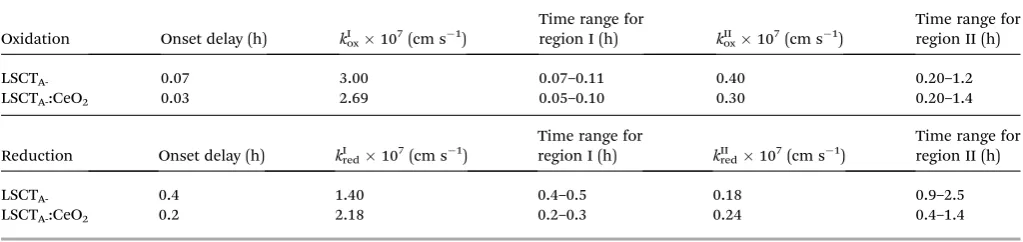
From the slope of these curves, rate constants for both oxidation and reduction kinetic processes were calculated and are tabulated in Table 4 along with the onset delay and relevant times for each relaxation type.
Considering reduction, ceria impregnation accelerates the process decreasing the onset delay and increasing the rate constant for both relaxation stages by 30–50%. The oxidation processes are more facile than reduction, see Fig. 11, with shorter onset times and higher rate constants for stage I but not for stage II. Ceria impregnation results in a decrease in onset time but also slightly lowers rate constants. Thus, different factors determine the inuence of ceria impregnation on oxidation and reduction rates in these experiments.
It is important to note that the reduction experiments start from a highly oxidized sample with few oxygen vacancies and thus catalysis of surface exchange by ceria has a signicant inuence on both the initial delay whilst percolation is achieved and the reduction process. In the oxidation stage, the sample has a high number of vacancies at the start of oxidation, hence surface exchange at ceria has little benecial inuence, apart from decreasing the onset delay.
We can also note the role of the ceria catalyst in the improvement of conductivity on reduction from 3.35 S cm1for the bare backbone to 5.87 S cm1 for the ceria impregnated sample.
It was reported31that LSCT
A-exhibits only a small increase
(ca. 0.3%) in the unit cell volume upon reduction which, together with this complete conductivity recovery upon redox cycling, makes this material an attractive candidate for a stable, conductive anode backbone in SOFC/SOEC applications. This was demonstrated recently as good redox stability (20 cycles) was observed for the LSCTA-impregnated with ceria and nickel
catalysts, as a power density in excess of 0.5 W cm2at 900C
was achieved with this anode in an electrolyte supported button cell conguration.32
Conclusions
A solution synthesis route was successfully adopted to synthe-size La0.2Sr0.25Ca0.45TiO3 powder. XRD spectra show that a
single orthorhombic phase could be obtained at relatively low calcination temperatures. A calcination temperature of 1000C was considered as optimum for a further promising processing of this material. LSCTA-showed n-type conduction nature where
the conductivity of a dense LSCTA- specimen sintered in air
[image:8.595.42.554.73.194.2]increased by three orders of magnitude aerin situreduction in
Table 4 Rate constantk(cm s1) calculated for two fold relaxation kinetics for redox cycles of La0.2Sr0.25Ca0.45TiO3and CeO2-impregnated La0.2Sr0.25Ca0.45TiO3at 880C
Oxidation Onset delay (h) kIox107(cm s1)
Time range for
region I (h) kIIox107(cm s1)
Time range for region II (h)
LSCTA- 0.07 3.00 0.07–0.11 0.40 0.20–1.2
LSCTA-:CeO2 0.03 2.69 0.05–0.10 0.30 0.20–1.4
Reduction Onset delay (h) kI
red107(cm s1)
Time range for
region I (h) kII
red107(cm s1)
Time range for region II (h)
LSCTA- 0.4 1.40 0.4–0.5 0.18 0.9–2.5
LSCTA-:CeO2 0.2 2.18 0.2–0.3 0.24 0.4–1.4
Open Access Article. Published on 27 September 2013. Downloaded on 15/11/2013 10:29:14.
This article is licensed under a
5% H2/Ar. Pre-reduction resulted in enhancement of
conduc-tivity to a value of 38 S cm1at 880C. Redox cycling showed encouraging redox stability of the ceramic system thus imparting a suitable anode conductive support candidateship. CeO2 impregnation resulted in further improvement in
conductivity by enhancing reduction kinetics, but had limited effect on the oxidation processes, which were a little faster in the absence of the catalyst. Whilst the obtained rate constants were derived using some approximations, all samples were treated similarly, hence the increase of rate constantkredby
about 50% due to ceria impregnation is signicant.
Acknowledgements
Higher Education Commission (HEC) of Pakistan, European project SCOTAS, The Royal Society and EPSRC-UK are acknowledged for thenancial support.
Notes and references
1 N. Q. Minh,J. Am. Chem. Soc., 1993,76, 563–588.
2 W. Bao, H. Guan and J. Cheng,J. Power Sources, 2008,175, 232–237.
3 W. Z. Zhu and S. C. Deevi,Mater. Sci. Eng., A, 2003,362, 228– 239.
4 J. B. Goodenough and Y. H. Huang,J. Power Sources, 2007, 173, 1–10.
5 S. Tao and J. T. S. Irvine,Chem. Rec., 2004,4, 83–95. 6 M. A. Pen~a and J. L. G. Fierro,Chem. Rev., 2001,101, 1981–
2017.
7 D. N. Miller and J. T. S. Irvine,J. Power Sources, 2011,196, 7323–7327.
8 J. Karczewski, B. Riegel, M. Gazda, P. Jasinski and B. Kusz,
J. Electroceram., 2010,24, 326–330.
9 A. Ovalle, J. C. Ruiz-Morales, J. Canales-Vasquez, D. Marrero-Lopez and J. T. S. Irvine,Solid State Ionics, 2006,177, 1997– 2003.
10 D. Neagu and J. T. S. Irvine,Chem. Mater., 2011,23, 1607– 1617.
11 X. Li, H. Zhao, F. Gao, N. Chen and N. Xu, Electrochem. Commun., 2008,10, 1567–1570.
12 D. P. Fagg, V. V. Kharton, J. R. Frade and A. A. L. Ferreira,
Solid State Ionics, 2003,156, 45–57.
13 N. G. Eror and U. Balachandran,J. Am. Ceram. Soc., 1982,65, 426–431.
14 T. Kolodiazhnyi and A. Petric,J. Electroceram., 2005,15, 5–11. 15 J. Canales-Vazquez, S. W. Tao and J. T. S. Irvine,Solid State
Ionics, 2003,159, 159–165.
16 K. B. Yoo and G. M. Choi,Solid State Ionics, 2009,180, 867– 871.
17 R. Mukundan, E. L. Brosha and F. H. Garzon,Electrochem. Solid-State Lett., 2004,7, A5–A7.
18 M. Roushanafshar, J.-L. Luo, A. L. Vincent, K. T. Chuang and A. R. Sanger,Int. J. Hydrogen Energy, 2012,37, 7762–7770. 19 O. A. Marina, N. L. Caneld and J. W. Stevenson,Solid State
Ionics, 2002,149, 21–28.
20 P. Blennow, A. Hagen, K. K. Hansen, L. R. Wallenberg and M. Mogensen,Solid State Ionics, 2008,179, 2047–2058. 21 P. R. Slater, D. P. Fagg and J. T. S. Irvine,J. Mater. Chem.,
1997,7, 2495–2498.
22 X. Huang, H. Zhao, W. Qiu, W. Wu and X. Li,Energy Convers. Manage., 2007,48, 1678–1682.
23 X. Li, H. Zhao, W. Shen, F. Gao, X. Huang, Y. Li and Z. Zhu,
J. Power Sources, 2007,166, 47–52.
24 D. Burnat, A. Heel, L. Holzer, D. Kata, J. Lis and T. Graule,
J. Power Sources, 2012,201, 26–36.
25 Q. Ma, F. Tietz, A. Leonide and E. Ivers-Tiff´ee,Electrochem. Commun., 2010,12, 1326–1328.
26 H. Zhao, F. Gao, X. Li, C. Zhang and Y. Zhao,Solid State Ionics, 2009,180, 193–197.
27 X. Li, H. Zhao, X. Zhou, N. Xu, Z. Xie and N. Chen, Int. J. Hydrogen Energy, 2010,35, 7913–7918.
28 C. D. Savaniu and J. T. S. Irvine,J. Mater. Chem., 2009,19, 8119–8128.
29 C. D. Savaniu and J. T. S. Irvine,Solid State Ionics, 2011,192, 491–493.
30 D. Neagu and J. T. S. Irvine,Chem. Mater., 2010,22, 5042– 5053.
31 A. D. Aljaberi and J. T. S. Irvine,J. Mater. Chem. A, 2013,1, 5868–5874.
32 M. C. Verbraeken, B. Iwanschitz, A. Mai and J. T. S. Irvine,
J. Electrochem. Soc., 2012,159, F757–F762.
33 A. Ries, A. Z. Simoes, M. Cilense, M. A. Zaghete and J. A. Varel,Mater. Charact., 2003,50, 217–221.
34 J. D. G. Fernandes, D. M. A. Melo, L. B. Zinner, C. M. Salustiano, Z. R. Silva, A. E. Martinelli, M. Cerqueira, C. Alves J´unior, E. Longo and M. I. B. Bernardi, Mater. Lett., 2002,53, 122–125.
35 L. J. van der Pauw,Philips Res. Rep., 1958,13, 1–9.
36 N. Lamrani, B. Itaalit, S. Marinel and M. Aliouat,Mater. Lett., 2011,65, 346–349.
37 J. T. S. Irvine, D. C. Sinclair and A. R. West,Adv. Mater., 1990, 2, 132–138.
38 C.-R. Song and H.-I. Yoo,Solid State Ionics, 1999,120, 141– 153.
39 D.-K. Lee and H.-I. Yoo,Solid State Ionics, 2006,177, 1–9.
Open Access Article. Published on 27 September 2013. Downloaded on 15/11/2013 10:29:14.
This article is licensed under a