Multilevel Societies in New World Primates?
Flexibility May Characterize the Organization
of Peruvian Red Uakaris (
Cacajao calvus ucayalii
)
Mark Bowler&Christoph Knogge&
Eckhard W. Heymann&Dietmar Zinner
Received: 19 January 2012 / Accepted: 6 March 2012
#The Author(s) 2012. This article is published with open access at Springerlink.com
Abstract Researchers have described multilevel societies with one-male, multife-male units (OMUs) forming within a larger group in several catarrhine species, but not in platyrhines. OMUs in multilevel societies are associated with extremely large group sizes, often with >100 individuals, and the only platyrhine genus that forms groups of this size isCacajao. We review available evidence for multilevel organi-zation and the formation of OMUs in groups ofCacajao, and test predictions for the frequency distribution patterns of male–male and male–female interindividual dis-tances within groups of red-faced uakaris (Cacajao calvus ucayalii), comparing year-round data with those collected at the peak of the breeding season, when group cohesion may be more pronounced. Groups ofCacajao fission and fuse, forming subgroup sizes at frequencies consistent with an OMU organization. In Cacajao calvus ucayalii and Cacajao calvus calvus, bachelor groups are also observed, a characteristic of several catarrhine species that form OMUs. However, researchers have observed both multimale–multifemale groups and groups with a single male and
DOI 10.1007/s10764-012-9603-6
M. Bowler (*)
School of Psychology, University of St. Andrews, KY16 9JP St. Andrews, UK e-mail: [email protected]
M. Bowler
e-mail: [email protected]
M. Bowler
Behavioral Ecology & Sociobiology Unit, German Primate Center (DPZ), 37077 Göttingen, Germany
C. Knogge
IPÊ–Institute for Ecological Research, Caixa Postal 47-12960-000 Nazaré Paulista, Brazil
E. W. Heymann
Behavioral Ecology & Sociobiology Unit, German Primate Center (DPZ), 37077 Göttingen, Germany
D. Zinner
multiple females inCacajao calvus. The frequency distributions of interindividual distances for male–male and male–female dyads are consistent with an OMU-based organization, but alternative interpretations of these data are possible. The distribu-tion of interindividual distances collected during the peak breeding season differed from those collected year-round, indicating seasonal changes in the spatial organiza-tion of Cacajao calvus ucayalii. We suggest a high degree of flexibility may characterize the social organization of Cacajao calvus ucayalii, which may form OMUs under certain conditions. Further studies with identifiable individuals, thus far not possible inCacajao, are required to confirm the social organization.
Keywords Breeding system . Mating system . One-male unit . Pitheciine . Social structure
Introduction
Researchers have described multilevel societies in several catarrhine species, e.g., hamadryas baboons (Papio hamadryas), geladas (Theropithecus gelada), and snub-nosed monkeys (Rhinopithecus spp.) (Grueter et al. 2012b). These species are characterized by large groups or troops that are composed of smaller one-male– sever-al-female groups or one-male units (OMUs). In some cases, additional intermediate levels between OMUs and troops are found, e.g., in hamadryas baboons, in which OMUs form clans and clans form bands (Abegglen1984; Schreier and Swedell2009). Multilevel organization in catarrhines has been related to exceptionally large group or aggregation sizes, in some cases several hundred individuals (Grueteret al.2012b). Multilevel societies with OMUs have evolved independently in two major catar-rhine clades with different ancestral social organizations: multimale–multifemale (mm–mf) groups in the papionins, and most likely single OMUs in the Colobinae. The first efforts to model the evolution of social organization analyzed the relation-ship between ecology and social structures (Clutton-Brock and Harvey1976; Crook and Gartlan1966), later incorporating further codependent factors such as male and female strategies (Wrangham 1979,1980). This eventually resulted in socioecolog-ical models relating social organization to differing food availability and distribution, predation risk, and risk of infanticide by males (Barton 2000; Fairbanks and Bird
1978; Sterck et al. 1997; van Schaik 1983,1989,1996; van Schaik and Kappeler
1997). Bachelor groups or all-male units (AMUs) are characteristic of some species that form OMUs within larger groups such as snub-nosed monkeys and geladas (Grueter and van Schaik2010; Grueter and Zinner 2004; Kirkpatrick and Grueter
2010), but not hamadryas baboons (Pineset al.2011; Swedellet al.2011). The threat imposed by bachelor groups is considered to be a driving factor leading to the formation of large groups consisting of OMUs in several species: zebras (Equus quagga: Rubenstein and Hack2004), snub-nosed monkeys, and geladas (Grueter and van Schaik2010; Grueteret al.2012a).
Although sociogeological factors will be important in modeling the evolution of primate social systems, these systems represent most likely a combination of adapta-tions to present-day environment and phylogenetic inertia (Chapman and Rothman
Kappeler and van Schaik2002) should be less constrained by phylogenetic inertia than others (Pope2000), and sociospatial organization and social relationships seem to be even less constrained and more flexible in adaption to environmental and social conditions. They may vary within species, e.g., in Semnopithecus (Jay 1965; Sugiyama1964) or between closely related species living under different conditions (Papionini: Dunbar1986; Kummer 1968; Stammbach1987; guenons: Cords1988; capuchins: Izaret al.2011). The prevalence of such social systems in unrelated catarrhines with extremely large group sizes allows us to hypothesize that a similar organization might occur within other primates that live in similarly large groups, which must experience similar selection pressures on their social system.
Multilevel systems have never been demonstrated in platyrrhines, perhaps because group sizes generally tend to be smaller than in catarrhines (Kappeler and Heymann
1996). However, large groups, comparable in size to those of OMU-forming catar-rhines, with low group cohesion, are typically found in uakaris, genusCacajao. The extremely large group sizes (for platyrrhines) seen inCacajao calvus ucayaliimake them the most likely candidate within platyrrhines in which to find a multilevel organization. Black-faced uakaris, traditionally considered as a single species, Caca-jao melanocephalus, are now split into three species: Cacajao melanocephalus,
Cacajao hosomi, andCacajao ayresi (Boubliet al. 2008) usually occur in groups of ≥100, and most groups studied show a fission–fussion grouping pattern (sensu
Aureliet al.2008; Chapmanet al.1993), with low cohesion and short-term changes in group sizes (Barnett and Brandon-Jones1997; Barnett and da Cunha1991; Bezerra
et al.2010; Defler1999). However, a group of 70Cacajao hosomiin caatinga forests did not fission, but spread out widely during travel (Boubli1997,1999). Within the red-faced uakaris (Cacajao calvusssp.: Hershkovitz1987), groups of 45–48Cacajao calvus calvus fissioned regularly, often spending several days apart (Ayres
1986,1989). Researchers have observed Peruvian red uakaris (Cacajao calvus ucaya-lii) in groups of≥200 individuals (Aquino1998; Bowler and Bodmer2009,2011), and fission–fusion also appears to be the norm in this subspecies. The question here is whether uakaris cleave in highly predictable ways according to established member-ship in social subunits, e.g., OMUs, often kin-based, within larger units or whether fissioning occurs in a more random fashion with resulting subunits being highly variable in size and membership.
Data on the social behavior of Cacajao are sparse, but here we review the available evidence for patterns that might indicate a multilevel organization in uakari groups, and the formation of OMUs, also considering evidence from other pitheciine primates, especially the very closely related Chioropotes. In doing so, we hope to point to gaps in our knowledge and guide future research. We also present new preliminary data to test whether the observed spatial arrangement of wild groups of
Review of Existing Data
Multilevel Societies in Uakaris
The reported low cohesion within groups of red uakaris implies multilevel organiza-tion. Heymann (1992) hypothesized that the social organization ofCacajao calvus ucayalii comprises three levels: the troop (ca. 50 to >100 individuals), which is composed of several groups (ca. 25–50 individuals), which in turn comprises several foraging units (up toca. 10 individuals). The distribution of group sizes observed within a local population of >200 individuals in the Lago Preto Conservation Concession (Bowler and Bodmer 2009) provides limited support for the existence of these three tiers. The average number of uakaris associating was 43.5 ±24.1 individuals (mean ± SD,N0759), but group sizes ranged from 1 to >150 individuals (Bowler and Bodmer 2009). However, the same patterns could be created by a simpler two-tiered organization in which units aggregate in nonconsistent ways. Because individuals were not identified during the study it was not possible to measure the consistency of group membership. In Cacajao calvus calvus, only groups of up to 48 have been observed; this intensively studied group frequently divided into smaller units, but it was isolated from other groups with which it could have formed larger troops (Ayres1986).
Uakari Social Organization and Mating System
The first study of the social behavior ofCacajaowas on a captive group ofCacajao calvus ucayalii, in which mating was said to be promiscuous, implying a mm–mf social organization and mating system (Fontaine1981). Observations of mating in wild uakaris have been of pairs that were not in the vicinity of other individuals (N0 6, Bowler and Bodmer2009;N01, C. Knoggeunpubl. data). These could be similar to the consort pairs found in mm–mf groups of baboons (Seyfarth 1978). Ayres (1986) made some limited observations on the social behavior ofcalvus, noting the temporary formation of pairs during the mating season, which were harassed by bachelor male groups of up to eight or nine individuals. On the basis of these observations, Ayres (1986) suggested a single-male mating system for uakaris, which implies an OMU social organization that could include pairs or single-male, multi-female groups. Researchers have also observed bachelor groups (AMUs) inucayalii
(Bowler and Bodmer 2009), but not in black-faced uakaris, despite increasing numbers of studies (Barnettet al.2005; Bezerraet al.2010; Defler1999). Gregory (2011) observed AMUs in Guianan bearded sakis (Chiropotes sagulatus), but most other groups of bearded sakis did not form male-only groups (Ayres1989; Silva and Ferrari2009; Veiga and Silva2005; Veigaet al.2006), although this might be due to a lower frequency of group fissions than inCacajao.
Spatial Arrangement of Age–Sex Classes
deriving evidence for the mating system and the organizational structure of the multilevel society. In an OMU organization, we would expect to see females as the nearest neighbors of breeding adult males more often than other males. In an mm–mf mating system, we could find that males are the most common nearest neighbors of breeding adult males, as found in Ateles and Brachyteles
(Strieret al.2002; Symington1990), or male–male associations might not occur, as in
Cebus(Fragaszyet al.2004) orLagothrix(Di Fiore and Fleisher2005).
Although M. Bowler frequently observed and recorded on video multiple males traveling in close proximity with pregnant females and those with young infants, nearest neighbor studies on ucayaliiat Lago Preto were hindered by the difficulty of identifying individuals within the local population of >200 individuals (Bowler and Bodmer2009), and the spatial organization was recorded only for age– sex classes. Adult males were recorded most commonly as the nearest neighbors of adult and subadult males, and adult females most commonly as the nearest neighbors of adult females. This is compatible with the mm–mf model, but no distinction could be made between males in bachelor units and males associating with adult females, and an OMU system could produce the same result through proximity between bachelor males. At Lago Preto, adult and subadult males were more often >30 m from their nearest neighbors than all other age–sex classes (Bowler and Bodmer
2009), indicating that groups were accompanied by peripheral males. There is no information on the spatial arrangement of age–sex classes from any other population ofCacajao.
Male–Male Affiliation and Coalitions Within mm–mf Groups
Greater levels of m–m affiliation may be possible between males in mm–mf groups than between males from different OMUs. This is a consequence of the smaller m–m distances in mm–mf groups, although there is also the possibility that males could increase their reproductive success through coalitions facilitated through m–m affil-iation. Although m–m affiliation, including frequent grooming and spatial proximity, is not always seen within mm–mf primate groups, e.g.Cebus(Fragaszyet al.2004),
Lagothrix(Di Fiore and Fleisher2005), and Papio ursinus(Swedell2011), several species do have affiliative males, e.g.,Brachyteles (Strier et al. 2002), andAteles
(Symington 1990). A high level of adult m–m affiliation appears the norm in
Chiropotes(Gregory 2011; Veiga and Silva 2005), and also occurs in adult male
ucayalii (Bowler and Bodmer 2009). Affiliation between males is not in itself evidence for an mm–mf mating system because affiliative behavior also occurs within bachelor groups in species that form OMUs, e.g. geladas (Dunbar1986). Even in hamadryas baboons in which bachelor groups are absent, solitary males may groom each other and spend the night in close proximity on the sleeping cliff (Pineset al
2011; Swedell and Plummer2012).
In addition to m–m grooming dyads, male uakaris at Lago Preto also engaged in aggressive chasing behaviors between cooperating m–m coalitions (sensuvan Schaik
New Data: Methods
Study Site
The Lago Preto Conservation Concession (LPCC: S04°27.5′ W071°45.9′) is a 9926-ha public–private reserve, 175 km southeast of Iquitos, Peru on the border of Brazil. Within the Concession, the Lago Preto study area includes 1400 ha of nonflooding terra firmeforest, 500 ha of white-water várzeaforest that floods each year with silt-laden water between November and May, and 300 ha ofaguajal
palm swamps, permanently waterlogged forest dominated by Mauritia flexuosa
palms. Groups of≤150 uakaris occurred throughout the study area, typically fission-ing and fusfission-ing through the day (Bowler and Bodmer2009).
Behavioral Methods
M. Bowler followed groups of Cacajao calvus ucayaliifor 945 h between April 2003 and July 2005, collecting data in all months except February 2004, April 2005, and May 2005. At 10-min intervals, M. Bowler randomly selected one focal individ-ual (from all age–sex classes; Bowler and Bodmer2009) and estimated interindivid-ual distances between the focal individinterindivid-ual and all its visible and identifiable neighbors within 30 m. Low visibility meant that we could not always identify the age–sex class of both focal individuals and their neighbors. We used interindividual distances for dyads of m–m and m–f adult animals (N0168) for analysis. Bowler and Bodmer (2009) analyzed the age–sex classes of the nearest neighbors of focal individuals using these data, but did not use interindividual distances.
C. Knogge collected data at LLPC, locating and following the same groups habituated by M. Bowler (Bowler and Bodmer 2009), over a period of 14 d between June 17 and July 11, 2006, within the mating season for red uakaris (Bowler
et al.in press; C. K. this study). During 30 h of contact, C. Knogge estimated interindividual distances of all visible individuals during 3-min scan samples at 10-min intervals, whenever possible indentifying sex and age class (adult, subadult, young) of the subjects. C. Knogge recorded 184 interindividual dis-tances between categorized individuals (m–m, m–f, female–female [f–f]) and 79 dyads in which only one dyad partner could not be categorized.
Data Analysis
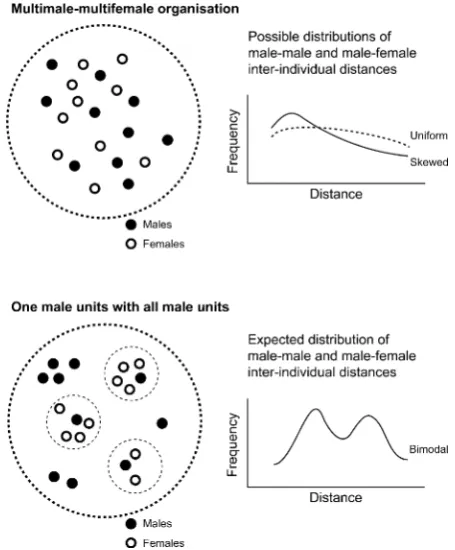
(Fig. 1). For an mm–mf organization we expected a uniform or skewed distribution of interindividual distance frequencies between m–f and m–m dyads. We had no clear predictions for the distribution f–f interindividual distances.
New Data: Results
Year-Round Interindividual Distances
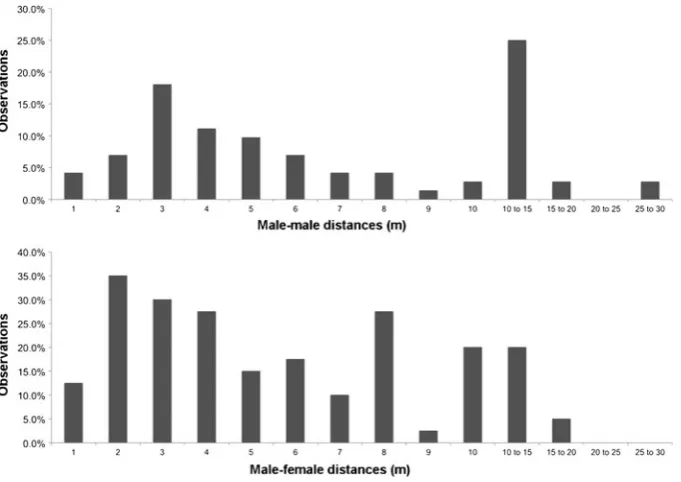
During the study by M. Bowler between April 2003 and July 2005 the frequency distribution of the interindividual distances for m–f and m–f associations appear to most closely fit the expected distributions for OMUs (Fig.2). In contrast, anecdotal observations suggested that adult females and their offspring were often accompanied by more than one adult male.
Breeding Season Interindividual Distances
During the study by C. Knogge in June and July 2006, red uakari subgroups, defined as all the individuals detected in the area by the researcher, were composed of 15–33 individuals. The frequency distributions of the interindividual distances for m–m and f–m appear to most closely fit the expected distributions for OMUs (Fig. 3).
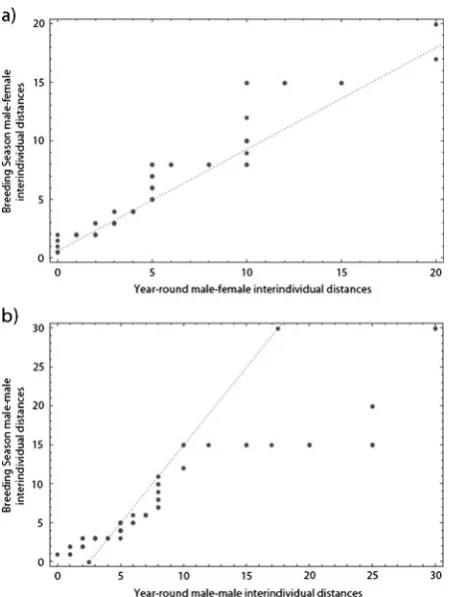
[image:7.439.106.334.322.597.2]Anecdotal observations suggested that the spatial configuration and composition of the foraging units was based on small OMUs with surrounding AMUs (five males or fewer). Typically the small units comprised two adult females and offspring, two subadults, and one adult male. In the breeding season, the frequency distributions of m–f interindividual distances were similar to those in the year-round data (Fig.4a). However, the distributions of m–m interindividual distances in the breeding season differed from those in the year-round data (Fig. 4b). The second peak of m–m interindividual distances was at shorter distances in the breeding season than in year-round data (Fig.3).
Discussion
The few studies on uakaris that have been conducted provide limited evidence for the social organization ofCacajao calvus. The lack of cohesion in groups suggests that there might be multiple levels to their societies (Heymann1992), but the consistency of membership of subgroups has not been tested. Groups containing several adult females and multiple adult males that Bowler and Bowler (2009) observed suggest an mm–mf organization, but a lack of individual identification meant that this could not be confirmed. AMUs occurred in bothCacajao calvus calvusand Cacajao calvus ucayalii (Ayres 1986; Bowler and Bodmer 2009) and are characteristic of many primate societies in which OMUs form, but are not diagnostic of an OMU social organization.
[image:8.439.54.387.54.291.2]Care must be taken in interpreting the results of the behavioral studies presented here; although the graphs fit the predictions made for groups containing OMUs, other inter-pretations of the data are possible. The second peaks in the frequencies of inter-individual distances could result from the peripheral males that occur at Lago Preto (Bowler and Bodmer2009). Although the weight of evidence appears to favour a mm–mf system forCacajao calvus, researchers have observed units apparently containing a single adult male in separate studies by Ayres (1986), Bowler and Bodmer (2009), and C. Knogge (this study). Therefore, we cannot rule out the formation of OMUs. One interesting difference between the year-round and mating season data collected by C. Knogge and M. Bowler was that the second peak frequency of interindividual distances for m–m dyads was at much shorter distances in the mating season. Although interob-server reliability could not be tested, the difference is too large to be accounted for by observers’differences in distance estimates. The discrepant pattern could be a result of bachelor male groups or peripheral males coming closer to OMUs or mm–mf subgroups during the breeding season.
Seasonal Flexibility in Uakari Social Organization
We suggest a high degree of flexibility may characterize the social organization of
Cacajao calvus, which may form OMUs under certain conditions. The discrepancy between results and observations made during long- and short-term studies at Lago Preto (Bowler and Bodmer2009;this study) could lie in the highly seasonal breeding and feeding patterns found inCacajao calvus; seasonal and synchronized breeding occurs inC. calvus(Ayres1986; Bowler and Bodmer2009; Bowleret al.in press),
[image:9.439.52.393.51.292.2]and strong seasonal fluctuation in the abundance of key resources (Ayres 1986; Bowler and Bodmer2011) creates great temporal variation in the selection pressures on uakari social systems. Ecological pressures will determine the cohesion of females in groups, while the pressures on males to go where the females are will vary temporally with the need to gain access to mates during the breeding season and defend their offspring against potential infanticide when infants are small (van Schaik and Kappeler1997). It is possible that uakari group composition is so flexible that both OMU and mm–mf foraging or breeding units can occur through the year depending on resource distribution and the number of ovulating females or young infants present. Researchers have also recorded flexibility and seasonal variation in social systems in mandrills (Mandrillus sphinx), in which mature males are most likely present only seasonally (Abernethyet al.2002), in patas monkeys (Erythrocebus patas), red-tailed monkeys (Cercopithecus ascanius), and blue monkeys (Cercopithecus mitis), in which researchers have observed seasonal influxes of males into single-male, multi-female groups (Carlson and Isbell2001; Chism and Rogers1997; Chism and Rowell
1986), and in baboons, in which strong f–f bonds and cliques form more frequently in lean periods than in times of plenty (Henziet al.2009).
[image:10.439.108.334.50.349.2]Evolution of the Uakari Social System
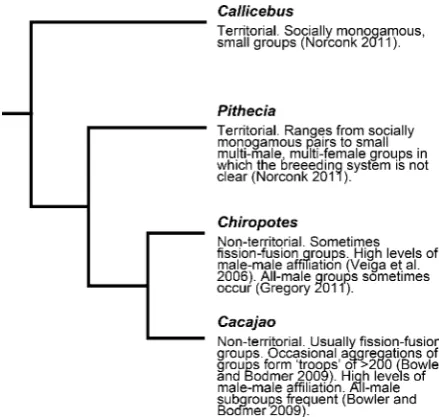
As with other multilevel primate species, there are two alternative hypotheses for the origin of the social organization of Cacajao. Ancestrally solitary OMUs, or pairs, could have converged to form large groups, as assumed forRhinopithecus, or they could have had an mm–mf organization that later became substructured. The social system ofCacajaois not well known, and similarly few studies have considered their social behavior. Regardless of whetherCacajaogroups are organized into mm–mf or OMUs within larger groups, we can plot their social systems with those of other pitheciids on a phylogeny to determine the most likely evolutionary path of uakari social organization (Fig.5). Titi monkeys (Callicebus) form territorial pairs, as do many groups of saki monkeys (Pithecia), and this is perhaps the ancestral pitheciid condition.Pitheciagroups sometimes contain more than one male (Norconk2011), providing evidence of the potential to deviate from monogamy and also of potential flexibility in social organization of the kind we are proposing forCacajao, albeit at the other end of the scale for group size. Chiropotes is very closely related to
Cacajao, having diverged relatively recently (ca. 6–7 million yr; Perelman et al.
2011). Chiropotes also occurs in large groups (>50 individuals; Norconk2011), and although several groups studied have foraged as a single unit (Ayres 1989), low cohesion and fission–fusion have been shown in other populations (Silva and Ferrari
2009; Veiga and Silva 2005; Veiga et al. 2006), which might suggest a grouping pattern similar to that ofCacajao. We can hypothesize that the common ancestor of Chiropotes and Cacajao also lived in large groups that evolved through the association of ancestrally solitary OMUs or more likely from pairs similar to those seen in titi and saki monkeys.
[image:11.439.108.328.397.605.2]Future Directions
Details of the social organization ofCacajao calvusremain unresolved. Studies have failed to conclusively distinguish between an OMU or mm–mf breeding system, a third tier of social organization has yet to be confirmed, and the nature of m–m coalitions is unclear. Difficulties in observing the animals in the wild have been the major factor in restricting knowledge of this genus, but progress is being made at a number of sites that should allow these questions to be answered.Cacajaorepresents an interesting opportunity to test general theories on the evolution of OMUs, m–m affiliation, and coalition. Testing these hypotheses will require identifiable or marked uakaris, which will have to be followed, and their social interactions or proximity recorded over an extended period. To determine whetherCacajaohas a two- or three-tiered society, the changing membership of groups and units will need to be tracked through time. Again this will require the reliable identification or marking of a number of individuals. If groups around the median size remain of consistent composition in the long term, especially following the fusioning and fissioning of groups to form ephemeral troops, then the three-tier concept would be confirmed.
Acknowledgments This article was written as part of a collaborative project funded by a grant awarded to M. Bowler by the German Academic Exchange Service (DAAD). Fieldwork was funded by Rufford Small Grants, LA Zoo, Conservation International, Primate Conservation Inc., and the Wildlife Conservation Society. Data were collected with a permit from INRENA (Instituto Nacional de Recursos Naturales) of the Peruvian government, and the methodology complied with their regulations. We extend special thanks to the Natural History Museum of the National University of San Marcos, Lima, WCS, Earthwatch and DICE, Pablo Puertas, Richard Bodmer, Miguel Antunez, Victor Pacheco, Fanny Cornejo, Alfonso Mendez, Marco Rios, Ricardo Zarate, Pedro Perez, Maribel Recharte, Paddy Brock, Lucy Garrett and Olivia Curno, the boat crews, field assistants, and people of Carolina and Nuevo Esperanza. We also thank two reviewers for their very constructive comments and finally we thank the editors of the special issue and the editor ofInternational Journal of Primatologyfor giving us the chance to publish our ideas on a multilevel organization in Peruvian red uakaris.
Open Access This article is distributed under the terms of the Creative Commons Attribution License which permits any use, distribution, and reproduction in any medium, provided the original author(s) and the source are credited.
References
Abegglen, J. J. (1984).On socialization in Hamadryas baboons: A field study. Lewisburg, PA: Bucknell University Press.
Abernethy, K. A., White, L. J. T., & Wickings, E. J. (2002). Hordes of mandrills (Mandrillus sphinx): extreme group size and seasonal male presence.Journal of Zoology, 258, 131–137.
Aquino, R. (1998). Some observations on the ecology ofCacajao calvus ucayaliiin the Peruvian Amazon.
Primate Conservation, 18, 21–24.
Aureli, F., Schafner, C. M., Boesch, C., Bearder, S. K., Call, J., Chapman, C. A., Conner, R., Difiore, A., Dunbar, R. I. M., Henzi, S. P., Holekamp, K. E., Korstjens, A. H., Layton, R. H., Lee, P., Leymann, J., Manson, J. H., Ramos-Fernandez, G., Strier, K. B., & van Schaik, C. P. (2008). Fission-fusion dynamics: new research frameworks.Current Anthropology, 49, 627–654.
Ayres, J. M. (1986).The white uakaris and the Amazonian flooded forests. Ph.D. thesis, Cambridge University.
Ayres, J. M. (1989). Comparative feeding ecology of the uakari and bearded saki,CacajaoandChiropotes.
Barnett, A. A., & Brandon-Jones, D. (1997). The ecology, biogeography and conservation of uakaris,
Cacajao(Pitheciinae).Folia Primatologica, 68, 223–235.
Barnett, A. A., & da Cunha, A. C. (1991). The golden-backed uacari on the upper Rio Negro.Oryx, 25, 80– 88.
Barnett, A. A., de Castilho, C. V., Shapley, R. L., & Anicacio, A. (2005). Diet, habitat selection, and natural history of the golden-backed uacari,Cacajao melanocephalus ouakary, in JaúNational Park, Brazil.
International Journal of Primatology, 26, 961–981.
Barton, R. 2000. Socioecology of baboons: the interaction of male and female strategies. In P. M. Kappeler (Ed.), Primate males: Causes and consequences of variation in group composition (pp. 97–107). Cambridge, UK: Cambridge University Press.
Bezerra, M. A., Barnett, A. A., Souto, A., & Jones, G. (2010). Ethogram and natural history of golden-backed uakaris (Cacajao melanocephalus).International Journal of Primatology, 32, 46–68. Boubli, J. P. (1997). A study of the black uakari,Cacajao melanocephalus melanocephalus, in the Pico da
Neblina National Park, Brazil.Neotropical Primates, 5, 113–115.
Boubli, J. P. (1999). Feeding ecology of black-headed uakaris (Cacajao melanocephalus melanocephalus) in the Pico de Neblina National Park, Brazil.International Journal of Primatology, 20, 719–749. Boubli, J. P., da Silva, M. N. F., Amado, M. V., Hrbek, T., Pontual, F. B., Farias, I. P. 2008. A taxonomic
reassessment of Cacajao melanocephalus Humboldt (1811), with the description of two new species. International Journal of Primatology 29: 723-741.
Bowler, M., & Bodmer, R. (2009). Social behavior in fission–fusion groups of red uakari monkeys (Cacajao calvus ucayalii).American Journal of Primatology, 71, 976–987.
Bowler, M., & Bodmer, R. (2011). Diet and food choice in Peruvian red uakaris (Cacajao calvus ucayalii) selective or opportunistic seed predation?International Journal of Primatology, 32, 1109–1122. Bowler, M., Barton, C., McCann-Wood, S., Puertas P., & Bodmer R. (in press). Annual variation in
breeding success and changes in population density ofCacajao calvus ucayaliiin the Lago Preto Conservation Concession, Peru. In B. B. Barnett & L. M. Veiga (Eds.),Evolutionary biology and conservation of titis,sakis and uacaris. Cambridge, UK: Cambridge University Press.
Carlson, A. A., & Isbell, L. A. (2001). Causes and consequences of single-male and multi-male mating in freeranging patas monkeys (Erythrocebus patas).Animal Behaviour, 62, 1047–1058.
Chapman C. A., White F. J., Wrangham R. W. 1993. Defining subgroup size in fission-fusion societies. Folia Primatologica 61:31–34.
Chapman, C. A., & Rothman, J. M. (2009). Within-species differences in primate social structure: evolution of plasticity and phylogenetic constraints.Primates, 50, 12–22.
Chism, J., & Rogers, W. (1997). Male competition, mating success and female choice in a seasonally breeding primate (Erythrocebus patas).Ethology, 103, 109–126.
Chism, J. B., & Rowell, T. E. (1986). Mating and residence patterns of male patas monkeys.Ethology, 72, 31–39.
Clutton-Brock, T. H., & Harvey, P. H. (1976). Evolutionary rules and primate societies. In P. P. G. Batson & R. A. Hinde (Eds.),Growing points in ethology(pp. 195–237). Cambridge, UK: Cambridge University Press.
Cords, M. (1988). Mating systems of forest guenons: A preliminary review. In A. Gautier-Hion, F. Bourlière, J. P. Gautier, & J. Kingdon (Eds.),A primate radiation: Evolutionary biology of the African guenons(pp. 323–329). Cambridge, UK: Cambridge University Press.
Crook, J. H., & Gartlan, J. C. (1966). Evolution of primate societies.Nature, 210, 1200–1203.
Defler, T. R. (1999). Fission-fusion in the black-headed uacari (Cacajao melanocephalus) in eastern Colombia.Neotropical Primates, 7, 5–8.
Di Fiore, A., & Fleisher, R. C. (2005). Social behavior, reproductive strategies, and population genetic structure ofLagothrix poeppigii.International Journal of Primatology, 26, 1137–1173.
Dunbar, R. I. M. (1986). The social ecology of gelada baboons. In D. I. Rubenstein & R. W. Wrangham (Eds.),Ecological aspects of social evolution(pp. 332–351). Princeton, NJ: Princeton University. Fairbanks, L. A., & Bird, B. (1978). Ecological correlates of interindividual distance in the St. Kitts vervet
(Cercopithecus aethiops sabaeus).Primates, 19, 605–614.
Fontaine, R. (1981). The uakaris, genusCacajao. In A. Coimbra-Filho & R. A. Mittermeier (Eds.),Ecology and behavior of neotropical primates(pp. 443–493). Rio de Janeiro: Academic Brasileira de Ciências. Fragaszy, D. M., Visalberghi, E., & Fedigan, L. M. (2004).The complete capuchin: The biology of the
genus Cebus. Cambridge, UK: Cambridge University Press.
Grueter, C. C., & van Schaik, C. P. (2010). Evolutionary determinants of modular societies in colobines.
Behavioral Ecology, 21, 63–71.
Grueter, C. C., & Zinner, D. (2004). Nested societies: convergent adaptations of baboons and snub-nosed monkeys?Primate Report, 70, 1–98.
Grueter, C. C., Chapais, B., & Zinner, D. (2012a). Evolution of multilevel social systems in nonhuman primates and humans.International Journal of Primatology,33
Grueter, C. C., Matsuda, I., Zhang, P., & Zinner, D. (2012b). Multilevel societies in primates and other mammals: Introduction to the special issue.International Journal of Primatology,33
Henzi, S. P., Lusseau, D., Weingrill, T., van Schaik, C. P., & Barrett, L. (2009). Cyclicity in the structure of female baboon social networks.Behavioural Ecology and Sociobiology, 63, 1015–1021.
Hershkovitz, P. (1987). Uacaries, new world monkeys of the genusCacajao(Cebidae, Platyrrhini): a preliminary taxonomic review with the description of a new subspecies.American Journal of Prima-tology, 12, 1–53.
Heymann, E. W. (1992). The red uakari (Cacajao calvus ucayalii): some field observations and spec-ulations on a little-known species.Primate Eye, 47, 6–7.
Izar, P., Verderane, M. P., Peternelli-Dos-Santos, L., Mendonça-Furtado, O., Presotto, A., Tokuda, M., Visalberghi, E., & Fragaszy, D. (2011). Flexible and conservative features of social systems in tufted capuchin monkeys: comparing the socioecology ofSapajus libidinosusandSapajus nigritus.American Journal of Primatology, 73, 1–17. online.
Jay, P. (1965). The common langur of North India. In I. DeVore (Ed.),Primate behaviour: Field studies of monkeys and apes(pp. 197–249). New York: Holt, Rinehart and Winston.
Kappeler, P. M., & Heymann, E. W. (1996). Nonconvergence in the evolution of primate life history and socio-ecology.Biological Journal of the Linnean Society, 59, 297–326.
Kappeler, P. M., & van Schaik, C. P. (2002). The evolution of primate social systems.International Journal of Primatology, 23, 707–740.
Kirkpatrick, R. C., & Grueter, C. C. (2010). Snub-nosed monkeys: multilevel societies across varied environments.Evolutionary Anthropology, 19, 98–113.
Kummer, H. (1968).Social organization of Hamadryas baboons: A field study. Chicago: University of Chicago Press.
Norconk, M. (2011). Sakis, uakaris, and titi monkeys: Behavioral diversity in a radiation of primate seed predators. In C. J. Campbell, A. Fuentes, K. C. MacKinnon, S. K. Bearder, & R. M. Stumpf (Eds.),
Primates in perspective(2nd ed., pp. 122–139). New York: Oxford University Press.
Perelman, P., Johnson, W. E., Roos, C., Seuánez, H. N., Horvath, J. E., et al. (2011). A molecular phylogeny of living primates.PLoS Genetics, 7(3), e1001342.
Pines, M., Saunders, J., & Swedell, L. (2011). Alternative routes to the leader male role in a multi-level society: follower vs. solitary male strategies and outcomes in hamadryas baboons.American Journal of Primatology, 73, 679–691.
Pope, T. R. (2000). The evolution of male philopatry in neotropical monkeys. In P. M. Kappeler (Ed.),
Primate males: Causes and consequences of variation in group composition(pp. 219–235). Cam-bridge, UK: Cambridge University Press.
Rubenstein, D. I., & Hack, M. (2004). Natural and sexual selection and the evolution of multi-level societies: Insights from zebras with comparisons to primates. In P. M. Kappeler & C. P. van Schaik (Eds.),Sexual selection in primates: New and comparative perspectives(pp. 266–279). Cambridge, UK: Cambridge University Press.
Schreier, A., & Swedell, L. (2009). The fourth level of social structure in a multi-level society: ecological and social functions of clans in hamadryas baboons.American Journal of Primatology, 71, 948–955. Seyfarth, R. M. (1978). Social relationships among adult male and female baboons. I. Behaviour during
sexual consortship.Behaviour, 64, 204–226.
Silva, S. S. B., & Ferrari, S. F. (2009). Behavior patterns of southern bearded sakis (Chiropotes satanas) in the fragmented landscape of eastern Brazilian Amazonia.American Journal of Primatology, 71, 1–7. Stammbach, E. (1987). Desert, forest, and mountain baboons: Multilevel societies. In B. B. Smuts, D. L. Cheney, R. M. Seyfarth, R. W. Wrangham, & T. T. Struhsacker (Eds.),Primate societies(pp. 112–120). Chicago: University of Chicago Press.
Sterck, E. H. M., Watts, D. P., & van Schaik, C. P. (1997). The evolution of female social relationships in nonhuman primates.Behavioral Ecology and Sociobiology, 41, 291–309.
Strier, K. B., Dib, L. T., & Figueira, J. E. C. (2002). Social dynamics of male muriquis (Brachyteles arachnoides hypoxanthus).Behaviour, 139, 315–342.
Swedell, L. (2011). African papionins: Diversity of social organization and ecological flexibility. In C. J. Campbell, A. Fuentes, K. C. MacKinnon, S. K. Bearder, & R. M. Stumpf (Eds.), Primates in perspective(2nd ed., pp. 241–277). New York: Oxford University Press.
Swedell, L., & Plummer, T. (2012). A papionin multilevelsociety as a model for early hominin evolution.
International Journal of Primatology,33.
Swedell, L., Saunders, J., Schreier, A., Davis, B., Tesfaye, T., & Pines, M. (2011). Female“dispersal”in hamadryas baboons: transfer among social units in a multilevel society.American Journal of Physical Anthropology, 145, 360–370.
Symington, M. M. (1990). Fission-fusion social organization inAtelesandPan.International Journal of Primatology, 11, 47–61.
van Schaik, C. P. (1983). Why are diurnal primates living in groups?Behaviour, 87, 120–144.
van Schaik, C. P. (1989). The ecology of social relationships among female primates. In V. Standen & R. A. Foley (Eds.),Comparative socioecology: The behavioural ecology of humans and other mammals(pp. 195–218). Oxford: Blackwell.
van Schaik, C. P. (1996). Social evolution in primates: the role of ecological factors and male behaviour.
Proceedings of the British Academy, 88, 9–31.
van Schaik, C. P., & Kappeler, P. M. (1997). Infanticide risk and the evolution of male–female association in primates.Proceedings of the Royal Society of London B: Biological Sciences, 264, 1687–1694. van Schaik, C. P., Pandit, S. A., & Vogel, E. R. (2006). Towards a general model for male-male coalitions in
primate groups. In C. P. van Schaik & P. M. Kappeler (Eds.),Cooperation in primates and humans: Mechanisms and evolution(pp. 151–171). Berlin: Springer.
Veiga, L. M., & Silva, S. S. B. (2005). Relatives or just good friends? Affiliative relationships among male southern bearded sakis (Chiropotes satanas). Livro de Resumos, XI Congresso Brasileiro de Prima-tologia, Porto Alegre. p 174 [abstract].
Veiga, L. M., Bowler, M., Cunningham, E., Di Fiore, A., & Fernandez-Duque, E. (2006). Variability in Pitheciine social organization.International Journal of Primatology,27(Supplement 1)[abstract 516]. Wrangham, R. W. (1979). On the evolution of ape social systems.Social Science Information, 18, 334–368. Wrangham, R. W. (1980). An ecological model of female bonded primates groups.Behaviour, 75, 262–