The Use of Proof Planning Critics to Diagnose Errors in the
Base Cases of Recursive Programs
∗Louise A. Dennis
School of Computer Science and Information Technology, University of Nottingham, [email protected]
January 12, 2005
Abstract
This paper reports the use of proof planning to diagnose errors in program code. In particular it looks at the errors that arise in the base cases of recursive programs produced by undergraduates. It describes two classes of error that arise in this situation. The use of test cases would catch these errors but would fail to distinguish between them. The system adapts proof critics, commonly used to patch faulty proofs, to diagnose such errors and distinguish between the two classes. It has been implemented inλClam, a proof planning system, and applied successfully to a small set of examples.
The use of mathematical proof to show that a computer program meets its specifica-tion has a long history in Computer Science (e.g. [14, 13]). Considerable time and effort has been invested in creating computer-based tools to support the process of proving programs correct (e.g. [15, 8]). However the technique and tools are only used in very specialised situations in industry where programmers generally rely on testing and bug reports from users to assess the extent to which a program meets its specification.
There are several reasons why there is such poor uptake of the use of proof in industry. One is that the final proof will tell you if the program is correct, but failing to find a proof does not, on immediate inspection, help in locating errors. This problem can be particularly severe when using automated proof techniques which generally produce no proof trace in the case of failure. Many cases have been reported where the process of attempting a proof by hand has highlighted an error, for instance Paulson’s discovery of new attacks against security protocols [16]. Anecdotal evidence suggests that errors are located by examining and reflecting on the process of the failed proof attempt.
It is worth noting the comparative success of model checking techniques (e.g. [11]). Model checkers are automated (though they require an expert user to convert the prob-lem into an appropriate form) and return counterexamples when they fail. This confirms the analysis that automated support for error discovery is valuable and might aid a more widespread uptake of theorem proving technology.
This paper reports preliminary work using the proof planning paradigm (in particular the concept of proof critics) to diagnose the errors in program code. I focus on two classes
of error that can arise in the base case of a recursive program and show how a proof critic can be written to distinguish between these two situations.
1
Proof Planning
Proof planning [1] is an Artificial Intelligence based technique for the automation of proof. One aspect of proof planning is the inspection of failed proof attempts by means ofproof critics [10] which attempt to patch the proof.
Proof planners use AI-style planning techniques to generate proof plans. A proof plan is a proof of a theorem at some level of abstraction. The main planning operators
used by a proof planner are called proof methods.
The first proof planner,Clam [3], focused on proof by mathematical induction using
the rippling heuristic (a form of rewriting constrained to be terminating by meta-logical
annotations) [2]. λClam [19, 5], which I used for this work, is a higher-order descendant
ofClamwhich incorporates both a hierarchical method structure and proof critics.
λClam works by using depth-first planning with proof methods. Each node in the
search tree is a subgoal under consideration at that point. The planner checks the preconditions for the available proof methods at each node and applies those whose preconditions succeed to create the child nodes. The plan produced is then a record
of the sequence of method applications that lead to a trivial subgoal. λClam’s proof
methods are believed to be sound although they are not currently reducible to sequences
of inference rule applications. This means that while λClam outputs something that
can be considered a proof in a similar way to a pen-and-paper correctness proof it does not produce a fully-formal proof.
1.1 Proof Methods
Proof method application is governed by preconditions (which may be either legal or
heuristic in nature) and by a proof strategy (or compound method) which restricts the
methods available depending on the progress through the proof. For instance we may wish to simplify a goal as much as possible by applying a rewriting method exhaustively before considering other procedures such as checking for tautologies.
InλClam a proof method can beatomicorcompound. If it is compound then it is a
sub-strategy built up from other methods andmethodicals1
[18]. Methodicals exist for
repeats, sequencing methods, creating or choices etc. and so complex proof strategies
for controlling the search for a proof can be created.
1.1.1 The Proof Strategy for Induction
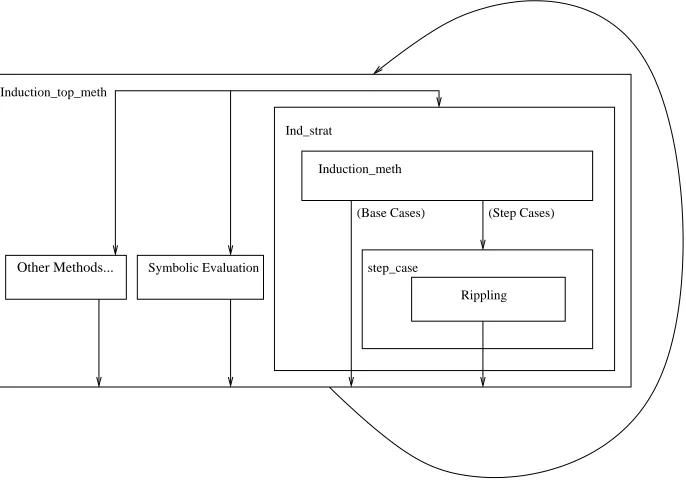
The proof strategy for induction can be seen in figure 12
. The diagram shows a top
level repeat which attempts a disjunction of methods (in λClam these are attempted
1
Analogous to a tactical in an LCF style theorem prover. 2
Symbolic Evaluation Other Methods...
Induction_top_meth
(Base Cases) (Step Cases) Ind_strat
Induction_meth
step_case
[image:3.612.128.471.38.278.2]Rippling
Figure 1: The Proof Strategy for Induction
from right to left, the planner backtracking out of failed choices). These include basic tautology checking, generalisation of common subterms and also symbolic evaluation
and the induction strategy (ind strat). Within the induction strategy, the induction
method chooses an induction scheme and produces subgoals for base and step cases. The top level strategy is reapplied to the base cases. The step cases are handled using rippling. The details of rippling are not important to the work described here and so are omitted from discussion. The results are then passed out to the top level strategy
again. The process terminates when all subgoals have been reduced totrue.
This proof strategy is used as the basis of the system for diagnosing errors in recursive programs discussed in this paper.
1.2 Proof Critics
A proof strategy provides a guide to which proof methods should be chosen at any given stage of the proof. Knowing which method is expected to apply gives additional information should the system generating the plan fail to apply it. Proof critics can be employed to analyse the reasons for failure and propose alternative choices. Critics are expressed in terms of preconditions and patches. The preconditions examine the reasons why the method has failed to apply. The proposed patch suggests some change to the proof plan or strategy. It may choose to propagate this change back through the plan and then continue from the current point, jump back to a previous point in the proof plan, or modify the current strategy being used by the planner, for instance by introducing new methods for consideration at that point.
criti-cals[9] in the same way that method strategies can be developed.
1.3 Related Work
Monroy [12] has already used proof planning to examine faulty conjectures. He follows
work by Franova and Kodratoff [7] and Protzen [17] and attempts to synthesize a
cor-rective predicate in the course of proof. The idea is that the corrective predicate will represent the theorem that the user intended to prove. This predicate is represented
by a meta-variable, P, such that P → G where G is the original (non)theorem. P
is instantiated during the course of a proof planning attempt. This approach assumes that, in some sense, the error arose because the original conjecture was too general.
The work reported here does not attempt to generate a corrective predicate. It seeks simply to diagnose the point in the code which is causing proof failure and allow a user to determine the appropriate modification. This allows for a more general class of errors to be identified beyond over-generalisations. Clearly there are advantages and disadvantages to both approaches and ideally they might at some point be combined into a system which both diagnosed the error and suggested a modification.
2
Novice Programs
In order to exploit the proof planning paradigm it is necessary to identify common patterns of proof in order to structure the proof strategy. In the case of faulty conjectures this would include identifying common patterns of proof failure which in turn requires the collection of a large body of data containing errors in order to observe the patterns of failure involved.
I have opted to study the programs produced by novice programmers, specifically undergraduates working on functional programming modules. It is relatively easy to acquire a large number of such programs and they are also likely to be well suited to proof by mathematical induction for which a mature proof strategy already exists (described above). On the downside such programs may not have a clear specification. Also, such programs may not contain the sort of bugs which we would expect to be generated by real programmers.
2.1 Errors in the Base Cases of Recursive Programs
I analysed a corpus of ML programs produced by students at the University of Edin-burgh. This was a large set of approximately 150 scripts (attempting up to 4 problems) of which half were examined (the remainder being kept aside for later testing). These programs were all recursive in nature and a number of errors were identified and classi-fied. This paper focuses specifically on errors occurring in the base cases of recursions. An obvious approach to such problems is to filter the programs through test cases (in fact this is the approach adopted by many practitioners). However my analysis revealed two different ways in which errors may appear – these two different circumstances would not be distinguished by a counter-example alone.
the rest of this paper I use a manufactured example in which the errors are duplicated but in which the basic problem is altered.
Consider the reverse function on lists3
commonly defined as:
reverse(nil) = nil,
reverse(X ::XS) = reverse(XS)<>(X ::nil).
The two errors that appeared to arise in student code were when either the base case of the recursion was incorrect in some way or it was omitted. A typical incorrect base case would be:
reverse(nil) = X ::XS.
The object of the research reported here was to distinguish between these two problems based on the failed proof attempt.
2.2 The Proof Strategy
The first challenge was to develop some sort of specification for the program. In this case I assume that the tutor has provided a “correct” version of the program and that
the system is attempting to prove their equivalence4
. In this case the initial proof goal is
∀l. student reverse(l) =tutor reverse(l).
Hand proofs of these equivalences suggest that the proof stalls in the base case of the induction at either
X ::XS=nil
when the base case is incorrect or
student reverse(nil) =nil
when the base case is missing.
In the case of the incorrect base case both the goal has been reduced to a falsehood (assuming a free constructor specification).
In the second case (missing base case) we have two inequal terms, one of which has been reduced to variables and type constructors while the other still contains a defined term.
2.3 Critics for missing and incorrect base cases
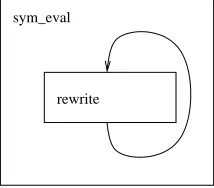
This analysis suggested that there should be a critic on the symbolic evaluation method. Symbolic Evaluation is, in fact, a compound method consisting of repeated applications of a rewrite method and is shown in figure 2. I implemented a modification to this
method so that a critic strategy is called if the rewrite method fails. This is shown
in figure 35
. The critic strategy calls an atomic critic, check equalities. This is
3
In what follows we usenil to indicate the empty list, :: to indicate the cons function that joins an element to the front of a list and<>to indicate a built-in append function which joins two lists together.
4
Obviously this scenario is unlikely in an industrial setting but was sufficient for the problem at hand. 5
sym_eval
[image:6.612.244.351.40.134.2]rewrite
Figure 2: The Symbolic Evaluation Method
sym_eval
rewrite sym_eval_crit
Check Equalities
stop_meth
modify strategy
Figure 3: The Symbolic Evaluation Method and Base Case Diagnosis Critic
shown in figure 4 however I have chosen to present this in terms of preconditions and effects rather than patches since the critic does not patch the proof (or the theorem). The “known to be false” precondition checks a small internal list of non-theorems for
a match – these assume a free constructor specification (ie. they contain ¬(0 =s(N))
whereN is a variable) there are clearly some issues with this assumption and an
obvi-ous area for improving the critic is in making the implementation of this precondition more rigorous for instance by using I-Axiomatizations [4]. If its preconditions succeed thencheck equalitiesprocesses its effects which in this case prints out an appropriate diagnosis message. If the critic succeeds the current strategy is changed so instead of
proceeding as normal a method called stop meth is invoked which closes the current
proof branch immediately. Other proof branches are left open to be explored, poten-tially finding additional errors in the program (e.g. in the case where two base cases are incorrect or missing both are diagnosed – this occurs in some examples using the
definition of even). If check equalities fails then the system returns to the normal
[image:6.612.189.406.182.378.2]Preconditions
Case 1 The current goal is known to be false.
OR
Case 2 The current goal is an equality and exactly one side of the equality is a simple term.
Effects
Case 1 Diagnose an incorrect base case.
Case 2 Diagnose a missing base case.
Figure 4: The Base Case Diagnosis Critic
3
Results
There are two sorts of results for the implementation of the base case diagnosis system. Firstly the system should correctly classify errors and secondly it should not diagnose
actual theorems as faulty6
.
A handful of student programs were converted intoλClam’s input format (modifying
the programs in some cases because of the problems they posed to the step case proofs though preserving the errors) all of these were correctly diagnosed by the system. The student and tutor programs used are listed as an appendix to this paper. It should be noted that where a student has chosen and alternative base case, say 1 rather than 0, the program still diagnoses a missing base case since the two programs are not equivalent for 0 as input. It could be argued that this is instead an instance of an incorrect base case or even that it has arisen from an insufficiently well-defined specification on the part of the tutor. At the moment the system ignores these distinctions though it might be possible to extend it to identify rewrite rules defined from the student program that were not used in the proof.
The system was also run onλClam’s benchmark sets of theorems on lists and natural
numbers – the new critic did not cause any of these to be incorrectly classified as faulty. The system can also prove the equivalence of the student program to the tutor one if if
they have chosen a more complex form of recursion (eg. in the case of reversehaving
two base cases, one for the empty and one for the one element list and then a recursive case which removes two elements from the head of the list at a time).
6
4
Further Work
There is a risk that a proof has failed to go through because of some missing lemma, or inference rule. For instance suppose that constructors are not free but the system is
unable to simplifys(p(X)) toX. In this case a falsehood could be detected where none
exists. There are some obvious improvements which can be implemented to the existing falsehood detection system (already discussed above) but it would also be useful to link a counter-example generator into the system since the existence of an example where each program gave a different answer would guarantee that the student program was incorrect while the diagnosis system could provide additional information and guidance about the nature of the error.
Similarly in the detection of missing base cases it is possible that the student has supplied a base case which has been rewritten but to some term about which the system can not reason further (most obviously they may have used some built-in function which is not represented in the proof system). Tight integration between the student programming environment and the proof system would help overcome this but it would also be useful to detect whether the student side of the equation had been rewritten at all (in which case they have supplied some sort of base case in the program) or whether it was simply irreducible from the moment the goal was set up. It is also possible that they have implicitly made use of some equality between built-in functions which is not represented in the rewrite rules of the system. Once again the ability to generate a counter-example would provide a useful sanity check here.
My immediate intention is to port the existing proof plan and critic for base case diagnosis to IsaPlanner [6]. This is a newly developed proof planner containing much of the existing work on induction but also containing a wider knowledge base of rewrite rules, theorems and non-theorems and providing a more robust implementation base
thanλClam. Within this framework I hope to implement the more sophisticated ideas
detecting falsehood and missing base cases discussed above. I also hope to investigate a wider set of examples and to use the actual programs produced by the students as the basis for theorems rather than porting their errors to functions more amenable to rippling.
4.1 Incorrect Step Cases
An obvious extension to this work is to look at errors occurring in the recursive case of functional programs. Several examples of these are also present in the data set. When the proof fails in these cases it takes place in the “tidying up” phase that follows the
use of the step casemethod, once again failing during symbolic evaluation.
This will raise more serious issues about false positives since in a number of existing proof plans symbolic evaluation fails at this point, the method is backtracked out of and
a subsidiary induction attempted7
.
7
5
Conclusion
This paper reported preliminary work to investigate the use of proof critics to diagnose program errors. It shows that, in principle at least, proof critics can be used to diagnose such errors and that they can be used to distinguish between different classes of error that would be picked up by the same counter-example. Potentially proof planning provides more information to a user about the nature of program error than a counter-example generator alone could.
References
[1] A. Bundy. A science of reasoning. In J.-L. Lassez and G. Plotkin, editors,
Com-putational Logic: Essays in Honor of Alan Robinson, pages 178–198. MIT Press, 1991.
[2] A. Bundy. The automation of proof by mathematical induction. In A. Robinson
and A. Voronkov, editors, Handbook of Automated Reasoning, volume 1. Elsevier,
2001.
[3] A. Bundy, F. van Harmelan, C. Horn, and A. Smaill. The oyster-clam system.
In M. E. Stickel, editor, 10th International Conference on Automated Deduction,
volume 449 of Lecture Notes in Artificial Intelligence, pages 647–648. Springer,
1990.
[4] H. Comon and R. Nieuwenhuis. Induction = I-axiomatization + first-order
consis-tency. Information and Computation, 159(1–2), 2000.
[5] L. A. Dennis and J. Brotherston. λclam v4: User/Developer’s Manual.
Mathemat-ical Reasoning Group, Division of Informatics, University of Edinburgh, 2002.
[6] L. Dixon and J. D. Fleuriot. IsaPlanner: A prototype proof planner in Isabelle. In
F. Baader, editor,19th International Conference on Automated Deduction, volume
2741 of Lecture Notes in Computer Science, pages 279–283. Springer, 2003.
[7] M. Franova and Y. Kodratoff. Predicate synthesis from formal specification. In
B. Neumann, editor, 10th European Conference on Artificial Intelligence, pages
97–91. John Wiley and Sons, 1992.
[8] M. J. C. Gordon and T. F. Melham. Introduction to HOL: A Theorem Proving
Environment for Higher Order Logic. Cambridge University Press, 1993.
[9] J. Gow. The Dynamic Creation of Induction Rules Using Proof Planning. PhD
thesis, Centre for Intelligent Systems and their Applications, School of Informatics, University of Edinburgh, 2004.
[10] A. Ireland and A. Bundy. Productive use of failure in inductive proof. Journal of
Automated Reasoning, 16(1–2):79–111, 1996.
[12] R. Monroy. Predicate synthesis for correcting faulty conjectures: The proof
plan-ning paradigm. Automated Software Engineering, 10(3):247–269, 2003.
[13] F. L. Morris and C. B. Jones. An early program proof by Alan Turing. Annals of
the History of Computing, 6:139–143, 1984.
[14] P. Naur. Proof of algorithms by general snapshots. BIT, 6:310–316, 1966.
[15] L. C. Paulson. Isabelle: A Generic Theorem Prover. Springer, 1994.
[16] L. C. Paulson. The inductive approach to verifying cryptographic protocols.Journal
of Computer Security, 6:85–128, 1998.
[17] M. Protzen. Patching faulty conjectures. In M. A. McRobbie and J. K. Slaney,
editors, 13th Conference on Automated Deduction, volume 1104 of Lecture Notes
in Artificial Intelligence, pages 77–91. Springer, 1996.
[18] J. D. C. Richardson and A. Smaill. Continuations of proof strategies. In M. P.
Bonancina and B. Gramlich, editors, 4th International Workshop on Strategies in
Automated Deduction (STRATEGIES 2001), Sienna, Italy, June 2001. Available from http://www.logic.at/strategies/strategies01/.
[19] J. D. C. Richardson, A. Smaill, and I. Green. System description: Proof planning in higher-order logic with lambda-clam. In C. Kirchner and H. Kirchner, editors,
15th International Conference on Automated Deduction, volume 1421 of Lecture Notes in Computer Science, pages 129–133. Springer, 1998.
6
Appendix
6.1 Tutor Programs
Insert Everywhere inserteverywhere(N, nil) = (N ::nil) ::nil
inserteverywhere(N, X ::XS) =
(N :: (X ::XS)) ::map(λl.(X ::l), inserteverywhere(N, XS))
Reverse reverse(nil) =nil
reverse(X ::XS) =reverse(XS)<>(X ::nil)
Even even(0) =T
even(s(0)) =F
6.2 Student Programs
Insert Everywhere
Version 1 inserteverywhere(N, nil) =nil ::nil
inserteverywhere(N, X ::XS) =
(N :: (X ::XS)) ::map(λl.(N ::l), inserteverywhere(N, XS))
Version 2 inserteverywhere(N, nil) =nil
inserteverywhere(N, X ::XS) =
(N :: (X ::XS)) ::map(λl.(N ::l), inserteverywhere(N, XS))
Version 3 inserteverywhere(N, X ::XS) =
(N :: (X ::XS)) ::map(λl.(N ::l), inserteverywhere(N, XS)) Reverse
Version 1 reverse(nil) =X ::XS
reverse(X ::XS) =reverse(XS) <>(X ::nil) Version 2 reverse(X ::XS) =reverse(XS)<>(X ::nil) Even
Version 1 even(0) =F
even(s(0)) =F
even(s(s(N)) =even(N)
Version 2 even(s(0)) =F
even(s(s(N)) =even(N)
Version 3 even(0) =T