ISSN Print: 2327-5952
A Study on Work Autonomy of Public Servant in
China
Haibo Yu, Ran An, Bingtao Zhu
Beijing Normal University, Beijing, China
Abstract
Public service motivation is an emerging focus in recent years. From the perspective of public service motivation theory, this study investigated the possible influencing factors of public service motivation. Based on a sample of 382 public servants through questionnaire survey, we got a result that work autonomy is significantly correlated with public service motivation.
Keywords
Public Service Motivation, Work Autonomy, Chinese Public Servant
1. Introduction
Recently, with the restructuring of government administration in China, the whole society proposes a higher request of service-oriented government as well as service-oriented public servant. However, on the other hand, there have been corruption cases during the process of economic transition in China. Due to an eight-point guideline for fighting bureaucracy and formalism and rejecting extravagance among party members, the new anticorruption policy, off-the- books income of some public servants has declined and restriction of power has been reinforced. As a result, some of public servants apply for resignation. Aware of this phenomenon, more and more scholars turn to study the public service motivation and find how to improve it inside public servants. But few studies focus on autonomy. This study tries to find the relationship between work autonomy and public service motivation and enrich the theory of public service motivation.
2. Theoretical Background
2.1. Public Service Motivation
Rainey [1] is considered a starting point to study public service motivation. He How to cite this paper: Yu, H.B., An, R.
and Zhu, B.T. (2017) A Study on Work Autonomy of Public Servant in China. Open Journal of Social Sciences, 5, 282-288. https://doi.org/10.4236/jss.2017.55020
Received: April 2, 2017 Accepted: May 20, 2017 Published: May 23, 2017
Copyright © 2017 by authors and Scientific Research Publishing Inc. This work is licensed under the Creative Commons Attribution International License (CC BY 4.0).
studied the reward preferences among public and private managers to search the service ethic. Perry and Wise [2] defined public service motivation as an indi-vidual’s predisposition to respond to motives grounded primarily or uniquely in public institutions and organizations. And they pointed out that a variety of ra-tional, norm-based, and affective motives appear to be primarily or exclusively associated with public service. After that, Perry [3] initially attempted to develop a scale to test public service motivation, based on an exploratory result, a 24- item scale with four subdimensions. The four subdimensions are attraction to policy making, commitment to public interest, compassion and self-sacrifice. Coursey and Pandey [4] refined those four subdimensions into three: attraction to policy making, commitment to public interest, and compassion. Brewer [5]
took an intensive research technique called Q-methodology to examine the mo-tives and identify four distinct conceptions of public service motivation: indi-viduals holding these conceptions are referred to as samaritans, communita-rians, patriots and humanitarians. According to Kim and Vandenabeele [6], the relationships between PSM and its dimensions show that it is more reasonable to define PSM as a formative construct. Public service motivation has formative dimensions and it is formed as a combination of attraction to public participa-tion, commitment to public values, compassion, and self-sacrifice.
Studies of antecedents of public service motivation have been taken for several years. For instance, Perry [7] [8] investigated the relationship of PSM to five sets of correlates: parental socialization, religious, professional identification, politi-cal ideology, and individual demographic characteristics. After a series of re-search, Perry [8] proposed a process theory of public-service motivation. Ac-cording to Perry’s study, public service motivation is influenced by four critical variables: sociohistorical context, motivational context, individual characteristics and behavior, which is embedded in Bandura’s [9] conception of reciprocal causal relationships among three factors: environmental influences, cognitive and other personal factors, and behavior. He called it triadic reciprocal deter-minism. The findings from Moynihan and Pandey [10] support the role of soci-ohistorical context, showing that public service motivation is strongly and posi-tively related to level of education and membership in professional organiza-tions. The results also underscore the significant influence of organizational in-stitutions, indicating that red tape and length of organizational membership are negatively related to public service motivation, whereas hierarchical authority and reform efforts have a positive relationship. In China, scholars also con-ducted research on antecedents of public service motivation. Xianbao Ye [11]
found that gender, age, organizational roles have effect on public service motiva-tion.
2.2. Work Autonomy
or work autonomy has negative effect on work initiative and work enthusiasm. Turner and Lawrence [13] thought that work autonomy is a subdimension of work control and defined it as “the amount of discretion the worker is expected to exercise in carrying put assigned work activities”. Hackman and Oldham [14]
thought that work autonomy is a dimension of work characteristics. They de-fined it as “the degree to which the job provides substantial freedom indepen-dence and discretion to the individuals in scheduling the work and in determin-ing the procedure to be used in carrydetermin-ing it out”. But they defined work autono-my and work independence as the same conception at the same time. So Breaugh [15] provided the most widely accepted definition of work autonomy: “the degree of control or discretion a worker is able to exercise with respect to work methods, work scheduling, and work criteria”. And he pointed out that work autonomy includes work method autonomy, work scheduling autonomy and work criteria autonomy.
3. Hypotheses Development
Work Autonomy and Public Service Motivation
According to work autonomy and public service motivation, there have been re-lated research shows that work autonomy can affect public service motivation. Deci and Gagne M [16] found that social-contextual factors that promote feel-ings of autonomy and competence enhance intrinsic motivation. They also ar-gued that the needs for competence and autonomy underlie intrinsic motivation. According to cognitive evaluation theory in self-determination theory, individu-al differences in people’s orientations toward the initiation and regulation. Con-trolling environment makes people feel that work is out of their control, which can lead to low work motivation. Work autonomy reflects low level of control. According to this:
Hypothesis: Work autonomy is significantly and positively correlated to pub-lic service motivation.
4. Measure and Method
In terms of quite sophisticated measurement tool in research of work autonomy, and public service motivation, this study adopts questionnaire in the literature based on their reliability, validity and proper length. The test of reliability and validity of questionnaire is taken before data analysis.
4.1. Public Service Motivation
proper public service motivation scale with 5-point Likert scoring method. In terms of reliability, the Cronbach’s alpha of this scale is 0.7. In addition, according to Table 1, the initial analysis of the scale structure with AMOS showed a good model fit. Therefore, this scale can be used to measure PSM.
4.2. Work Autonomy
This research takes use of the measurement of work autonomy by Breaugh [15], including work method autonomy, work scheduling autonomy and work criteria autonomy. After removing some questions for a better reliability and validity, this adopts measurement scale of work autonomy within 6 questions and 5-point Likert scoring method.
In terms of reliability, the Cronbach’s alpha of this scale is 0.8. In addition, In addition, according to Table 2, the initial analysis of the scale structure with AMOS showed a good model fit. Therefore, this scale can be used to measure work autonomy.
4.3. Data Analysis Method
This study will verify the hypothesis through regression analysis result. So this research takes use of softwares named SPSS 21.0 and AMOS 18.0 for reliability, correlation and regression data analysis.
5. Data Collection
A questionnaire survey of public servant form Shandong Province, Beijing, Si-chuan Province and Hunan Province constitutes the sample. The sample con-sists of many public sectors such as the party committee, government, court, in-dustrial and commercial bureau, tax department, education sector, health and family planning department and prison administration. The questionnaire takes 2 basic variables including work autonomy, public service motivation and de-mographic variables such as gender, age, occupation level job rank and seniority. 500 questionnaires are distributed, 410 of them are collected and 382 question-naires are valid.
6. Results
Work Autonomy and Public Service Motivation
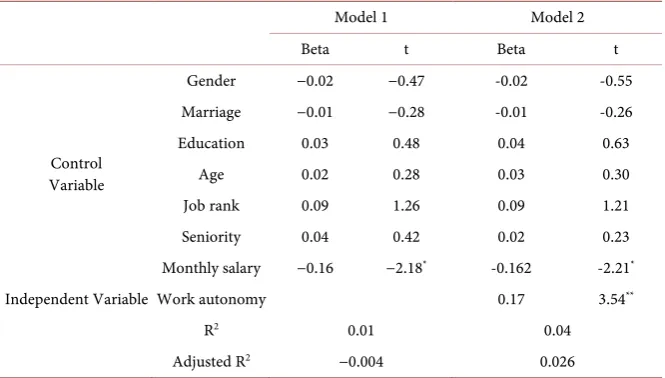
[image:4.595.203.541.634.670.2]According to the Table 3, work autonomy can positively predict public service
Table 1. Results of PSM Scale Model Fit.
Fit index χ2/df RMR NFI RFI IFI TLI CFI RMSEA Fit indices 6.54 0.05 0.82 0.75 0.84 0.78 0.84 0.11
Table 2. Results of Work Autonomy Scale Model Fit.
[image:4.595.206.541.704.736.2]Table 3. The Regression Analysis of Work Autonomy to Public Service Motivation.
Model 1 Model 2
Beta t Beta t
Control Variable
Gender −0.02 −0.47 -0.02 -0.55
Marriage −0.01 −0.28 -0.01 -0.26
Education 0.03 0.48 0.04 0.63
Age 0.02 0.28 0.03 0.30
Job rank 0.09 1.26 0.09 1.21
Seniority 0.04 0.42 0.02 0.23
Monthly salary −0.16 −2.18* -0.162 -2.21*
Independent Variable Work autonomy 0.17 3.54**
R2 0.01 0.04
Adjusted R2 −0.004 0.026
note: *p < 0.05; **p < 0.01 (two-tailed test).
motivation to a significant degree (β = 0.17, p < 0.001). That is to say, the higher work autonomy, the stronger public service motivation. So hypothesis can be ve-rified.
7. Discussion
This study finds that work autonomy can predict public service motivation posi-tively. That is to say, when the level of work autonomy is low, the level of public service motivation is low. When the level of work autonomy is high, the level of public service motivation is high. From practical perspectives, when public ser-vants are at high level of autonomy in their works, their motive to serve the pub-lic is strong. If at low level of autonomy, their motive is weak correspondingly. So if we want to improve the level of public service motivation of Chinese ser-vants, we should consider improving their work environment such as work au-tonomy. But in Chinese public services system, it is difficult to simply change the work autonomy due to the existing public service system. In the future, more study should be done to find how to improve public servants’ work autonomy level as well as not to break the previous rules and regulations.
8. Conclusion
According to the result, the data analysis outcome shows that work autonomy can predict public service motivation positively. We can improve public ser-vants’ public service motivation by providing more work autonomy. Although work autonomy is hard to change significantly in short time in Chinese govern-ment, it is still meaningful to find possible path and mechanism to improve pub-lic service motivation through variables related to autonomy.
9. Limitations and Future Research
variance in public service motivation, so work autonomy doesn’t have significant prediction of public service motivation. Public service motivation is an implicit variable and is probably influenced by other factors. In the future research, we expect to reveal more factors that can not only influence public service motiva-tion but also build in-depth models that involve mediate and moderate factors to study work autonomy and public service. For example, further studies can bring more behavioral variables or outcome variables, such as job crafting and job burnout.
References
[1] Ainey, H.G. (1982) Reward Preferences Among Public and Private Managers: In Search of the Service Ethic. American Review of Public Administration, 16, 288- 302. https://doi.org/10.1177/027507408201600402
[2] Perry, J.L. and Wise, L.R. (1990) The Motivational Bases of Public Service. Public Administration Review, 50, 367-373. https://doi.org/10.2307/976618
[3] Perry, J.L. (1996) Measuring Public Service Motivation: An Assessment of Con-struct Reliability and Validity. Journal of Public Administration Research & Theory, 6, 5-22. https://doi.org/10.1093/oxfordjournals.jpart.a024303
[4] Coursey, D.H. and Pandey, S.K. (2007) Public Service Motivation Measurement: Testing an Abridged Version of Perry’s Scale. Administration & Society, 39, 547- 568. https://doi.org/10.1177/0095399707303634
[5] Brewer, G.A., Selden, S.C. and Facer, R.L. (2000) Individual Conceptions of Public Service Motivation. Public Administration Review, 60, 254-264.
https://doi.org/10.1111/0033-3352.00085
[6] Kim, S. and Vandenabeele, W. (2010) A Strategy for Building Public Service Moti-vation Research Internationally. Public Administration Review, 70, 701-709. https://doi.org/10.1111/j.1540-6210.2010.02198.x
[7] Perry, J.L. (1997) Antecedents of Public Service Motivation. Journal of Public Ad-ministration Research & Theory, 7, 181-197.
https://doi.org/10.1093/oxfordjournals.jpart.a024345
[8] Perry, J.L. (2000) Bringing Society In: Toward a Theory of Public-Service Motiva-tion. Journal of Public Administration Research & Theory, 10, 471-488.
https://doi.org/10.1093/oxfordjournals.jpart.a024277
[9] Bandura, A. (1986) Social Foundation of Thought and Action: A Social Cognitive Theory. Journal of Applied Psychology, 56, 11-18.
[10] Moynihan, D.P. and Pandey, S.K. (2007) The Role of Organizations in Fostering Public Service Motivation. Public Administration Review, 67, 40-53.
https://doi.org/10.1111/j.1540-6210.2006.00695.x
[11] Ye, X. and Lai, G. (2011) Public Service Motivation: Measurement, Comparation and Influence—Based on the Analysis of the Questionnaire Survey on Samples from Fujian Province. Chinese Public Administration, No. 8, 107-111.
[12] Parker, S.K., Jackson, P.R. and Wall, T.D. (1993) Autonomous Group Working within Integrated Manufacturing: A Longitudinal Investigation of Employee Role Orientations. Human-Computer Interaction: Applications and Case Studies, Pro-ceedings of the Fifth International Conference on Human-Computer Interaction, DBLP, 44-49.
Review, 30, 810-811. https://doi.org/10.2307/2091181
[14] Hackman, J.R. and Oldham, G.R. (1976) Motivation through the Design of Work: Test of a Theory. Organizational Behavior and Human Performance, 16, 250-279. [15] Breaugh, J.A. (1985) The Measurement of Work Autonomy. Human Relations, 38,
551-570. https://doi.org/10.1177/001872678503800604
[16] Gagné, M. and Deci, E.L. (2005) Self-Determination Theory and Work Motivation. Journal of Organizational Behavior, 26, 331-362. https://doi.org/10.1002/job.322
Submit or recommend next manuscript to SCIRP and we will provide best service for you:
Accepting pre-submission inquiries through Email, Facebook, LinkedIn, Twitter, etc. A wide selection of journals (inclusive of 9 subjects, more than 200 journals)
Providing 24-hour high-quality service User-friendly online submission system Fair and swift peer-review system
Efficient typesetting and proofreading procedure
Display of the result of downloads and visits, as well as the number of cited articles Maximum dissemination of your research work