Munich Personal RePEc Archive
Serial default and debt renegotiation
Asonuma, Tamon
International Monetary Fund
2 April 2012
Online at
https://mpra.ub.uni-muenchen.de/55139/
Serial Default and Debt Renegotiation
Tamon Asonumay
International Monetary Fund
April 2, 2012
Abstract
Emerging countries that have defaulted on their debt repayment obligations in the past are
more likely to default again in the future than are non-defaulters even with the same
debt-to-GDP ratio. This paper explains this stylized fact within a dynamic stochastic general equilibrium
framework by explicitly modeling renegotiations between a defaulting country and its creditors.
The quantitative analysis of the model reveals that the equilibrium probability of default for a
given debt-to-GDP level is weakly increasing with the number of past defaults, consistent with
empirical observations. The equilibrium of the model also accords with an additional observed
fact: a country for which default terms require less than a 100 percent recovery rate tends to pay
a higher rate of return (relative to a risk-free rate) on subsequently issued debt than do defaulting
countries that agree to a full recovery rate.
JEL Classi…cation Codes: E43; F32; F34; G12
Key words: Serial default; Debt renegotiation; Past credit history; Recovery rates; Interest
spreads
I am indebted to Marianne Baxter, Francois Gourio, Laurence Kotliko¤ and Adrien Verdelhan for guidance and support. I am also grateful to Christoph Trebesch for kindly providing the data. I thank Jochen Andritzky, Ran Bi, Charles Blitzer, Marcos Chamon, Bertrand C. Gruss, Juan Carlos Hatchondo, Allison Holland, Cosmin Ilut, Jun Il Kim, Hanno Lustig, Stephen Morris, Romain Ranciere, Guillem Riambau, Leena Rudanko, Georg Strasser, Cedric Tille, Christoph Trebesch, Siew Ling Yew, Vivian Yue and Mark Wright for useful comments and suggestions as well as seminar participants at the IMF RES, INS, AFR, the 2009 Midwest Theory, the 2009 Midwest Macroeconomic Meeting, the 2009 North American Summer Meeting of Econometric Society, the 2009 European Economic Association, the 2010 American Economic Association, the 2010 Society of Economic Dynamics, Modeling Economic Dynamics, BC-BU Green Line Macro Meeting, Berlin Conference on Sovereign Debt, Boston U., GRIPS, Keio U., Osaka U., Banco de Espana, Durham Business School, Birmingham Business School, Bank of Japan, Halle Economic Research Institute, Geneva Graduate Institute, Dutch Central Bank, CERDI, and LUISS. Additional thanks go to Andrew Ellis and Jeremy Smith for editorial suggestions and Brian Moon for research assistance. An early version of this paper has been circulated with the title "Sovereign default and renegotiation: recovery rates, interest spreads and credit history". All remaining errors are my own. Any views expressed in this paper are those of the author and do not re‡ect any views of the International Monetary Fund.
1
Introduction
Emerging countries that have defaulted on their debt repayment obligations in the past are more likely
to default again in the future than are non-defaulters with the same debt-to-GDP ratio. This paper
explains this stylized fact within a dynamic stochastic general equilibrium framework that explicitly
models renegotiations between a defaulting country and its creditors. Speci…cally, the model extends
the existing literature by allowing the defaulter and creditors to bargain not just over recovery rates,
but also over the rate of return o¤ered on newly-issued debt. Quantitative analysis of the model
reveals that the equilibrium probability of default for a given debt-to-GDP level is weakly increasing
with the number of past defaults, consistent with empirical observations. The equilibrium of the
model also accords with an additional observed trend: a country for which default terms require less
than a 100 percent recovery rate tend to pay a higher rate of return (relative to a risk-free rate) on
debt that is issued subsequently than do defaulting countries that agree to a full recovery rate. These
…ndings are robust to extensions that allow the renegotiation outcome to be modeled more ‡exibly.
This paper deals with endogenous debt renegotiation after default in a standard dynamic model of
defaultable debt. The renegotiation process involves Nash bargaining between the defaulting debtor
and creditors over both the recovery rate and increases in rates of return on new debt. Evidence
suggests that the spread between the rate of return on new debt and the risk-free rate increases after
default more for defaulters that pay less than a full recovery rate than for defaulters that agree to repay
all of the defaulted debt (i.e. a 100 percent recovery rate). Thus, it appears that, at least implicitly,
a country that defaults negotiates with its creditors both over recovery rates and over future rates
of return. This re‡ects a trade-o¤ for defaulting country: the defaulted debt can be repaid in the
present at a high short-run cost in return for only a small or even negligible deterioration in long-term
credit condition; or the short-run bene…t of repaying the debt only partially will be o¤set by having
to pay lenders a higher rate of return on future issuances. The trade-o¤ for creditors is symmetric: if
they are not appeased by a full recovery of funds in the short term, they can attempt to recoup their
losses by demanding higher rates of return for holding the country’s bonds in the future.
The present paper seeks to incorporate these trade-o¤s facing the debtor and creditors during
renegotiations following defaults. In the model, the endogenously-determined terms of renegotiations
increases in yield spreads. An emerging country that defaults once therefore pays a penalty either
through a large recovery rate in the short term or through higher borrowing costs in the long term.
If it chooses to repay less than full recovery rates, it will face high borrowing costs, which lead
to increase the risks that the country will default again in the future. This mechanism drives the
equilibrium serial default behavior in the model, and it is a plausible explanation of the pattern of
repeat defaults observed in the data. Hence, the model is able to jointly explain both stylized facts
of debt renegotiations and repeat defaults.
We embed the debt renegotiation in a dynamic sovereign debt model with endogenous defaults
where an emerging country is subject to exogenous income shocks. This part of the model builds on
recent quantitative analysis of sovereign debt such as Aguiar and Gopinath (2006), Arellano (2008)
and Tomz and Wright (2007) which are based on classical setup of Eaton and Gersovitz (1981). At the
renegotiation, creditors and defaulting country bargain over increases in rate of return on new debt
together with recovery rates. Outcomes of the renegotiation represent trade-o¤s of both defaulting
country and creditors, as indicated above. Total spread between the rate of return on new debt and
the risk-free rate, incorporates not only the probability of future default but also impacts on increases
in rate of return on new debt agreed at the past renegotiations.
Our paper is most closely related with Yue (2010), in which a dynamic model of defaultable debt
is argumented with an endogenous treatment of debt renegotiation after default. Our model di¤ers
from her model in that we incorporate the e¤ects of increases in rate of return on new debt. At the
renegotiation, both parties bargain not only over recovery rates, but also over increases in rate of
return on new debt. Therefore, its credit condition, i.e. borrowing cost of the country after re-entry to
the market, depends on how much the country pays at the debt renegotiation. Increase in borrowing
costs accompanied by repaying the debt only partially will lead to increase future default probability.
In special case where the country always repays in full the level of defaulted debt, increases in rate
of return on new debt will be close to zero. As impacts of additional default premia are totally
negligible, results will be quite similar to ones in Yue (2010).
The rest of the paper is organized as follows. Section 2 reviews two strands of literature. Section
3 overviews stylized facts of debt negotiations and serial defaults. We provide our stochastic dynamic
general equilibrium model in Section 4. We de…ne recursive equilibrium of the model in Section
Section 7. A short conclusion summarizes the discussion. The computation algorithm is provided in
Appendix A.
2
Literature Review
This paper is related to the literature of serial default. Reinhart, Rogo¤ and Savastano (2003) and
Reinhart and Rogo¤ (2005) both advocate the role of past credit history in debt intolerance. On
con-trary, Eichengreen, Hausmann, and Panizza (2003) show that countries with "original sin", inability
to issue bonds in their domestic currencies, must pay an additional risk premium when they borrow,
increasing their solvency risks since the …nancial market knows this inability is a source of …nancial
fragility. However, none provides economic models describing how weak credit history or "original
sin" features are associated with serial defaults. With stochastic dynamic model, Kovrijnykh and
Szentes (2007) explain the equilibrium default cycles, but they do not derive any relation between
de-fault occurrences and outcomes of negotiations. This paper improves these papers by explaining how
outcomes of current debt renegotiation, such as additional spread premia, lead to higher probability
of next default in future.
The other strand of literature models the sovereign default and renegotiation as a game between
a sovereign debtor and its creditors.1 Yue (2010) treats debt renegotiation process using a
one-round Nash bargaining game. Moreover, Bai and Zhang (2010), Benjamin and Wright (2009) and Bi
(2008) presume a multi-round bargaining to analyze delay in renegotiation. Benjamin and Wright
(2009) assume that debtor and representative creditor randomly alternate in their ability to propose
a bargaining outcome with changes in the probability of making future proposals serving to capture
changes in bargaining power, while Bi (2008) supposes that lenders have an option to "pass" proposing
to the debtor. Bai and Zhang (2010) focus on the role of information friction which generates the
delay. Furthermore, Pitchford and Wright (2007) regard multi-creditor renegotiation process as a
series of bilateral bargaining games to explain delays in renegotiation. Similarly, Kovrijnykh and
Szentes (2007) also study multi-creditor renegotiation and makes the time of exclusion from the
…nancial market endogenously and potentially long. Our paper di¤ers from this literature in that
1Our borrowing environment, besides the debt renegotiation, is a version of the Eaton and Gersovitz (1981) model of
we concentrate on the observed pattern that lower recovery rates at the renegotiation are highly
associated with larger increases in yield spreads.2
Lastly, our empirical …nding is linked to studies analyzing the impacts of past defaults on future
spreads. Ozler (1993) …nds that past defaulters had to pay a premium on the interest rate for the
sovereign debt issued in the 1970s and defaults previous to 1930 did not a¤ect the premium paid but
defaults after that did a¤ect it. In a similar context, Ozler (1992) empirically shows that borrower’s
repeated experience in the market contributes signi…cantly to the variation of spreads. Cantor and
Packer also con…rm that sovereign yields tend to rise as sovereign has a bad default history.3 On
the contrary, Lindert and Morton (1989) focusing on borrowing experience in late 1970s, …nd no
evidence that defaulters were punished by creditors through higher interest rates on new loans. What
is distinctive in our paper relative to previous work is that we analyze the deterioration of long-term
borrowing in the short window after the renegotiations on bonds during 1986-2007 and how it di¤ers
in terms of agreed recovery rates.
3
Stylized facts
Evidence of serial defaults re‡ects that past defaulters are more likely to default in the future than
are non-defaulters given the debt-to-GDP ratio. Moreover, from recent debt renegotiation episodes,
we observe that lower recovery rates at the renegotiation are highly associated with larger increases
in yield spreads between the rate of return on new debt and the risk-free rate.
3.1 Evidence on serial defaults
In this subsection, we cover stylized facts of serial defaults, especially some features di¤ering by
countries’ history of defaults.
2We assume that debt renegotiation takes place only once for each default.
3Trebesch (2009) indicates that unilateral, aggressive sovereign debt policies lead to a stronger decline in corporate
Figure 1: External debt/GDP, bond spreads, and credit ratings, average 2005-2010
Source: Bloomberg, Datastream, De Paoli, Hoggarth and Saporta (2006), Haver, IMF WB
Quarterly External Debt Statistics, IMF World Economic Outlook and Moody’s.
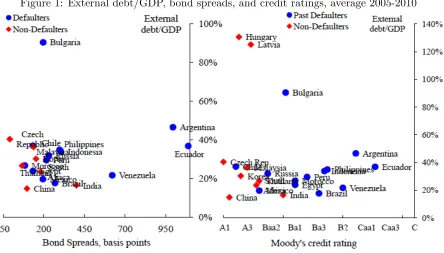
Figure 1 reports external debt-to-GDP ratio, bond spreads and credit ratings. Bond spreads
of past defaulters are higher than those of non-defaulters given external debt-to-GDP ratio. Past
defaulters tend to su¤er higher spreads on the newly issued bonds in the future after default, even
if they have the same level of foreign debt relative to GDP as before. Similarly, past defaulters have
lower credit ratings than non-defaulters, re‡ecting higher default probability.
Moreover, Reinhart, Rogo¤ and Savastano (2003) show that countries with a weak credit history
may become more vulnerable even at much lower levels of external debt, relative to countries with a
sound credit history. Table 1 illustrates predicted Institutional Investor ratings and debt intolerance
regions for Argentina and Malaysia.4
[Insert Table 1 here]
4In order to address this point, Reinhart, Rogo¤ and Savastano (2003) use the estimated coe¢cients from the
It is apparent that precarious debt intolerance situation of Argentina is more severe than one
of Malaysia.5 Since Argentina is representative of many countries with a weak credit history and
Malaysia is representative of countries with a sound credit history, this result re‡ects that the debt
thresholds of countries with a weak credit history are lower than that of countries with a sound credit
history. In other words, the default probability of countries with a weak credit history is higher than
one of countries with a sound credit history, given the same level of debt-to-GNP.
In addition, Reinhart, Rogo¤ and Savastano (2003) report that defaulters repeat defaults or
restructurings in short periods: emerging countries with at least one external default or restructuring
since 1824, have experienced 5.2 defaults or restructurings in average as shown in Table 2.
[Insert Table 2 here]
3.2 Recent sovereign debt renegotiations
We start with an overview of recent debt renegotiation episodes. Table 3 summarizes 15 cases of
expost-default and preemptive restructurings in the ten years from 1998 to 2007.6 We present default
year, defaulted debts, recovery rates, and increases in interest spreads for each episode. One feature
which stands out is that recovery rates vary depending on the cases.
[Insert Table 3 here]
Furthermore, Figure 2 displays recovery rates and increases in spreads for 35 sovereign debt
renegotiation episodes during 1986-2007.78
5Argentina only remains in the relatively safe "region 1" as long as its external debt is below 15 percent of GNP,
whereas Malaysia stays in "region1" up to a debt-to-GNP ratio of 30 percent, and it is still in the relatively safe "region
2" with a debt of 35 percent of GNP.
6We exclude the cases of swap agreements and delay in payment such as Venezuela in 1995, 1998 and 2005, Peru in
2000 and Paraguay in 2003.
7For 6 cases such as Argentina 2001, Ecuador 1999, Pakistan, Russia 1998, Ukraine 1998, Uruguay 2003, we use
recovery rates in Sturzenegger and Zettlemeyer (2008). Recovery rates for Grenada, Dominican Rep.2005 and Belize are from Bedford, Penalver and Salmon (2005). The remaining cases are based on Benjamin and Wright (2009).
8Sturzenegger and Zettelmeyer (2006, 2008) de…ne recovery rates as the market value of the new instruments, plus
Figure 2: Recovery rates and increases in spreads for recent debt renegotiations
Source: Bedford, Penalver and Salmon (2005), Benjamin and Wright (2009), Datastream, and Sturzenegger
and Zettelmeyer (2006 and 2008)
We focus only on expost-default and preemptive renegotiation episodes in the sample periods,
and we exclude examples of delays in payment such as Paraguay in 2003, and Venezuela in 1995,
1998, 2005, and swap agreement for Peru in 2000. We de…ne "increase in spreads" as the di¤erence
in spreads between the time of renegotiation and one year before the renegotiation.910 The …tted
line is obtained by regressing recovery rates on increases in spreads controlling for actual detrended
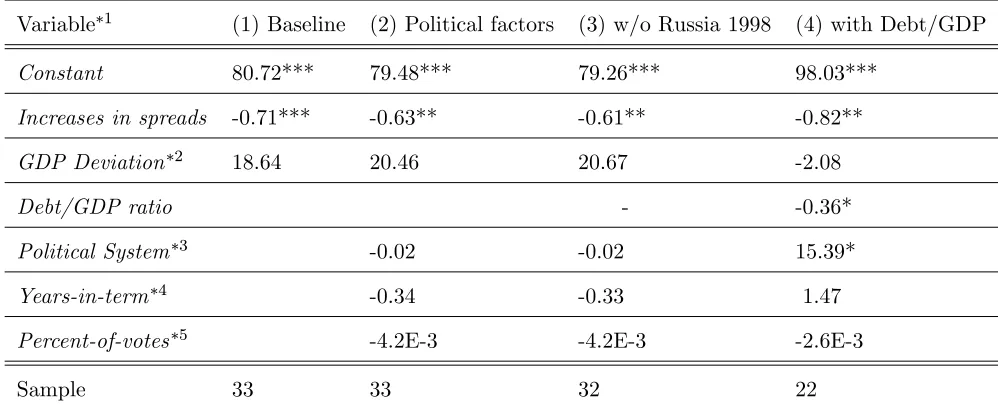
GDP and political indicators as indicated in the third column of Table 4. This negative relationship
is robust even controlling for debt/GDP ratio and omitting an outlier case of Russia 1998 shown
9The bond spreads data are from the J.P. Morgan’s Emerging Markets Bond Index Global (EMBIG) data for
respective countries. Included in the EMBI Global are U.S.-dollar-denominated Brady bonds, Eurobonds, traded loans, and local market debt instruments issued by sovereign and quasi-sovereign entities. The spreads are computed as an arithmetic, market capitalization-weighte average of bond spreads over U.S. treasury bonds of comparable duration.
1 0According to J.P. Morgan (1999), a new issue that meets the EMBI Global’s admission requirements is added to the
in the fourth and …fth columns respectively.11 These results re‡ect that lower recovery rates at the
renegotiation are associated with larger increases in yield spreads between the rates of return on new
debt and the risk-free rate. This presents a trade-o¤ for defaulting countries; if the countries recover
a larger fraction of debt at the renegotiations, long-term borrowing costs will be smaller. At the same
time, we can interpret it as a trade-o¤ of creditors. If the creditors receive payments for only a small
fraction of defaulted debt, they can recoup their losses by demanding higher rates of return for the
[image:10.612.64.563.248.452.2]newly issued bonds.
Table 4: Regression results
Variable 1 (1) Baseline (2) Political factors (3) w/o Russia 1998 (4) with Debt/GDP
Constant 80.72*** 79.48*** 79.26*** 98.03***
Increases in spreads -0.71*** -0.63** -0.61** -0.82**
GDP Deviation 2 18.64 20.46 20.67 -2.08
Debt/GDP ratio - -0.36*
Political System 3 -0.02 -0.02 15.39*
Years-in-term 4 -0.34 -0.33 1.47
Percent-of-votes 5 -4.2E-3 -4.2E-3 -2.6E-3
Sample 33 33 32 22
Source: Bedford, Penalver and Salmon (2005), Benjamin and Wright (2009), Datastream, Sturzenegger and
Zettelmeyer (2006 and 2008), Reinhart and Rogo¤ (2010), and World Bank The Database for Political
Institutions (PDI). Note: Standard errors are in parentheses. ***, **, * show signi…cance at 1, 5, and 10
percent levels respectively. 1: All regression results are based on least square estimations. 2: GDP deviation
from the trend is a percentage deviation from the trend obtained by applying the Hodrick-Prescott (H-P)
…lter. 3: "Political system" indicator is di¤erenciated by parliamentary, assembly-elected president, and
presidential ststems. 4: "Years-in-term" indicator de…nes years left in current term. 5: "Percent-of-votes"
indicator speci…es percentages of votes the current president got in the 1st round of election.
1 1When we de…ne "increase in spreads" for 2-year window, such as the di¤erence between one year before and after
4
Model environment
The basic structure of the model follows previous work that extends the model of sovereign default
by Eaton and Gersovitz (1981) and applies its quantitative analysis. Among these studies, the closest
reference to our paper is Yue (2010). The distinctive feature in our model with respect to her model
is that we introduce e¤ects of increases in rate of return on new debt after the re-entry to the market.
Since both recovery rates and increases in rate of return on new debt are determined endogenously,
how much the country pays at the renegotiation will a¤ect its credit condition in the future, i.e.
borrowing costs of the country after re-entry to the market, which will have impacts on default
probability.12
4.1 General points
The model analyzes sovereign default and negotiation in a stochastic dynamic equilibrium model. We
consider a risk-averse country that can’t a¤ect world risk-free interest rate. The country’s preference
is given by following utility function:
E0 1 X
t=0
tu(c t)
where 0 < <1 is a discount factor, ct denotes consumption in period t, and u(:) is its one-period
utility function, which is continuous, strictly increasing and strictly concave and satis…es the Inada
conditions. A discount factor re‡ects both pure time preference and probability that the current
sovereignty will survive into next period.
In each period, the country starts with its credit history ht, which satis…es ht 2 H where
H = [0;1;2; :::; hmax]. The credit history expresses number of debt renegotiations the country has
experienced in the past.13 The reason why we assume multi-state credit history rather than
two-state credit history as in Yue (2010) is to analyze how the outcomes of past debt renegotiations
associated with defaults a¤ect the probability of next default. Moreover, we assume that the credit
1 2On contrary, Yue (2010) has not taken into account impacts of increases in rate of return on new debt. In her model,
both parties negotiate over only recovery rate after default. The reason why e¤ects of increases in rate of return on new debt are missing in her model is that the country’s credit condition will always return to the same level irrelevant to recovery rate which is determined at the renegotiation.
1 3The model simply distinguishes h
t = 0 andht >0 as the non-default history and defaulting history, not as the
history reverts with exogenous probability conditional on that the country chooses to pay the spread
returns after defaults.14
The country receives an exogenous income shockyt. Income shock (yt) is stochastic, drawn from
a compact set Y = [ymin; ymax] R+. (yt+1jyt) is the probability distribution of a shock yt+1
conditional on previous realization yt.
There is an in…nite number of investors who are risk-neutral and behave competitively in the
international capital market. They have perfect information on the country’s assets, credit history,
income shocks and additional spread premia agreed to at previous debt renegotiation. We also
assume that they can borrow or lend as much as needed at a constant risk-free interest rate (r) in the
market. Since they are symmetric and similarly ranked, we can interpret them as "a representative
investor" lending money to the country. The country borrows the money from the same representative
investor though bond exchanges even after it defaults.15 As investors are able to collude at the debt
renegotaition, "a representative investor" has a bargaining power at the renegotiation in order to
impose higher spreads on future bonds, though its bargaining power is low compared to that of
country.16 Moreover, we assume that all the investors behave in the same manner: they all lend the
money to the country every time the country issues bonds, and there is no sub-group of investors
who behave di¤erently from the majority of investors such as they still lend money to the country
even if the country defaults and refuse to negotiate with the majority of investors.17
The international capital market is incomplete. The country and foreign investors can borrow
and lend only via one-period zero-coupon bonds where bt+1 denotes amount of bonds to be repaid
next period. When the country purchases bonds, bt+1 >0, and when it issues new bonds, bt+1 <0.
1 4Following the consumer defaults as in Chatterjee et al (2007), we assume that the record of the recent default
remains on the country’s credit history for only a …nite number of years.
1 5The country negotiates wtih the creditors who hold its debts and the creditors receive the recovered debts as in
current model. Thus, it is true that the country borrows again from the same creditors. While in the reality, there exists the secondary markets where the creditors can sell and purchase the exchanged bonds, the current model abstracts this feature.
1 6In usual debt restructurings, the bond holders organize a committee, which conduct research on the soverign and
consolidate creditors’ view to faciliate the discussion. Given the restructuring plan proposed by the soverign, all creditors vote on it. If a critical mass of the creditor approve, the proposal is passed and …nalized. Otherwise, the government has to revise the proposal until it passes. In order to smooth the renegotiation, the committee plays an important role to re‡ect the creditors’ view on the sovereign’s proposal. Thus, it is identical to say that a committee has a barganing power, but it is relatively low as the committee has a di¢culity to consolidate views across investors. Rie¤el (2003) provides description of sovereign debt renegotiation.
1 7It is true that the current model abstracts elements of entry of new creditors and existance of secondary markets.
The set of amount of bonds is B = [bmin; bmax] R wherebmin 0 bmax. The upper bound is the
highest level of assets that the country can accumulate and the lower bound is the highest level of
debts that the country can hold. We assumeq(bt+1; ht; yt) is the price of a bond with asset position
(bt+1), credit history (ht), and income level (yt). The bond price will be determined in equilibrium.
We assume that foreign investors always commit to repay their debt. However, the country is
free to decide whether to repay its debt or to default. If the country chooses to repay its debt, it will
preserve access to the international capital market next period.
If the country chooses not to pay its debt, it is subject to both exclusion from the international
capital markets and direct output cost.1819 When a default occurs, the country and foreign investors
negotiate reduction of unpaid debt via Nash bargaining. At the renegotiation, both recovery rates
and additional spread premia on the newly issued bonds are agreed to by both parties.20 The country
regains access to the market after excluded from the market a short period, but the country’s credit
history records the current debt renegotiation.21 In order to avoid permanent exclusion from the
international capital market, the country has an incentive to negotiate over haircut rates (recovery
rates) and additional default premia. From foreign investors’ point of view, Foreign investors want to
maximize the payment from recovered debt and spread returns on newly issued bonds after default,
so they are also willing to negotiate over reduction of unpaid debt.
All the information on the country’s asset, credit history, and income realization is perfect.22
4.2 Timing of the model
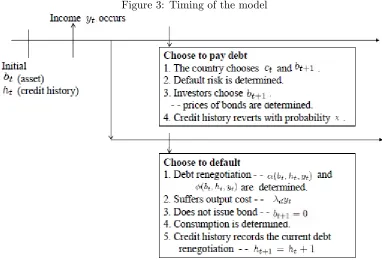
Timing of decisions within each period is summarized in Figure 3.
1 8There are several estimates for output loss at the time of default. Sturzeneger (2002) esimates output loss as around
2% of GDP. On contrary, De Paoli, Hoggarth, and Saporta (2006) suggest that the output loss in the wake of sovereign default apprears to be very large - around 7% a year on the median measure - as well as long lasting.
1 9Mendoza and Yue (2011) explain that output cost associated sovereign default is e¢ciency loss of production through
two channels: ine¢cient production using domestic inputs which are imperfect substitutable with imported inputs, and labor reallocation away from …nal good production.
2 0After the bond exchanges are annouced, the creditors at the market price the yields and spreads of exchanged
bonds depending on recovered level of bonds. At each round of debt renegotaitions, both parties take into account the possible impacts of spreads depending on proposed recovery rates. Thus, it is identical to say that both recovery rates and increases in spreads are determined by both parties at the renegotaition.
2 1In our model, the period of exclusion from the market is …xed as in Yue (2010). Bi (2008) and Benjamin and Wright
(2009) replicate the endogenous periods of exclusion from the market by assuming multi-round renegotaitions.
2 2Alfaro and Kanczuk (2005) and D’Erasmo (2011) develop a model of sovereign debt with heterogenous governments
Figure 3: Timing of the model
The country starts the current period with initial asset position (bt) and credit history (ht). After
observing the current income shock (yt), the country chooses either to pay the debt or to default. If
the country decides to pay the debt, given the bond price schedule, the country chooses next period
assets (bt+1) and consumption (ct). Then the default probability and price of bond are determined
by the market equilibrium. Given the price of bonds, foreign investors choose bt+1 consistent with
belief of default probability. Its credit history will be upgraded with exogenous probability .
If the country chooses to default, the country and foreign investors negotiate a debt reduction.
Both recovery rates (bt; ht; yt), and additional spread premia (bt; ht; yt) are agreed to by both
sides. After negotiation, the country pays the recovered debt (bt; ht; yt)btand su¤ers direct output
cost due to default, dyt. The country can not raise funds in the international capital market this
period (bt+1 = 0), but will regain access to the market next period. The consumption level is
ct= (1 d)yt+ (bt; ht; yt)bt. The country’s credit history records the current debt renegotiation
ht+1=ht+ 1.
5
Recursive Equilibrium
5.1 Sovereign country’s problem
The country’s problem is to maximize its expected lifetime utility. The country makes its default
decision and determines its assets for next period (bt+1), given its current asset position (bt), credit
history (ht), and income shock (yt). Let V(bt; ht; yt) be one value function of the country that starts
the current period with initial asset (bt), credit history (ht), and income (yt).
Given with the bond market price q(bt+1; ht; yt), debt recovery rates (bt; ht; yt), and additional
spread premia (bt; ht; yt), the country solves its optimization problem. We assume both the debt
recovery rates and additional spread premia determined at current debt negotiation depend on these
state variables.
For simplicity, we consider the problem with ht = 0, indicating that the country has never
experienced the debt renegotiation in the past. Later, we consider the problem with general cases
ht 1.
Forbt 0(ht= 0), the country has savings. The country receives payments from foreign investors
and determines its next-period asset position bt+1 and its consumption ct to maximize utility, given
the price of bond q(bt+1;0; yt). Thus the value function is
V(bt;0; yt) = max ct;bt+1
u(ct) + Z
Y
V(bt+1;0; yt+1)d (yt+1;yt) (1)
s:t: ct+q(bt+1;0; yt)bt+1 =yt+bt
Forbt<0(ht= 0), the country has the debt. If the country decides to pay its debt, it chooses its
next-period asset positionbt+1 and consumptionct. On contrary, if the country chooses to default, it
become …nancial autarky for this period and its credit history deteriorates to ht+1 = 1 next period.
Due to agreement in debt renegotiation, the country must pay (bt;0; yt)bt in current period, and
it regains access to the international capital market next period with history ht+1 = 1. With credit
history ht+1 = 1, when the country issues new bonds, it must pay interests on newly issued bonds
equal to the sum of the risk-free rate (r) and the spread premia agreed at the last renegotiation
Given the option to default,V(bt;0; yt) satis…es
V(bt;0; yt) = max VR(bt;0; yt); VD(bt;0; yt; (bt;0; yt); (bt;0; yt)) (2)
where VR(bt;0; yt) is the value associated with paying debt:
VR(bt;0; yt) = max ct;bt+1
u(ct) + Z
Y
V(bt+1;0; yt+1)d (yt+1;yt) (3)
s:t: ct+q(bt+1;0; yt)bt+1 =yt+bt
and VD(b
t;0; yt; (bt;0; yt); (bt;1; yt))is the value associated with default given with debt recovery
schedule (bt;0; yt), and additional spread premia (bt;1; yt)which will be determined at renegotiation
after current default.
VD(bt;0; yt; (bt;0; yt); (bt;1; yt)) =u((1 d)yt+ (bt;0; yt)bt)+ Z
Y
V(0;1; yt+1)d (yt+1; yt) (4)
whereV(0;1; yt+1)is value function next period with credit historyht+1= 1de…ned below in general
cases withht 1and (bt;0; yt)btis the amount of defaulted debt which the country repays at the
debt negotiation and dyt denotes output costs which the country su¤ers due to defaults.
Next we consider the problem withht 1expressing that the country has experienced the debt
renegotiation at least once in the past.
Forbt 0(ht 1), the country has savings. The country receives payments from foreign investors
and determines its next-period asset position (bt) and its consumption (ct) to maximize utility. Thus
the value function is
V(bt; ht; yt) = max ct;bt+1
u(ct) + Z
Y
V(bt+1; ht; yt+1)d (yt+1;yt) (5)
s:t: ct+q(bt+1; ht; yt)bt+1 =yt+bt
Note that credit history remains unchanged in next period ht+1 =ht.
For bt<0 (ht 1), the country has the debt. The country can borrow money from the foreign
spread premia (bt; ht; yt) which was agreed to by both the country and foreign investors at the time
of previous debt renegotiations. Thus, the price of bonds q(bt+1; ht; yt)is di¤erent from the one with
history ht = 0, de…ned as q(bt+1;0; yt), as it incorporates the e¤ects of additional default premia
associated with deteriorated credit history. As in the case of history ht = 0, the country chooses
either to pay the debt or to default. The values are as before:
V(bt; ht; yt) = max VR(bt; ht; yt); VD(bt; ht; yt; (bt; ht; yt); (bt; ht+ 1; yt)) (6)
where VR(b
t; ht; yt) is the value associated with paying debt with historyht 1,
VR(bt; ht; yt) = max ct;bt+1
u(ct) + 2 6 6 6 6 4 (1 ) Z Y
V(bt+1; ht; yt+1)d (yt+1;yt)
+
Z
Y
V(bt+1; ht 1; yt+1)d (yt+1;yt) 3 7 7 7 7 5 (7)
s:t: ct+q(bt+1; ht; yt)bt+1 =yt+bt
Note that with exogenous probability , the country’s credit history next period will revert due to
limited memory of the investors as ht+1 =ht 1. Otherwise, it remains constant asht+1=ht.
VD(b
t; ht; yt; (bt; ht; yt); (bt; ht + 1; yt)) is the value associated with default given with debt
recovery schedule (bt; ht; yt), and additional spread premia agreed after current default (bt; ht+1; yt)
which are de…ned below:
VD(bt; ht; yt; (bt; ht; yt); (bt; ht+ 1; yt)) =u((1 d)yt+ (bt; ht; yt)bt)+ Z
Y
V (0; ht+ 1; yt+1)d (yt+1; yt)
(8)
where V(0; ht + 1; yt+1) is the value function next period with credit history ht+1 = ht+ 1 and
(bt; ht; yt)btis amount of defaulted debt which the country recovers after negotiation.
Every time (at periodt) the country defaults, its credit history records the current debt
renego-tiation ht+1 =ht+ 1. Thus, the credit condition, i.e. borrowing costs of the country after re-entry
to the market depends on how much the country pays at the renegotiation. When the country issues
new bonds after it defaults, it must pay returns based on the risk-free rate and the sum of additional
The country’s default policy can be characterized by default setsD(bt; ht) Y, de…ned as the set
of income shock y’s for which default is optimal given the debt positionbt, and credit historyht.
D(bt; ht) = yt2Y :VR(bt; ht; yt)< VD(bt; ht; yt; (bt; ht; yt); (bt; ht+ 1; yt)) (9)
Furthermore, we de…ne an indicator of non-defaulting given initial asset position (bt<0), credit
history (ht), and income level (yt) as follows;
I(bt; ht; yt) =
1 if yt2=D(bt; ht)
0 if yt2D(bt; ht)
Finally, based on the policy function of asset position derived above (bt+1(bt; ht; yt)) and
non-defaulting indicatorI(bt; ht; yt), we de…ne discounted value of expected amount of debt which will be
paid to investors next period as:
P(bt; ht; yt) =
1 1 +r
Z
Y
I(bt+1(bt; ht; yt); ht; yt+1)bt+1(bt; ht; yt)d (yt+1; yt) (10)
Note that we use the discount factor for foreign investors (1+1r), not the discount factor for the country
( ).
5.2 Debt renegotiation problem
The debt renegotiation takes a form of generalized Nash bargaining game. Not only the recovery rate,
but also additional spread premia are agreed to by both parties. This is because foreign investors
will obtain interest returns every time the country issues new bonds after current default as long as
the country does not default again. From the country’s perspective, it has to pay interests on bonds
every time it issues new bonds after renegotiation, unless it chooses to remain in the …nancial autarky
permanently.
After debt renegotiation, the country pays a fraction (bt; ht; yt) of defaulted debt. The value of
the country after the renegotiation is de…ned above;
VD(bt; ht; yt; (bt; ht; yt); (bt; ht+ 1; yt)) =u((1 d)yt+ (bt; ht; yt)bt)+ Z
Y
Needless to say, this value takes into account the impact of both debt reduction to (bt; ht; yt)bt,
and additional spread premia (bt; ht+ 1; yt) which will be agreed at current debt negotiation.
Foreign investors obtain the present value of the reduced debt (bt; ht; yt)bt and interests on
newly issued bonds after debt negotiation. The present value of expected payment of bonds which
investors receive in the future after the country’s re-entry to the market, can be de…ned in the following
recursive form:
R(bt; ht; yt) =P(bt; ht; yt) +
1 1 +r
Z
Y
R(bt+1; ht; yt+1)d (yt+1; yt) (11)
s:t: bt+1=bt+1(bt; ht; yt);
where P(bt; ht; yt) is the discounted value of expected amount of bonds which are returned in next
period de…ned in equation (10) and bt+1(bt; ht; yt) is policy function of the country if it chooses not
to default (ht+i=ht).
We assume that debt negotiation takes place only once for each default event. The threat point
of the bargaining game is that the country stays in permanent autarky and the foreign investors get
nothing. Moreover, we assume that impose direct sanctions syton the country, which is in addition
to the defaulting country’s direct output cost dyt if the country chooses not to negotiate. The
expected value of autarky for the country, VAU T(y
t) is given by following expression;
VAU T(yt) =u((1 s d)yt) + Z
Y
VAU T(yt+1)d (yt+1;yt) (12)
We consider one-round bargaining since one-round bargaining keeps the model tractable as there is
no need to consider multiple rounds of bargaining or the debt arrears based on di¤erent reduction
schedules.23
For any debt recovery rate at and additional spread premia spt, we denote the country’s surplus
2 3Bi (2008) and Benjamin and Wright (2009) analyze multi-round bargaining to consider delay in renegotiation. Based
in Nash bargaining by B(at; spt;bt; ht; yt), which is the di¤erence between the value of accepting
a proposal of debt recovery rate at and additional spread premia spt, and the value of rejecting it,
given the country’s debt level (bt), credit history (ht), and income level (yt):
B(a
t; spt;bt; ht; yt) =VD(bt; ht; yt; (bt; ht; yt); (bt; ht+ 1; yt)) VAU T(yt) (13)
The surplus to the country comes from two sources. First, the country will be able to issue bonds
again from the following period, though its credit history deteriorates. Also, the direct cost to output
is smaller under renegotiations because no sanctions are imposed.
On contrary, the surplus to investors is the present value of the sum of recovered debt and interest
returns on newly issued bonds after renegotiation:
L(a
t; spt;bt; ht; yt) = atbt sptR(bt; ht+ 1; yt) (14)
where interest returns are evaluated with expected payment incorporating the future default choices
of the country as in equation (11).
We assume that the country has a bargaining power and foreign investors have a bargaining
power (1 ). A bargaining power parameter summarizes the institutional arrangement of debt
negotiation. To ensure that the bargaining problem is well de…ned, we de…ne the bargaining power
set [0;1]such that for 2 the negotiation surplus has a unique optimum for any asset position
(bt<0) , its history (ht), income level (yt).
Given the country’s asset level (bt < 0), its credit history (ht), and income level (yt), recovery
rates (bt; ht; yt)and additional spread premia (bt; ht+ 1; yt)solve the following bargaining problem:
(bt; ht; yt)
(bt; ht+ 1; yt)
= arg max
at;spt h
B(a
t; spt;bt; ht; yt) L(at; spt;bt; ht; yt) 1 i
(15)
s:t: B(at; spt;bt; ht; yt) 0
s:t: L(at; spt;bt; ht; yt) 0
btandyt.24 Since the set of both debt recovery schedule and additional spread premia that maximize
total negotiation surplus conditional on the country’s asset level, credit history, and income level,
negotiation outcome provides better insurance to the country in the case of default.
5.3 Foreign investors’ problem
For the cases withht 1, our derived bond price incorporates the e¤ects of additional spread premia
agreed at previous debt renegotiations, which are the new elements in our model. First we consider
foreign investors’ problem given the country’s credit history ht= 0.
With the country’s credit historyht= 0, taking the bond price function as given, foreign investors
choose the amount of asset (bt+1) that maximizes their expected pro…t (bt+1;0; yt), given by
(bt+1;0; yt) =
q(bt+1;0; yt)bt+1 1+1rbt+1 if bt+1 0
[1 p(bt+1;0;yt)+p(bt+1;0;yt) (bt+1;0;yt)]
1+r ( bt+1) q(bt+1;0; yt)( bt+1) otherwise
(16)
wherep(bt+1;0; yt)and (bt+1;0; yt) are the expected default probability and expected recovery rates
respectively for country with asset position (bt+1 <0), credit history (ht= 0), income level (yt), and
r is risk-free rate.
Since we assume that the market for new sovereign bonds is completely competitive, foreign
investors’ expected pro…t is zero in equilibrium. Using the zero expected pro…t condition, we get
q(bt+1;0; yt) = 1
1+r if bt+1 0
[1 p(bt+1;0;yt)+p(bt+1;0;yt) (bt+1;0;yt)]
1+r otherwise
(17)
When the country buys bonds from foreign investors bt+1 0, the sovereign bond price is equal to
the price of risk-free bond, 1+1r. When the country issues bonds to foreign investorsbt+1 <0, there is
default risk, and the bond is priced to compensate foreign investors for this. Since0 p(bt+1;0; yt) 1
and 0 (bt+1;0; yt) 1, the bond price q(bt+1;0; yt)lies in h
0;1+1ri.
Next, we consider foreign investors’ problem for general cases with the country’s historyht 1.
Note that the borrowing costs of the country is denoted by1 +r+ (bt; ht; yt)which include the
addi-tional spread premia agreed at the previous debt renegotiations. Given the borrowing costs, together
2 4As the credit history keeps track of timing of default and debt renegotiation and is reverted with exogenous
probability, the spread premia are pinned down by both current level of debt (bt) and income (yt) together with
with the bond price q(bt+1; ht; yt), foreign investors maximize their expected pro…t (bt+1; ht; yt),
given by
(bt+1; ht; yt) =
q(bt+1; ht; yt)bt+1 1+1rbt+1 if bt+1 0
[1 p(bt+1;ht;yt)+p(bt+1;ht;yt) (bt+1;ht;yt)]
1+r+ (bt;ht;yt) ( bt+1) q(bt+1; ht; yt)( bt+1) otherwise
(18)
where p(bt+1; ht; yt)and (bt+1; ht; yt) are as above. Using the zero pro…t condition, we obtain
q(bt+1; ht; yt) = 1
1+r if bt+1 0
[1 p(bt+1;ht;yt)+p(bt+1;ht;yt) (bt+1;ht;yt)]
1+r+ (bt;ht;yt) otherwise
(19)
When the country issues bonds to foreign investors, the bond priceq(bt+1; ht; yt)lies in h
0;1+r+ (1b
t;ht;yt) i
since 0 p(bt+1; ht; yt) 1 and 0 (bt+1; ht; yt) 1. Thus, the bond price incorporates the
addi-tional default premia (bt; ht; yt)due to the previous debt renegotiations; the price of bonds decreases
as additional spread premia increase.
Moreover, for any credit history (ht), interest rate on sovereign bonds is de…ned as follows;
rS(b
t+1; ht; yt) = q(bt+11;ht;yt) 1. It is bounded below by the risk-free rate (r). We de…ne the
country’s total spreads which is a di¤erence between country’s interest rate and the risk-free rate,
s(bt+1; ht; yt) =
1
q(bt+1; ht; yt)
1 r (20)
5.4 Recursive equilibrium
We de…ne a stationary recursive equilibrium of the model.
De…nition 1 :A recursive equilibrium is a set of functions for, the country’s value function
V (bt; ht; yt) (together with V R(bt; ht; yt) and V D(bt; ht; yt)), asset position bt+1(bt; ht; yt),
con-sumption ct(bt; ht; yt), default set D (bt; ht), discounted expected payment P (bt; ht; yt), recovery rate
(bt; ht; yt), additional spread premia (bt; ht; yt), bond price function q (bt+1; ht; yt), and total
spread s (bt+1; ht; yt) such that
[1]. Given the bond price function q (bt+1; ht; yt), recovery rate (bt; ht; yt)and additional spread
asset position bt+1(bt; ht; yt), consumptionct(bt; ht; yt), default set D (bt; ht) satisfy the country’s
op-timization problem (1)-(10).
[2]. Given the bond price function q (bt+1; ht; yt), the country’s value function V (bt; ht; yt)
(to-gether withV R(b
t; ht; yt)andV D(bt; ht; yt)), discounted expected paymentP (bt; ht; yt), the recovery
rate (bt; ht; yt) and additional spread premia (bt; ht; yt) solve debt renegotiation problem (15).
[3]. Given recovery rate (bt; ht; yt) and additional spread premia (bt; ht; yt), the bond price
functionq (bt+1; ht; yt), total spreads (bt+1; ht; yt)and satisfy optimal conditions of foreign investors’
problem (17), (19) and (20).
In equilibrium, default probabilityp (bt+1; ht; yt)is de…ned by using the country’s default decision:
p (bt+1; ht; yt) = Z
D (bt+1;ht)
d (yt+1;yt) (21)
The expected recovery rate (bt+1; ht; yt) in equilibrium is given by
(bt+1; ht; yt) =
Z
D (bt+1;ht)
(bt+1; ht; yt+1)d (yt+1;yt)
Z
D (bt+1;ht)
d (yt+1;yt)
=
Z
D (bt+1;ht)
(bt+1; ht; yt+1)d (yt+1;yt)
p (bt+1; ht; yt)
(22)
The numerator is expected proportion of the debt which the country will repays at renegotiation, and
the denominator is default probability.
6
Quantitative Analysis
This section provides quantitative analysis of the model. We set parameters and functional forms of
the model and discuss equilibrium properties of the model. Simulation results based on equilibrium
distribution of the model are presented in Section 6.3. We explore the impacts of additional spread
6.1 Parameters and functional forms
We use most of parameters and functional forms speci…ed in Yue (2010). There are three new elements
in our model: (1) the maximum level of additional spread premia, (2) the maximum level of credit
history and (3) probability of upgrading in credit history. The rationale of the upper limits of both
additional spread premia and credit history is to satisfy the stationarity of the model; if we do not
set the upper limits, the country will face high borrowing costs and repeat defaults in short periods
leading to higher spreads, and investors will not be able to receive spread payments. Re‡ecting the
fact that the record of defaults remains on the country’s credit history for only a …nite number of
years rather than in…nite periods, we assume the probability of upgrading in credit history.
We de…ne each period as a quarter. The following constant relative risk-aversion (CRRA) utility
function is used in numerical simulations:
u(ct) =
c1t 1
1 (23)
where expresses degree of risk aversion. We set equal to 2, which is a common value used in real
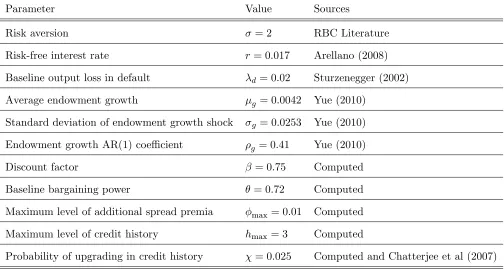
business cycle studies. Following Arellano (2008), the risk-free rate is equal to 1.7%. The baseline
output loss parameter d is set to 2% based on Strurzeneger’s (2002) estimate.
We follow the same stochastic process for output used in Yue (2010). She models the output
growth rate as AR(1) process to capture the stochastic trend in GDP of Argentina as;
log(yt) = (1 g) log(1 + g) + glog(yt 1) + gt (24)
where growth rate is gt = ytyt1, growth shock is g
t si:i:d: N(0; 2g), and log(1 + g) is expected log
gross growth rate of the country’s endowment. We set g = 0:0042, g= 0:0253, and g = 0:41, and
approximate this stochastic process as a discrete Markov chain of 21 equally spaced grids by using
the quadrature method in Tauchen (1986).
Since a realization of the growth shock permanently a¤ects endowment and the model economy is
nonstationary, we detrend the model by dividing by the lagged endowment level yt 1. The detrended
counterpart of the any variable xt is thus x^t = xxtt1. The equilibrium value function, bond price
Concerning time discount factor and baseline country’s bargaining power , we set = 0:75,
= 0:72, to obtain its average default frequency2:65%annually or0:66%quarterly and recovery rate
31:3%. We target default probability 2.7% annually and the average recovery rate 33% for the 2005
international debt restructuring estimated by Sturzenegger and Zettelmeyer (2006, 2008). For interest
spreads, we set the maximum level of additional spread premia ( max) corresponding to the evidence
in Figure 2 that increase in spreads is less than 0.01 (100 basis points). Lastly, taking into account
3 defaults of Argentina in the period from 1901-2002 indicated in Reinhart, Rogo¤, and Savastano
(2003), we specify the maximum level of credit history (hmax) as 3. The probability of upgrading
, which governs the average length of time that a recent default remains on the country’s credit
history is set to 0.025, re‡ecting that investors’ memory lasts for 10 years.25 This is also consistent
with spreads dynamics in Argentina: an average of spreads for 2002Q1-2011Q4 is higher than one for
pre-default period. Table 5 summarizes the model parameters. Our computation algorithm is shown
in Appendix A.
Table 5: Model parameters
Parameter Value Sources
Risk aversion = 2 RBC Literature
Risk-free interest rate r = 0:017 Arellano (2008)
Baseline output loss in default d= 0:02 Sturzenegger (2002)
Average endowment growth g = 0:0042 Yue (2010)
Standard deviation of endowment growth shock g = 0:0253 Yue (2010)
Endowment growth AR(1) coe¢cient g = 0:41 Yue (2010)
Discount factor = 0:75 Computed
Baseline bargaining power = 0:72 Computed
Maximum level of additional spread premia max= 0:01 Computed
Maximum level of credit history hmax= 3 Computed
Probability of upgrading in credit history = 0:025 Computed and Chatterjee et al (2007)
6.2 Numerical results on equilibrium properties
In this subsection, we cover the equilibrium properties of the model. Figure 4 shows the relationship
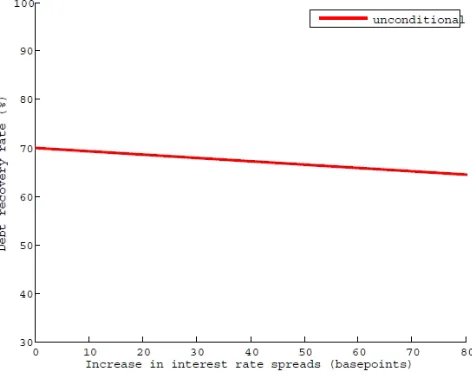
between increase in interest spreads and recovery rates unconditional on income states.26 As in
Section 3, we de…ne increase in spreads as the di¤erence between spreads with defaults and those
with non-defaults. We calculate spreads after default based on both expected recovery rates for
next default and agreed additional spread premia, and spreads with non-defaults are measured with
expected recovery rates for the current default. It is clear that there is a negative relationship between
recovery rates and increase in interest spreads. If the increase in spreads is high, recovery rate is low
and vice versa. One interpretation is that if the country repays a large fraction of its debt at the
renegotiations, long-term borrowing costs will be small. In the case of Yue (2010), the slope of the
contract curve is vertical as shown in Appendix C. A driving force which makes our results di¤erent
from Yue (2010) is additional spread premia agreed at the debt restructurings.
2 6Figure A2 in Appendix D displays the relationship between increase in interest spreads and recovery rates conditional
Figure 4: Relationship between increase in interest spreads and recovery rates
[image:27.612.185.425.270.495.2]Figure 5: Default probability under baseline case
Figure 5 illustrates the baseline default probability at the mean income level. It is apparent that
the default probability is weakly increasing with the credit history. At the higher level of credit
history, additional increase in spreads on the newly issued bonds, determined at the previous debt
renegotiation, leads to higher costs for the country to borrow from investors compared with credit
history ht= 0.
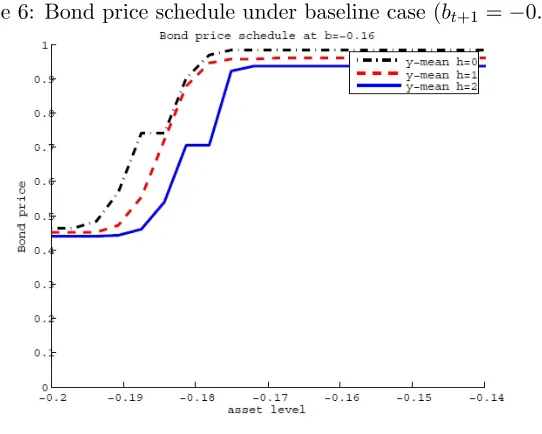
Figure 6 presents that bond price is also weakly decreasing with respect to the credit history.
What play behind are additional spread premia agreed at the past debt renegotiations: as explained
in detail in Section 6.4, these additional spread premia decrease the bond price both directly and
Figure 6: Bond price schedule under baseline case (bt+1 = 0:16)
6.3 Simulation results
We conduct 1000 rounds of simulations with 2000 periods per round and then extract 80 observations
before and 25 observations after each default event in stationary distribution to compute statistics.27
Bond spreads are from the J.P. Morgan’s Emerging Markets Bond Index Global (EMBIG) for
Ar-gentina for 1997Q1–2001Q4 and 2005Q3–2011Q3. Output data are seasonally adjusted from the
MECON for 1980Q1–2001Q4 and 2005Q3–2011Q3. Consumption and trade balance data are also
seasonally adjusted from the MECON for 1993Q1–2001Q4 and 2005Q3–2011Q3. Trade balance is
calculated as ratio to real GDP. Argetina’s external debt data are from the IMF WEO for 1980–2001
and 2005–2011. We compute two measures of the sovereign’s indebtness: the …rst measure is the
average external debt/GDP ratio. We also compute the ratio of the country’s debt service (including
short-term debt) to its GDP for Argentina. One advantage of our model compared with Yue (2010)
or Aguiar and Gopinath (2006) is that we obtain the statistics for post-default periods.
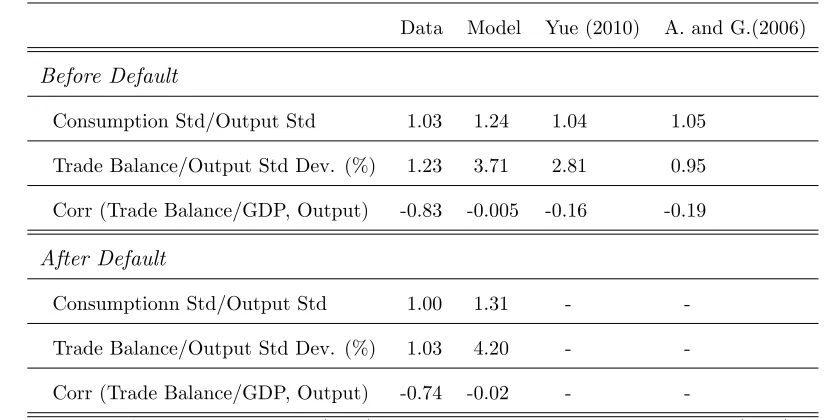
As apparent from Table 6, the model matches the business cycle statistics in data. For pre-default
periods, our model replicates volatile consumption and trade balance/GDP volatility, both of which
are prominent features of emerging economies business cycle models In addition, it also generates the
negative correlation between trade balance and output. However, a novelty of our model comes from
the better match of statistics with data in post-default periods, particilarly on consumption volatility
2 7We choose 80 observations prior to and 25 observations after a default event to compute the sample in the data
and correlation of trade balance and output.
Table 6: Business Cycle Statistics
Data Model Yue (2010) A. and G.(2006)
Before Default
Consumption Std/Output Std 1.03 1.24 1.04 1.05
Trade Balance/Output Std Dev. (%) 1.23 3.71 2.81 0.95
Corr (Trade Balance/GDP, Output) -0.83 -0.005 -0.16 -0.19
After Default
Consumptionn Std/Output Std 1.00 1.31 -
-Trade Balance/Output Std Dev. (%) 1.03 4.20 -
-Corr (Trade Balance/GDP, Output) -0.74 -0.02 -
-Source: Aguiar and Gopinath (2006), Datastream, IMF WEO, MECON, Yue (2010)
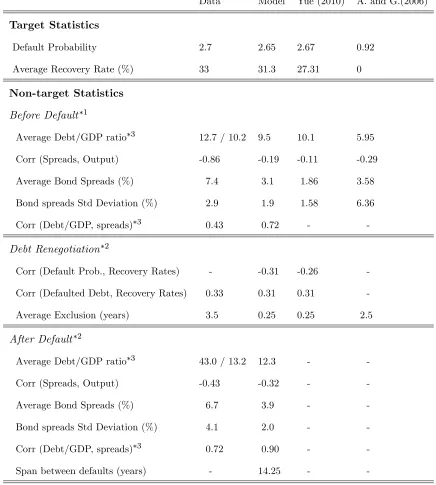
We move on to non-business cycle statistics of the model and data. First of all, in pre-default
periods, the model creates a moderate level of debt relative to data statistics. In the data, the total
debt service/GDP ratio is 10.2%. The model generates the average debt/GDP ratio of 10.4%. In
addition, the model also shows the relation among bond spreads, debt/GDP ratio and outputs as in
the data. Bonds spreads are possitively correlated with debt/GDP, but negatively correlated with
output. This is because default probability is high and recovery rates are low in low income states
resulting in high spreads. The average bond spreads is 3.1% in our simulations, lower than 7.4%
reported in the data, but higher than in Yue (2010). The volatility of bond spreads is 1.9% in our
simulation, close to the data (2.9%). The debt recovery rates are negatively correlated with default
probability.
What makes our model more distinctive is the model accounts the regularities in the post-default
periods. The average debt/GDP ratio is 12.3%, close to the debt service/GDP ratio of 13.2%. It is
clear that the model explains one prominent feature of average debt/GDP ratio in both pre-default
and post-default periods: the average debt/GDP ratio is higher in post-default period (12.3%) than
in pre-default period (10.4%). What is driving behind is increase in borrowing costs which forces
the sovereign to accumulate higher debts. Furthermore, our model provides the better match of the
periods. Even in the same low income states, the sovereign tends to accumulate higher debts in
post-default periods leading to higher spreads than in pre-post-default periods. This is also justi…ed by the
average bond spreads in post-default periods (3.9%) higher than one in pre-default periods (3.0%). It
also shows an obvious improvement of the average spreads compared with Yue (2010). On contrary,
[image:30.612.87.523.234.719.2]the volatility of bond sreads in the post-default periods remains the same as in pre-crisis period.
Table 7: Model statistics for Argentina
Data Model Yue (2010) A. and G.(2006)
Target Statistics
Default Probability 2.7 2.65 2.67 0.92
Average Recovery Rate (%) 33 31.3 27.31 0
Non-target Statistics
Before Default 1
Average Debt/GDP ratio 3 12.7 / 10.2 9.5 10.1 5.95
Corr (Spreads, Output) -0.86 -0.19 -0.11 -0.29
Average Bond Spreads (%) 7.4 3.1 1.86 3.58
Bond spreads Std Deviation (%) 2.9 1.9 1.58 6.36
Corr (Debt/GDP, spreads) 3 0.43 0.72 -
-Debt Renegotiation 2
Corr (Default Prob., Recovery Rates) - -0.31 -0.26
-Corr (Defaulted Debt, Recovery Rates) 0.33 0.31 0.31
-Average Exclusion (years) 3.5 0.25 0.25 2.5
After Default 2
Average Debt/GDP ratio 3 43.0 / 13.2 12.3 -
-Corr (Spreads, Output) -0.43 -0.32 -
-Average Bond Spreads (%) 6.7 3.9 -
-Bond spreads Std Deviation (%) 4.1 2.0 -
-Corr (Debt/GDP, spreads) 3 0.72 0.90 -
-Source: Aguiar and Gopinath (2006), Datastream, IMF WEO, MECON, Yue (2010)
1: Data statistics before default correspond to sample of 1980Q1-2001Q4 (output), 1990Q1-2001Q4 (trade
balance and consumption), and 1997Q1-2001Q4 (spreads). 2: Data statistics during and after debt
renegotiation correspond to samples of 2002Q1-2005Q2 and of 2005Q3-2011Q3 respectively. 3: Two
measures are the average total debt service (interest and amortization paid) and the average short-term debt
outstanding at year end. We use the second measure (short-tern debt outstanding) to calculate correlation.
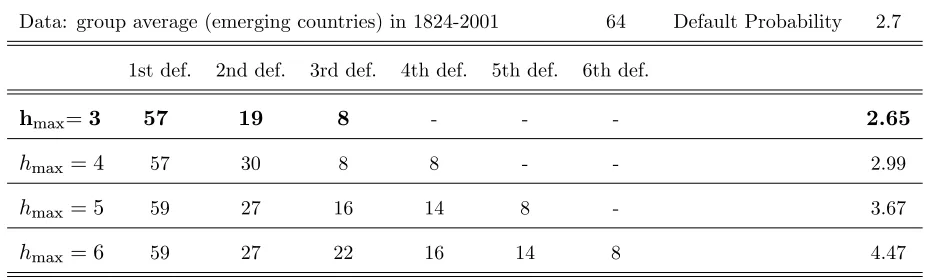
Furthermore, we calculate the average time spans between defaults based on 2000 rounds of
simulations by extracting the initial 200 periods of total 2000 periods per round. Table 8 reports that
the average spans between defaults are weakly decreasing with respect to the number of past debt
[image:31.612.73.538.328.468.2]renegotiations. This feature is robust to extensions related with the upper limits of credit history.
Table 8: Average time spans between defaults (quarters)
Data: group average (emerging countries) in 1824-2001 64 Default Probability 2.7
1st def. 2nd def. 3rd def. 4th def. 5th def. 6th def.
hmax=3 57 19 8 - - - 2.65
hmax= 4 57 30 8 8 - - 2.99
hmax= 5 59 27 16 14 8 - 3.67
hmax= 6 59 27 22 16 14 8 4.47
6.4 Impacts of additional spread premia
In this subsection, we explain how additional spread premia agreed at past debt renegotiations lead
to increase in spreads, which distinguishes this paper with the previous work. Based on equation (19)
and (20), we can rewrite interest spreads for credit history ht 1 as follows.
s(bt+1; ht; yt) =
0 if bt+1 0 1+r+ (bt;ht;yt)
[1 p(bt+1;ht;yt)+p(bt+1;ht;yt) (bt+1;ht;yt)] (1 +r) otherwise
(20a)
Given risk-free rate (r), total spreads can be decomposed into two factors:
(A) spread components based on "pure" default probability,
(B) spread components based on impact of additional spread premia.
irrelevant to the credit history. It is the measure of interest spreads used in Yue (2010). The latter
is how much the term (bt; ht; yt), increases total spreads. It can be regarded as spread components
associated with the past default history.
Figure 7 displays both the total spreads and spread components measured with "pure" default
probability. The spread components measured with "pure" default probability is equal to (A). The
total spreads is de…ned by equation (20a). The di¤erence between these two corresponds to (B),
which can be interpreted as spread components associated with the past default history. It is clear
that total spreads deviate from spread components measured with "pure" default probability when
[image:32.612.159.462.280.502.2]the debt-to-GDP ratio is above the threshold value 0.175 in the mean income state.
Figure 7: The total spreads and spreads based on "pure" default probability
6.5 A brief summary of quantitative analysis
Our major …ndings can be summarized as follows. First of all, by incorporating additional spread
premia, the model accommodates an observed pattern of lower recovery rates associated with larger
increases in yield spreads. Second, we show that default probability is weakly increasing with credit
history, given the same debt-to-GDP ratio. Third, simulation exercises show that our model accounts
both business cycle and non-business cycle regularities in the post-default periods, which di¤erentiates
this model from the previous work Finally, interest spreads in our model can be decomposed into two
parts: spread components based on "pure" default probability, and spread components associated
7
Model implications
In this section, we explore the determinants of the slope of the contract curve. Moreover, we consider
possible implications derived from the changes in length of creditors’ memory and size of additional
spread premia.
7.1 Determinants of the slope of the contract curve
We focus on factors which a¤ect the value of the slope of the contract curve. Table 9 shows the values
of the slope under di¤erent values for the discount factor, the maximum level of additional spread
premia, output cost, risk-free rate and probability of upgrading in credit history.28 The impacts of a
[image:33.612.66.565.323.526.2]change in one parameter, leaving all other parameters …xed are indicated respectively.
Table 9: Values of the slope of the contract curve under di¤erent parameter values
Data -0.62
Discount factor Slope Maximum level of additional spread premia Slope Output cost Slope
= 0:81 -0.03 max= 0:025 -0.03 d= 0:025 -0.10
=0:75 -0.07 max=0:01 -0.07 d=0:0225 -0.08
max= 0:005 -0.12 d= 0:02 -0.07
Risk-free interest rate Probability of upgrading in credit history
r = 0:03 -0.08 = 0 -0.07
r=0:017 -0.07 =0:025 -0.07
r = 0:01 -0.05 = 0:075 -0.07
Note: all the values are those at the default
First, the slope gets steeper as the discount factor decreases. From the country’s perspective, the
cost of paying to one additional unit of defaulted debt at the renegotiation relative to the cost of
facing one additional unit of increase in spreads, gets smaller as the discount factor decreases. Next,
when the maximum level of additional spread premia is reduced to 50 basis points ( max = 0:005),
the absolute value of the slope increases. Since increase in spreads is limited to a lower level due to
the lower maximum level of additional spread premia, paying one additional unit of defaulted debt at
2 8Changes in value for bargaining power has an ambitious impact on the slope of the contract curve. Rather than the
the renegotiation is less costly relative to paying one additional unit of spread increases in the future
period.
On contrary, an increase in output cost leads to an increase in the absolute value of the slope. As
the cost of default is larger for the country, relative cost of paying one additional unit of defaulted
debt at the renegotiation instead of facing one additional unit of increase in spreads decreases taking
into account the cost of next default.
The absolute value of slope increases as the risk-free rate increases. Total size of increase in
spreads gets larger associated with an increase in risk-free interest rate. Given the constant change in
recovery rate, it makes the slope of the contract curve more ‡atter, indicating that from the country’s
point of view, paying one additional unit of defaulted debt at the renegotiation is less costly than
paying one additional unit of spread returns in the future periods. Lastly, probability of upgrading
in credit history does not a¤ect the value of slope.
7.2 Duration and size of additional spread premia
Determination of both recovery rates and additional spread premia at the debt renegotiation plays
an important role in our model. Probability of upgrading in credit history and maximum level of
additional spread premia are two key parameters which specify the duration and size of deterioration
in long-term credit. Table 10 reports how changes in these parameter values in‡uence the non-business
cycle statistics.29
Increase in probability of upgrading reduces the average debt/GDP ratio, average bond spreads
and correlation between debt/GDP and spreads. As the probability of upgrading in credit history
gets higher, length of deterioration in long-run credit gets shorter. The sovereign tends to have lower
levels of debt and spreads, which also lead to lower correlation between debt/GDP ratio and spreads.
On the contrary, not only the average debt/GDP, average bond spreads and correlation between
debt/GDP and spreads, but also the default probability increases as the upper limit of additional
spread premia gets higher. The maximum level of additional spread premia identi…es the size of
deterioration in long-term credit, given the …xed duration. Associated with increase in borrowing
costs, the sovereign accumulates more debts leading to increases in both spreads and probability in
2 9Changes in parameter values of both probability in credit history and maximum level of additional spread premia
default.
Table 10: Statistics for di¤erent levels of upgrading in credit history and additional spread premia
Probability of upgrading Maximum level of additional spread premia
= 0 =0:025 = 0:075 max= 0:005 max=0:01 max= 0:025
Default Probability 2.67 2.65 2.65 2.55 2.65 3.04
Average Recovery Rate (%) 31.9 31.3 31.9 32.2 31.3 31.5
Before Default 1
Average Debt/GDP ratio 3 10.4 9.5 10.4 10.4 9.5 11.8
Corr (Spreads, Output) -0.08 -0.06 -0.08 -0.05 -0.06 -0.13
Average Bond Spreads (%) 3.4 3.0 3.4 3.2 3.0 4.0
Bond spreads Std Deviation (%) 1.9 1.9 1.9 1.8 1.9 2.4
Corr (Debt/GDP, spreads) 3 0.82 0.72 0.82 0.81 0.72 0.82
After Default 2
Average Debt/GDP ratio 3 10.9 12.3 10.9 10.9 12.3 12.4
Corr (Spreads, Output) -0.25 -0.41 -0.27 -0.29 -0.41 -0.21
Average Bond Spreads (%) 3.9 3.9 3.9 3.6 3.9 4.6
Bond spreads Std Deviation (%) 2.0 2.0 2.0 1.9 2.0 2.6
Corr (Debt/GDP, spreads) 3 0.90 0.90 0.90 0.88 0.90 0.89
8
Conclusion
Emerging countries that have defaulted on their debt repayment obligations in the past are more
likely to default again in the future than are non-defaulters with the same debt-to-GDP ratio. This
paper explains this stylized fact within a dynamic stochastic general equilibrium framework that
explicitly models debt renegotiations between a defaulting country and its creditors. Speci…cally, the
model extends the existing literature by allowing defaulters and creditors to bargain not just over
recovery rates, but also over the rate of return o¤ered on newly-issued debt. Quantitative analysis of
the model reveals that the equilibrium probability of default for a given debt-to-GDP level is weakly