http://www.scirp.org/journal/jpee ISSN Online: 2327-5901
ISSN Print: 2327-588X
An Isothermal Study of the Electrochemical
Performance of Intermediate Temperature
Solid Oxide Fuel Cells
O. O. Ighodaro
1,2*, K. Scott
2, L. Xing
31Department of Mechanical Engineering, University of Benin, Benin City, Nigeria
2School of Chemical Engineering and Advanced Materials, Newcastle University, Newcastle upon Tyne, UK 3School of Chemical Engineering, University of Birmingham, Birmingham, UK
Abstract
A two-dimensional along the channel micro-scale isothermal model of a SOFC is developed and validated against experimental data and other simu-lated results from literature. The steady state behaviour of the cell was deter-mined by numerical solution of the combined transport, continuity and ki-netic equations. An important characteristic of the model is the consideration of the triple phase boundary as a distinct layer. The model is capable of pre-dicting the cell performance including polarisation behaviour and power output. The model is used to study the effect of the support structure, geomet-ric parameters and the effect of operating conditions on cell performance. Several parametric studies include the effect of operating conditions and geo-metric parameters on cell performance with a view to optimising the cell. The simulation results showed that the anode supported SOFC displayed the best performance with the activation and ohmic overpotentials being responsible for most of the voltage losses in the cell.
Keywords
Isothermal, Overpotential, Solid Oxide Fuel Cell, Anode Support
1. Introduction
Solid oxide fuel cells (SOFCs) are promising candidates for energy conversion systems because of their huge potentials for power generation in stationary, portable and transport applications and their high energy conversion efficiency
when compared to other fuel cells [1][2][3][4]. In addition, internal reforming
of hydrocarbons can be carried out in the anode and they have significantly lower emissions of sulphur oxides, nitrogen oxides and carbon dioxide
com-How to cite this paper: Ighodaro, O.O., Scott, K. and Xing, L. (2017) An Isothermal Study of the Electrochemical Performance of Intermediate Temperature Solid Oxide Fuel Cells. Journal of Power and Energy Engineering, 5, 97-122.
https://doi.org/10.4236/jpee.2017.52006
Received: January 26, 2017 Accepted: February 20, 2017 Published: February 23, 2017
Copyright © 2017 by authors and Scientific Research Publishing Inc. This work is licensed under the Creative Commons Attribution International License (CC BY 4.0).
http://creativecommons.org/licenses/by/4.0/
pared to conventional power generation devices [5][6][7].
Although there have been significant advances with respect to development of new materials with improved properties and better fabrication processes in the
last two decades [8], some barriers still hamper the development and
commer-cialisation of SOFCs. The high operating temperature is the major limiting fac-tor to using SOFCs. In order to overcome this limitation and achieve stability and economy, recent efforts are geared towards intermediate temperature SOFCs
(IT-SOFCs) [9][10]; these may be achieved by either reducing the thickness of
the electrolyte which reduces its ohmic resistance [11][12][13], developing new
electrodes with improved catalytic activities which reduce overpotential [14]
[15] [16] [17] or improving the electrode microstructure which increases the
electrochemical reaction area [3][18][19].
To compensate for the reduced cell performance associated with operating at intermediate temperatures through any of the three routes mentioned above, the
use of thin film micro SOFCs is investigated [20][21][22][23]. Amongst them,
the technique of thin electrolyte is widely used for intermediate temperature SOFCs. Furthermore Yittra stabilised zirconia (YSZ) which is normally used as electrolyte for high temperature SOFCs can be used at intermediate tempera-tures by reducing its thickness.
Quite a number of existing micro models found in literature are modelled
with the traditional SOFC geometric structure i.e. without the electrochemical
reaction layers [3] [24]-[32] whereby the consumption and generation of
gase-ous species are carried out at the interfaces and the governing equations are coupled only by the boundary conditions. For micro-SOFCs modelled with a distinct reaction layer, the electrochemical active layers extend from the elec-trode/electrolyte interfaces to the reaction layer. The gaseous species are con-sumed and generated within the reaction layer and the governing equations are coupled not only by the boundary conditions but also by the source or sink terms. Consequently, it is only recently that a few authors are considering micro-
SOFCs with distinct reaction layers in their models [33][34][35][36][37].
This study investigates the electrochemical performance of an isothermal pla-nar SOFC model by characterising the overpotentials. The concentration de-pendent Butler-Volmer equation is used in describing the activation and con-centration overpotentials, with the exchange current densities dependent on the operating temperature. The ohmic overpotential depends of the thickness of the individual cell components while the ionic and electronic conductivities relate to the operating temperature. The cells electrochemical performance is used in comparing the performance of three different support structures and to study the effect of operating conditions and geometric parameters of the micro-scale SOFC model in which the reaction layer is modelled as a distinct layer.
2. Model Description
2.1. Computational Domain and Assumptions
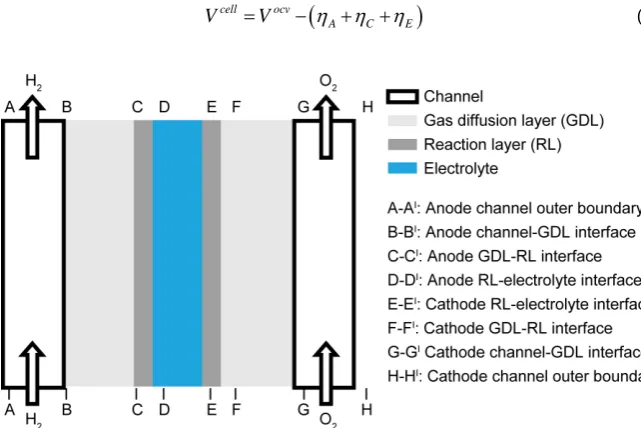
supported SOFC unit is shown in Figure 1, which includes the gas flow chan-nels, gas diffusion layers and reaction layers on both the anode and cathode sides and a thin electrolyte layer sandwiched between the reaction layers. The model considers seven sub-domains; anode channel (ACH), anode diffusion layer (ADL), anode reaction layer (ARL), electrolyte, cathode reaction layer (CRL), cathode diffusion layer (CDL) and cathode channel (CCH). The ARL is com-posed of a mixture of equally sized Ni and YSZ particles while the CRL is made of a mixture of equally sized LSM and YSZ particles. The ADL is composed of Ni particles while the CDL is made up of LSM particles.
The simulation is carried out with the following assumptions:
• The temperature and total pressure are constant and uniform throughout the
cell.
• Additional resistance due to the presence of interconnector are not
consid-ered.
• The reactant gases at both the anode and cathode are introduced by plug flow.
• Co-flow mode of reactant gases into the flow channels is applied.
• The electrode layers are made up of binary spherical particles that are
ran-domly packed.
• The spherical particles are equal sizes.
• The electrochemical reactions occur only in the reaction layers.
• The flow in the channels is treated as laminar and incompressible.
• No slip boundary condition is applied on the cell walls.
• Species transport at channel outlet is by convective flux only.
2.2. Modelling Equations
The cell voltage of SOFC, cell
V , is expressed as the combination of the open
circuit voltage (OCV), ocv
V , overall anode overpotential, ηA, overall cathode
overpotential, ηC and the ohmic loss in the electrolyte, ηE.
(
)
cell ocv
A C E
[image:3.595.208.529.499.713.2]V =V −
η η
+ +η
(1)(
)
A a Rarl Radl iv
η =η + + (2)
(
)
C c Rcrl Rcdl iv
η =η + + (3)
E R ie v
η = (4)
where Ri is the resistance of the layer and iv the volumetric current density.
2.3. Electrochemical Reaction Kinetics
The volumetric current densities of both the anode and cathode are often repre-sented by the non-linear Butler-Volmer equation. However, in SOFCs, the mass and charge transfer phenomena occur at comparable rates, thus the Butler-
Volmer equations need to be corrected [38], the corrected equations are given
as:
(
)
2 2
2 2
H H O
, , ,
H , H O,
1
exp a exp a
v a v a o a
ref ref
c F c F
i A i
c RT c RT
α η α η − = −
(5)
(
)
2 2
2 2
O O
, , ,
O , O ,
1
exp c exp c
v c v c o c
ref ref
c F c F
i A i
c RT c RT
α η α η − = −
(6)
where cH ,2ref , cH O,2 ref and cO ,2ref are the reference concentrations of
hydro-gen, water and oxyhydro-gen, n is the number of electrons transferred in the single
elementary rate limiting reaction step, Av is the actual reactive surface area per
unit volume, α the charge transfer coefficient and ηi is the polarisation. The
subscripts i=a or c refers to the anode and cathode respectively. The
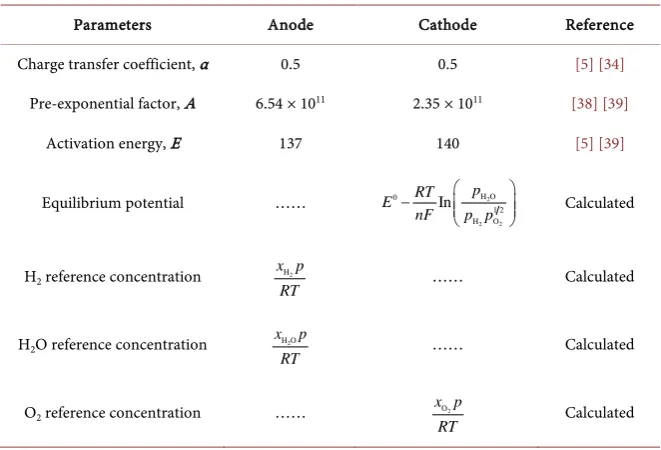
elec-trochemical parameters used in the model are listed in Table 3.
The polarisation terms ηi expressed in Equation (1) are defined as
2 2
2 2
H H O
H O H
In 2
b r
conc
a s i A s s b r
p p
RT
F p p
η =ϕ ϕ η− − =ϕ ϕ− +
(7)
2 2 O O 4 b
ocv conc ocv
c i s c i s r
p RT
V V
F p
η = + −ϕ ϕ η− = + −ϕ ϕ +
(8)
where ϕs is the electronic phase potential, ϕi is the ionic phase potential and
conc
η is the concentration polarisation. The electrochemical parameters used in
developing the model are listed in Table 1.
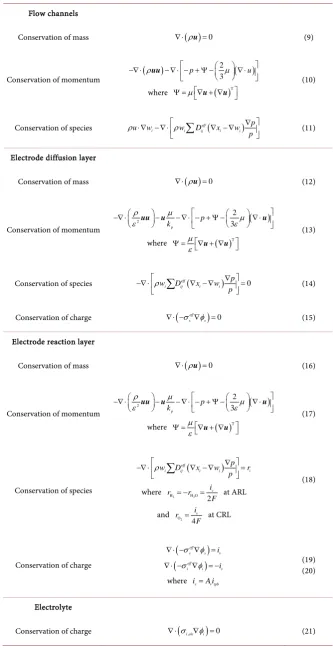
The governing and constitutive equations for each layer used in developing
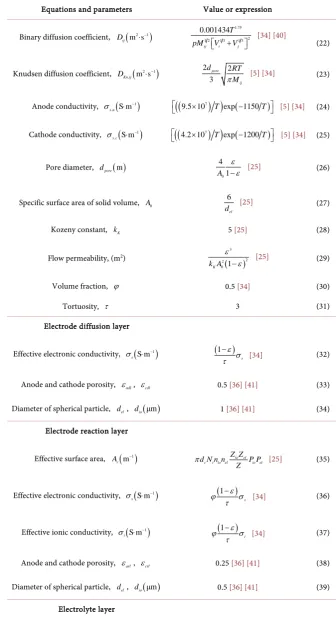
this model are defined in Table 2 and Table 3 respectively. The developed
term, this is calculated by imposing ϕ =s 0 at the bottom of the ADL and
cell
s V
ϕ = at the top of the CDL.
2.4. Boundary Conditions
Boundary conditions are applied at particular locations in the cell in order to
solve the governing equations. These locations are illustrated in Figure 1. The
external boundaries are treated as solid walls with no-slip conditions, the
com-position of the gaseous species are specified at channel inlets AI-BI and GI-HI.
0
s
ϕ = at B-BI and cell
s V
ϕ = at G-GI were imposed to calculate the electrical
potential. The boundary conditions between the diffusion and reaction layers
(C-CI and F-FI) are continuous flux for gaseous species and electronic potential
but insulated for the ionic potential. At locations D-DI and E-EI between the
re-action layers and electrolyte, diffusion flux and electronic current density are insulated while the ionic current density is continuous. The pressure at the inlet and outlet was set to ambient conditions at 1atm. The detailed boundary
condi-tions are listed in Table 4.
3. Numerical Procedure
The finite element commercial software COMSOL Multiphysics (version 4.3a) is used to solve the non-linear system of governing equations and boundary condi-tions described above. The software is designed to solve sets of coupled algebraic and differential equations. The computational geometry consists of 333,742 de-grees of freedom and 120,196 elements, the distance between each element is known as a step. At each step, the equations accounting for each phenomenon
are fully coupled and computed as shown in the schematic in Figure 2. The
convergence of the numerical solutions was judged by the relative tolerance
[image:5.595.208.539.510.735.2]cri-teria of 1 × 10⁻³.
Table 1. Electrochemical parameters.
Parameters Anode Cathode Reference
Charge transfer coefficient, α 0.5 0.5 [5][34]
Pre-exponential factor, A 6.54 × 10¹¹ 2.35 × 10¹¹ [38][39]
Activation energy, E 137 140 [5][39]
Equilibrium potential …… 2
2 2
H O 0
1 2 H O
In p
RT E
nF p p
−
Calculated
H2 reference concentration x pH2
RT …… Calculated
H2O reference concentration xH O2 p
RT …… Calculated
O2 reference concentration …… x pO2
Table 2. Governing equations.
Flow channels
Conservation of mass ∇ ⋅( )ρu =0 (9)
Conservation of momentum ( ) ( )
2 3
p u
ρ µ
−∇ ⋅ − ∇ ⋅ − + Ψ − ∇ ⋅
uu
where
( )
Tµ
Ψ = ∇ + ∇u u
(10)
Conservation of species eff( )
i i ij i i
p
u w w D x w
p
ρ ⋅∇ − ∇ ⋅ρ ∇ − ∇ ∇
∑
(11)Electrode diffusion layer
Conservation of mass ∇ ⋅( )ρu =0 (12)
Conservation of momentum
( ) 2 2 3 p p k
ρ µ µ
ε ε
−∇ ⋅ − − ∇ ⋅ − + Ψ − ∇ ⋅
uu u u
where µ ( )T
ε
Ψ = ∇ + ∇u u
(13)
Conservation of species eff( ) 0
i ij i i
p
w D x w
p
ρ
∇
−∇ ⋅ ∇ − ∇ =
∑
(14)Conservation of charge
(
eff)
0s s
σ φ
∇ ⋅ − ∇ = (15)
Electrode reaction layer
Conservation of mass ∇ ⋅
( )
ρu =0 (16)Conservation of momentum
( ) 2 2 3 p p k
ρ µ µ
ε ε
−∇ ⋅ − − ∇ ⋅ − + Ψ − ∇ ⋅
uu u u
where µ ( )T
ε
Ψ = ∇ + ∇u u
(17)
Conservation of species
( )
eff
i ij i i i
p
w D x w r
p
ρ
∇
−∇ ⋅ ∇ − ∇ =
∑
where H2 H O2
2
v
i
r r
F
= − = at ARL
and O2
4
v
i r
F = at CRL
(18)
Conservation of charge
(
eff)
s s iv
σ φ
∇ ⋅ − ∇ =
(
eff)
i i iv
σ φ
∇ ⋅ − ∇ = −
where iv=A iv tpb
(19) (20)
Electrolyte
Table 3. Constitutive equations and parameters used in the simulation.
Equations and parameters Value or expression
Binary diffusion coefficient,
(
2 1)
m s
ij
D ⋅−
1.75 2 1 2 1 3 1 3
0.001434
ij i j
T
pM V +V [34][40] (22)
Knudsen diffusion coefficient,
(
2 1)
, m sKn ij
D ⋅− 2 2
3
pore ij
d RT
M
π [5][34] (23)
Anode conductivity,
(
1)
, S ms a
σ ⋅ −
(
(
9.5 10× 7)
T)
exp(
−1150T)
[5][34] (24)
Cathode conductivity,
(
1)
, S ms c
σ ⋅ −
(
(
7)
)
(
)
4.2 10 T exp 1200T
× −
[5][34] (25)
Pore diameter, dpore
( )
m0 4 1 A ε ε
− [25] (26)
Specific surface area of solid volume, A0
6
el
d [25] (27)
Kozeny constant, kK 5 [25] (28)
Flow permeability, (m2)
( ) 3 2 2 0 1 K k A ε ε
− [25] (29)
Volume fraction, ϕ 0.5 [34] (30)
Tortuosity, τ 3 (31)
Electrode diffusion layer
Effective electronic conductivity,
(
1)
S m
s
σ ⋅ − (1 )
s
ε σ τ −
[34] (32)
Anode and cathode porosity, εadl, εcdl 0.5 [36][41] (33)
Diameter of spherical particle, del, dio( )μm 1 [36][41] (34)
Electrode reaction layer
Effective surface area,
( )
1m v
A − io el
c t io el io el
Z Z
d N n n P P
Z
π [25] (35)
Effective electronic conductivity,
(
1)
S m
s
σ ⋅ − (1 )
s ε ϕ σ τ − [34] (36)
Effective ionic conductivity,
(
1)
S m
i
σ ⋅ − (1 )
i ε ϕ σ τ − [34] (37)
Anode and cathode porosity, εarl, εcrl 0.25 [36][41] (38)
Diameter of spherical particle, del, dio( )μm 0.5 [36][41] (39)
Electrolyte layer
Electrolyte conductivity,
(
1)
S m i
Table 4. Boundary conditions.
Boundary (Figure 1) Condition expressions
Anode inlet (Boundary AI-BI)
2
H specified
x = ,
2 2
H O 1 H
x = −x , pa=1atm
Cathode inlet (Boundary GI-HI)
2
O specified
x = ,
2 2
N 1 O
x = −x , pc=1atm
Anode outlet (Boundary A-B) ρuxH2⋅ =n 0
Cathode outlet (Boundary G-H) ρuxH2⋅ =n 0
Anode flow channel-anode diffusion
layer interface (Boundary B-BI) ϕ =s 0,
(
H2 H2)
H2 dl chux j j
ρ + ⋅n = ⋅n
cathode flow channel-cathode diffusion layer interface (Boundary G-GI)
cell s V
ϕ = ,
(
ρuxO2+jO2)
⋅nch=jO2⋅ndlAnode diffusion layer-anode reaction
layer interface(Boundary C-CI) jH2⋅ndl=jH2⋅nrl, is⋅ndl=is⋅nrl, ii=0
Cathode diffusion layer-cathode reaction
layer interface (Boundary F-FI) jO2⋅ndl=jO2⋅nrl, is⋅ndl=is⋅nrl, ii=0
Anode reaction layer-electrolyte interface
(Boundary D-DI) jH2=0, is=0, ii=i
Cathode reaction layer-electrolyte interface
[image:8.595.206.540.94.615.2](Boundary E-EI) jO2=0, is=0, ii=i
Figure 2. Schematic of computational process.
4. Cell Performance Validation
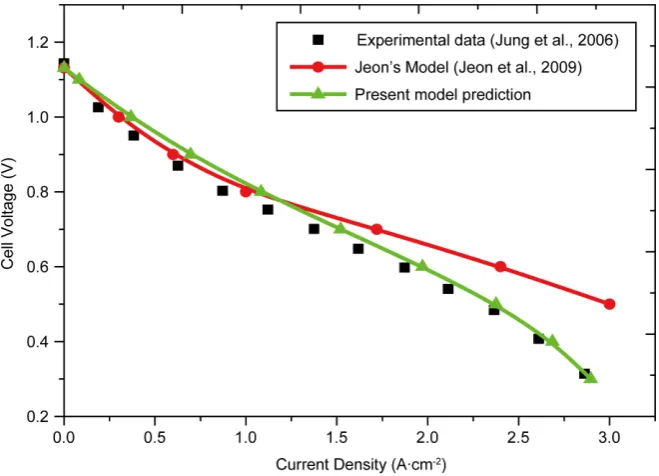
The range of validity and accuracy of the hydrogen fed, isothermal SOFC model is determined by comparing experimental data with the numerically developed cell performance result.
oxide fuel cells” by Jung et al.[42] and the numerical simulation studies carried
out by Jeon [36] titled “A comprehensive CFD model of anode-supported solid
oxide fuel cells” is used.
[image:9.595.209.539.479.717.2]Numerical Approach
Figure 3 compares this model simulation with that simulated by Jeon et al.[36]
and that obtained from the above experimental data [42] at 1073 K. The
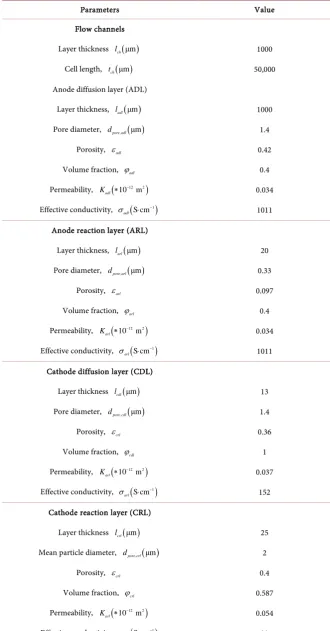
pa-rameters used for the model simulation are listed in Table 5. Most of the
pa-rameters used in validating the model were obtained from Jung et al. [42], other
parameters not provided by the experimental report were obtained from litera-ture.
This present model predictions gives better agreement with the experimental
results than those obtained by Jeon’s et al. model [36]. The tortuosity value is
varied to obtain the best fit between the experimental results and those from the simulation.
5. Results and Discussion
The simulated model aims at analysing the electrochemical performance of the cell by studying the effect of design and operating conditions on the predicted SOFC performance under isothermal conditions. In order to characterise the cell’s performance, the overpotentials in the different components of the cell are first determined. The model predicts the activation and ohmic overpotential in the electrodes and electrolyte as well as the concentration overpotentials in the electrodes.
The role of support structures and the influence of key operating parameters on SOFC performance are investigated. Three basic support structure approaches
Table 5. Parameters used in validating the model.
Parameters Value
Flow channels
Layer thickness lch
( )
μm 1000Cell length, tch
( )
μm 50,000Anode diffusion layer (ADL)
Layer thickness, ladl( )μm 1000
Pore diameter, dpore adl,
( )
μm 1.4Porosity, εadl 0.42
Volume fraction, ϕadl 0.4
Permeability,
(
12 2)
10 m
adl
K ∗ − 0.034
Effective conductivity,
(
1)
S cm
adl
σ ⋅ −
1011
Anode reaction layer (ARL)
Layer thickness, larl
( )
μm 20Pore diameter, dpore arl, ( )μm 0.33
Porosity, εarl 0.097
Volume fraction, ϕarl 0.4
Permeability,
(
12 2)
10 m
arl
K ∗ − 0.034
Effective conductivity,
(
1)
S cm
arl
σ ⋅ −
1011
Cathode diffusion layer (CDL)
Layer thickness lcdl( )μm 13
Pore diameter, dpore cdl,
( )
μm 1.4Porosity, εcrl 0.36
Volume fraction, ϕcdl 1
Permeability,
(
12 2)
10 m
arl
K ∗ − 0.037
Effective conductivity,
(
1)
S cm
arl
σ ⋅ −
152
Cathode reaction layer (CRL)
Layer thickness lcrl
( )
μm 25Mean particle diameter, dpore crl, ( )μm 2
Porosity, εcrl 0.4
Volume fraction, ϕcrl 0.587
Permeability,
(
12 2)
10 m
arl
K ∗ − 0.054
Effective conductivity,
(
1)
S cm
arl
σ ⋅ −
Continued
Electrolyte (E)
Layer thickness le
( )
μm 8Effective conductivity,
(
1)
S cm
arl
σ ⋅ −
0.047
Operating conditions
Operating temperature, T K( ) 1073K
Total pressure, p atm
(
)
1.0Fuel inlet composition, xH2; xH O2 0.97; 0.03
Air inlet composition, xO2; xN2 0.21; 0.79
are proposed in the development of planar SOFCs [39]: the anode-supported,
cathode-supported and electrolyte supported SOFCs.
The results obtained from the 2-D simulation of the three support structures are presented initially. After which, parametric analysis on key design parame-ters is carried out.
5.1. Role of Support Structures
5.1.1. Anode-Supported SOFCIn the anode-supported SOFC, the anode is the thickness component, while the cathode and electrolyte are very thin. The thick anode layer helps in decreasing the ohmic resistance as thin electrolyte layers can now be used, this makes them more suited for operations at lower temperatures (873 - 1073 K) since the ex-pected high ohmic overpotential at low temperatures will be minimised by the thin electrolyte layer. Due to the reduced operating temperatures, cheaper mate-rials such as stainless steel can be used for the interconnectors instead of the ex-pensive high chrome alloys or oxides, resulting in reduced material and
manu-facturing costs [34].
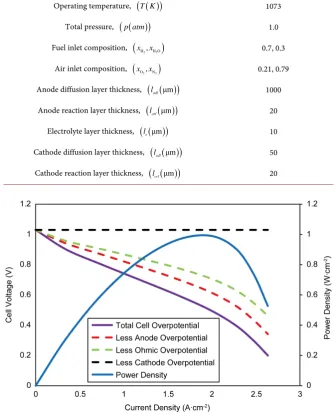
The operating conditions and geometric parameters used in the simulation of
the anode supported SOFC are listed in Table 6. The other design parameters
used are listed in Table 1. The simulated performance of the anode supported
cell is shown in Figure 4.
The performance characteristics of an anode-supported SOFC operating
un-der isothermal conditions are shown in Figure 4. The figure illustrates the cell
Table 6. Base case parameters used in simulating an anode-supported SOFC.
Operating temperature,
(
T K( ))
1073Total pressure,
(
p atm( ))
1.0Fuel inlet composition,
(
xH2,xH O2)
0.7, 0.3Air inlet composition,
(
xO2,xN2)
0.21, 0.79Anode diffusion layer thickness,
(
ladl( )μm)
1000Anode reaction layer thickness,
(
larl( )μm)
20Electrolyte layer thickness,
(
le( )μm)
10Cathode diffusion layer thickness,
(
lcdl( )μm)
50Cathode reaction layer thickness,
(
lcrl( )μm)
20Figure 4. Base case performance of an anode-supported SOFC at 1073 K.
layers. The electrolyte ovepotential include only the ohmic overpotentials due to the resistance to the flow of ions in the electrolyte.
The power density is observed to increase to a maximum of 0.63 W∙cm−2 at a
current density of 1.48 A∙cm−2 and a cell voltage of 0.44 V, after which it begins
to decrease towards zero. SOFC’s are usually designed to operate at 0.7 V [43]
thus based on Figure 4, the best operating point for the cell would be at current
density of 0.9 A∙cm−2 leading to a power density of 0.58 W∙cm−2.
The activation overpotential is the single largest contributor to the overall anode overpotential, followed by the concentration overpotential which is due to the thick electrode diffusion layer. A thick electrode layer inhibits the diffusion
process by slowing down the diffusion of H2 gas to the reaction sites which leads
to a decrease in its partial pressure at the site. However, the generation of H2O at
tion overpotentials at high current densities. In contrast, the cathode concentra-tion overpotential is negligible; this is due to the very thin cathode electrode layer. Nonetheless, the contributions of the activation overpotential is signifi-cantly higher than that on the anode due to its lower exchange current density and as a result of the sluggish resistance of the oxygen ion transfer reaction.
5.1.2. Cathode-Supported SOFC
In cathode-supported SOFCs, the cathode electrode layer is the thickest compo-nent while the other layers are very thin. Cathode supported cells are considered advantageous because of the reduced risk of carbon poisoning in thin anode
lay-ers when hydrocarbon fuel is used [44], furthermore, the risk of Ni oxidation by
water is reduced in thin anode layers [45], in addition to the ohmic polarisation
as a result of the thin electrolyte thickness.
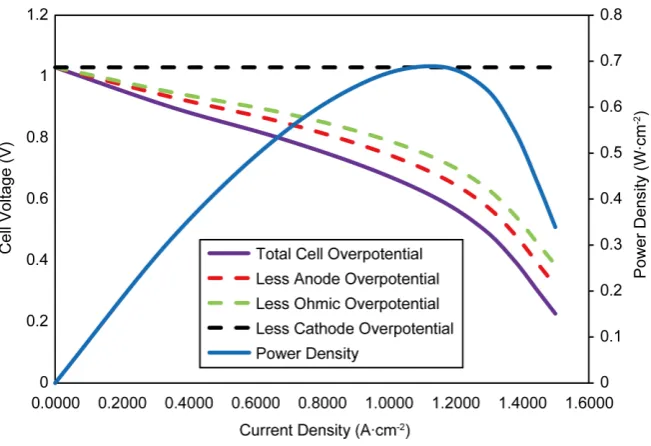
The operating conditions and geometric parameters used in the simulation of
the cathode supported SOFC are listed in Table 7. The other design parameters
used are listed in Table 1. The simulated performance of the cathode supported
cell is shown in Figure 9.
The performance of the cathode-supported SOFC is shown in Figure 5. The
curve is seen to exhibit activation and concentration overpotential regions at low current densities and high current densities respectively. It can also be seen that the maximum power density obtained from the cathode-supported SOFC is 0.52
W∙cm−2, at a current density of 0.95 A∙cm−2. The most significant contributor to
cell voltage loss is the cathode overpotential, which accounts for 66.7% of the
to-tal overpotential at current density of 1.00 A∙cm−2, the cathode concentration
overpotential remains relatively small compared to the other overpotentials even though it is a cathode-supported cell.
5.1.3. Electrolyte-Supported SOFC
[image:13.595.210.540.540.742.2]In electrolyte-supported SOFCs, the electrolyte is the thickest component while the other layers are very thin. The thick electrolyte layer usually results in high
Table 7. Base case parameters used in simulating a cathode-supported SOFC.
Operating temperature,
(
T K( ))
1073Total pressure,
(
p atm( ))
1.0Fuel inlet composition,
(
xH2,xH O2)
0.7, 0.3Air inlet composition,
(
xO2,xN2)
0.21, 0.79Anode diffusion layer thickness,
(
ladl( )μm)
50Anode reaction layer thickness,
(
larl( )μm)
20Electrolyte layer thickness,
(
le( )μm)
10Cathode diffusion layer thickness,
(
lcdl( )μm)
1000Figure 5. Base case performance of a Cathode-supported SOFC at 1073 K.
ohmic resistance. Thus, more effort is focussed on high temperature operation
for electrolyte-supported SOFCs in a bid to reduce the ohmic resistance [39].
The base case parameters used in simulating the electrolyte-supported SOFC
are listed in Table 8, while other design parameters used are same as those used
for the other support structure models and listed in Table 1.
The performance of the electrolyte supported SOFC is shown in Figure 6
il-lustrating the cell voltage and power density against the current density. It can be seen that the cell performance exhibits only ohmic overpotentials at regions of low and high current densities, indicating negligible contributions of activa-tion and concentraactiva-tion overpotentials in electrolyte supported SOFC’s.
It is observed that the maximum power density obtained from an electrolyte
supported SOFC operating at 1073 K is 0.048 W∙cm−2 at current density of 0.1
A∙cm−2. Furthermore, it can be seen that the largest contributor to cell voltage
loss is the ohmic overpotential in the electrolyte; whereas the anode and cathode overpotentials are totally negligible in the overall cell performance.
The extremely high ohmic overpotential in the electrolyte which accounts for about 98.3% of the total cell overpotential can be attributed to the temperature dependent ionic conductivity in the electrolyte, hence the need to operate elec-trolyte-supported SOFC at high operating temperature so as to reduce the ionic conductivity and consequently the ohmic overpotential.
5.2. Performance Comparison with Different Support Structures
Table 8. Base case parameters used in simulating an electrolyte-supported SOFC.
Operating temperature,
(
T K( ))
1073Total pressure,
(
p atm( ))
1.0Fuel inlet composition,
(
xH2,xH O2)
0.7, 0.3Air inlet composition,
(
xO2,xN2)
0.21, 0.79Anode diffusion layer thickness,
(
ladl( )μm)
50Anode reaction layer thickness,
(
larl( )μm)
20Electrolyte layer thickness,
(
le( )μm)
1000Cathode diffusion layer thickness,
(
lcdl( )μm)
50 [image:15.595.206.540.99.487.2] [image:15.595.210.538.511.715.2]Cathode reaction layer thickness,
(
lcrl( )μm)
20Figure 6. Base case performance of an electrolyte-supported SOFC.
a smaller cell area will be required compared to the others with the subsequent reduction in manufacturing cost.
From simulation results expressed in Figure 7, it can be seen that the
elec-trode-supported SOFCs displays better performance than electrolyte supported, in addition, the electrolyte-supported SOFCs are usually operated at high oper-ating temperature in other to reduce its high ohmic overpotentials which con-sequently means it requires expensive alloys as interconnectors, thereby in-creasing material and manufacturing cost. On the other hand, the anode sup-ported SOFCs exhibits the best performance at reduced operating temperature. Operating SOFC’s at reduced temperature allows many of the material-related problems to be resolved. Thus, anode supported design of SOFCs holds more potentials for the commercialisation process for planar SOFCs. Therefore, the next section further investigates the effect of key geometric and operating pa-rameters on the performance of an anode-supported SOFC.
5.3. Parametric Studies
A parametric analysis is carried out in order to investigate the sensitivity of the simulated model, this is done by studying the effect of varying operating condi-tions and geometric features on the performance of the simulated model.
5.3.1. Effect of Temperature
The characteristic curve of cell voltage and power density for an anode
sup-ported SOFC at different operating temperatures is shown in Figure 8. Anode
[image:16.595.212.539.509.715.2]supported SOFCs are usually operated at temperatures between 873 K and 1073 K, described as the intermediate temperature operation, as such, this tempera-ture range will be used in examining its effect on cell performance. Furthermore, all other operating and design conditions used in the simulation are kept con-stant in accordance to the base parameters.
It is seen that the cell performance improves significantly when the operating temperature is increased, with the maximum power density increasing from
0.049 W∙cm−2 at 873 K (at a current density of 0.1 A∙cm−2 and a cell voltage of 0.5
V) to 0.51 W∙cm−2 at 973 K (at a current density of 0.55 A∙cm−2 and a cell voltage
of 0.55 V) and to 0.63 W∙cm−2 at 1073 K (at a current density of 1.35 A∙cm−2 and
a cell voltage of 0.51 V). The increasing operating temperature leads to a
reduc-tion of the open circuit voltage (i.e. the cell voltage at zero current density) and
increases the limiting current density (i.e. the current density at zero cell
volt-age).
The improved cell performance at increased operating temperature is not only due to the enhanced rate of electrochemical reaction at the reaction sites, but also due to the effect of temperature dependence of the individual overpotentials
in the cell as shown in Figures 9(a)-(c).
The ohmic polarisation is temperature dependent due to the thermally acti-vated dependence of the YSZ ionic conductivity in both the electrode reaction layers and the electrolyte; as a result, the higher the temperature, the higher the conductivity which in turn reduces the ohmic overpotentials and consequently
improves cell performance as shown in Figure 9(c).
(a) (b)
[image:17.595.209.535.355.700.2](c)
The activation overpotential is also thermally activated, this is reflected in the exchange current density which is temperature dependent, as such the higher the operating temperature, the lower the activation overpotential. This reduces the contribution of the activation overpotential to the overall cell overpotential
which in turn improves cell performance, this is shown in Figure 9(a).
On the other hand, the concentration overpotential is weakly dependent on the operating temperature; this is reflected through the temperature dependence
of the partial pressures of the reactant gases H2 and O2 at the reaction sites as
well as through the effective diffusivities. The binary diffusion coefficients are
proportional to 3 2
T using the Chapman-Enskogg relationship (see Table 1)
this reduces the resistance to mass transport in the thick anode and therefore slightly increases the concentration overpotential with increasing temperature as
seen in Figure 9(b).
Thus, the improvement on cell performance of the anode-supported SOFC at increasing temperature is primarily due to the reduced ohmic and activation overpotentials.
As earlier discussed, there are many advantages to reducing the operating temperature of SOFCs in terms of cost and ease of manufacturing, however, a reduction in cell performance is reported when this is done, thus the need to enhance the ionic conductivity in the electrodes and electrolyte in order to effec-tively operate SOFCs below 1073 K.
5.3.2. Effect of Pressure
[image:18.595.209.539.526.715.2]The effect of operating pressure on cell voltage and power density is shown in
Figure 10, in which the operating pressure is varied from 0.5 atm to 3 atm while all other operating and design parameters are kept at base conditions.
It is observed from Figure 10 that increasing the operating pressure improves
the performance of the anode-supported SOFC, this is due to increased reactant concentration at the reaction sites as a result of the ease with which the fuel and oxidant diffuses, this subsequently increases the rate of electrochemical reaction
and rate of mass transport, resulting in reduced concentration overpotential hence enhanced cell performance. Also, at high operating pressures, the open circuit voltage increases, resulting in the minimisation of the activation overpo-tential which also results in improved cell performance.
Increasing the operating pressure of anode-supported SOFCs may seem a vi-able option to increasing its performance, however it also results in a number of constraints such as material selection limitations, gas sealing problems and
is-sues with mechanical strength [1]; these have to be taken into consideration
be-fore increased pressure could be an option.
5.4. Effect of SOFC Geometric Parameters on Overpotentials
The impact of the individual cell component thickness on overpotential is
ana-lysed here. Figure 11 shows the variation of the anode side overpotential with
the ARL thickness (Larl) at 0.7V when all the other geometric parameters are kept
constant. Significant reduction in anode overpotential is observed when Larl is
increased from 5 µm to 14 µm, this may be attributed to the increase in the reac-tive surface area, which enhances the electrochemical reaction rate and conse-quently reduces the overpotential. However, the anode overpotential is seen to increase with further increases in the ARL thickness. This is due to the increase in concentration and ohmic polarisation which sets in due to the thicker ARL. Also, at thicker diffusion layers, a reduction in concentration of the species are expected, this leads to higher activation polarisation. Thus the optimum thick-ness of the ARL is set at 14 µm.
The relationship between anode overpotential and the anode diffusion layer
thickness (Ladl) is presented in Figure 12 for diffusion layer thickness ranging
[image:19.595.209.538.535.717.2]between 500 and 3000 µm while all the other geometric parameters are kept constant. The profound effect of the thickness on polarisation is clearly seen in
Figure 11. Increased thickness increases the resistance of the gaseous species through the diffusion layer resulting in increased concentration polarisation. It is thus important to make the layer as thin as possible, although from the view
Figure 12. Effect of Anode diffusion layer thickness on anode overpotential.
point of cell support and mechanical ruggedness, the lower limit of 500 µm is suitable.
The cathode overpotential is probably the most important component of the total SOFC overpotential as it accounts for about 60% of the total overpotential
at large current densities (see Figure 4). The CRL thickness is an important
fac-tor affecting the overpotential. Figure 13 shows the variation of the cathode
overpotential with the CRL thickness (Lcrl). A reduction in the overpotential is
observed when the Lcrl is increased from 5 to 10 µm, further increases in LCRL
in-creases the overpotential. This is because of an increase in the activation
over-potential resulting from the reduced concentration of O2 at the layer and the
in-creased ohmic overpotential due to the thicker layer. Therefore, the optimum Lcrl
is set at 10 µm.
Figure 14 shows the effect on cathode overpotential of cathode diffusion layer thickness between 20 and 200 µm, increasing the thickness does not have any significant effect on overpotential as it remains constant, based on the insignifi-cant contribution of concentration overpotential even at the higher limit of 200 µm. The optimum thickness is arbitrarily set at 85 µm.
The impact of electrolyte thickness on the electrolyte overpotential is
pre-sented in Figure 15. The electrolyte thickness is varied from 5 - 50 µm while all
other geometric parameters are kept constant. The profound effect of electrolyte layer thickness on the overpotential is clearly seen. This is due to the increased ohmic overpotential as the thickness is increased, thus making the electrolyte layer as thin as possible is important, although from the viewpoint of ease of fab-rication, probably the lower limit is about 10 µm.
5.5. The Optimised Cell
A comparison of the base case simulated cell and the optimised cell based on
geometric parameters is presented in Figure 16. The optimised geometric
Figure 13. Effect of cathode reaction layer thickness on cathode overpotential.
Figure 14. Effect of cathode diffusion layer thickness on cathode overpotential.
[image:21.595.208.536.520.715.2]Figure 16. Performance comparison of optimised cell and base case cell.
Table 9. Optimised geometric parameters used in simulating an anode-supported SOFC.
Anode diffusion layer thickness,
(
ladl( )μm)
500Anode reaction layer thickness,
(
larl( )μm)
14Electrolyte layer thickness,
(
le( )μm)
10Cathode diffusion layer thickness,
(
lcdl( )μm)
80Cathode reaction layer thickness,
(
lcrl( )μm)
10The optimised cell exhibits a maximum power density of 1.32 W∙cm−2 while
that of the base case simulated cell exhibited a maximum power density of 0.99
W∙cm−2, signifying a 20% reduction in the total cell overpotential compared to
the base case at a current density of 2.4 A∙cm−2. However, it should be noted that
it was only the geometric parameters that were varied to optimise the cell. Clearly further performance gains are to be expected when the microstructural parameters are varied.
6. Conclusions
The solution obtained from the numerical implementation of the two-dimen- sional, along the channel, microscale, steady state, isothermal SOFC model is presented. The electrochemical model is first validated with measured experi-mental data and simulated data published in literature by measuring the cell performance. The developed model is then used to predict the performance of three different support structures, namely anode-supported, cathode supported and electrolyte supported. At intermediate temperature conditions, it was found that the anode supported SOFC exhibits the best electrical performance amongst all three support structures.
[image:22.595.224.537.323.431.2]it was found that the cathode ohmic overpotential was the single largest con-tributor, followed by the cathode activation and the electrolyte ohmic overpo-tentials. On the other hand, the cathode activation overpotential is the largest contributor in the cathode-supported SOFC while the electrolyte ohmic overpo-tential was the overwhelming largest contributor for the electrolyte supported SOFC, accounting for 98% of the total cell overpotential.
Following, the two-dimensional anode-supported SOFC developed was used to examine the effect of key operating condition and design conditions on the performance of cell, with the aim of probing the robustness of the model as an optimisation tool. It was found that reducing the operating temperature of the model below 1073 K results in a significant drop in the SOFC performance while at the same time reducing the material cost and ease of manufacturing. Increas-ing the operatIncreas-ing pressure was observed to increase the SOFC performance con-siderably; however a number of constraints such as material selection and me-chanical rigidity could limit this. In addition, the effect of varying geometric pa-rameters on SOFC performance was studied; it was found that the individual layer thickness has profound effect on the overpotentials. Optimum values were obtained for each layer thickness with a view to optimising the cell.
Finally, the optimised layer thicknesses obtained were then used to simulate the optimised SOFC performance. It was found that the optimised cell was con-siderably better than the base case cell accounting for a 20% reduction in the overall cell overpotential.
References
[1] Singhal, S.C. and Kendall, K. (2003) High-Temperature Solid Oxide Fuel Cells: Fundamentals, Design, and Applications. Elsevier Advanced Technology, New York, 16, 405 p.
[2] Larminie, J. and Dicks, A. (2003) Fuel Cell Systems Explained. 2nd Edition, Wiley, Chichester, 22, 406 p.https://doi.org/10.1002/9781118878330
[3] Chinda, P., Chanchaona, S., Brault, P. and Wechsatol, W. (2010) Mathematical Modelling of a Solid Oxide Fuel Cell with Nearly Spherical Shaped Electrode Parti-cles. Journal of Sustainable Energy and Environment, 1, 181-184.
[4] Dyer, C.K. (1999) Replacing the Battery in Portable Electronics. Scientific Ameri-can, 281, 88-93.https://doi.org/10.1038/scientificamerican0799-88
[5] Andersson, M., Yuan, J. and Sundén, B. (2012) SOFC Modeling Considering Elec-trochemical Reactions at the Active Three Phase Boundaries. International Journal
of Heat and Mass Transfer, 55, 773-788.
https://doi.org/10.1016/j.ijheatmasstransfer.2011.10.032
[6] Staniforth, J. and Ormerod, R.M. (2002) Implications for Using Biogas as a Fuel Source for Solid Oxide Fuel Cells: Internal Dry Reforming in a Small Tubular Solid Oxide Fuel Cell. Catalysis Letters, 81, 19-23.
https://doi.org/10.1023/A:1016000519280
[7] Yakabe, H., Ogiwara, T., Hishinuma, M. and Yasuda, I. (2001) 3-D Model Calcula-tion for Planar SOFC. Journal of Power Sources, 102, 144-154.
https://doi.org/10.1016/S0378-7753(01)00792-3
https://doi.org/10.1039/b105764m
[9] Brett, D.J.L., Atkinson, A., Brandon, N.P. and Skinner, S.J. (2008) Intermediate Temperature Solid Oxide Fuel Cells. Chemical Society Reviews, 37, 1568-1578.
https://doi.org/10.1039/b612060c
[10] Ralph, J.M., Schoeler, A.C. and Krumpelt, M. (2001) Materials for Lower Tempera-ture Solid Oxide Fuel Cells. Journal of Materials Science, 36, 1161-1172.
https://doi.org/10.1023/A:1004881825710
[11] Yuan, J., Rokni, M. and Sunden, B. (2003) Three Dimensional Computational Analysis of Gas and Heat Transport Phenomena in Ducts Relevant for Anode Sup-ported Solid Oxide Fuel Cells. International Journal of Heat and Mass Transfer, 46, 809-821.https://doi.org/10.1016/S0017-9310(02)00357-5
[12] Yuan, J. and Sundén, B. (2005) Analysis of Intermediate Temperature Solid Oxide Fuel Cell Transport Processes and Performance. Journal of Heat Transfer, 127, 1380-1390.https://doi.org/10.1115/1.2098847
[13] Steele, B.C.H. and Heinzel, A. (2001) Materials for Fuel-Cell Technologies. Nature, 414, 345-352.https://doi.org/10.1038/35104620
[14] Huang, K., Wan, J.-H. and Goodenough, J.B. (2001) Increasing Power Density of LSGM-Based Solid Oxide Fuel Cells Using New Anode Materials. Journal of the
Electrochemical Society, 148, A788-A794.https://doi.org/10.1149/1.1378289
[15] Murray, E.P., Tsai, T. and Barnett, S.A. (1999) A Direct-Methane Fuel Cell with a Ceria-Based Anode. Nature, 400, 649-651.https://doi.org/10.1038/23220
[16] Huijsmans, J.P.P., van Berkel, F. and Christie, G.M. (1998) Intermediate Tempera-ture SOFC— A Promise for the 21st Century. Journal of Power Sources, 71, 107- 110.https://doi.org/10.1016/S0378-7753(97)02789-4
[17] Sun, C. and Stimming, U. (2007) Recent Anode Advances in Solid Oxide Fuel Cells.
Journal of Power Sources, 171, 247-260.
https://doi.org/10.1016/j.jpowsour.2007.06.086
[18] McIntosh, S. and Gorte, R.J. (2004) Direct Hydrocarbon Solid Oxide Fuel Cells.
Chemical Reviews, 104, 4845-4866.https://doi.org/10.1021/cr020725g
[19] Peters, C., Weber, A. and Ivers-Tiffée, E. (2008) Nanoscaled ( La0.5Sr0.5 ) CoO3 - δ Thin Film Cathodes for SOFC Application at 500˚C < T < 700˚C. Journal of the
Electrochemical Society, 155, B730-B737.https://doi.org/10.1149/1.2909552
[20] Takagi, Y., Lai, B.-K., Kerman, K. and Ramanathan, S. (2011) Low Temperature Thin Film Solid Oxide Fuel Cells with Nanoporous Ruthenium Anodes for Direct Methane Operation. Energy & Environmental Science, 4, 3473-3478.
https://doi.org/10.1039/c1ee01310f
[21] Kwon, C.-W., Son, J.-W., Lee, J.-H., Kim, H.-M., Lee, H.-W. and Kim, K.-B. (2011) High-Performance Micro-Solid Oxide Fuel Cells Fabricated on Nanoporous Anodic Aluminum Oxide Templates. Advanced Functional Materials, 21, 1154-1159.
https://doi.org/10.1002/adfm.201002137
[22] Ko, C., Kerman, K. and Ramanathan, S. (2012) Ultra-Thin Film Solid Oxide Fuel Cells Utilising Undoped Nanostructured Zirconia Electrolytes. Journal of Power
Sources, 213, 343-349.https://doi.org/10.1016/j.jpowsour.2012.04.034
[23] Chen, X., Wu, N.J., Smith, L. and Ignatiev, A. (2004) Thin-Film Heterostructure Solid Oxide Fuel Cells. Applied Physics Letters, 84, 2700-2702.
https://doi.org/10.1063/1.1697623
130, 136-148.https://doi.org/10.1016/j.jpowsour.2003.11.074
[25] Nam, J.H. and Jeon, D.H. (2006) A Comprehensive Micro-Scale Model for Trans-port and Reaction in Intermediate Temperature Solid Oxide Fuel Cells.
Electro-chimica Acta, 51, 3446-3460.https://doi.org/10.1016/j.electacta.2005.09.041
[26] Chan, S.H., Chen, X.J. and Khor, K.A. (2004) Cathode Micromodel of Solid Oxide Fuel Cell. Journal of the Electrochemical Society, 151, A164-A172.
https://doi.org/10.1149/1.1630036
[27] Ota, T., Koyama, M., Wen, C., Yamada, K. and Takahashi, H. (2003) Object-Based Modeling of SOFC System: Dynamic Behavior of Micro-Tube SOFC. Journal of
Power Sources, 118, 430-439.https://doi.org/10.1016/S0378-7753(03)00109-5
[28] Ni, M., Leung, M.K.H. and Leung, D.Y.C. (2007) Micro-Scale Modeling of a Func-tionally Graded Ni-YSZ Anode. Chemical Engineering & Technology, 30, 587-592.
https://doi.org/10.1002/ceat.200600385
[29] Costamagna, P., Costa, P. and Antonucci, V. (1998) Micro-Modelling of Solid Ox-ide Fuel Cell Electrodes. Electrochimica Acta, 43, 375-394.
https://doi.org/10.1016/S0013-4686(97)00063-7
[30] Lin, Z., Stevenson, J.W. and Khaleel, M.A. (2003) The Effect of Interconnect Rib Size on the Fuel Cell Concentration Polarization in Planar SOFCs. Journal of Power
Sources, 117, 92-97.https://doi.org/10.1016/S0378-7753(02)00726-7
[31] Liu, S., Song, C. and Lin, Z. (2008) The Effects of the Interconnect Rib Contact Re-sistance on the Performance of Planar Solid Oxide Fuel Cell Stack and the Rib De-sign Optimization. Journal of Power Sources, 183, 214-225.
https://doi.org/10.1016/j.jpowsour.2008.04.054
[32] Golbert, J., Adjiman, C.S. and Brandon, N.P. (2008) Microstructural Modeling of Solid Oxide Fuel Cell Anodes. Industrial & Engineering Chemistry Research, 47, 7693-7699.https://doi.org/10.1021/ie800065w
[33] Liu, S., Kong, W. and Lin, Z. (2009) A Microscale Modeling Tool for the Design and Optimisation of Solid Oxide Fuel Cells. Energies, 2, 427-444.
https://doi.org/10.3390/en20200427
[34] Hussain, M.M., Li, X. and Dincer, I. (2006) Mathematical Modeling of Planar Solid Oxide Fuel Cells. Journal of Power Sources, 161, 1012-1022.
https://doi.org/10.1016/j.jpowsour.2006.05.055
[35] Ho, T.X., et al. (2009) Numerical Analysis of a Planar Anode-Supported SOFC with Composite Electrodes. International Journal of Hydrogen Energy, 34, 3488-3499.
https://doi.org/10.1016/j.ijhydene.2009.02.016
[36] Jeon, D.H. (2009) A Comprehensive CFD Model of Anode-Supported Solid Oxide Fuel Cells. Electrochimica Acta, 54, 2727-2736.
https://doi.org/10.1016/j.electacta.2008.11.048
[37] Kenney, B. and Karan, K. (2007) Engineering of Microstructure and Design of a Planar Porous Composite SOFC Cathode: A Numerical Analysis. Solid State Ionics, 178, 297-306.https://doi.org/10.1016/j.ssi.2006.12.009
[38] Aguiar, P., Adjiman, C.S. and Brandon, N.P. (2004) Anode-Supported Intermediate Temperature Direct Internal Reforming Solid Oxide Fuel Cell. I: Model-Based Steady-State Performance. Journal of Power Sources, 138, 120-136.
https://doi.org/10.1016/j.jpowsour.2004.06.040
[39] Patcharavorachot, Y., Arpornwichanop, A. and Chuachuensuk, A. (2008) Electro-chemical Study of a Planar Solid Oxide Fuel Cell: Role of Support Structures.
Jour-nal of Power Sources, 177, 254-261.https://doi.org/10.1016/j.jpowsour.2007.11.079
for Use in Solid Oxide Fuel Cell Modelling. Journal of Power Sources, 110, 186-200.
https://doi.org/10.1016/S0378-7753(02)00277-X
[41] Jeon, D.H., Nam, J.H. and Kim, C.-J. (2006) Microstructural Optimization of An-ode-Supported Solid Oxide Fuel Cells by a Comprehensive Microscale Model.
Journal of the Electrochemical Society, 153, A406-A417.
https://doi.org/10.1149/1.2139954
[42] Jung, H.Y., et al. (2006) Effect of Cathode Current-Collecting Layer on Unit-Cell Performance of Anode-Supported Solid Oxide Fuel Cells. Journal of Power Sources, 155, 145-151.https://doi.org/10.1016/j.jpowsour.2005.05.015
[43] Aguiar, P., Adjiman, C.S. and Brandon, N.P. (2005) Anode-Supported Intermedi-ate-Temperature Direct Internal Reforming Solid Oxide Fuel Cell: II. Model-Based Dynamic Performance and Control. Journal of Power Sources, 147, 136-147.
https://doi.org/10.1016/j.jpowsour.2005.01.017
[44] Liu, M., et al. (2008) High-Performance Cathode-Supported SOFCs Prepared by a Single-Step Co-Firing Process. Journal of Power Sources, 182, 585-588.
https://doi.org/10.1016/j.jpowsour.2008.04.039
[45] Yamahara, K., et al. (2005) Catalyst-Infiltrated Supporting Cathode for Thin-Film SOFCs. Solid State Ionics, 176, 451-456.https://doi.org/10.1016/j.ssi.2004.09.023
Submit or recommend next manuscript to SCIRP and we will provide best service for you:
Accepting pre-submission inquiries through Email, Facebook, LinkedIn, Twitter, etc. A wide selection of journals (inclusive of 9 subjects, more than 200 journals)
Providing 24-hour high-quality service User-friendly online submission system Fair and swift peer-review system
Efficient typesetting and proofreading procedure
Display of the result of downloads and visits, as well as the number of cited articles Maximum dissemination of your research work
Submit your manuscript at: http://papersubmission.scirp.org/