http://www.scirp.org/journal/ojn ISSN Online: 2162-5344
ISSN Print: 2162-5336
Value Based Purchasing and Nursing Case
Management
Louise Pernisi1, Ronald Lagoe2*, Barbara Drapola3, Shelly Littau2
1Upstate University Hospital—SUNY UMU, Syracuse, NY, USA 2Hospital Executive Council, Syracuse, NY, USA
3Crouse Hospital, Syracuse, NY, USA
Abstract
The implementation of value based purchasing will bring major changes to the delivery of health care in the United States. This effort is being led by the Medicare Access and CHIP Reauthorization Act (MACRA). Medicaid and private insurance plans are developing similar programs. These programs re-flect a change in pay or incentives in the direction of primary and ambulatory care at the community level. This study described the use of nursing case management as a tool for monitoring and coordinating the impact of value based programs at the community level. It suggested that, under these pro-grams, nursing case management can contribute to reduction of hospital ad-missions/discharges, emergency department visits, and hospital readmissions. This can be accomplished through monitoring of utilization levels for these indicators. These are major objectives of MACRA and related programs. The study also suggested that nursing case management can contribute to the de-velopment of new programs, such as Complex Care, as a means of reaching these objectives. The study included estimates of the costs and benefits of us-ing case management to reduce hospital admissions for low severity of illness patients at the community level. It suggested that the service can provide im-portant opportunities for health planning and development in this area.
Keywords
Hospital Utilization, Hospital Admissions, Hospital Emergency Departments, Managed Care, Nursing Case Management
1. Introduction
Important changes in the health care system of the United States are developing. As the national debate concerning the future of the Affordable Health Care Act
How to cite this paper: Pernisi, L., Lagoe, R., Drapola, B. and Littau, S. (2017) Value Based Purchasing and Nursing Case Man-agement. Open Journal of Nursing, 7, 307- 317.
https://doi.org/10.4236/ojn.2017.72025 Received: January 7, 2017
Accepted: February 25, 2017 Published: February 28, 2017
Copyright © 2017 by authors and Scientific Research Publishing Inc. This work is licensed under the Creative Commons Attribution International License (CC BY 4.0).
http://creativecommons.org/licenses/by/4.0/
continues, these changes will probably have a greater impact on the delivery and coordination of care [1].
A number of these developments comprise the value based purchasing pro-grams focusing on improving the efficiency and outcomes of services through primary and ambulatory care. These include the Medicare Access and CHIP Reauthorization Act (MACRA) program that will take effect on January 1, 2017. They also include State Medicaid and private insurance value based purchasing programs [2][3][4][5].
Unlike many previous initiatives, these programs focus on improving the outcomes and efficiency of care through primary and ambulatory care, rather than through hospitals. The MACRA program ties physician payments under the Medicare fee schedule to performance. It provides for 4 percent negative payment adjustments under the Medicare fee schedule for physicians who do not participate. Physicians who participate may obtain positive payment adjust-ments depending on the cost reductions that they generate [6][7][8].
Under MACRA, positive payment adjustments will depend on the extent to which each participating physician reaches quality and performance levels. These involve reducing hospital admissions, hospital readmissions, and emer-gency department visits. The program will substantially increase the focus on keeping patients out of the hospital. This means that physicians will be rewarded for judicious referrals across the health care continuum. The program has estab-lished the criteria and left it for providers to make the necessary adjustments.
The MACRA program also includes incentives for hospitals to reduce acute care costs. This will impact cooperative activities between physicians and hospit-al partners [6].
These developments are also consistent with the results of the general elec-tions of 2016. The MACRA program was sponsored by Republicans when it passed both houses of Congress. It is also anticipated that Medicaid reform pro-grams will address conservative concerns with the high costs of this payer [8][9] [10].
In addition to MACRA, the Medicare Accountable Care Organization pro-grams are an important component of the transition to alternative models for more efficient care. For each Accountable Care Organization, the program fo-cuses on limiting the average level of Medicare spending during a three-year pe-riod. Accountable Care also addresses value based purchasing objectives. [11].
pro-viding value to patients and their health care systems [14].
Under the Affordable Health Care Act, the use of registered nurses for care coordination increased because of the complexity of cases. This included a major emphasis on evidence based practice [15][16].
The implementation of value based programs has stimulated additional inter-est in the use of nursing case management on a community wide basis. This in-cludes use of it in primary and ambulatory care. This role emphasizes the use of case management for coordination of services at the community level. This is the arena where most health care services are delivered. The community level is also the location of primary care and ambulatory care services that are important to value based purchasing [15]. Nursing case managers are largely the drivers of care management and disease prevention programs for patients that are high risk and/or high cost, the focus of value based purchasing programs [14].
2. Population
This study described potential uses of nursing case management to address health care utilization related to value based purchasing in the metropolitan area of Syracuse, New York. Most of the case management in this area has been de-veloped by the Syracuse hospitals. They include Crouse Hospital (19,790 dis-charges excluding well newborns, 2015), St. Joseph’s Hospital Health Center (24,808 discharges excluding well newborns, 2015), and Upstate University Hos-pital (28,236 discharges excluding well newborns, 2015).
The Syracuse hospitals provide primary and secondary acute care to an im-mediate service area with a population of approximately 600,000. They also pro-vide tertiary services to the Central New York Health Service area with a popula-tion of approximately 1,400,000 [17].
The Syracuse hospitals have employed nursing case management to address a number of utilization and outcomes issues. These include programs to reduce inpatient lengths of stay between 1983 and the present and efforts to reduce in-patient readmissions beginning in 2012. A number of these programs have been coordinated by the Hospital Executive Council, the planning organization for the hospitals [18][19].
The implementation of value based programs in the service area of the Syra-cuse hospitals is being generated through the three major payers. The largest component of hospital discharges involves Medicare, through the MACRA pro-gram. They also include Medicaid through the Delivery System Reform Incen-tive Payment (DSRIP), a program focusing on reduction of hospital admissions and emergency department visits administered by New York State government. The largest health insurance payer in the local market, Excellus Blue Cross Blue Shield, is implementing value based purchasing as an Accountable Care and Quality Arrangement (ACQA) program.
3. Method
The major focus of MACRA and other value based programs is reduction of the costs of expensive services such as hospital admissions and emergency depart-ment visits through judicious use of services across the health care continuum. Physicians who reduce hospital admissions and emergency department visits will be rewarded financially. Those who do not will be penalized. Historically, the Hospital Executive Council has tracked these indicators for the Syracuse hospitals.
This study was developed by the case management leaders of the hospitals. They provided ethical clearance for the study.
Data for the study were developed to address the use of nursing care man-agement in the implementation of value based purchasing. Specific components of this approach follow.
The initial component of the study involved historical data concerning hos-pital admissions and emergency department visits in the health care system. These indicators are a focus for nursing case management in primary care and ambulatory care with respect to value based purchasing programs. This infor-mation was identified by year for 2010-2016, the most recent 12 month periods for which data were available.
Hospital admissions were identified as discharges per 1000 population for residents of Onondaga County, the center of the Syracuse metropolitan area. The resident data for this indicator were obtained from the New York State Planning and Research Cooperative System, SPARCS, by the Hospital Executive Council.
Hospital utilization was also identified as admissions/discharges for adult medicine, the service associated with most efforts to reduce inpatient admis-sions. The study data were collected for total adult medicine discharges and for adult medicine discharges at Minor severity of illness in the combined Syracuse hospitals for 2011-2016. Severity of illness was identified with the All Patients Refined Diagnosis Related Group System. Data were collected by the Hospital Executive Council.
Emergency department visits and ambulances received were employed to track changes in the use of this service. Both were collected from Hospital Ex-ecutive Council data. Visits were obtained from the individual Syracuse hospit-als. Ambulance transports were obtained from a software system that connects the hospitals.
The third component of the study focused on the use of case management to develop Subacute and Complex Care Programs in the Syracuse hospitals. These programs were employed to reduce hospital lengths of stay for discharges to nursing homes, however, they could also be used to address other components of health are utilization.
The Subacute and Complex Care programs were developed by case managers to address the needs of patients requiring long term acute care in the Syracuse hospitals. Through them, nursing care management extended from coordinating to creating services. The programs were based on studies of factors responsible for the longest hospital stays. They included Subacute Programs responsible for individual therapies such as intravenous medications and extended wound care, as well as Complex Care programs that involved multiple therapies. The Hospit-al Executive Council has coordinated the programs.
Data concerning lengths of stay for discharges to nursing homes were based on severity of illness for adult medicine and adult surgery patients in the com-bined Syracuse hospitals for 2008-2015. These data were developed using the All Patients Refined Diagnosis Related Group System developed by 3M™ Health In-formation Systems. The system is based on the principal and secondary diag-noses, as well as demographic indicators such as age, gender, and residence.
The fourth component of the study focused on examples of the potential costs and benefits of nursing case management under value based purchasing. It in-volved data related to adult medicine admissions/discharges at Minor severity of illness in the Syracuse hospitals. This population has high potential for avoid-ance of admissions under Medicare, Medicaid, and private insuravoid-ance pro-grams.
In this analysis, the potential costs and benefits of avoiding 2 percent, 5 per-cent, 10 perper-cent, and 15 percent of 4100 annual adult medicine Minor severity admissions in the combined Syracuse hospitals were identified. Costs were based on case management services for experienced professionals and alternative ser-vices for home care and medications in the community. Benefits were based on assumed payments for all payers in the community.
4. Results
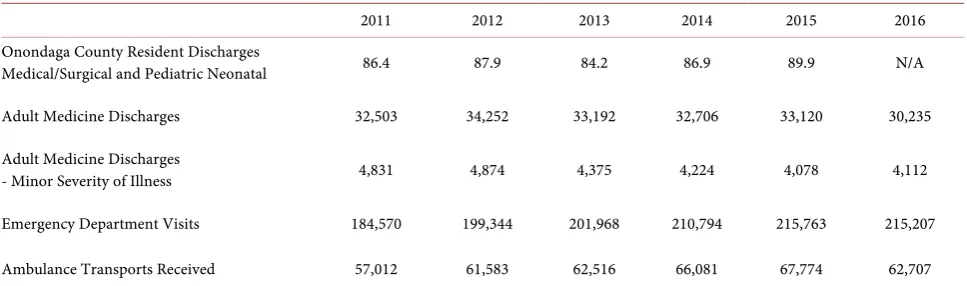
The initial component of the analysis included hospital adult medicine admis-sions/discharges and emergency department visits in the metropolitan area of the Syracuse hospitals. Related data are summarized in Table 1.
Reduction of hospital inpatient admissions and emergency department visits is a major objective of value based purchasing because of the costs of these ser-vices. The study focused on adult medicine admissions because of the potential impact of case management on this population.
Table 1. Selected utilization indicators, Syracuse Hospitals, 2011-2016.
2011 2012 2013 2014 2015 2016
Onondaga County Resident Discharges
Medical/Surgical and Pediatric Neonatal 86.4 87.9 84.2 86.9 89.9 N/A
Adult Medicine Discharges 32,503 34,252 33,192 32,706 33,120 30,235
Adult Medicine Discharges
- Minor Severity of Illness 4,831 4,874 4,375 4,224 4,078 4,112
Emergency Department Visits 184,570 199,344 201,968 210,794 215,763 215,207
Ambulance Transports Received 57,012 61,583 62,516 66,081 67,774 62,707
Onondaga County resident discharges per 1000 population based on New York Statewide Planning and Research Cooperative System (SPARCS) statewide data.
Adult medicine discharges for 2016 annualized based on January-November 2016 actual experience.
4831 to 4112. Much of these reductions occurred because of the movement of a large number of adult medicine inpatients to medical observation status begin-ning in October 2013. This change had a disproportionate impact on low severi-ty of illness admissions because they had the most potential to be served without inpatient admission in 2016. The population was stable during this period.
This information suggested that, during 2015 and 2016, adult medicine utili-zation at Minor severity of illness had stabilized at approximately 4100 annual discharges in the combined Syracuse hospitals. This equated to approximately 342 discharges per month. For case management purposes, this level amounted to a guideline for monitoring reduction of hospital inpatient admissions for this population under value based purchasing. The same approach suggested a guideline of approximately 30,000 annual adult medicine discharges, or 2500 per month for the combined hospitals.
The data in Table 1 also demonstrated that emergency department utilization, another focus on value based purchasing programs, increased markedly in the Syracuse hospitals between 2015 and 2016. Annual emergency department visits increased by 16.6 percent, from 184,570 to 215,207, between 2011 and 2015 be-fore stabilizing at 215,000 between 2015 and 2016. Annual ambulance transports received increased by 18.8 percent, from 57,012 to 67,774, between 2011 and 2015 before declining by 7.5 percent to 62,707 between 2015 and 2016.
These data demonstrated that, in contrast to adult medicine admissions/ discharges, emergency department utilization in the combined Syracuse hospit-als increased for most of the period between 2011 and 2015. This indicator began to stabilize or decline only within the past two years. For case management pur-poses, the levels between 2015 and 2016 will be monitored to determine whether value based purchasing causes the recent reductions to be sustained.
Table 2. Potentially preventable readmissions within 30 days, adult medical/surgical pa-tients—all payors, Syracuse Hospitals, January 2012-September 2016.
January- December
2012
January- December
2013
January- December
2014
January- December
2015
January- September
2016
Number of Readmissions 4129 4154 4020 4000 3066
At Risk Population 48,248 51,354 51,990 53,012 40,867
Readmission Rate 8.56 8.09 7.73 7.55 7.50
Data exclude obstetrics, pediatrics, psychiatry, alcohol/substance abuse treatment, rehabilitation, and all patients aged 0 - 17 years.
The reduction of inpatient hospital readmissions has been a challenge for hospitals in Syracuse and elsewhere because many of these patients require ser-vices that are not available outside hospitals in the community. Reduction of these readmissions will be an objective under value based purchasing.
The data in Table 2 indicated that the adult medical-surgical readmission rate for the Syracuse hospitals declined by 11.8 percent between 2012 and 2015, while the annual number of readmissions declined by 3.1 percent. Most of the reduc-tion in the rate occurred as the total at risk populareduc-tion increased, rather thanas a result of a decline in the original readmission population.
These data suggested that the nursing case management programs in the Sy-racuse hospitals were able to support declines in the readmission rate addressing additional adult medical-surgical patients in the community. This impact was produced through increased coordination with ambulatory care and long term care services. The impact was limited by the extent of alternative services availa-ble for patients who need rehospitalization in the community.
The third component of the study focused on the development of Subacute and Complex Care Programs by nursing case management to reduce inpatient lengths of stay for inpatient lengths of stay for adult medicine and adult surgery in the Syracuse hospitals. Related data are summarized in Table 3.
In the Syracuse hospitals, inpatient stays have been an indicator of the impact of nursing case management for a number of years. As in the case of adult medi-cine admissions/discharges, this impact has been complicated by the movement of adult medicine patients to observation status.
Between 2008 and 2016, inpatient lengths of stay in the Syracuse hospitals were impacted by the implementation of Subacute and Complex Care Programs developed by nursing case managers. These programs were created to address the needs of patients with the longest stays, those requiring long term acute care services for multiple intravenous antibiotics, extended wound care, dialysis, and other services. These services demonstrated the ability of nursing case manage-ment to address community needs by creating new services, as well as by coor-dinating care.
Table 3. Inpatient mean lengths of stay, adult medicine and adult surgery, Syracuse Hos-pitals, 2008, 2010, 2012, 2014, 2016.
2008 2010 2012 2014 2016*
Adult Medicine
Number of Discharges 28,565 32,221 35,274 33,421 30,876
Mean Length of Stay 4.98 5.18 5.14 5.45 5.07
Excess Patient Days 8,569.50 10,955.14 4,938.36 8,355.25 2,778.84
Adult Surgery
Number of Discharges 19,241 19,170 20,439 20,562 20,792
Mean Length of Stay 6.23 6.25 6.04 6.04 5.86
Excess Patient Days 11,544.60 6,901.20 5,927.31 1,850.58 −4,158.40
Long Term Care and
Subacute Program Patients 185 166 104 139 81
*2016 length of stay data annualized based January - October 2016 actual experience.
Adult medicine data exclude Diagnosis Related Groups concerning surgery, obstetrics, pediatrics, psychiatry, alcohol/substance abuse treatment, rehabilitation, and all patients aged 0 - 17 years. Adult surgery data exclude Diagnosis Related Groups concerning medicine, obstetrics, pediatrics, psychiatry, alcohol/substance abuse treatment, and all patients aged 0 - 17 years.
2012 and 2014, the period when the medical observation regulations were im-plemented, before declining to 5.07 days in 2016. This impact was supported by the decline in adult medicine discharges that occurred between 2012 and 2014.
Between 2008 and 2016, adult surgery inpatient stays declined by 5.9 percent, from 6.23 to 5.86 days, in the combined hospitals as admissions/discharges for this service continued to increase. The negative number of excess days for 2016 was produced by a hospital stay that was shorter than the severity adjusted na-tional average.
This contrast demonstrated the impact of changes in the inpatient medicine population. The shift of some adult medicine admissions to observation status caused the inpatient length of stay for remaining inpatients to increase between 2012 and 2014. Inpatient stays for adult surgery, which were not impacted by the shift, continued to decline.
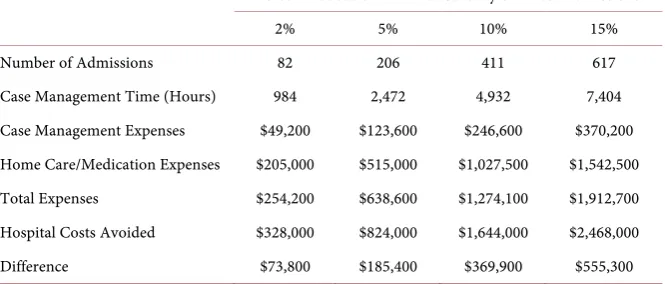
The fourth component of the study involved a summary analysis of the costs and benefits of nursing case management related to reduction of hospital admis-sions/discharges in the combined Syracuse hospitals. Related data are summa-rized in Table 4.
Table 4. Estimated costs and benefits, reducing Minor severity of illness admissions/dis- charges, Syracuse Hospitals.
Percent Reduction in Minor Severity of Illness Admissions
2% 5% 10% 15%
Number of Admissions 82 206 411 617
Case Management Time (Hours) 984 2,472 4,932 7,404
Case Management Expenses $49,200 $123,600 $246,600 $370,200
Home Care/Medication Expenses $205,000 $515,000 $1,027,500 $1,542,500
Total Expenses $254,200 $638,600 $1,274,100 $1,912,700
Hospital Costs Avoided $328,000 $824,000 $1,644,000 $2,468,000
Difference $73,800 $185,400 $369,900 $555,300
for whom hospitalization could be avoided, ranging from 2 percent to 15 per-cent. This amounted to between 82 and 617 patients.
The cost data suggested that, at 12 hours of case management at $50 per hour, these expenses would range from $49,200 for 2 percent of the population to $370,200 for 15 percent of the population. Based on costs of home care and me-dications estimated at $2500 per patient, the data suggested expenses ranging from $205,000 for 2 percent of the population to $1,542,500 for 15 percent of the population. This amounted to a range in expenses from $254,200 to $1,912,700.
The benefits of avoiding these hospital admissions at $4000 per patient ranged from $328,000 for 2 percent of the population to $2,468,000 for 15 percent of the population. Including the expenses for alternative services, this produced an es-timated savings from $73,800 to $555,300.
5. Discussion
The implementation of the Medicare Access and Chip Reauthorization Act (MACRA) promises to bring major changes to the delivery of health care in communities throughout the United States. By providing incentives for making more judicious use of services across the continuum, it will result in fewer hos-pital admissions, readmissions, and emergency department visits.
Historically, Medicare has provided leadership on the implementation of pro-grams to improve the efficiency of health care utilization, such as hospital reim-bursement by discharges in the 1980s. This experience suggests that the impact of MACRA will be extended through other payers such as the DSRIP program for Medicaid in New York State and the Blue Cross Blue Shield ACQA program.
At the community level, these developments will amount to a renewal of in-terest in managed care. The traditional version of this mechanism included di-rect involvement for payers. The current version will involve more didi-rection and activity by providers.
of primary and ambulatory care, case managers can extend their roles beyond hospitals and long term care to address utilization and outcomes throughout lo-cal health care systems. These roles will be necessary for physician practices and allied health providers, as well as hospitals, home health agencies, and nursing homes to meet the clinical and financial objectives of value based purchasing.
This study provided examples of how nursing case managers in the metropol-itan area of Syracuse, New York, a small community with a population of about 600,000 will be addressing the impact of MACRA and related programs. It sug-gested that these activities will include monitoring of important utilization indi-cators, as well as development of additional services. It also suggested that these activities should go beyond coordination of existing services.
The data in this study identified baseline levels in the Syracuse hospitals for case management under value based purchasing utilization indicators including hospital admissions/discharges, emergency department visits, and hospital readmissions. Each of these had a different context. Adult medicine discharges stabilized after the impact of the medical observation regulations was absorbed. Emergency department visits stabilized after a lengthy period of increases. Adult medicine and adult surgery readmissions have declined at a gradual rate. Using these types of data for major value based indicators, nursing case managers should be able to implement approaches to produce additional efficiencies.
The experiences of the Syracuse hospitals suggest that one approach to these efficiencies can be the development of new levels of care similar to the Subacute and Complex Care Programs. These initiatives grew out of the experiences of nursing case managers related to length of stay reduction. They involved the de-velopment of new services for long term acute care. They could also be applied to ambulatory care patients in order to avoid hospital admissions and emergency department visits. They could also be employed to reduce inpatient readmissions with nursing home alternatives.
The study also indicated that the use of case management to reduce utilization of expensive services, such as hospital admissions, can generate financial benefits for health care payers. Estimating the amounts of these benefits requires identi-fication of the costs of case management and the alternative services it employs.
This information demonstrates that the advent of MACRA and other value based purchasing programs will provide important opportunities for health planning and development at the community level. They suggest that nursing case management can be a major tool to address these needs.
References
[1] Dentzler, S. (2011) Urgent Measures for an Old Problem. Health Affairs, 30, 1626. https://doi.org/10.1377/hlthaff.2011.0961
[2] Toone, K. and Muhlstein, D. (2016) MACRA: Quality Incentives, Provider Consid-erations, and the Path Forward. Leavitt Partners, New York.
[3] Barkholz, D. (2016) Under Construction: Risk Based Reimbursement. Modern
[4] Muchmore, S. (2016) Few Docs Ready for Risk. Modern Healthcare, 46, 20-22. [5] Advisory Board (2016) Our First Thoughts on the MACRA Final Rule. Advisory
Board, Washington DC.
[6] Van Dyke, M. (2016) Make Way for MACRA. Hospitals and Health Networks, 90, 27-31.
[7] Rau, J. (2012) Medicare to Penalize 2,211 Hospitals for Excess Readmissions. Kaiser Health News.
[8] Aguilar, A., Dickson, V. and Whitman, E. (2016) Trump’s HHS Nominees Tee up Obamacare Repeal Effort. Modern Healthcare, 46, 8-9.
[9] Whitman, E. (2016) Will Value Based Payment Initiatives Continue Under Trump?
Modern Healthcare, 46, 18.
[10] Dickson, V. (2017) Republicans Target Medicaid, Medicare for Big Changes.
Mod-ern Healthcare, 47, 18.
[11] Rose, S., Zaslavsky, A.M. and McWilliams, J.M. (2016) Variation in Accountable Care Organization Spending and Sensitivity to Risk Adjusting: Implications for Benchmarking. Health Affairs, 35, 440-448.
https://doi.org/10.1377/hlthaff.2015.1026
[12] Tahan, H.A. (1999) Clarifying Case Management: What Is in a Label? Nursing Case
Management, 4, 268-278.
[13] Ahmed, O.I. (2016) Disease Management, Case Management, and Care Coordina-tion. A Framework and Brief Manual for Care Programs and Staff. Professional
Case Management, 25, 137-146.
[14] Mullahy, C. (2017) Case Manager’s Handbook. 6th Edition, Jones and Bartlett Learning, Burlington, 548.
[15] Joo, J.Y. and Huber, D.L. (2014) Evidence Based Nursing Case Management in Community Health. Professional Case Management, 19, 265-273.
https://doi.org/10.1097/NCM.0000000000000058
[16] American Nurses Association (2013) The Supreme Court Decision Matters for Reg-istered Nurses, Their Families, and Their Patients. www.nursingworld.org [17] Lagoe, R., Pasinski, T., Kronenberg, P., Quinn, T. and Schaengold, P. (2006)
Link-ing Health Services at the Community Level. Canada Healthcare Quarterly, 9, 60-
65. https://doi.org/10.12927/hcq..18229
[18] Lagoe, R.J., Westert, G.P., Kendrick, K., Morreale, G. and Mnich, S. (2005) Manag-ing Hospital Length of Stay Reduction: A Multihospital Approach. Health Care
Management Review, 30, 89-92.
https://doi.org/10.1097/00004010-200504000-00002
[19] Lagoe, R.J., Nanno, D.S. and Luziani, M.E. (2012) Quantitative Tools for Address-ing Hospital Readmissions. BMC Research Notes, 5, 620.
Submit or recommend next manuscript to SCIRP and we will provide best service for you:
Accepting pre-submission inquiries through Email, Facebook, LinkedIn, Twitter, etc. A wide selection of journals (inclusive of 9 subjects, more than 200 journals)
Providing 24-hour high-quality service User-friendly online submission system Fair and swift peer-review system
Efficient typesetting and proofreading procedure
Display of the result of downloads and visits, as well as the number of cited articles Maximum dissemination of your research work
Submit your manuscript at: http://papersubmission.scirp.org/