Munich Personal RePEc Archive
Technical Appendix to "Macroeconomic
effects of public sector unions"
Vasilev, Aleksandar
AUBG
June 2013
Online at
https://mpra.ub.uni-muenchen.de/68235/
Technical Appendix to ”Macroeconomic effects of public
sector unions
Aleksandar Vasilev
∗December 6, 2015
1
Technical Appendix
1.1
Optimality conditions
1.1.1 Firm’s problem
The profit function is maximized when the derivatives of that function are set to zero.
Therefore, the optimal amount of capital - holding the level of technologyAt and labor input
Ntp constant - is determined by setting the derivative of the profit function with respect to
Ktp equal to zero. This derivative is
(1−θ)At(Kp t)
−θ
(Ntp)θ(Kg
t)ν−rt = 0 (1)
where (1−θ)At(Ktp)−θ
(Ntp)θ(Ktg)ν is the marginal product of capital because it expresses
how much output will increase if capital increases by one unit. The economic interpretation
of this First-Order Condition (FOC) is that in equilibrium, firms will rent capital up to
the point where the benefit of renting an additional unit of capital, which is the marginal
product of capital, equals the rental cost, i.e the interest rate.
rt = (1−θ)At(Ktp)
−θ
(Ntp)θ(Ktg)ν (2)
∗Asst. Professor, American University in Bulgaria, Department of Economics, Blagoevgrad 2700,
Now, multiply byKtp and rearrange terms. This gives the following relationship:
Ktp(1−θ)At(Kp t)
−θ
(Ntp)θ(Ktg)ν =rtKtp or (1−θ)Yt =rtKtp (3)
because
Ktp(1−θ)At(Ktp)
−θ
(Ntp)θ(Ktg)ν =At(Ktp)1
−θ
(Ntp)θ(Ktg)ν = (1−θ)Yt
To derive firms’ optimal labor demand, set the derivative of the profit function with respect
to the labor input equal to zero, holding technology and capital constant:
θAt(Ktp)1
−θ
(Ntp)θ
−1
(Ktg)ν −wpt = 0 or wpt =θAt(Ktp)1
−θ
(Ntp)θ
−1
(Ktg)ν (4)
In equilibrium, firms will hire labor up to the point where the benefit of hiring an additional
hour of labor services, which is the marginal product of labor, equals the cost, i.e the hourly
wage rate.
Now multiply both sides of the equation by Ntp and rearrange terms to yield
NtpθAt(Ktp)1
−θ
(Ntp)θ
−1
(Ktg)ν =wtpNtp or θYt =wptNtp (5)
Next, it will be shown that in equilibrium, economic profits are zero. Using the results above
one can obtain
Πt = Yt−rtKtp−wptNtp =Yt−(1−θ)Yt−θYt= 0 (6)
Indeed, in equilibrium, economic profits are zero.
1.1.2 Consumer problem
Set up the Lagrangian
L(Ct, Kp t+1, N
p
t; Λt) =E0 ∞
X
t=0
(
(Ct+ωGct)ψ(1−Nt)(1
−ψ)
1−α
−1
1−α + (7)
+Λt
"
(1−τl)(wtpNtp+wtgNtg) + (1−τk)rtKtp +
+τkδpKtp−(1 +τc)Ct−Ktp+1+ (1−δ)K
p t
This is a concave programming problem, so the FOCs, together with the additional,
bound-ary (”transversality”) conditions for private physical capital and government bonds are both
necessary and sufficient for an optimum.
To derive the FOCs, first take the derivative of the Lagrangian w.r.t Ct (holding all other
variables unchanged) and set it to 0,i.e. LC
t = 0. That will result in the following expression
βt
(
1−α 1−α
(Ct+ωGct)ψ(1−Nth)(1
−ψ)
−α
×
ψ(Ct+ωGct)ψ
−1
(1−Nh t)(1
−ψ)
−Λt(1 +τc)
)
= 0 (8)
Cancel the βt and the 1−α terms to obtain
(Ct+ωGct)ψ(1−Nt)(1
−ψ)
−α
ψ(Ct+ωGct)ψ
−1
(1−Nt)(1−ψ)
−Λt(1 +τc) = 0 (9)
Move Λt to the right so that
(Ct+ωGct)ψ(1−Nt)(1
−ψ)
−α
ψ(Ct+ωGct)ψ
−1
(1−Nt)(1−ψ)
= Λt(1 +τc) (10)
This optimality condition equates marginal utility of consumption to the marginal utility of
wealth.
Now take the derivative of the Lagrangian w.r.tKtp+1 (holding all other variables unchanged)
and set it to 0, i.e. L
Ktp+1 = 0. That will result in the following expression
βt
(
−Λt+EtΛt+1
(1−τk)rt+1+τkδp + (1−δp)
)
= 0 (11)
Cancel the βt term to obtain
−Λt+βEtΛt+1
(1−τk)rt+1+τkδp+ (1−δp)
= 0 (12)
Move Λt to the right so that
βEtΛt+1
(1−τk)rt+1+τkδp+ (1−δp)
Using the expression for the real interest rate shifted one period forward one can obtain
rt+1 = (1−θ)
Yt+1
Ktp+1
βEtΛt+1
(1−τk)(1−θ)Yt+1
Ktp+1 +τ
kδp+ (1−δp)
= Λt (14)
This is the Euler equation, which determines how consumption is allocated across periods.
Take now the derivative of the Lagrangian w.r.t Ntp (holding all other variables unchanged)
and set it to 0, i.e. LNp
t = 0. That will result in the following expression
βt
(
1−α 1−α
(Ct+ωGct)ψ(1−Nt)(1
−ψ)
−α
×
(1−ψ)(Ct+ωGc
t)ψ(1−Nt)
−ψ
(−1) + Λt(1−τl)wp t
)
= 0 (15)
Cancel the βt and the 1−α terms to obtain
(Ct+ωGct)ψ(1−Nt)(1
−ψ)
−α
(1−ψ)
Ct+ωGct 1−Nt
ψ
(−1) + Λt(1−τl)wp
t = 0 (16)
Rearranging, one can obtain
(Ct+ωGct)ψ(1−Nt)(1
−ψ)
−α
(1−ψ)(Ct+ωGc
t)ψ(1−Nt)
−ψ
= Λt(1−τl)wp
t (17)
Plug in the expression for wh
t, that is,
wpt =θ
Yt
Ntp (18)
into the equation above. Rearranging, one can obtain
(Ct+ωGct)ψ(1−Nt)(1
−ψ)
−α
(1−ψ)(Ct+ωGc
t)ψ(1−Nt)
−ψ
= Λt(1−τl)θ Yt
Ntp
(19)
Transversality conditions need to be imposed to prevent Ponzi schemes, i.e borrowing bigger
and bigger amounts every subsequent period and never paying it off.
lim t→∞β
tΛ
1.1.3 The Objective Function of a Public Sector Union: Derivation
This subsection shows that the objective function in the government sector is a generalized
version of Stone-Geary monopoly union utility function used in Dertouzos and Pencavel
(1981) and Brown and Ashenfelter (1986). The utility function is
V(wg, Ng) = (wg −w¯g)φ(Ng−N¯g)(1−φ)
, (21)
where φ and 1−φ are the weights attached to public wage and hours, respectively, and ¯wg
and ¯Ng denote subsistence wage rate and hours. Since there is no minimum wage in the
model, ¯wg = 0. Additionally, as public hours are assumed to be unproductive, it follows
that ¯Ng = 0 as well. Therefore, the utility function simplifies to
V(wg, Ng) = (wg)φ(Ng)(1−φ)
. (22)
Doiron (1992) uses a generalized representation, which encompasses (2) as a special case
when ρ→0.
φ(Ng)−ρ
+ (1−φ)(wg−w¯)−ρ
−1/ρ
, (23)
when ¯w= 0, the function simplifies to
φ(Ng)−ρ
+ (1−φ)(wg)−ρ
−1/ρ
, (24)
Union objective function used in the paper is very similar to Doiron’s (1992) simplified
version:
(Ng)ρ+η(wg)ρ
1/ρ
, (25)
can be transformed to
(Ng)ρ+ φ (1−φ)(w
g)ρ
1/ρ
, (26)
Collecting terms under common denominator
(1−φ) (1−φ)(N
g)ρ+ φ (1−φ)(w
g)ρ
1/ρ
Factoring out the common term
1 1−φ
1/ρ
(1−φ)(Ng)ρ+φ(wg)ρ
1/ρ
, (28)
Note that the constant term
1 1−φ
1/ρ
>0 can be ignored, as utility functions are invariant
to positive affine transformations. After rearranging terms, the equivalent function
˜
V =
φ(wg)ρ+ (1−φ)(Ng)ρ
1/ρ
. (29)
Take natural logarithms from both sides to obtain
ln ˜V = 1
ρln
φ(wg)ρ+ (1−φ)(Ng)ρ
. (30)
Take the limit ρ→0
lim
ρ→0ln ˜V = limρ→0
ln
φ(wg)ρ+ (1−φ)(Ng)ρ
ρ (31)
Apply L’Hopital’s Rule on the R.H.S. to obtain
lim
ρ→0ln ˜V = limρ→0
∂ ∂ρln
φ(wg)ρ+ (1−φ)(Ng)ρ
∂ρ ∂ρ
(32)
Thus
ln ˜V = lim ρ→0
φ(wgt)ρlnwg+ (1−φ)(Ng)ρlnNg
/
φ(wg)ρ+ (1−φ)(Ng)ρ
1 (33)
Simplify to obtain
ln ˜V =
limρ→0
φ(wgt)ρlnwg+ (1−φ)(Ng)ρlnNg
limρ→0
φ(wg)ρ+ (1−φ)(Ng)ρ
=
φlnwg + (1−φ) lnNg
φ+ (1−φ) (34)
Therefore,
Exponentiate both sides of the equation to obtain
eln ˜V =eφlnwg+(1−φ) lnNg
. (36)
Thus
˜
V =eln(wg)φ+ln(Ng)(1−φ)
. (37)
or
˜
V =eln(wg)φ(Ng)(1−φ)
. (38)
Finally,
˜
V = (wg)φ(Ng)(1−φ)
(39)
Furthermore, government period budget constraint serves the role of a labor demand
func-tion. Additionally, the public sector demand curve will be subject to shock, resulting from
innovations to the fiscal shares. The balanced budget assumption is thus important in the
model setup. Since wage bill is a residual, if wage rate is increased, then hours need to be
decreased. Additionally, government period budget constraint can be expressed in the form
Ng =Ng(wg) as
Ng = τ
lwpNp +τk(r−δp)Kp+τcC−Gc−Gi−Gt
(1−τl)wg (40)
Therefore, the problem in the government sector is reshaped in the standard formulation in
the union literature:
max wg,NgV(w
g, Ng) s.t. Ng =Ng(wg) (41)
Since union optimizes over both the public wage and hours, the outcome is efficient. The
solution pair is on the contract curve (obtained from FOCs), at the intersection point with
1.1.4 Public sector union optimization problem
The union solves the following problem:
max wtg,N
g t
(Ntg)ρ+η(wgt)ρ
1/ρ
(42)
s.t
Gct+Gtt+Git+wtgNtg =τcCt+τkrtKtp−τkδpKt+τl[wptNtp +wgtNtg] (43)
Setup the Lagrangian
V(wg
t, Ntg;νt) = max wgt,N
g t
(Ntg)ρ+η(wgt)ρ
1/ρ
(44)
−νt
Gct +Gtt+Git+wtgNtg−τcCt−τkrtKtp+τkδpKt−τl[wtpNtp+wtgNtg]
Optimal public employment is obtained, when the derivative of the government Lagrangian
is et to zero, i.e V
Ntg = 0
(1/ρ)
(Ntg)ρ+η(wg t)ρ
(1/ρ)−1
ρ(Ntg)ρ−1
−(1−τl)νtwg
t = 0 (45)
or, when ρ is canceled out and (1−τl)νtwg
t put to the right
(Ntg)ρ+η(wgt)ρ
(1/ρ)−1
(Ntg)ρ−1
= (1−τl)νtwg
t (46)
Optimal public wage is obtained, when the derivative of the government Lagrandean is et
to zero, i.e Vwg t = 0
(1/ρ)
(Ntg)ρ+η(wtg)ρ
(1/ρ)−1
ηρ(wgt)ρ−1
−(1−τl)νtNg
t = 0 (47)
or, when ρ is canceled out and(1−τl)ν
tNtg term put to the right
(Ntg)ρ+η(wtg)ρ
(1/ρ)−1
η(wtg)ρ−1
= (1−τl)νtNg
t (48)
Divide (11.1.46) and (11.1.48) side by side to obtain
(Ntg)ρ+η(wgt)ρ
(1/ρ)−1
(Ntg)ρ
−1
(Ntg)ρ+η(wtg)ρ
(1/ρ)−1
η(wtg)ρ−1
= (1−τ l)ν
twtg (1−τl)ν
tNtg
Cancel out the common terms
(Ntg)ρ
−1
η(wtg)ρ−1 =
wtg
Ntg (50)
Now cross-multiply to obtain
(Ntg)ρ
η = (w
g
t)ρ (51)
Hence
wtg =
1
η
1/ρ
Ntg (52)
The wage bill expression, which is obtained after simple rearrangement of the government
budget constraint, is as follows
wtgNtg =
τcC
t+τkrtKtp−τkδpKt+τlwptNtp−Gtc−Gtt−Git
1−τl (53)
Use the wage bill equation and the relationship between public wage and employment in
order to obtain
wtg =η
−1
2ρ
τcC
t+τkrtKtp−τkδpKt+τlwtpNtp−Gtc−Gtt−Git 1−τl
12
(54)
and
Ntg =η21ρ
τcC
t+τkrtKtp−τkδpKt+τlwptN p
t −Gct −Gtt−Git 1−τl
12
1.2
Log-linearized model equations
1.2.1 Linearized market clearing
ct+kpt+1+gtc+gti−(1−δp)k p
t = yt (56)
Take logs from both sides to obtain
ln[ct+kpt+1+gtc+gti−(1−δp)k p
t] = ln(yt) (57)
Totally differentiate with respect to time
dln[ct+kpt+1+gtc+gti−(1−δp)k p t]
dt = dln(yt) (58)
[ 1
c+gc +gi+δpkp][
dct dt c c + dgc t dt g g + dgi t dt gi
gi +
dktp+1 dt
kp
kp −(1−δ p)dk
p t
dt kp
kp] =
dyt
dt
1
y (59)
Define ˆz = dzt
dt
1
z. Thus passing to log-deviations 1
y[ˆctc+ ˆg
c
tgc + ˆgitgi + ˆk p
t+1kp−(1−δp)ˆk
p
tkp] = ˆyt (60)
ˆ
ctc+ ˆgtcgc + ˆgitgi + ˆk p
t+1kp−(1−δp)ˆk
p
tkp = yyˆt (61)
kpˆkpt+1 = yyˆt−ccˆt−gcˆgtc−giˆgti+ (1−δp)kpkˆ p
t (62)
1.2.2 Linearized production function
yt = at(kpt)1
−θ
(npt)θ(kgt)ν (63)
Take natural logs from both sides to obtain
lnyt = lnat+ (1−θ) lnktp+θlnn p
t +νlnk g
t (64)
Totally differentiate with respect to time to obtain
dlnyt
dt =
dlnat
dt + (1−θ) dlnkpt
dt +θ
dlnnpt
dt +ν
dlnkgt
dt (65) 1 y dyt dt = 1 a dat dt +
1−θ
kp
dkpt dt +
θ np
dnpt
dt +
ν kg
dktg
dt (66)
Pass to log-deviations to obtain
0 = −yˆt+ (1−θ)ˆkp
t + ˆat+θnˆpt +νkˆ g
1.2.3 Linearized FOC consumption
[(ct+ωgtc)ψ(1−nt)(1
−ψ)
]−α
ψ(ct+ωgtc)ψ
−1
(1−nt)(1−ψ)
= (1 +τc)λt (68)
Simplify to obtain
ψ(ct+ωgtc)ψ
−1−αψ
(1−nt)(1−α)(1−ψ)
= (1 +τc)λt (69)
Take natural logs from both sides to obtain
lnψ(ct+ωgtc)ψ
−1−αψ
(1−nt)(1−α)(1−ψ)
= ln(1 +τc) + lnλ
t (70)
ln(ct+ωgtc)ψ
−1−αψ
(1−nt)(1−α)(1−ψ)
= ln(1 +τc) + lnλ
t (71)
(ψ−1−αψ) ln(ct+ωgc
t) + (1−α)(1−ψ) ln(1−nt) = ln(1 +τc) + lnλt (72)
Totally differentiate with respect to time to obtain
(ψ−1−αψ)dln(ct+ωg c t)
dt + (1−α)(1−ψ)
dln(1−nt)
dt =
= dln(1 +τ c)
dt +
dlnλt
dt (73)
(ψ−1−αψ) 1
c+ωgc(
dct
dt +ω dgc
t
dt ) + (1−α)(1−ψ)
−1 1−n
dnt dt = dλt dt 1 λ (74)
(ψ−1−αψ)
c+ωgc
dct
dt c c +
ω(ψ−1−αψ)
c+ωgc
dgc t
dt gc
gc +
−(1−α)(1−ψ) 1 1−n
dnt dt n n = dλt dt 1 λ (75)
c(ψ−1−αψ)
c+ωgc cˆt+
ωgc(ψ−1−αψ)
c+ωgc gˆ c
t −(1−α)(1−ψ)
n
1−nnˆ = ˆλt (76) Since
ˆ
n = n
p
np+ngˆn
p+ ng
np+ngnˆ g = np
n nˆ
p+ ng
nnˆ
g, (77)
and consumers choose np only, pass to log-deviations to obtain
c(ψ−1−αψ)
c+ωgc cˆt+
ωgc(ψ−1−αψ)
cc+ωg gˆ c
t −(1−α)(1−ψ)
n
1−n
np
np +ngˆn
p = ˆλ
t (78)
Since n=np +ng, it follows that
c(ψ−1−αψ)
c+ωgc ˆct+
ωgc(ψ−1−αψ)
c+ωgc ˆg c
t −(1−α)(1−ψ)
np 1−nnˆ
1.2.4 Linearized no-arbitrage condition for capital
λt = βEtλt+1[(1−τk)rt+1+τkδp+ (1−δp)] (80)
Substitute out rt+1 on the right hand side of the equation to obtain
λt = βEt[λt+1((1−τk)(1−θ)
yt+1
ktp+1 +τ
kδp+ 1−δp)] (81)
Take natural logs from both sides of the equation to obtain
lnλt = lnEt[λt+1((1−τk)(1−θ)
yt+1
ktp+1 +τ
kδp+ 1−δp)] (82)
Totally differentiate with respect to time to obtain
dlnλt
dt =
dlnEt[λt+1((1−τk)(1−θ)yktp+1 t+1 +τ
kδp+ 1−δp)]
dt (83)
1
λ dλt
dt =Et
(
1
λ((1−τk)(1−θ)y
kp + 1−δp+τkδp
×
"
((1−τk)(1−θ)y
kp +τ
kδp + 1−δp)dλt+1
dt λ λ
+λ(1−τ
k)(1−θ)
kp
dyt+1
dt y y −
λ(1−τk)(1−θ)y (kp)2
dktp+1 dt
kp
kp
#)
(84)
Pass to log-deviations to obtain
ˆ
λt=Et
(
ˆ
λt+1+
(1−τk)(1−θ)y ((1−τk)(1−θ)yt+1
kpt+1 +τ
kδp+ 1−δp)kpyˆt+1
− (1−τ
k)(1−θ)y
((1−θ)yt+1
ktp+1 +τ
kδp+ 1−δp)kpkˆ p t+1
)
(85)
Observe that
(1−τk)(1−θ)yt+1
ktp+1 +τ
kδp+ 1−δp = 1/β (86)
Plug it into the equation to obtain
ˆ
λt = Et
ˆ
λt+1+
β(1−τk)(1−θ)y
kp yˆt+1−
β(1−τk)(1−θ)y
kp ˆk
p t+1
(87)
ˆ
λt = Etλˆt+1+
β(1−τk)(1−θ)y
kp Etˆyt+1−
β(1−τk)(1−θ)y
kp Etˆk
p
1.2.5 Linearized MRS
(1−ψ)(ct+ωgc
t) = ψ(1−nt)
(1−τl) (1 +τc)θ
yt
npt
(89)
Take natural logs from both sides of the equation to obtain
ln(1−ψ)(ct+ωgc
t) = lnψ(1−nt)
(1−τl) (1 +τc)θ
yt
npt
(90)
ln(ct+ωgct) = ln(1−nt) + lnyt−lnnpt (91)
Totally differentiate with respect to time to obtain
dln(ct+ωgtc)
dt =
dln(1−nt)
dt +
dlnyt
dt −
dlnnpt
dt (92)
1
c+ωgc(
dct
dt +ω dgc
t
dt ) = −
1 1−n
dnt dt + 1 y dyt dt − 1 np
dnpt
dt (93)
1
c+ωgc
dct
dt c c+
ω c+ωgc
dgc t
dt gc
gc = −
1 1−n
dnt dt n n + 1 y dyt dt − 1 np
dnpt
dt (94)
c c+ωgc
dct
dt
1
c + ωgc
c+ωgc
dgc t
dt
1
gc = −
n
1−n
dnt dt 1 n + 1 y dyt dt − 1 np
dnpt
dt (95)
Pass to log-deviations to obtain
c
c+ωgccˆt+
ωgc
c+ωggˆ
c
t = −
n
1−nnˆ+ ˆyt−nˆ p
t (96)
Since
ˆ
n= n
p
np+ngnˆ
p+ ng
np+ngnˆ
g, (97)
and noting that consumers are only choosing np, then
c
c+ωgccˆt+
ωgc
c+ωgcˆg c
t = −
n
1−n
np
np+ngˆn p+ ˆy
t−nˆpt (98)
c
c+ωgccˆt+
ωgc
c+ωgcˆg c
t = −
n
1−n
np
np+ngˆn p+ ˆy
t−nˆpt (99)
c
c+ωgcˆct+
ωgc
c+ωgcgˆ c
t = −
1 + n 1−n
np
np+ng
ˆ
np+ ˆyt (100)
Since n=np +ng, it follows that
c
c+ωgcˆct+
ωgc
c+ωgcgˆ c
t = −
1 + n p 1−n
ˆ
np+ ˆyt (101)
c
c+ωgcˆct+
ωgc
c+ωgcˆg c t +
1 + n p 1−n
ˆ
1.2.6 Linearized private capital accumulation
ktp+1 = it+ (1−δp)ktp (103)
Take natural logs from both sides of the equation to obtain
lnkpt+1 = ln(it+ (1−δp)ktp) (104)
Totally differentiate with respect to time to obtain
dlnkpt+1
dt =
1
i+ (1−δp)kp
d(it+ (1−δp)ktp)
dt (105)
Observe that since
i=δpkp, it follows that i+ (1−δp)kp =δpkp+ (1−δp)kp =kp. Then (106)
dktp+1 dt
1
kp =
1
kp
dit
dt i i +
kp
i+ (1−δp)kp t
dkpt dt
kp
kp (107)
Pass to log-deviations to obtain
ˆ
kpt+1 = δ pkp
kp ˆit+
(1−δp)kp
kp kˆ p
t (108)
ˆ
ktp+1 = δpˆit+ (1−δp)ˆktp (109)
1.2.7 Linearized government capital accumulation
kgt+1 = gti+ (1−δg)kg
t (110)
Take natural logs from both sides to obtain
lnktg+1 = ln(gti+ (1−δg)kg
t) (111)
Totally differentiate with respect to time to obtain
dlnktg+1
dt =
1
gi+ (1−δg)kg
d(git+ (1−δg)ktg)
dt (112)
Observe that since
it follows that
gi+ (1−δg)kg =δgkg+ (1−δg)kg =kg. (114)
Hence,
dktg+1 dt
1
kg = 1 kg dgi t dt gi
gi +
kg
x+ (1−δg)
dkgt dt
kg
kg (115)
Pass to log-deviations to obtain
ˆ
ktg+1 = δ gkg
kg ˆg i t+
(1−δg)kg
kg ˆk g
t (116)
Cancel out the kg terms to obtain
ˆ
ktg+1 = δgˆgti+ (1−δg)ˆkg
t (117)
1.2.8 Public wage rate rule
wgt =η−1
2ρ
τcc
t+τkrtktp−τkδpk p t +τlw
p tn
p
t −gct−gtt−gti 1−τl
12
(118)
Take logs from both sides to obtain
lnwgt =− 1
2ρlnη−
1
2ln(1−τ l) +
1 2ln
τcct+τkrtktp−τkδpktp+τlwtpnpt −gct −gtt−gti
(119)
Totally differentiate with respect to time to obtain
dlnwgt
dt = 1 2 d dtln
τcct+τkrtktp−τkδpk p t +τlw
p tn
p
t −gct −gtt−gti
(120)
Observe that
τkrtkpt −τkδpkt+τlwtpnpt =τk(1−θ)yt+τlθyt−τkδpkpt =
=
τk(1−θ) +τlθ
yt−τkδpktp (121)
Also
(1−τl)wgng =τcc+ [τk(1−θ) +τlθ]y−τkδpkp−gc−gi−gt
Thus
dwtg dt
1
wg = 1 2
1 (1−τl)wgng
τcdct dt + [τ
k(1−θ) +τlθ]dyt
dt −τ
kδpdk p t dt − dgc t dt − dgi t dt − dgt t dt (123)
dwtg dt
1
wg = 1 2
1
(1−τl)wgng ×
τcdct dt
c c+
τk(1−θ) +τlθ
dyt
dt y y −τ
kδpdk p t
dt kp
kp −
dgc t
dt gc
gc −
dgi t
dt gi
gi −
dgt t dt gt gt (124)
dwtg dt
1
wg =
(1/2)τcc (1−τl)wgng
dct
dt
1
c +
(1/2)
τk(1−θ) +τlθ
y
(1−τl)wgng
dyt
dt
1
y
−(1/2)τ kδpkp (1−τl)wgng
dktp
dt
1
kp −
(1/2)gc (1−τl)wgng
dgc t
dt
1
gc
− (1/2)g i
(1−τl)wgng
dgi t
dt
1
gi −
(1/2)gt (1−τl)wgng
dgt t
dt
1
gt (125)
Pass to log-deviations to obtain
ˆ
wgt =
(1/2)τcc (1−τl)wgngcˆt+
(1/2)
τk(1−θ) +τlθ
y
(1−τl)wgng yˆt
−(1/2)τ kδpkp
(1−τl)wgngˆkt−
(1/2)gc (1−τl)wgnggˆ
c t −
(1/2)gi (1−τl)wgngˆg
i t−
(1/2)gt (1−τl)wgnggˆ
t
t (126)
1.2.9 Public hours/employment rule
ngt = η1ρwg
t (127)
Take logs from both sides to obtain
lnngt = 1
ρlnη+ lnw
g
t (128)
Totally differentiate both sides to obtain
dlnngt
dt =
dlnwgt
dt (129)
dngt
dt
1
ng =
dwgt
dt
1
wg (130)
Pass to log-deviations to obtain
ˆ
1.2.10 Total hours/employment
nt = ngt +n p
t (132)
Take logs from both sides to obtain
lnnt = ln(ngt +n p
t) (133)
Totally differentiate to obtain
dlnnt
dt =
dln(ngt +npt)
dt (134) dnt dt 1 n =
dngt
dt +
dnpt
dt 1 n (135) dnt dt 1 n =
dngt
dt ng
ng +
dnpt
dt np np 1 n (136) dnt dt 1 n =
dngt dt
1
ng
ng
n +
dnpt dt
1
np
np
n (137)
Pass to log-deviations to obtain
ˆ
nt =
ng
n nˆ
g t +
np
n nˆ
p
t (138)
1.2.11 Linearized private wage rate
wpt =θ
yt
npt (139)
Take natural logarithms from both sides to obtain
lnwtp = lnθ+ lnyt−lnnpt (140)
Totally differentiate with respect to time to obtain
dlnwpt
dt =
dlnθ
dt +
dlnyt
dt −
dlnnpt
dt (141)
Simplify to obtain
dwpt dt
1
wp =
dyt
dt
1
y − dnpt
dt
1
np (142)
Pass to log-deviations to obtain
ˆ
1.2.12 Linearized real interest rate
rt=θ
yt
kpt
(144)
Take natural logarithms from both sides to obtain
lnrt = lnθ+ lnyt−lnktp (145)
Totally differentiate with respect to time to obtain
dlnrt
dt =
dlnθ
dt +
dlnyt
dt −
dlnktp
dt (146)
Simplify to obtain
dr dt
1
r = dyt
dt
1
y − dktp
dt
1
kp (147)
Pass to log-deviations to obtain
ˆ
rt = ˆyt−ˆktp (148)
1.2.13 Public/private wage ratio
rwt = wgt/wpt (149)
Take logs from both sides of the equation
lnrwt = lnwtg−lnw p
t (150)
Totally differentiate to obtain
dlnrwt
dt =
dlnwtg
dt −
dlnwpt
dt (151)
drwt
dt
1
rw =
dwgt dt
1
wg −
dwtp dt
1
wp (152)
Pass to log-deviations to obtain
ˆ
1.2.14 Public/private hours/employment ratio
rlt = ngt/n p
t (154)
Take logs from both sides of the equation
lnrlt = lnngt −lnnpt (155)
Totally differentiate to obtain
dlnrlt
dt =
dlnngt
dt −
dlnnpt
dt (156)
drlt
dt
1
rl =
dngt
dt
1
ng −
dnpt
dt
1
np (157)
Pass to log-deviations to obtain
ˆ
rlt = ˆngt −nˆ p
t (158)
1.2.15 Linearized technology shock process
lnat+1 = ρalnat+ǫat+1 (159)
Totally differentiate with respect to time to obtain
dlnat+1
dt = ρa
dlnat
dt +
dǫa t+1
dt (160)
dat+1
dt = ρa
dat
dt +ǫ
a
t+1 (161)
where for t = 1 dǫat+1
dt ≈ ln(e ǫa
t+1/eǫa) = ǫa
t+1−ǫa =ǫat+1 since ǫa = 0. Pass to log-deviations
to obtain
ˆ
1.2.16 Linearized stochastic process for government consumption/output share
lngtcy+1 = (1−ρg) lngcy+ρglngcy
t +ǫct+1 (163)
Totally differentiate with respect to time to obtain
dlngtcy+1
dt = (1−ρ
g)dlngcy
dt +ρ
gdlng cy t
dt +
dǫc t+1
dt (164)
dgcyt+1
dt = ρg
dgtcy
dt +ǫ
c
t+1 (165)
where for t= 1 dǫct+1
dt ≈ln(e ǫc
t+1/eǫc) = ǫc
t+1−ǫc =ǫct+1 since ǫc = 0. Pass to log-deviations to
obtain
ˆ
gtcy+1 = ρgˆgtcy+ǫct+1 (166)
1.2.17 Linearized level of government consumption
gtc =gtcyyt (167)
Take natural logarithms from both sides to obtain
lngtc = lngtcy+ lnyt (168)
Totally differentiate with respect to time to obtain
dlngc t
dt =
dlngtcy
dt +
dlnyt
dt (169)
dgc t
dt
1
gc =
dgtcy
dt
1
gc +
dyt
dt
1
y (170)
Pass to log-deviations to obtain
ˆ
1.2.18 Linearized stochastic process for the government investment/output ra-tio
lngiyt+1 = (1−ρi) lngiy+ρilngiy
t +ǫit+1 (172)
Totally differentiate with respect to time to obtain
dlngiyt+1
dt = (1−ρ
i)dlngiy
dt +ρ
idlng iy t
dt +
dǫi t+1
dt (173)
dgtiy+1
dt = ρg
dgiyt dt +ǫ
i
t+1 (174)
where fort = 1 dǫit+1
dt ≈ln(e ǫi
t+1/eǫi) =ǫi
t+1−ǫi =ǫit+1 since ǫi = 0. Pass to log-deviations to
obtain
ˆ
gtiy+1 = ρigˆiyt +ǫit+1 (175)
1.2.19 Linearized level of government investment
gti =gtiyyt (176)
Take natural logarithms from both sides to obtain
lngit= lngtiy+ lnyt (177)
Totally differentiate with respect to time to obtain
dlngi t
dt =
dlngtiy
dt +
dlnyt
dt (178)
dgi t
dt
1
gi =
dgtiy dt
1
gi +
dyt
dt
1
y (179)
Pass to log-deviations to obtain
ˆ
1.2.20 Linearized level of government transfers
gtt=gtyyt (181)
Take natural logarithms from both sides to obtain
lngtt= lngty+ lnyt (182)
Totally differentiate with respect to time to obtain
dlngt t
dt =
dlngty
dt +
dlnyt
dt (183)
dgt t
dt
1
gt =
dyt
dt
1
y (184)
Pass to log-deviations to obtain
ˆ
1.3
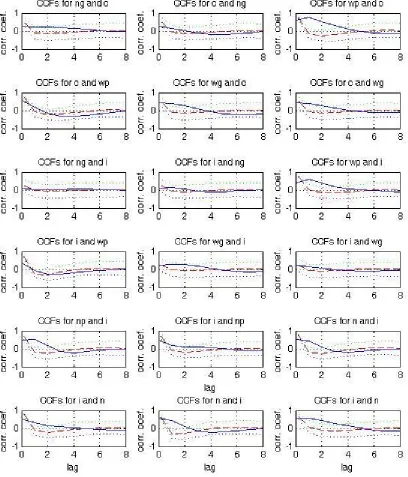
Auto- and cross-correlation functions
As an additional test of model fit, this appendix compares auto- and cross-correlation
func-tions generated from the model with collective bargaining and Finn (1998) calibrated for
Germany, with their empirical counterparts. The main emphasis in this subsection is on the
ACFs and CCFs of labor market variables. In particular, close attention is paid to cyclical
properties of public and private wage rates and hours. To establish 95% confidence intervals
for the theoretical ACFs and CCFs, as in Gregory and Smith (1991), the simulated time
series are used to obtain 1000 ACFs and CCFs. The mean ACFs and CCFs are computed by
averaging across simulations, as well as the corresponding standard error across simulations.
Those moments allow for the lower and upper bounds for the ACFs confidence intervals to
be estimated. The empirical ACFs and CCFs are then plotted, together with the theoretical
ones. If empirical ACFs lie within the confidence region, this means that the calibrated
model fits data well.
Empirical ACFs and CCFs were generated from a Vector Auto-Regressive (VAR) process of
order 1. Since ACFs and CCFs are robust to identifying restrictions (Canova (2007), Ch.7),
the VAR(1) was left unrestricted. The figures on the following pages display empirical ACFs
(solid line), together with the simulated average ACFs (dashed line) and the corresponding
stochastic error bounds (dotted lines). This is done for the union model first , and then for
the calibration using Finn’s (1998) framework.
The model with the public sector union calibrated for Germany outperforms Finn (1998),
especially in the prediction of the dynamic behavior of labor market variables. In terms
of capturing the autocorrelation structure of the variables, the union model fits data quite
well. One exception is the public sector wage: in data, it is highly autocorrelated, while the
model generates low persistence. A possible explanation could be that the public union puts
weight also on last year’s public sector wage level, i.e. the union bargains over the public
wage increase rate, and not just the wage level. Public and total hours are also borderline
perfect positive contemporaneous correlation between public wages and hours, while in data,
it is negative. Overall, the model with public sector union calibrated for Germany captures
the dynamic co-movement of hours and wages with output, consumption and investment.
In addition, union model is able to address and match some new dimensions such as the
dynamic correlation of the two wage rates and the pair of hours worked.
1.4
Sensitivity analysis
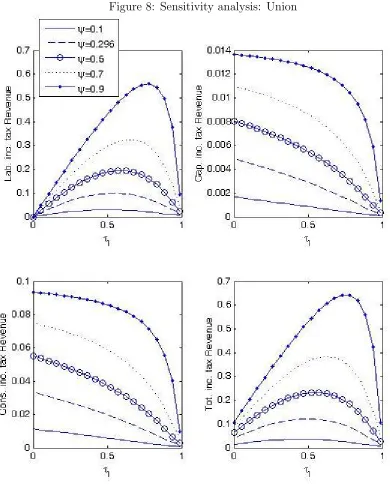
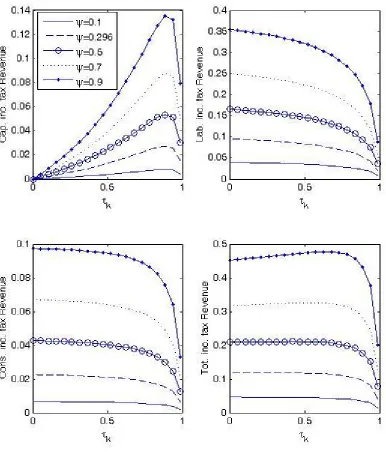
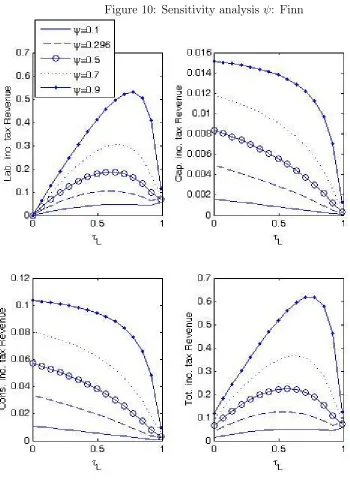
To evaluate the effect of structural parameters on the shape of the Laffer curves, this section
performs sensitivity analysis for different values of model parameters and how those affect
tax revenues. The two parameters of interest are the curvature parameter of household’s
Cobb-Douglas utility function α, as well as the weight on composite consumption, ψ.
In-terestingly, as α is allowed to vary, steady-state revenues are essentially unchanged. Even
an implausibly high value, α = 50, does not produce any difference in steady state tax
rev-enues. In both models considered in this paper, the preference parameter is not important
for steady-state fiscal policy effect. This result is not surprising in the literature, as Trabandt
and Uhlig (2010) obtain a very similar finding in their paper.1
In contrast, changes in the second parameter, ψ, yield significant differences. Both the
capital and labor tax Laffer curves, and the responses of the other tax bases to capital and
labor income tax rate are affected when ψ is allowed to vary.2 Higher values of ψ shift up
the Laffer curve and make it steeper, without significant change in its peak. The difference
between Finn and the model with endogenous public employment becomes significant for
implausibly high values ofψ, i.e. ψ >0.5. (As explained in the calibration section,
parame-ter ψ = 0.296, describing household’s preference was calculated as the ratio of hours of work
out of total potential hours in the model.) Intuitively, a higher ψ corresponds to a lower
weight to leisure, (1−ψ), in the household’s utility function. In other words, a higher ψ
1Parameterαis important for model dynamics, though.
2Consumption tax Laffer curve proves to be very sensitive toψ parameter. In the majority of the cases
decreases the elasticity of private labor supply. Intuitively, when labor tax rate increases, or
equivalently, after tax private wage falls, private hours respond less, thus increasing labor
income tax revenue, as well as total tax revenue.
The effect of higher ψ on capital tax Laffer curve is similar to ψ’s effect on the labor tax
Laffer curve above. When τk is allowed to vary, a higher weight attached to consumption in
household’s utility function, together with the optimality condition for the marginal rate of
substitution between consumption and hours require private higher capital stock to finance
private consumption. Therefore, a higher ψ shifts the capital tax Laffer curve upward as
well.
1.5
Measuring conditional welfare
In steady state
u(c, gc,1−n) = [(c+ωg
c)ψ(1−n)(1−ψ)
](1−α)−
1
1−α (186)
LetAandB denote two different regimes. The welfare gain,ζ, is the fraction of consumption
that is needed to complement household’s steady-state consumption in regimeB so that the
household is indifferent between the two regimes. Thus
[(cA+ωgc,A)ψ(1−nA)(1−ψ)
](1−α)−
1
1−α =
[((1 +ζ)cB+ωgc,B)ψ(1−nB)(1−ψ)
](1−α)−
1
1−α (187)
Multiply both sides by (1−α) to obtain
[(cA+ωgc,A)ψ(1−nA)(1−ψ)
](1−α)
−1 = [((1 +ζ)cB+ωgc,B)ψ(1−nB)(1−ψ)
](1−α)
−1 (188)
Cancel −1 terms at both sides to obtain
[(cA+ωgc,A)ψ(1−nA)(1−ψ)
](1−α)
= [((1 +ζ)cB+ωgc,B)ψ(1−nB)(1−ψ)
](1−α)
(189)
Raise both sides to the power 1
1−α to obtain
(cA+ωgc,A)ψ(1−nA)(1−ψ)
= ((1 +ζ)cB+ωgc,B)ψ(1−nB)(1−ψ)
(190)
Divide throughout by (1−nB)(1−ψ)
to obtain
((1 +ζ)cB+ωgc,B)ψ = (cA+ωgc,A)ψ
1−nA 1−nB
Raise both sides to the power 1/ψ to obtain
(1 +ζ)cB+ωgc,B = (cA+ωgc,A)
1−nA 1−nB
(1−ψψ)
(191)
Move ωgc,B term to the right to obtain
(1 +ζ)cB = (cA+ωgc,A)
1−nA 1−nB
(1−ψψ)
−ωgc,B (192)
Divide both sides by cB to obtain
1 +ζ = 1
cB
(cA+ωgc,A)
1−nA 1−nB
(1−ψψ)
−ωgc,B
(193)
Thus
ζ = 1
cB
(cA+ωgc,A)
1−nA 1−nB
(1−ψψ)
−ωgc,B
−1 (194)
Note that if ζ >0(<0), there is a welfare gain (loss) of moving from B toA. In this paper