Evaluation of the Controlled Release Ability of
Theophylline from Xanthan/Chondroitin Sulfate
Hydrogels
Ana-Maria Oprea1, Manuela-Tatiana Nistor1, Lenuta Profire3, Marcel Ionel Popa2, Catalina Elena Lupusoru3, Cornelia Vasile1*
1Department of Physical Chemistry of Polymers, Romanian Academy, “P. Poni” Institute of Macromolecular Chemistry, Iasi, Roma- nia; 2Faculty of Chemical Engineering and Environmental Protection, “Gh. Asachi” Technical University, Iasi, Romania; 3Depart- ment of Pharmacology and Algesiology, “Gr. T. Popa” Medicine and Pharmacy University, Iasi, Romania.
Email: *[email protected]
Received January 14th, 2013; revised February 28th, 2013; accepted March 30th, 2013
Copyright © 2013 Ana-Maria Oprea et al. This is an open access article distributed under the Creative Commons Attribution License, which permits unrestricted use, distribution, and reproduction in any medium, provided the original work is properly cited.
ABSTRACT
The xanthan/chondroitin sulfate (X/CS) hydrogels, obtained by a crosslinking technique, were evaluated in vitro and in vivo as matrices for theophylline release. The influence of pH of simulated physiological media on the X/CS swelling behaviour at 37˚C was investigated. The hydrogels theophylline loading degree was evaluated by near infrared chemical imaging (NIR-CI) technique and confirmed also by FT-IR spectroscopy; the drug loading was about 77.5% based on PLS-DA prediction (Partial least squares-Discriminate Analysis). The release profiles of theophylline from X/CS hy- drogels in simulated gastric fluid (SGF) and simulated intestinal fluid (SIF) depend on CS content. The release mecha- nisms were controlled by the drug solubility and ionic properties of the polymers. In vivo theophylline delivery was done by oral administration. Pharmacokinetic analysis revealed sustained-release characteristics for 50/50 X/CS theo- phylline-loaded formulation compared with raw theophylline which was rapidly absorbed, distributed and eliminated. A good in vitro-in vivo correlation was found.
Keywords: Polysaccharide; Hydrogels; Theophylline; Swelling; In Vitro/In Vivo Release; Pharmacokinetics
1. Introduction
Sustained release dosage forms extend the duration time of drug therapy, reduce side-effects and increase safety and patient compliance by reducing the frequency of dosing. Multiple daily administration of an immediate re- lease dosage form results in patient non-compliance. To control and modulate drug release properties of drugs, retardant polymers including hydrophilic polymers such as chitosan, chondroitin sulfate, xanthan and other poly- saccharides have been utilized in dosage forms. The hy- drophilic polymers control drug release from dosage forms by hydrogelation. The retardation mechanism is based on the intramolecular hydrogelation of a hydro- philic polymer during swelling and can be affected by the ionic strength of the dissolution medium. It is well known that the pH of the gastrointestinal tract (GI tract) varies from pH 1 to 3 in the stomach and increases to approxi-
mately pH 7 - 8 in the colon. Furthermore, the pH of the stomach can fluctuate with food intake, as well as with the age and health of the patient.
Due to the differences in ionic strength of gastric and intestinal fluids, as well as wide variations and fluctua- tions in its pH of the GI tract, the in vitro and in vivo data for sustained release dosage forms may not always cor- relate [1].
Xanthan gum (X) is an extracellular complex poly- saccharide secreted by the microorganism Xanthomonas campestris consisting of a cellulose backbone and tri- saccharide side chains containing glucuronic acids that give this polymer a negative charge [2]. It is totally de- graded in the colon by resident bacteria [3]. Xanthan gum was used for controlled release in combination with other polysaccharides as konjac glucomannan [4], ethyl- cellulose [5], guar gum [6], hydroxypropyl methylcellu- lose [7,8], chitosan and mesquite seed gum [9]. Xanthan gum, as a hydrophilic polymer, was added to the formu-
lations to increase the drug release since ibuprofen re- lease from the ibuprofen/ethylcellulose matrices (60/40, w/w) was too slow (20% in 24 hours). Changing the xan- than gum concentration as well as its particle size modi- fied the in vitro drug release. Increasing xanthan gum con- centrations yielded a faster drug release due to a higher liquid uptake, swelling and erosion rate [10].
Natural polysaccharides such as xanthan gum, xylan and guar gum are not digested in the human stomach or small intestine, but are degraded in the colon by resident bacteria [3] so that the drug remaining in matrix will be finally release by degradation/erosion of the matrix when drug delivery systems found suitable conditions. Because of the presence of the biodegradable enzymes only in the colon, the use of biodegradable polymers for colon spe- cific drug delivery seems to be a more site specific ap- proach as compared to other approaches. These types of matrices could shield the drug from the environments of stomach and small intestine and are able to deliver the drug to the colon. On reaching the colon, they undergo assimilation by microorganisms or degradation by en- zyme or break down of the polymer backbone.
Drug release from the mini-matrices was mainly diffu- sion controlled, but swelling played an important role to obtain complete drug release. Drug release was influ- enced by the ionic strength of the medium as the confor- mation of xanthan gum molecules is determined by the salt concentration.
Chondroitin sulfate (CS) is one of the glycosaminogly- cans which consists in repeating disaccharide units of D- glucuronic acid and N-acetyl galatosamine sulfated at ei- ther 4- or 6-positions having a negative charge [11]. It is a biological polymer that is abundant in the extracellular matrix (ECM) of tissues throughout the body. CS can be used in various formulations, in combination with natural [12,13] or synthetic polymers [14] as component of the drug release systems.
Theophylline, an alkaloid found in Camellia sinensis
leaves is an effective drug used in the treatment of as- thma and pulmonary disease and has been widely used as a model drug in various controlled release studies.
The aim of our study was to investigate the influence of the swelling/dissolution medium on the swelling be- haviour of the xanthan/chondroitin sulfate hydrogels and the release mechanism of theophylline (THP) from these hydrogels. Correlation between in vitro and invivo test- ing has been also followed.
2. Materials and Methods
2.1. Materials
Xanthan (X) with an average molecular weight of 2 × 10⁶
g/mol was purchased from Sigma-Aldrich, Germany.
Chondroitin sulfate (CS) was purchased from Roth, Ger- many. It was obtained from bovine tracheal cartilage. Epichlorohydrin used as crosslinking agent of analytical purity was purchased from Sigma-Aldrich and theophyl- line from Merck, Germany.
Preparation of xanthan/chondroitin sulfate hydrogels and their characterization were described in detail in a previous paper [15]. Briefly, the hydrogel samples were prepared in various weight mixing ratios (wt%) as: 90/10, 80/20, 70/30, 60/40, 50/50 X/CS. Freshly distilled epich- lorohydrin was added to the xanthan/chondroitin sulfate mixtures under vigorously continuous stirring. The sam- ples gels-like were lied on glass plates and then the cross linking reaction was performed for 8 hours at 80˚C. Hy- drogels were extensively washed with warm water to re- move unreacted compounds especially epichlorohydrin. Obtained hydrogels were undergone to freeze drying for 10 hours by means of a LABCONCO FreeZone device.
2.2. Investigation Methods for Hydrogels
2.2.1. Swelling Tests
Swelling studies were carried out by direct immersion in simulated gastric fluid (SGF) (pH 2.2) and simulated intestinal fluid (SIF) (pH 7.4) at 37˚C as in vivo experi- ments were done by oral administration. SGF was ob- tained by adding small HCl drops (37 wt%) in a certain quantity of water and SIF consisted in a PBS solution based on mixing 1.19 g of KH2PO4 and 4.3 g Na2HPO4.
The hydrogel samples were periodically removed from the solutions, gently wiped with a soft tissue to remove the excess surface solution, weighed and than carefully placed back into the vessel as quickly as possible. The re- ported weight of each sample was an average value of three measurements. The swelling degree (S) was calcu- lated according to the equation:
t d
dS % W W W 100 (1)
where Wt is the weight of the swollen samples at time t
and Wd is the weight of the dry sample.
2.2.2. FT-IR Spectroscopy
The hydrogels loaded with theophylline were analyzed by FT-IR spectroscopy, using the KBr pellet technique. The spectra were scanned on a Bruker VERTEX 70 (USA) device, over the 4000 - 500 cm−1 range, at a re-
solution of 4 cm−1.
2.2.3. Drug Loading
X/CS hydrogel in powder form was suspended in a 4% theophylline solution (1:1 v/v, ethyl alcohol/water) under mild stirring and left to swell 24 hours, period corre- sponding with the time in which the compositions rea- ched their equilibrium swelling degree, as determined from the swelling studies [16]. The loaded samples were then freeze-dried using a LABCONCO FreeZone device.
2.2.4. Near Infrared Chemical Imaging Technique (NIR-CI Technique)
NIR spectra of theophylline-loaded hydrogels were re- corded on a SPECIM’S Ltd. SisuCHEMA controlled with Evince software package for processing the original im- age data. The system includes a Chemical Imaging Work- station for 1000 - 2500 nm NIR domains. The original image for each sample was taken with a NIR model spec- tral camera, respectively an imaging spectrograph type ImSpector N17E with 320 and 640 pixel spatial resolu- tion at a rate of 60 - 350 Hz.
2.2.5. In Vitro Theophylline Release
The in vitro release studies were performed both in SGF (pH 2.2) and SIF (pH 7.4). During dissolution testing, the media was maintained at 37˚C ± 0.5˚C. Aliquots of the medium of 1 mL were withdrawn periodically at prede- termined time intervals and analyzed using a HP 8450A UV-visible spectrophotometer atλ = 271 nm, the wave- length characteristic to theophylline. In order to maintain the solution concentration the sample was carefully rein- troduced in the circuit after analyzing. The concentra- tions of the drug were calculated based on calibration curves determined at the same wavelength.
A simple, semi-empirical equation using Korsmeyer and Peppas model was used to kinetically analyze the data regarding the drug release from studied matrices sys- tem which is applied at the initial stages (approximately 60% fractional release) [17]:
nr t
M M k tr (2)
where Mt/M∞ represents the fraction of the released drug, Mt and M∞ are the cumulative amount of drug released at time t and at infinite time (in this case maximum release amount in the experimental conditions used, at the pla- teau of the release curves), respectively, kr is a constant
incorporating characteristics of the macromolecular ma- trix and of the drug: nr is the diffusion exponent, which
suggests the release mechanism. In the equation above a value of nr≤ 0.5 indicates a Fickian diffusion mechanism
(sometimes tridimensional one) of the drug from matrix, while a value 0.5 < nr < 1 indicates anomalous or non-
Fickian behaviour. When nr = 1 a case II transport me-
chanism is involved while nr > 1 indicates a special case
II transport mechanism [18-20].
The corresponding drug-release profiles were repre- sented through plots of the cumulative percentage of drug release versus time.
2.2.6. In Vivo Theophylline Release
Healthy Wistar rats weighing between 350 - 420 g pur- chased from Cantacuzino Institute, Bucharest, Romania were used for the study. The animals were maintained in identical laboratory conditions for one week before start- ing the experiments having access at food and water ad libitum. In vivo tests were performed in accordance with the ethical rules stated in the paper “Ethical guidelines for investigations of experimental pain in conscious ani- mals” [21].
The tested theophylline-loaded hydrogels have been orally delivered as suspensions in sodium carboxyme- thylcellulose of 0.5 wt%. A dose of 15 mg THP powder/ kg body weight was administrated for each rat. Blood samples were drawn out at established time intervals up to 72 hours. They were allowed to stand for 1 hour, cen- trifuged to separate the serum which was kept frozen (−20˚C) until further analysis. THP serum extraction was performed mainly as described in the literature [22] with a few minor changes. After thawing, 1 mL serum was mixed with 250 μl 10 wt% (NH4)2SO4 solution and ho-
3. Results and Discussion
3.1. Matrix Characterization
Swelling Studies in SGF and SIF
The range of ionic strength (μ) in gastrointestinal (GI) fluid is about 0.010 - 0.166 [23], but in pH 7.4 may reach a value of μ0.25 [24]. The simulated medium used has a significant influence on X/CS hydrogels swelling rate.
All X/CS hydrogels swelled, in SGF and SIF, very quickly during the first minutes (Figure 1); then the
swelling rates of the X/CS hydrogels became very slow, and finally reached the swelling equilibrium in about 100 minutes. These are typical biphasic swelling patterns, namely a rapid swelling followed by a slower sustained swelling (equilibrium swelling).
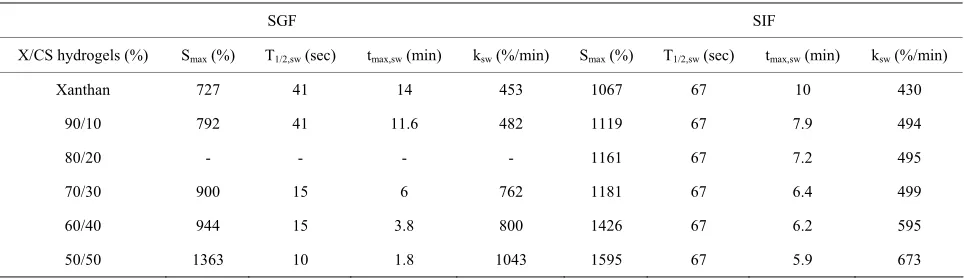
Time to reach the maximum swelling degree, in SGF, varies from 14 minutes in case of xanthan-based matrix with a degree of swelling about 727% to 6 minutes for composition 70/30 X/CS with a degree of swelling of 900%, the process being much faster for the composition 50/50 X/CS with a maximum swelling degree of 1363% recorded in about 2 minutes (Table 1).
Equilibrium swelling degree values vary, also, with composition, the highest values being obtained for 60/40
[image:4.595.89.509.390.553.2]X/CS and 50/50 X/CS matrices in both swelling media being of about 982% and 1381% in SGF and 1495% and 1642% in SIF, respectively.
Table 1 summarizes data on the swelling process cha-
racteristics in SGF and SIF of X/CS hydrogels with dif- ferent mixing ratios at 37˚C.
For X/CS hydrogels swelled in SIF the maximum swelling degree (Smax) varies from 1067% for xanthan-
based composition to 1426% and 1595% for 60/40 X/CS and 50/50 X/CS, respectively and the values of time to reach maximum swelling degree (tmax,sw) decrease from
10 minutes for xanthan-based hydrogels to about 6 min- utes for 70/30 X/CS, 60/40 X/CS and 50/50 X/CS com- positions (Table 1).
Swelling rate (ksw) increases, in SGF, with 400%/min-
ute for xanthan-containing and 90/10 X/CS compositions reaching a value of 1043%/minute for 50/50 X/CS matrix and in SIF is about 500%/minute for 90/10 X/CS, 80/20 X/CS and 70/30 X/CS reaching a value of 673% for 50/ 50 X/CS matrix (Table 1)
Half-swelling time (t1/2,sw) values obtained for X/CS com-
positions vary in range between 41 - 10 seconds in SGF decreasing with increasing CS content in hydrogels com- positions and in SIF is about 67 seconds for all matrices.
(a) (b)
[image:4.595.57.539.596.736.2]Figure 1. Swelling profiles of X/CS hydrogels with different compositions in medium of pH 2.2 (a) and pH 7.4 (b).
Table 1. The characteristics of the swelling process in SGF and SIF of X/CS hydrogels of different composition at 37˚C.
SGF SIF
X/CS hydrogels (%) Smax (%) T1/2,sw (sec) tmax,sw (min) ksw (%/min) Smax (%) T1/2,sw (sec) tmax,sw (min) ksw (%/min)
Xanthan 727 41 14 453 1067 67 10 430
90/10 792 41 11.6 482 1119 67 7.9 494
80/20 - - - - 1161 67 7.2 495
70/30 900 15 6 762 1181 67 6.4 499
60/40 944 15 3.8 800 1426 67 6.2 595
50/50 1363 10 1.8 1043 1595 67 5.9 673
The swelling profiles of xanthan-containing hydrogels in SGF and SIF indicated that the swelling degree values in acidic medium are lower than in phosphate buffer so- lution. It is obvious that, being an acidic polymer with a pKa of 3.1, xanthan became less soluble at such a low pH
value. From this result it can be predicted that swelling of this polysaccharide and of xanthan-containing hydrogels will be different in the stomach and intestine.
The X/CS hydrogels are superabsorbant and because the swelling process is very fast, the kinetic parameters such as nsw—exponent describing the mode of the pene-
trant transport mechanism and ksw—characteristic rate
constant of the material describing the rate of swelling do not fit to any known transport mechanisms. The values of nsw,obtained both in SGF and SIF, are between 0.06 and
0.14 which indicated that the transport mechanism was tridimensional Fickian diffusion [19], but very low val- ues of n are still controversed. If nsw is almost constant
for all hydrogel compositions, ksw values increase with
the amount of CS in hydrogel composition.
3.2. Theophylline-Loaded Hydrogels Characterization
3.2.1. FT-IR Analysis
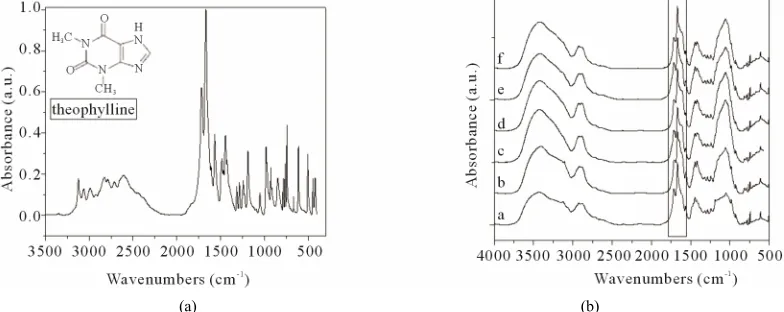
FT-IR spectra of X/CS hydrogels loaded with theophyl- line are shown in Figure 2.
The band appearing at 3121 cm−1 is assigned to the
aromatic C-H stretching vibrations, whereas that appear- ing at 2922 cm−1 corresponding to aliphatic C-H stretch-
ing vibrations. The peaks appearing in region 2824 - 2712 cm−1 are attributed to N=CH bond.
The C-N stretching vibrations are seen at 1049 cm−1,
while the one that appeared at 1243 cm−1 is assigned to
aromatic C=O stretching vibrations.
A slight shift of bands position from 1717 cm−1 to
1720 cm−1 and from 1667 cm−1 to 1670 cm−1 attributed to
-CO-N(R)-CO- theophylline characteristic group con-
firms presence of the theophylline in hydrogels and also the interactions between drug and hydrogels.
Some absorption bands could be influenced also by drug-hydrogels interactions such as slight shift of bands position to 1567 cm−1 and 1314 cm−1.
3.2.2. NIR-CI Studies
Theophylline distribution into X/CS hydrogels and its homogeneity were evaluated by the near infrared chemi- cal imaging (NIR-CI) technique. The prediction of load- ing degree was evaluated based the new near infrared chemical imaging maps. The chemical imaging provides a simple method for evaluating the spatial drug distribu- tion. The non-destructive character and minimal sample preparation required, show the feasibility of this tech- nique which is used to investigate samples with pharma- ceutical applications.
[image:5.595.103.495.552.708.2]Both PLS-DA (Partial Least Squares-Discriminate Ana- lysis) and PCA (Principal Component Analysis) models were used to determine the homogeneity and distribution of the two components, namely the drug and polymeric matrix. PLS-DA model based on multivariate inverse least squares discrimination method is used by Evince to classify the components. This could be achieved because of these two models based of mathematical processing. Assigning a colour for each principal component allows visual assessment of the degree of homogeneity of the components. As noted with a value between 0 and 1 of the same original component facilitated obtaining quan- titative information. For the first component value 1 re- presents an available percentage of 100% and the value tends to zero when there is an unknown structure. The correct information can be extracted from the cube of in- formation. The final images have for every pixel a com- plete spectrum that includes contributions from all the chemical components present in system.
Figure 3 corresponds to the PLS-DA model for 50/50
(a) (b)
Figure 2. FT-IR spectra of theophylline (a) and X/CS hydrogels loaded with theophylline: (a) Xanthan-based hydrogel, (b) 0/10 X/CS, (c) 80/20 X/CS, (d) 70/30 X/CS, (e) 60/40 X/CS, (f) 50/50 X/CS.
X/CS composition.
A uniform distribution was observed corresponding to a high homogeneity degree of the drug distribution in the X/CS hydrogel matrix. Based on PLS-DA prediction, a theophylline loaded amount up to 77.5% into the 50/50 X/CS composition was found.
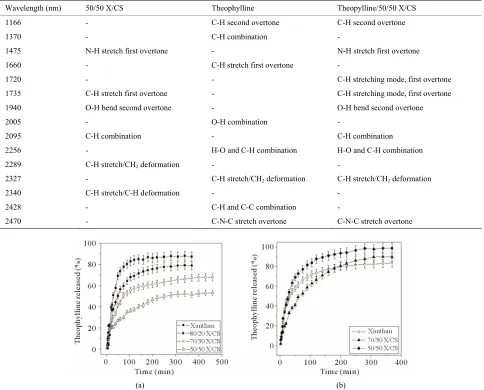
The obviously overlapping between the polymers and theophylline bands in near infrared region (Table 2) em-
power for the use a multivariate regression for the simul- taneous determination of drug content in samples.
The NIR data of Table 2 confirm also FT-IR spectra
results.
3.2.3. Theophylline in Vitro Release Studies
The release profiles of theophylline from X/CS hydrogels in SGF and SIF are shown in Figure 4.
In vitro release study of theophylline from X/CS hy-
[image:6.595.330.512.85.279.2]PLS-DA Model
[image:6.595.56.541.322.724.2]Figure 3. PLS-DA model for X/CS hydrogel.
Table 2. The wavelength corresponding to the functional groups on NIR spectra for 50/50 X/CS hydogel, theophylline and theophylline/50/50 X/CS system.
Wavelength (nm) 50/50 X/CS Theophylline Theopylline/50/50 X/CS
1166 - C-H second overtone C-H second overtone
1370 - C-H combination -
1475 N-H stretch first overtone - N-H stretch first overtone
1660 - C-H stretch first overtone -
1720 - - C-H stretching mode, first overtone
1735 C-H stretch first overtone - C-H stretching mode, first overtone
1940 O-H bend second overtone - O-H bend second overtone
2005 - O-H combination -
2095 C-H combination - C-H combination
2256 - H-O and C-H combination H-O and C-H combination
2289 C-H stretch/CH2 deformation - -
2327 - C-H stretch/CH2 deformation C-H stretch/CH2 deformation
2340 C-H stretch/C-H deformation - -
2428 - C-H and C-C combination -
2470 - C-N-C stretch overtone C-N-C stretch overtone
(a) (b)
[image:6.595.57.541.330.720.2]drogels with different compositions was performed in SGF and SIF media at 37˚C.
In both cases, the release profiles of theophylline from X/CS hydrogels depend on CS content.
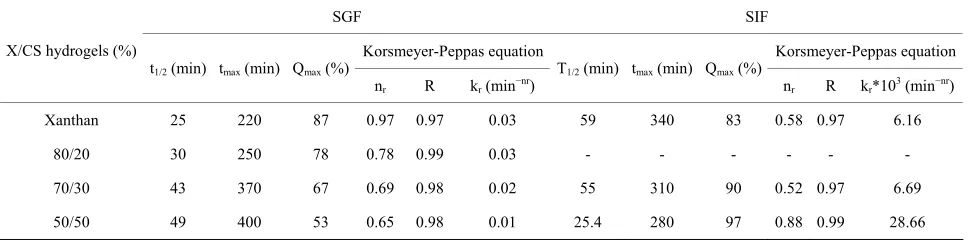
In SGF, an increase of CS content leads to a decrease of theophylline percent released from 87% in case of xanthan-based hydrogel to 78% for 80/20 X/CS com- position, 67% for 70/30 X/CS matrix reaching up to 53% in case of 50/50 X/CS hydrogel (Figure 4(a) and Table 3).
Half-release time (t1/2) and time to reach maximum
percent released (tmax) values from 50/50 X/CS composi-
tion are about two times higher than those obtained for xanthan-based matrix, namely theophylline half-release time values for xanthan-based composition is about 25 minutes and for 50/50 X/CS matrix is about 49 minutes. Time to reach maximum percent released (Qmax) varies
between 220 minutes for xanthan-based hydrogel to 400 minutes in case of 50/50 X/CS composition (Table 3).
It can be concluded that the release behaviour of theo- phylline in SGF from X/CS hydrogels depends on CS content so an increased percent of this component leads to a prolonged release process and small amount released. These results can be interpreted taking into consideration the dimensional and physical changes of the polymeric matrix during swelling according to the results obtained by other authors [25]. Substantial water uptake and gell- ing of xanthan gum appears to be responsible for sus- tained drug release [26].
The release studies performed in SIF showed that the maximum percentage cumulative release (Qmax) is higher
in case of 50/50 X/CS formulation than 70/30 X/CS and xanthan-based hydrogels (the trend is: 50/50 X/CS > 70/30 X/CS > xanthan-based hydrogel) (Table 3).
Half release time (t1/2) and time to reach maximum
percent released (tmax) values decrease with increasing
CS content in hydrogels compositions from 59 to 25.36 minutes and 340 to 280 minutes, respectively (Table 3).
The in vitro drug release experiments performed in SIF medium indicated the formation of a firmer gel struc- tures and increased drug release rates in this medium.
3.2.4. Kinetic Study of Theophylline Release
The kinetic parameters for theophylline released in SGF and SIF from X/CS-based hydrogels are showed in Ta- ble 3.
The release mechanism of theophylline in SGF and SIF is described by an anomalous transport for all tested formulations. In SGF the nr values decreased and in SIF
increased with increasing CS content in hydrogel com- position. The same behaviour was observed for the re- lease rate constant values.
3.2.5. In Vivo Release Profiles of Theophylline
The raw theophylline and theophylline-loaded hydrogel have been orally delivered in rats as suspensions in so- dium carboxymethyl cellulose of 0.5 wt%. A dose of 15 mg THP powder/kg body weight was administrated for each rat. The chosen hydrogel composition for in vivo re- lease study of theophylline was 50/50 X/CS which showed a sustained release during in vitro testing in SGF.
Figure 5 presents the pharmacokinetic release profiles
of raw theophylline and theophylline-loaded in 50/50 X/ CS formulation.
The in vivo release profiles showed the sustained re- lease of theophylline loaded in 50/50 X/CS formulation compared with raw theophylline which is removed from the body in the first 17 hours from administration. The theophylline released from 50/50 X/CS hydrogel showed a prolonged plasma concentration profile than raw theo- phylline, traces of active principles being recorded up to 20 hours after administration.
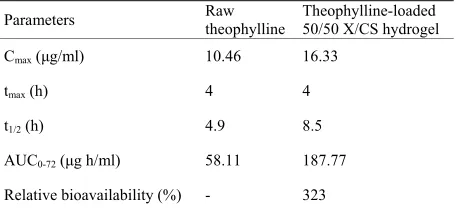
The evaluated pharmacokinetic parameters are given in Table 4.
The mean plasma level of raw theophylline was re- corded at a Cmax value of 10.46 μg/ml at tmax of 4 hours,
while the t1/2 is about 4.9 hours which indicated a fast
absorption of pure theophylline. The theophylline serum concentration, released from 50/50 X/CS composition, reached a maximum value of Cmax of 16.33 μg/ml with a
tmax of 4 hours and a t1/2 of 8.5 hours, exhibiting a de-
layed absorption in blood (Table 4).
[image:7.595.57.541.616.736.2]Serum theophylline concentration decreased with a re-
Table 3. The kinetic parameters and release characteristics of theophylline from X/CS hydrogels evaluated according to Korsmeyer-Peppas equation.
SGF SIF
Korsmeyer-Peppas equation Korsmeyer-Peppas equation
X/CS hydrogels (%)
t1/2 (min) tmax (min) Qmax (%)
nr R kr (min−nr)
T1/2 (min) tmax (min) Qmax (%)
nr R kr*103 (min−nr)
Xanthan 25 220 87 0.97 0.97 0.03 59 340 83 0.58 0.97 6.16
80/20 30 250 78 0.78 0.99 0.03 - - -
70/30 43 370 67 0.69 0.98 0.02 55 310 90 0.52 0.97 6.69
Figure 5. Plasma theophylline concentration versus time. Each point is presented as mean ± S.D., n = 4.
Table 4. Pharmacokinetic parameters obtained for raw theo- phylline and theophylline-loaded 50/50 X/CS hydrogel.
Parameters Raw theophylline Theophylline-loaded 50/50 X/CS hydrogel
Cmax (μg/ml) 10.46 16.33
tmax (h) 4 4
t1/2 (h) 4.9 8.5
AUC0-72 (μg h/ml) 58.11 187.77
Relative bioavailability (%) - 323
latively low rate in 24 - 48 hours interval.
The value of area under the curve (AUC) or time de- pendence of plasma after administration of a single dose of drug was determined to be about 58.11 μg h/ml for raw theophylline compared to 187.77 μg h/ml for theo- phylline loaded in 50/50 X/CS formulation.
The relative bioavailability of 50/50 X/CS formulation loaded with theophylline compared to raw theophylline, both products containing the same dose of the same drug, is obtained by comparing their respective AUCs [27].
theophylline loaded 50/50 X/CS raw theophylline
Relative bioavailability
AUC AUC
(3)
The significant differences between pharmacokinetic parameters may be due to the presence of chondroitin sulfate which increases the bioavailability about to 300% for the tested formulation and drug absorption through gastrointestinal mucosa without producing damage to the biological system, compared with raw theophylline.
The results obtained for in vivo therapeutic efficacy as- sessment of 50/50 X/CS hydrogel loaded with theophyl- line are correlated with those obtained for in vitro eva- luation of the matrix in SGF. The sustained release abil- ity of the theophylline, obtained both in vitro and in vivo,
showed the qualities of this matrix; the presence of chon- droitin sulfate in the composition causes the controlled and sustained behavior of release process.
4. Conclusions
The influence of the ionic strength on the theophylline- loaded release mechanism was evaluated in terms of phar- maceutical kinetics. Swelling of the xanthan/chondroitin sulfate matrix in acidic and buffer solutions showed that the ionic strength of the liquid has a strong effect on the sorptive properties of the matrix. From the release ex- periments, conducted at 37˚C, it was found that the drug delivery process was accomplished within the first 300 minute after immersion and theophylline was always re- leased via a non-Fickian transport. The phenomenon can be described by a release by an equation with exponent (nr) varying from 0.65 to 0.97 depending on matrix com-
position. An increase of CS content leads to a decreased theophylline percent released in SGF in case of 50/50 X/CS formulation and in SIF the theophylline releasing trend is: 50/50 X/CS > 70/30 X/CS > xanthan-based hy- drogel.
The results obtained in case of theophylline release studies performed in vitro, in SGF and in vivo are corre- lated, a sustained release ability of 50/50 X/CS matrix being revealed due to the presence of chondroitin sulfate in the composition.
5. Acknowledgements
The financial support from Romanian ANCS-UEFISCDI by PCCA Tip II BIONANOMED 164/2012 is gratefully acknowledged.
REFERENCES
[1] T. R. Reddy, D. Dhachinamoorthi and K. B. Chandrasek- hara, “Independent Release Behavior of Glipizide Matrix Release Tablets Containing Chitosan and Xanthan Gum,”
International Journal of Pharmaceutical and Biomedical Research, Vol. 1, No. 2, 2010, pp. 64-70.
[2] J. V. Gruber, “Polysaccharide-Based Polymers in Cos- metics,” In: E. D. Goddard and J. V. Gruber, Eds., Prin- ciples of Polymer Science and Technology in Cosmetics and Personal Care, Marcel Dekker, New York, 1999, pp. 339-403.
[3] A. A. Salyers, J. R. Vercellotti, S. E. West and T. D. Wilkins, “Fermentation of Mucin and Plant Polysaccha- rides by Strains of Bacteroides from the Human Colon,”
Applied and Environmental Microbiology, Vol. 33, No. 2, 1977, pp. 319-322.
[image:8.595.59.288.329.435.2]doi:10.1007/s11705-009-0299-x
[5] T. Quinten, T. De Beer, F. O. Onofre, G. Mendez-Mon- tealvo, Y. J. Wang, J. P. Remon and C. Vervaet, “Sustained-Release and Swelling Characteristics of Xan- than Gum/Ethylcellulose-Based Injection Moulded Matrix Tablets: In Vitro and in Vivo Evaluation,” Journal of Pharmaceutical Sciences,Vol. 100, No. 7, 2011, pp. 2858- 2870. doi:10.1002/jps.22480
[6] J. Mor and A. Nanda, “Formulation and Evaluation of a Colon Targeted Drug Delivery System Using Ibuprofen as a Model Drug,” The Pharmaceutical Research,Vol. 5, No. 1, 2011, pp. 176-183.
[7] W. Darunkaisorn and T. Phaechamud, “Sustained Release of Propranolol HCl Using Matrix Granule Comprising Wax and Polymers,” Research Journal of Pharmaceutical,
Biological and Chemical Sciences, Vol. 2, No. 1, 2011, pp. 158-166.
[8] M. M. Talukdar and R. Kinget, “Comparative Study on Xanthan Gum and Hydroxypropylmethyl Cellulose as Matrices for Controlled-Release Drug Delivery. II. Drug Diffusion in Hydrated Matrices,” International Journal of Pharmaceutics, Vol. 151, No. 1, 1997, pp. 99-107. doi:10.1016/S0378-5173(97)04896-5
[9] C. César, S. Nogueira, L. M. Cabral, T. C. Dos Santos, A. Marucci and F. Alhaique, “Evaluation of New Polysac- charides Networks for Extended-Release Purposes: Mes- quite Seed Gum (MSG), Xanthan Gum and Chitosan,”
Brazilian Journal of Pharmaceutical Sciences, Vol. 39, No. 3, 2003, pp. 273-288.
[10] E. Verhoeven, C. Vervaet and J. P. Remon, “Xanthan Gum to Tailor Drug Release of Sustained-Release Ethyl- cellulose Mini-Matrices Prepared via Hot-Melt Extrusion:
In Vitro and in Vivo Evaluation,” European Journal of Pharmaceutics and Biopharmaceutics, Vol. 63, No. 3, 2006, pp. 320-330. doi:10.1016/j.ejpb.2005.12.004 [11] C. T. Lee, P. H. Kung and Y. D. Lee, “Preparation of
Poly(Vinyl Alcohol)-Chondroitin Sulphate Hydrogel as Matrices in Tissue Engineering,” Carbohydrate Polymers, Vol. 61, 2005, pp. 348-354.
doi:10.1016/j.carbpol.2005.06.018
[12] L. Huang, W. Sui, Y. Wang and Q. Jiao, “Preparation of Chitosan/Chondroitin Sulfate Complex Microcapsules and Application in Controlled Release of 5-Fluorouracil,”
Carbohydrate Polymers, Vol. 80, No. 1, 2010, pp. 168- 173. doi:10.1016/j.carbpol.2009.11.007
[13] K. Kofuji, T. Ito, Y. Murata and S. Kawashima, “Effect of Chondroitin Sulfate on the Biodegradation and Drug Release of Chitosan Gel Beads in Subcutaneous Air Pouches of Mice,” Biological and Pharmaceutical Bul- letin, Vol. 25, No. 2, 2002, pp. 268-271.
doi:10.1248/bpb.25.268
[14] E. C. Muniz, E. G. Crispim, A. R. Fajardo, J. F. Piai, E. R. F. Ramos, T. U. Nakamura, C. V. Nakamura and A. F. Rubira, “Hydrogels Based on Chemically Modified Poly (Vinyl Alcohol) (PVA-GMA) and PVA-GMA/Chondroi- tin Sulfate: Preparation and Characterization,” Express Polymer Letters, Vol. 6, No. 5, 2012, pp. 383-395. [15] A. M. Oprea, A. Neamtu and C. Vasile, “Xanthan/Chon-
droitin Sulfate Hydrogels as Carrier for Drug Delivery
Applications,” Sectiunea Genetica si Biologie Moleculara, Vol. 12, No. 2, 2011, pp. 97-102.
[16] N. Popa, O. Novac, L. Profire, C. E. Lupusoru and M. I. Popa, “Hydrogels Based on Chitosan-Xanthan for Con- trolled Release of Theophylline,” Journal of Materials Science: Materials in Medicine, Vol. 21, No. 4, 2010, pp. 1241-1248. doi:10.1007/s10856-009-3937-4
[17] R. W. Korsmeyer, S. R. Lusting and N. A. Peppas, “Solute and Penetrant Diffusion in Swellable Polymers. I. Mathematical Modeling,” Journal of Polymer Science Part B: Polymer Physics, Vol. 24, No. 2, 1986, pp. 395- 408. doi:10.1002/polb.1986.090240214
[18] R. W. Korsmeyer and N. A. Peppas, “Solute and Pene- trant Diffusion in Swellable Polymers. III. Drug Release from Glassy Poly (HEMA-co-NVP) Copolymers,” Jour- nal of Controlled Release,Vol. 1, No. 2, 1984, pp. 89-98. doi:10.1016/0168-3659(84)90001-4
[19] A. Kostić, B. Adnadjevic, A. Popovic and J. Jovanovic, “Comparison of the Swelling Kinetics of a Partially Neutralized Poly (Acrylic Acid) Hydrogel in Distilled Water and Physiological Solution,” Journal of the Serbian Chemical Society, Vol. 72, No. 11, 2007, pp. 1139-1153. doi:10.2298/JSC0711139K
[20] L. Serra, J. Doménech and N. A. Peppas, “Drug Transport Mechanisms and Release Kinetics from Molecularly De- signed Poly(Acrylic Acid-G-Ethylene Glycol) Hydrogels,”
Biomaterials, Vol. 27, No. 31, 2006, pp. 5440-5451. doi:10.1016/j.biomaterials.2006.06.011
[21] M. Zimmermann, “Ethical Guidelines for Investigations of Experimental Pain in Conscious Animals,” Pain, Vol. 16, No. 2, 1983, pp. 109-110.
doi:10.1016/0304-3959(83)90201-4
[22] N. Labačevski, D. Zendelovska, O. Sibinovska, S. Si- meska, I. Kikerkov, P. Milosevski and S. Petrov, “De- velopment and Validation of the HPLC Method for the Determination of Theophylline Serum Concentration: A Comparison with FPIA Method and Its Application for Bioequivalence Study,” Bulletin of Chemists and Tech- nologists of Macedonia, Vol. 22, No. 2, 2003, pp. 97-104. [23] J. L. Johnson, J. Holinej and M. D. Williams, “Influence of Ionis Strength on Matrix Integrity and Drug Release from Hydroxypropyl Cellulose Compacts,” International Journal of Pharmaceutics, Vol. 90, No. 2, 1993, pp. 151- 159. doi:10.1016/0378-5173(93)90151-5
[24] T. Solomon, “The Definition and Unit of Ionic Strength,”
Journal of Chemical Education, Vol. 78, No. 12, 2001, pp. 1691-1692. doi:10.1021/ed078p1691
[25] A. G. Andreopoulos and P. A. Tarantili, “Xanthan Gum as a Carrier for Controlled Release of Drugs,” Journal of Biomaterials Applications, Vol. 16, No. 1, 2001, pp. 34- 46. doi:10.1106/XBFG-FYFX-9TW9-M83U
[26] M. C. Cohel and S. H. Bariya, “Fabrication of Triple- Layer Matrix Tablets of Venlafaxine Hydrochloride Us- ing Xanthan Gum,” AAPS PharmSciTech,Vol. 10, No. 2, 2009, pp. 624-630. doi:10.1208/s12249-009-9244-z [27] R. Chereson, “Bioavailability, Bioeqiuvalence and Drug