Comparative Study of Functions Affecting the Behavioral
Patterns of Tourists in Iran and America’s Tourism
Marketing Plan Utilizing SWOT Model
Issa Ebrahimzadeh, Monir Yari
Faculty of Geography and Environmental Planning, University of Sistan and Baluchestan, Zahedan, Iran. Email: [email protected]
Received November 14th, 2012; revised December 16th, 2012; accepted December 30th, 2012
ABSTRACT
Behavioral patterns of tourists are designed aiming to present a scientific framework of how the variables are interacted and factors influencing consumer behavior can help decision makers and market activists in predicting and controlling consumer behavior. This study aims to explore the functions influencing tourist’s behavioral patterns in Iran and Amer- ica’s tourism marketing planning which has comparatively been studied. The research methodology is analyti- cal-descriptive and it has been studied and analyzed utilizing SWOT technique. Analytical results of this study show that America in proportion with culture, potentials and operational functions in Iran can be in some cases exploited.
Keywords: Tourism; Tourists Behavioral Patterns; Marketing; SWOT Technique; Iran; America
1. Introduction
Tourism development, particularly for developing coun- tries to get away from problems such as high unemploy- ment, limited foreign exchange and single-product econ- omy is very important. Iran’s economy which is highly dependent on the incomes obtained from oil exchange, its macro-economic variables are affected to strong fluc- tuations over time, in order to diversify sources of eco- nomic growth and foreign exchange earnings as well as creating new job opportunities in the country, tourism development is highly important in [1].
The researches performed by World Tourism Organi- zation and other ones show that marketing is essential for developing this industry in any country or region’ how- ever, people must be known the tourism potentials of that specific region to attract tourists to a region [2]. However, the point is that the majority of tourists attractions in Iran are not only are not well known not only in Iran, but in abroad. Therefore, it seems that marketing weaknesses and lack of appropriate advertising with tourist’s needs and tourism markets and also lack of designing tourists’ behavioral patterns is one of the factors that can be asso- ciated with Iran’s underdevelopment tourism industry. Although the studies indicate that only marketing cannot be led to sustainable development of tourism industry for the attractions of a region without existing infrastructure facilities and services, the necessity and significance of marketing planning is to the extent that it is sometimes
considered in the field of tourism literature as a main pillar of developing this industry in tourism plans. There- fore, designing and developing macroeconomics and also strategic approaches for tourism development in the framework of “tourism marketing planning process” is so critical [3].
2. Research Theoretical Approach
2.1. Tourist’s Behavioral Patterns
Behavioral, conceptual and motivational differences have great impact on personal decisions; individuals’ behavior depends on their conception of the world and is influ- enced by their subjective perception toward a location or a travel agency which are determined by factors such as childhood, family experiences and working personality. Tourism factors include supply and demand and the study of tourist’s behavior is taken into account the sup- ply dimension, as most researchers focused their atten- tion to research attractions (supply). It is essential that tourism enterprises identify their demographic and geo- graphical characteristics of their consumers [4]. Tourism behavioral studies will be taken shape in three categories namely before travel, during travel and after travel.
tures, psychology, previous experiences and motiva- tion.
By during the travel, it means the tourist behavior and their perception of the quality of facilities and the amount of money they spent.
After the travel includes satisfaction and fulfillment of tourists and the intention to return again as well as the tourist’s reception with the host community. Tourists behaviors (Figure 1) includes human’s reac- tion against needs and their demands to decide to have a travel, then the satisfaction or dissatisfaction of tourists with tourist facilities, services and attractions during travel and ultimately their understanding of tourism des- tinations, persistency, the decision to return or not to re- turn to the tourist destination and travel reflection. Meanwhile, tourist’s behavioral patterns consist of cate- gorizing the tourists in similar and convergent groups based on their behavior in three stages of before the travel, during the travel and after the travel [5].
2.2. Market and Tourism Marketing
Market is a set of actual and potential purchasers of a product; a potential market is the customers that have the desire and interest to buy goods or services. In order to potential customers become actual customers, they should both have access to product and have enough in- come. Therefore, an accessible market is the set of cus- tomers who have the interest and power to buy products and have access to the regarded product. The concept of market finally brings us to the concept of marketing. Marketing means working with markets to provide ex-
The decision to travel (tourist’s motivarion) Stage 1
Stage 2
Stage 3
During the trip: Being satisfied with the infrastructures, facilities,
attractions and community
After the travel: tourist’s faithfulness (permanency and travel reflection and repetition)
[image:2.595.72.272.491.703.2]Tourist’S Behavioral Patterns
Figure 1. Tourist’s behavioral patterns in three stages of decision to travel, during the travel and after the travel [5].
changes with the aim of supplying human’s needs and desires [6]. Meanwhile, the concept of marketing can be defined in a simple term; that is coordinating the product with the needs and demands of the market and people and what they want to buy should be offered and sug- gested [7]. Marketing services is certainly complex, for they do not have the capability to store and stock services and for this respect its marketing differs from marketing products and its supplying method to markets is also dif- ferent [8].
Marketing is necessary and essential for sustaining the existence of tourism industry. In fact, the potential tour- ists can be attracted to the purposes intended for through marketing methods. Therefore, developing strategic mar- keting programs can effectively contribute in achieving the objectives of tourism projects [3]. Despite the fact that marketing discussions are extensive, its position in tourism industry management and development is essen- tial [9]. In fact, market segmentation is a process of iden- tifying major differences in the characteristics of the buyer to divide the market into two or more groups with a specific goal, selecting the part of the market that the institution will serve with and also designing the product and marketing programs in such a way that it satisfies the specific features of the targeted group [10]. Tourism mar- keting aims to identify and predict the tourist’s needs and providing facilities to meet their needs and making them informed and creating motivation within them to visit the destination again [11]. Given the specific characteristics of tourism products, the role of marketing in this industry has particular importance than other industries and effec- tive use of tourism marketing tools is essential for a country or region, for the potential tourists can be sup- plied with information about what a specific region can provide through marketing and encourage them to visit that region [12].
3. Examples of Comprehensive Behavioral
Patterns of Tourists in America
Self-flourishing or self-discovery: customers who have high income and are successful, active, modern and responsible. These customers are looking for the best products.
Prosperous: mature professional and responsible cus- tomers who have higher education, and their informa- tion about global issues is good and are ready to ac- cept new ideas and social changes. They prefer prod- ucts which are durable and have appropriate per- formance and value.
Successful: people who are successful and profes- sional who obtain their satisfaction from their family and business. They are looking for products that pro- vide them prestige which indicates their success.
Experience-driven: these consumers are young people with 25 years mean age; they have lots of energy spent for exercise and social activities. A large part of their income is spent on clothing, food, music, cinema and other new products with an emphasis on being modern.
Believers: they are conservative and traditional peo- ple which welcome familiar and well-accustomed products as well as are middle-income.
Hard-working: people with low financial resources and feeling of insecurity who are seeking for other’s approval. These customers are looking for buying fashionable products to show themselves as those who have high financial resources.
Constructive: they are pragmatic, self-sufficient-tra- ditional and family-oriented people. Their income is low and they are seeking for products that can be ap- plied.
Activist: these consumers are in the lowest income levels. They are elderly, retired and passive people; their average age is 61 years old and they are loyal to their favorite brands [6].
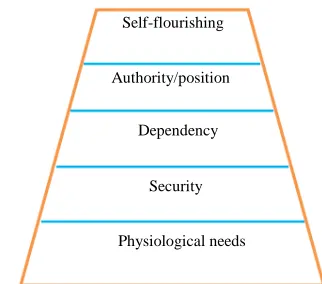
Motivational Behavioral Pattern of American Tour- ists: Maslow presented for the first time the pyramid of human needs with psychological and human motivation approach in his valuable works entitled “Motivation and Personality” in 1954 (Figure 2) which has taken into consideration a pattern of human behaviors. In fact, Maslow maintains that it is possible that human motiva- tions and behaviors in the field of tourism suggest his/her needs. These needs are often manifested behind human’s activities and personal or hidden matters [14].
The above-mentioned theory contributes the consump- tion behavior in tourism industry [15]. Also, the differ- ences and its influences in tourist’s behaviors and rela- tionships with physical and cultural milieus as well as people during travel and in destination has caused that the categories are useful in such a way that it offers a
Authority/position Self-flourishing
Dependency
Security
[image:3.595.338.499.93.235.2]Physiological needs
Figure 2. Hierarchy of needs according to Maslow’s ideas (1954).
simple classification of complex phenomena, allowing them to be understood. Much of this work was done dur-ing the 1970s and early 1980s and part of it was reviewed by Lowick and Fen Rongeno and Blaert (1992). The es- pecially began discussion about Gallup Organization which was representative of American Express Travel Services. The aim of the above study was traveller’s classification and by making initial talks from 6500 vol- unteers’ respondents in United States, Germany, Great Britain and Japan, the world’s four major economic forces, almost 4000 people were among the travellers from the total of respondents. The evaluation in overall showed that almost 13,000 people have been traveling over the past 12 months. According to this study, the tourists who decided to travel in different ways regard- less of origin and destination have been divided into five groups as follows:
Adventurers: they are independent and reckless and trying to create new activities, see new people and also become familiar with different cultures. They are generally more educated and more affluent than members of other groups. Travelling has a man role in life for these people. On the other hand, adventur- ers are young men who 44% of the members of the group are in the age range of 11 - 34 years old.
Heartsick: these people are affected by too much worries and concerns and do not have confidence in decisions related to travelling and are generally scared of flying. These people are less educated and affluent than others. This group travel less than other four groups and if they initiate to have a travel, they will tend to domestic travels. Most of these people are women and a major part of them are elderly and nearly more than half of them have 50 years old.
routes and destinations, their business travel is much less impressive than their thoughts and beliefs and often they have a tendency to rest relaxation than ad- venture and seeking for incidence. Such people can be among low income and less educated people who most of them are 50 year women or older than it. When these people travel to new places, they often carry maps and guide books with themselves.
Thrifty people: travelling provides an opportunity for relaxation and leisure for thrifty people and it is an experience from the perspective of travelling that gives meaning to their life. Travelling costs does not matter for them and do not think of the notion that they should pay extra money for the services and fa- cilities provided for. Such people have a moderate income and have not culturally been advanced. It can be said that they travel twice a year; even they do not have the ability to do so. These people are more wo- men than men and are usually a little older than their travelling companions.
Indulgent and wasteful people: the financial condition of such people is usually much better than other trav- ellers and they want to pay more money for more convenience and better services during the travel. They tend to stay in great hotels compared to others and are more interested in indolence. They support the adventurers during travelling and the number of men and women in such group is the same [3].
4. Examples of Comprehensive Behavioral
Patterns of Tourists in Iran
In order to achieve a comprehensive and sustainable de- velopment as well as replace alternative resources of revenue instead of oil resources in today Iran, using all the facilities and capabilities in our country are needed. In this regard, developing the tourism industry believed to the third dynamic and growing economic phenomenon after oil and automobile industry in the world by the economists is also considered as a basic requirement in Iran. Hence, reviewing the obstacles in the development of this industry in our country is very necessary. In this regard, the tourism marketing weaknesses can be one of the obstacles to tourism development in Iran. Meanwhile, the lack of conducting basic and applied research in the behavioral patterns of Iranian tourists as a prerequisite for tourism marketing is considered the most constraints of tourism development in Iran. Little research has been done in recent years in this field in a sporadic fashion as follows: in the study conducted by Ranjbarian & Zahedi [16], the effects of repeated travels to Isfahan on the for- eign tourist’s satisfaction were explored and the results of their study indicate that the satisfaction level of tour-
ists who repeat the travel to Isfahan was much lower than those who experience such a travelling for the first time. In the study performed by Kazemi M. [17], Zahedan citizen’s understanding on Chabahar tourism develop- ment had has been analyzed. His findings indicate that inasmuch as product marketing of tourism in any country or region depends on buyer’s interests and perceptions and with regard to the comprehensive tourism plan of Sistan and Baluchestan, Iran in intra-provisional tourism development strategy, now the motivation of Zahedan citizens to travelling to Chabahar are cultural, commer- cial, physical activities, gaining peace, natural, luxurious and emotional motivations. Reza Jaravandi & Forghani [18] conducted a study entitled “comparison of travel motives among both youths and adults (a case study of Shiraz travellers and came to this conclusion that there is no significant difference between different age groups in travelling to Dubai. His studied motivation were divided into five groups among which the impact of age and life cycle are considered less effective and he maintained that its cause is to how advertise in that he represents trav- elling to Dubai as a trip to the whole family and no dis- tinction is considered in age or gender in advertising, as the motivation all family members are more influenced by family and familial conditions than influenced by variables as cultural sub-groups or reference groups. Alilou et al. [19] compared in another study the personal- ity traits of a group of Iranian tourists with a non-tourist group. The findings of this study showed that there is a significance difference between tourists and non-tourists in seeking emotion, extraversion and openness against experience. The tourist group achieved higher scores than the non-tourist ones in personality traits of extraver- sion, openness against experience. The extroverts are gregarious and plebiscites who prefer large groups and gatherings; as a result the extroverts are more willing to travel.
5. Research Methodology
analysis of affecting factors facing tourism marketing us- ing the gradation factors (Tables 1-4) [20].
Research Locational Scope
According to research purposes, which comparatively study the influential functions on tourist’s behavioral patterns in the two developed and developing countries, the research locational scope has been selected in both Iran and America (Figure 3). United States of America as an area of 9,363,364 square kilometers is located in
[image:5.595.62.538.249.731.2]North American continent. This country gained inde- pendence from England on 4/7/1776. The government type id federal republic with two legislative houses. Eng- lish is the official language of this country and its capital is Washington, and the Islamic Republic of Iran as an area of 1,648,195 square kilometers is located in Asia. Iran has an ancient history and its government type is Islamic republic with one legislative house. Persian is the official language of this country and its capital is Tehran [21].
Table 1. Results of external factors analysis affecting marketing tourism of America.
External environment (threats and opportunities) weight Grade Weighted score
O1—creating a balance between tourism firms, tourists and society’s advantages 0.01 3 0.03
O2—estimating the tourism markets opportunities 0.04 2 0.08
O3—government’s support against competitors 0.07 5 0.35
O4—the growing process of America’s tourism destination acceptance
through domestic and foreign markets 0.04 4 0.14
O5—clear goals and proper planning of firms to achieve the objectives 0.03 4 0.12
O6—the possibility of competition in international tourism markets 0.05 4 0.20
O7—creating new ideas in marketing 0.03 1 0.03
O8—tourism development as one of the factors of economic growth 0.05 4 0.20
O9—developing promoting activities in the field of advertising 0.05 1 0.05
O10—identifying strengths and weaknesses of one’s own firms and those of competitors 0.03 3 0.09
O11—formulaing the costs 0.02 2 0.04
O12—increasing the country’s exchange incomes 0.08 4 0.32
O13—advertising in order to expand the use of country’s aviation services 0.04 4 0.16
O14—creating motives in potential tourists to travel to America 0.04 3 0.12
O15—gaining loyal customers in domestic and foreign markets
T1—tourism system leads strongly people towards dependence to materials 0.01 2 0.02
T2—water pollution (people are invaded by advertising) 0.01 2 0.02
T3—dividing the tourism markets into smaller sectors with less profitability 0.05 3 0.15
T4—lack of ability to implement all strategies through tourism organization 0.03 1 0.03
T5—taking into consideration general solutions in tourism markets 0.04 3 0.12
T6—global markets segmentation with general variables without taking into consideration the subcultures 0.05 3 0.08
T7—the competitor’s progress in other developing countries 0.04 4 0.16
T8—recission in America 0.08 5 0.40
T9—demonetizing the tourist’s demands with changing the tourist’s imaginations from the adopted style 0.02 4 0.08
T10—removing the small companies through big ones 0.05 5 0.25
T11—using unfair competitive practices for damaging or destructing other firms 0.02 4 0.16
Total 1 - 3.43
Table 2. Results of internal factors analysis affecting marketing tourism of America.
Internal environment (weaknesses and strengths) weight grade Weighted score
S1—existing tourism markets with the highest compliance with
what are existed and tourism facilities 0.07 4 0.28
S2—adapting the type of advertisements with the needs and demands of
actual and potential tourists 0.03 4 0.12
S3—estimating the possible demand in each sector of tourism markets 0.03 3 0.09
S4—enough identification of the status quo of tourism markets 0.02 3 0.06
S5—clarifying the customers in each sector of the tourism market 0.05 2 0.10
S6—identifying the needs and demands of tourists 0.04 1 0.04
S7—coordination between demand and supply of products
and tourism services 0.02 1 0.02
S8—paying attention to new needs of tourists 0.01 2 0.02
S9—evaluating the criteria of market segmentation 0.04 1 0.04
S10—increased right of customer’s choice 0.03 2 0.06
S11—maximizing the tourist’s consumption 0.02 3 0.06
S12—existing various courses related to tourism and marketing 0.03 1 0.03
S13—consecrating adequate funding to marketing programs 0.08 5 0.40
S14—existing much research in the field of market and marketing studies 0.02 4 0.08
S15—existing statistical bases and appropriate tourism information 0.05 5 0.25
S16—a complete and comprehensive information regarding attractions
and tourists locations 0.04 4 0.16
S17—existing skillful personnel in marketing 0.05 4 0.20
S18—existing tourism offices in other countries 0.02 4 0.08
W1—increasing prices in some market segments 0.04 4 0.16
W2—exaggeration in portraying the destination features 0.02 4 0.08
W3—changing the structures of life cycle in America 0.02 1 0.02
W4—much migrations to America 0.02 1 0.02
W5—changing the population structure in America 0.03 3 0.09
W6—misuse of state officials 0.08 4 0.32
W7—high cost of over-distributing goods and services 0.05 3 0.15
W8—high cost of advertisement 0.05 4 0.20
W9—lack of attention to ethical issues in marketing 0.04 4 0.16
Total 1 - 3.34
Table 3. Results of the analysis of the internal factors affecting tourism marketing in Iran.
Internal Environment (Weaknesses and Strengths) Weight Grading Weighted score
S1—existing tangible and intangible cultural and historical heritages 0.07 4 0.28
S2—diversity of natural landscapes and diverse climatic conditions 0.08 5 0.40S
S3—Iranian cities as the cheapest cities in the world 0.04 4 0.16
S4—ethnic and subcultures diversity in Iran 0.3 2 0.6
S5—Iran’s geographic position in the Middle East and Central Asia 0.09 3 0.27
S6—existing young forces in the country 0.05 4 0.20
W1—lack or shortage of researcher in the field of tourist’s behavioral patterns 0.07 2 0.14
W2—lack of connection between science and practice of marketing 0.08 2 0.16
W3—changes in the country’s population structure 0.04 1 0.04
W4—shortage of skillful personnel in the delivery of tourism products and services 0.04 2 0.08
W5—lack of a complete and comprehensive regarding tourism attractions 0.05 4 0.20
W6—lack of statistical base and appropriate information for the tourists 0.07 4 0.28
W7—poor infrastructures and tourism facilities in Iran 0.09 5 0.45
W8—lack of existing a management in each sector of tourisms system 0.6 2 0.12
W9—lack of funding for market and marketing segmentation 0.05 4 0.20
W10—lack of using technological tools in marketing 0.05 3 0.15
W11—lack of coordination in some patterns of market segmentation in the domestic market of Iran 0.3 4 0.12
W12—marketing research is time consuming 0.01 2 0.02
Total 1 - 3.13
Source: [The analysis of research findings by authors, 2010].
Table 4. Results of analysis of external factors on tourism marketing in Iran.
External Environment Weight Grading Weighted score
O1—predicting demand in various market assessments 0.04 3 0.12
O2—identifying the goals and motivations of tourists in the form of behavioral patterns 0.05 2 0.10
O3—being aware of potential tourists 0.04 2 0.08
O4—identifying the expected level and beyond the expectations of tourists 0.03 1 0.03
O5—understanding how to supply goods and services to different market segments 0.03 3 0.09
O6—promoting the level of tourist’s loyalty to the company’s regarded products and services 0.05 2 0.10
O7—existing the areas for the future development of tourism in Iran 0.07 4 0.28
O8—meeting the needs and demands of internal tourists to prevent from the
outgoing exchange from the country 0.09 3 0.27
O9—identifying the needs and demands of tourists in domestic and foreign tourism markets 0.04 4 0.16
O10—increased rights for tourists to have a choice 0.05 2 0.10
O11—finding tourism markets with the highest compliance with tourism attractions and facilities 0.06 4 0.24
O12—job creation in tourism sector 0.08 5 0.40
T1—the superficiality of some classification of behavioral patterns 0.06 2 0.12
T2—lack of repeating surveys from tourists 0.07 3 0.21
T3—distributing survey forms in an inappropriate time and place 0.02 3 0.06
T4—lack of meeting tourist’s needs and demands of one market sector in good atmosphere 0.05 5 0.25
T5—poor research in tourism market and marketing 0.08 4 0.32
T6—lack of appropriate tourist acceptance culture in the country 0.04 4 0.16
T7—lack of coordination of tourism-related sectors 0.05 2 0.10
Total 1 - 3.3
[image:7.595.54.537.418.725.2]Figure 3. Iran and America location in world map (authors, 2010).
6. Research Findings Analysis
Today, the functions affecting Iranian and American tourist’s behavioral patterns benefitted from SWOT analysis are considered as a new tool for performance analysis and functional gaps status will be used by stra- tegic designers and evaluators. Therefore, this method is used in this study. In fact, this model is considered a conceptual framework for systemic analysis which makes possible the evaluation and comparison of bottle-necks, threats, harmful aspects, opportunities, demands and ex- ternal environment conditions associated with strategic strengths and weaknesses (Table 5). The combination and incorporation of these factors with each other is in fact the base of devising four types of strategies, include- ing 1) combining the strengths and opportunities (SO), 2) combining the strengths and threats (ST), 3) combining the weaknesses and opportunities (WO), 4) combining the weaknesses and threats (WT) [22].
6.1. Analysis of Internal and External Factors Affecting Tourism Marketing Behavioral Patterns in AMERICA
The results achieved from analyzing influential functions on tourism behavioral patterns in America, as noted in Table 1, indicate that the most important opportunities from the perspective of those polled (students of Tourism Industry Planning), include protection against competi- tors with a score of 0.35, increasing foreign exchange earning with a score of 0.32, tourism development as one of the factors of economic growth and the possibility of competitiveness in international tourism markets, each with a score of 0.20. At the same time, of the most im- portant threats are recession in America with a score of
0.40, outfighting of small organizations through mam- moth ones and preventing the entry of new companies with a score of 0.25, using unfair competitive marketing practices for damaging or destruction of other companies and the progress of competitors in other developed coun- tries, each with a score of 0.16. The weighted score of external environment in marketing tourism of America is 3.43 which indicate its high influence.
Now, according to the results obtained in Table 2, the most important strengths from the perspective of those polled (students of tourism industry planning) include sufficient funding t marketing programs with a score of 0.35, existing tourism markets with the highest compli- ance with what is owned and tourism facilities with a score of 0.28, existing statistical bases and appropriate tourism information with a score of 0.25, existing skillful personnel in marketing with a score of 0.20. The most important weaknesses include misuse of state officials with a score of 0.32, the high cost of advertising with a score of 0.20, lack of attention to ethical issues in mar- keting and high prices in some market segments, each with a score of 0.16. The weighted score in tourism mar- keting of America is 3.34 which indicate its high influ- ence.
Developing Affective Strategies on Tourist’s
Behavioral Patterns in Order to Optimize Marketing in America
Table 5. Quadruplet strategies of SWOT matrix and how to determine it.
Weaknesses (W) (are listed) Strengths (S) (are listed)
Subjects Subjects
SWOT Matrix
Opportunities (O) (are listed)
Subjects
SO strategies (max-max) By making benefits of strengths, the opportunities are utilized.
WO strategies (min-max)
By making benefits of weaknesses, weaknesses are removed.
Threats (T) (are listed)
Subjects
ST strategies (max-min), strengths are used to avoid threats.
WT strategies (min-min),
weaknesses are reduced and threats are avoided.
Source: [22].
order to optimize the tourism marketing. In this way, these functions and its strategic planning are presented in the framework of four competitive basic strategy, namely competitive, diversity, defensive and revisionist strate- gies as follows:
Competitive strategies affecting tourist’s behavioral patterns in America’s marketing:
So1—designing conceptual diagrams: these diagrams are designed in two parts; in part one the expected level and beyond expectations in every part of the market are scored and in the second part, the tourists give scores to their satisfaction about facilities on their patterns which by comparing the two parts, the deficiencies are known in the part of tourism and some plans are devised to eliminate it;
So2—presenting behavioral patterns with new vari- ables by the companies and organizations to find new markets;
So3—the participation of same level enterprises in or- der to take advantage of new opportunities; in this state, companies are able to reach their specific targets by combining capital, managerial capabilities and marketing resources;
So4—Finding the most appropriate media with regard to tourist’s behavioral patterns; considering the fact that which media the parts of the market deals with, the me- dia appropriate to that market can be selected for adver- tising;
So5—product development and tourism services with the current product development, services, creativity and innovation to create new products and services.
Diversity strategies (ST) affecting tourist’s behavioral patterns in America marketing:
St1—focusing on submarkets in other countries; St2—research regarding other countries’ domestic markets;
St3—changing the criteria and segmentation standards of the market according to new demands;
St4—developing ethical marketing policy; these poli- cies should include measures of advertising, giving ser- vices to customers in diverse parts of the market, pricing
and competitive ethical criteria;
St5—appointing prizes and supporting new ideas in the field of marketing and competition
Defensive strategies (WT) affecting tourist’s behav- ioral patterns in America marketing:
Wt1—reviewin and assessing advertising and progres- sive tax on the cost of advertising;
Wt2—development of observer sector interfering with each factor on each other in the whole country’s market- ing system;
Wt3—taking advantage of focused marketing; when- ever the market is faced with restrictions, instead of try- ing to look for a small proportion of a great market, the company tries to create a relatively small portion of one or more submarkets.
Revisionist strategies (WO) affecting on tourist’s be- havioral patterns in America’s marketing:
Wo1—redicing costs in order to fit the prices of goods and services in market sectors;
Wo2—reviewing the consumer’s demands and tourism organizations needs and long-term interests of consum- ers.
6.2. Analysis of Internal and External Factors Affecting the Behavioral Patterns of Tourism Marketing in Iran
tourism attractions with a score of 0.20. The weighted score of internal environment in tourism marketing in Iran is 3.13 which indicate its high influence.
Now, according to the results obtained from Table 4, the most important opportunities from the perspectives of those polled (students of tourism industry planning) af- fecting tourism marketing is job creation in the field of tourism with score 0.40, existing the field of future de- velopment of tourism in the area with the score 0.28, satisfying the needs and demands of foreign tourists to avoid outgoing foreign exchange from the country with the score 0.27; in addition, the most important threats are weaknesses in market research and tourism marketing with the score 0.32, lack of meeting the needs and de- mands of tourists of one market segment in an appropri- ate environment with the score 0.25 and superficiality of some behavioral patterns division with the score 0.12.
The weighted score of external environment in Iran’s tourism marketing is 3.3 which show its high effective- ness.
Developing Strategies Affecting Tourist’s Behavioral Patterns to Optimize Marketing in Iran’s Tourism Now basic competitive, diversity, defensive and revi- sionist strategies and their functions and strategic plan- ning in Iran is presented as follows:
Competitive strategies (SO) affecting tourist’s behav- ioural patterns in Iran’s marketing:
So1—analyzing the tourist’s behavioral patterns in Middle East and Central Asia and Persian Gulf countries as targeted markets towards planning to achieve tourism markets appropriate to the country’s tourism attractions;
So2—Organizing the tourism advertisement according to tourist’s needs and demands and tourism destinations attractions;
So3—Creating advanced courses of management and tourism marketing for youths in order to utilize and em- ploy a trained group in the positions related to marketing in the country and supporting new ideas in tourism mar- keting system.
Diversity strategies (ST) affecting tourist’s behav- ioural patterns in Iran’s marketing:
St1—designing products and presenting services ap-propriate to tourist’s needs and demands of different cit-ies and ethnics;
St2—using secondary data, including the ones other people and organizations or that organization itself have collected for other purposes such as sociological, psy- chological and geographical information which can be utilized in Iran’s targeted tourism marketing.
Defensive strategies (WT) affecting tourist’s behav- ioural pattern in Iran’s marketing:
Wt1—selecting efficient managers for each segment
of the market to establish intersection cooperation; Wt2—using advertisement in math media to make publicize the tourism culture among people;
Wt3—constricting behavioral patterns with variables consistent with Iran’s tourism marketing;
Wt4—designing new patterns with repeated surveys due to changes in variables such as changes in population structure of internal and external tourism markets;
Wt5—utilizing and employing tourism experts out of successful marketing companies in developed countries.
Revisionist strategies (WO) affecting tourist’s behav- ioral patterns in Iran’s marketing:
Wo1—application of copycat marketing and taking advantage of successful marketing patterns in developed countries appropriate to targeted markets in Iran’s mar- keting;
Wo2—developing and designing local patterns appro- priate to market variables to correctly segment the tour- ism market;
Wo3—participating of same level organizations for taking more advantage of new opportunities; in such case, the mentioned organizations can reach their goals with the combination of capital, managerial abilities and mar- keting resources.
7. Conclusions
Tourism markets can be flourished primarily through identifying behavioral patterns and attracts the potential tourists to purposes intended. On the other hand, the needs and demands of tourist can be identified well with a customer-focused marketing and marketers will be consciously make a plan for attracting tourists and there- fore the level of tourist’s satisfaction will be increased. Travelling repetition will be increased by increasing the level of satisfaction and demand will be maintained in a desirable level and hence tourists are indirectly involved in tourism planning.
of 3.13 in this country. Now, a fundamental question is raised indicating that given the America’s successes in tourism marketing and its difference with Iran, is Amer- ica’s strategies can be utilized for improving and pro- moting Iran’s tourism marketing as well as the strategies recommended for Iran?
According to the studies performed by the writers in this regard, it can be said that America’s tourism devel- opment strategies will be applied in Iran when it is put in the socio-cultural, economic and potential contexts of Iran’s tourism; otherwise, this industry may be led to instability due to developing inappropriate tourism mar- kets. In other words, application of copycat marketing and utilizing successful marketing patterns in developed countries according to Iran’s targeted tourism markets will be effective by providing and developing indigenous patterns appropriate to Iran’s market variables in order to properly exploit the tourism market.
REFERENCES
[1] S. Tayebi, R. Babaki and A. Jabari, “Study of the Rela- tionship between Tourism Development and Economic Growth in Iran (1959-2004),” Bulletin of Humanities and
Social Sciences Especially in Economics, Vol. 26, No. 7,
2007, pp. 83-110.
[2] N. Naserpour, “Studying and Explaining the Obstacles Facing Tourism Industry in Lorestan Province and Pre- senting Appropriate Strategies in this Regard,” MA The- sis, Mazandaran University, Babolsar, 2003.
[3] R. Heydari, “Principles of Tourism Industry Planning,” SAMT Publications, Tehran, 2008.
[4] S. Amirtahmaseb, “The Typology of Inbound Tourists Visiting Iran,” Master Thesis, Department of Business Administration and Social Sciences, Division of Indus- trial Marketing and E-Commerce, Lulea University of Technology, Lulea, 2007.
[5] M. Yari, “Behavioral Patterns of Khoramabad Pre-Prov- ince Tourists,” MA Thesis, University of Sistan and Baluchestan, Zahedan, 2011.
[6] H. Esmaelpour, “Principles of Marketing Management,” Negah Danesh Publications, Tehran, 2005.
[7] R. Doswell, “Tourism Management,” Cultural Research Office Publications, Tehran, 2010.
[8] M. Ketabchi, “Principles of Marketing of Travel and Marketing Services,” Faras Publications, Tehran, 2004.
[9] M. Kazemi, “Analysis of Zahedan Citizen’s Perceptions in Chabahar Tourism Development,” Journal of Geogra-
phy and Development, Vol. 6, No. 12, 2006, pp. 81-100.
[10] K. Kamali and M. Dadkhah, “Networking and Network Management (Scientific-Practical),” Shahre Ashoub Pub- lications, Tehran, 2005.
[11] K. G. Brown, “Island Tourism Marketing Music and Culture,” International Journal of Culture Tourism and
Hospitality, Vol. 3, No. 1, 2009, pp. 25-32.
doi:10.1108/17506180910940324
[12] P. Laimer and W. Juergen, “Portfolio Analysis as a Stra- tegic Tool for Tourism Policy,” Tourism Review, Vol. 64, No. 1, 2009, pp. 17-31.
doi:10.1108/16605370910948830
[13] O. C. Walker, J. Mullins and H. Boyd, “Marketing Strat- egy: A Decision Focused Approach,” 7th Edition, Mc- Graw-Hill/Irwin, 2010.
[14] R. Lankovar, “Tourism Sociology and Travelling,” Sha- hid Beheshti University, Tehran, 2002.
[15] L. Lumsdon, “Tourism Marketing,” Thomson Business Press, London, 1997.
[16] B. Ranjbarian and M. Zahedi, “Study of the Effects of Repeating Traveling to Isfahan on Foreign Tourist’s Sat- isfaction,” Journal of Geography and Development, Vol. 9, No. 9, 2007, pp. 65-78.
[17] M. Kazemi, “Tourism Management,” SAMT Publications, Tehran, 2008.
[18] R. Jarvandi and N. Forghani, “Comparison of Travelling Motives Among Two Young and Elderly Generations (Case Study of Shiraz City Travellers),” Journal of Youth
Studies, Culture and Society, 2nd Edition, Vol. 2, 2009,
pp. 123-143.
[19] M. Alilou, S. H. Razmi and F. Nemati Sogoulitapeh, “Comparison of Group Personality Traits of Iranian Tour- ists with Non-Tourist Groups,” Studies on Behavioral
Sciences, Vol. 1, No. 7, 2009, pp. 55-62.
[20] I. Ebrahimzadeh and A. Aghasizadeh, “Analyzing the Factors Affecting Tourism Development in Chabahar Coastal Area, Using SWOT Strategic Model,” Journal of
Urban and Regional Researches and Studies, Vol. 1, No.
1, 2009, pp. 107-128.
[21] Research Unit and Cosmography Compilation, “Cos- mography Comprehensive Atlas,” Gitashenasi Publica- tions, Tehran, 2005.
![Figure 1. Tourist’s behavioral patterns in three stages of decision to travel, during the travel and after the travel [5]](https://thumb-us.123doks.com/thumbv2/123dok_us/7742229.708137/2.595.72.272.491.703/figure-tourist-behavioral-patterns-stages-decision-travel-travel.webp)