tutor's guide
BENNETT, Anthony <http://orcid.org/0000-0001-7082-2585>
Available from Sheffield Hallam University Research Archive (SHURA) at:
http://shura.shu.ac.uk/21008/
This document is the author deposited version. You are advised to consult the publisher's version if you wish to cite from it.
Published version
BENNETT, Anthony (2014). Developing teaching material from a research project: the tutor's guide. UCLAN Journal of Pedagogic Research, 5.
Copyright and re-use policy
See http://shura.shu.ac.uk/information.html
Developing Teaching Material From A Research Project: The Tutor’s Guide
DR TONY BENNETT
UNIVERSITY OF CENTRAL LANCASHIRE
Abstract
It is rightly argued that pedagogic research is crucial in underpinning the practice and
development of teaching in the HE sector. The focus of this article, as part of that
endeavour, is a reflection on how discipline-based research and its findings can be
made accessible for other academics to utilise in their teaching. The aim of the
project was, through the dissemination of empirical research, to provide business
and management students with a greater understanding of both the theoretical
underpinning of but also practical solutions to managing workplace conflict. To that
end the discussion highlights the potential efficacy of developing a tutor manual to
accompany a research report to share as common resources online.
Introduction and background to the project
As Ridley-Duff and Bennett note (2011), effective dispute resolution in the
workplace remains a key element of successfully managing the employment
relationship and as such is a key area of study and understanding for all business
students aspiring to take up a role in management. Further from the perspective of
successfully delivering that learning, valuable literature exists on the centrality of
pedagogic research in enhancing teaching in HE, and the case for explicating the ‘teaching-research nexus’ (Jenkins and Healey, 2005) has been particularly well made. The aim of this article is to build on this knowledge by reflecting on the
process through which discipline focussed research and its findings can be
effectively disseminated as a resource for teaching colleagues and their students via
the medium of a tutor guide.
The ‘learning and conflict project’ research, on which this article is based, was carried out in 2012 as a jointly supported study for the British Universities’ Human Resource Development (HRD) Forum1 and TUC Unionlearn2 in the North West. Its objective was to investigate a little studied element of employee relations and
To what degree do learning partnerships between trade unions and management
have an impact on managing conflict in those organisations?
In addition, a further objective of the research was to provide a tutor guide to
accompany the research report that academic colleagues accessing the learning
bank of the HRD Forum could utilise in their subsequent teaching of employment
development. This article thus outlines the industry-set research project but also,
crucially, the pedagogic strategy adopted in order to develop the teaching aid for
those colleagues to effectively disseminate those research findings to students.
The article is structured to first critically review the existing relevant literature on
pedagogic research in higher education, highlighting the absence of a specific focus on developing a tutor’s guide for disseminating subject related research findings. The discussion turns then to the research methodology. This is followed by a section that
outlines the key research findings of the project. From this point the discussion
moves to a consideration of the pedagogic strategy adopted in designing and
evaluating the methods for utilisation of the tutor guide in relation to effectively and
critically disseminating industrial research findings.
Pedagogic research
‘Research informed teaching’, or ‘teaching informed research’, is key element of the pedagogic process of enhancing the learning experience of HE students. Appleby and Barton’s (2009) work on the reflective learning of trainee teachers, for instance, is an excellent example of the effectiveness of pedagogic research. Similarly, the
value of engaging students in research and its findings is well made (Gurbutt, 2012; Brewer, 2012). This may be either in terms of it being more ‘research-led’ or led more by the students as active participants (Jenkins and Healey (2005: 22).
The value of the case study has also been noted, even while recognising that its
perceived efficacy as a learning medium can vary depending on the type of student
(Brennan and Ahmad, 2005). Crucially whilst the case study, simulations and
placements have all been rightly cited as key vehicles for enhancing student skills
less has been reported on the pedagogic process of building discipline-related
research findings into specific teaching materials and instruments.
Interestingly, James (2011) questions the whole notion of whether ‘excellence’ in
research actually impacts to any degree on the quality of teaching in HE. In contrast,
Ottewill highlights the on-going challenges for business school academics to ‘keep
up to date with business trends’ and also ‘balancing theory with practice’ (2003: 4).
Lucas and Milford (2003) offer further valuable counsel in terms of the target group
of students related to this study. From their research they conclude that business
teaching is enhanced by seeking to balance the need to both deliver learning ‘about business’ as a theoretical and academic discipline whilst also recognising the demand to develop technical skills amongst students ‘for business’. Similarly, Knowles and Horscher proffer the need to balance avoiding the charge of ‘academic irrelevancy’ with the perceived imperative to develop more ‘practical business skills’. As they argue, ‘by sharing research with students through a carefully designed
curriculum academics are able to impart the complex knowledge and research skills that practitioners need (even if the students may not recognise it)’ (2005: 5). Furthermore, reporting for the HEA3, Jenkins and Healey (2005) offer a comprehensive critical review of how ‘research-led’ teaching can effectively enrich the learning experience. This was to be a key objective of the design of the
pedagogic intervention under discussion. Furthermore, little of the existing literature
made specific reference to the process of dissemination of research results, certainly
with respect to the practical support of a medium such as a tutor manual. The
second key objective of the research was, therefore, in small part to offer a template
to address this pedagogic deficit.
The research methodology
The research stage of the project commenced with an initial study of existing TUC
reports. Subsequent discussions with officers at TUC Unionlearn in the North West
helped identify a number of potential case study organisations and union projects
which were seen as representative of successful learning partnerships in the region.
From this initial research, the project design was based on semi-structured
interviews with a cross-section of thirty managers and union learning co-ordinators
have supported those organisations. The majority of meetings were face-to-face with
a smaller number conducted by telephone. Interviews averaged an hour in duration.
All interviews were recorded and fully transcribed. The interview data were
analysed through the use of template analysis (King, 2004). This process entailed
the construction of an initial template, whereby early categorisation could be made
based on the initial questions put to the respondents. Key areas of discussion with
respondents included:
The causes and consequences of conflict
The state of employee relations pre and post establishing the learning agreement
The type of learning initiatives taking place in the organisation The impact of learning on individual conflict in the organisation
The impact of learning on collective issues around conflict in the organisation
Template analysis allowed additional themes to be developed. For instance, a
strategy utilised by union reps to identify members’ learning needs and then address
them to prevent performance issues otherwise arising, was not a specific question in
the original schedule. However, subsequent analysis highlighted this as a key issue
for the interviewees and became, therefore, a category within the analytic template.
Crucially, the aim of the research was to address two key questions:
How does union-led learning impact specifically on managing individual conflict?
How does union-led learning impact specifically on managing collective conflict?
The key research findings
Significantly, the research produced an additional number of key findings, in that a
majority of respondents reported:
The reduction or pre-empting of performance and discipline issues by prior support for worker skills and knowledge acquisition through learning and
development
The impact of learning on the ‘well-being’ of the individual and its consequential positive impact on individual conflict (for instance, improved
health and safety and the more effective management of stress).
The impact of learning on other key measures of individual conflict reduction through increased morale, commitment, trust and managing job loss (in
addition to more formal measures like absence and resignation).
The impact of learning on the collective elements of conflict: managing change, better communication, more extensive consultation, managing
redundancy and redeployment and building greater trust and understanding
between management and the unions through partnership
Pedagogic strategy
To recap, the key aim of the research was to not only offer new insight into how
learning partnerships impact on the employee relations climate within an
organisation, but also how those findings could usefully inform the teaching of
human resource development within business schools via dissemination on the
UFHRD on-line learning resource bank. To this end the final report was
supplemented with a separate teaching guide with suggestions on how best to utilise
the report as a medium for learning. The report is underpinned by a detailed critical
review of the literature on the causes and consequences of conflict and, specifically
in relation to the core element of the study, the role of trade unions in promoting
learning in the workplace and its concomitant impact on workplace conflict. This
knowledge for students would then provide the context for the research and its
findings. It was the next stage of the project that provided the pedagogical
Facilitating the teaching and research nexus
The project had been sponsored by the UFHRD. Therefore, a key objective of the
final write up of material was to adhere to the format they use to provide learning
materials for their users4. From a pedagogic perspective, this raised the interesting question of how the nexus between teaching and research in the context of this
study could best be managed in order to embed greater understanding of empirical
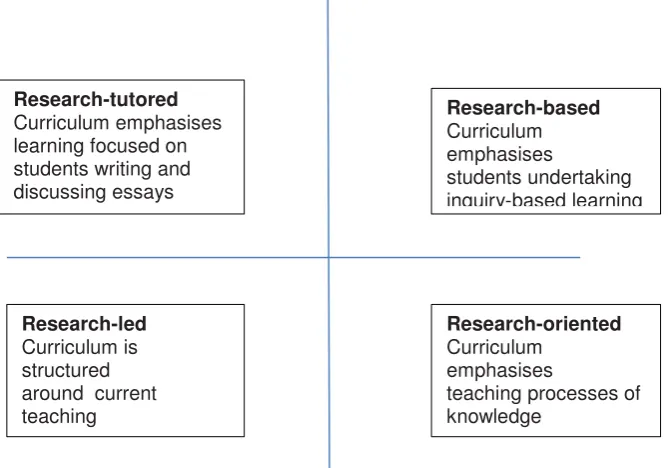
[image:7.595.123.459.522.756.2]research and its utilisation for the students. Healey’s influential model, as seen in
figure one, proved a useful vehicle
The project could be seen primarily as ‘research led’ teaching by the tutor; in the
sense that its main aim was to also enable the tutor, through both the report and
guide, to enhance the understanding of their students of an empirically based study
that provided both practical and theoretical outcomes. Nonetheless, it could be
argued that the design of the materials also allowed an element of ‘research oriented’ learning; in that the UFHRD format and a detailed study of the report, guided by their tutor, also opened up students’ understanding to ‘how’ the findings
were made available and not simply their interpretation. Furthermore, although this
Research-tutored Curriculum emphasises learning focused on students writing and discussing essays papers
Research-based Curriculum emphasises
students undertaking inquiry-based learning
Research-led Curriculum is structured around current teaching subject content
Research-oriented Curriculum
emphasises
teaching processes of knowledge
Figure 1: Curriculum design and the research-teaching nexus
Source: Healey (2005a) in Jenkins, A. and Healey, M. (2005)
might not explicitly lead to a ‘research-based’ learning outcome, it is significant that
in the evaluation element of the project outlined below, it did aid the students in
developing ideas and techniques for how they could subsequently undertake a very
practical assignment – designing a workshop guide which was underpinned by their
own inquiry-based learning.
Design of the tutor guide
Guided by Lucas and Milford’s counsel (2003) that business teaching is in some ways a ‘unique’ discipline, in that it must satisfy both the need to develop technical and theoretical skills and impart knowledge within its student groups, the tutor guide
was designed specifically to achieve this end. That is, whilst signposting tutor, and
therefore students, to the research objectives, the review of the appropriate
literature, the findings and their critical review in the report, the activities in the guide
were also intended to equip students, with a clear understanding of the strategies
and practices available to managers when seeking to actually resolve workplace
disputes, and the central role of learning in that objective. Appendix A outlines the
guidance notes for the use of the tutor guide.
Primarily, the guide allows the tutor to set the context of the study in terms of
workplace conflict, its relationship with learning and the role of the unions, and then
to cross reference the activities sequentially to sections of the report to iteratively
develop the students' understanding and knowledge and the application of that
knowledge in a practical sense. To this end, firstly the causes and consequences of
conflict are discussed through the particular activity. Then the second activity
facilitated by the tutor identifies solutions to that conflict. Thirdly referring specifically
to the research findings in the report, how trade union and management learning
partnerships could offer an alternative solution can be critically discussed. Fourthly,
how this is related to individual and collective disputes is facilitated by a further
In this way the report and its tutor guide, with associated activities, offers more than
a simple reading to be assigned to students for discussion the following week. But
rather it becomes a resource to use, for instance, over a couple of weeks in critically
discussing key elements of managing conflict in the workplace. So with respect to
appendix 1, for each of the key stages 1-7 the guide offers an activity referring to the
specific part of the report and then provides a set of possible answers to guide the
tutor in their discussion with their students. Appendix B illustrates an example of the
type of activities contained in the guide. In this particular activity, the students,
having previously identified in an earlier discussion the causes and consequences of
workplace conflict, are encouraged to identify possible solutions. This becomes then
the basis for context and prior understanding for the tutor to then specifically
introduce the findings of the research, and critically discuss with them the degree to
which union–management learning partnerships offer a further solution to the
resolution of such conflict
Evaluation and feedback
Following completion of the guide, the aim was then to test its fitness for purpose
with respect to its relevance to the target student group, their understanding of the
topic, the coherence of the activities in terms of achieving their learning objectives,
and also building an overall understanding for the students of why workplace conflict
management is a key part of their study of employee development.
This element of the methodology, which arguably can be the most challenging,
involved trialling the material in my own and also another two HE institutions. Former
colleagues from those institutions were able to first review then utilise the teaching
material, reporting back that they had been well received by their students and
offering suggestions that were then built into the final version of the tutor guide.
At UCLAN, the material was further trialled in February 2013 with a fairly typical
cohort of students on the fulltime MSc HRD degree in the Business School. The
students were undertaking the module ‘designing, delivering and evaluating learning and development provision’.
The feedback from both the tutor and the students was very positive in terms of
unions together. The tutor suggested that also utilising the TUC Unionlearn website,
which has accessible films on their work, would be a good way of summarising the
role of the union. This idea was subsequently added to the tutor guide. The students
also commented that as one of their module assessments is based on critically
analysing the role of stakeholders in promoting training and development, the
workshop had been very instructive. Furthermore, their second assignment was on
designing, delivering and writing a guide on a learning intervention. Therefore, a
discussion on the process of how the manual was designed was also very helpful for
them.
Methodology of disseminating learning from a research report
In summary, from the discussion above the process can be seen as a series of
stages:
1. Undertake the research project
2. Satisfy the commitment to key stakeholders
3. From a pedagogic perspective, then decide what should be the key learning
outcomes
4. Designing the tutor guide
- Underpin the study and user guide with a critical review of the appropriate
literature to build understanding of the subject and give the findings
relevance and context (through signposting to the report)
- Providing underpinning knowledge and context from the research findings
(through signposting to the report)
- Design activities to facility discussion on the relevance and applicability of
that knowledge for students (Offering possible answers for all activities to
support the tutor in facilitating those discussions)
- Ensure that the research findings and delivery methods for sharing those
findings appeal to both the tutor and the student
5. Test the effectiveness of the resource and amend accordingly
Conclusion
As academics it is increasingly important that we not only demonstrate our ability to
carry out and report on relevant research findings from within our chosen discipline
but also to embed that research within our teaching. This article has sought to
consider this imperative in the context of designing one particular pedagogic process
to achieve this objective. The discussion would suggest that when undertaken in a
systematic manner, empirical research and its findings can, through the medium of a
bespoke designed tutor guide, offer a valuable resource for dissemination of those
results to our students for critical discussion and interrogation.
Can I record my thanks to the reviewers for their advice and guidance on revising an
earlier version of the article.
1
‘The UFHRD is an international association for universities, reflective practitioners, and learning oriented organisations. The Forum’s mission is to create, develop and inform leading–edge HRD theories and practices by promoting professionally-focused qualifications, co-operative research initiatives, consultancy interventions. It seeks to promote wide discussion and debate about human
resource development from a range of perspectives: individual, group and organisational’
(www.ufhrd.co.uk). 22‘
Unionlearn is the learning and skills organisation of the TUC. Unionlearn works to assist unions in the delivery of learning opportunities for their members as well as managing the £15 million Union Learning Fund (ULF). Over the past 12 years, more than 28,000 union learning representatives (ULRs) have been trained and 230,000 people are being given training and learning opportunities through their union every year. Unionlearn is also responsible for providing education and training opportunities for workplace reps and professionals via TUC Education. Each year more than 50,000 trade union members enrol in trade union education courses organised by the TUC’
(www.unionlearn.org.uk/about-unionlearn).
3
Higher Education Academy 4
The UFHRD resource format and tutor guide can be found on:
The learning and conflict project: A tutor’s guide (2013) Joint teaching resource for the University Forum for HRD and TUC Unionlearn http://www.ufhrd.co.uk/wordpress/teaching-learning/
References
Beaty, L. (2003) ‘Supporting learning from experience’, in 2nd Ed. A Handbook for
Teaching and Learning in Higher Education: Enhancing Academic Practice, eds. Fry,
H., Ketteridge, S. and Marshall, S. London: Routledge-Falmer, 134-147.
Brennan, R. and Ahmad, S.J. (2005) ‘Using case studies in management education: the student perspective’, International Journal of Management Education, 4, 3, 21-30.
Brewer, G. (2012) ‘Enhancing the undergraduate research experience’ UCLAN Journal of Pedagogic Research, 3, 25-26.
Fallows, S. (2003) ‘Teaching and learning for student skills development’, in 2nd Ed.
A Handbook for Teaching and Learning in Higher Education: Enhancing Academic
Practice, eds. Fry, H., Ketteridge, S. and Marshall, S. London: Routledge-Falmer,
121-133.
Gurbutt, D. (2102) ‘Improving undergraduate student experience and retention:
Development of an activity-based research teaching package’ UCLAN Journal of
Pedagogic Research, 3, 17-24.
James, S. (2011) ‘Does business school research have to be “excellent” to benefit business school teaching?’ InternationalJournal of Management Education, 9, 2, 37-47.
Jenkins, A. and Healey, M. (2005) ‘Institutional strategies to link teaching and
research’ Report for the Higher Education Academy October 2005
King, N. (2004), ‘Template analysis’, in Cassell, G. and Symon, G. Eds, Essential guide to qualitative methods in organizational research, London: Sage, 256-270.
Knowles, L. and Hensher, D. (2005) ‘The postgraduate business curriculum: the
frontline in the war between professionalism and academic irrelevance’ International
Lucas, U. and Milford, P. (2003) ‘Key aspects of teaching and learning in accounting, business and management’ in A handbook for teaching and learning in higher Education 2nd. Ed. Eds. Fry, H., Ketterbridge, S. and Marshall, S. London: Routledge Falmer, 391-412.
Ottewill, R. (2003) ‘Pedagogic Challenges Facing Business and Management
Educators: Assessing the evidence’, International Journal of Management
Education, 3, 3, 34-41.
Ridley-Duff, R. and Bennett, A. (2011), ‘Towards Mediation: Developing a Theoretical Framework to Understand Alternative Dispute Resolution’, Industrial Relations Journal, 42, 2, 106-123.
Stuart, M., Cutter, J., Cook, H. and Winterton, J. (2010), ‘Assessing the impact of
union learning and the union learning fund; Union and employer perspectives’,
Appendix A
How to use the guide
The guide offers colleagues suggestions on how students’ knowledge and
understanding of a number of key elements of human resource development and management could be enhanced. In this sense it seeks to give greater context to HRD in relation to aspects of the overall management of the employment
relationship. The primary areas for consideration are:
1. The causes of conflict
2. Strategies for addressing conflict 3. The role of trade unions
4. The learning challenges facing organisations today 5. The specific role of trade unions in promoting learning
6. The nature of learning partnerships between management and unions 7. How these learning partnerships can also help address conflict in the
workplace
It is important to note that whilst the intended target audience is business and management students with a particular interest in HRD, reflecting the reality of managing people in the workplace, the guide and the associated report seek to emphasise that managing people, the role of trade unions, conflict and its causes and learning and development are all intertwined elements of organisational life. Elements, it is argued, that need to be understood both separately but more
importantly in how they also interact with one another (ACAS, 2006; Ridley-Duff and Bennett, 2011).
In practical terms, depending on the degree to which you may wish to utilise the report, the complete document might either be given out at the end of the activities or it could be printed off and given out in sections at the end; either way in order that students don’t ‘spot the answers’. It is suggested that all activities are undertaken in groups or in pairs in order to promote critical discussion and debate.
3.3 Solutions for addressing conflict
The discussion so far is valuable (i.e. prior to this activity) as it gets the students to reflect on and discuss the causes and consequences of conflict in the workplace – for many students it is an introduction to the key idea that management practice is actually very much about managing conflict (or ideally pre-empting conflict).
In terms of the overall theme of the report, the discussion (facilitated by this activity) now turns to how that conflict can be addressed – That is different actions and
strategies can be considered by the students before, for the purposes of understanding the key findings from the report, a set of activities consider how promoting learning can be seen as a key potential way of addressing that conflict.
The purpose then of this activity is for the learners to list which solutions they might consider when addressing conflict in the workplace. Section 2.5 gives an overview of and context to this discussion. Box 3 offers points that can be discussed in relation to this activity.
Box 3 Solutions for managing conflict Informal solutions
A quite word with a colleague
A quite word from the manager to a member of their team An informal discussion between a manager and the union rep Seek advice off HRM on options available
Do nothing
Take absence (‘go on the sick’). Leave the organisation
Seek advice off the union
Formal solutions
Submit a grievance
Initiate the discipline or performance management procedure
Formalise an individual or collective dispute between the union and management Dispute escalated to an employment tribunal
Initiate the organisation bullying or harassment procedure
Contact the health and safety reps for the company and the union
Alternative dispute resolution
Contact ACAS for advice and support