FPGA-based image processing
GARCIA, Paulo, BHOWMIK, Deepayan
<http://orcid.org/0000-0003-1762-1578>, STEWART, Robert, MICHAELSON, Greg and WALLACE, Andrew
Available from Sheffield Hallam University Research Archive (SHURA) at:
http://shura.shu.ac.uk/24382/
This document is the author deposited version. You are advised to consult the
publisher's version if you wish to cite from it.
Published version
GARCIA, Paulo, BHOWMIK, Deepayan, STEWART, Robert, MICHAELSON, Greg
and WALLACE, Andrew (2019). Optimized memory allocation and power
minimization for FPGA-based image processing. Journal of Imaging, 5 (1), p. 7.
Copyright and re-use policy
See
http://shura.shu.ac.uk/information.html
Imaging
Article
Optimized Memory Allocation and Power
Minimization for FPGA-Based Image Processing
Paulo Garcia1,* , Deepayan Bhowmik2 , Robert Stewart3, Greg Michaelson3and Andrew Wallace4
1 Department of Systems and Computer Engineering, Carleton University, Ottawa, ON K1S 5B6, Canada 2 Div. of Computing Science and Mathematics, University of Stirling, Stirling FK9 4LA, UK;
3 School of Mathematical and Computer Sciences, Heriot Watt University, Edinburgh EH14 4AS, UK;
[email protected] (R.S.); [email protected] (G.M.)
4 School of Engineering and Physical Sciences, Heriot Watt University, Edinburgh EH14 4AS, UK;
* Correspondence: [email protected]
Received: 19 November 2018; Accepted: 27 December 2018; Published: 1 January 2019
Abstract: Memory is the biggest limiting factor to the widespread use of FPGAs for high-level image processing, which require complete frame(s) to be stored in situ. Since FPGAs have limited on-chip memory capabilities, efficient use of such resources is essential to meet performance, size and power constraints. In this paper, we investigate allocation of on-chip memory resources in order to minimize resource usage and power consumption, contributing to the realization of power-efficient high-level image processing fully contained on FPGAs. We propose methods for generating memory architectures, from both Hardware Description Languages and High Level Synthesis designs, which minimize memory usage and power consumption. Based on a formalization of on-chip memory configuration options and a power model, we demonstrate how our partitioning algorithms can outperform traditional strategies. Compared to commercial FPGA synthesis and High Level Synthesis tools, our results show that the proposed algorithms can result in up to 60% higher utilization efficiency, increasing the sizes and/or number of frames that can be accommodated, and reduce frame buffers’ dynamic power consumption by up to approximately 70%. In our experiments using Optical Flow and MeanShift Tracking, representative high-level algorithms, data show that partitioning algorithms can reduce total power by up to 25% and 30%, respectively, without impacting performance.
Keywords:field programmable gate array (FPGA); memory; power; image processing; design
1. Introduction
Advances in Field Programmable Gate Array (FPGA) technology [1] have made them the de facto implementation platform for a variety of computer vision applications [2]. Several algorithms, e.g., stereo-matching [3], are not feasibly processed in real-time on conventional general purpose processors and are best suited to hardware implementation [4,5]. The absence of a sufficiently comprehensive, one size fits allhardware pipeline for the computer vision domain [6] motivates the use of FPGAs in a myriad of computer vision scenarios, especially in applications where processing should be performed in situ, such as in smart cameras [7], where FPGAs embed data acquisition, processing and communication subsystems. Adoption of FPGA technology by the computer vision community has accelerated during recent years thanks to the availability of High Level Synthesis (HLS) tools which enable FPGA design within established software design contexts.
However, since FPGAs have limited on-chip memory capabilities (e.g., approx. 6MB of on-chip memory on high end Virtex 7 FPGAs), external memory (i.e., DDR-RAM chips connected to the FPGA) is often used to accommodate frames [8,9]. This causes penalties onperformance(latency is much higher for off-chip memory access) and perhaps more importantly, onsize(two chips, FPGA and DDR, rather than just FPGA),power(DDR memories are power hungry [10]) and have associated monetary costs, hindering the adoption of FPGAs.
In this paper, we research allocation of on-chip memory resources in order to minimize resource usage and power consumption, contributing to the realization of power-efficient high-level image processing systems fully contained on FPGAs. We propose methods for generating on-chip memory architectures, applicable from both HLS and Hardware Description Languages (HDL) designs, which minimize FPGA memory resource usage and power consumption for image processing applications. Our approach does not exclude external memory access: rather, it is orthogonal to any memory hierarchy, and applicable to any instances of on-chip memory. Specifically, this paper offers the following contributions:
• A formal analysis of on-chip memory allocation schemes and associated memory usage for given frame sizes and possible on-chip memory configurations.
• Methods for selecting a memory configuration for optimized on-chip memory resource usage and balanced usage/power for a given frame size.
• A theoretical analysis of the effects on resource usage and power consumption of our partitioning methods.
• Empirical validation of resource usage, power and performance of the proposed methods, compared to a commercial HLS tool.
Our experiments show that on-chip memory dynamic power consumption can be reduced by up to approximately 70%; using representative high-level algorithms, this corresponds to a reduction of total power by up to 25% and 30%, respectively, without impacting performance. The remainder of this paper is organized as follows: Section2describes related work within FPGA memory systems architecture and design for image processing. In Section3, we formally describe the research problem of power-size optimization, present a motivational example that highlights the limitations of standard HLS approaches, and present alternative partitioning methods. Section4describes our experimental methodology and experimental results, and Section5presents a thorough discussion of said results. Finally, Section6presents our concluding remarks.
Throughout this paper, we use the term BRAM (Block Random Access Memory), a Xilinx nomenclature for on-chip memories, to refer to on-chip FPGA memories in general.
2. Background and Related Work
Within FPGA processing sub-systems, algorithms evolve from typical software-suitable representations into more hardware-friendly ones [6,11] which can fully exploit data parallelism [11] through application-specific hardware architectures [3], often substantially different from the traditional Von Neumann model, such as dataflow [12,13] or biologically inspired processing [14]. These heterogeneous architectures are customized for FPGA implementation not just for performance (e.g., by exploiting binary logarithmic arithmetic for efficient multiplication/division [15]), but also for power efficiency (e.g., by static/dynamic frequency scaling across parallel datapaths for reduced power consumption [16]).
More often than not, computer vision applications deployed on FPGAs are constrained by performance, power and real-time requirements [3]. Real time streaming applications (i.e., performing image processing on real-time video feeds [6]) require bounded acquisition, processing and communication times [16] which can only be achieved, while maintaining the required computational power, through exploitation of data parallelism [11] by dedicated functional blocks [7].
(e.g., sliding window filters) [15] are relatively simple to implement using hardware structures such as line buffers [3]. However, complex algorithms based on global operations require complete frame(s) to be stored in situ [11]; examples of contemporary applications that require global operations are object detection, identification and tracking, critical to security. Notice we use the term “global operations” to simultaneously refer to two characteristics: the use ofglobal operators(atomic operations which require the whole image, such as transposition or rotation) andundetermined(unpredictable) access patterns (e.g., a person identification system might only need a subset of a frame, but which subset cannot be decided at design time, as it depends on person location at runtime).
A possible approach is to refine image processing algorithms so they can perform on smaller frame sizes that can be contained on an FPGA [2]. Several algorithms maintain robustness for downscaled images [17], e.g., the Face Certainty Map [18]) or employ intelligent on-chip memory allocation schemes [8] to accommodate complete frames that take into account power profiles. The latter requires methods to optimize on-chip memory configurations in order to maximize valuable usage; often at odds with performance-oriented allocation schemes standard in HLS code generators. Other possible approaches include stream-processing algorithm refactoring to minimize memory requirements [19] or programming-language abstractions for efficient hardware pipeline generation [20]; these are orthogonal to our approach, and outside the scope of this work.
In our context, the most significant related work on the use of FPGA on-chip memory for image processing applications has focused on four aspects: processing-specific memory architectures, caching systems for off-chip memory access, partitioning algorithms for performance and on chip memory power reduction.
2.1. Processing-Specific Memory Architectures
Memory architectures specialized for specific processing pipelines typically exhibit poor BRAM utilization. Torres-Huitzil and Nuno-Maganda [9] presented a mirrored memory system: in order to cope with dual access required by computational datapaths; data is replicated in two parallel memories and a third one is used for intermediate computations. The need for data replication to support paralellism inhibits scaling for higher frame sizes. Mori et al. [21] described the use of neighbourhood loader: input pixels are fed to shift registers which de-serialize the input stream into a neighbourhood region. Their approach supports only one output port, and sequential region read (no random access). This approach does not exploit datapath parallelism, nor does it support classes of algorithms which require disparate region access. Chen et al. [22] use distributed data buffers for expediting Fast Fourier computations; they partially exploit spatial parallelism, focusing on time-multiplexing as a means for reducing resource-usage and power consumption. Although time-multiplexing is a convenient technique for certain classes of applications, it cannot be used in real-time streaming where input pixels arrive at steady rates (without discarding frames). Klaiber et al. [23] have developed a distributed memory that divides input frames into vertical regions stored in separate memories. Their approach allows fine grained parallelism, but is only capable of handling single-pass algorithms, i.e., which do not require storage of intermediate values. While this suffices for simple computations, it does not satisfy the requirements of sophisticated computer vision algorithms which process data iteratively (e.g., MeanShift Tracking [24]).
2.2. Caching Systems
on-chip as rows, consuming precious processing time. Similarly, Chou et al. [26] have shown the use of vector scratchpad memories for accelerating vector processing on FPGAs, but still rely on random-access external memories; a similar approach is followed by Naylor et al. [27] in the context of FPGAs as accelerators. The use of external memories solves the storage limitation: however, it greatly limits parallelism (only one access per external memory chip can be performed at once) or greatly exacerbates financial and power costs, if several external memories are used.
2.3. Partitioning Algorithms
For HLS-based designs, computer vision algorithms are naturally expressed by assuming frames are stored in unbounded address spaces [28]. This software approach to FPGA design not only easily exceeds FPGA memory capabilities but is also not easily integrated in streaming designs without significant refactoring. This has led to the development of custom hardware blocks and APIs for software integration [29]: “naive” C-based HLS results in several on-chip memory structures, whose sizes and interfaces are dependent on variables’ types, often sub-utilizing available on-chip memory. Most HLS tools offer compiler directives—pragmas—which guide the synthesis tool according to the designer’s intention: optimizing for performance through loop unrolling, or selecting different implementations (on-chip memories or LUTs). We advocate that more directives, invoking different synthesis strategies, are required in order to tackle design constraints such as space and power.
The majority of research into partitioning algorithms has mainly focused on performance: namely, throughput. Gallo et al. [30] have shown how to construct efficient parallel memory architectures through High-Level Synthesis: however, their approach is predicated on re-organizing memory placement at algorithm level, by examining computational behavior and placing data accordingly through lattice-based partitioning, which is not feasible on streaming applications where pixels are inputted sequentially. Although possible, it would require a complex memory addressing mechanism between pixel input and memory structure. The authors then expanded their work to incorporate information about loop unrolling [31], providing new partitioning algorithms for maximizing parallelism; however, they did not tackle the utilization problem. Similarly, Wang et al. [32] have demonstrated an extremely efficient algorithm for improving throughput, by creating memory structures that facilitate loop pipelining in high level synthesis. Their approach saves up to 21% of BRAMs compared to previous work [33]; still, since their objective is maximizing throughput, supporting loop pipelining, their approach does not achieve optimized memory allocation in terms of utilization efficiency.
2.4. Memory Power Reduction
The impact of memory partitioning on power consumption has been researched by Kadric et al. [34]. Their approach investigates the impact of parallelism, i.e., how data placement can be leveraged for parallel access, minimizing communication power. A similar approach is taken in [35]. Tessier et al. [36] show on chip memory power reduction through partitioning, similar to our approach and previous work by the same authors [37], and more recently in [38]. However, none of these investigations assume constraints on memory availability. In contrast, we investigate tradeoffs between power and scarce availability, inherent to the image processing domain, future work need clearly identified by Tessier et al: “an investigation to determine the optimal size and availability of different-sized embedded memory blocks is needed".
3. Memory Partitioning on FPGA
problem formulation. We assume that only one possible BRAM configuration is used for each image frame buffer.
3.1. Problem Formulation: Utilization Efficiency
Definition 1. Given a BRAM storage capacity C, and a number of possible configurations i, the configurations setCfgis a vector of i elements:
Cfg=
(M1,N1)
(M2,N2)
. . . (Mi,Ni)
= Cfg1 Cfg2 . . . Cfgi (1)
where the first component of each element depicts BRAM width M and the second component depicts BRAM height N, such that:
Mx×Nx≤C,∀x∈[0,i−1] (2)
For any given frame size, several possible BRAM topologies are possible (Different BRAM configurations do not always equal the same logical bit capacity. Whilst the total physical capacity is the same, in some configurations parity bits can be used as additional data bits. E.g., configuration (1,16384) can store 16384 bits, whilst configuration (9,2048) can store 18432 bits). A frame is a 3-dimensional array, of dimensions widthW, heightH, and pixel bit widthBw(typically defined as a 2-dimensional array
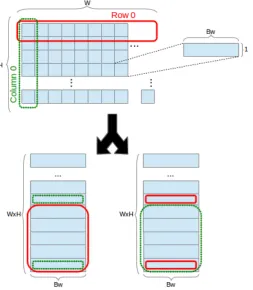
[image:6.595.174.428.435.726.2]where the type defines the bit width dimension). BRAM topologies are defined based on amappingof 3-D to 2-D arrays and apartitioningof a 2-D array to a particular memory structure (Figure1).
Throughout the remainder of this paper, we assume the use of a mapping scheme which assigns Bw to the x dimension and H andW to the y dimension, in both row-major and column-major
order (wherexandyare 2-D array width and height, respectively). This is the default approach in software implementations, where the type/bit width dimension is considered implicit, and a sensible approach for hardware implementations. Mapping bit widthBwacross theydimension would result
in implementations where different bits of the same array element (pixel) would be scattered among different memory positions of the same BRAM. This would require sequential logic to read/write a pixel, accessing several memory positions, creating performance, power and size overheads. It should be noted that this approach might offer performance advantages for certain classes of algorithms which might want to compare individual bits of different elements; however, we delegate this aspect to future work. Hence, we define only the default mapping scheme:
Definition 2. A mapping scheme m transforms a 3-D arrayA3into a 2-D arrayA2of dimensions x and y by assigning Bwto the x dimension and ordered combinations of W and H to the y dimension, for a total of two
possible configurations, as depicted in Figure1. Mapping schemes are defined as:
(x,y) =m(W,H,Bw) (3)
A2x,y=A3y\W,y%W,x, x =Bw,y=W×H (4)
A2x,y=A3y%H,y\H,x, x =Bw,y=W×H (5)
where\and%represent integer division and modulo, respectively.
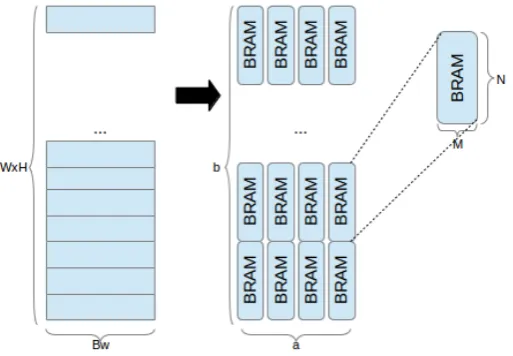
Definition 3. Given a 2-D mapped image frame of dimensions x and y, a partitioning scheme p which assigns pixels across a×b BRAMs, depicted in Figure2, is defined as the linear combination:
p(x,y) =Cfg∗(a1,b1),(a2,b2), ...,(ai,bi)
(6)
where∗stands for linear combination, such that only one(ax,bx),∀x∈[0,i−1]pair has non-zero components
(such a pair is generated as a function of x and y), selecting Mpand Npsubject to:
[image:7.595.172.429.520.698.2]((a×Mp)≥x)∩((b×Np)≥y) (7)
Figure 2.Mapping 2-D array of dimensionsx=Bwandy=W×Htoa×bBRAMs configured for
widthMand heightN.
and resource usage. As this is the greatest bottleneck in implementing high-level image processing pipelines on an FPGA, it is paramount to define BRAM usage efficiency, i.e., the ratio between the total data capacity of the assigned BRAMs and the amount of data which is actually used.
Definition 4. Given a partitioning scheme p and maximum BRAM capacity C, the utilization efficiency E is defined as the ratio:
E= x×y
ap×bp×C (8)
The default mapping and partitioning schemes in state of the art HLS tools are geared towards minimizing addressing logic (abundant in contemporary FPGAs), resulting in sub-par efficiency in BRAMs usage (still scarce for the requirements of high-level image processing systems). Alternative schemes must be used in order to ensure memory availability within HLS design flows. We define the problem as:
Problem 1(Utilization Efficiency). Given an image frame of width W, height H and pixel width Bw, select a
partitioning scheme, in order to:
Maximize E= a x×y
p×bp×C
Subject to((a×Mp)≥x)∩((b×Np)≥y)
3.2. Utilization Example
Consider an image frame of widthW = 320 and height H = 240, where each pixel is 8 bits (monochrome), and BRAMs which can be configured according to:
Cfg= (1, 16384) (2, 8192) (4, 4096) (9, 2048) (18, 1024) (36, 512) (9)
which is representative of state of the art FPGAs (Xilinx Virtex 7 family 18Kbits BRAM.), where total BRAM capacityCis given byC=36×512. Using a partitioning scheme
p(m(320, 240, 8)) =Cfg∗
(8, 8) (0, 0) (0, 0) (0, 0) (0, 0) (0, 0) T (10)
wherem(320, 240, 8) = (8, 76800)(Equation (3)), yields a BRAM usage count of 64 (8×8 BRAMs configured for width 1 and height 16384), with storage efficiency:
E= 8×(320×240)
8×8×(36×512) =0.520833333 (11) We have observed that this is the default behaviour for Xilinx Vivado HLS synthesis tools: empirical results show that configuration(M1,N1) = (1, 16384)is selected through a partitioning
scheme wherea1=Bwand
b1= W
×H
rounded up to the nearest power of 2. Our experiments show that for any frame size, the synthesis tools’ default partitioning scheme can be given by:
p(m(W,H,Bw)) =Cfg∗
(Bw, 2
dlog2(WN×1H)e)
(0, 0) (0, 0) (0, 0) (0, 0) (0, 0)
T (13)
where 2dlog2(WN×1H)eshould be read as 2 to therounded up(ceiled) result of the logarithm operation (i.e.,
2 to an integer power).
Now consider the same mapping (x=Bw,y=W×H), but with a partitioning scheme:
p(m(320, 240, 8)) =Cfg∗
(8, 5) (0, 0) (0, 0) (0, 0) (0, 0) (0, 0) T (14)
which partitions data unevenly across BRAMs, rather than evenly. This scheme yields a BRAM usage count of 40, with storage efficiency:
E= 320×240×8
8×5×(36×512) =0.833333333 (15) Yet a better partitioning scheme for the same mapping would be:
p(m(320, 240, 8)) =Cfg∗
(0, 0) (0, 0) (2, 19)
(0, 0) (0, 0) (0, 0)
T (16)
yielding a BRAM count of 38 and efficiency:
E= 320×240×8
2×19×(36×512) =0.877192982 (17) Clearly, partitioning schemes depend on the frame dimensions, width, height, and bit width, to enable efficient use of on-chip memory blocks.
3.3. Power Considerations
Having formalized the utilization problem, we may proceed to analyse the power implications of each configuration. We model BRAM dynamic power consumption using the model described by Tessier et al. [37]: a power quantum is consumed per read and/or write. BRAM static power is directly proportional to utilization, hence addressed in the utilization problem.
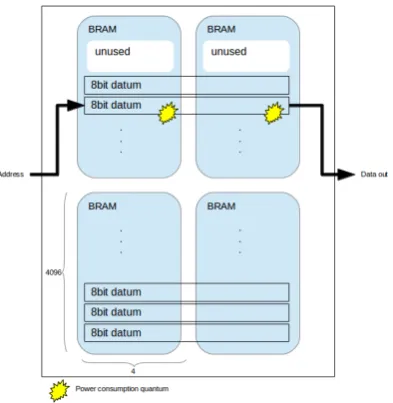
Now consider the partitioning presented in Equation (10) where each datum is distributed across eight BRAMs, and the partitioning presented in Equation (16), where each datum is distributed across two BRAMs. Each read/write operation in the former must consume power across four times the number of BRAMs in the latter. Figures3and4depict examples of power consumption for two partitioning schemes.
Figure 3.Partitioning across two BRAMs horizontally. Each access consumes two power consumption quantums.
Figure 4.Partitioning across one BRAM horizontally. Each access consumes 1 power consumption quantum.
A partitioning scheme which minimizes horizontal usage of BRAMs (i.e., acrossx) is more suitable for clock gating. Since fewer BRAMs must be accessed per operation, the proportian of unused ones, which can be effectively gated, increases. It is straightforward to implement clock gating through chip enable selection [39] which is enabled/disabled based on address decoding. colorred In other words, BRAM power consumption is proportional to the number of BRAMs required to access each pixel: and this number depends on which configuration is selected.
An intuitive approach to balance power consumption and utilization is to always use the widest BRAM configuration that suffices forBw, or multiples of the widest available.
[image:10.595.202.394.405.601.2]BRAMs might increase: utilization efficiency is modified. Additionally, the logic required for address (and chip enable) signals increases when moving to a wider configuration. This aspect makes the utilization and power problems indivisible. In the following section, we describe our approach to balance these two aspects.
3.4. Partitioning for Power and Utilization
We begin by presenting a brute force optimized partitioning procedure for maximizing utilization efficiency, described in Algorithm1in pseudo code notation.
Algorithm 1Optimized Utilization Efficiency can be achieved by:
1: procedureOPTIMIZEDPARTITION 2: efficiency←0
3: best←0
4: forx=0 :i-1do 5: (Mx,Nx)←Cfgx
6: a←Bw/Mx
7: b←W×H/Nx
8: efficiency←(W×H×Bw)/(a×b×C)
9: ifefficiencygreater thanbestthen
10: best←e f f iciency
11: configuration←(Mx,Nx)
12: end if
13: end for
For each element in the configurations setCfg(possessing a total ofielements), the procedure calculates the required number of BRAMs to store a frame of widthW, heightHand bit widthBw, the efficiency of such a configuration and compares it with the highest efficiency found so far. The focus here is solely on utilization. Effectively, this is an exhaustive search as the number of possible memory configurations is finite and this is an off-line process.
[image:11.595.81.522.215.400.2] [image:11.595.80.514.593.674.2]Table1depicts the configurations selected by procedure1for a representative number of frame sizes and pixel bit widths. Several of the configurations are not power-optimised: notice that for pixels of widths 10, 14 and 22, BRAM configuration 2×8192 is chosen most often (consuming power on 5, 7 and 11 BRAMs per access, respectively). This is intuitive from a utilization efficiency perspective: it is the only configuration that divides the width, and is in accordance with the selection of configuration 4×4096 for pixels of width 8, 12, 20 and 24 and configuration 18×1024 for pixels of width 18.
Table 1.BRAM configurations based on optimized utilization procedure.
Pixel Width
Frame 8 10 12 14 16 18 20 22 24
160×120 4×4096 4×4096 4×4096 18×1024 18×1024 18×1024 4×4096 9×2048 4×4096 320×240 4×4096 2×8192 4×4096 2×8192 18×1024 18×1024 4×4096 2×8192 4×4096 512×512 4×4096 2×8192 4×4096 2×8192 4×4096 18×1024 4×4096 2×8192 1×16384 640×480 4×4096 2×8192 4×4096 2×8192 18×1024 18×1024 4×4096 2×8192 4×4096 1280×720 4×4096 2×8192 4×4096 2×8192 18×1024 18×1024 4×4096 2×8192 4×4096
Algorithm 2Balanced Power-Utilization can be achieved by:
1: procedureBALANCEDPARTITION 2: efficiency←0
3: configuration←get_MxNx(OptimizedPartition())
4: best←get_efficiency(OptimizedPartition())
5: j←get_index(OptimizedPartition())
6: forx=j+1 :i-1doefficiency
7: (Mx,Nx)←Cfgx
8: a←Bw/Mx
9: b←W×H/Nx
10: efficiency←(W×H×Bw)/(a×b×C)
11: ifefficiencyless thanbest - tradeoffthen
12: break
13: end if
14: configuration←(Mx,Nx)
15: end for
Procedure2begins by selecting the optimized utilization solution and iterating over wider BRAM configurations (in thexdimension), calculating utilization efficiency. As long as the utilization is above the threshold limit, given by the difference between best utilization and tradeoff, in percentage points, the procedure continues. When it finds the first solution below the threshold, it exits, returning the last solution above the threshold limit. This approach follows the power model heuristics [37] described in the previous section: power consumption decreases as BRAM horizontal width increases (Figures3and4).
[image:12.595.81.520.98.301.2] [image:12.595.77.516.498.579.2]Table2depicts the BRAM configurations selected by the balanced procedure, with the tradeoff set to 12 percentage points. Compared to the optimized configurations, the majority of widths are increased, resulting in a more power efficient solution based on the aforementioned heuristics.
Table 2.BRAM configurations based on balanced procedure with tradeoff equal to twelve percentage points.
Pixel Width
Frame 8 10 12 14 16 18 20 22 24
160×120 9×2048 4×4096 4×4096 18×1024 18×1024 18×1024 4×4096 9×2048 9×2048 320×240 9×2048 4×4096 4×4096 18×1024 18×1024 18×1024 4×4096 9×2048 9×2048 512×512 9×2048 2×8192 4×4096 18×1024 18×1024 18×1024 4×4096 9×2048 9×2048 640×480 9×2048 2×8192 4×4096 18×1024 18×1024 18×1024 4×4096 9×2048 9×2048 1280×720 9×2048 2×8192 4×4096 18×1024 18×1024 18×1024 4×4096 9×2048 9×2048
3.5. Applying Memory Partitioning: Methodology
Figure 5. Proposed design flow from HDL and HLS, highlighting the additional steps required for minimizing utilization and power.
After a memory structure has been derived from the procedure specification, according to Equations (3)–(5), procedures1and/or2are computed to determine BRAM partitioning. BRAMs of the computed configuration are instantiated and contained in modules (i.e., hardware entities). A top module instantiates all sub-modules, providing interfaces identical to the base HDL design or to the specification of the HLS tool. Addressing logic within the top module controls chip enable signals to each sub-module, ensuring that non-addressed BRAMs are not enabled. This careful partitioning of HDL logic in hierarchical modules, where addressing logic is determined by the top-level interconnect and BRAM configuration is determined by module configuration parameters ensures that the desired configurations are used (this is based on our experiments using Vivado: different synthesis tools might require additional compiler pragmas).
4. Experimental Results
Our experiments target state of the art FPGA devices (Xilinx Virtex 7 device xc7vx690tffg1761-1C and Zynq xc7z020clg484-1). We use Vivado v2016.1 for HDL design, Vivado HLS v2016.1 for High Level Synthesis, and Xilinx Power Estimator for power characterization of implemented designs. We begin by generating frame buffers in several configurations, in order to characterise utilization efficiency and power consumption. We then compare utilization and power against equivalent frame buffers generated by a HLS tool. We conclude by implementing two high level image processing algorithms through HLS, and modifying frame buffers according to the proposed strategies, in order to quantify our algorithms’ impact on resource usage and power consumption within complete image processing systems.
4.1. Frame Buffers: BRAM Configuration Impact
We implemented frame buffers in Verilog HDL in Vivado v2016.1, explicitly instantiating BRAMs according to the desired configurations. Logic in our design hierarchy routes data, addresses and control signals accordingly. Analysis of post-implementation reports was performed in order to ensure that BRAMs were instantiated according to the desired configuration (depending on the design hierarchy, synthesis tool optimizations could feasibly re-organize BRAM allocation). We performed asequential read/writeexperiment, where a complete frame is written to memory (sequential pixel input, in row-major order) and then read in the same order. This allows us to validate the power model heuristics assumed in the previous section. Table3depicts power and utilization results for monochrome frames of sizes 320×240 and 512×512.
Table 3.FPGA power usage and utilization efficiency (Eff.) for monochromatic (8 bits) frames of sizes 320×240 and 512×512 for different BRAM configurations.
320×240 512×512
Configuration Power (W) Eff. (%) Configuration Power (W) Eff. (%)
Static Dynamic BRAM Static Dynamic BRAM
8×5–1×16384 0.328 0.054 0.036 83.33 8×16–1×16384 0.332 0.07 0.036 88.88 4×10–2×8192 0.327 0.036 0.018 83.33 4×32–2×8192 0.331 0.053 0.018 88.88 2×19–4×4096 0.327 0.026 0.009 87.72 2×64–4×4096 0.331 0.043 0.009 88.88 1×38–9×2048 0.327 0.027 0.005 87.72 1×128–9×2048 0.331 0.046 0.005 88.88
4.2. Frame Buffers: HLS Comparison
Our second set of experiments compares the proposed partitioning algorithms with default strategies employed by commercial HLS tools. The goal of this set of experiments was to confirm that the proposed methodology outperforms commercial HLS tools in both utilization and power consumption.
We performed C-based high level synthesis using Xilinx Vivado HLS, describing frames in the standard format (array type determines bit width, indices determine frame width and height). For each frame size, we report BRAM usage and additional resources (slice registers and LUTs). We utilized standard pixel widths (8 bits for monochrome images, 24 bits for RGB). We estimated optimized BRAM usage using the optimized utilization algorithm and according to the balanced partitioning algorithm in order to compare the power and utilization impact—algorithms were run offline; we have not integrated them in any HLS tool at this point. We implemented the frame buffers in Verilog HDL according to each algorithm, ensuring external interfaces (i.e., read/write data, address and control singals ports) are identical to the ones generated by Vivado HLS from C. We then replaced the frame buffers generated from HLS with our hand-coded Verilog HDL versions. For each frame size, we report BRAM usage and additional resources (slice registers and LUTs) required to implement addressing logic.
Table 4. FPGA resource usage for monochromatic frames: generated from Vivado HLS versus hand-coded modifications according to the proposed algorithms.
8 bits HLS Optimized Utilization Balanced
Frame BRAMs LUTs BRAMs LUTs BRAMs LUTs
Usage Mode Reduction Usage Mode Reduction
160×120 16 0 10 4×4096 −37.5% 22 10 9×2048 −37.5% 48
320×240 64 9 38 4×4096 −40.6% 79 38 9×2048 −40.6% 186
512×512 128 17 128 4×4096 0% 285 128 9×2048 0% 596
640×480 256 34 150 4×4096 −41.4% 337 150 9×2048 −41.4% 742
1280×720 512 64 450 4×4096 −12.1% 1039 450 9×2048 −12.1% 2284
24 bits HLS Optimized Utilization Balanced
Frame BRAMs LUTs BRAMs LUTs BRAMs LUTs
Usage Mode Reduction Usage Mode Reduction
160×120 48 0 30 4×4096 −37.5% 41 30 9×2048 −37.5% 91
320×240 192 25 114 4×4096 −40.6% 140 114 9×2048 −40.6% 308
512×512 384 49 384 1×16384 0% 504 384 9×2048 0% 1109
640×480 768 98 450 4×4096 −41.4% 584 450 9×2048 −41.4% 1285
[image:15.595.144.451.337.485.2]1280×720 1536 192 1350 4×4096 −12.1% 1760 1350 9×2048 −12.1% 3877
Figure 6.BRAM utilization efficiency for RGB frames: Vivado HLS versus proposed methods.
[image:15.595.146.446.530.683.2]Figure 8.Total dynamic power consumption for sequential read/write: Vivado HLS versus proposed methods.
Figure 9. Total dynamic power consumption for 3×3 sliding window read: Vivado HLS versus proposed methods.
[image:16.595.146.450.505.657.2]Figure 11.BRAM power consumption for 3×3 sliding window read: Vivado HLS versus proposed methods.
4.3. High-Level Image Processing
Out third set of experiments contextualises the impact of memory allocation on high-level image processing systems. The goal of this set of experiments was to quantify how much frame buffers impact resource usage and power consumption within complete image processing systems, based on default and proposed partitioning strategies.
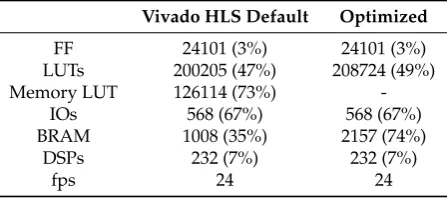
We use Optical Flow and MeanShift Tracking as case studies. Optical Flow estimates the apparent motion of objects caused by the relative motion of an observer; i.e., for two sequential frames, Optical Flow estimates the movement of each pixel (or larger regions) from one frame to the other. It belongs to thetemporal class of image processing algorithms, i.e., it performs computations across time (different frames). Our Optical Flow implementation is based on the code available from [40] using the TV-L1 method, refactored so it complies with Vivado HLS C synthesis requirements (e.g., dynamic memory allocation was replaced by static memory allocation); we performed no other optimizations. We compute a single scale, rather than multiple scales, for images of size 160×120: an example is depicted in Figure12. We used the publicly available dataset from [41]. We developed three versions: with default memory allocation and following the optimized utilization and balanced algorithms. FPGA utilization results for Xilinx Virtex 7 are depicted in Table5(optimized and balanced strategies yield the same BRAM utilization, although different configurations, for our implementation). For the default strategy, BRAMs were insufficient to accommodate all memory requirements, causing the synthesis tool to infer Memory LUTs for parts of the design. Using our approach, BRAMs suffice to implement the complete system. Power consumption per version is depicted in Figure13.
Table 5.Optical Flow FPGA resource usage and performance on Virtex 7 xc7vx690tffg1761-1: generated from Vivado HLS versus hand-coded modifications according to the proposed algorithm.
Vivado HLS Default Optimized
FF 24101 (3%) 24101 (3%) LUTs 200205 (47%) 208724 (49%) Memory LUT 126114 (73%)
-IOs 568 (67%) 568 (67%) BRAM 1008 (35%) 2157 (74%)
DSPs 232 (7%) 232 (7%)
[image:17.595.185.409.606.706.2](a)First frame (b)Second frame
[image:18.595.144.453.79.265.2](c)1 scale optical flow (d)5 scales optical flow
Figure 12.Optical Flow results using the implementation from [40]. (a,b): source frames. (c): output from 1 scale optical flow (used in our FPGA implementation). (d): output from 5 scales optical flow.
Figure 13.TV-L1 Optical Flow power consumption on Virtex 7.
[image:18.595.170.430.311.442.2]Figure 14.Zedboard connected to PC through Ethernet.
Figure 15.MeanShift Tracking: real-time face tracking displayed on PC. Image sent from Zedboard over Ethernet connection.
We developed three system versions: with default memory allocation, optimized utilization memory allocation and balanced allocation for image sizes of 320×240 where each pixel is 24 bits (RGB), with a region of interest of size M = 16 andN = 21. Identical to the previous experiment, our baseline is the MeanShift Tracking implementation generated by Vivado HLS. The versions used for comparison replace the HLS frame buffer with hand-coded implementations: all other MeanShift Tracking modules are unmodified (generated from C through Vivado HLS). Resource usage for each version is depicted in Table6. Power consumption per version is depicted in Figure16.
Table 6.MeanShift Tracking FPGA resource usage and performance on Zynq 7020: generated from Vivado HLS versus hand-coded modifications according to the proposed algorithms.
Vivado HLS Default Optimized Balanced
FF 6264 (5%) 6264 (5%) 6264 (5%) LUTs 9197 (17%) 9310 (17.5%) 9475 (17.8%)
IOs 64 (32%) 64 (32%) 64 (32%) BRAM 228 (81%) 150 (54%) 150 (54%)
DSPs 8 (3%) 8 (3%) 8 (3%)
[image:19.595.170.426.649.736.2]Figure 16.MeanShift Tracking power consumption on Zedboard.
5. Discussion of Results
Regarding the experiments in Section4.1, we purposely chose these configurations in order to highlight the non-linear relationship between efficiency and power; while for frames of size 320×240, different configurations yield different efficiency and different power consumption, efficiency is identical across configurations for frames of size 512×512, while power consumption still varies. It is worthwhile noticing that for both sizes, BRAM configuration 9×2048 is less power efficient than configuration 4×4096, despite achieving the same efficiency; although BRAM power is decreased (from 0.009 W to 0.005 W in both cases), total dynamic power (comprised of BRAM, clocks, signals, logic and I/O) increases due to more complex logic, as previously described.
Experiments show that our partitioning algorithms achieve higher efficiency than default synthesis strategies, except for frames of size 512×512 where the efficiency is unchanged. This is the case where default strategies perform equally well in terms of utilization since the image height and width are powers of 2 (refer back to Equation (13)). This confirms that modified partitioning strategies are required, according to requirements, in order to improve memory usage.
Static power consumption depicted in Figure7decreases across frame sizes, except for frames of sizes 512×512 and 1280×720, where the utilization efficiency difference between default and proposed strategies is smallest (Figure6) and additional addressing logic becomes too (static) power hungry. This confirms the utilization and power problems are indivisible, and must be treated in synergy.
Total dynamic power, on experiments performed on frame buffers, is reduced on average by 74.708% (σ=7.819%) for read/write experiments (Figure8), and on average by 72.206% (σ=12.546%)
for read-only experiments (Figure9). This confirms our hypothesis that memory partitioning offers opportunities for power reduction, despite the need for logic overhead. Considering BRAM dynamic power only, our partitioning methods result in 95.945% average power reduction (σ =1.351%) for
read/write experiments (Figure10) and 95.691% average power reduction (σ=1.331%) for read-only
experiments (Figure11).
26% BRAM power reduction, at the expense of 1.6% clock frequency reduction; our methodology achieves up to 74% BRAM power reduction, without sacrificing clock frequency. This is due to the fact that their approach does not consider the power consumption differences caused by different BRAM configurations, a key aspect of our methodology.
5.1. Power Consumption
In Section3.3, we illustrated how different BRAM configurations affect power consumption: depending on how many BRAMs must be strobed in order to access a pixel (in other words, depending on which configuration is used for memory allocation), different power consumption quanta are expended (assuming the remaining ones are clock gated, as per our methodology). The interested reader may refer to [37] for a detailed explanation of this power model. Figures3and4visually display this phenomenon. Table4showed how, for the same frame size, different configurations can reduce power consumption expended on BRAMs by up to 82%; this corresponded to total dynamic power reduction of up to 50%. These results showed how severely BRAM configuration affects power consumption. Note that it is possible that a very small reduction in BRAM utilization (i.e., the number of BRAMs required to implement frame storage) can yield substantial power reductions.
In our experiments using complex high level algorithms, we showed that BRAM power constitutes a substantial portion of total power consumption: namely, using the default Vivado HLS strategy, BRAMs account for 8% of Optical Flow power consumption and 34% of Meanshift Tracking power consumption (Figures13and16). Additionally, significant power is spent on logic due to BRAM output change (prevented in our approach due to clock gating strategies).
5.2. Hardware Overhead
The default memory allocation strategy employed by HLS tools appears to be focused on minimizing addressing logic (implemented through LUTs), at the expense of memory usage. In contrast, our approach minimizes memory usage (a scarcer resource than LUTs) at the expense of more complex addressing. i.e., due to the use of different BRAM configurations, memory control logic (write-enable signals, address decoding, etc.) becomes slightly more complex, consuming more LUTs to implement. In our experiments using high level algorithms (Meanshift tracking and Optical Flow), this LUT overhead was of 0.8 and 2.0 percentage points, respectively (see Tables5and6).
6. Conclusions
Efficient mapping of high-level descriptions of image frames to low-level memory systems is an essential enabler for the widespread adoption of FPGAs as deployment platforms for high-level image processing applications. Partitioning algorithms are one of the design techniques which provide routes towards power-and-space efficient designs which can tackle contemporary application requirements.
Based on a formalization of BRAM configuration options and a memory power model, we have demonstrated how partitioning algorithms can outperform traditional strategies in the context of High Level Synthesis. Our data show that the proposed algorithms can result in up to 60% higher utilization efficiency, increasing the sizes and/or number of frames that can be accommodated on-chip, and reduce frame buffers dynamic power consumption by up to approximately 70%. In our experiments using Optical Flow and MeanShift Tracking, representative high-level image processing algorithms, data show that partitioning algorithms can reduce total power by up to 25% and 30%, respectively, without any performance degradation. Our strategies can be applied to any FPGA family and can easily scale as required for future FPGA platforms with novel on-chip memory capabilities and configurations.
characterization of technologies’ properties, but also sufficiently powerful modeling abstractions which can lift these properties to high-level descriptions. It will also be interesting to profile and refactor image processing algorithms to determine if alternative mappings (refer back to Equations (4) and (5)) could provide higher performance and utilization; this could be pursued in future work involving multi-objective optimizations.
Research in FPGA dynamic reconfiguration has focused on overcoming space limitations; whether this capability can be exploited for image processing power reduction, based on heuristics and runtime decisions, essentially transforming approximate computing design from a static to a dynamic paradigm, remains an open question.
Author Contributions:Conceptualization and methodology, P.G. and D.B.; methodology and software, P.G. and R.S.; validation, P.G., R.S. and A.W.; writing—original draft preparation, P.G., D.B.and A.W.; writing—review and editing, A.W. and G.M.; project administration and funding acquisition, A.W. and G.M.
Funding: We acknowledge the support of the Engineering and Physical Research Council, grant references EP/K009931/1 (Programmable embedded platforms for remote and compute intensive image processing applications) and EP/K014277/1 (MOD University Defence Research Collaboration in Signal Processing).
Conflicts of Interest:The authors declare no conflict of interest. The funders had no role in the design of the study; in the collection, analyses, or interpretation of data; in the writing of the manuscript, or in the decision to publish the results.
References
1. Wang, J.; Zhong, S.; Yan, L.; Cao, Z. An Embedded System-on-Chip Architecture for Real-time Visual Detection and Matching. IEEE Trans. Circuits Syst. Video Technol.2014,24, 525–538. [CrossRef]
2. Mondal, P.; Biswal, P.K.; Banerjee, S. FPGA based accelerated 3D affine transform for real-time image processing applications.Comput. Electr. Eng.2016,49, 69–83. [CrossRef]
3. Wang, W.; Yan, J.; Xu, N.; Wang, Y.; Hsu, F.H. Real-Time High-Quality Stereo Vision System in FPGA.
IEEE Trans. Circuits Syst. Video Technol.2015,25, 1696–1708. [CrossRef]
4. Jin, S.; Cho, J.; Pham, X.D.; Lee, K.M.; Park, S.K.; Kim, M.; Jeon, J.W. FPGA Design and Implementation of a Real-Time Stereo Vision System. IEEE Trans. Circuits Syst. Video Technol.2010,20, 15–26.
5. Perri, S.; Frustaci, F.; Spagnolo, F.; Corsonello, P. Design of Real-Time FPGA-based Embedded System for Stereo Vision. In Proceedings of the 2018 IEEE International Symposium on Circuits and Systems (ISCAS), Florence, Italy, 27–30 May 2018; pp. 1–5.
6. Schlessman, J.; Wolf, M. Tailoring design for embedded computer vision applications. Computer2015,
48, 58–62. [CrossRef]
7. Stevanovic, U.; Caselle, M.; Cecilia, A.; Chilingaryan, S.; Farago, T.; Gasilov, S.; Herth, A.; Kopmann, A.; Vogelgesang, M.; Balzer, M.; Baumbach, T.; Weber, M. A Control System and Streaming DAQ Platform with Image-Based Trigger for X-ray Imaging.IEEE Trans. Nucl. Sci.2015,62, 911–918. [CrossRef]
8. Dessouky, G.; Klaiber, M.J.; Bailey, D.G.; Simon, S. Adaptive Dynamic On-chip Memory Management for FPGA-based reconfigurable architectures. In Proceedings of the 2014 24th International Conference on Field Programmable Logic and Applications (FPL), Munich, Germany, 2–4 September 2014; pp. 1–8.
9. Torres-Huitzil, C.; Nuño-Maganda, M.A. Areatime Efficient Implementation of Local Adaptive Image Thresholding in Reconfigurable Hardware.ACM SIGARCH Comput. Arch. News2014,42, 33–38. [CrossRef] 10. Appuswamy, R.; Olma, M.; Ailamaki, A. Scaling the Memory Power Wall With DRAM-Aware Data Management. In Proceedings of the 11th International Workshop on Data Management on New Hardware, Melbourne, Australia, 31 May–4 June 2015; p. 3.
11. Memik, S.O.; Katsaggelos, A.K.; Sarrafzadeh, M. Analysis and FPGA implementation of image restoration under resource constraints. IEEE Trans. Comput.2003,52, 390–399. [CrossRef]
12. Jiang, H.; Ardo, H.; Owall, V. A Hardware Architecture for Real-Time Video Segmentation Utilizing Memory Reduction Techniques.IEEE Trans. Circuits Syst. Video Technol.2009,19, 226–236. [CrossRef]
14. Fowers, S.G.; Lee, D.J.; Ventura, D.A.; Archibald, J.K. The Nature-Inspired BASIS Feature Descriptor for UAV Imagery and Its Hardware Implementation. IEEE Trans. Circuits Syst. Video Technol.2013,23, 756–768. [CrossRef]
15. Pandey, J.; Karmakar, A.; Shekhar, C.; Gurunarayanan, S. An FPGA-Based Architecture for Local Similarity Measure for Image/Video Processing Applications. In Proceedings of the 2015 28th International Conference on VLSI Design, Bangalore, India, 3–7 January 2015; pp. 339–344.
16. Ali, K.; Ben Atitallah, R.; Fakhfakh, N.; Dekeyser, J.L. Using hardware parallelism for reducing power consumption in video streaming applications. In Proceedings of the 2015 10th International Symposium on Reconfigurable Communication-centric Systems-on-Chip (ReCoSoC), Bremen, Germany, 29 June–1 July 2015; pp. 1–7.
17. Atkinson, P.M. Downscaling in remote sensing.Int. J. Appl. Earth Obser. Geoinf.2013,22, 106–114. [CrossRef] 18. Jin, S.; Kim, D.; Nguyen, T.T.; Kim, D.; Kim, M.; Jeon, J.W. Design and Implementation of a Pipelined
Datapath for High-Speed Face Detection Using FPGA.IEEE Trans. Ind. Inf.2012,8, 158–167. [CrossRef] 19. Stewart, R.; Michaelson, G.; Bhowmik, D.; Garcia, P.; Wallace, A. A Dataflow IR for Memory Efficient
RIPL Compilation to FPGAs. In Proceedings of the International Workshop on Data Locality in Modern Computing Systems, Granada, Spain, 14–16 December 2016.
20. Hegarty, J.; Brunhaver, J.; DeVito, Z.; Ragan-Kelley, J.; Cohen, N.; Bell, S.; Vasilyev, A.; Horowitz, M.; Hanrahan, P. Darkroom: Compiling High-level Image Processing Code into Hardware Pipelines. ACM Trans. Graph.2014,
33, 144:1–144:11. [CrossRef]
21. Mori, J.Y.; Kautz, F.; Hübner, M. Applied Reconfigurable Computing. In Proceedings of the 12th International Symposium, Mangaratiba, RJ, Brazil, 22–24 March 2016; pp. 328–333.
22. Chen, R.; Park, N.; Prasanna, V.K. High throughput energy efficient parallel FFT architecture on FPGAs. In Proceedings of the High Performance Extreme Computing Conference (HPEC), Waltham, MA, USA, 10–12 September 2013; pp. 1–6.
23. Klaiber, M.J.; Bailey, D.G.; Ahmed, S.; Baroud, Y.; Simon, S. A high-throughput FPGA architecture for parallel connected components analysis based on label reuse. In Proceedings of the 2013 International Conference on Field-Programmable Technology (FPT), Kyoto, Japan, 9–11 December 2013; pp. 302–305.
24. Ning, J.; Zhang, L.; Zhang, D.; Wu, C. Robust mean-shift tracking with corrected background-weighted histogram. IET Comput. Vis.2012,6, 62–69. [CrossRef]
25. Sahlbach, H.; Ernst, R.; Wonneberger, S.; Graf, T. Exploration of FPGA-based dense block matching for motion estimation and stereo vision on a single chip. In Proceedings of the Intelligent Vehicles Symposium (IV), Gold Coast, Australia, 23–26 June 2013; pp. 823–828.
26. Chou, C.H.; Severance, A.; Brant, A.D.; Liu, Z.; Sant, S.; Lemieux, G.G. VEGAS: Soft Vector Processor with Scratchpad Memory. In Proceedings of the 19th ACM/SIGDA International Symposium on Field Programmable Gate Arrays, Monterey, CA, USA, 27 February–1 March 2011; pp. 15–24.
27. Naylor, M.; Fox, P.J.; Markettos, A.T.; Moore, S.W. Managing the FPGA memory wall: Custom computing or vector processing? In Proceedings of the 2013 23rd International Conference on Field Programmable Logic and Applications (FPL), Porto, Portugal, 2–4 September 2013; pp. 1–6.
28. Schmid, M.; Apelt, N.; Hannig, F.; Teich, J. An image processing library for C-based high-level synthesis. In Proceedings of the 2014 24th International Conference on Field Programmable Logic and Applications (FPL), Munich, Germany, 2–4 September 2014; pp. 1–4.
29. Chen, Y.T.; Cong, J.; Ghodrat, M.A.; Huang, M.; Liu, C.; Xiao, B.; Zou, Y. Accelerator-rich CMPs: From concept to real hardware. In Proceedings of the 2013 IEEE 31st International Conference on Computer Design (ICCD), Asheville, NC, USA, 6–9 October 2013; pp. 169–176.
30. Gallo, L.; Cilardo, A.; Thomas, D.; Bayliss, S.; Constantinides, G.A. Area implications of memory partitioning for high-level synthesis on FPGAs. In Proceedings of the 2014 24th International Conference on Field Programmable Logic and Applications (FPL), Munich, Germany, 2–4 September 2014; pp. 1–4.
31. Cilardo, A.; Gallo, L. Interplay of Loop Unrolling and Multidimensional Memory Partitioning in HLS. In Proceedings of the 2015 Design, Automation & Test in Europe Conference & Exhibition (DATE ’15), Grenoble, France, 9–13 March 2015; EDA Consortium: San Jose, CA, USA; pp. 163–168.
33. Cong, J.; Jiang, W.; Liu, B.; Zou, Y. Automatic Memory Partitioning and Scheduling for Throughput and Power Optimization. ACM Trans. Des. Autom. Electron. Syst.2011,16, 15:1–15:25. [CrossRef]
34. Kadric, E.; Lakata, D.; Dehon, A. Impact of Parallelism and Memory Architecture on FPGA Communication Energy. ACM Trans. Reconfigurable Technol. Syst.2016,9, 30:1–30:23. [CrossRef]
35. Kadric, E.; Lakata, D.; DeHon, A. Impact of Memory Architecture on FPGA Energy Consumption. In Proceedings of the 2015 ACM/SIGDA International Symposium on Field-Programmable Gate Arrays, Monterey, CA, USA, 22–24 February 2015; pp. 146–155.
36. Tessier, R.; Betz, V.; Neto, D.; Egier, A.; Gopalsamy, T. Power-Efficient RAM Mapping Algorithms for FPGA Embedded Memory Blocks.IEEE Trans. Comput.-Aided Des. Integr. Circuits Syst.2007,26, 278–290. [CrossRef] 37. Tessier, R.; Betz, V.; Neto, D.; Gopalsamy, T. Power-aware RAM Mapping for FPGA Embedded Memory Blocks. In Proceedings of the 2006 ACM/SIGDA 14th International Symposium on Field Programmable Gate Arrays, Monterey, CA, USA, 22–24 February 2006; pp. 189–198.
38. Kaur, I.; Rohilla, L.; Nagpal, A.; Pandey, B.; Sharma, S. Different Configuration of Low-Power Memory Design Using Capacitance Scaling on 28-nm Field-Programmable Gate Array. InSystem and Architecture; Springer: New York, NY, USA, 2018; pp. 151–161.
39. Rivoallon, F. Reducing Switching Power with Intelligent Clock Gating. Xilinx White Paper. Available online: https://www.xilinx.com/support/documentation/white_papers/wp370_Intelligent_Clock_Gating.pdf (accessed on 1 January 2019).
40. Sánchez Pérez, J.; Meinhardt-Llopis, E.; Facciolo, G. TV-L1 Optical Flow Estimation.Image Process. Line2013,
3, 137–150. [CrossRef]
41. Baker, S.; Scharstein, D.; Lewis, J.; Roth, S.; Black, M.J.; Szeliski, R. A database and evaluation methodology for optical flow. Int. J. Comput. Vis.2011,92, 1–31. [CrossRef]
c