LOFTHOUSE, Vicky
Available from Sheffield Hallam University Research Archive (SHURA) at:
http://shura.shu.ac.uk/551/
This document is the author deposited version. You are advised to consult the
publisher's version if you wish to cite from it.
Published version
LOFTHOUSE, Vicky (2009). Designing Refillable Packaging: A Qualitative Approach.
In: Undisciplined! Design Research Society Conference 2008, Sheffield Hallam
University, Sheffield, UK, 16-19 July 2008.
Copyright and re-use policy
See
http://shura.shu.ac.uk/information.html
Designing Refillable Packaging:
A Qualitative Approach
Vicky Lofthouse, Sustainable Design Research Group, Department of Design and Technology, Loughborough University, United Kingdom
Abstract
In recognition of the fact that current packaging design fails to address the resource reductions needed to support the sustainability agenda (INCPEN, 2001; Environmental Services Association, 2004), a 2 year collaborative
research project between Loughborough University and The Boots Company, funded by DEFRA, was set up to investigate the feasibility of developing refillable packaging systems which appeal to the consumer whilst reducing the overall sustainability impact.
The overall aim of the project – ‘Refillable Packaging Systems’, reported on in this paper was to develop a refillable packaging system for a ‘body wash’ product and to investigate its feasibility with respect to consumer acceptance (female customers, aged 21-40) and sustainability improvements. In order to achieve the project aim a broad range of qualitative methods were used. This paper details the methods used to collate background understanding, develop design concepts and test the viability of the design solutions. It reflects on why they were used, how effective they were and on the benefits of combining these different methods at different stages.
The paper concludes that combining together an array of design related qualitative methods, of the nature described, can produce rich and valuable outcomes. The project demonstrates that this approach can lead to the development of a more detailed understanding of the topic under
investigation and open up discussion by creating demonstrator products which can be handled, critiqued and examined.
Keywords
Packaging; Design Methods; Questionnaire; Visual Templates; Prototyping; Consumer Workshops
245/2
Literature review
Categorisation of refills
Market analysis consumer questionnaire
Barriers & Drivers workshop
Product selection
Creativity workshop 1 Creativity workshop 2
Prototype ideas 6a, 6b, 6c
Pilot study: Consumer focus group Using empathic design techniques
Main study: Consumer focus group Using empathic design techniques
Data analysis
Reporting Idea 1
Idea 2 Idea 3 Idea 4
Idea 5 Idea 6
Idea 7 Idea 8 Idea 9
Idea 10
Environmental analysis
Background
Testing Idea generation
In recognition of the fact that current packaging design fails to address the resource reductions needed to support the sustainability agenda, a 2 year collaborative research project between Loughborough University and The Boots Company, funded by DEFRA, was set up to investigate the feasibility of developing refillable packaging systems which appeal to the consumer whilst reducing the overall sustainability impact. Refillable packaging has long been cited as a possible approach to reducing packaging waste, but the general wisdom has been that past attempts to extend the use of refillables beyond a few traditional areas have met with little success (Darlow, 2003).
The overall aim of the project – ‘Refillable Packaging Systems’, reported on in this paper was to use research-led design practice to develop a refillable packaging system for ‘body wash’ products and to investigate its feasibility with respect to consumer acceptance and sustainability improvements. All the development work was carried out, as a collaboration between the design team at Loughborough and staff at Boots with the consumer testing being carried out with real consumers (female customers, aged 21-40) via the Boots Evaluation suite.
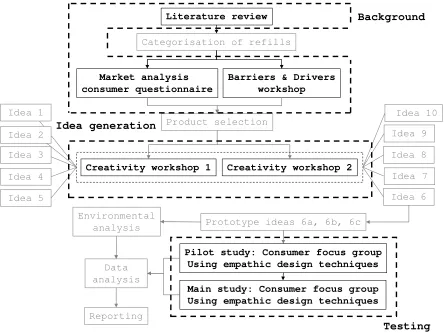
[image:3.595.121.566.392.725.2]In order to achieve the project aim a broad range of qualitative methods were used to collate background understanding, develop design concepts and test the viability of the design solutions (see Figure 1). This paper outlines the methods used, their purpose and the advantages that they created at those three key stages of the project, reflecting on one stage at a time.
The methods used to generate background understanding
Three different methods were used to build up background understanding – a literature review, a consumer questionnaire and an industry based workshop.Literature review and market analysis
A review of the literature identified that although there is a useful body of work on consumer attitudes of packaging (INCPEN 2003a) and consumer
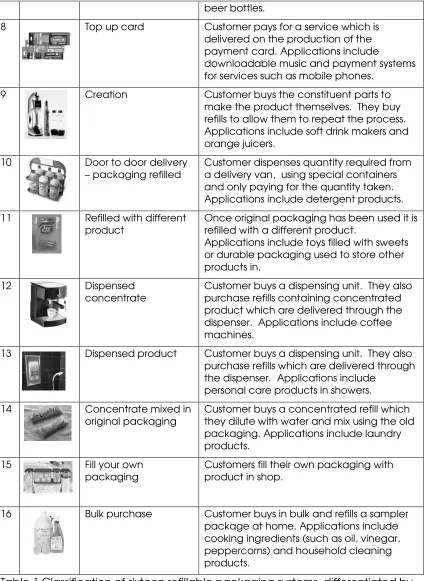
perceptions of green or environmental packaging (INCPEN 2003b; INCPEN 2003c), there is little evidence of investigation into consumer perceptions of refills or refillable packaging. In light of this, primary research was needed to investigate this area. Carrying out this work led to an unforeseen opportunity to identify 16 different categories of refillable packaging systems which can be differentiated in terms of their delivery mechanism and relationship to the consumer/industry (see Table 1). This in turn led to the recognition that each has different benefits and disadvantages from a consumer, industrial and sustainability perspective (Lofthouse & Bhamra, 2006a).
Example Refill Approach Description
1 Lightweight self contained refill delivered through dispenser
Customer buys a self contained refill which they take home and put into their durable dispenser. Applications include Wipes, face creams, razors, cosmetics, fabric
conditioner & air fresheners.
2 Lighter weight refill through part reuse
Customer buys a new bottle of product and reuses the spray pump. Applications include cleaning products.
3 Empty packaging
refilled in shop
Customer takes the original packaging back to the store for it to be refilled with the same product. Applications include
shampoo, conditioner, shower gel, bath products and fabric conditioner.
4 Self dispense Customer takes reusable container back to the store where they refill it with the same product. Applications include dry goods, personal care products and cosmetics.
5 Original packaging swapped for new product
Customer returns empty packaging to a unit where they leave it and pick up a new product. The old packaging is refilled for future use by someone else. Applications include toner cartridges and single use cameras.
6 Door to door delivery – packaging
replaced
On demand the customer receives full packaging and leaves empty packaging for supplier to collect, when they are finished. Returned packaging is refilled for other customers. Applications include milk bottles and vegetable box system.
7 Deposit system Customer returns empty packaging to supplier for a financial incentive.
245/4 beer bottles.
8 Top up card Customer pays for a service which is delivered on the production of the payment card. Applications include
downloadable music and payment systems for services such as mobile phones.
9 Creation Customer buys the constituent parts to make the product themselves. They buy refills to allow them to repeat the process. Applications include soft drink makers and orange juicers.
10 Door to door delivery – packaging refilled
Customer dispenses quantity required from a delivery van, using special containers and only paying for the quantity taken. Applications include detergent products.
11 Refilled with different product
Once original packaging has been used it is refilled with a different product.
Applications include toys filled with sweets or durable packaging used to store other products in.
12 Dispensed
concentrate
Customer buys a dispensing unit. They also purchase refills containing concentrated product which are delivered through the dispenser. Applications include coffee machines.
13 Dispensed product Customer buys a dispensing unit. They also purchase refills which are delivered through the dispenser. Applications include
personal care products in showers.
14 Concentrate mixed in original packaging
Customer buys a concentrated refill which they dilute with water and mix using the old packaging. Applications include laundry products.
15 Fill your own packaging
Customers fill their own packaging with product in shop.
[image:5.595.120.544.73.654.2]16 Bulk purchase Customer buys in bulk and refills a sampler package at home. Applications include cooking ingredients (such as oil, vinegar, peppercorns) and household cleaning products.
Table 1 Classification of sixteen refillable packaging systems, differentiated by delivery mechanism and level of consumer/business interaction
Questionnaire methodology
In order to further investigate consumer perceptions of refills a questionnaire was developed and delivered to 200 volunteers via the Boots Evaluation Suite (Lofthouse & Bhamra 2006a). It focused on investigating consumer
exercise – Table 1) as well as asking general questions about perceptions of refills.
Analysis was carried out using ‘coding and clustering’, a common procedure for analysing qualitative data, and was selected as the most appropriate method of analysis as it allows the researcher to derive meaning from words and build theory from data (Miles & Huberman, 1994). Internal validity was adhered to by the process of pattern matching and explanation which took place during the data analysis (Yin, 1994).
A questionnaire methodology, rather than focus groups, was selected for this stage of the project as it was felt that it would provide the best opportunity to investigate the perceptions of a broad a range of people as possible from a cross section of society. It also provided the opportunity to access rich data quickly and could be easily administered through the evaluation suite.
Barriers and Drivers to the use of refillable packaging systems
In order to better understand the business drivers and barriers associated with existing refills, the different refill approaches outlined in Table 1 were analysed to identify potential organisational and sustainability drivers and barriers. A large visual template (approx. 5ft x 4ft) which drew on the principles
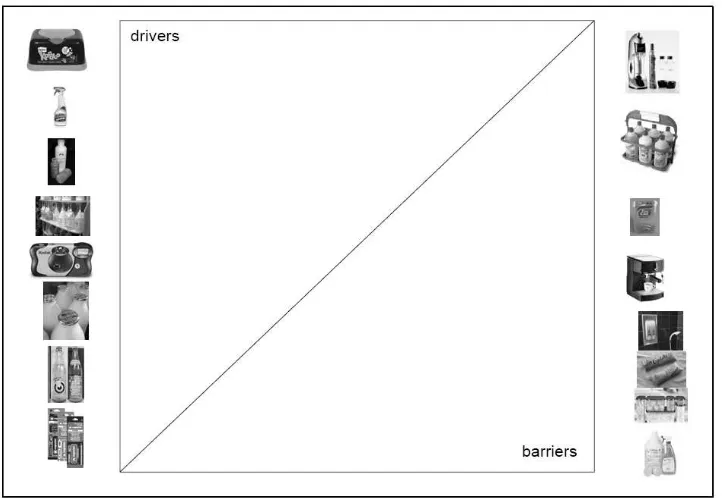
[image:6.595.150.511.473.722.2]developed by The Grove Consultants International (2001) was developed and used to facilitate a conversation with Boots personnel from Product Bank and Environmental affairs during a ‘Drivers and Barriers’ workshop. Figure 2 shows a representation of the template used. The images were intended to remind the team to consider all relevant issues and the simplicity of the centre of the template was to allow ideas to be recorded without constraint. The data resulting from the workshop was analysed and reported on (Lofthouse & Bhamra, 2006b).
245/6
Reflections on the use of the template
Visual templates had been used in previous projects to great success
(Lofthouse, Bhamra & Burrow, 2005). However on this occasion they were not found to be quite as successful. Unfortunately due to time constraints it was not possible to pilot the template. During the workshop it quickly became obvious that the format developed would not enable all of the detail needed to be captured. Consequently the team ended up adapting the template and drawing lines between the ‘issue’ identified and the different refills that it related to. Though this was not the perfect solution it is a testament to the flexibility of templates of this nature.
It also provides a clear demonstration that even if teams have extensive experience of using techniques, it is critical to pilot them as even the smallest change can lead to unexpected outcomes.
Benefits of combining these methods
Combining these three different techniques in an attempt to contextualise the project allowed us to recognise the variety of refills already available and build a clearer picture of the consumer perceptions to refillable packaging systems and of the barriers an drivers for business. This enabled the team to build a picture of the context in which new concepts needed to fit.
The methods used to develop design concepts
Two half day creative workshop were run to help facilitate the creation of potential refillable packaging system concepts for body wash products
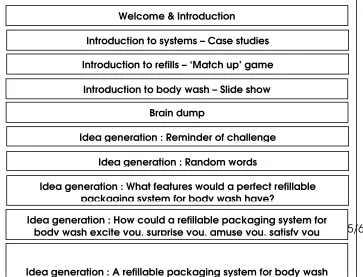
[image:7.595.174.537.565.842.2]suitable for the Botanics range. The key challenge of developing the creative workshop was to determine how to encourage the participants to think about the different types of refills available, outline the attributes of body wash products, feed in other sources of inspiration, and provide the group with the time to generate ideas which met the refillable packaging systems brief. In order to meet these requirements, a series of activities, generated from a range of external stimulus (Allan, Kingdon, Murrin & Rudkin, 1999; Cave, 1999; The Grove Consultants International, 2003; Creative Advantage Inc., 2006) were combined together to create the ‘creative workshop’ illustrated in Figure 3.
Welcome & Introduction
Brain dump
Idea generation : Reminder of challenge
Idea generation : Random words Introduction to body wash – Slide show Introduction to refills – ‘Match up’ game
Introduction to systems – Case studies
Idea generation : What features would a perfect refillable packaging system for body wash have?
Idea generation : How could a refillable packaging system for body wash excite you, surprise you, amuse you, satisfy you
Figure 3 An overview of the creative workshop
The first of the two workshops, was run at Boots Head office in Nottingham, UK with a multidisciplinary group from Boots and Loughborough University
(Lofthouse, 2006a). The second workshop was run at Loughborough University with a multidisciplinary group of external experts who specialised in
sustainable design and packaging design (Lofthouse, 2006b). Both workshops were held in a spacious, self contained room, with a large table in the centre and chairs around the edge. A laptop and projector were set up at one end, along with video to record the session. A Dictaphone and microphone were also set up on the desk and a still camera was available. A series of creative templates that would be used during the workshops, were attached to the walls and the large table was covered with A2 sheets of paper and
‘decorated’ with body wash product examples, coloured pens, Post-it™ notes, boiled sweets, nuts, water, shells, stones, and Tangle toys™
At the start of the workshop the facilitator welcomed the participants,
introduced herself and asked the others to do likewise. They were then asked to make themselves a name badge. The home made badges helped to reflect the relaxed environment that was being aimed for and gave the participants something to do. The creative context of the workshop was then introduced to the group. The purpose of ‘nibbles’ and toys on the table was explained; the oils in nuts has been found to lubricate the brain, the sugar in boiled sweets keeps you alert, fiddling with shells and toys helps to stimulate your neurons and encourage creative thinking and water helps to keep you alert (Evans, 2006). Participants were encouraged to help themselves to
whatever they fancied playing with or eating, and also encouraged to get up and walk around as they wished. Introducing these elements and outlining their role, proved to be an effective warm-up exercise and created quite a fizz of excitement and interest from the participants. Following this, the timetable for the day was presented and the aim of the workshop - ‘to generate an innovative concept for refillable packaging systems for ‘body wash’ products’ was reiterated.
Background thinking
245/8 The next two activities set out to raise the participants understanding of refills. An interactive game and presentation were selected and developed to meet this requirement. The interactive game called “Match up”, involved a large paper template which listed the names and descriptions of the different types of refills and a series of laminated images of the different types of packaging which were given to the participants. The participants were asked to match the images to the descriptions and were encouraged to help each other out. This activity had the combined benefits of encouraging discussion, teamwork and physical movement.
To finish of the education, the participants were given a short PowerPoint presentation which summarised some of the most interesting findings which came out of the early consumer research (Lofthouse & Bhamra 2006a). Each point was presented on a separate slide with a title, illustrative image and a range of relevant quotes to help ground them in reality.
Finally the participants were given a short visual slide show which aimed to get them thinking about ‘body wash’ products. The slide show aimed to illustrate how these products can be ‘trendy’, ‘luxurious’, ‘sporty’ and ‘healthy’, and how they can be described and delivered in many different ways. The
delivery approaches highlighted included: spray, liquid, foam, crystals, bubble, block, wipe, balls. Each approach was illustrated with a colourful image.
To wrap up the morning session, the participants were given 3 minutes to brainstorm what they thought innovative refillable packaging systems for ‘body wash’ products might look like. The aim of this activity was to give the participants the opportunity to ‘brain dump’ any ideas which they had sitting in their heads – which might otherwise stop them generating new creative ideas.
Idea generation
Following the break the participants came back into a two hour idea generation session in which they worked through three exploratory creative activities and a development session. After the three rules of creativity were introduced – do not criticise other peoples ideas, do not criticise your own ideas, and listen to each other, they launched into the first activity – Random Links.
‘Random links’ (Allan et al., 1999; Cave, 1999) was designed to get the participants thinking differently. Within this activity one participant was asked to select a random word from a hat and read it out to the group. All the participants then brainstorm as many related words as possible e.g. pencil – round, lead, stripy, sharp, rubber etc. The group was then asked to try and relate as many of those words as possible back to ‘refillable packaging systems’. This activity was designed to encourage them to think differently about the context. The group then carried out a fairly conventional brainstorm identifying the ‘features that a perfect refillable system for body wash would have’. Working together they shouted out their ideas and then recorded them - one idea per post it. The purpose of this activity was to encourage the
participants to think without constraints and effectively generate a ‘wish list’ of attributes that could be drawn upon later.
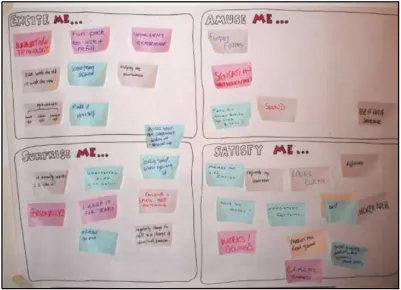
used by The Grove Consultants International (2003) and the ‘emotion based’ questions used in the Compass Ideation technique developed by Creative Advantage Inc. (2006). The hybrid activity involved the participants standing up around the template shown in Figure 4 and brainstorming ideas for
attributes which would excite them, surprise them, amuse them, and satisfy them in relation to body wash products. The participants recorded their ideas - one idea per post it note on the template. The purpose of this activity was to investigate their emotions around body wash, tap into their personal insights and create a richer understanding of how people feel about the ‘body washing’ experience.
Finally the group were given 45 minutes in which to develop a refillable packaging system for body wash. They were asked to consider how it would work; what it would look like; why it will work; what features it has; what would be needed; as well as the risks associated with it and anything that we don’t know. During the design activity an inspirational slide show was run in the back ground to give the participants some additional sources of inspiration, should they need them.
[image:10.595.128.529.340.630.2]The session was concluded with a wrap up and reflection from the facilitator.
Figure 4 ‘Excite me - surprise me - amuse me – satisfy me’ template
Benefits of the ‘creative workshop’ methodology
245/10 is also a lot of fun and promotes a creative environment in which people can generate new ideas without fear of criticism.
A wide range of different ideas emerged from the two creative workshops. After discussion with Boots two ideas, ‘Dissolvable Test Tube’ and ‘Snip Test Tube’ were identified to be carried forward into the prototyping and consumer testing stages. The basic premise behind these ideas was that concentrated shower gel would be mixed with tap water at home to create shower gel.
The methods used to test the viability of the design solutions
Two methods were combined to test the viability of the design solutions; prototyping and consumer focus groups.Prototyping
In order to illicit useful responses from the consumers in the focus groups workshops, it was decided that concept models needed to be created and that these models should be as close to ‘real products’ as possible. This was based on previous experience which illustrated that non-designers / the consumers in the trials are not familiar with prototypes and as such tend to comment on irrelevant issues (e.g. the quality of the labels), if confronted with unfinished prototypes (Lofthouse et al., 2005).
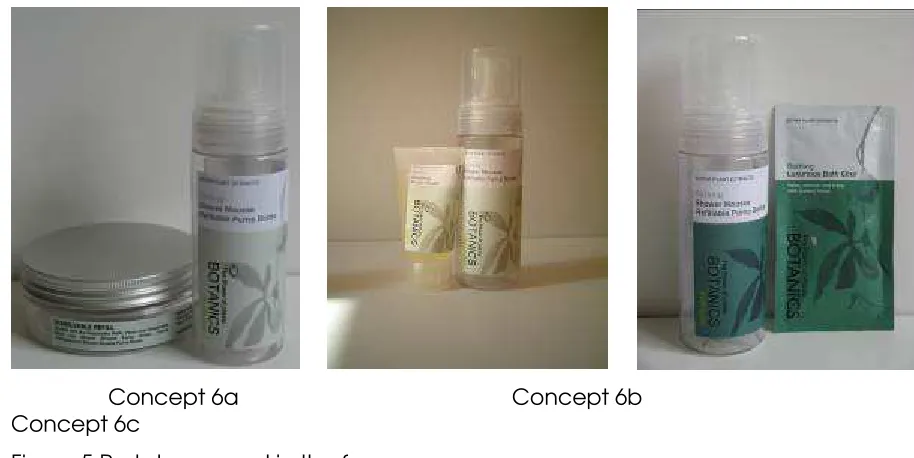
The final models which were presented to the consumer panel are illustrated in Figure 5. To achieve these outputs a number of prototyping loops had to be passed through – these are described in more detail below.
[image:11.595.115.572.421.650.2]Concept 6a Concept 6b Concept 6c
Figure 5 Prototypes used in the focus groups
The models were developed through a prototyping process of trial and error. Early on it was identified that when a BOLD Liqui tab (which works on the same principle as concept 6a) is dissolved, the resulting liquid was too runny to constitute a body wash product. In light of this the Boots team highlighted the opportunity to use an existing 150ml pump bottle, which aerates the liquid as it passed through the delivery mechanism and creates a foam. It was
Prototyping concept 6a
6a required a dissolvable ‘tablet’ filled with concentrated shower gel to be developed for use during the consumers trials. A number of investigations were carried out to test the suitability of dissolvable bags currently available on the market. Two types of PLA (dissolvable film) products Fish bait bags and Ariel liquid bags were tested to investigate their suitability for creating life like prototypes. These trials identified that concentrated shower gel would have to be used as any water content dissolves the PLA material and both PLA materials took a long time to dissolve and left an unattractive residue (see Figure 6).
Figure 6 Residue left at the bottom of the glass
Through this initial prototyping it also became clear that it would be possible to make dissolvable tablets from the PLA material by ironing the seams of the sachet together. In order to achieve a satisfactory finish a piece of paper needed to be positioned over the PLA material and then be ironed on the highest setting. The tube could then be filled with Ariel concentrated liquid and sealed in the same way (Lofthouse et al., 2007b).
Following these initial investigations two actions were taken. Clarifoil who have expertise in plastic film manufacture, were contacted and the problem of the PLA not fully dissolving was raised. They suggested a high grade PLA material which dissolved fully on contact with warm tap water. This material could also be sealed in the same way as the PLA material used during the trials. Secondly, a quantity of Botanics shower gel was boiled down in order to remove the water content and produce enough concentrate to be used during the consumer trials.
A tub was selected by the research team to hold the dissolvable refills and was labelled to match the pump bottle1.
Prototyping Idea 6b
To model up concept 6b, a 50ml travel tube of energising shower gel was used as the refill. During trials of this system it was identified that refitting the pump to the bottle lifts the level of the water quite a lot. This was important when placing a graphic for the water ‘fill line’ on the label. It was also identified that the mixture of 50ml shower gel (not concentrated) and 100ml
[image:12.595.236.439.217.369.2]245/12 of water seems more than adequate, so concentrate would not need to be made.
Prototyping Idea 6c
Concept 6c was essentially developed by the participants during the pilot study. When struggling to remove all the contents of the tube refill used in concept 6b, many of the participants stated that they would prefer it to be a sachet. For the main study sachets of Botanics Energising Shower Gel were provided by Boots2.
Labelling
A significant amount of work also went into developing the labels for the models, with a number of changes being made after the pilot studies (Lofthouse & Trimingham, 2007). Effective communication is critical to the success of refillable packaging systems. Labelling and packaging must be crystal clear (Lofthouse et al. 2007a).
Consumer focus groups
In order to test the feasibility of the two different concepts with typical
Botanics customers (females, aged 21-40), a consumer focus group workshop, drawing on empathic design techniques (Evans, Burns & Barrett, 2002), was developed. The workshops aimed to understand; how consumer felt about the refillable packaging concepts, if they could use them, what elements of the process consumers instinctively understood, and what they needed to be told about. Initially a pilot study was run with seven women recruited through The Boot’s Evaluation Suite to test the process, it was then refined before the main study was carried out. For both the pilot and main studies a protocol document the following, was produced: A checklist of things to do before the workshop; a checklist of things needed for the workshop; layout plans for the main room and foyer; a timing guide; a summary of activities; the detailed process.
The focus group programme was designed to encourage as much interactive behaviour as possible. To achieve this it consisted of a number of different activities, each with a specific objective (see Figure 7). These will be discussed in more detail in the following subsections.
2 The size of the sachet is larger than would actually be required and is purely for prototyping purposes.
! " !! "" ! "
# $
% &
' ( ) &
% &
* &
+ ,
" % "" %% " %
- "
' &
& . & &
" % "" %% " %
- "
! " !! "" ! " # $ ' & & & /
Activity… Reason… Guidance…
# $ ## $$ # $ #### " $ " $ " $ " $ #% $ #% $ #% $ #% $ #### " $ " $ " $ " $ % &
' ( ) &
#% $
#% $
#% $
#% $
! " !! "" ! "
# $
" % "" %% " %
- "
' &
& . & &
% &
Figure 7 Summary of consumer focus group activities
Both focus groups were videoed and audio taped to allow the researchers to interact with the participants without having to physically record data. This also allowed the researchers to leave the room on occasions to allow the ladies to talk freely about their experiences and thoughts.
Introduction
The introduction consisted of formalities such as giving out name badges, and reiterating to the participants that we would be filming and recording the session, and a ‘warm up’ activity.
The ‘warm up’ activity was delivered in the foyer before they went into the room, over coffee and cake, aimed to relax the ladies and get them talking to us and each other. It is well documented that when running a focus group the first words are the hardest, so if you can get everyone talking initially, they are much more likely to contribute to the whole session.
‘Point of sale’ activity
[image:14.595.204.456.557.725.2]After the introduction, the ladies were sent into the main room to have a look at the fake ‘point of sale’ (see Figure 8), whilst the facilitators stayed behind in the foyer. Soft music was playing in the background to reduce any discomfort felt at being in a room of strangers and to direct the participants to the right area of the room.
Figure 8 Point of sale unit
245/14
“When you get in the room, you’ll see a point of sale stand which is holding the new product that we are going to talk about today… please feel free to have a look and play around with the products on this, I’ll be along in a few minutes and we’ll have a quick chat about what you’ve just seen.”
The aim here was to signal that the researchers would not be with them in the room to start with and that they would be asked to talk about their
experiences in due course.
The participants were left to have a look at the point of sale for a while, whilst being recorded on video camera and audio tape. This activity provided the opportunity to capture the ladies initial thoughts on the refill concept, and how they behaved in a shop environment.
Filing 6b plus discussion
The next activity was aimed at investigating issues around the filling of concept 6b. At the start of this activity the ladies were told the following;
‘…now have a look at the instructions on the back and see if you can work out what you need to do… carry out the instructions on the bottle - feel free to talk amongst yourselves…’
They were then left to get on with it, being filmed and recorded all the way through. A sink, set up to resemble the home environment was set up for the ladies to use. This activity was followed up with a directed discussion to investigate in detail the experiences that the ladies had. A number of questions (summarised in Table 2) were woven into the conversation.
Were the instructions clear? What did you think about the process? Did you have any specific problems? How easy did you find the process? How did the refill process make you feel? What did you find difficult?
Would you be happy to keep the bottle for more than 1 refill?
How often would you be willing to carry out the refill process–everyday/ week/ month/ 3 months?
Did you like the feel of the mousse? Do you like the idea of having a foaming shower product?’
What other products do you think it would be [more] suitable for?
Do you think this is a good way to buy shower products?
What would using this type of product make you feel? (cheap, glamorous, ethical?)
What words would you use to describe this type of product?
How do you think you’d feel about initially buying an empty bottle?’
Would you buy this type of product?
Table 2 Examples of the types of questions investigated with the participants
In addition to this two other questions were investigated, though not directly asked, to avoiding leading their answers:
Do you mind it being filled with tap water? Do you foresee any issues regarding cleanliness?
A conversation about the potential cost of the refill compared with the existing product was also elicited.
Filing 6c and 6a, plus discussion
go thorough the process. A similar set of question to those in Table 2 were again woven into the conversation.
Benefits of using real prototypes and empathic design style
focus groups
Prototyping (or making things real) (Allan et al., 1999) is widely recognised as being an important part of the process which designers work through during the design process (Meyerson, 2004; IDEO, 2008). As can be seen from the process summarised above, the process of prototyping is a fantastic way of evoking new insights (Allan et al., 1999) allowing designers to test out ideas, trial approaches and identify potential problems (such as the ‘gloopiness’ issue discussed above) prior to the consumer testing. Once the prototyping have reached the point where the required level of ‘realness’ has been achieved, the working models or ‘products’, provide a useful platform upon which to illicit consumer responses prior to any heavy financial investment in tooling.
The consumer focus group methodology had a wide range of incredibly valuable benefits at this latter stage of the project. The approach enabled us to get close to the customer, observe them using the ‘products’, ask open ended questions about each ‘product’, and find out what they REALLY thought by listening to the murmur of the customer.
A wide range of very useful insights, which were only made possible through the use of hands on testing and discrete observation, came out of the
workshop. These provided some initial insights into the suitability of packaging of this nature, along with potential success factors and stumbling points.
Conclusions
The programme adopted for this project (see Figure 1) enabled the project team to develop a deep understanding of consumer perceptions of refillable packaging, by combining together a questionnaire, and consumer testing. The consumer testing has also enabled a detailed study of a number of refillable packaging system concepts where a concentrate is mixed in the original packaging. This study demonstrated consumer interest in using
product delivery systems of this nature, which offers encouragement for future investigations. It also highlighted a number of issues which would need to be considered in future designs to ensure a balance is met between consumer wants/ needs, business requirements and environmental impact (Lofthouse et al. 2007a). Beyond this, this work has opened up the opportunity for similar investigations into the other refillable packaging approaches.
Including prototyping in the programme may have led to a number of design challenges, but also led to the development of three sets of demonstrator concept models which illustrate new ways of thinking about refillable
245/16
References
Allan, D., Kingdon, M., Murrin, K. and Rudkin, D. (1999). ?What If!: How to Start a Creative Revolution at Work. Oxford: Capstone Publishing.
Cave, C. (1999). Creativity Web. Australia. Retrieved 26th July 1999 from http://www.ozemail.com.au/~caveman/creative.htm
Creative Advantage Inc. (2006). Compass Ideation technique. Retrieved 3rd September 2006 from http://www.creativeadvantage.com/compass.html
Darlow, T. (2003). Waste Plans: Report on Categorisation and Pilot Studies. Edinburgh, Scottish Institute of Sustainable Technology: 1-65.
Environmental Services Association (2004). ESA Briefing: Packaging and Packaging Waste Directive. Retrieved September 2004 from
http://www.esauk.org/work/briefings/pack.asp
Evans, S., Burns, A. and Barrett, R. (2002). Empathic Design Tutor. Cranfield, IERC, Cranfield University.
Evans, V. (2006).Tap into your Creativity. Vision and Training Development,
University of Birmingham.
Holdway, R., D. Walker, and Hilton, M. (2002). Ecodesign and Successful packaging. Design Management Journal 13(4): 45-53.
IDEO (2008) Prototyping. http://www.ideo.com/about/methods/info.asp?x=3
INCPEN (2001). Towards Greener Households: Products, Packaging and Energy. Reading, INCPEN.
INCPEN (2003a). INCPEN - Consumer Attitudes to Packaging Survey.
http://www.iflsites.co.uk/resource/userdata/ipu/Consumerattitudestopackagi ngsurvey.pdf
INCPEN (2003b). Recycling. http://www.iflsites.co.uk/resource/pv5.exe
INCPEN (2003). Reusable Packaging. http://www.iflsites.co.uk/resource/pv5.exe
Lewis, H., Gertsakis, J., Grant, T., Morelli, N. and Sweatman, A. (2001). Design + environment, a global guide to designing greener goods. Sheffield: Greenleaf publishing.
Lofthouse, V., Bhamra, T and Burrow, T. (2005). A new way of understanding the customer, for fibre manufacturers. International Journal of Clothing Science and Technology, 17(5), pp. 349-360.
Lofthouse V. (2006a). Refillable Packaging Systems: Creativity Workshop, Boots, 7th September 2006
Lofthouse V. (2006b). Refillable Packaging Systems: Creativity Workshop, Loughborough University, 21st September 2006
Lofthouse, V. and T Bhamra (2006a). An investigation into consumer
perceptions of refills and refillable packaging. Loughborough: Loughborough University: 1-33.
Lofthouse V, Bhamra, T & Trimingham R, (2007a). Refillable packaging systems: lessons for industry, Loughborough: Loughborough University
Lofthouse, V., Bhamra, T. and Trimingham, R. (2007b). Refillable packaging systems: Key Methods and Processes, Loughborough:Loughborough University
Lofthouse V and Trimingham R (2007). Changes made between the pilot workshop and the main study, 29th June 2007 [PowerPoint Presentation] http://www.lboro.ac.uk/research/susdesign/Refillable/publications.htm
Meyerson, J. (2004) Ideo: Masters of Innovation, Laurence King Publishing.
Miles, M. B. and A. M. Huberman (1994). An Expanded Sourcebook - Qualitative Data Analysis, Sage Publications.
The Grove Consultants International (2001). A Graphic Facilitation Retrospective: Charting What We Learned. Retrieved June 2001 from www.grove.com/new/new_gfretro.html
The Grove Consultants International (2003). The Grove Consultants International. Retrieved 18th June 2003 from www.grove.com
Yin, R. K. (1994). Case Study Research - Design and Methods. Thousand Oaks, London, New Delhi: Sage Publications, Inc.
Dr. Vicky Lofthouse
Dr. Vicky Lofthouse is a Lecturer in Industrial Design in the Department of
Design and Technology at Loughborough University, UK. For the past ten years she has been very active in developing research in the field of ecodesign and sustainability. Her interests include: how to engage designers in ecodesign; improving the ecodesign performance of product & packaging design; and using creativity to develop innovative solutions. She has a growing presence for her research on the international stage, having been an invited speaker to events in the UK, France and China. She is a reviewer for three international journals, has written over 40 papers for international conferences and journals, and a book entitled Design for Sustainability: a practical approach. Vicky also runs the UK based Sustainable Design Network which attracts over 190