decision-making and transitions beyond school in the UK
HART, CarolineAvailable from Sheffield Hallam University Research Archive (SHURA) at:
http://shura.shu.ac.uk/6891/
This document is the author deposited version. You are advised to consult the publisher's version if you wish to cite from it.
Published version
HART, Caroline (2011). Thinking, doing, feeling: capabilities in relation to decision-making and transitions beyond school in the UK. In: 2011 Children’s Capabilities and Human Development Conference, University of Cambridge, 11-12 April 2011.
Copyright and re-use policy
See http://shura.shu.ac.uk/information.html
Thinking, Doing, Feeling: Capabilities in Relation to
Decision-Making and Transitions beyond School in the UK.
Caroline Hart, University of Cambridge
Email for correspondence: [email protected]
Introduction
The paper is based on a mixed-methods case study involving 580 young people aged 17-19 in northern England. The city of Sheffield, where the study took place, was chosen due to its contrasting areas of high and low participation in higher education (HE). Students in post-16 education from four institutions took part in the study. Two of the institutions were based in an area of Sheffield that has high participation rates in higher education and two institutions were based in an area of Sheffield with low participation rates in higher education1. Methods included a quantitative survey, individual and group interviews. A survey response rate of over 90% of the sample population was achieved in each institution. The research took place over an academic year with Phase 1 comprising group interviews, Phase 2 a large-scale quantitative survey and Phase 3 comprising individual interviews with a sub-sample of survey participants.
The study examined a number of separate but related questions and some of these have been reported elsewhere (Hart, 2008, 2009, 2010a). This paper examines the question, ‘What can a capability perspective add to understanding young people’s decision-making processes in transitions beyond school?’ The study undertaken had a particular focus on young people’s decision-making processes in relation to applications for higher education places. However, the mechanisms of decision-making elucidated by the findings have ramifications for decision-decision-making by children and young people at all stages of the education process. Indeed, there are wider ramifications to the workplace and other social contexts that become apparent as the discussion develops.
1 The institutions were given pseudonyms as follows: Goldsmiths school and Speedwell school (high
Much of the present and past education policy rhetoric in the UK has focussed on the inequalities resulting from identified socioeconomic differences in the population. In this paper it is argued that an individual’s well-being freedom is based on factors beyond socio-economic group differences. The capability approach illuminates the way that socioeconomic differences are mediated by differences based on gender, ethnicity, ability, aspirations and individual social and learner identities. In the specific case in point, that of deciding what to do on leaving school or college, these multifaceted variables are found to add to the complexity of understanding the relative advantage of different individuals. The paper argues that whilst significant group differences can be helpful in indicating patterns of inequality this is not adequate to comprehensively identify disadvantage for specific individuals in a British context. Indeed, further research may well show the findings are not limited by national context. It is further argued that young people’s capabilities with regard to decision-making are integrally connected to three different registers of meaning and action. These registers of meaning and action are linked to firstly, perceptions of performance and achievement, secondly, perceptions of ‘fitting in’ socio-culturally and thirdly, emotional responses to current experiences and anticipated future scenarios. All of these perceptions pertain both to the individual and to significant others involved in their care.
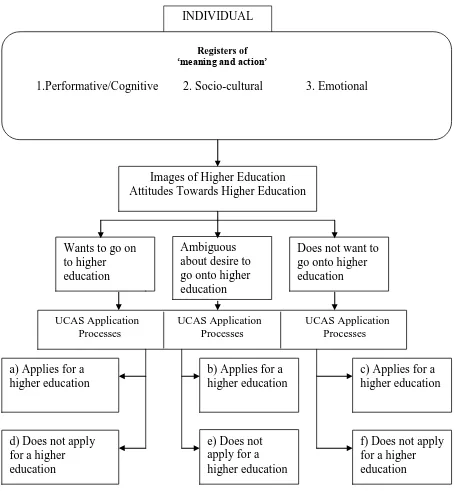
After offering some general contextualisation on the ‘possibility of higher education’ the paper is structured in two main parts. Firstly, the roles of the three registers of meaning and action identified in Figure 1 (see p.22) are discussed in relation to young people’s conceptualisations of themselves in relation to higher education. Secondly, research participants’ decision-making processes around higher education are explored in relation to young people’s experiences of the university application process. The paper concludes by summarising key conceptual developments arising from the discussion.
1. The Possibility of Higher Education
the family’ to become an undergraduate. The interview data from the case study illustrated that for young people the process of deciding whether to apply for a higher education place was often complex and involved significant challenges and risks to individual identities.
Overall, seven key areas were identified from the survey and interview data as being particularly influential in individuals’ constructions of self and decision-making in relation to understandings of higher education. Drawing on Reay, David and Ball three ‘registers of meaning and action’ are identified and these are addressed in the ensuing discussion (Reay, David & Ball, 2005:19). Drawing on earlier work by Bourdieu (1996), an additional four areas relate to four fields2 of education, family, work and leisure and these are discussed elsewhere (Hart, 2010b, Hart 2012). It is argued that these seven areas contribute to an individual’s self-perceptions and are seen as crucial in the transition of aspirations into capabilities. The registers of meaning and action include ‘performative and cognitive’ factors and ‘socio-cultural factors’, both identified by Reay, David and Ball (2005:19), and a third additional set of emotional factors that has been developed in the light of my own data collection and analysis. It is argued that a young person’s images of and relationship to higher education develop out of the interplay of an individual’s interactions in different
fields, and the influences of these interactions on the three registers of ‘meaning and action’ (Reay et al, 2005). Drawing on data from all phases of the research, Figure 1 illustrates the role of social and psychological factors in young people’s decision-making, aspirations and capabilities. It also identifies six major choice pathways (labelled in Figure 1 as a-f) in relation to higher education. Figure 1 is used as a framework for the discussion and presentation of findings in this paper.
1.1 Performative Register of Meaning and Action
The cognitive and performative register of meaning and action relates to an individual’s tendency to select institutions and courses of higher education by matching their academic performance (Reay et al, 2005). Regarding this register of meaning and action, interview data reflected some students’ desires to connect their
2 Bourdieu’s concept of field comes from the French ‘le champ’ which has been used to describe, ‘an
area of land, a battlefield and a field of knowledge’ (Thompson, 2008:68). Perhaps the middle
higher education choices with their perceived, achieved and predicted abilities. The performative and cognitive register is linked to individuals asking the question, ‘Can I
do it?’
1.2 Socio-Cultural Register of Meaning and Action
Secondly, Reay et al have drawn attention to the way individuals socially classify themselves. They identify a ‘socio-cultural’ register of meaning and action that relates to an individual’s social classifications of themselves and their consequent choice of higher education institutions’ (ibid, 2005:19). The socio-cultural register is linked to individuals asking the question of, ‘How will I fit in?’ The findings from the study presented here support and extend this view by Reay and her colleagues. It is argued that individual classifications are important and that these are linked to individuals’ perceptions of how they have been classified by others. Case study data indicated students had a tendency to consider their suitability to current and prospective educational institutions in terms of their perceived chances of fitting in. Young people’s perceptions of whether a place was for people like themselves seemed very much based on socio-cultural norms and expectations. This reflects recent work by Reay, Crozier and Clayton (2010).
1.3 Emotional Register of Meaning and Action
The third register of meaning and action is linked to individual emotions in relation to their decision-making processes. Based on the case study findings, it is argued that individuals use emotional language in their discourses around higher education choices, suggesting that their pathways are informed by emotional as well as pragmatic choices. This third emotional register is linked to, ‘How will I feel?’ Several of the young interviewees spoke about their emotional responses to higher education and the influence this had on their decision-making processes.
2. Registers of Meaning and Action
interactions and the application of different registers of meaning to their experiences, actions and choices.
2.1 Performative and Cognitive Register
The ‘performative and cognitive’ register of meaning and action is used here to refer to the way individuals make decisions about higher education based on their perceptions of their academic ability and potential in relation to the courses for which they applied (Reay et al, 2005). Around two out of three young people in the survey sample (N=580) felt confident to cope with the workload at university (63%). There was a significant group difference based on higher education intentions in relation to young people’s confidence in their ability to cope with the workload at university (χ2=29.66, ρ<0.001, N=459). Those young people who felt confident that they could cope with the workload at university were more likely to intend to apply for a higher education place compared to their less confident, although not necessarily less able, counterparts.
In addition to individual’s perceptions of their ability, the interviews showed that individuals were also influenced by the perceptions of significant others including teachers and family members. There were numerous examples where young interviewees described how significant others had tried to persuade them to apply to higher education.
Furthermore, predicted grades3, determined by teachers, were mentioned frequently by young people as factors influencing their choices. The predicted grades also had an influence on young people’s academic self-concepts and learner identity. For example, Sarah (white female, Goldsmiths) explained:
I think I'm just not very good at exams really because I was estimated to get an
A, for example, in my AS Sociology I was supposed to get an A but I got a C in
3 In England it is currently the practise that teachers generate ‘predicted grades’ for students planning to
the end because I'm just not very good at exams and writing essays and stuff
like that….
Conversely, students’ behaviour appeared to have an influence on teachers’ academic concepts of their students. In this second example, Dalia (Asian, female, Speedwell) describes how she feels her teachers perceived her and how this related to her predicted grades:
I was always quite opinionated and got involved in things but I never was the
star pupil. I didn’t hand in my homework all the time, on time and things but I
think it just shocked them…I wasn’t the hardest working one there and I still got an A [at AS Level] as well…I think they might have resented that a bit, the fact that I did do well.’ (Dalia, Speedwell).
Dalia explained that she had not applied for university this year because she was upset by her teachers’ lower than anticipated predictions in Sociology. Dalia felt that the time that she found out her predicted grades was the best time to apply for the kind of popular courses she wanted to pursue (at Manchester University). Dalia felt she had changed her subject choice from Law to Management and then to English partly due to her uncertainty about grades and as a result she needed to rewrite her personal statement for the higher education (UCAS) application form4. In the end she explained finding the process very stressful and decide to focus on achieving the best grades she could in her exams and postponing a university application until later. Dalia explained,
‘it's just really draining. I just thought “oh I really don’t have a clue what I'm gonna do here” and there isn’t really anyone I thought I could speak to either
about it because I mean each student has their own, you know, their own
problems with it so you can't really share it’ (Dalia, Speedwell).
4
The Universities and Colleges Admissions Service (UCAS) is the organisation responsible for managing applications to higher education course in the UK. For further information see
Dalia’s commentary offers insights into the way other people’s perceptions of an individual’s ability may influence their choices with respect to higher education participation.
2.2 Socio-cultural Register
The socio-cultural register of meaning and action is used to describe the second framework an individual uses to decide which higher education institutions they will apply to. In this case their choice is based on how well they feel they will fit in the HE field from a socio-cultural perspective. In the survey sample as a whole 77% of young people felt they would make friends easily at university although this was statistically significantly more likely to be the case for Westside students (χ2=8.19,
ρ<0.05, N=497). A similar proportion of young people (77%) felt they would ‘fit in easily to university life’ although this was significantly less likely to be the case for EMA5 recipients compared to their counterparts from higher income families (z=-2.132, N=516, ρ<0.05). 18% of survey participants did not feel that university was for ‘people like me’. Young people from Eastside institutions were more likely to feel this way (χ2
=23.007 N=533, ρ<0.05) as were EMA recipients (z=-2.9, N=513,
ρ<0.01) compared to their respective counterparts. These figures indicate a general trend for young people from lower socioeconomic groups to be less likely to feel they would make friends easily at university and there has been a growing body of research supporting these findings (Brennan & Osborne, 2008; Archer, Hutchings & Ross 2003; Vignoles & Powdthavee 2010; Reay, Crozier & Clayton 2010). However, the findings also indicated some important variations within institutions and within social groups. These findings highlight difficulties of making generalisations about inequalities based on group characteristics.
It is not clear on what basis students felt they would or would not fit in and the factors may not only relate to socio-economic circumstances. Young people in the interviews gave a variety of examples of concerns they had about whether or not they would fit in at university and two examples are given here. Adam (white, male, Goldsmiths)
5 EMA stands for ‘Educational Maintenance Allowance. At the time the research was carried out the
explains that he may not easily fit in because he feels he does not share the same interests as his peers:
Well if you take my childhood I did ballet for 7 years which didn’t help me fitting in and then I've … I dunno, it’s just I'm not interested in this whole culture… which is based on…going out drinking and it’s not that I don’t drink I just don’t see it as a defining factor of my lifestyle, which quite a lot of people, certainly of my age, seem to.’ (Adam, white male, Goldsmiths, non-EMA)
The study findings suggested that individuals develop their identities based on both their own self-perceptions and the perceptions of significant others such as family, friends and teachers. This finding is supported by both the sociology and psychology literature, with foundations, for example, in work by Cooley (1902) on the looking-glass self and by Mead on the ‘I’ and the ‘me’ (Mead, 1934). The perceptions of significant others seemed to play a key role in the way young people viewed themselves. For example, the interviews showed evidence of young people seeking to reconstruct events and biographies in ways which gave their lives consistency and meaning.
2.3 Emotional Register
for a place at university’ but a similar number (58%) were worried about the costs of going to university with around a third of the sample of young people experiencing both sets of emotions (35%, n=208). These findings suggested that individuals held contrasting emotions in tension and perhaps some individuals are better equipped to deal with such tensions. Elster describes how individuals may adapt their preferences as a way of reducing tension that is difficult to handle (Elster, 1983). In deciding to apply for university some young people accepted that it would push their comfort zone in some ways. However, others, like Dalia and Rowan end up not applying for higher education at least in part due to the emotional strains they experience.
Compared to the rest of the survey sample students from lower socioeconomic backgrounds (as indicated by their EMA eligibility status) were more likely to feel university would be a stressful experience (z=-2.044, ρ=0.05, N=521) and they were also less likely to think that university would be ‘fun’ although this latter difference was not statistically significant. Students from lower income families were significantly more likely to be worried about getting into debt if they went onto higher education (χ2
=4.00, ρ<0.05, df=3, N=486). It seemed that images of universities, student life and studying were used as relational concepts in individuals’ own self-concepts and these issues are considered in relation to the examples that follow. In the following example, Helen talked about some of her anxieties in relation to higher education saying,
‘But I'm quite scared though because I don’t know, it sounds silly, I don’t
mean to put myself down a lot, but I come from that road, and it's not the
sparkliest of areas. I don’t know how they'll feel about me and my accent and how I talk….Because I'm not really well pronounced and things like that. And
I worry if they might be quite hostile to me…I'm not gonna ever pretend to be
anybody else so that I fit into a certain … although, I get nervous about what people think of me…But, you know, you learn to deal with stuff like that as you get older, don’t you? ‘If people can't hear me they'll have to say wont they?
Like 'eh', no-one says 'eh', what if they don’t understand and it's stuff like that
The language referring to Helen’s emotions is underlined to highlight her concerns. Helen expanded by saying that the ‘they’ she was referring to was other students. She says she has heard university students around Sheffield talking and thought they mostly had ‘London accents’. Helen is worried especially because of her accent and explained how she thought people will think, 'well she must be from somewhere that she hasn’t had much education, what's she doing in University?' In this example, Helen is using an emotional register of meaning and action to make sense of her potential position in the field of education. She imagines what the other students may be like although Helen had not visited a university at the time of the interview.
In this interview, Helen constructs herself as working class in contrast to, ‘more privileged people’. There is a sense that these people have some kind of ownership of the social space, culture and customs of university life. However, Helen attempts to assert her right to share this space and is adamant that it will not change her. Helen described earlier in the interview that she felt working class and here she constructs her identity as fixed with her ‘working classness’ as a point of reference. Whilst other young people may slip into the dominant culture of university life without feeling the essence of their identity is under threat, Helen illustrates how her identity is at risk. Later in the extract she alludes to a latent anxiety that others may see her as, ‘a right common tramp’. Helen seems to perceive a social risk in being a ‘working class’ person in a middle class milieu. Archer et al (2003:93-94) write about the varying experiences of students in relation to HE based on factors relating to social class. For example, they argue that, ‘…working class students may perceive higher education as a threat to their class identity.’
‘I'm absolutely terrified because, I mean, I'm staying at home as well...so that
means that I'm gonna be even less involved in the union things…and that's my
main concern, that I'm not gonna be able to make friends because I've never
been in the, like the sort of place where I've been completely alone before.’
(Amy, white female, Goldsmiths, non-EMA)
The third example illustrates that the emotional register is used by both males and females. Tom (white male, Goldsmiths, non-EMA) also reported that he had been bullied when he was younger. He explained that he had been, ‘beat up by just about everybody…because I was smarter at the time than everyone else and I didn’t like football.’ Tom would be the first in his family to go onto higher education and explained how he felt:
‘a bit excited because I'm the first to do something at long last. A bit nervous because there's part of me that thinks that I'm going to university and my
brothers will start taking the mick, 'oh you’re a swot now' and 'you're a
student' and yeah when my cousin comes over they always point and go
'student, student' and take the mick out of him so I think they'd probably do the
same to me which is annoying.’ (Tom, white male, Goldsmiths, non-EMA)
Although Tom uses the emotional register of meaning and action it is possible that there may be different trends in the range of the register used by different groups relating, for example, to gender. This could not be ascertained from the case study but warrants further investigation. These examples illustrate that some young people, at least, bring an emotional dimension to their vision of what university might be like and in the cases of Helen, Amy and Tom they are able to overcome their anxieties and intend to apply for university despite their concerns.
In this example, James (white male, Goldsmiths, non-EMA) described being pressurised by his parents to apply to certain universities and to follow in the footsteps of his elder brother who had succeeded in gaining a place at Cambridge University:
‘…my parents were really, really bugging me about it at the time to pick good
Cambridge even though my grades weren’t big enough. He was like ‘oh just apply for the hell of it’ and I was thinking ‘no because they’ll just reject me straight away’ and my mum wanted me to go to Aston. She kept on going ‘oh apply to Aston, apply to Aston’ and yeah and so I just, I dunno, I think I just
picked them all quickly just to get it over with I guess. I dunno. Maybe I
should have spent more time on it.’ (James, white Male,Goldsmiths, Non-EMA)
James rushes into applying to institutions he is not familiar with in places he has never visited. This example illustrates that the emotional register is not bounded by socio-economic group or by academic ability. In a similar way, Eddie, who feels literally forced into applying for university, deliberately applies to institutions on the south coast of England as far away as possible from his parents. These examples help to illustrate the insight the capability approach offers when evaluating the issue of participation in HE. Government analyses have tended to focus on participation and non-participation in HE noting that young people from lower social classes are under-represented in higher education (DfES, 2003; HEFCE, 2005, HEFCE 2010). The examples of James and Eddie highlight the different kinds of concerns young people may have in relation to higher education coming from higher social class backgrounds and with family experience of higher education. From a capability perspective their wellbeing freedom may be seen as being constrained by their experiences.
3. Decision-making in Relation to Higher Education
address this weakness and has particular value in relation to understanding complex decision-making processes.
3.1 Aspiration to Apply to Higher Education
3.1.1 Applicants: Aisha
Aisha (Asian female, Eastside, EMA recipient), applied for a university place hoping to fulfil her ambition to become a midwife. Aisha explained in her interview that following some hospital work experience she had considered working as a Support Worker and then applying later to study Midwifery at university. She thought she may be more likely to gain a place with some work experience. However, Aisha’s UCAS application to study midwifery at university was unsuccessful although at the time of the interview she had not received any feedback on the reasons for this outcome. Aisha’s impression was that Midwifery was a very competitive course to get on. She commented,
‘they just want… probably want outstanding, you know people that have like a … probably got straight distinction in their course, go for the top, you know and I'm just in the middle I think…. Yeah. I'm not nothing special. I think they go for the ones that are special.’
which in turn may lead to better institutional support to help them realise their aspirations without undermining their sense of identity (Archer, 2007).
3.1.2 Non-applicants: Dalia
Dalia, is an example of an individual who aspired to apply for a university place but who has not been able to fulfil this aspiration. In her interview, Dalia explained her decision not to apply with several different, yet overlapping, reasons. As described in section 2.1 above Dalia was disappointed with her teachers’ predicted grades. She also described how this affected her motivation. In the following extract from Dalia’s interview she explains how she found the process of completing a university application a barrier in itself. This related particularly to the section of the form where students are required to write a personal statement about themselves. She explained,
I just didn’t know what to do with it and I thought well where do I start? What do I say, because I felt like if I didn’t add certain things then I'd be wasting, you know, my opportunity really…and I just thought what do I need to add in, what don’t I….and I just thought 'oh God why am I writing this?' and I just thought this is such a mess…. that was actually part of why I decided not to apply, as well, because I just thought I really don’t know what I'm gonna
put…’ (Dalia, Asian, Speedwell).
Dalia said that she felt that many students lied in their university application forms but she would not have the confidence to do that in case she was then caught out in a university interview. She explained,
‘I'd rather just say what I have done, what I haven’t done but it just seems unfair that it isn’t as simple as that any more. I mean people that do lie about those things can end up you know with good opportunities and things’ (Dalia).
Dalia’s experience contrasted with other students who had greater help with the application process. This did not only relate to whether parents had academic capital
Dalia’s parents had separated and she alternated staying with each parent. This may have made it more difficult for Dalia to access the support she needed.
3.2 Ambiguous About Applying to Higher Education
Some of the young people were unsure about whether they wanted to go on to HE either in the immediate future or in the longer term. Amongst this group, some applied for a university place anyway, either as an ‘insurance’ against not having an alternative plan and/or under pressure from significant others including family and staff at school or college.
3.2.1 Applicant: Martha
Martha (white female, Sherwood) was unsure about whether she wanted to go to university at the time that her college were going through the UCAS process. She explained,
Well I did apply to University but I just thought I don’t want to go. I just one
day just decided. I'd been like I thought I best apply in case I do really want to
go but I've never been 100% wanting to go but now I'm fed up of being
learning in like a traditional classroom. I'd rather be more hands-on like I
want to do like an apprenticeship type thing. I couldn’t bear going to
University for like 4 years. I'd just get so bored and I know I'd quit and it'd be
like a waste of money really so …
she applied to university because, ‘I didn’t know what else I could do…but once I’ve looked into it I’ve realised it’s not the only option in life.’
Martha has been able to draw on the cultural capital6 within her family in considering alternative avenues other than HE. Her father and brother are both in the police and Martha thinks she would like to join the police force in the future although she explained new recruits are not usually accepted under 21 years of age. Martha’s mum works in a school and this is how Martha initially gained information about Modern Apprenticeships. Again, Martha did her own follow-up research on the internet. Martha explains that she has applied independently from college to take up a modern apprenticeship and commented,
‘college didn’t really help me but I thought apprenticeships were just like mechanics, electrical kind of things, like man jobs but they’re not at all but I
never realised that until I found out for myself. I think that's what the college
need to encourage because University isn’t like for everyone’ (Martha, white female, Sherwood).
Martha is able to access knowledge about the possibility of an apprenticeship via her mother and her own initiative. In Martha’s case the college emphasis on university application constrained her well-being freedom but fortunately due to the family
capital she was able to access together with her own research she was able to find out about alternatives to HE which suit her aspirations. Martha explained that she had not ruled out the possibility of university but it was not something she would consider until later in life. She is very interested in the idea of applying to join the police when she is older and is aware that a degree is not an essential requirement. Martha explained,
‘My dad's a policeman, my brother's a policeman and it just seems like such a
fascinating job, like I've been into work with my dad a few times and it's
always different; there's never the same job twice.’ (Martha)
6 The term capital used here is drawn from work by French sociologist Pierre Bourdieu. Bourdieu
Martha stood out from all of the interviewees because she was able to articulate a clear understanding of at least three different future pathways which she had reason to value. From a capability perspective Martha has a real opportunity of choosing a future she has reason to value from a range of valued alternatives, despite the fact that this was not facilitated by school. Martha highlighted that there is an enormous pressure on young people to go into HE immediately on leaving school or college, and whilst a HE may expand some capabilities it may also limit individual freedom in other ways.
3.2.2 Non-applicant: Rita
Rita (white female, Riverdale, EMA recipient) explained that she was not ready to apply for university on leaving college. She wanted to enjoy life and travel around the country. She said it was important for her to have time to ‘play’ but that she may consider going to university at a future point in time. Rita’s comments struck a poignant chord as she emphasised the relative lack of ‘play’ in many young people’s lives. This point of transition between school and college and between youth and adulthood is constructed around decision-making and an expectation of knowing about the future. Play is not seriously considered within education policy for post-school transitions and, for example, enjoying a university social life is incidental to the government’s role for education in their socio-economic agenda. On the other hand, as seen in the statistics presented earlier, enjoyment and socialising are integral to the way many young people think about their futures. Rita’s comments served as an important reminder of the many different ways of being and doing that are of value to members of society of all ages. Indeed, Nussbaum identifies ‘play’ as one of the ten central human capabilities defining it as, ‘Being able to laugh, to play, to enjoy recreational activities’ (Nussbaum, 2005:44).
3.3 Not Wanting To Apply for Higher Education: Eddie
3.3.1 Applicants
apply to HE but he did not want to at this stage. Eddie’s parents only realised he had not applied for HE when they attended a parents’ evening at college. When his parents became aware of the situation they were very annoyed because they wanted him to go to university. Eddie explained that after his parents had spoken to college he was sent by the College Principal to see the college careers advisor and ‘forced to apply’. He explained, ‘I didn’t want to do it, I didn’t want to do it so basically I got forced to apply for University…. At some point I was even praying not to get any offers.’
In retaliation Eddie applied for courses as far away from Sheffield as possible. He had not visited any of them and when I asked Eddie if he knew how to reach the places he had applied to he commented,
‘No to be honest I don’t know how to get down there….Don’t know how to get down to any of them. I know the course of London and I know you've got to
get to London first and then probably catch another train or something to
different places…’
This evidence suggests that the nature of children and young people’s participation in education must be closely examined in order to evaluate development in terms of social justice.7 Educational progression cannot be assumed to constitute the achievement of valued ways of being and doing for a given individual. Nor can it be assumed to be indicative of relative freedom between different individuals.
3.3.2 Non-applicants: Robyn
Robeyn (white female, Goldsmiths) is an example of a young person who did not want to apply to university and who actually did not apply. However, she experienced continual pressure from pastoral staff at Goldsmiths to apply and was told that if she did not she would be ‘wasting her talent’. Unfortunately Robeyn did not receive the help she needed to look into how to achieve her own aspiration to work abroad in Tenerife once she left school. She felt disenfranchised by the strong
7 I have expanded on the concept of ‘participation’ in a paper presented at the HDCA International
focus of what were called ‘Guidance’ lessons on application to higher education. Robeyn said she felt she had been ‘left to disappear into oblivion’ as a result. The influence of the school environment on Robeyn’s experience of decision-making appears to have compromised her achieved well-being. Indeed, the lack of appropriate support in pursuing a valued alternative to higher education has also compromised Robeyn’s well-being freedom.
Conclusions
The young people’s explanations of how they went about making plans for the future were fragmented, messy and even contradictory at times. Thus it was difficult to tease out a hierarchical set of factors that influenced an individual’s choices. Indeed, many of the young people who participated in the interviews commented that they had not previously had the opportunity of talking in depth about their aspirations and choices. This seemed to be reflected in many of the interviews where somewhat chaotic accounts were given of the multiple factors young people associated with their HE choices. The relative weight and impact of individual factors appeared not only unclear to me but also to the young people themselves. In a sense what seemed important was not the individual factors but the overall impact on an individual of a constellation of factors which may be linked to family, educational institutions, work and social networks as well as individuals’ own perceived personal abilities and traits.
There is an assumption in policy rhetoric that if similar percentages of young people from diverse socioeconomic groups go onto experience HE then a greater degree of ‘equality’ will have been reached. However, the way the policy has been implemented has led some students with non-university aspirations to feel excluded. At the same time many students who aspire to HE fail to succeed in transforming their aspirations into capabilities. Ultimately statistics on young people’s transitions to higher education do not tell us about the degree of well-being freedom an individual experiences within this new environment. Even within higher education itself there are many variations, for example, in relation to different institutional and disciplinary cultures. These internal variations will further differentiate an individual’s well-being and agency freedoms.
Ball et al observe, ‘In the late modern period, the self is constantly engaged in a process of self-construction and reconstruction as part of a contingently reflective lifetime biographical project which responds to new risks and new opportunities’ (Ball et al, 2000:2). Improved understandings of how young people construct their identities in relation to HE may contribute towards improving institutional practices which allow individuals to fulfil their aspirations without threatening their identity. Understanding the complexities of identity construction and reconstruction is a vital part of furthering knowledge of how policy works in practice and in recent years there has been some valuable work undertaken in this area (Archer et al, 2003; Reay et al, 2005; Sen, 2006). The importance of educational institutions in contributing to all young people’s well-being freedom emerges as a crucial element.
be an important factor, for example, in securing employment opportunities over and above a university education (Brooks, 2009). This resonates with Bourdieu’s analysis that it is the holder of a qualification which matters rather than merely the qualification itself (Bourdieu & Passeron, 2000). Having said this, it is important not to reduce HE to a means to an end in the way that current policy discourse seems to. HE has intrinsic value and individuals may be able to benefit from HE at difference points in their life course.
The examples have illustrated the range of capabilities that develop from the possibility to going onto HE. For example, students’ choices may be limited based on ability, perceived ability, course speciality or length and hours of courses. Some students are limited by university living costs and feel they can only chose from local institutions. Others, such as Helen, are ‘scared to leave the city’. The findings draw attention to a potential problem with a policy focus on achieving a ‘threshold’ in terms of participation in HE as it does not say anything about the variation in capability to participate in HE that different young people face. This underlines Sen’s argument that rather than drawing up a generic list of capabilities to be pursued in multiple contexts, in fact it is more justified to develop context-specific goals in relation to developing individual well-being freedom (Sen, 2005). This may be the case, particularly in ‘rich’ countries such as the UK where, in general education policy terms, the country is able to move beyond a threshold approach in relation to access to education8. Where this is not the case in other countries the idea of a threshold still has an intrinsic value.
8 The term ‘rich’ is used by Unicef to describe the UK as a relatively economically wealthy country
FIGURE 1: REDUCED MODEL OF SOCIAL AND PSYCHOLOGICAL PROCESSES INFLUENCING YOUNG PEOPLE’S CHOICE PATHWAYS REGARDING APPLICATION
TO HIGHER EDUCATION.*
* A more comprehensive model has been developed elsewhere (Hart, 2010a, 2012). Does not want to
go onto higher education Wants to go on
to higher education
c) Applies for a higher education
f) Does not apply for a higher education Ambiguous
about desire to go onto higher education
d) Does not apply for a higher education a) Applies for a higher education
e) Does not apply for a higher education b) Applies for a higher education
UCAS Application UCAS Application UCAS Application Processes Processes Processes
Images of Higher Education Attitudes Towards Higher Education
INDIVIDUAL
Registers of ‘meaning and action’
References
Archer, L. (2007) Diversity, Equality and Higher Education: A Critical Reflection on the Ab/uses of Equity Discourse within Widening Participation, Teaching in Higher Education, 12 (5/6), pp.635-653.
Archer, L., Hutchings, M. & Ross, A. (2003) Higher Education and Social Class. Issues of Exclusion and Inclusion (London, Routledge Falmer).
Ball, S.J., Maguire, M. & Macrae, S. (2000) Choice, Pathways and Transitions Post-16. New Economies in the Global City (London, Routledge-Falmer).
Bourdieu, P. (1986) The Forms of Capital. In, Richardson, J. (Ed) Handbook of Theory and Research for the Sociology of Education (New York, Greenwood). Bourdieu, P. & Passeron, J-C. (2000) Reproduction in Education, Society & Culture.
Second Edition. (London, Sage).
Bradshaw, B., Hoelscher, P. & Richardson, D. (2006) Comparing Child Well-being in OECD Countries: Concepts and Methods. Innocenti Working Paper No.2006-03 (Florence, UNICEF Innocenti Research Centre).
Bradshaw, J. & Mayhew, E. (Eds) (2005) The Well-being of Children in the UK.
Second Edition (London, Save the Children).
Brennan, J. & Osborne, M. (2008) Higher Education’s Many Diversities: of Students, Institutions and Experiences; and Outcomes? Research Papers in Education, 23 (2), pp.179-190.
Brown, P. & Smetherham, C. (2005, November) The Changing Graduate Labour Market: A Review of the Evidence. Report for the Independent Study into the Devolution of the Student Support System and Tuition Fee Regime. National Assembly of Wales, pp.vi-xii+1-56.
Brooks, R. & Everett, G. (2009) Post-graduation Reflections on the Value of A Degree, British Educational Research Journal, 35(3), pp.333-349.
Burke, P.J. (2002) Accessing Education. Effectively Widening Participation (Stoke-on-Trent, Trentham Books).
Cooley, C.H. (1902) Human Nature and the Social Order (New York, Scribner’s). Department for Education and Skills (2003) White Paper: The Future of Higher
Education (London, DfES).
Elster, J. (1983) Sour Grapes: Studies in the Subversion of Rationality (Cambridge, Cambridge University Press).
Hart, C.S. (2007) Understanding the Role of Education in Promoting Child Well-being, United Kingdom Forum on International Education and Training Conference, University of Oxford, September 2007.
Hart, C.S. (2008) What Can Young People Tell Us About Promoting Equality and Inclusion Through Widening participation in Higher Education in England?
Paper presented at the Human Development and Capability Association annual conference, Delhi, September.
Hart, C.S. (2009) Quo Vadis? The Capability Space and New Directions for the Philosophy of Educational Research, Studies in Philosophy & Education, 28(5), pp391-402.[Special Issue on the Capability Approach].
Hart, C.S. (2010a) Aspirations Re-Examined: A Capability Approach to Widening Participation in Higher Education, Doctoral Thesis, (Cambridge, University of Cambridge).
Hart, C.S. (2012) Aspirations and the Genesis of Capabilities (London, Continuum, forthcoming).
Higher Education Funding Council for England (2005) Young Participation in Higher Education (London, HEFCE).
Higher Education Funding Council for England (2010) Trends inYoung Participation in Higher Education: Core results for England (London, HEFCE).
Hinchliffe, G. & Jolly, A. (2009) Exploring Graduate Identity, Paper presented at the Capability Approach Education Network, 8 February, University of Cambridge.
Mead, G.H. (1934) Mind, Self and Society. Edited by Morris, C. (Chicago, University of Chicago Press).
Nussbaum, M.C. (2005) Capabilities as Fundamental Entitlements: Sen and Social Justice. In Agarwal, B., Humphries, J, & Robeyns, I. (Eds) Amartya Sen’s
Work and Ideas – A Gender Perspective (London, Routledge).
Power, S., Edwards, T., Whitty, G. & Wigfall, V. (2003) Education and the Middle Class (Buckingham, Open University Press).
Reay, D. (2001) Finding or Losing Yourself: Working Class Relationships to Education, Journal of Education Policy, 16 (4), pp.333-346.
Reay, D., David, M. & Ball, S. (2005) Degrees of Choice: Class, Race, Gender and Higher Education (Stoke on Trent, Trentham).
Reay, D., Crozier, G. & Clayton, J. (2010) ‘Fitting In’ or ‘Standing Out’: Working-Class Students in UK Higher Education, British Education Research Journal, 36 (1), pp.107-124.
Sen, A. (1992) Inequality Re-Examined (Oxford, Clarendon Press).
Sen, A. (2005) Capabilities, Lists and Public Reason: Continuing the Conversation. In Agarwal, B., Humphries, J, & Robeyns, I. (Eds) Amartya Sen’s Work and
Ideas – A Gender Perspective (London, Routledge).
Sen, A. (2006) Identity and Violence. The Illusion of Destiny (London, Penguin). Thompson, P. (2008) Field. In Grenfell, M. (Ed) Pierre Bourdieu. Key Concepts
(Stocksfield, Acumen).
Unicef (2007) Child Poverty in Perspective: An Overview of Child Well-Being in Rich Countries. Report Card 7 (Florence, UNICEF Innocenti Research Centre). Unterhalter, E. (2003) The Capability Approach and Gendered Education: An
Examination of South African Complexities, Theory and Research in Education, 1 (1), 7-22.