and instrumentality
JONES, Peter <http://orcid.org/0000-0002-1225-0192>
Available from Sheffield Hallam University Research Archive (SHURA) at:
http://shura.shu.ac.uk/13401/
This document is the author deposited version. You are advised to consult the publisher's version if you wish to cite from it.
Published version
JONES, Peter (2017). Language - the transparent tool: reflections on reflexivity and instrumentality. Language Sciences, 61, 5-16.
Copyright and re-use policy
See http://shura.shu.ac.uk/information.html
Language – the transparent tool: reflections on reflexivity and instrumentality
Preamble
‘Linguistics is logically impossible’, Nigel Love (2007: 705) has argued, on the
grounds that its subject matter – the linguistic sign – is the product of the specialized metalinguistic procedures of the theoretician, rather than an entity identifiable
independently of any form or type of communicative practice. Indeed, since ‘[t]here are no (first-order) linguistic objects of any kind’ (2007: 705), then the linguist’s ‘analytic discourse about language’ is not ‘a matter of reporting on objectively given first-order realities’ but involves the positing of a ‘second-order’ construct which ‘requires decontextualization, abstraction and reification’ (2007: 705) of ‘first-order’ language use.
At the same time, however, as Harris notes (1998: 20), ‘everybody is a linguist. And necessarily so. Whether we are “educated” or not: whether we are “literate” or not’. He goes on: ‘For all human beings engage in analytic reflection about their own linguistic experience: this is a sine qua non of engaging in language itself’.
From the perspective of Harris’s everybody, then, the first-order reality of linguistic communication is positively bursting with linguistic objects of innumerable kinds: from the common or garden communicational constructs relating to mundane
housekeeping (names, labels, shopping lists, recipes), to those involved in mundane interaction (request, greeting, lie, interview, joke) to those involved in more
specialised ‘talk about talk’ (words of one syllable, accent, loan word). Furthermore, such instances form merely the most obvious tip of an indefinably large iceberg of ‘metalinguistic practice’ which includes, but is not restricted to, linguistic acts as such (Agha, 2007: 17).1
This relentless analytic reflection, this effortless ability to immediately hear (see or feel) a communicational value in what someone does or has done, is clearly fundamental to linguistic experience as we all know it (Taylor, 2010, 2015) and testifies to what we might call the transparency of communicational behaviour to the ‘first-order linguistic objects’ in play in particular contexts. This paper is devoted to a tentative and informal exploration of some aspects of this communicational
transparency.2 In particular, I intend to explore the following three questions:
1. Is there value in extending the notion of ‘transparent technology’ (Clark, 2003, 2011) to linguistic (and metalinguistic) activity?
2. Is the distinction between ‘orders of language’ (specifically the distinction between ‘first-order’ and ’second-order’ as per Love, 2007) better viewed as a relationship between different ‘first-order’ linguistic or communicative practices?
1
As Agha explains: ‘metalinguistic acts necessarily typify aspects of language, though they need not
themselves be linguistic utterances. An eyebrow raised in response to a remark implicitly evaluates the import of that remark and is, to this extent, a metalinguistic act. But it is not an instance of language use’ (2007: 17).
2 I’m grateful to Paul Thibault for alerting me to Kim Sterelny’s existing notions of ‘informational transparency’
3. How does the vital communicational transparency involved in lay analytic
linguistic reflection differ from the reifying and decontextualizing ‘analytic discourse about language’ which, in Love’s view, is testimony only to the ‘impossibility of linguistics’?
1. The ‘Scrabble stance’
Which of these words is the odd one out: JIFFY, JUNKY, QUAKY, ZAPPY, ZAXES, ZINKY, ZIPPY, FURZY? And what does the word CHLORODYNE mean?
The answer to the first question is FURZY: it is a 20 point word at Scrabble with the others on 21 points. The answer to the second one is … Let me first introduce Nigel Richards (Illustration 1).
Illustration 1: Nigel Richards (Wahlquist, 2015)
Nigel Richards is ‘the highest-scoring Scrabble player of all time’ (Wahlquist, 2015). In July 2015, ‘Richards won the francophone world Scrabble championships despite not being able to speak more than a few words of French, having memorised the French Scrabble dictionary in nine weeks’ (Wahlquist, 2015). And the word CHLORODYNE was produced by Richards during a match in 1998 and means ‘Richards is the greatest Scrabble player to ever live’ (Roeder, 2014).
Top flight Scrabble players, as the comment about Richards’s competence in French implies, have a rather special acquaintance with language – a ‘Scrabble stance’ perhaps, if not quite a ‘language stance’ Cowley (2011). As Roeder (2014) explains:
English language, but rather as a giant rulebook. Words exist merely as valid strings with which to score points’.
Roeder elaborates:
‘A Scrabble board after two top players are finished playing on it might look, to the uninitiated, as though they had played in Martian. Here’s a taste: In a single game in last year’s Nationals, Richards played the following words: zarf (a metal holder for a coffee cup), waddy (to strike with a thick club), hulloed (to hallo, to shout), sajous (a capuchin, a monkey), qi (the vital force in Chinese thought), flyboats (a small, fast boat), trigo (wheat) and threaper (one that threaps, disputes)’.
(To which one might retort: try stepping into the laboratory of the professional linguist or discourse analyst. Here one might find plenty of words that are so alien that they haven’t even made their way into the Scrabble dictionary (or perhaps any dictionary) yet: ‘subjacency’, ‘addressivity’, ‘adjacency pair’, ‘transmodal integration’, insert your favourite metalinguistic term).
To scrabble to the top of the Scrabble professional tree, you therefore need a very particular eye for words. Richards, for example, ‘is said to conjure up images of specific pages of the dictionary when recalling words’ (Roeder, 2014) and can
instantly see and calculate point scoring possibilities on the board that lesser mortals can’t. He looks at the board and tiles and sees possible Scrabble words and points.
What interests me here is this honed and practiced, creative, task specific
communicative seeing, this transparency of the tiles and board to the skilled gamer - this semiotic transparency or transparent semiotic of the ‘Scrabble stance’. I bring it in for two main reasons. First of all, it serves, as already implied, as a useful analogy with, or, if you prefer, a metaphor for the esoteric metalinguistic practices of
professional linguistic description and analysis, an issue to which I will return. But it also raises the question of what ‘order of language’ the ‘Scrabble stance’ represents. On what rung of the linguistic/metalinguistic ladder is the Scrabble player standing? On the one hand, the basic ‘linguistic’ unit of Scrabble – the ‘Scrabble word’ – is a seriously processed product, many times removed from mundane linguistic
interaction. It emerges as the output of a whole extended chain of abstracting, reifying and decontextualizing involving such things as ‘the English language’,
linguistic interaction. The problem comes to centre-stage, I think, in the discussion of the first-order and second-order distinction in Pablé and Hutton (2015: 31):
‘To take the relation between word and object as the foundation of language is to mistake one specific second-order labelling practice for the essence of language and communication. The pedagogical case of pointing at an object and naming it is not a paradigm example of communication, but rather an ancillary, albeit a necessary, second-order practice’.
Now, whether the pointing-and-naming game is a ‘paradigm example of
communication’ or not, it is undoubtedly an example of communication, and an example of situated interpersonal linguistic communication to boot. But that makes it a first-order linguistic practice in Love’s terms. Similarly, any ‘talk about talk’, whether in mundane or specialised contexts, is first-order language. From that point of view, there could be no such thing as a second-order linguistic practice. The point about the pointing-and-naming game, then, is not to downplay it because the
correspondences between words and objects which it takes for granted offend our theoretical taste – specifically our objection to simple nomenclaturism
(‘surrogationalism’ in Harris’s terms). The point, rather, is to understand the
unproblematic commitment to the naming or referential properties of words in terms of the transparency of their role within particular communicational transactions. On this basis, our explanatory task would involve exploring the (meta-)communicational abilities and assumptions which performance at the naming game presupposes, and to see how this particular language game relates to, informs, influences and is
influenced by, other games in specific ways. (We will take a very superficial look later at a café setting in which a very particular ‘relation between word and object’ is
established). In other words, I’m suggesting that we rethink the concept of ‘orders of language’ in terms of the socio-communicative conditions of possibility and the relations between different (‘first-order’) communicative practices, a point to which I return below.
2. ‘Transparent technology’ and language use
An early trial took place in a simplified experimental setting in which subjects (with blindfolds and headphones) manipulated the robot manually by means of the rein. They were asked to use the rein to push the robot in a straight line ahead of them. On each push the subjects were asked to report on whether they could detect
anything in the path of the robot and, if so, how heavy it was. There were a restricted number of options: there might be no object in front, or there might be one of three objects distinguished by weight. Subjects were asked to call out what they could feel on each trial, using, as far as possible, the verbal expressions (along with definitions) below, but with no prior training given on how to apply these terms in practice:
Nothing - no object could be felt. Light - a light object could be felt.
Medium – an object of medium weight, quite easily movable, could be felt. Heavy - a heavy object, possibly not movable, could be felt.
Not sure - the subject was not sure if they could feel any object.
Not sure which - the subject could feel an object but was not sure of the weight.
We were interested in how quickly reliable skills of haptic discrimination and
reporting would develop, specifically in whether our subjects would be able to create a successful and reliable match between their haptic experiences and the system of verbal labels supplied. We were impressed by the ease with which most subjects quickly mastered the task specific haptic idiom (see Jones, et al., 2013 for results) and in order to explain their success we made appeal to the concept of ‘transparent technology’. As Andy Clark (2011) explains, the concept of ‘transparent technology’ derives from the Heideggerian notion of ‘transparent equipment’, equipment, that is, ‘that is not the focus of attention in use’ (Clark, 2011). The user does not feel the equipment in his or her hands, rather ‘the user “sees through” the equipment to the task in hand.’ (2011). A ‘transparent technology’, then, ‘is a technology that is so well fitted to, and integrated with, our own lives, biological capacities, and projects as to become … almost invisible in use’ (Clark, 2003).
The classic illustration of transparent technology was the use of a cane by a blind person (‘cane traveller’) for navigational purposes (Clark, 2003), as per the now familiar account of Bateson (1973: 318):
‘But what about “me”? Suppose I am a blind man, and I use a stick. I go tap, tap, tap. Where do I start? Is my mental system bounded at the handle of the stick? Is it bounded by my skin? Does it start halfway up the stick? Does it start at the tip of the stick? But these are nonsense questions. The stick is a pathway along which
As Clark explains, this human ability to render our technological aids transparent in this way has profound consequences for how we understand not simply our physical and mental abilities but, more fundamentally, how we understand what it is to be human. Specifically, it involves a view according to which tools are not so much ‘used’ by people but ‘incorporated’ (Clark, 2011) into novel dynamic systems of embodied activity and interaction to form part of the users themselves.
How might we understand the communicational task in the REINS experiment in Harrisian integrational terms? The task requires the development of specialised integrational proficiencies combining different types of semiological integration (Harris, 2009: 72), notably ‘interpersonal integration’ (communicating object characteristics to the experimenter), and ‘environmental integration’ (pushing the robot with the rein). Mastering the task-specific verbal skills, then, represents a novel, and complex, integrational challenge. It is neither simply to do with ‘linguistic’ knowledge – in this case, knowledge of ‘English’ vocabulary - nor with the
‘psychobiological’ (‘biomechanical’ in Harris, 1996) ability to make perceptual discriminations. As Harris argues:
‘Even the use of ordinary grading words, like heavy, good, unusual, typically involves a simultaneous assessment of facts and terminological appropriateness, correlated in such a way that when doubts arise it often makes little sense to ask whether they are factual doubts or linguistic doubts. They may in one sense be a mixture of both, but not necessarily a mixture that could even in principle be sorted out into two separate components’ (Harris, 1981).
In practice, then, participants had to find a way to fashion an appropriately stable, task-relevant way of integrating their own haptic experiences with the words prescribed. Thus, subjects would have to introduce some semantic order into their understanding and use of these terms as an inseparable dimension of developing the haptic discrimination skills themselves. In effect, then, the words used to report weight, no less than the instrument for feeling weight (the rein), would need to be transformed into transparent technology. The subjects would need to feel the weights of objects encountered in terms of the available system of verbal labels (‘nothing’, ‘light’, ‘medium’ or ‘heavy’) through which they were to report them or, what is another way of saying the same thing, they would have to understand and use the words as mapping the system of relevant feelings occasioned by task activity. The development of transparent technology in linguistic usage is, therefore, a mark of integrational proficiency in Harris’s terms. This way of looking at language use is clearly very far from the usual linguistic-pragmatic model of utterance
understanding in terms of mental calculation based on literal meaning plus inference. The communicational transparency we are describing is in effect a visceral semiotic: a goal-directed tuning of bodily skills and sensibilities to efficient execution of the communicational requirements of the task.
emerges in and through the repeated incorporation of the cane into programmes of purposeful locomotor action of which he or she is the author or subject. The cane’s becoming instrumentally transparent is not due to any change in the cane as such as an object but to a change in the subject, or, rather, to a change in the relationship between subjectand object once the object becomes a tool - a growing together (‘incorporation’ in the words of Clark, 2003) in repeated practice of tool and user and therewith the development of quite unique, task-specific skills and discriminatory sensibilities in the tool user.3
But now, as Bateson says, think about when the cane traveller puts down the cane to have lunch. If the cane, when used as a tool to navigate, ‘disappears’ or becomes invisible (intangible) to the subject in the heat of the action, then when the subject sits down to eat, its (non instrumental) objectivity as a cane is now only too opaque to the touch. The REINS subjects, similarly, leave behind the specialised linguistic skills and sensibilities developed on-task when they sever the relevant pathways of the experimental setting and re-enter everyday communicative life. This parallel between cane-as-tool and word-as-tool appears, therefore, to justify talk of ‘transparent technology’ in both cases.
However, there is also a question to be answered. As the cane becomes invisible to the subject in use, what becomes visible is the object to which the cane is applied, namely the street or wall. The cane is, as it were, transparent to the object. But what object is the word transparent to? What is it that we are ‘seeing’ through the word? What is it that becomes visible through the invisibility of the word? In the case of the cane, Bateson’s pathways run from the subject to the cane to the object. But in the REINS task it is more complicated than that. The pathways run, in similar fashion, from the subject to the rein to the robot to the object, but at the same time the
pathways stretch from one subject (the rein user) to another subject (the researcher) via the activity of linguistic reporting. There is a key difference to be noted, then, in this second case: the transparency of the word in the REINS task is a function of the social organization of the task, that is, it is due to the specific relations, roles and identities mutually adopted and refined between the participating individuals.4 In performing whatever speech act is involved in calling out, for example, ‘medium!’, the experimental subject must simultaneously fit him or herself both to the mechanical technology of the rein and the interpersonal communicational ‘technology’ – what Harris (1996) calls the ‘communicational infrastructure’ - of the experimental setting. Consequently, linguistic instrumentality is social instrumentality, it is an interactional technology become transparent - a visceral socio-transparency in which the ‘social
3 See Jones (2011) on saxophone playing viewed in similar light.
4 In fact, there are different ‘transparencies’ in play in the
REINS setting. The researchers’
task of recording the verbal reports of the experimental subjects does not involve, or require, the visceral integrational matching that the subjects’ performance requires. The experimental task overall, then, illustrates the integrationist point that successful joint action presupposes a complementarity of individual experience and action rather than ‘common ground’ (cf.,
artifice’ (to use a Humean term), in which we are ‘incorporated’, becomes ‘(almost) invisible’.5
But this socio-transparency of language use is just another way of talking about linguistic reflexivity, to which, therefore, we now turn.
3. Transparency and reflexivity
As we noted above, linguistic or communicational reflexivity has come to be seen as ‘a sine qua non of engaging in language itself’ (Harris, 1998: 20) rather than as a specialised theoretical activity of the linguistics analyst. Recent work (Agha, 2007; Taylor, 2000, 2010, 2012, 2015) has revealed ever more clearly the complexity and creativity of mundane linguistic reflexivity and its significance for our understanding not only of language use but of sociality more generally. As Agha, explains, ‘the social life of language, and of language users, is pervasively organized through and around reflexive activities’ (2007: 16).
A pioneering work in establishing the significance of linguistic reflexivity for linguistic theory was Valentin Voloshinov’s famous book, Marxism and the Philosophy of Language (Voloshinov, 1973).In this fascinating text, well ahead of its time,
Voloshinov delivers a detailed and cogent critique of a tradition of linguistic thinking he dubs ‘abstract objectivism’, a current of thought whose ‘most striking expression’ he sees ‘at the present time in the so-called Geneva school of Ferdinand de
Saussure’ (1973: 58). Among the key tenets of abstract objectivism, Voloshinov highlights the following (1973: 59):
‘1. Language is a stable, immutable system of normatively identical linguistic forms which the individual consciousness finds ready-made and which is incontestable for that consciousness’.
‘2. Individual acts of speaking are, from the viewpoint of language, merely fortuitous refractions and variations or plain and simple distortions of normatively identical forms’.
What is particularly interesting, however, is that Voloshinov constructs his ‘Marxist’ critique of abstract objectivism around an appeal to individual linguistic experience, as in the following passage:
‘what is important for the speaker about a linguistic form is not that it is a stable and always self-equivalent signal, but that it is an always changeable and adaptable sign. That is the speaker’s point of view … the task of understanding does not basically amount to recognizing the form used, but rather to understanding it in a particular, concrete context, to understanding its meaning in a particular utterance, i.e., it amounts to understanding its novelty and not to recognizing its identity’ (1973: 68).
More specifically, Voloshinov attacks the very foundations of abstract objectivism by invoking the reflexive or metalinguistic awareness of individual speakers:
5 At this point we are in the territory which Bourdieu has marked out in his theory of practice with the concept
‘The verbal consciousness of speakers has, by and large, nothing whatever to do with linguistic form as such or with language as such’ (1973: 70, my emphasis). Indeed:
‘From the viewpoint of the speaker’s consciousness and his real-life practice in social intercourse, there is no direct access to the system of language envisioned by
abstract objectivism (1973: 71)’.
He goes on:
‘In point of fact, the linguistic form, which, as we have just shown, exists for the speaker only in the context of specific utterances, exists, consequently, only in a specific ideological context. In actuality, we never say or hear words, we say and hear what is true or false, good or bad, important or unimportant, pleasant or unpleasant, and so on. Words are always filled with content and meaning drawn from behaviour or ideology. That is the way we understand words, and we can respond only to words that engage us behaviorally or ideologically’ (1973: 70).
In my terms, we see here how Voloshinov develops his own unique position by synthesising linguistic transparency (‘we never say or hear words’), linguistic reflexivity (‘we say and hear what is true or false, good or bad’) and social
instrumentality (‘we can respond only to words that engage us behaviorally’). Verbal communication, as Voloshinov puts it, ‘can never be understood and explained outside of this connection with a concrete situation’ (1973) since ‘the sign and its social situation are inextricably fused together’ (1973: 37), a claim which arguably prefigures key aspects of the integrationist perspective.
In passing, it is interesting to briefly compare Voloshinov’s position with the recent treatment of linguistic transparency presented by Stephen Cowley (2011: 1). Cowley draws a parallel ‘between wordings and Gibson’s … view of picture perception’ (2011: 4), arguing that ‘hearing “words” is like seeing “things” in pictures’, which he refers to as ‘taking a language stance’ (2011: 1). The parallel in question rests on the insight that ‘[b]oth modes of action’ (i.e., ‘hearing words’ and ‘seeing “things” in
pictures’) ‘use discrepant forms of awareness’, in the following sense: ‘When looking at a picture, we see both an object (e.g., a painted piece of canvas in a frame) and a “thing” depicted’ (2011: 4). Dialogue too, then, ‘rests on perceptual skills that develop in the service of action’ (2011: 4). The parallel is undoubtedly an insightful one, and worthy of further examination. However, in some respects Cowley’s aim is arguably a little off-centre in relation to Voloshinov’s focus. For Voloshinov, ‘we never say or hear words’, while for Cowley, the language stance means ‘treating speech as if it consisted of verbal patterns’ (2011: 3). As Cowley explains: ‘learning to talk resembles coming to look at images in pictures. In language, we begin with
For an alternative way of exploring the nature and implications of linguistic
transparency, I turn to the work of Erving Goffman and, in particular, to his notion of ‘situated activity system’ as developed in his analysis of ‘focused gatherings’ or ‘encounters’ (Goffman, 1972: 8). Goffman’s account is striking and remarkable as it appears to draw together in a single account the various aspects of communicative interaction (social, instrumental, reflexive, transparent and visceral) we have touched on so far.
For his analysis of encounters, Goffman begins with games:
‘They illustrate how participants are willing to foreswear for the duration of the play any apparent interest in the esthetic, sentimental, or monetary value of the
equipment employed, adhering to what might be called rules of irrelevance. For example, it appears that whether checkers are played with bottle tops on a piece of squared linoleum, with gold figurines on inlaid marble, or with uniformed men standing on colored flagstones in a specially arranged court square, the pairs of players can start with the “same” positions, employ the same sequence of strategic moves and countermoves, and generate the same contour of excitement’ (1972: 19).
While Goffman is, on the one hand, making a point about the game-internal
semiological value (‘valeur’) of game pieces and equipment in Saussurean spirit, he is also doing something more profound, namely foregrounding the work that the players have to do themselves (and on themselves) in each game-playing encounter in order to construct this game-relevant ‘valeur’. Specifically, Goffman emphasises the visceral quality or, in his words, ‘the organismic psychobiological nature’ of ‘spontaneous involvement’, as the most crucial among the ‘unique and significant properties’ which focused gatherings have (1972: 35). As he puts it: ‘The elegance and strength of this structure of inattention to most things of the world is a great tribute to the social organization of human propensities’ (1972).
Games are only possible, therefore, due to the ‘structure of inattention’ (‘rules of irrelevance’) which participants learn to collectively operate and sustain in the service of the play. Games, as he puts it, ‘place a “frame” around a spate of
immediate events, determining the type of “sense” that will be accorded everything within the frame. Rules of irrelevance are strictly applied, but, of course, only for the duration of the playing’ (1972: 20). Thus, the activity ‘acts as a boundary around the participants, sealing them off from many potential worlds of meaning and action’ (1972: 24).
As Goffman argues, the game world constitutes a reality of its own (of our own) making:
‘The set of rules which tells us what should not be given relevance tells us also what we are to treat as real. There can be an event only because a game is in progress, generating the possibility of an array of game-meaningful happenings’ (1972: 24-25).
He elaborates, now quoting from an unpublished paper by Harold Garfinkel:
hand and places it on the table as the event “putting down a pasteboard” or
“effecting a translation of position of a card”, but rather through the translation of the card’s position the player signalizes that “he has played the ace of spades as the first card of the trick”’ (Goffman, 1972: 25).
‘Games, then’, Goffman asserts, ‘are world-building activities’. But of course his analysis of games is only the prelude to the main business, since he also wants ‘to suggest that serious activities have this quality too.’ He illustrates:
‘It is only around a small table that one can show coolness in poker or the capacity to be bluffed out of a pair of aces; but, similarly, it is only on the road that the rules of motorist and pedestrian take on full meaning, and it is only among persons avowedly joined in a state of talk that we can learn something of the meaning of half-concealed inattentiveness or relative frequency of times each individual talks’ (1972: 26).
In addition to his ‘frame analysis’ of situated activities, Goffman also addresses the relationship between different ‘frames’, including movement between them, in terms of a concept of ‘transformation rules’:
‘We have been focusing our attention on the boundary between the wider world and the mutual activity embedded in a focused gathering, and we have asked how properties from the outside world are selectively handled within the encounter. We found that the barrier to externally realized properties was more like a screen than like a solid wall, and we then came to see that the screen not only selects but also transforms and modifies what is passed through it .. We find, then, transformation rules, in the geometrical sense of that term, these being rules … that tell us what modification in shape will occur when an external pattern of properties is given expression inside the encounter’ (1972: 31).
I suggest that Goffman’s account is central to an understanding of communicational reflexivity and transparency as we have been discussing it here. The game of Scrabble obviously fits most cleanly into the terms of Goffman’s frame analysis as a ‘situated activity system’. A specialised, visceral structure of inattention determines the relevant communicational properties of the linguistic objects in play, with the consequence that nobody needs to speak or understand any French at all to use ‘French words’ in the game. The ready-codified words of ‘English’ or ‘French’ (I suspect there is no bilingual Scrabble) are modified in shape (functionally speaking) to become ‘Scrabble words’ as they pass through the screen from the
lexicographical world (the dictionary) into the interactional bubble of the Scrabble world. More exactly, the products of a whole chain of prior linguistic practices, in being taken through the Scrabble screen, are transformed, re-valorized and seen as meaningful objects within this new host system, their ‘visible’ properties irreducible to and undiscoverable from whatever properties they may have had within the source frames. Only at Scrabble can one be the kind of genius – the kind of ‘monster at the board’ – that Nigel Richards exemplifies.
moves communicationally in and out of the navigational world. But they can also allow their ‘Scrabble stance’ playfully to (re-)enter the ordinary conversational world, wearing T-shirts ‘with slogans such as “It’s your word against mine” and “Triple nerd score”’ (Wahlquist, 2015). Or they can (semi-)playfully turn it on in everyday
conversation:
‘A few people introduce themselves, assuming I’m a player they somehow missed in the previous four days of competition. One woman pauses and, still shaking my hand, looks at her friend. “Calla. Is that a Scrabble word?” she asks. “It is,” the friend confirms. “Seven points.” A player named Anderina McLean, from New Zealand, explains this is normal. “People meet you and say, ‘Anderina. Any good scrabble words in that?’” (Wahlquist, 2015).
Indeed, you could imagine a situation in which Scrabble became such a highly
valued language practice that the Scrabble frame colonized other linguistic practices. The student’s essay would come back with feedback from the tutor: ‘Your arguments are sound and your academic style is first rate, but you now need to include more big points words in your exposition; your essay comes in at a mid range 5600 points total whereas we expect 10000 points at least at this level’. The ‘first-order’ Scrabble frame thereby comes to provide the metalinguistic vocabulary, along with the
accompanying communicational criteria of evaluation and judgement, for a quite different set of (first-order) practices. We start to see written words in essays as ‘Scrabble words’. If it sounds far fetched, it’s no more so in principle than insisting (as we good anti-prescriptionists dutifully do) on ‘the correct spelling’ of a word, on starting a sentence with a capital letter, or on speaking in ‘Standard English’. And when we describe the construction ‘Mary had a little lamb’ as a ‘sentence’ consisting of ‘Noun Phrase’ followed by ‘Verb Phrase’ we may not always realize what kind of ‘transformation rules’ between frames we have learned to operate.
Perhaps, then, we can look at some types of metalinguistic activity, such as the specialised analytic discourse of the linguist, in terms of this moving across the boundaries of different first-order practices, or using one first-order practice (one language game) to ‘frame’ another. The processes, products or outcomes of one practice are thereby ‘transformed’ into the effective units of a second practice or game, perhaps without us even being aware of there being a transformation at all, or of what kind of social instrumentality the new frame enacts.6 It is also important to understand what aspects of the products of the source frame are transformable in this way. In Scrabble, for example, the meanings of words are left at the door and only letter sequences, as legitimized by a prior codification practice, are retained and pass through the screen. Putting it another way, the frame of the host game,
Scrabble (with its particular ‘structure of inattention’), determines what aspects or properties of the activity of the source frame are see-able, hence real in the game world, with all the consequences that may follow from seeing the source activity in that light. This seems to be the basic condition – the ‘law’ if you like – of instrumental framing. Think, for example, of what the linguistic practice of transcription says (and
6 This idea of moves within and between activity frames might be usefully compared with the distinction
does) for our understanding of live spoken conversation. Or, more grandiosely, think about what the practice of exchanging goods for money does to all the different activities involved in the production of goods for sale on the market.
One might say, therefore, that the very particular ‘language stance’ of the theoretical linguist, no less than the ‘Scrabble stance’ of the professional gamer, is the fruit of a specialized activity frame or ‘world-building activity’. But on that note, let us return to the issue with which we started. What exactly is it that distinguishes the ‘analytic discourse’ of the theoretical linguist from the ‘analytic reflection’ that everybody engages in, and must engage in? What is it that makes the former ‘logically impossible’ and the latter an unexceptional and vital everyday occurrence?
4. Reflexivity and instrumental abstraction
In answer to this question, I want to suggest that analyticabstraction is as much a part of everyday language use as it is of theoretical discourse, except that
abstraction is taking place on a different basis, according to a different method, in the two cases. Or perhaps we could say that there are different kinds of abstracting in play: what I will call instrumental (or functional) abstraction in the everyday case and formal (or empirical) abstraction in the case of theoretical description and analysis. Let me try and illustrate what I mean with a case in which a very particular ‘relation between word and object’ (Pablé and Hutton, 2015) is established.
The café frame7
We’re sitting in a café looking at a menu. A waiter comes up to take what we refer to as our ‘order’. I say:
‘Could we have eggs benedict with bacon and avocado and two flat white coffees, please?’
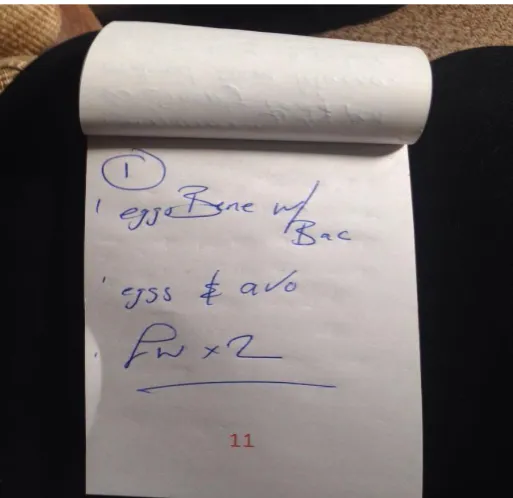
The waiter writes down my order (note: why would we not say ‘transcribes my utterance’?) on the order pad as per Figure 1. (I might, of course, have
communicated ‘the same order’ in any number of ways. For example, I could have just pointed and gestured at the menu, but let’s assume the pad would have shown the same thing). The waiter takes the pad to the till area, inputs the order into the computer whereupon a docket is transmitted to the kitchen staff who print it out and prepare the food for delivery to the table.
Now the question is: in what relationship does, for example,
fw x 2
(‘two flat white coffees’) (See Figure 1)stand to my actual initial utterance in making the order? To judge by the bare formula inscribed on the pad, it looks like an analytic abstraction of some kind has been performed on the utterance, purging it of all kinds of concrete detail to do with the original interactional context. Although, to state the obvious, nothing would be gained (indeed much would be jeopardized) if anybody was to insist, let’s say, on the waiter
7 My thanks to local experts Mhairi Jamieson and Jessica Jones for their catering insights. The case of ordering
giving a verbatim blow by blow account of the encounter, or providing an accurate phonetic transcription of the ordering utterance. And that is because the waiter has performed a quite specific metalinguistic act: he has not taken what I said as an utterance, he has taken it as an order; it’s not about what I say, but what I want. This means that, however my utterance actually came out in real time in the interactional moment, it has already passed through the screen of the café activity system and been transformed, or rendered functionally, within that new frame in a relevant way. The waiter heard and extracted an order in what I said and what he created on the pad is the relevant ‘transform’ of it in the shape of something designed to serve as the communicational trigger for the rest of the moves in the game, specifically something that will enable the kitchen staff to get to work within their own, relatively autonomous, food preparation frame. In fact, my order is not merely a fact about the initial interaction between me and the waiter. My having made an order is a fact, or action state, which hangs over, as it were, and drives all subsequent events within the café frame (until I pay and leave). The ‘first-order’ communicational encounters of the café system, therefore, create (so the parties hope) a world of systematic correspondences between word (the customer order) and object (the food that arrives on the table).
If the waiter has made an abstraction from my utterance in writing down fw x 2, does this abstracting procedure (and its product) effect a reification or decontextualization of my utterance? No, not at all: the abstraction is an instrumental or functional one – it is a means of fitting or connecting my utterance to what comes next in the socially organized game world to which it now belongs. This is the social instrumentality of language as transparent technology: the utterance is not de-contextualized because the goal-directed instrumentality of the process leaves behind its contextually
irrelevant features and takes everything from it that is needed to follow on with the next move. The utterance is not ‘reified’ but carried off into the processing stream of events in the café frame. In that light, we could say that the ‘first-order’
communicative act of ordering is contextualized in (at least) two ways. Firstly, it is contextualized ‘in the moment’, exquisitely geared to interpersonal and circumstantial minutiae which are unrepeatable.8 Secondly, it has, or makes, its place within a particular goal-directed sequence of relevant events, within a particular, pre-established communicational infrastructure.9 Consequently, the communicational episode has both a concretely unreproducible quality and, at the same time, an
8
The communicational episode is therefore also a completely ‘locally realizable event’ In Goffman’s terms (1972: 26). By this, he does not mean that the event has no material or cultural connections with, or presuppositions in, the surrounding world (near and far) but that each focussed gathering can ‘be viewed as having carved everything needed from the stuffs at hand’. Thus, ‘a customer, a clerk and a floor manager can among themselves play out the drama that is possible in shops’. This approach, using a concept of ‘realized resources’ relative to particular game frames, perhaps allows a different perspective on what has been called ‘the principle of non-locality’ with respect to communicative acts (Steffensen, 2015; Steffenson and Cowley, 2010).
9 For some discussion of different emphases within the integrationist camp about the relationship between
abstract or generic quality due to its functional incorporation into the streamlined, constantly repeating cycles of activity in the café.10
Clearly, the identity or equivalence between my ordering utterance and
[image:16.595.73.330.213.462.2]fw x 2 is not to be found in any formal resemblance; the criteria for equivalence cannot be specified empirically in any way.The equivalence, rather, is a functional or instrumental equivalence with respect to the chain of moves in a particular frame. That is, it is the socially organized reality of the café frame that makes my utterance transparent to ‘what the customer ordered’.
Figure 1 The order pad
The routine character of the café setting makes it easy to see how the reflexivity and transparency of communicative acts is a function of the contribution of these acts to the activity frame. The reflexivity of mundane, free flowing conversation, we could argue, is also due to instrumental framing although without the predictability and rigidity of the kind of task framing that running a catering outlet involves.11 At each
10
From the perspective of Harris (1996: 259), the waiter’s inscription is a ‘duplex sign’, combining the functions of ‘emblem’ and ‘token’ (as Harris defines these). The inscription records a new customer order (‘token’) but the order itself (‘two flat whites’) is a case of ‘the same thing again’ (‘emblem’) for the café staff. This ability to ‘tell the difference between ‘things and people previously encountered and ‘others not
previously encountered’ is ‘the basis for the temporal integration of the sign’ (1996: 259) and consequently ‘underlies all human communicational strategies’ (1996: 260).
11In Conversation Analysis, a distinction is made between ‘mundane talk’ and ‘institutional
point in ordinary conversation, what has been said (and done) prior to that moment is being analytically framed (or re-framed) in the next move in order to enable or
warrant subsequent moves.12 But the framing is open ended and subject to the more or less fleeting, more or less playful, more or less pre-planned interactional goals of the participants, as Goffman shows, partly in relation to what he calls ‘footing’ (Goffman, 1981). As Agha (2007: 28, his emphasis) puts it:
‘Part of the reflexive power of language consists of the fact that the object typified may be deictically near or far, specific or generic, manifestly real or imaginary, or made real (actualized) only later, through subsequent semiotic activities. But the typifying sign is itself always materially embodied; it is the perceivable product of an act in very case’.
For example, I ask a work colleague: ‘how did your “conversation” with your line manager go?’ Let’s take it that the colleague has no trouble in identifying the communicational episode (‘the conversation’) I’m alluding to. We can imagine a number of possible replies: a) ‘They basically asked me to think about retiring’; b) ‘Let’s just say a bollocking was given and received’; c) raised eyebrow. Each
response equally bears witness to what Agha calls ‘the reflexive power of language’ but the differences between them demonstrate that this power (a power of people not of language) is a creative, constructive power to take a particular interaction (between me and the colleague) forward in a particular direction. Similarly, in taking what somebody has just said (and done) as a compliment, a lie, a question, a
hesitation, a confession etc., we’re operating an improvised instrumental abstraction over an indeterminately wide set of present and past behaviours or events.
Reflexivity, then, is constructive and transformative, not ‘descriptive’ as such.13
Furthermore, like the café order in this respect, our communicational response is worked to have different implications on different levels and timescales. It provides an immediate next move in a provisionally established and highly dynamic
interactional frame but also contributes to, or initiates, a longer term project or commitment which will ‘hang over’ our lives on a more enduring basis14
. So if, in the course of an argument, I say ‘well OK I’ll turn up next Tuesday without fail’, there are all sorts of ways in which my utterance is crafted to be relevant to, and to continue, the specific interactional moment, a fact which the Conversation Analysis tradition attempts to address through the concept of ‘recipient design’. These specific
communicational properties do not and cannot outlive that particular moment. Love’s claim that ‘the sign has no existence outside its unique communicative episode’
point of view, it would perhaps be better to look at ‘mundane conversation’ as ‘loosening the screws’, so to speak.
12 See Agha’s discussion of ‘emergent reflexive models’ (2007: 25). In fact, rather than
saying that ‘something’ already said or done is framed or re-framed in subsequent moves, it would perhaps be better to say that current communicative acts ‘construct’ or ‘project’ (explicitly or by implication) a past ‘something’ to be interpreted as a pretext or warrant for the current contribution.
13 It is interesting that Agha (2007) speaks of ‘typifying’ rather than describing or representing.
14 Perhaps the most detailed study of the varying functional roles of communicative acts within joint projects is
(2007: 705) captures this ‘in the moment’ aspect of linguistic sign-making, an aspect which he foregrounds in his critique of the decontextualizing tendencies of linguistics. And yet something, indeed something rather crucial, may survive the ‘unique
communicative episode’, namely, in this case, the promise. In holding me to ‘the promise I made’, long after the relevant communicational episode, are you not
responsible for ‘abstracting and reifying some aspect of that episode, and presenting the reification for inspection and analysis as “the sign” in question’ (Love, 2007: 705)? The answer, clearly, is ‘no’. And the reason for the ‘no’ answer has to do, once more, with the social instrumentality of sign-making practice. Promising, like any speech act, is not about what you say but about what you do. Or, rather, it is about what you do in saying. Issuing a promise is a unique communicational act ‘in the moment’ but it effects a change in our interpersonal relations, creating a commitment which is carried over into, which ‘hangs over’ and informs, implicitly or explicitly, subsequent interactional business. Holding me to my promise, then, is not
decontextualizing or reifying the communicational episode or any component of it, but re-affirming the change in relational standing thereby effected. And so there is certainly a kind of abstraction involved in this freeing of ‘the promise’ from all the gory detail of its immediate context of production, but what is abstracted (or
extracted) is not some schematic rendering of the words uttered but what was done to our business or to our lives through that communicational episode - what was done by the words at that moment.
Finally, then, what game is the theoretical linguist playing? It depends, of course, on what theoretical commitments and what methods of investigation are in play. The starting point for most of the traditions that have dominated the field (at least till now) is the search for recurrent patterns or rule-governed units in the products or traces of live linguistic performance. A language, seen as a system of rules and units, is, therefore, a reality of the specialised linguistics game world in Goffman’s terms. Linguistics, like other activities, is ‘world-building’ and constructs its own significant moves and procedures in accordance with its peculiar ‘structure of inattention’. In that sense, the analytic discourse of linguistics is also the product and vehicle of ‘instrumental abstraction’ within the relevant frame and in accordance with the rules of the game. The linguistics game world, like any first-order practice, effects its own peculiar transformation on the ‘material’ which it takes through the screen.
But what is the basis, that is, what is the frame for establishing and judging equivalences or identities of relevant units within the material transformed in this way? The mainstream linguistic tradition has generally worked according to a
method in which units can be ascribed to a linguistic object, that is, they can be seen as intrinsic to the object studied, as inhering in the phenomenon of ‘(a) language’, to be found and described by linguistic analysis. This methodology in turn re-frames for specialised purposes more fundamental procedures, including whole traditions of literate practice with their pedagogical spin-offs, which construct ‘the language’ as a socially-uniform, trans-situational, trans-contextual coding system. In a sense, then, linguistics as a separate and self-contained discipline treats ‘language’ (or ‘a
Whereas in fact, as Goffman’s account shows, linguistic communication is only possible within specially organized frames of situated activity. An utterance may certainly be (transiently and provisionally) ‘frameable’ (as an order in a café, say) but language is not frameable: there is no all-encompassing, universal frame within which ‘language’ as such can be defined or contained. On the contrary, ‘languaging’, like human creativity generally, is a continuous activity of making, maintaining,
breaking and re-making frames of social action without limit. Nothing shows this open-ended unframeability of linguistic activity more clearly than the reflexive, metalinguistic practices of everyday language use where language is constantly re-imagined and re-invented.
Conclusion
The results of this tentative and superficial exploration of the instrumentality of language can now be briefly summarized.
I have argued that it is within relatively permeable and dynamically transformable ‘frames’ of social action that language becomes ‘transparent technology’: we hear and see not words but promises, orders, excuses, etc. What becomes ‘invisible’ in the process is the social artifice, that is, the arranging and relating of people in mutually intelligible action that creates the frame within which communicative acts are transparent to (count as) the value or function which they contribute. As the social instrumentality of the action frame becomes ‘invisible’ through practiced, visceral participation (enabling refined ‘structures of inattention’) we feel directly, personally, the impact on one another that, as subjects, we effect in performing such acts.
Linguistic reflexivity in all its forms is a testament to the social instrumentality of communicative practice. Such reflexivity involves a particular kind of abstraction which I have called ‘instrumental abstraction’, a power to progress instrumentally relevant and efficacious communicative moves within ongoing lines of action. This ‘instrumental abstraction’, rooted in participation in concrete frames of social practice, differs from the ‘formal abstraction’ evident in much linguistic practice in which the rules of the analytical game create a ‘frame’ of equivalence criteria in which ‘(a) language’ of units and rules takes on reality as a well-defined object of study.
I have claimed that integrationism has important insights to offer in relation to our understanding of the instrumental socio-transparency of linguistic communication. But at the same time, I have argued that it may be worth re-thinking the distinction frequently made between ‘first-order’ and ‘second-order’ language or linguistic constructs in terms of the investigation of the conditions of possibility and the relations between different (‘first-order’) linguistic practices and the
is the act of instantiating products of that decontextualisation’, as Love put it in his critique of Austin (Love, 1996: 65, his emphasis). The ‘performance of speech acts’, in the terms presented here, is a process of ‘instrumental’, rather than ‘formal’, abstraction. Consequently, the issue is not about ‘language as an activity’ but about very particular linguistic activities (language games or frames) and the relationships between them. Theoretical linguistic description, on this view, does not involve ‘decontextualising linguistic signs’ so much as the creation of a new activity frame, a new and highly specialised instrumental context for linguistic sign-making whose procedures and procedural products (including metalinguistic terms) do not describe ‘language’ but construct ‘language’ in their own image and make this ‘language’ real to those who operate by them.
Finally, what would follow from these reflections?
Firstly, developing a perspective on language in terms of ‘transparent technology’ may help to distance us from the highly intellectualised view of linguistic interaction in terms of ‘rules and units’ or ‘code plus inference’ which still dominates the
language sciences (see Taylor & Cameron, 1987; Hutton, 1990). This is not to say that inferential processes are not going on and are not part of communicative activity – far from it. But our communicational behaviours often come, as Bloomer (1969: 178)15 put it, ‘in the form of a judgement based on sensing the social relations of the situation in which the behavior occurs and on applying some social norm present in the experience of the observer’ (my emphasis). As Bloomer goes on:
‘It may be argued that the designation of an act as being respectful, hateful, aggressive, etc., is actually an inference and so is not properly part of the
observation. That it is an inference is, I think, unquestionable, but in many instances it is an inference that is fused immediately into the observation itself’ (1969: 178-179, my emphasis).
The visceral socio-transparency of communicative interaction - Bloomer’s ‘sensing the social relations of the situation’ - may provide an alternative focus to explanations of language and human mental capacities in terms of ‘reading’ and ‘segmenting’ ‘communicative intention‘ (Tomasello, 2003: 297). Rather than postulating a species-specific mind-reading ability, we might emphasise the far-reaching inter-dependence between people which is manifest in their need to be part of one another’s business for even the most basic vital processes. In being involved with one another in this way we learn to fit ourselves into jointly and reciprocally developing lines of action, to feel what is coming, or should come next, and to sense this next step in the other’s acts, attitude and demeanour.
Secondly, we might take up with renewed vigour the critique of the historical and social conditions for the emergence of modern thinking about language which we find in, for example, Harris (1980, 1981) and Foucault (1970), albeit from very different standpoints. The ‘frame’ of modern linguistic thinking is more than just a metaphor that we (or some of us) live by (as George Lakoff might put it) but a form of organized social practice whose priorities and blindspots (whose ‘structures of
15
inattention’) have significant consequences both practical and intellectual. From that point of view, the critique of linguistics merges with critical social theory.
References
Agha, A. (2007) Language and Social Relations. Cambridge: Cambridge University Press.
Bateson, G. (1973). Steps to an Ecology of Mind. St Albans: Paladin.
Bourdieu, P. (1977). Outline of a Theory of Practice. Cambridge University Press. Bloomer, H. (1969). Symbolic Interactionism. Perspective and Method. Berkeley:
University of California Press.
Bruner, J. (1983). Child’s Talk: Learning to Use Language. New York: Norton. Clark, A. (2003). Natural-Born Cyborgs. Minds, Technologies and the Future of
Human Intelligence. Oxford: Oxford University Press.
Clark, A. (2011). Supersizing the Mind: Embodiment, Action, and Cognitive Extension. Oxford: Oxford University Press.
Clark, H.H. (1996). Using Language. Cambridge: Cambridge University Press. Cowley, S.J. (2011). Taking a Language Stance. Ecological Psychology, 23: 1-25. Cowley, S.J. & Harvey, M.I. (2015). The Illusion of Common Ground. New Ideas in
Psychology.
Foucault, M. (1970). The Order of Things. An Archaeology of the Human Sciences. New York: Random House.
Goffman, E. (1972). Encounters. Two Studies in the Sociology of Interaction. Harmondsworth: Penguin.
Goffman, E. (1981). Forms of Talk. Oxford: Basil Blackwell. Harris, r. (1980). The Language-Makers. London: Duckworth. Harris, R. (1981). The Language Myth. London: Duckworth.
Harris, R. (1996). Signs, Language and Communication. London: Routledge. Harris, R. (1998) Introduction to Integrational Linguistics. Oxford: Pergamon. Harris, R. (2009) After Epistemology. Gamlingay: Bright Pen.
Hutchby, I. & Wooffitt, R. (1998) Conversation Analysis. Principles, Practices and Applications. Polity Press.
Hutton, C. (1990) Abstraction and Instance: the Type-Token Relation in Linguistic Theory. Oxford: Pergamon.
Jones, P.E. (2011). Signs of Activity: Integrating Language and Practical Action. Language Sciences, 33 (1); 11-19.
Jones, P.E. (2013). Reality Check: Some Thoughts in Response to Pablé. Social Epistemology and Reply Collective 2 (11): 16-19.
Jones, P.E. (2015). ‘Coordination’ (Herbert H Clark), ‘Integration’ (Roy Harris) and the Foundations of Communication Theory: Common Ground or Competing Visions? Language Sciences
Jones, P.E., Ghosh, A., Penders, J., & Reed, H. (2013). Towards Human
Technology Symbiosis in the Haptic Mode. In: International Conference on Communication, Media, Technology and Design, Famagusta, North Cyprus, 2-4 May: 307-312.
Levinson, S.C. (1979). Activity Types and Language. In P. Drew, & J. Heritage (Eds.) Talk at Work: Interaction in Institutional Settings. Cambridge: Cambridge University Press: 66-100.
Love, N. (2007). Are Languages Digital Codes? Language Sciences 29: 690-709. Pablé, A. (2013). Integrating Rorty and (Social) Constructivism: A View from
Harrisian Semiology. Social Epistemology
Pablé, A. & Hutton, C. (2015). Signs, Meaning and Experience. Integrational Approaches to Linguistics and Semiotics. Boston: De Gruyter.
Rączaszek-Leonardi, J., Dębska, A., & Sochanowicz, A. (2014). Pooling the Ground: Understanding and Coordination in Collective Sense Making. Frontiers in Psychology, Volume 5: 1-13.
Roeder, O. (2014). What Makes Nigel Richards The Best Scrabble Player On Earth
http://fivethirtyeight.com/features/what-makes-nigel-richards-the-best-scrabble-player-on-earth/
Steffensen, S.V. (2015). Distributed Language and Dialogism: Notes on Non-locality, sense-making and interactivity. Language Sciences
Steffensen, S.V. & Cowley, S.J. (2010). Signifying Bodies and Health: a Non-local Aftermath. In Cowley, S.J. et al. (eds.) Signifying Bodies: Biosemiosis, Interaction and Health. Braga: Catholic University of Portugal, 331-335. Sterelny, K. (2003). Thought in a Hostile World. Oxford: Blackwell.
Taylor, T.J. (2000) Language constructing Language: Implications of Reflexivity for Linguistic Theory. Language Sciences, 22 (4): 483-499.
Taylor, T.J. (2010). Where does Language come from? The Role of Reflexive Enculturation in Language Development. Language Sciences, 32: 14-27. Taylor, T.J. (2012). Understanding Others and Understanding Language: How do
Children Do it? Language Sciences 34: 1-12.
Taylor, T.J. (2015) Folk-Linguistic Fictions and the Explananda of the Language Sciences, New Ideas in Psychology
Taylor, T.J. & Cameron, D. (1987). Analyzing Conversation. Rules and Units in the Structure of Talk. Oxford: Pergamon.
Voloshinov, V.N. (1973). Marxism and the Philosophy of Language. New York: Academic Press.
Wahlquist, C. (2015). Nigeria's Wellington Jighere almost lost for words after Scrabble world title triumph.