Audio versus written feedback: exploring learners’
preference and the impact of feedback format on students’
academic performance
MORRIS, Cecile <http://orcid.org/0000-0001-6821-1232> and CHIKWA,
Gladson
Available from Sheffield Hallam University Research Archive (SHURA) at:
http://shura.shu.ac.uk/9122/
This document is the author deposited version. You are advised to consult the
publisher's version if you wish to cite from it.
Published version
MORRIS, Cecile and CHIKWA, Gladson (2016). Audio versus written feedback:
exploring learners’ preference and the impact of feedback format on students’
academic performance. Active Learning in Higher Education, 17 (2), 125-137.
Copyright and re-use policy
See
http://shura.shu.ac.uk/information.html
Sheffield Hallam University Research Archive
Page 1 of 14
Audio versus written feedback: exploring learners’ preference and the impact of feedback format on students’ academic performance.
Cecile Morris and Gladson Chikwa
Contact/biographical details of authors
Dr. Cecile Morris. Senior lecturer, Food Group, Sheffield Business School, Sheffield Hallam University, Sheffield, S1 1WB, UK. Email: [email protected].
Dr. Gladson Chikwa. Assistant Professor, Centre for Academic Practices, Middle East College, Knowledge Oasis Muscat, P.O. Box 79, Al Rusayl, PC 124, Sultanate of Oman. Email:
Cecile Morris, a Senior Lecturer in food studies, teaches food chemistry and sensory science on Food/ Nutrition courses at Undergraduate and Post-graduate levels. Her research revolves around food structure, food sensory properties and consumer perception. She has an interest in developing teaching resources and exploring techniques which can enhance student learning experience.
Gladson Chikwa, an education developer, works with academic staff and students supporting the strategic enhancement of learning and teaching and the development of the student academic experience. His research interests are divided between technology enhanced learning, pedagogy and assessment and feedback in higher education.
Abstract
Very little is known about the impact of the different types of feedback on students’ academic performance. This paper explores students’ preference in the use of audio and written feedback and how each type of feedback received by students impact on their academic performance in subsequent assignments. The study involved 68 students who were divided into two groups that received either audio or written feedback in their first assignment which was then recalled and applied into the second assignment. An analysis of results obtained in the second assignment was conducted and comparisons made between students in the audio and written feedback group. Students were also surveyed using an online questionnaire to ascertain their perceptions about the type of feedback they had received. The study established that the type of feedback received did not impact on students’ grades in the subsequent assignment. In addition, while students were broadly positive about audio feedback, they indicated a strong preference for written feedback in future assignments. The study recommends, among other things, further investigation into the link between students’ learning styles and their preferences for different types of feedback.
Key words: feedback; audio feedback; written feedback; feed-forward; academic performance
Students’ use and engagement with feedback
Page 2 of 14
Research shows that student engagement with feedback they receive is one of the key elements for successful student learning and achievement (Price et al., 2010). A study by Parkin et al. (2012) indicates that students engage with feedback in some way and make efforts to apply the feedback in their future learning. A number of studies conducted in different disciplines and institutions have demonstrated that provision of timely and constructive feedback enhances student achievement (Gibbs and Simpson, 2004; Hattie and Timperley, 2007; Biggs and Tang, 2007; Nicol and MacFarlane-Dick, 2006). It is also known that student feedback has been consistently an area of concern in the UK (Lipsett, 2007; Fielding et al., 2010) as is likely the case the world over. As a result, there is a lot of interest in exploring what constitutes best practice for good quality and timely feedback to scaffold students’ learning.
Yet, students do not always make use of feedback. For instance, some studies report that tutors complain about students not making use of the feedback that they receive (King et al., 2008; Sadler, 2010; Handley et al., 2011). A number of reasons why students fail to make use of feedback have been discussed in the literature. Students may fail to use feedback because the feedback is received too late to be considered useful, or students find their tutors’ comments difficult to understand (Weaver, 2006). In addition, it may also be attributed to the lack of clear advice given on how to improve (Bevan et al., 2008). It is important that academic staff ensure that the feedback they give provides opportunities to address future development (Price et al., 2011). However, another reason may be that students find it difficult to engage with the type of feedback provided by the tutor. For instance, it is possible that students who are uncomfortable with the processing of written information may want to explore the use of alternative forms of feedback. Merry and Orsmond (2008) highlight that students with different learning styles have preferences for different forms of feedback including visual, oral, written or kinaesthetic information.
In practice, students receive feedback in a variety of formats as shown in a study in which students across different disciplines named different forms in which they received feedback (Scott et al., 2011). It is also known that students have clear preferences for the type of feedback they receive. For example, students find written comments to be the most useful feedback especially when it is typed, legible and easy to read (Hepplestone and Chikwa, 2014). There is a diversity of preferences in the way students receive and process information in the learning process (Rowe and Wood, 2008). Most feedback is provided in written or verbal format, but students do not always understand written feedback (Gibbs and Simpson, 2004). One of the difficulties that students find with written feedback, in particular, handwritten feedback is illegibility (Scott et al., 2011). It is noted, however, that, ‘staff perceive a frequent lack of engagement with written feedback, much of which goes uncollected or unread’ (Cann, 2014: 1). This makes it imperative for staff to explore alternative forms of feedback to support their students’ learning.
There is an increase of interest in the provision of verbal feedback in the form of digital audio files (commonly referred to as audio feedback), a phenomenon that has been linked to a number of factors including the availability of cheap and easy to use recording devices and computer software (Rotherham, 2007; Middleton, 2011). However, a majority of students preferred face to face verbal feedback from lecturers as it enables questioning and discussion (Orsmond et al, 2005) and that their preferred method of receiving feedback is to receive it individually by their tutors, enabling a dialogue about that feedback to take place that can facilitate negotiation of meaning and clarify confusions promptly (Yang and Carless, 2013).
Students perceive and implement audio feedback in different and more meaningful ways than written feedback because of the following reasons (Merry and Orsmond, 2008):
it is easier to understand because handwriting is often illegible
it has more depth because possible strategies for solving problems are included rather than just stating what the problems are,
it seems ‘more genuine’ indicating that speech is received in a more personal way than writing (p.101).
Page 3 of 14
these can be divided into categories sometimes referred to as modalities which include visual, aural, reading/ writing and kinaesthetic (Felder and Silverman, 1988; Coffield et al., 2004).
Students are up to ten times more likely to open audio files compared to collecting written feedback in person (Lunt and Curran, 2009). As well as being useful as a good means to get students to collect and read feedback on their work, audio feedback can play an important role in accommodating learner preferences and different learning styles (McCullagh, 2011). It is an effective option for auditory learners who find it easy to remember much of what they hear. The use of audio feedback has been associated with other benefits such as reduction of time spent by tutors supplying the feedback and the ability to provide more detailed and more personalised feedback (King et al., 2008). Audio feedback can be produced quickly and easily using simple MP3 recorders in a similar time frame to equivalent written feedback (Rotherham, 2007) and audio feedback is more time efficient than equivalent amounts of written or video screen capture feedback for similar assignments (Cullen, 2011).
A number of studies have explored the provision of feedback in both audio file and written format to enhance effectiveness and engagement with feedback (Ice et al., 2007; Merry and Orsmond, 2008; Lunt and Curran, 2009). The literature shows that studies have focused on the students’ perceptions of written and other forms of feedback including audio feedback in different disciplines and institutions. However, there is no research evidence on the impact of different types of feedback received by students on their academic performance. For instance, we do not know whether students who receive and make use of audio feedback in future learning perform better than students who receive and use written feedback or vice versa. . The study described in this article therefore seeks to determine the extent to which students deploy audio and written feedback from one assignment into the next assignment by assessing the students’ ability to feed-forward (Duncan, 2007) following both written and oral feedback. To this end, the main research questions are:
Is there any difference in academic performance in subsequent assignments of a similar nature between students who receive audio and written feedback?
Is there any difference in students' satisfaction and perception of the role of feedback between audio and written feedback?
What is the preferred form of feedback between written and audio feedback?
Methodology
Participants
The participants were 68 first year students studying a science-lab based core module at a UK university. Data collection took place between February and May during the 2013/14 academic year. All students had the same tutor for the lectures and practical sessions. The 68 students were randomly allocated in two groups to receive either audio (34 students) or written feedback (34 students) on their first assignment (see study design in Table 1). Permission to conduct the study was sought and granted by the School’s faculty research ethics committee. While students were randomly allocated to either audio or written feedback, they were given the opportunity to request feedback in the alternative format. None of the students made such request. Students who chose to answer the survey were considered to have voluntarily accepted to take part in the second phase of the study which focused on students’ views on the type of feedback received.
Assessment package and support to students
Assessment
The module was assessed by 100% coursework with 50% of the module mark awarded for a lab report bearing on one of the practical session of the first semester for which the students received either audio or written feedback depending on which group they had been randomly allocated to. The remaining 50% of the module mark was awarded for a lab report bearing on second semester practical sessions. This second assignment was used as a marker to measure the impact of feedback received on the first assignment.
Page 4 of 14
The study design is detailed in Table 1. The markers selected were: time spent on marking and giving feedback; average mark on both assignments; number of students not performing well on selected item (both assignments); students’ satisfaction with the feedback they received; perceived feedback role and preferred type of feedback for subsequent assignments.
<<Insert Table 1 here>>
Time spent marking and giving feedback
The time spent to mark and give feedback on each report was recorded using a stopwatch. Additionally, the overall time spent saving and uploading the audio files onto the VLE was recorded.
Assignment marks
The average marks obtained by each group (audio and written) on the first assignment were compared to test whether the groups were of comparable strength at baseline. The average marks obtained by both groups on the second assignment were compared to test whether the type of feedback had an impact on overall performance. The data analysis (unpaired, 2 tailed, equal variance t-test) was performed using Excel (Microsoft, Seattle).
Number of students not performing well on selected item
Prior to the hand in date of the first lab report, a one hour lecture was used to revisit the guidelines issued to write a lab report. These detailed what was expected of each section of the report, tips, do’s and don’ts with examples drawn from unassessed practical sessions. The guidelines were also available on the module learning room on the VLE. More specifically, one of the guidelines dealt with the writing style: the reports were to be written in the passive voice and past tense. This item was selected as a marker of the extent to which students used the feedback provided on their first assignment to write their second assignment. It was selected as an appropriate marker of whether students had assimilated the feedback provided to them for two reasons. One, it is important for students to adhere to the appropriate conventional writing style for this type of task and this feedback is therefore useful for their academic development and subsequent tasks of similar nature. Two, it could not be content specific as students are genuinely not assessed twice on the same content which in turn, would have made it impossible to assess whether the students had used the feedback provided on subsequent tasks. All the students who did not follow this guideline (use of passive voice and past tense) in their first assignment received individual feedback, either in the audio or written form on how to improve this aspect of their work. All the student work was marked by the same tutor. A conscious effort was made to keep the feedback consistent in terms of content and length regardless of the feedback type. The feedback structure was the same for both types of feedback: for each section of the assignment, elements which the student had tackled satisfactorily were highlighted then items requiring attention and how to improve these aspects of their work were detailed.
The numbers of students in each group who did not perform well on the selected item for their first and second assignments were recorded to test whether the groups were comparable at baseline and measure improvement following feedback. The data was analysed by Chi Square test using SPSS (IBM, Newark).
Students’ feedback on the feedback they received
Page 5 of 14 Results
Marking time
The average time spent on marking and giving feedback was lower for the audio feedback (10.9 +/- 1.6 min per report) than for written feedback (13.4 +/- 1.9 min per report). However, it took an average of 1.3 minutes per file to save and upload on the VLE. Overall audio feedback did not result in a gain of time spent on marking and giving feedback.
Students’ performance Overall marks
There was no significant difference in average marks on the first assignment between the audio and written group (respectively 56.3% and 55.7%, p=0.766) indicating that the written feedback group was an adequate control to the audio group. On the second assignment, the average marks for the audio and written groups were 59.9% and 59.4% respectively (p=0.850) indicating that the type of feedback received did not impact on subsequent grades.
For the first assignment, the marks of the students who did not perform well on the selected item (use of passive voice and past tense) were lower than the marks of those who did well on this item for both the audio and written groups (58.6% and 53.4% for the audio group and 57.5% and 53.6% for the written group), however, this did not reach significance (p=0.070 and p=0.130). The difference in grades is unlikely to be solely due to marks awarded for performing well on the selected item but may be explained by the fact that the students who performed well on this item may have followed more closely all the guidelines provided to tackle the assignment including that related to the selected item.
While there was no significant difference between the first and second assignment marks for the students who did well on the selected item in either audio or written group (p=0.356 and p=0.846), the students who did not do well on that item in the first assignment significantly improved their marks in their second assignment; this was true for both audio (+6.2%, p=0.040) and written (+8.4%, p<0.001) groups. This would appear to indicate that the students who did not perform well on the specific item for their first assignment benefited from the feedback received regardless of its type to a greater extent than the students who had done well on the selected item for their first assignment. It is possible that those students engaged better with the tailored feedback received for their first assignment than with the generic guidelines provided in preparation for the assignments.
Improvement on selected item
In the audio group, 6 students out of the 15 who did not perform well on the selected item and received specific feedback on how to improve this, went on to do well on this item for their second assignment (8 did not improve and 1 student did not hand-in assignment 2). In the written feedback group, the same trend was observed with 6 out of 13 students performing well on this item after receiving specific feedback on how to improve that aspect of their work (7 did not). Both types of feedback were therefore found to be equally effective at getting the message across.
Students’ engagement with the feedback received
Out of 68 students who were sent the survey, 24 students replied, of those, 14 had received audio feedback. One student in the audio group did not listen to her feedback because she “got the mark [she] wanted”. The 23 other students all listened or read the feedback provided.
Satisfaction with the feedback received
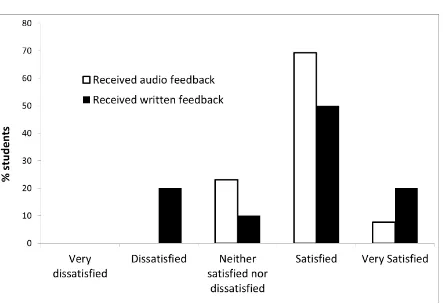
Overall, 76.9% (audio group) and 70% (written group) of students were satisfied or very satisfied with the feedback they received.
<<Insert Figure 1 here>>
Page 6 of 14
does not appear that the type of feedback received impacted greatly on students’ satisfaction with their feedback.
Perceived feedback role
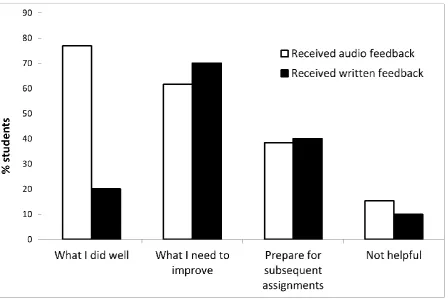
Students’ understanding of the role played by the feedback received differed between the audio and written feedback groups. A majority of students in the audio group felt that the feedback had helped them to know what they had done well whereas only 20% of students in the written feedback selected that statement (Figure 2) despite the fact that there was a conscientious effort to match the feedback for content across the audio and feedback groups.
<<Insert Figure 2 here>>
The percentages of students who felt that the feedback had helped them to know what they needed to improve, helped them to prepare for subsequent assignments or was not helpful were similar in both groups.
Feedback in the future
Despite similar levels of satisfaction with the feedback received and higher percentages of audio group students feeling that the feedback provided helped them to know what they had done well; the majority of students in the audio group (64.3%) would prefer to receive written feedback in the future (Figure 3).
<<Insert Figure 3 here>>
For students receiving audio and written feedback alike, the main reasons cited for preferring written feedback in the future mainly related to ease of access when preparing another assignment. A sample of typical comments made by students is presented below:
“I liked the audio feedback but it is useful to have written [feedback]as it is easier to access when needing to know how to improve in the next assignment” (audio feedback group student)
“Being able to reread is less stressful than constantly rewinding” (audio feedback group student)
“with written I can skip to the parts I feel are really important to read again” (audio feedback group student)
“Written feedback is always better as it is easy to refer back to for future reports” (written feedback group student).
Another reason cited from a student who received audio feedback related to learning style “I am a visual learner and prefer the written word”.
Only one of the audio group students who indicated they would prefer audio feedback in the future elaborated on the reason why this was the case and stated that “I liked the audio feedback since a lot can be said in a short period of time. Also it's easier to understand for me since usually written feedback can be hard to read”. The rest of the students in the audio feedback group indicated that they would prefer to receive written feedback in future.
Discussion and conclusions
Page 7 of 14
noted also by Merry and Orsmond (2008). It is therefore our submission that the use of audio feedback cannot be promoted on the notion of saving staff time but it is important to appreciate the other benefits which include the observation that audio feedback is highly acceptable to students (Cann, 2014) and that it increases the amount of feedback given to students (Rotherham, 2007).
As for student performance, that is, marks, the type of feedback received did not impact on subsequent grades. There was no significant difference in attainment between students who received audio and written feedback in the second assignment. While feedback is an important factor in students’ learning (Gibbs and Simpson, 2004), it appears that the delivery mode may not be as critical. Students can make use of either audio or written feedback as long as there are opportunities to apply the feedback. This view is consistent with findings from Pokorny and Pickford (2010) who found out that students perceive feedback to be poor or unhelpful if there are no opportunities to apply the feedback, particularly in the same module. It is worth noting that audio or written feedback that is carefully constructed and provided on time to enable students to apply it in the next assignment can be equally helpful in supporting students’ learning. The timing of the feedback may be of greater importance in terms of the impact on attainment than the format of the feedback (Brearley and Cullen, 2012).
For the first assignment, the marks of the students who did not perform well on the selected item were lower than the marks of those who did well on this item for both the audio and written groups although not significantly so. While there was no significant difference between the first and second assignment marks for the students who did well on the selected item in either audio or written group, the students who did not do well on that item in the first assignment significantly improved their marks in their second assignment; this was true of both audio and written groups. This would appear to indicate that the students who did not perform well on the specific item for their first assignment benefited from the feedback received regardless of its type to a greater extent than the students who had done well on the selected item for their first assignment. In this respect, generic guidelines may be regarded as generic feedback which has been shown to be of little help for students who may not be able to make enough sense of it to apply it in their future learning (Gibbs and Simpson, 2004).
In terms of improvement following feedback, just over half of the students who did not perform well on the selected item and received specific feedback on how to improve this went on to do well on this item for their second assignment. In the written feedback group, the same trend was observed with students performing well on this item after receiving specific feedback on how to improve that aspect of their work. Both types of feedback were therefore found to be equally effective at getting the message across. When it comes to students’ engagement with the feedback received and how satisfied they are with it, all who responded said that they listened or read the feedback provided and around three quarters said that they were satisfied or very satisfied with the feedback they received. It does not appear that the type of feedback received impacted greatly on students’ satisfaction with their feedback, although this is to be interpreted with caution due to the survey low response rate.
With regard to the perceived role of feedback, students’ understanding of the role played by the feedback received differed between the audio and written feedback groups. A majority of students in the audio group felt that the feedback had helped them to know what they had done well whereas only a small percentage of students in the written feedback selected that statement despite the fact that there was a conscientious effort to match the feedback for content across the audio and feedback groups. Audio feedback has been described as more personal in nature than written feedback because of the nuances that the tutor’s voice can express (Ice et al., 2007; Carruthers et al., 2014). This may explain why the students in the audio group perceived or recalled the praises related to their work better than the students in the written group. The percentages of students who felt that the feedback had helped them to know what they needed to improve, helped them to prepare for subsequent assignments or was not helpful were similar in both groups. Despite similar levels of satisfaction with the feedback received and higher percentages of audio group students feeling that the feedback provided helped them to know what they had done well; the majority of students in the audio group would prefer to receive written feedback in the future.
Page 8 of 14
Silverman, 1998; Flemming, 2007; Merry and Orsmond, 2008; Rowe and Wood, 2008). These students’ comments suggest that audio feedback can play a role in accommodating learner preferences and different learner styles (McCullagh, 2011).
Arguably, if students present different learning styles, it is important for the academic staff to use information about student characteristics as a framework for the design and management of learning experiences (Coffield et al., 2004), and this includes the provision of feedback. Rowe and Wood (2008) cite a number of authorities (Hattie and Timperley, 2007; Parikh et al., 2001; Rucker and Thompson, 2003) whose research findings reveal that feedback is most effective when it is provided in a manner sensitive to students’ learning styles, provided soon after the task performance, clearly identifies strengths and weaknesses, has suggestions for improvement and is constructive and motivating. This appears to show that learning styles, among other things, are important to understand and consider when providing feedback. The learning styles are linked with the approaches to studying that students adopt. For instance, according to Rowe and Wood (2008) deep learners appreciate feedback that enables them to learn more about the subject in a much more independent way, whereas the superficial learners value most feedback that directly enables them to improve their performance.
Only one of the audio group students who indicated they would prefer audio feedback in the future elaborated on the reason why this was the case and stated that: “I liked the audio feedback since a lot can be said in a short period of time. Also it's easier to understand for me since usually written feedback can be hard to read”. The rest of the students in the audio feedback group indicated that they would prefer to receive written feedback in future. Similar results were discussed in the literature, for example, Brearley and Cullen (2012) found that although many students in their study were positive about audio feedback they still felt the need to have some written feedback. The students’ preference for written feedback over audio feedback ‘may reflect difficulties for some students in mapping comments in their audio feedback to specific sections of their work’ (Brearley and Cullen, 2012:30). In the same vein, students indicate that although audio feedback had some benefits in their learning, ‘it was harder to link the comments to the relevant sections of the essay’ [and as a result felt] that written comments were better in that respect’ (King et al., 2008: 152).None of the students who had received written feedback expressed the wish to receive audio feedback in the future. This may be partly due to the fact that the students had never received audio feedback in the past and may be reluctant to adopt a new type of feedback when their overall satisfaction level with their current type of feedback is largely satisfactory.
The study sought to make a significant contribution to our understanding of student engagement with feedback and how this impacts on their academic performance in future learning. Like any other study, there are some limitations. One of the limitations of the study is that participants were drawn from only one module in a single department at a single UK university. This means that the findings of the study are based on experiences of students in a specific discipline. The small-scale nature of the study in terms of sample size coupled with low response rate on the survey does not help to make any broad generalisations from the findings. It is necessary for future work to consider conducting similar studies involving students at different levels of study and/ or students from different disciplines to compare results and see the bigger picture. A second limitation is the use of an online questionnaire to elicit students’ views regarding the type of feedback they received. Further studies should explore the use of other methods such as semi-structured interviews which enable students to articulate their perceptions in greater depth. A third limitation of the study is that the lecturer involved in teaching the module was responsible for data collection; it is possible that students’ views were influenced by their relationship with the lecturer. There should be further studies involving different researchers and different groups of students from different institutions and disciplines to compare results. Although the study helps to illuminate our understanding in some areas, it has also raised new questions in others. For instance, the study did not explore the link between student feedback preferences and their learning styles. It is recommended that further investigation is required into how the students’ learning styles are linked with preferences for particular types of feedback. Furthermore, it is worthwhile to further examine the link between the nature of the task and the type of feedback provided.
feed-Page 9 of 14
forward. In addition, for students to be able to apply the feedback in their future learning, the feedback provided should be constructive, that is, it should clearly indicate areas of strengths and areas that need improvement. It is also important to maintain a dialogue with students to ensure that one elicits students’ views on the nature of feedback they find useful and easy to recall and apply in their future learning.
References
Bevan R, Badge J, Cann A, Willmot C and Scott J (2008) Seeing eye-to-eye? Staff and student views on feedback. Bioscience Education 12 (1): 1-15.
Biggs JB and Tang C (2007) Teaching for quality learning at university. Maidenhead: Open University Press/Mcgraw-Hill Education
Brearley FQ and Cullen RW (2012) Providing students with formative audio feedback. Bioscience
Education 20 (1): 22-36
Cann A (2014) Engaging students with Audio Feedback. Bioscience Education 22 (1): 31-41
Carruthers C, McCarron B and Bolan P (2014) Listening and Learning: Reflections on the use of Audio feedback. An Excellence in Teaching and Learning Note. Business and Management
Education in Higher Education 1 (1): 4-11.
Coffield F, Moseley D, Hall E and Ecclestone K (2004) Should we be using Learning Styles? What research has to say to practice. Learning and Skills Research Centre, UK.
Cullen WR (2011) A multi-technology formative assessment strategy, media-enhanced feedback case studies and methods. In: Proceedings of the Media-enhanced Feedback Event (ed. A. Middleton), Sheffield, UK, 2010, pp. 28-33. Available at http://ppp.chester.ac.uk/images/
archive/4/43/20110329150219! Middleton-Media-enhanced_feedback_proceedings-final.pdf (accessed 7 Aril 2014).
Duncan N (2007) Feed-forward: improving students’ use of tutors’ comments. Assessment and
Evaluation in Higher Education 32 (3): 271-283.
Felder RM and Silverman LK (1988) Learning and Teaching Styles In Engineering Education.
Engineering Education 78 (7): 674-681.
Fielding AF, Dunleavy PJ and Langan AM (2010) Interpreting context to the UK’s National Student (Satisfaction) Survey data for science subjects. Journal of Further and Higher Education 34 (3): 347-368.
Flemming NA (2007) VARK--A Guide to Your Learning Preferences. Available at http://www.vark-learn.com/english/index.asp (Accessed 15 July 2014).
Gibbs G and Simpson C (2004) Conditions under which assessment supports learning. Learning and
Teaching in Higher Education 1 (1): 3-31.
Glover C and Brown E (2006) Written feedback for students: too much, too detailed or too incomprehensible to be effective? Bioscience Education 7 (1): 1-16.
Handley K, Price M and Millar J (2011) Beyond doing time : investigating the concept of student engagement with feedback. Oxford Review of Education 37 (4) : 543-560.
Hattie J and Timperley H (2007) The power of feedback. Review of Educational Research 77 (1): 81-112.
Hepplestone S and Chikwa G (2014) Understanding how students process and use feedback to support their learning. Practitioner Research in Higher Education 8 (1) : 41-53.
Ice P, Curtis R, Phillips P and Wells J (2007) Using asynchronous audio feedback to enhance teaching presence and students’ sense of community. Journal of Asynchronous Learning networks 11 (2) : 3-23.
King D, McGugan S and Bunyan N (2008) Does it make a difference ? Replacing text with audio feedback. Practice and Evidence of Scholarship of Teaching and Learning in Higher Education 3 (2) : 145-163.
Lipsett A (2007) Students’ biggest concern is feedback. Available at http://www.guardian.co.uk/education/2007/sep/12/highereducation.uk2 (accessed 21 July 2014). Lunt T and Curran J (2009) Are you listening please ? The advantages of electronic audio feedback compared to written feedback. Assessment and Evaluation in Higher Education 35 (7) : 759-769. McCullagh C (2011) Talking about writing: exploring the use of audio feedback in EAP writing classes, Media-Enhanced Feedback case studies and methods. In: Proceedings of the Media-Enhanced
Feedback event, 2010, Sheffield, pp.28-33 available at
Page 10 of 14
Merry S and Orsmond P (2008) Students’ attitudes to and usage of academic feedback provided via audio files. Biosciences Education 11 (3): 1-11.
Middleton A (2011) (Ed.) Media-enhanced feedback case studies and methods. In: Proceedings of the Media-Enhanced Feedback Event, 2010, Sheffield, available at
http://ppp.chester.ac.uk/images/archives/4/43/20110329! Middleton-Media-enhanced_feedback_proceedings-final.pdf (accessed 18 July 2014).
Nicol DJ and MacFarlane-Dick D (2006) Formative assessment and self-regulated learning: a model and seven principles of good feedback practice. Studies in Higher Education 30 (2): 199-218.
Orsmond P, Merry S, and Reiling K (2005) Biology students’ utilisation of tutors’ formative feedback: a qualitative interview study. Assessment and Evaluation in Higher Education 30 (4): 369-386.
Pokorny H and Pickford P (2010) Complexity, cue and relationships: student perceptions of feedback.
Active Learning in Higher Education 11 (1): 21-30
Price M, Handley K, Millar J and O’Donovan B (2010) Feedback all that effort but what is the effect?
Assessment & Evaluation in Higher Education 35 (3): 277-289.
Rotherham B (2007) Using an MP3 recorder to give feedback on student assignments. Educational
Developments 8 (2): 7-10
Rowe AD and Wood LN (2008) Student Perceptions and Preferences for Feedback. Asian Social
Science Journal 4 (3): 1-11.
Sadler DR (2010) Beyond feedback: developing student capability in complex appraisal. Assessment & Evaluation in Higher Education 35 (5): 535-550.
Scott J, Shields C, Gardner J, Hancock A and Nutt A (2011) Student Engagement with Feedback.
Bioscience Education eJournal 18 (1): 1-9.
Weaver MR (2006) Do students value feedback? Student perceptions of tutors’ written responses.
Assessment & Evaluation in Higher Education 31 (3): 379-394.
Page 11 of 14
[image:12.595.68.533.155.669.2]Tables
Table 1: Study design and selected markers
Study design
Timeline
Markers selected
68 students
Guidelines issued
34 students
audio
feedback
group
34 students
written
feedback
group
Time spent marking and giving
feedback
1
stassignment
- Average mark
- Number of students not
performing
well
on
selected item
Feedback handed
out
Survey
-
Students’
satisfaction
with feedback received
- Perceived
role
of
feedback
- Type of feedback wished
in future
34 students
34 students
2
ndassignment
- Average mark
- Number of students not
performing
well
on
Page 12 of 14
Figures
Figure 1: Students’ satisfaction with feedback received
Figure 1: Details the satisfaction with the feedback received for the audio and written
Page 13 of 14
Page 14 of 14
[image:15.595.72.519.99.398.2]