Simulation of failure of air plasma sprayed thermal barrier
coating due to interfacial and bulk cracks using
surface-based cohesive interaction and extended finite element
method
KYAW, Si <http://orcid.org/0000-0001-8568-500X>, JONES, I A and HYDE, T H
Available from Sheffield Hallam University Research Archive (SHURA) at:
http://shura.shu.ac.uk/14264/
This document is the author deposited version. You are advised to consult the publisher's version if you wish to cite from it.
Published version
KYAW, Si, JONES, I A and HYDE, T H (2016). Simulation of failure of air plasma sprayed thermal barrier coating due to interfacial and bulk cracks using surface-based cohesive interaction and extended finite element method. Journal of Strain Analysis for Engineering Design, 51 (2), 132-143.
Copyright and re-use policy
See http://shura.shu.ac.uk/information.html
1 Simulation of failure of air plasma sprayed thermal barrier coating due to interfacial
and bulk cracks by using surface based cohesive interaction and extended finite element
method
S.T. Kyaw*, I.A.Jones, T.H.Hyde
Faculty of Engineering, The University of Nottingham University Park, Nottingham, NG7 2RD, UK
*Corresponding author email: [email protected]
Address: C03, ITRC building, University Park, University of Nottingham, NG7 2RD Phone: +44-1159513811
Abstract
The present paper describes a method of predicting the failure of a thermal barrier
coating system due to interfacial cracks and cracks within bulk coatings. The interfacial crack
is modelled by applying cohesive interfaces where the thermally grown oxide is bonded to
the ceramic thermal barrier coating. Initiation and propagation of arbitrary cracks within
coatings are modelled using the extended finite element method. Two sets of parametric
studies were carried out, concentrating on the effect of thickness of the oxide layer and that of
initial cracks within the ceramic coating on the growth of coating cracks and the subsequent
failures. These studies have shown that a thicker oxide layer creates higher tensile residual
stresses during cooling from high temperature, leading to longer coating cracks. Initial cracks
parallel to the oxide interface accelerate coating spallation and simulation of this process is
presented in this paper. By contrast, segmented cracks prevent growth of parallel cracks
which can lead to spallation.
Keywords: TBC, cohesive interaction, XFEM, crack growth, spallation
Nomenclature
NI(x) Conventional shape function, taking the value 1 at node I and 0 at all other nodes
a Half diagonal length of the impression
I
2
α I
b
Enriched degree of freedom for XFEMc Half of the crack length
D Damage parameter for the traction-separation model
E Young’s modulus
f Crack nucleation factor
xFα Crack tip asymptotic function for XFEM enrichment
GC Critical strain energy release rate (also GIC,GIIC)
Geq Equivalent critical strain energy release rate mixed-mode failure
GI Strain energy release rate for Mode I failure (also GII and GIII)
C I
K Fracture toughness of Mode I failure
m Loading stiffness
P maximum indentation load
T Traction stress at which damage initiation occurs
I
u
Degree of freedom for node Iβ phase angle for mixed mode failure
δ
Crack opening/separation at which damage initiation occursδz Critical crack opening at D = 1
δeff Effective critical crack opening for mixed mode failure
δn Critical crack opening for Mode I failure
δslip Critical crack opening for Mode II failure
Material constant in equation for calculating C
3 1 Introduction
A thermal barrier coating (TBC) system is usually made up of three layers: ceramic
TBC, bond coat (BC) and thermally grown oxide (TGO) and the substrate. An air plasma
sprayed (APS) TBC system will be considered here and this manufacturing method is
commonly used for spraying TBCs onto components of land based engines. Unlike the
electron beam physical vapour deposition (EBPVD) method, which is used in the aerospace
industry, the APS method does not require the use of a vacuum during manufacturing,
bringing down the investment cost for coating equipments. Nevertheless, it requires multiple
passes of spraying to achieve the required coating thickness.
The growth of parallel cracks within the coating and interfacial delamination cracks
can lead to failure of coating systems. The initiation of these cracks can be predicted based on
simulated stress distributions within the system. While this type of prediction is reasonable
for failure analysis, it does not take into account stress relaxation as a result of the growth of
cracks. Here, the failure of air plasma spray (APS) TBC systems for gas turbines will be
explored by implementing models for the crack growth mechanisms both at the coating
interfaces and within the bulk coatings.
Stresses which are concentrated around the TGO interfaces at the end of a thermal
cycle have been assumed to be the major cause of spallation of the TBC. Tensile stresses
originate from the mismatch of strains between layers of the TBC system during the start up
or the shutdown of engines. When these stresses exceed the fracture strengths of the TBC
layers or the TGO interfaces, they create cracks within the bulk layers and weaken the TGO
interfaces by creating delamination cracks. The fracture toughness of the TGO interfaces and
of the TBC layers determine the propagation of those cracks and of the overall failure
mechanism (ductile or brittle) of TBC system.
Failures of TBC systems based on cracks created within the TBC and the TGO layers
have been investigated experimentally by various researchers [1, 2]. Naumenko et al. [2]
observed that failure of the APS TBC system mainly occurs within the TBC layer near the
TGO/TBC interface because a significant amount of TBC remains attached to the substrate
after failure, compared to EBPVD coating systems.
Delamination and spallation failures of TBC systems have been simulated using
cohesive bonds with predefined crack paths [3-5] but these models are unable to predict
arbitrary crack propagation within the bulk coatings as the crack paths are defined at the
pre-processing stage. Although an iterative crack propagation scheme as presented in [6] can be
4 tip is required, and it is therefore computationally expensive especially for 3D models.
Arbitrary crack propagation has been modelled for EBPVD systems in [7, 8] but the study
does not implement cohesive interface for possible growth of interfacial cracks and
delamination.
In this paper, the extended FE method (XFEM) is applied to the simulation of
arbitrary crack propagation within the TBC and the TGO while a cohesive interaction is
applied at the TGO/TBC interface to investigate the degradation of interface bonding.
Furthermore, initial cracks and discontinuities within the TBC are also implemented in the
model and their influences on TBC spallation are studied. Initial cracks could sometimes be
deliberately introduced to the system using proprietary spraying processes such as the
solution-precursor plasma sprayed process (SPPS) as explained in [9] for better strain
tolerance.
2 Geometry and boundary conditions
Modelling has taken place regarding the initiation and propagation of cracks within
the TBC system when it is cooled down from the operating temperature (1000°C) to 20°C.
The TBC model consists of a nickel based superalloy cylinder with an inner (Ri) and an outer
radius (Ro) of 3.2mm and 6.2mm respectively. The BC and the TBC with respective
thicknesses of 100 μm and 200 μm are assumed to be coated onto the cylindrical substrate.
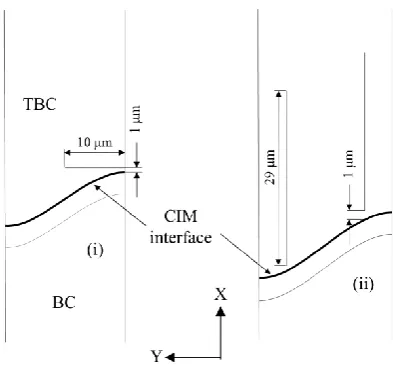
The dimensions of the TGO interface have been taken as a wavelength of 48μm and an
amplitude of 6μm; these values are within the range of the typical TGO interface as measured
in [10]. The current TBC model does not take account of out of plane geometry variations of
complex TGO interfaces and relevant stress developments as shown in [11]. Geometries of
the TBC system are shown in Fig. 1 (i) and (ii). Only one half of a period of a sinusoidal
interface is used as FE unit cell as shown in Fig. 1 (i). Mesh and boundary conditions for a
unit cell are illustrated in Fig. 1 (iii). Periodicity of a unit cell and symmetry boundary
conditions are applied. Although generalised plane strain elements (CPEG4) are more
suitable for constructing a 2D representation of a coated cylinder with prismatic surface
features and of a finite length, the commercially available XFEM enrichment scheme in
Abaqus [12] is not formulated for CPEG4. Therefore, a specially-developed user defined
element (UEL) [12] was required. For simplicity, a plane strain element (CPE4) was used
instead by assuming the cylinder is constrained against axial expansion or contraction.
Elements with the full integration scheme for displacement based FEA tend to overestimate
5 scheme with fewer Gauss (integration) points is advised for such simulations and it is
therefore chosen for the current problem.
The TBC system is assumed to be defect-free during the pre-processing stage for the
first part of analysis. Initial TBC cracks were implemented in the second part of the analysis
in order to understand their influences on spallation. Two types of APS TBC cracks were
considered for implementation at the pre-processing stage: cracks which originate from the
intersplat boundaries, which are parallel to the TGO interface (parallel cracks), and cracks
that are perpendicular to the interface (segmented cracks) as shown in Fig. 2 (i) and (ii)
respectively. The formation of cracks is driven by maximum principal stresses of the TBC
systems under thermal cyclic load.
Various researchers [14-16] have explored the relationship between the failure of the
TBC system and the thickness of the TGO layer. To observe the relationship between crack
growth and TGO thickness, parametric studies were carried out with different TGO
thicknesses varied from 1 to 4µm while keeping the aspect ratio the same as for the
sinusoidal TGO interface for the initially crack-free model. The TGO thickness, for the
model with initial defects, is set to 4μm, which is assumed as the critical TGO thickness for
the spallation, to simulate the final spallation of the TBC. The TBC system is considered to
be stress-free at the end of the steady state due to the stress relaxation within the BC in
accordance with the assumptions made by Rösler [17].
XFEM enrichment was applied to the TGO and the TBC layers based on the principal
stress criterion. The adhesion between the TGO and the TBC layer and subsequent
degradation of the interface from interfacial crack opening is modelled by using the cohesive
interaction method [12] (CIM). The CIM is only applied to the TGO/TBC interface since it
has been shown experimentally [2] that spallation of the TBC in the vicinity of the TGO is
most common for APS TBCs.
3 Crack growth modelling using XFEM
Until recently, crack nucleation and propagation have been modelled within Abaqus
using virtual crack closure or cohesive methods. These methods allow crack growth along a
predefined path following the element boundaries. This has limited the potential of modelling
arbitrary crack growth within the model. Moreover, computationally demanding mesh
optimisation is required around the crack tip where stress concentrates. By using a
displacement interpolation scheme [12] as shown in Eq (1), XFEM can model initiation of
6 [18] by further enhancing the partition of unity method introduced by Melenk and Babuska
[19].
tip tip H N I N N I α I 1 α α I I N I I h b x F a sgn(x) u (x) N x u (1)where NI(x) is a conventional shape function used in elements, regardless of whether XFEM
enrichment is used.
u
I represents the degrees of freedom (dof) of nodes for the FEcalculations within ordinary isoparametric elements, while
a
I and bαI are enriched dof for theimplementation of discontinuities within the elements. sgn(x) is a Heaviside distribution. NH
are nodes belonging to the elements cut by a crack. Ntip are nodes belonging to the element
within which a crack tip lies. Fα
x is a crack tip asymptotic function. More details for theXFEM can be found in [20].
For propagating cracks, the traction-separation model (explained in Section 4) is
applied using phantom nodes. Phantom nodes are superimposed onto the nodes of the
elements through which the crack has passed. These phantom nodes at opposite sides of the
crack will be separated causing opening of the crack face as the loading is applied. The
magnitude of the separation of the crack surface before the complete failure is governed by
the fracture toughness of the material. For propagating cracks, the crack tip asymptotic
singularity is not considered. This means that a crack only initiates when all nodal values
(stress or strain) for the element are higher than user-defined critical values, and the crack tip
always lies at the element boundary.
In terms of engineering applications, XFEM can be used to predict arbitrary
solution-dependent crack initiation and propagation within structures under loading. It can be used in
parallel with cohesive failure models. Here, it is used to model crack propagation within the
TBC and TGO in conjunction with the CIM model for the propagation of a delaminating
crack at the TGO/TBC interface.
4 Traction-separation damage model
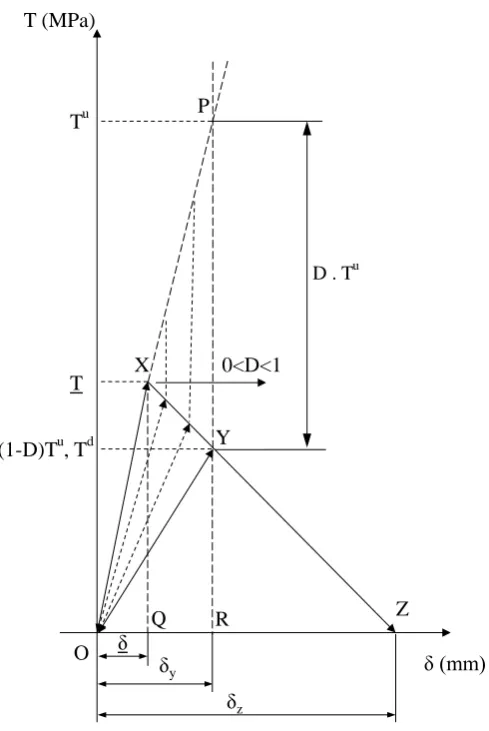
A linear traction-separation law [21] as shown in Fig. 3 was applied as a damage
model for both cohesive nodes of the TGO/TBC interface and XFEM enriched elements. The
model has been applied extensively in [5, 7, 8] to simulate either interfacial cracks or cracks
7
stress (T) and separation (
δ
) at which damage initiation occurs. Damage or crack initiationcan be determined by either a critical principal stress/strain or a critical separation criterion.
Stresses between the crack surfaces reduce while the cohesive interface or the crack plane is
separating during degradation. If unloading is applied at point Y (refer to Fig. 3), the cohesive
stiffness is reduced to (1-D)×k for the next loading step. D is the damage parameter and it can
be derived as follows.
D is zero during the elastic loading region (OX) and if the unloading occurs at this region both traction and crack separation should go back to zero. Damage initiates at point X where D is 0 and final failure point is Z where D is 1. To illustrate this, the damage parameter is derived for unloading at point Y as shown in Fig. 4. The loading stiffness (m) after
unloading at point Y will be
y u δ T D 1 m (2)However,
y u δ
T is the stiffness of the undamaged crack (k). Hence m can be
expressed in terms of k. Tu is the stress when there is no cohesive damage whereas Td is the actual traction stress with cohesive damage.
The damage parameter D can be related to the crack separation distances. The slope m is written again as
OR YR
m (3)
Since ZQX and ZRY form a pair of similar triangles, YR can be written as
z y z u T ZQ ZR QX YR (4)Substituting Eq (2) & (4) into (3),
y u δ T D 1 y z y z u T (5)By simplying Eq (5), the damage parameter can be related to crack opening displacement as
δ δ
δ δ δ δ D z y y z (6)
Final failure occurs when the strain energy release rate due to the crack opening is
higher than the critical strain energy release rate (GC). The strain energy release rate can be
8
depends on the value of GC; high and low GC are related to the ductile and brittle failure
respectively.
Critical crack opening (δz) depends on the fracture stress (T) and fracture toughness
( C
I
K ) and relationship for Mode I failure is shown in Eq (7).
T E K 2 δ 2 C Iz (7)
5 Traction-separation damage model for mixed mode loading
If a shear mode of failure is taken into account, the effective critical separation (δeff)
can be expressed using normal crack opening (δn) and tangential crack opening (δslip) as
shown in Eq (8). This effective separation can be used to define failure criterion as an
alternative stress based criteria as follows. For mixed mode failure, a quadratic stress or strain
criterion can be used for damage initiation in traction-separation model [12] and the former is
used here to derive mixed mode failure parameters. The crack nucleates when the parameter
(f) as shown in Eq (9) becomes unity.
2 slip 2 n
eff δ δ
δ (8)
2 c 2 c τ τ σ σ f (9)
where σ and τ are nodal direct and shear stresses and
cand
care critical direct and shearstresses. The Macaulay bracket means only tensile direct stress is considered for crack
initiation. If
σ τ
tanβ , then the effective traction stress for damage initiation can be
described as in Eq (10), where β is the phase angle for mixed mode failure.
0.5 2 2 C 2 C 2
C sin β
τ σ β cos σ T (10)
For mixed mode damage evolution, the critical energy GC is the equivalent critical
strain energy release rate (Geq). This can be calculated in various ways [12]; a B-K
(Benzeggagh and Kenane) law for Geq is shown in Eq (11) as an example.
n9
where GIC and GIIC are critical strain energy release rates of direct and shear modes of failure
respectively and GI, GII and GIII are energy release rate for a direct and two shear modes of
failure respectively. n is a constant power, which is usually determined empirically.
Currently, it is assumed that the initiation and evolution of damage are independent of
failure mode, due to lack of experimental data. Once experimental data for the shear strengths
and mode dependent energy release rates of the coatings are available in future, they can be
implemented in the mixed-mode failure model as shown by the framework above.
6 Material properties
6.1 Elastic and thermal properties
To model time dependent material properties of a complex TBC system, a user
defined material subroutine (UMAT) is required [22]. Due to current limitations of the
XFEM code implemented within Abaqus [12], it is not possible to couple UMAT with
XFEM code. A more complicated user defined element (UEL) is required for this purpose.
As a first attempt, the coating layers are currently considered to be elastic during the cooling
stage and the system is also assumed to be stress-free at the beginning of the cooling stage.
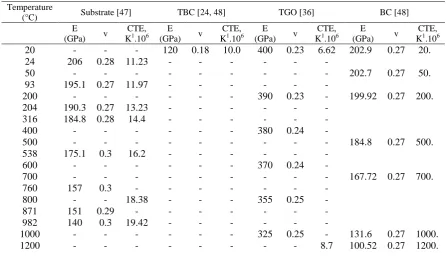
Elastic and thermal properties for the substrate, the TGO and the coating layers are given in
Table 1. The system used for the study is an APS TBC system. It includes IN-738LC
superalloy substrate, yttria stabilised zirconia (YSZ) ceramic coating, beta (NiAl) - gamma
(Ni) BC and alumina (Al2O3) TGO. Please note that elastic and CTE of TBC are measured at
room temperature. However studies[23-27] have shown that sintering at high temperature
could modify the elastic modulus significantly and hence either empirical sintering model
[22] or physical models [28] should be considered for further studies.
Despite the simplifications made in this study, significant research [29-31] has
showed the effects of dilational strain, due to growth of an oxide layer during the steady state
at high temperatures, on residual stress state within TBC systems. These stresses are further
distributed due to creep relaxation of bond coat as demonstrated in [32-35]. Hence, further
work is expected to couple the current analysis with thermo-mechanical analysis of TBC
system with time dependent material properties and oxide growth like models in [22, 34]
10 6.2 Tensile strengths of coatings
To apply the traction-separation law, the maximum stress and cohesive interface
stiffness for damage initiation and the critical strain energy release rate for damage evolution
and failure have to be defined. Tensile strength was taken as the maximum stress for damage
initiation by assuming that both the TGO and TBC are brittle with no yielding at the point of
failure. Tensile strength of the TGO is 260MPa as reported by Munro [36]. The strength does
not vary significantly for the temperature range between 20°C and 1000°C although it falls
linearly to 10MPa between 1000°C and 1400°C [36]. It is assumed that TGO formed within
the TBC system is comparable to bulk alumina (mass fraction of Al2O3 ≥ 0.995 and a
nominal grain size of 5μm) used for experimental testing in [36].The fracture stress of the
YSZ TBC is largely dependent on its yttria content as demonstrated in [37]. It was observed
that at a high concentration of yttria, the tensile strength is almost equal to the flexural
strength. Since no reliable temperature dependent tensile strengths are available, the
temperature dependent flexural strengths of YSZ with 6.5 mol% of yttria in [38] are taken as
the fracture strength of the TBC. The strength of the sintered YSZ varies from 150 MPa to
50MPa between 20°C to 1000°C. Please note that the specimens used for the experiments in
[36, 38] are made up of bulk coating materials whose dimensions are much larger than actual
coating layers. The tensile strength of coatings could be size-dependent and it should be
investigated further.
6.3 Interfacial tensile strength
Coating failure is strongly dependent on the adhesion strength of the interface under
tensile loading. Various techniques have been proposed to estimate the tensile adhesion
strength of the TBC. The most common standardised methods are DIN 50160 and ASTM
D7234-05 both of which are tensile pull tests. These have been applied in [39, 40] to obtain
TBC bond strength. An experiment following the DIN 50160 standard is shown in Fig. 5. It is
doubtful that the measured bond strength represents the actual adhesion strength at the
coating interface as the measured values [39, 41] are much lower than analytically or
numerically predicted mismatch stresses at the interface. To obtain reliable strength data from
a pull test, the bonding strength of the epoxy has to be stronger than that of the coating in
order to avoid failure at the epoxy interface. Moreover, because of the porous nature of APS
TBC, the adhesive can seep into the coating and this might alter the strength of the
coating/metal interface. Finally, at the point of coating failure, the ratio of failure load to
11 Therefore, the predicted bond strengths from pull tests such as the one in [39] are much lower
than maximum out-of-plane tensile stresses (normal to the coating interface) simulated using
FE models.
An alternative method for bond strength, which is based on experimental spallation
tests and the FE method, is proposed as follows. It is assumed that the coating delaminates
when the mismatch stress, due to cooling, exceeds the critical stress as explained in [26].
Experimentally, the critical thermal load for delamination can be obtained by applying
different thermal cycles to the TBC system. According to data from spallation tests [42],
delamination occurs after cooling down from heating at 1000°C for 1050h. When the same
thermal cycle was applied to the FE model of the TBC system [22], the maximum tensile
out-of-plane stress at the TGO/TBC interface is found to be 196.5MPa at the end of cooling. This
stress is taken as the delamination strength of the interface.
6.4 Interfacial cohesive stiffness
Unlike physical properties (e.g. the tensile strength or toughness of materials), the
cohesive stiffness for traction-separation model is an assumed property without a direct
physical interpretation. Some researchers investigating adhesive joints [43] have suggested
the use of a stiffness value which is equal to the ratio of the modulus of the adhesive to its
thickness. However, the physical thickness of the adhesive has no relevance to the case of a
cohesive bond as in the model applied here. Therefore, a sensitivity study was carried out to
obtain a useful interface cohesive stiffness. This is chosen to give values of out-of-plane
stress at the cohesive interface, within the linear elastic region, close to the stress values
predicted from the model with completely tied interfaces. The value of traction stress for
damage initiation at the TGO/TBC interface is assumed to be 3 GPa to ensure the mismatch
stresses will not initiate delamination cracks and affect the stress distribution. Cohesive
stiffnesses ranging from 1.5×10⁸ to 1.5×10¹¹ MPa/mm were applied at the TGO/TBC
interface within the sensitivity study.
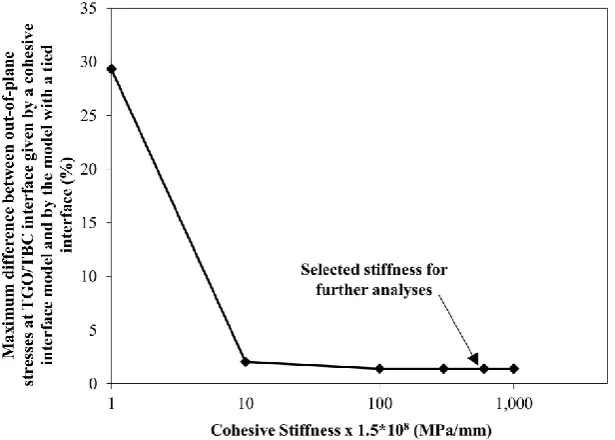
Maximum difference between out-of-plane stresses at the TGO/TBC interface given
by a cohesive interface model and by the model with a tied interface is plotted for different
cohesive stiffnesses as shown in Fig. 6. For a cohesive stiffness of 1.5×10¹¹ MPa/mm, the
difference is less than 1.5% and this value was therefore chosen as the cohesive interface
stiffness for the studies carried out here. Although a larger cohesive stiffness can be chosen,
12
is less than 1.31 ×10⁻¹⁰ mm for a cohesive stiffness of 1.5×10¹² MPa/mm) before the damage
starts. This can lead to numerical instability.
6.5 Critical strain energies and fracture toughness
The critical strain energy release rate can be related to the bulk/interfacial fracture
toughness ( C
I
K ) and modulus (E) as GC C E
2
I K
for plane strain Mode I failure. The fracture
toughness values for a TGO film (thickness = 0.38µm) and bulk TBC (thickness = 1mm)
were measured by Stollberg, et al. [44] using the nanoindentation method. The relationship
between nanoindentation test data and fracture toughness value can be shown by Eq (12). The
corresponding values are 2.22±0.31 and 1.3±0.29 MPa m. Yamazaki et al. [45]
investigated the TGO/TBC interface toughness and estimated it to be around 3.5 MPa m.
In the absence of the physical elastic modulus for the TGO/TBC interface, the apparent
modulus of the interface acquired from the load-depth indentation curve according to ISO
14577 is used by Yamazaki et al. [45]. The modulus is obtained by equating fracture
toughness measured by the nanoindentation technique to the value measured from a 4 point
bend test [45]:
E P c a
C
3
I
K (12)
where is a constant, E is the elastic modulus or apparent elastic modulus for interfacial
toughness, a is half diagonal length of the impression, P is maximum indentation load and c is
half of the crack length.
7 Results and discussion
7.1 Parametric study of the influence of TGO thickness on crack growth within bulk
coatings
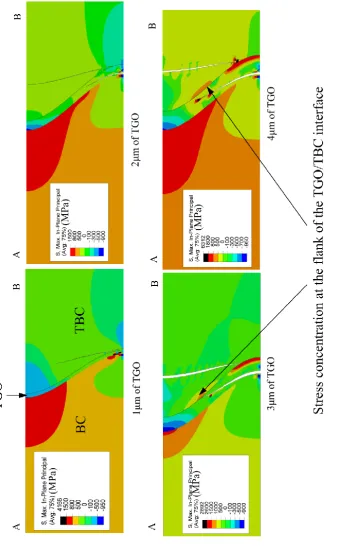
For initially defect-free systems, after cooling down from 1000°C to 20°C, principal
stresses within the TBC systems for different TGO thicknesses are presented in Fig. 7. The
stress contours are significantly different from those relating to the crack-free models [14, 34,
46], which show stress concentrations at the peak and valley regions of the TGO interfaces.
However, for the current models, stresses at the peak region of TBC/TGO interface are
relaxed by crack formations and stresses are found to be concentrated at the flank of the
13 significant as the changes in direction for TGO cracks, which are growing towards the
TGO/TBC interface. Thicker TGOs can lead to higher mistmatch stresses within the TBC
system[14], which cause propagation of longer cracks. From the current study, the TBC crack
propagates completely through the periodicity plane AB of the model when the TGO is
thicker than 2μm. Therefore, coalescence of cracks within the TBC and the spallation of the
TBC are expected when the TGO becomes thicker due to oxidation of the system at high
temperature.
As shown in Fig. 7, there are multiple regions with stresses which are higher than the
tensile strength of the coatings, and these stresses can cause initiation of further cracks.
However, in this case, new cracks are not generated due to the limitations in the XFEM
enrichment within Abaqus [12]. Formation of new cracks is not allowed in the vicinity of the
existing crack until the complete separation of the existing crack face occurs. This could be
because formation of multiple cracks within an element is not currently supported by Abaqus.
In other words, XFEM is not suitable for modelling failure caused by multiple cracks which
nucleate simultaneously. As seen from the damage parameter contours for XFEM cracks
shown in Fig. 8, the existing cracks have some regions with damage parameters less than 1.
This prevents the initiation of new cracks near the regions of the existing cracks.
7.2 Parametric study of influence of TGO thickness on crack growth at the TGO/TBC
interface
The damage status of a delamination crack at the interface can be studied by
monitoring the contact opening variable within Abaqus. For mixed-mode failure, the
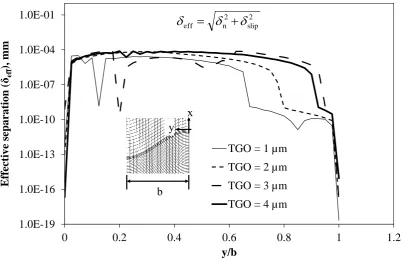
effective opening (δeff) can be calculated from direct (COPEN, δn) and shear crack opening
(CSLIP, δslip) variables as shown in Eq (8). The crack opens when δn or δslip is higher than δ
and the complete failure occurs when δeff reaches the critical separation (δz) as shown in
Fig. 3. For this case, (δ) and δz are 1.31x10-09 mm and 1.597x10⁻³ mm respectively. δn
and effective separations along the TGO/TBC interfaces are plotted for systems with different
TGO thicknesses as shown in Fig. 9 & Fig. 10 respectively. Generally, tangential separations
are around half an order to an order of magnitude higher than normal separations (Fig. 9 &
Fig. 10). None of the models show a completely delaminated interface while contact
separations in both directions are higher for thicker TGOs. However, the separations for the
model with 4μm TGO are lower compared to the values from the system with 3μm TGO
because of higher stress relaxation at the interface for 4μm TGO model from the formation of
14 7.3 Influence of initial parallel TBC cracks on crack growth within the TBC system
For the system with an initial parallel crack, the existing crack has little effect on the
initiation of the TGO crack and its propagation. The TGO crack grows towards the
TBC/TGO interface as shown in Fig. 11(i) in a similar manner to the initially damage-free
models of Fig. 8. Tensile principal stresses, due to CTE mismatch, are observed near the
flank of the TGO/TBC interface [Fig. 11 (i)] and this makes the initial TBC crack grow
towards the valley. Once the TBC crack reaches the periodicity plane (AB), a rapid
separation of the TBC cracked planes occurs according to a linear traction separation law.
Principal stress distribution before and after the complete TBC spallation is demonstrated in
Fig. 11 (ii). Numerous cracks near the TBC flank after the spallation can be explained by the
limitations of Abaqus XFEM enrichment [12]. The elements at the region where those cracks
occur have stresses higher than maximum principal stress before spallation. Nevertheless,
initiation of cracks is not allowed due to limitation explained in 7.1. After spallation, the
damage parameter (STATUSFEM) becomes unity for the existing TBC crack and nucleation
of multiple cracks in its vicinity is possible. This results in the spontaneous appearance of
multiple cracks at the TBC flank as shown in Fig. 11 (ii) after complete spallation has
occurred.
7.4 Influence of initial segmented TBC cracks on crack growth within the TBC system
Fig. 12 shows the maximum principal stresses and cracks within the bulk coating for
the system with two initial segmented cracks. When cooling is applied to the system, opening
of the initial cracks is not expected to occur. This is because the in-plane (parallel to the TGO
interface) mismatch stress within the TBC is compressive due to its lower CTE compared to
the BC and substrate. The initial cracks also have no effect on the propagation direction of a
TGO crack, which is growing towards the TGO/TBC interface in a similar manner to the
damage-free models (Fig. 7). In the vicinity of one of the initial segmented cracks, two
parallel cracks are developed during cooling. The propagation of one of the cracks is stalled
once it reaches the crack surface of the initial segmented cracks. It can also be observed that
if a parallel TBC crack penetrates the TBC/TGO interface, interface separation initiates and
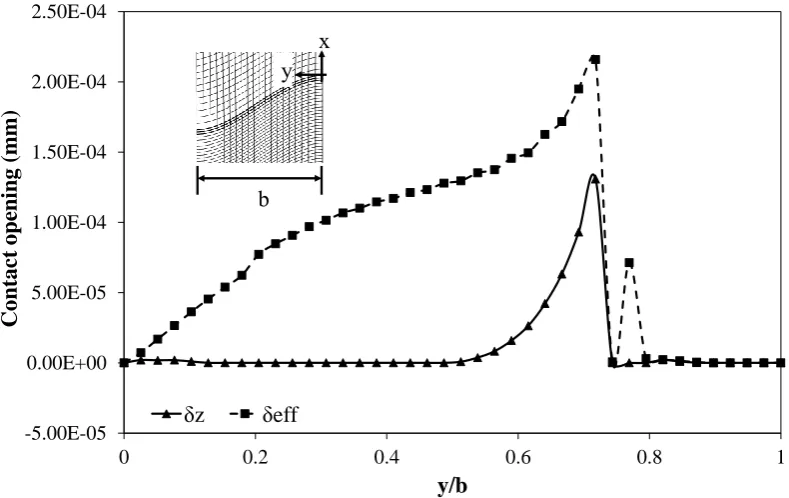
the interfacial bond weakens. Normal and effective contact openings at the interface (Fig. 13)
significantly increase at the point where TBC crack penetrates the interface (y/b = 0.72 in
Fig. 13). At that point, the delamination crack is expected to nucleate and this can lead to
15 8 Conclusions
The conclusions made from the presented parametric studies are as follows.
The thicker the TGO is, the longer the parallel cracks within the TBC and the TGO
will be. Coalescence of these cracks within the TBC can lead to partial spallation of
the TBC.
The delamination crack opening at the TGO/TBC interface, as observed from contact
openings at the interface, also becomes larger when the TGO becomes thicker.
In general, tangential contact separations at the TGO/TBC interface are an order of
magnitude higher than normal separations. This observation indicates that it is
necessary to implement mixed mode interfacial failure.
Inclusion of initial segmented cracks in the TBC increases the strain tolerance of the
TBC and reduces the risk of spallation as the cracks prevent the propagations of
parallel cracks. As a result, the lengths of the parallel cracks are significantly shorter
for the model with initial segmented cracks (Fig. 12). This confirms that using a
spraying method which creates segmented cracks after deposition (e.g. SPPS), is
likely to be beneficial for coating life.
On the other hand, initial parallel micro-cracks within a TBC leads to complete
spallation of the TBC and the deposition process has to be optimised to reduce this
type of crack.
The proposed algorithm presented can be utilised to predict the failure of TBC systems.
However, various sets of data (e.g. fracture toughness and interfacial bond strengths) for
mixed-mode fracture behaviour of bulk coatings and interfaces are not currently taken into
account due to a lack of experimental data. Moreover, improvements in the XFEM element
formulations would enable time dependent creep deformation during steady state to be
16 Acknowledgement
We would like to acknowledge the support of The Energy Programme, which is a
Research Councils UK cross council initiative led by EPSRC and contributed to by ESRC,
NERC, BBSRC and STFC, and specifically the Supergen initiative (Grants GR / S86334 / 01
and EP / F029748) and the following companies; Alstom Power Ltd., Doosan Power, E.ON,
National Physical Laboratory, Praxair Surface Technologies Ltd, QinetiQ, Rolls-Royce plc,
RWE npower, Siemens Industrial Turbomachinery Ltd. and Tata Steel, for their valuable
17 References
[1] K.W. Schlichting, N.P. Padture, E.H. Jordan, M. Gell, Materials Science and Engineering A, 342 (2003) 120-130.
[2] D. Naumenko, V. Shemet, L. Singheiser, W. Quadakkers, Journal of Materials Science, 44 (2009) 1687-1703.
[3] H. Bhatnagar, S. Ghosh, M.E. Walter, Mechanics of Materials, 42 (2010) 96-107.
[4] M. Caliez, J.L. Chaboche, F. Feyel, S. Kruch, Acta Materialia, 51 (2003) 1133-1141.
[5] R. Soulignac, V. Maurel, L. Rémy, A. Köster, Surface and Coatings Technology, 237 (2013) 95-104.
[6] P. Seiler, M. Bäker, J. Rösier, IOP Conference Series: Materials Science and Engineering, 10 (2010) 012056.
[7] T.S. Hille, T.J. Nijdam, A.S.J. Suiker, S. Turteltaub, W.G. Sloof, Acta Materialia, 57 (2009) 2624-2630.
[8] T.S. Hille, A.S.J. Suiker, S. Turteltaub, Engineering Fracture Mechanics, 76 (2009) 813-825.
[9] L. Xie, D. Chen, E.H. Jordan, A. Ozturk, F. Wu, X. Ma, B.M. Cetegen, M. Gell, Surface & Coatings Technology 201 ((2006)) 1058-1064.
[10] U. Hermosilla, University of Nottingham, (Thesis (PhD), 2008).
[11] V. Maurel, E.P. Busso, J. Frachon, J. Besson, F. N’Guyen, INT J SOLIDS STRUCT, 51(19) ((2014)) 3293-3330.
[12] Abaqus, Dassault Systemes Simulia Corp., (2011).
[13] C. Sharma, Master Thesis (University of Pavia), (2007).
[14] M. Martena, D. Botto, P. Fino, S. Sabbadini, M.M. Gola, C. Badini, Eng. Fail. Anal., 13 (2006) 409-426.
[15] A. Rabiei, A.G. Evans, Acta Materialia, 48 (2000) 3963-3976.
[16] P.K. Wright, A.G. Evans, Current Opinion in Solid State and Materials Science, 4 (1999) 255-265.
[17] M. Bäker, J. Rösler, G. Heinze, Acta Materialia, 53 (2005) 469-476.
[18] T. Belytschko, T. Black, International Journal for Numerical Methods in Engineering, 45 ((1999)) 601-620.
[19] J.M. Melenk, I. Babuska, Comput. Assist. Mech. Eng. Sci, 4 (1997) 607-632.
[20] T. Belytschko, R. Gracie, G. Ventura, IOP Publishing Ltd • Modelling and Simulation in Materials Science and Engineering, Volume 17, Number 4, (2009).
[21] G. Alfano, M.A. Crisfield, International Journal for Numerical Methods in Engineering, 50 (2001) 1701-1736.
[22] S.T. Kyaw, I.A. Jones, T.H. Hyde, Eng. Fail. Anal., 27 (2013) 150-164.
[23] L. Baiamonte, F. Marra, G. Pulci, J. Tirillò, F. Sarasini, C. Bartuli, T. Valente, Surface and Coatings Technology, 277 (2015) 289-298.
[24] D. Zhu, R. Miller, Journal of Thermal Spray Technology, 9 (2000) 175-180.
18 [26] M.Shinozaki, T.W. Clyne, Presented at Energy Materials Conference, (2012).
[27] Thompson.J.A, Ji.W, Klocker.T, Clyne T.W, Ninth International Symposium on Superalloys, (2000) 685-692.
[28] A. Cipitria, I.O. Golosnoy, T.W. Clyne, Sintering Kinetics of Plasma-Sprayed Zirconia TBCs. In, 2007 International Thermal Spray Conference, Beijing, China, 14 - 16 May 2007. ASM International, 434-439.
[29] E.P. Busso, H.E. Evans, Z.Q. Qian, M.P. Taylor, Acta Materialia, 58 (2010) 1242-1251.
[30] E.P. Busso, J. Lin, S. Sakurai, M. Nakayama, Acta Mater., 49 (2001) 1515-1528.
[31] E.P. Busso, J. Phys. IV France, 09 (1999) Pr9-287-Pr289-296.
[32] J. Rösler, M. Bäker, K. Aufzug, Acta Mater. , 52 (2004) 4809-4817.
[33] E.P. Busso, Z.Q. Qian, M.P. Taylor, H.E. Evans, Acta Materialia, 57 (2009) 2349-2361.
[34] U. Hermosilla, M.S.A. Karunaratne, I.A. Jones, T.H. Hyde, R.C. Thomson, Mater. Sci. Eng. A, 513-514 (2009) 302-310.
[35] S. Maharjan, X. C. Zhang, F. Z. Xuan, Z. D. Wang, S.T. Tu, J. Appl. Phys. 110, 063511 (2011), (2011).
[36] R.G. Munro, J. Am. Ceram. Soc., 80 (1997) 1919-1928.
[37] J. Kondoh, H. Shiota, K. Kawachi, T. Nakatani, Journal of Alloys and Compounds, 365 (2004) 253-258.
[38] J.W. Adams, R. Ruh, K.S. Mazdiyasni, Journal of the American Ceramic Society, 80 (1997) 903-908.
[39] M. Gell, J. Eric, V. Krishnakumar, K. McCarron, B. Barber, Y.-H. Sohn, V.K. Tolpygo, Surface and Coatings Technology, 120–121 (1999) 53-60.
[40] M. Okazaki, Y. Yamazaki, K. Namba, K. Ogawa, M. Ohki, K. Fujiyama, H. Waki, M. Arai, M. Sekihara, A. Itoh, H. Fukanuma, N. Ohno, H. Kaneko, M. Kawamura, Journal of Solid Mechanics and Materials Engineering, Volume 4, Issue 2, pp. 252-263 (2010).
[41] C. Berndt, Journal of Materials Engineering, 11 (1989) 275-282.
[42] M. Seraffon, N.J. Simms, J.R. Nicholls, J. Sumner, J. Nunn, Mater. High Temp., 28 (2011 ) 309-314.
[43] F. Krasucki, S. Lenci, International Journal of Solids and Structures, 37 (2000) 3619-3632.
[44] D.W. Stollberg, J.M. Hampikian, L. Riester, W.B. Carter, Materials Science and Engineering A, 359 (2003) 112-118.
[45] Y.YAMAZAKI, S.KUGA, T.YOSHIDA, Acta Metallurgica Sinica(English letters), Vol.24 (2011) 109-117.
[46] M. Ranjbar-Far, J. Absi, G. Mariaux, F. Dubois, Mater. & Des., 31 (2010) 772-781.
[47] The International Nickel Company Inc. Alloy IN-738 technical data.
19
Fig. 1: (i) A TBC system with a sinusoidal TGO with periodicity in the circumferential direction
(Cells bounded by double-dashed line are used for a FE unit cell); not to scale (ii) A detailed
geometry of the TGO interface (iii) Mesh and boundary conditions of a unit cell (uθ represents
displacement in the circumferential direction)
[image:20.595.113.485.68.348.2] [image:20.595.216.413.435.620.2]20
Fig. 3: Linear traction-separation law
Fig. 4: Damage parameter and unloading process δn(mm)
O
X
Y
Z
δ T
T (MPa)
δz
δy k
(1-D)k
δ (mm) O
X
Y
Z δ
T T (MPa)
δz
δy
Tu
(1-D)Tu, Td
0<D<1 P
Q R
[image:21.595.173.418.316.682.2]21
Fig. 5: Adhesion tensile pull test (DIN 50160)
Fig. 6: Maximum difference between out-of-plane stresses at the TGO/TBC interface given by a cohesive interface model with different cohesive stiffness and by the model with a tied interface
F
F
Epoxy based adhesive coating
metal
[image:22.595.145.453.321.541.2]22
Fig.
7
: Max
im
um p
ri
nc
ip
al
s
tre
ss
es
f
o
r t
he
m
od
el
s
w
it
h d
if
fer
en
t T
G
O
t
hi
ck
ness
[image:23.595.120.464.72.619.2]24
Fig. 9: Normal separations at the TGO/TBC interface for the models with different TGO thicknesses
Fig. 10: Effective separations at the TGO/TBC interface for the models with different TGO thicknesses
-1.0E-05 0.0E+00 1.0E-05 2.0E-05
3.0E-05
4.0E-05
0 0.2 0.4 0.6 0.8 1 1.2
No
rm
al
separat
ion
(δ
n
),
mm
y/b
COPEN(TGO = 2 µm) COPEN(TGO = 4 µm) COPEN (TGO = 1 µm) COPEN(TGO = 3 µm)
y x
b
1.0E-19 1.0E-16 1.0E-13 1.0E-10 1.0E-07 1.0E-04 1.0E-01
0 0.2 0.4 0.6 0.8 1 1.2
Effectiv
e
sepa
rat
ion
(δeff
),
mm
y/b
TGO = 1 µm
TGO = 2 µm
TGO = 3 µm
TGO = 4 µm
2 slip 2 n
eff
y x
[image:25.595.95.498.398.656.2]26
Fig. 12: XFEM cracks within the TBC systems with initial segmented cracks after cooling to 20°C from 1000°C (4μm TGO)
Fig. 13: Normal and effective contact openings at the TGO/TBC interface for the system with initial segmented cracks within the TBC
Initial segmented crack TGO crack
Newly formed parallel cracks
-5.00E-05 0.00E+00 5.00E-05 1.00E-04 1.50E-04 2.00E-04 2.50E-04
0 0.2 0.4 0.6 0.8 1
Co
nt
act
op
ening
(mm)
y/b
δz δeff
y x
[image:27.595.96.491.346.595.2]27
Table 1: Elastic properties and CTEs of coatings and substrate
Temperature
(°C) Substrate [47] TBC [24, 48] TGO [36] BC [48] E
(GPa) v
CTE, K1.106
E (GPa) v
CTE, K1.106
E (GPa) v
CTE, K1.106
E (GPa) v
CTE, K1.106
20 - - - 120 0.18 10.0 400 0.23 6.62 202.9 0.27 20.
24 206 0.28 11.23 - - - -
50 - - - 202.7 0.27 50.
93 195.1 0.27 11.97 - - - -
200 - - - 390 0.23 - 199.92 0.27 200.
204 190.3 0.27 13.23 - - - -
316 184.8 0.28 14.4 - - - -
400 - - - 380 0.24 -
500 - - - 184.8 0.27 500.
538 175.1 0.3 16.2 - - - -
600 - - - 370 0.24 -
700 - - - 167.72 0.27 700.
760 157 0.3 - - - -
800 - - 18.38 - - - 355 0.25 -
871 151 0.29 - - - -
982 140 0.3 19.42 - - - -
1000 - - - 325 0.25 - 131.6 0.27 1000.