Gender differences in psychosocial complexity for a
cohort of adolescents attending youth-specific substance
abuse services
MITCHELL, Penelope F., KUTIN, Jozica J., DALEY, Kathryn, BEST, David
<http://orcid.org/0000-0002-6792-916X> and BRUUN, Andrew J.
Available from Sheffield Hallam University Research Archive (SHURA) at:
http://shura.shu.ac.uk/12787/
This document is the author deposited version. You are advised to consult the
publisher's version if you wish to cite from it.
Published version
MITCHELL, Penelope F., KUTIN, Jozica J., DALEY, Kathryn, BEST, David and
BRUUN, Andrew J. (2016). Gender differences in psychosocial complexity for a
cohort of adolescents attending youth-specific substance abuse services. Children
and Youth Services Review, 68, 34-43.
Copyright and re-use policy
See
http://shura.shu.ac.uk/information.html
Elsevier Editorial System(tm) for Children and Youth Services Review
Manuscript Draft
Manuscript Number:
Title: Gender differences in psychosocial complexity for a cohort of adolescents attending youth-specific substance abuse services
Article Type: Research Paper
Keywords: substance abuse services; adolescents;
young people; census;
psychosocial complexity; gender differences
Corresponding Author: Dr. Penelope Mitchell, Ph.D.
Corresponding Author's Institution: University of Melbourne
First Author: Penelope Mitchell, Ph.D.
Order of Authors: Penelope Mitchell, Ph.D.; Jozica J Kutin; Kathryn Daley, Ph.D.; David Best, Ph.D.; Andrew J Bruun
Abstract: Little research has examined gender differences in the
characteristics of young people attending alcohol and other drug (AOD) services. Several studies have found differences suggesting that young women sometimes present with greater severity of substance use and with greater psychosocial complexity, but there is inconsistency in these findings. Research is needed with larger samples to better understand the circumstances in which the experiences and needs of young women may
differ from those of young men. This study reports results of a census of clients (N = 1,000) attending youth-specific alcohol and other drug (AOD) services in the state of Victoria, Australia.
Suggested Reviewers: Margie Skeer Tufts University
Author of work relevant to interpretation of our data
Sara Lovenhag
Uppsala Universitet [email protected]
Author of one of the key studies we reviewed
Bobby P Smyth
HSE Addiction Services [email protected]
Author of one of the key studies we reviewed
Published a lot of research about the population of adolescents of concern in our research.
Joanna Henderson University of Toronto [email protected]
Author of a key study that we reviewed
Philip James
HSE Addiction Services [email protected]
Author of a key study we reviewed
Ria Schroder
University of Otago [email protected]
Gender differences in psychosocial complexity for a cohort of
adolescents attending youth-specific substance abuse services
Penelope F. Mitchell
a,b,*, Jozica J. Kutin
b,1,
Kathryn Daley
c, David Best
d,2, and Andrew J.
Bruun
ba
Centre for Mental Health, Melbourne School of Population and Global Health, The University of Melbourne, Level 4, 207 Bouverie Street, Carlton Victoria 3010, Australia.
b
Youth Support and Advocacy Service, P.O. Box 2950, Fitzroy, Victoria 3065, Australia. c
School of Global, Urban and Social Studies, RMIT University, Building 37, GPO Box 2476, Melbourne Victoria 3001, Australia
d
Turning Point, 54-62 Gertrude St, Fitzroy, Victoria 3065, Australia.
1
School of Economics, Finance and Marketing, RMIT University, Building 80, Level 11, 445 Swanston Street, Melbourne Victoria 3000, Australia
2 Department of Law and Criminology, Sheffield Hallam University, Collegiate Crescent, Sheffield, UK, S10
2BQ
* Corresponding author. Tel. +61 3 9415 8881, Email [email protected]
Highlights
Youth attending AOD treatment experience numerous co-occurring psychosocial
problems
Young women experience more co-morbid psychosocial problems than young
men
Young men experience higher rates of criminal justice involvement
Delays in accessing services may result in more psychosocial complexity for
young women
1
Gender differences in psychosocial complexity for a cohort of
adolescents attending youth-specific substance abuse services
Little research has examined gender differences in the characteristics of young people
attending alcohol and other drug (AOD) services. Several studies have found
differences suggesting that young women sometimes present with greater severity of
substance use and with greater psychosocial complexity, but there is inconsistency in
these findings. Research is needed with larger samples to better understand the
circumstances in which the experiences and needs of young women may differ from
those of young men. This study reports results of a census of clients (N = 1,000)
attending youth-specific alcohol and other drug (AOD) services in the state of Victoria,
Australia.
KEYWORDS: substance abuse services; adolescents; young people; census;
psychosocial complexity; gender differences.
1. Introduction
It is well established that males are more highly represented than females in substance abuse
treatment services. It has long been assumed that this reflects a higher prevalence and severity
of substance use problems among male than female adolescents, but recent research is
challenging this assumption and raising the question of whether selection factors other than
need are shaping entry to higher levels of care for young males (Landsverk & Reid, 2013).
It is also well known that a large proportion of adolescents receiving treatment for substance
abuse and dependence also experience additional behavioural health problems such as mental
disorders and offending behaviour. Males are more highly represented in the service settings *Manuscript
that provide treatment and remediation for these concerns. This may lead to the conclusion
that these behavioural health problems are more prevalent and or more severe among males
than females.
Much of the information that we have about the co-occurrence of substance use problems and
other psychosocial difficulties comes from population-based surveys conducted in the general
community or in schools. Fairly consistently these studies do find higher rates and higher
severity of substance use, offending behaviour and other externalising mental health issues for
males than females (Armstrong & Costello, 2002; Essau, 2011; Merikangas & McClair, 2012;
Slade, Johnston, Teesson, et al., 2009). A problem with these studies is that they capture small
numbers of youth with multiple and complex needs, and do not study issues specific to this
population in depth (Rounds-Bryant, Kristiansen, Fairbank, & Hubbard, 1998). To do this,
research needs to be conducted with the populations attending services.
Only a small number of such studies have been conducted from the perspective of substance
abuse treatment services. One of the earliest (also the largest) was conducted over 20 years ago
from 1993 to 1995. Rounds-Bryant et al (1998) found that young women and young men had
very similar rates of substance use and dependence, but that young women had higher rates of
mental health problems, as well as past and current physical and sexual abuse. Young men had
higher rates of justice system involvement, but gender differences in rates of involvement in
illegal activity were not as marked, particularly for more serious types of crimes (Rounds-Bryant,
et al., 1998).
Following a long gap in research activity, several recent studies conducted in substance abuse
services have confirmed differences between young males and females in the prevalence of
co-occurring emotional and behavioural health problems (Dean, McBride, MacDonald, Connolly, &
McDermott, 2010; Edokpolo, James, Kearns, Campbell, & Smyth, 2010; Hodgins, Lovenhag,
Rehn, & Nilsson, 2014; James, Smyth, & Apantaku-Olajide, 2012; Keane, Ducray, & Smyth, 2015;
3
This literature is highly fragmented, with studies varying substantially in their jurisdiction, the
variables examined, and the methods used to collect the data. Most studies also involve small
samples. Despite this variability, some potentially important patterns are emerging involving
higher prevalence of emotional and behavioural health problems among females. Unsurprisingly
there are also inconsistencies in the data. There is a need to bring this literature together and
develop methods of investigating gender differences with the potential to reduce
fragmentation, and resolve or explain inconsistencies. Only then will it be possible to develop
and test hypotheses about underlying causal processes and confidently identify potential
practice implications.
We present a brief review of this recent literature, followed by a report of results from original
research conducted in Victoria, Australia. Our work introduces a new method that enables
investigation of a wider range of variables in a larger sample than has been achieved in previous
studies. Our results and discussion demonstrate the potential of this approach to integrate and
mobilise the existing research base by testing emerging trends, generating hypotheses about
causal processes, and discerning implications for practice and further research.
2. Literature review
The following review presents findings of Australian and international work conducted from the
perspective of AOD treatment settings. Only studies published within 10 years of the current
research (2013) are included.
2.1. Mental health problems
The co-occurrence of substance misuse and other mental health problems has been extensively
studied, including among adolescents, however few studies have examined gender differences
substance use problems appear more prevalent among males (Wu, Gersing, Burchett, Woody, &
Blazer, 2011), there is growing evidence that mental health problems are more prevalent among
females than males in youth AOD services. However, this evidence is inconsistent. The overall
prevalence of mental disorders varies substantially across programs and the gender disparity
varies across diagnoses.
Gender differences have mostly been reported within the diagnostic categories of depression,
anxiety, conduct disorder and ADHD. The largest study in this review involved a sample of 419
adolescents aged 12-18 recruited from four large chemical dependency programs in California
(Wu, et al., 2004). A substantially higher proportion of females than males experienced anxiety
disorders (13% vs 3%), depression (35% vs 19%) and conduct disorders (15% vs 9%). Females
had lower rates of ADHD than males (5% vs 13%) (Wu, et al., 2004). In New Zealand, a study of
184 youth aged 13-19 also found that more females than males were diagnosed with depression
(38% vs 14%) and less females than males had a diagnosis of ADHD (1.4% vs 22%) (Schroder,
Sellman, Frampton, & Deering, 2008). In contrast to the Californian study significantly less
female than male subjects were diagnosed with conduct disorder (14% vs 52%). Slesnick and
Prestopnik (2005) studied a sample of 226 youth residing at a shelter in California for runaways
who were attending treatment for substance abuse. The majority (60%) met criteria for dual or
multiple psychiatric diagnoses. Females (33%) were significantly more likely than males (17%) to
have multiple psychiatric diagnoses. This effect held for affective and anxiety disorders. Males
(44%) were more likely than females (30%) to be diagnosed with conduct disorder or
oppositional defiant disorder.
Several studies have analysed gender differences across psychiatric diagnostic groups or in
terms of alternative concepts that are not dependent on diagnosis. In Ireland, Edokpolo et al.
(2010) studied 88 adolescents aged 13-18 attending a community AOD treatment program.
They found that 68% had an additional moderate or severe psychological problem in at least
5
to experience additional psychological problems in four out of five domains including
self-concept, anxiety, depression, and anger. Only disruptive behaviours were equally common for
males and females. A study of 262 adolescents admitted to an AOD withdrawal unit in the
Australian state of Queensland found that 88% were recorded at intake as having “any mental
health issue”, and 44% were actually involved in current mental health treatment. No gender
differences were found (Dean, et al., 2010).
Another recent study in Ireland (Keane, et al., 2015) examined gender differences in mental
health within a very small group of heroin dependent adolescents (n = 52). Using the BYI-II they
found significant differences between male and female heroin users only for self-concept and
disruptive behaviour, with females having more moderate to severe problems in these areas
than males. The prevalence of anxiety and depression was almost identical for males and
females. The BYI scores also suggested large differences in anger, with 57% of females vs 37% of
males having moderate to severe anger problems, but this difference was not statistically
significant (p = 0.16). In discussion these authors note that due to small sample size their study
may have lacked power to detect anything other than very large differences between males and
females (Keane, et al., 2015).
Most research has examined the prevalence of mental disorders at the time of current
admission to the youth AOD facility. At least one study, in Ireland, has examined lifetime history
of psychiatric disorders (James, et al., 2012), and found that females were much more likely
than males to have a lifetime history of psychiatric disorders (OR = 3.7; p = 0.005).
2.3. Self-injury and suicide attempts
Self-injury and suicide attempts are behavioural problems of substantial concern to
practitioners in youth substance abuse services. There are little reliable data to indicate the
prevalence of self-injury among those attending AOD services, but this behavior is widely
accepted as far more common among females than males. James et al. (2012) found that 27% of
Young women were more likely to have a history of deliberate self-harm (58%) than young men
(20%) (OR, 5.3; 95% CI, 2.2-13.1). In her Victorian snowball sample, Daley (2015) found that
self-injury was more common than not among young women, with 20 of the 26 young women in the
study disclosing a history of self-injury. This compared to only 9% of the young men.
2.4. Criminal involvement
Prevalence of criminal involvement has also been studied in the youth AOD population. It is
generally understood that levels of criminal involvement are higher among males than females.
Consistent with this a study of 180 adolescents seeking treatment for substance misuse in
Sweden found significant gender differences for both violent crime (43% females vs. 66% males)
and non-violent crime (76% females vs. 86% males) (Hodgins, et al., 2014). By contrast the
Queensland study by Dean et al. (2010) found no significant differences in the rates of
involvement in illegal activities between males (76%) and females (71%).
2.5. Homelessness
In regard to homelessness, Dean et al. (2010) in Queensland found that adolescent girls were
more likely to be homeless at admission to the AOD withdrawal unit (17.5%) compared to boys
(5.5%). In unstructured interviews with a snowball sample of 61 young people recruited from
youth AOD services in Victoria, 96% of the young women and 86% of the young men reported
having experienced homelessness at some stage (Daley, 2015).
2.6. Family environment
It is well established that a young person’s family environment influences the development of
harmful substance use (Skeer, McCormick, Normand, et al., 2011; Wu, et al., 2004). Wu et al.
(2004) examined gender differences in the prevalence of three family environment factors in a
population of 419 adolescents aged 12-18 years attending substance abuse treatment services
7
and negative perceptions of family environment, but lower than males on absence of limit
setting. Females also reported more substance abusing family members.
2.7. Neglect and abuse
Neglect and abuse, including physical, sexual and psychological or emotional abuse, are now
well established as some of the most significant general risk factors for a broad range of
emotional and behavioral problems in adolescence and young adulthood (King, Abram, Romero,
et al., 2011; Lansford, Dodge, Pettit, & Bates, 2010; Oshri, Tubman, & Jaccard, 2011;
Rosenkranz, Muller, & Henderson, 2012; Tanaka, Wekerle, Schmuck, Paglia-Boak, & Team,
2011). Surprisingly there has been very little research examining the prevalence of different
types of child maltreatment in the population of adolescents attending youth AOD services.
Rather, most studies have concentrated on examining the strength of the relationship between
types of abuse and substance use outcomes. In this regard some interesting findings on gender
differences are emerging.
A study of 216 youth aged 16 to 24 years entering an outpatient substance use treatment
program in Canada found that 90% of females and 72% of males had been psychologically
maltreated. Further, after controlling for all other forms of abuse, only emotional abuse and
emotional neglect emerged as significant predictors of substance use problem severity
(Rosenkranz, et al., 2012). There was a significant interaction between gender and emotional
abuse such that females with emotional abuse histories reported greater substance use
problem severity.
In their sample of 180 adolescents recruited from a Swedish AOD service in 2004, Hodgins et al.
(2014) found that females (46%) were more likely than males (9%) to have experienced sexual
abuse (p = 0.000). Several studies have found that effects of sexual abuse and physical abuse on
substance use problems may be specific to females (Clark, Perkins, McCullumsmith, et al., 2012;
Lansford, et al., 2010; Oshri, et al., 2011; Shin, Hong, & Hazen, 2010). Hodgins et al. (2014) also
males (76%), but that neglect predicted the presence of a drug use disorder 5 years later only
for males.
2.8. Child protection involvement
Involvement with child protection or child welfare services is a proxy indicator of exposure to
extreme family difficulty, including exposure to neglect and abuse. It is also recognised that
removal from the family home, and some of the other experiences that are common for
children in the out-of-home care system can be traumatising in themselves (Bloom, 2005). This
review could find only one study that has examined gender differences in the prevalence of
child protection involvement in a population of young people using AOD services. Schroder et al.
(2008) found that 40% of their New Zealand sample had spent time in the care of Child, Youth
and Family Services, with no gender differences in this regard.
2.9. Disconnection from study and work
Premature and problematic school disengagement is recognised as another general risk factor
for a broad range of emotional and behaviour problems (Maynard, McCrea, Pigott, & Kelly,
2012) including psychiatric disorders (Vaughn, Wexler, Beaver, et al., 2011), delinquency (Henry,
Knight, & Thornberry, 2012), substance use (Cheng & Lo, 2011; Henry, et al., 2012) and running
away from home (Tucker, Edelen, Ellickson, & Klein, 2011). This review found no studies
reporting gender comparisons in study/work participation for the population of young people
attending AOD services.
2.10. Summary
This brief review has revealed evidence of differences between males and females in the
patterns of co-occurrence and interactions between AOD use and other psychosocial problems
and exposures. Specifically, young women attending youth AOD services appear to experience
higher rates of some additional problems including mental health problems (particularly
9
maltreatment including sexual abuse, emotional abuse and neglect. In contrast males are more
likely to have criminal involvement and to have received diagnoses of ADHD. Findings around
conduct disorder are inconsistent, with at least one larger study finding higher rates of conduct
disorder among females than males.
3. Limitations of existing research and aims of the current study
The existing research base is scant, some inconsistencies exist in the available findings, and for
some important conditions and exposures only one or two studies examining gender differences
could be found. These include variables that may be most likely to play key roles as antecedent
exposures: family environment, sexual abuse, emotional abuse, and involvement in the child
protection system. No studies could be found examining gender differences in disconnection
from study and work.
Because males are more commonly seen, most youth AOD services are oriented towards the
needs of young men, but the evidence reviewed here regarding the higher prevalence and
severity of several co-occurring difficulties among females, is sufficient to raise concerns that
the needs of young women may not be receiving adequate attention in youth AOD service
settings. More research is needed to enhance understanding of the characteristics of young
women attending youth AOD services, and how these characteristics may vary from those of
their male counterparts.
Two main limitations of existing research have compromised the ability of researchers to
adequately examine gender differences in the prevalence of emotional and behavioral health
problems that co-occur with substance misuse among adolescents and young adults.
First, most studies have a limited scope in terms of the range of co-occurring emotional and
behavioural health issues that they consider. A high proportion examine only the co-occurrence
psychosocial factors that may act as risk factors common to these co-occurring behavioural
health outcomes.
Second, most studies have involved very small samples of the study population. This may
account for the variability in the results and the failure of one Australian study in particular to
find any gender differences (with the exception of homelessness), even in predicted directions
(Dean, et al., 2010). Two other recent Australian studies of clients in youth AOD services could
not analyse for gender differences due to small sample sizes (N = 163 and 150) (Best, Wilson,
Reed, et al., 2012; MacLean, Kutin, Best, Bruun, & Green, 2013). Larger samples can be achieved
by studies that use administrative data and do not rely on interviewing clients, for example Wu
et al. (2004) (N = 419). Reliance on administrative data however, comes at the cost of
comprehensiveness in the variables that can be examined. This is due to widely recognized
problems with quality such as missing data within the fields that may be of interest to
researchers as opposed to funders.
Surveys that collect data directly from clients for the specific purpose of research have
advantages and disadvantages virtually converse to those of administrative data. Careful
questionnaire design that is informed by previous research can ensure a range of fields
comprehensive enough, and framing of items nuanced enough to answer complex questions.
Collection of data by dedicated researchers with a direct interest in the results yields relatively
high levels of field completion. A disadvantage of purpose built client surveys is that they are
highly time consuming and expensive to conduct. High costs tend to limit the sample size that
can be captured thereby reducing the power of statistical analyses to detect subtle patterns in
the data. An exception to this is the very large youth self-report study involving 3382
respondents attending 37 programs in 6 cities (Rounds-Bryant, et al., 1998). This study was
conducted in 1993-1995 and budgets for research are considerably tighter now. Quantitative
surveys that collect a comprehensive range of data fields can involve a considerable burden of
11
response rates and sampling biases. Rounds-Bryant et al (1998) do not report response rates for
their sample.
The current study used a method of data collection that sought a middle ground between
reliance on administrative data and structured interviews with clients. A census was conducted
in which data were recorded by practitioners, using a structured survey instrument designed by
researchers. By collecting data about all clients registered in current caseloads on a particular
day this method aimed to maximize sample size and minimize sampling bias. By using an
instrument designed by researchers and completed by practitioners drawing from their case
notes and practice-based knowledge, this method aimed to maximize the response rate (and
hence the representativeness of the sample), collect data on a reasonably comprehensive set of
fields and achieve high rates of field completion while minimizing costs of data collection and
making no imposition on clients.
The study aimed to determine the prevalence and severity of substance use and psychosocial
risk factors for the population of young people aged 12 to 25 years attending youth-specific
AOD services in the state of Victoria. This article presents a descriptive analysis of results
focusing on gender differences, explores three plausible interpretations of the emerging pattern
of gender differences, and discusses implications for practice and further research. The
strengths and limitations of the innovative method are also discussed.
4. Method
4.1. Setting
The data were drawn from agencies across the state of Victoria that provided drug and alcohol
treatment services to young people aged 12 to 25 years. Thirty-six AOD services/sites
participated and offered programs such as outreach, counselling, residential rehabilitation, and
4.2. Procedure
The census date was Thursday 6 June, 2013. Clients were deemed eligible if their current
episode of care was “open” on the census day. The key worker for each client was asked to
complete an online survey, one survey per client, based on their current knowledge of that
client. Surveys were completed by staff in the two weeks following the census date. Clients
were not contacted or asked to complete survey questions. Each survey took approximately 15
minutes to complete. Clients were at any stage of their treatment pathway.
Thirty-six (out of 48) AOD service sites agreed to participate and reported that their current
caseload was 1,188. A total of 1,009 surveys were completed online but due to some having a
very high missing data rate, a final sample of 1,000 was achieved. The final sample represented
an 84% response rate.
4.3. Questionnaire
A 56 question online survey was developed utilising existing dataset items and questions
developed by literature review and expert consultation. The majority of questions required
a “Yes/No/Don’t know” response.
The survey covered the following domains: demographics, program involvement, drug use
(primary drug of concern and recent drug use), drug use harms, involvement in employment,
education or training, literacy and numeracy, housing, family conflict, mental health, suicide and
self-harm, experience of neglect, physical, emotional and sexual abuse, or violence, and
involvement in the criminal justice system. Workers were asked to rate their clients’ level of
physical health, psychological health and quality of life using Likert scales from the Australian
Treatment Outcome Profile (ATOP) (Ryan, Holmes, Hunt, et al., 2014). They were also asked to
make a rating of client AOD severity, dependence, and psychosocial vulnerability based on their
own clinical understanding of the client.
13
Data were analyzed using SPSS version 22. The sample sizes for the gender comparisons were
339 (females) and 655 (males). Six clients were identified as intersex or transgender, and given
the small sample size were not included in the gender comparisons. Continuous data were
analyzed using Student’s t-test, and categorical data was analyzed using Chi-square tests.
Significance values were set at the probability value of 0.05.
4.5. Ethics Approval
The project was approved by the Eastern Health Research and Ethics Committee (ref. E28-1213),
Melbourne, Australia.
5. Results
5.1. Demographics
Of the 1,000 clients reviewed for the Census, 66% were male (n = 655) and 34% female (n = 339)
and 0.6% were intersex or transgender clients (n = 6). The average age was 18.9 years (SD = 2.8,
MIN = 8, MAX = 27). There were no gender differences in average age. The male and female
proportions are equivalent to overall proportions of young Victorians using AOD services (69%
and 31% respectively) as reported in the National Minimum Data Set (Australian Institute of
Health and Welfare, 2014).
Clients were identified as belonging to 53 different cultural backgrounds: 71% were identified as
“Australian”; 8% as Aboriginal or Torres Strait Islander; 5.1% as Pacific Islander; 4.4% from
African cultures, and 11.7% from other cultures.
It is difficult to assess how the 8% Aboriginal and Torres Strait Islander utilisation of mainstream
Victorian youth AOD services compares with the national proportion accessing treatment.
Indigenous Australians comprise 14.4% of all AOD clients (adult and youth) Australia-wide
than the Victorian population (0.7%) (Australian Bureau of Statistics, 2011). No data were
available for youth only comparisons.
5.2. Modalities of service use
The most common mode of engagement of young people in treatment agencies is through
outreach (64%), followed by counselling (20%), day programs (5%), residential withdrawal (4%),
non-residential withdrawal (4%), long-term residential care (residential rehabilitation or
supported accommodation) (3%) or a young parents program (1%).
5.3. Recent substance use
The primary drug of concern for the highest proportion of clients (37.7%) was cannabis.
Methamphetamine was cited as the second most common drug of concern (25.5%) followed by
alcohol (21.7%). For the purposes of analysis primary drugs of concern were collapsed into 5
categories: alcohol, cannabis, meth/amphetamine, heroin and other opiates, and other drugs.
There were no gender differences for primary drug of concern (Χ2 = 7.49, df = 4, p = .112).
In terms of substances used in the 4 weeks prior to the census, those used by the highest
proportions of young people were cannabis (64.5%), alcohol (63.2%), tobacco products (51.5%),
meth/amphetamines (34.9%), prescription drugs (13.3%), heroin (7.1%), ecstasy (4.0%), and
inhalants (2.0%).
There were few gender differences for drugs used in the last 4 weeks. Young women were less
likely to use alcohol (57.5%) compared to young men (66.1%) (Χ2 = 7.08, df = 1, p = .008); were
more likely to have used heroin (10.0%) compared to young men (5.6%)(Χ2 = 6.46, df = 1, p =
.011); and were more likely to have used prescription drugs (17.4%) compared to young men
(11.3%) (Χ2 = 7.19, df = 1, p = .007).
15
There are high rates of daily use overall. The substances most likely to be used daily or almost
daily in the last 4 weeks were cannabis (47.7%), tobacco products (41.3%), alcohol (19.6%),
meth/amphetamines (13.4%), prescription drugs (4.7%) and heroin (2.9%). The only gender
difference for daily substance use was for tobacco: young women were more likely to smoke
daily compared to young men (Χ2 = 7.26, df = 1, p = .007) (see Table 1).
INSERT TABLE 1 ABOUT HERE
Several additional indicators of drug use severity were assessed including history of injecting
drug use, and worker ratings of ‘dependence’ and ‘severity’.
On average, clients used 2.0 (SD = 1.3, MIN = 0, MAX = 7) different drugs in the previous 4
weeks, and on average 0.9 (SD = 0.9, MIN = 0, MAX = 6) drugs daily or almost daily. There were
no differences between males and females in the average number of different types of
substances used in the previous 4 weeks (t = 0.17, p = .682) or the number of substances used
daily or almost daily (t = 0.04, p = .835).
Just over 12% of clients had used a drug by injection in the 4 weeks prior to the Census and
21.9% of clients had used drugs by injection at some time in the past. Young women (15.3%)
were more likely than young men (10.4%) to have used a drug by injection in the last 4 weeks
and had a greater lifetime prevalence of injecting drug use (females 28.0% vs. males 18.8%) (see
Table 1).
Practitioners assessed 54.6% of clients as being ‘dependent’, and there were no differences in
the proportion assessed by gender. There were also no differences in severity ratings for male
The rate of experiencing drug use harms1 in the 3 months prior to the census was significant between genders. Workers reported that females were more likely to have experienced drug
use harms (43.4%) compared to males (36.0%).
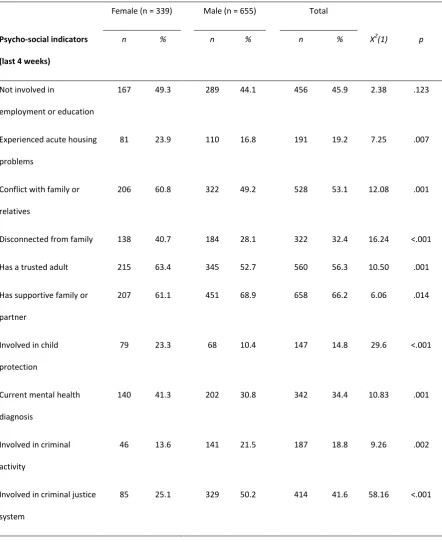
5.5. Current co-occurring issues and risk factors
Table 2 shows the number and percentage of females and males who experienced particular
psychosocial risk factors in the 4 weeks prior to the Census. A high proportion of clients
experienced lack of involvement with employment or education (45.9%); conflict with family or
relatives (53.1%), and/or involvement in the criminal justice system (41.6%). Smaller
proportions experienced disconnection from their family (32.4%), a current mental health
diagnosis (34.4%), involvement in criminal activity (18.8%), acute housing problems (19.2%),
and/or current involvement in child protection (14.8%). With respect to protective factors,
56.3% had a trusted adult that they could turn to for support, and 66.2% had a supportive family
or partner.
Females were significantly more likely than males to experience conflict with family or relatives
(60.8% vs. 49.2%), be disconnected from their family (40.7% vs. 28.1%), be involved in child
protection (23.3% vs. 10.4%), have acute housing problems (23.9% vs. 16.8%) and have a
current mental health diagnosis (41.3% vs. 30.8%). Females were less likely than males to
currently be involved in the criminal justice system (25.1% vs. 50.2%), or be engaged in criminal
activity (13.6% vs. 21.5%).
INSERT TABLE 2 ABOUT HERE
5.6. Lifetime co-occurring issues and risk factors
1
17
The lifetime prevalence of criminal justice involvement was 64.4%, while 32.6% had ever been
involved in child protection, 39.6% had ever had a formal mental health diagnosis, 25.9% had
made suicide attempts, and 41.5% had deliberately self-harmed. There were significant
differences between males and females on almost all of these indicators (see Table 3) as young
women were more likely to have been involved in child protection (46.3% vs. 25.5%), attempted
suicide (37.5% vs. 19.9%), have a history of self-harm (61.3% vs. 31.4%), and to have had a
mental health diagnosis (48.1% vs. 35.3%). Young men on the other hand were more likely to
have a history of criminal justice involvement (72.5% vs. 48.7%).
INSERT TABLE 3 ABOUT HERE
5.7. Victim of abuse, neglect, or violence
As shown in Table 4 rates of lifetime exposure to abuse, neglect or violence were high.
Emotional abuse was the most frequently reported (53.1% of clients) followed by physical abuse
(44.6%) and neglect (41.0%). A total of 32.0% of clients were reported to have ever been a
victim of a violent crime, while 20.3% had experienced sexual abuse. All five of these exposures
were identified as significantly more prevalent among females than males. The largest
difference was for sexual abuse which was reported for 44.1% of females and 8.2% of males (Χ2
= 180.48, df = 1, p = .001).
A substantial proportion of clients had also experienced neglect and abuse in the 4 weeks prior
to the Census. Again, these exposures were significantly more frequent for young women
compared to young men including emotional abuse (32.6% vs. 15.2%), physical abuse (17.7% vs.
8.0%) and sexual abuse (5.5% vs. 0.5%) (all p values < 0.001). There were no differences
A very high proportion of respondents recorded a ‘Don’t Know’ response for the abuse and
neglect items. ‘Don’t know’ responses were highest for the ‘Ever experienced sexual abuse’
question (34.0% for females and 42.8% for males). Workers were also less likely to know about
the histories of their male clients than female clients in relation to ‘Ever experienced neglect’
(18.0% for females vs. 25.0% for males), emotional abuse (15.5% for females vs. 23.6% for
males), and physical abuse (21.1% for females vs. 27.7% for males).
INSERT TABLE 4 ABOUT HERE
5.7. Assessment of psychological and physical health, and quality of life
On all three dimensions assessed on the ATOP scales, scores of young people in AOD treatment
were relatively low (with means of approximately 5 out of 10 points, when 0 = Poor and 10 =
Good).
As shown in Table 5, young women had significantly lower scores than young male clients on all
three scales including psychological health (M = 4.4 vs. 5.0), physical health (5.3 vs. 5.8) and
quality of life (4.9 vs 5.3).
INSERT TABLE 5 ABOUT HERE
6. Discussion of specific psychosocial characteristics
Clients engaged with youth AOD services in Victoria were found to have significant and many
gender differences when examining psychosocial complexity factors, and few differences when
19
psychosocial problems for nearly all variables when compared to young men, except for
involvement in the criminal justice system, and involvement in education and employment.
6.1. Substance use, dependence and severity
Even though males are more likely than females to have problems with substance use and to be
represented in the population of clients attending youth AOD services, our data suggest that
there are few differences between young men and young women in their patterns of substance
use. Specifically we found no significant differences in the daily or near daily use of a wide range
of substances, except for tobacco. Females were more likely than males to have injected drugs
within the past 4 weeks, to have ever injected, and to have experienced drug use harms within
the past months. Our findings are generally consistent with those of previous studies in finding a
tendency for females to be involved in more severe, risky and harmful substance use (Dean, et
al., 2010; Keane, et al., 2015).
In contrast to the few and moderate gender differences in substance use and dependence, we
found many and substantial gender differences in co-occurring psychosocial difficulties, risk and
protective factors.
6.2. Mental health
Our Victorian Census found that mental health problems were more prevalent and more severe
among young females than young males attending youth AOD services. A current formal
diagnosis of a mental disorder was reported for 34% of clients in the current study. This figure is
substantially lower than the range of 60-80% usually reported in previous research conducted
within youth AOD settings (Chisholm, Mulatu, & Brown, 2009; Christie, Merry, & Robinson,
2010), including Australian research (Best, et al., 2012). Previous studies finding higher rates of
It is possible that the worker report method used in the current study underestimates the
current prevalence of mental disorders. It is important to distinguish between the prevalence of
formal diagnoses, and the prevalence of ‘diagnosable’ mental disorders.
In Victorian youth AOD services worker report on formal diagnoses is likely to be based on
knowledge of diagnoses made by medical or mental health practitioners. To the extent that
young people who meet criteria for diagnoses are not accessing these service providers, or that
they fail to make diagnoses, youth AOD worker report based on administrative data can be
expected to underestimate the prevalence of diagnosable mental disorders young people
attending youth AOD services. There is also a growing trend in Australia for health service
providers to steer away from making formal diagnoses of mental disorders for young people
under the age of 18. This finding points to the importance of systematic screening for mental
health problems, and more specifically, screening with a structured instrument with
demonstrated sensitivity. Although considerable efforts have been made over recent years to
introduce systematic screening, use of validated instruments for this purpose is not yet routine
in Victoria.
6.3. Self-injury and suicide attempts
Our Census results were consistent with previous studies in finding high rates of self-injury and
suicide attempts in the population, with substantially higher rates among young women than
young men. Compared to James et al. (2012) in Ireland we found similar rates of self-injury
among females (close to 60%) and somewhat higher rates of self-injury among males (31.4%,
compared to 20%).
6.4. Criminal involvement
Our Census found that 42% of youth AOD clients in Victoria were currently involved in the youth
justice system, and that 19% had been involved in criminal activity in the past 4 weeks. A larger
21
were significantly less likely than males to be involved in the justice system either currently or
ever. They were also less likely to have recently been involved in criminal activity.
Our findings are consistent with those from a study in Sweden which found significant gender
differences in rates of criminal convictions for both violent crime (43% females vs. 66% males)
and non-violent crime (76% females vs. 86% males) (Hodgins, et al., 2014). These findings were
based on official convictions data and presumably referred to all convictions over the lifetime. In
contrast Dean et al. (2010) in Queensland found no differences between females and males in
rates of involvement in illegal activities, using administrative data.
Differences in overall rates of criminal involvement between studies are unsurprising because
referral patterns to youth AOD services from criminal justice systems vary substantially across
jurisdictions according to administrative policy and jurisprudence practice. Gender differences
have also been found in patterns of treatment orders emanating from the courts, with several
studies finding that males are more likely to be referred for drug treatment while females are
more likely to be referred for mental health care (Yan & Dannerbeck, 2011). Much more
research is needed to better understand gender differences in the criminal and justice system
involvement of adolescents attending youth AOD services.
6.5. Child protection involvement
A higher proportion of young women than young men were reported as involved with child
protection services both currently (23% vs 10%) and over their lifespan (46% vs. 26%). Our
results contrast with those of Schroder et al. (2008) in New Zealand who found no gender
differences in lifetime child protection involvement. Overall, 33% of the individuals in our
sample were identified by AOD workers as ever having been involved with child protection. This
rate is somewhat lower than that found by Schroder et al. (40%), but very similar to the 36% of
young people who self-reported as ever having had “involvement with a child protection
Generally consistent with the current findings, a substantial body of international research has
demonstrated high levels of co-occurrence in the experience of AOD problems and involvement
in child protection (Aarons, Brown, Hough, Garland, & Wood, 2001; Keller, Salazar, & Courtney,
2010; Traube, James, Zhang, & Landsverk, 2012).
6.6. Homelessness, family environment, and access to social support
We found that significantly higher proportions of young women had experienced acute housing
problems (23.9%) than young men (16.8%). These gender differences are roughly consistent
with those reported by Dean et al. (2010) who found that adolescent girls were more likely to
be homeless at the time of admission to an AOD withdrawal unit (17.5%) compared to boys
(5.5%).
Homelessness is often precipitated by acute conflict within the family, and disconnection from
family stands as a background factor that places young people at higher risk of housing
insecurity. Problems within the family are also well known as risk factors for substance use.
Despite this, very few studies of youth AOD services have reported on the prevalence of recent
family conflict their client populations. In our sample, just over half of all young people were
recorded as experiencing family conflict within the past 4 weeks, while nearly one-third were
disconnected from family. Young women were significantly more likely than young men to have
experienced conflict with family or relatives or be disconnected from family. Young women
were also less likely than young men to have a supportive family and less likely to have a trusted
adult in their life.
Our findings are consistent with those of Wu et al. (2004) who found that females reported
more family conflict and more negative perceptions of family environment than males. Recent
longitudinal data suggests that family conflict may be a more important predictor of substance
use problems for young women than for young men (Skeer, et al., 2011).
23
We found that 46% of young people were not involved in either employment or education in
the past 4 weeks. This compares to 77% reporting no such involvement in the previous 6
months in the study by Best et al (2012). We found no gender differences on this risk indicator.
6.8. Abuse and neglect
Consistent with expectations, our data suggest that exposure to various kinds of abuse and
neglect are common experiences for young people attending youth AOD services in Victoria,
especially for young women. Our findings concur with those of Hodgins et al. (2014) in regard to
sexual abuse and neglect, and with Rosenkranz et al (2012) in relation to emotional abuse.
Despite consistency with what is already known anecdotally and from previous studies, caution
must be exercised in drawing conclusions. A concern with our data was a high rate of “Don’t
Know” responses particularly for the question on sexual abuse history (34% for females and 43%
for males). Our data may underestimate the prevalence of sexual abuse across both sexes, but
particularly for males, and overestimate the size of the difference between females and males.
7. General discussion
Our findings reinforce existing knowledge and extend what is currently known about gender
differences in substance use severity and associated psychosocial problems and risk factors
among adolescents using AOD treatment services. Our data add to evidence from just one or
two previous studies in regard to gender differences in self-injury, suicide attempts, family
environment, sexual abuse, emotional abuse, and child protection involvement. While several
studies have explored the relationships between substance abuse and various forms of neglect
and abuse, there are very little data available that shed light on the prevalence of these
exposures among youth attending treatment for substance use issues. Our study yields
estimates of the prevalence of five different types of neglect and abuse. We also add data on
Although males attend youth AOD services in larger numbers, females who do attend
demonstrate levels of substance use that are at least as high, and perhaps more harmful than
that of males. Our data also add to a growing base of evidence that young women attending
youth AOD services experience additional psychosocial problems at higher rates than their male
counterparts. This evidence is now fairly consistent in regard to mental health problems (past
and present), self-injury, suicide attempts, and homelessness. Our data suggest that the gender
imbalance may extend to child protection involvement, family conflict and disconnection, access
to social support, and exposure to neglect and abuse. In contrast there is consistent evidence
that males attending youth AOD services have higher rates of criminal involvement than
females.
There are at least three processes that could be shaping the pattern of gender differences found
here. They concern gender differences in: (i) levels of exposure to key underlying risk factors, (ii)
differential sensitivity to underlying risk factors, and (iii) referral and access to AOD services.
First, females in youth AOD services may have higher levels of substance use severity and
psychosocial complexity due to higher levels of exposure among females in the general
community to key underlying risk factors. In Australia, females are twice as likely as males to be
the subjects of substantiated cases of sexual abuse (Australian Institute of Family Studies, 2015).
Childhood maltreatment including physical, sexual, psychological abuse, as well as emotional
maltreatment, is now well established as one of the most significant general risk factors for a
broad range of emotional and behavioural problems in adolescence and young adulthood (King,
et al., 2011; Lansford, et al., 2010; Oshri, et al., 2011; Rosenkranz, et al., 2012; Tanaka, et al.,
2011).
Second, the higher levels of severity and complexity among young females using AOD services
may also be due to females being more sensitive than males to the impact of certain exposures.
Skeer et al (2011) hypothesize for example, on the basis of several early studies, that females
25
relationship between family conflict in childhood and substance use disorders in adolescence is
significant only for females supports this view. So too do the recent longitudinal findings that
effects of sexual abuse and physical abuse on substance use problems may be specific to
females (Clark, et al., 2012; Lansford, et al., 2010; Oshri, et al., 2011; Shin, et al., 2010) and that
effects of psychological maltreatment may be larger for females than males (Rosenkranz, et al.,
2012). On the other hand, the hypothesis that females are more sensitive to early trauma and
family stressors is not consistent with the fact that substance use disorders generally are more
prevalent among males (Merikangas & McClair, 2012).
Third, when we consider that males in AOD treatment considerably outnumber females, the
greater psychosocial complexity among females could be due to females having less access to
treatment. Nearly 20 years ago Rounds-Bryant et al (1998) hypothesized that girls’ level of
impairment may have to be equal to or greater than boys’ for them to be judged in need of
treatment for substance abuse. The justice system is a dominant source of referral to AOD
treatment services for males (Yan & Dannerbeck, 2011), while for females referral sources are
more diverse and referral from self and parents or carers plays a much larger role. In the
context of alternatives such as incarceration, the AOD treatment system may be a preferred
option for males. In the absence of such focused choices, young women and their families or
carers may tend to wait until substance use problems and associated harms are very substantial
before they turn to services for assistance. This pattern of referral and help-seeking is a
particularly plausible explanation for higher rates of mental health problems, homelessness, and
other substance use related harms among young women, while rates of criminal involvement
are higher for males. Furthermore, for that additional proportion of young women who are
homeless, disconnected from family, and have less social support, there is likely to be less
assistance available to them in accessing services, and this is likely to further exacerbate harms.
Further research could help test the relative contribution of these social processes to the gender
influences is not a prerequisite for discerning the most pressing implications for practice and
service development. Consistent with this position, our recommendations for research focus on
gathering data to better inform service development.
7.1. Implications for practice and service development
Efforts to identify, encourage help seeking, and intervene earlier with young women who
experience negative family environments including family conflict and maltreatment are
warranted. Families riven by conflict, in which parents are themselves misusing substances or in
which neglect and maltreatment is taking place, are families in which parents are less likely to
seek help for a child who is developing problems with substance use. Authorities that come into
contact with these families such as schools, child protection and out-of-home care services need
to do more to ensure that children who have been maltreated have access to effective
therapeutic interventions that can mitigate the well-known negative psychosocial outcomes.
While males who develop conduct problems will continue to come to the attention of the
ever-vigilant justice system, young women in distress and at risk are less likely to be noticed and
assisted. More concerted efforts are required by youth AOD services, in collaboration with
schools and family services, to reach out to young women in troubled families.
Gender differences in the harms associated with substance misuse, and in associated
complexity, point to changes that may be needed within youth AOD services. Because of their
numerical dominance within the youth AOD service client population, and because of the
dominance of the youth justice system as the main source of referrals, youth AOD services tend
to be strongly oriented and geared towards responding to the needs of young males. Youth AOD
services may need to increase the level of monitoring of substance use severity and
psychosocial complexity presented by young women and men attending their services, and be
ready to recalibrate service responses towards the needs of young women. This shift will
require youth AOD services to attend more closely to helping young women deal with the
27
Our finding that 53% of clients experienced significant family conflict, that 32% were
disconnected from their family, and that 46% of clients were not involved in education, training
or employment suggests that considerable gains could be achieved by improving practice in
these areas. Young women in particular may benefit from interventions that help mitigate
family conflict and improve the amount and quality of support provided by family members.
Skeer et al. (2011) note that a focus on coping skills has demonstrated effectiveness in this
regard. Practical interventions such as teaching safety strategies, emotion regulation and
distress tolerance skills drawn from trauma-focused therapeutic models like Dialectical
Behaviour Therapy (McKay, Wood, & Brantley, 2007; Miller, Rathus, & Linehan, 2007;
Woodberry & Popenoe, 2008) and Seeking Safety Therapy (Najavits, 2002) also warrant more
investment in youth AOD services (Bruun & Mitchell, 2012). Residential withdrawal services
might also need to consider scheduling regular periods of time that are women-only.
7.2. Implications for research
Information is needed about what services are currently doing to address the needs of young
women, and to assess whether any changes are warranted. In Australia, very little is known at
all about the nature of the psychosocial interventions that are actually provided or how
extensively evidence-based interventions are available across the service system. Research that
appraises this is well overdue. Our results suggest that any such service activity review should
include a strong focus on exploring practitioner and client perspectives on whether and how the
needs of young women and men may differ and what is currently being provided that is
appropriate to the needs of both sexes, as well as specific to any perceived needs that are
gender specific. The domain of trauma-informed practice is particularly cogent. Given the high
rates of exposure to physical, psychological and sexual abuse, information is needed about the
extent to which usual practice in youth AOD services is trauma-informed, gender-sensitive, and
the extent to which elements drawn from evidence-based programs are offered or viewed as
The high rates of family conflict and family disconnection found in our study should be of great
concern to practitioners. Family conflict (or lack thereof) (at baseline and 6 month followup)
was the strongest predictor of reduction in substance use from baseline to 18 month followup
in The Youth Cohort Study (Best, et al., 2012). The extent to which youth AOD services are
providing assistance to young people and their families aimed at improving their family
relationships remains unknown.
Our data also raise questions about the role of sectors other than drug treatment in the lives of
our clients. The current study did not investigate levels of cross-sectoral involvement as a
primary question. Only two previous Australian studies have reported the level of involvement
of youth AOD clients in both the youth justice and child protection systems and the results are
broadly consistent in demonstrating high levels of cross-sectoral involvement (Best, et al., 2012;
MacLean, et al., 2013). These findings raise numerous questions: To what extent do young
people in the child protection and youth justice systems need and receive interventions for
substance use problems? To what extent are young people in drug treatment services with
mental disorders gaining access to specialist mental health care? How do mental health and
drug treatment services differ in the levels of complexity and cross-sectoral involvement
experienced by their clientele?
Other implications for research are suggested by consideration of the weaknesses in the current
study. Practitioner report as a method of collecting data about young people attending drug
treatment services is novel, largely untested, and warrants further investigation.
There is a need to systematically assess the reliability and validity of practitioner report
compared to youth self-report by collecting data on the same set of variables for the same set
of clients using both methods simultaneously. Our findings suggest that practitioner report may
underestimate the prevalence of some experiences such as mental health diagnoses, and
various forms of abuse and neglect, particularly sexual abuse. A process of research to quantify
29
The high rate of ‘Don’t Know’ responses to the question on sexual abuse history (34% for
females and 43% for males) is a particular concern in our data. Given that the clients concerned
have been with the service for more than 6 weeks on average it might reasonably be expected
that abuse history would have been assessed or discerned. Clearly this is not the case. There are
several understandable reasons why practitioners may be reluctant to explore sexual abuse
history with clients. Practitioners may not know how to approach the topic or frame questions
in ways that maintain safety and containment for the young person and for themselves. They
may also feel ill-equipped to respond appropriately in terms of being able to offer appropriate
therapeutic interventions.
Research is warranted to investigate the reasons why youth AOD practitioners have not
assessed the sexual abuse histories of so many clients. If practitioners are found to feel unsafe,
or that they have no interventions to offer, this situation can be rectified. Reliably measuring
exposure to sexual abuse is difficult for several reasons. Research ethics committees are often
reluctant to broach the topic, definitions are variable, and there is little agreement on the
wording of questions to put to young people. Attempting to measure the prevalence of sexual
abuse in youth-report surveys may also be unwise because of safety concerns. Practitioner
report based on clinical assessment conducted carefully and safely over time has potential as a
method for collecting more useful data on the prevalence of sexual abuse while avoiding
additional imposition upon emotionally vulnerable adolescents.
8. Conclusion
This paper explains the key findings of the first Victorian census of youth accessing AOD
services. Using practitioner report this study achieved coverage of a broad array of emotional
and behavioural issues that co-occur with substance abuse and dependence, a very high
response rate yielding a large representative sample, and high rates of field completion2. Most
2
previous research has involved trade-offs between these highly desirable features of study
design. Practitioner report as a method for collecting data offers the advantage of substantially
lower cost compared to collecting data directly from young people.
Our data add substantially to the pool of information available about gender differences among
young people attending youth AOD services. We have confirmed some emerging trends, helped
clarify some inconsistencies, and added data on characteristics not previously studied. While the
reliability and validity of the practitioner-completed census method has not been tested with
this client and practitioner cohort, and the results suggest under-estimation of some key
characteristics, most of our results are consistent with what has been found in one or more
previous studies.
It was established that both the young men and women had typically experienced multiple
forms of chronic disadvantage, such as abuse, neglect, mental health issues, along with
involvement with child protection and justice systems. Comprising just over a third of the
population, young women in treatment were faring worse than young men across almost all
domains. The young women had higher rates of child protection involvement and
correspondingly, conflict with and disconnection from family. These factors are likely to be
interconnected with young women’s significantly higher rates of sexual abuse, suicide attempts,
self-injury and mental health issues. These findings raise important implications for practice.
Limitations in field breadth and data completeness in routinely collected administrative data
sets, combined with the high costs of interviewing representative samples of clients has limited
the information that is available about the population of young people using youth AOD
services. This information is needed to evaluate and plan services that better meet the changing
31
needs of this population. Asking practitioners to report on behalf of all current clients using
purpose designed census forms may offer a methodologically acceptable, technically feasible,
and cost-effective alternative method of building data sets capable of answering challenging
questions that have remained beyond the reach of child and youth services research for too
long.
Acknowledgements
Support for this work was provided entirely by the Youth Support and Advocacy Service Pty Ltd. Many
thanks are due to the frontline workers who took the time from already very busy schedules to participate in
this research.
R
EFERENCESAarons, G. A., Brown, S. A., Hough, R. L., Garland, A. F., & Wood, P. A. (2001). Prevalence of adolescent
substance use disorders across five sectors of care. Journal of the American Academy of Child and
Adolescent Psychiatry, 40(4), 419-426.
Armstrong, T. D., & Costello, E., Jane. (2002). Community studies on adolescent substance use, abuse, or
dependence and psychiatric comorbidity. Journal of Consulting and Clinical Psychology, 70(6),
1224-1239.
Australian Bureau of Statistics. (2011). Census QuickStats: Victoria. Retrieved from
http://www.censusdata.abs.gov.au/census_services/getproduct/census/2011/quickstat/
Australian Institute of Family Studies. (2015). Child abuse and neglect statistics. Child Family Community
Australia (CFCA) Resource Sheet Retrieved 15 June, 2015, from
https://aifs.gov.au/cfca/publications/child-abuse-and-neglect-statistics
Australian Institute of Health and Welfare. (2014). Alcohol and other drug treatment services in Victoria
2012-13: findings from the National Minimum Data Set. Canberra: Australian Institute of Health and
Welfare.
Best, D., Wilson, A., Reed, M., Harney, A., Pahoki, S., Kutin, J., et al. (2012). Youth Cohort Study: Young
people's pathways through AOD treatment services. Melbourne: Turning Point Alcohol and Drug