A framework for model transformation verification
LANO, Kevin, CLARK, T. <http://orcid.org/0000-0003-3167-0739> and
KOLAHDOUZ-RAHIMI, S.
Available from Sheffield Hallam University Research Archive (SHURA) at:
http://shura.shu.ac.uk/12046/
This document is the author deposited version. You are advised to consult the
publisher's version if you wish to cite from it.
Published version
LANO, Kevin, CLARK, T. and KOLAHDOUZ-RAHIMI, S. (2015). A framework for
model transformation verification. Formal Aspects of Computing, 27 (1), 193-235.
Copyright and re-use policy
See
http://shura.shu.ac.uk/information.html
A framework for verification of model transformations
K. Lano, T. Clark, S. Kolahdouz-Rahimi
Dept. of Informatics, King’s College London; Dept. of Informatics, Middlesex University
Abstract. A model transformation verification task may involve a number of different trans-formations, from one or more of a wide range of different model transformation languages, each transformation may have a particular transformation style, and there are a number of different verification properties which can be verified for each language and style of transfor-mation. Transformations may operate upon many different modelling languages. This diver-sity of languages and properties indicates the need for a suitably generic framework for model transformation verification, independent of particular model transformation languages, and able to provide support for systematic procedures for verification across a range of languages, and for a range of properties.
In this paper we describe the elements of such a framework, and apply this framework to a range of transformation verification problems. Our particular contributions are (i) language-independent verification techniques based around the concepts of transformationinvariants
andvariants; (ii) language-independent representation metamodels for transformation spec-ifications and implementations, (iii) mappings from these representations to the B and Z3 formalisms, (iv) the use of transformation patterns to facilitate verification.
The paper is novel in covering a wide range of different verification techniques for a wide range of MT languages, within an integrated framework.
Keywords: Model transformation verification; model transformation specification; model
transfor-mation engineering.
1
Introduction
Model transformation (MT) verification is a relatively new field, in which most work has so far been specific to particular model transformation languages, or to particular verification properties. Such approaches lead to problems in scenarios where systems consisting of multiple transformations, possibly defined using different languages, need to be verified. In addition, the reuse of verification techniques for different transformation languages is hindered by the language-specific nature of these techniques.
The development of model transformations has often been unsystematic, and focussed upon the implementation level, disregarding specifications. Common styles of transformation definition, utilising recursion and implicit operation calls, also hinder verification.
In this paper we define a general language-independent framework for transformation verifica-tion, and a range of language-independent verification techniques. The framework can be applied to different transformation languages, and can employ different verification technologies appropriate for establishing particular properties. The framework provides a systematic organisation for the process of transformation verification, and defines a uniform semantic basis for verification.
The elements of the framework are:
– Metamodels to represent modelling languages, transformation specifications and transformation implementations (Section 2).
– Transformation verification properties formalised in terms of this framework (Section 3). – Language-independent verification techniques incorporated into the framework (Sections 4, 5,
7, 8).
2
Metamodels for model transformations
In this section we define metamodels for modelling languages, transformation specifications and implementations, and show how languages, specifications and implementations for transformations can be given formal mathematical interpretations, in order to support transformation verification.
2.1 Representation of languages
Transformations manipulate models or texts which conform to some metamodel or syntax definition. There may be several input (source) models used by a transformation, and possibly several output (target) models. A transformation is termedupdate-in-placeif a model is both an input and output, otherwise it is aseparate-models transformation.
The key concepts for describing the effect of transformations at a high level are therefore
lan-guages and instances of languages (ie., models of the languages). Languages can be specified in
many different ways, eg., by UML class diagrams, by BNF syntax definitions, etc. Here we will assume that UML class diagrams are used, together with OCL constraints. These form theconcrete
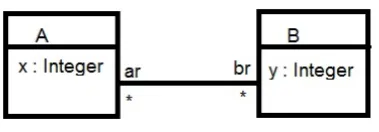
syntax of language descriptions. For example, Figure 1 shows a simple language with two entity
types A andB, integer-valued attribute features of each, and a bidirectional association between them. There is an explicit constraint that a.x >0 for each a :A, and an implicit constraint that the association rolesar andbr are mutually inverse:
A→forAll(a|a.x >0)
and
A→forAll(a|B→forAll(b|a.br→includes(b)equiv b.ar→includes(a)))
[image:3.595.186.376.496.562.2]For convenience, in the following we will use the notationx :sto abbreviate the OCL expression s→includes(x).
Fig. 1.Example language
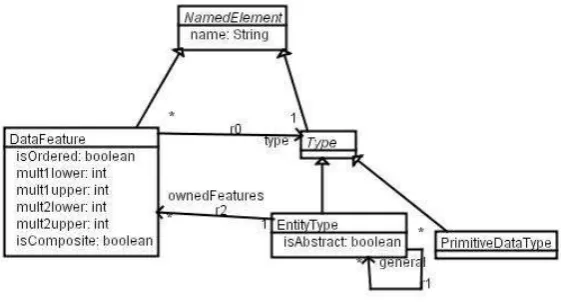
In addition to such descriptions, we also need anabstract syntaxfor languages, ie., a metamodel for languages, and a mathematical equivalent of the languages, in order to define concepts of proof and satisfaction relative to a language.
Fig. 2.Minimal metamodel (M4) for modelling languages
Our example language can be represented as elements
A:EntityType B :EntityType
x :DataFeature y :DataFeature ar:DataFeature br :DataFeature
Integer :PrimitiveDataType
A.ownedFeatures={x,br}
B.ownedFeatures={y,ar}
x.type=Integer y.type =Integer
ar.type=A br.type=B
of an instance of M4, together with instances c1,c2 of a constraint metatype to represent the constraints.
The metamodel for languages, based on M4, is shown in Figure 3.
Fig. 3.Language metamodel
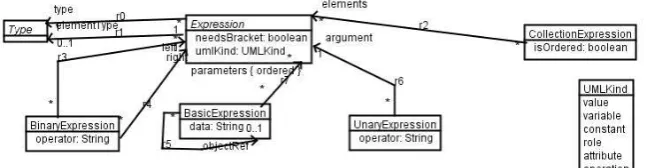
Many variations on constraint languages could be used, Figure 4 shows one possible metamodel for constraint expressions, which is used in UML-RSDS [49]. BinaryExpression, BasicExpression,
UnaryExpressionandCollectionExpression all inherit fromExpression.
To support verification, we need to be able to define a proof theory and (logical) model theory wrt given languages, hence we need to associate a formal first order language and logic to each instance of M4. Table 1 defines how a formal first-order set theory (FOL) language LL can be associated to instances L of M4. The table defines how different forms of elements in the M4 metamodel correspond to conceptual modelling elements, and how they are formalised in first-order set theory.
Ifmult1upper= 1 andmult1lower= 1 ormult1lower= 0 (ie, multiplicity 0..1 at the source end
[image:4.595.157.428.473.591.2]Fig. 4.Example constraint language
Modelling concept M4 representation Formal semantics
Entity typeE Element ofEntityType Type symbolE, the
set of instances ofE
Concrete entity Element ofEntityType
typeE withisAbstract =false
Abstract entity Element ofEntityType E =E1∪...∪El
typeE withisAbstract =true whereE1, ...,El are all direct subtypes ofE
Primitive typeT Element of Mathematical type,
PrimitiveDataType Z,B,R,S, etc.
Single-valued DataFeature element with Function symbol
attributeatt:Typ mult2upper= 1,mult2lower= 1 att:E →Typ′ ofE andtype∈PrimitiveDataType Typ′ representsTyp
Single-valued role DataFeature element with Function symbol
r ofE with target mult2upper= 1,mult2lower= 1 r:E→E1
entity typeE1 andtype∈EntityType
Unordered many- DataFeature element with Function symbol
valued rolerofE mult2upper̸= 1 ormult2lower̸= 1r:E→F(E1)
with target andisOrdered=false and
entity typeE1 type∈EntityType
Ordered many-valuedDataFeature element with Function symbol
roler ofE with mult2upper̸= 1 ormult2lower̸= 1r:E→seq(E1)
target entity andisOrdered=true and
typeE1 type∈EntityType
SupertypeE1 of Element of TypeE1 with
E E.general E ⊆E1
[image:5.595.122.454.390.683.2]data terminology. A−1 multiplicity value represents∗ multiplicity. An expression is either single-valued (denoting a single value of a primitive data type, or a single instance of an entity type), or many-valued, denoting a collection. Collections according to this metamodel are either ordered (sequence-valued) or unordered (set-valued). Bags and ordered sets can be defined in terms of sequences. Notice that an optional association end (withmult2lower = 0 and mult2upper = 1) is formally represented as a set (or sequence) of size 0 or 1. Thus null elements are in this case represented as empty collections, as in the OCL standard [44]. A denumerable typeObject OBJ is included in eachLLto represent the set of all possible object references1. A finite setobjects⊆
Object OBJ represents the set of all existing objects at any point in time. Each entity typeE has
E ⊆objects. Additional axioms, eg., that distinct entity types unrelated by subtyping have disjoint
extents, could be assumed if required.
For simplicity, we will not consider the cases of OCL invalid or null expression values in this paper, and we will operate entirely within two-valued logic both for OCL and its logical representa-tions. As argued in [29], this is a pragmatic choice which greatly simplifies analysis of specifications, and is adequate in most cases. Transformation specifiers should separately ensure that invalid expression evaluations cannot occur in their transformations, using the definedness conditions of expressions (Section 5). Instead of defining operators such as select or collect by iterators, we will give these a conventional mathematical definition as set-comprehension expressions. Ultimately all the standard numeric, string and collection function symbols and predicate symbols can be derived from = and set membership (: or∈).
We use some minor extensions of OCL. For entity typesEwith one attributeiddesignated as an
identity attribute (primary key), the abbreviationE[v] is introduced to representE.allInstances()→select(id = v)→any(), ifv is single-valued, and to representE.allInstances()→select(id :v) if v is
collection-valued. E.id denotes E.allInstances()→collect(id). The finite range of numbers from n to m in-clusive is denoted Integer.subrange(n,m). The operator v→subcollections() gives the set of finite subsets of a setv. The operatorv→isDeleted() expresses that the object or object collectionv are removed from the model, ie., thatobjects→excludes(v) for an object v, it is inverse to oclIsNew [44]. Operatorss→intersectAll(e) and s→unionAll(e) form distributed intersections and unions, and transitive closure of a many-valued self-association role end r : E → Set(E) is defined2 as
x.r→closure() =Integer.subrange(0,E.size)→unionAll(n |x.rn).
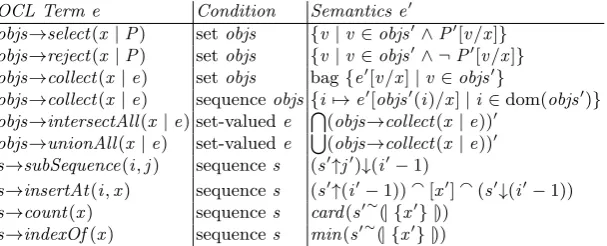
Constraints in this version of OCL are mathematically represented as first-order set theory axioms in LL, for each languageL. Tables 2 and 3 show some examples of semantic interpretations of OCL logical operators, collection types and operators. In total, we have defined a mathematical semantics for 33 OCL operators on non-collection types, and for 36 OCL collection type operators [49].
Here we adopt the notation for set theory used by the B AMN formalism [31]. OCL sets are represented as mathematical sets, OCL sequencess are represented as maps from 1..s.sizeto their set of elements. Strings are also represented as sequences, of integers representing characters, or as a primitive type.
E[e/x] denotes the substitution ofe for free occurrences ofx in E (avoiding free variable cap-ture).sq↑i for sequencesq is the initial subsequence ofsq with domain 1..i,sq↓iis the subsequence of the elements with index >i.
For our example language of Figure 1 we have a corresponding formal first-order set theory language LL, which has sort symbols (A,B), function symbols (x,y,ar,br), and axioms
∀a:A·x(a)>0
∀a:A; b:B·b∈br(a) ≡ a∈ar(b)
Therefore we can operate simultaneously with three corresponding views of a language: (i) as a set of entity types and their data features and specialisation relations, defined by a class diagram, with OCL constraints defining restrictions on these elements; (ii) as instances of M4, together with abstract syntax representations of the constraints; (iii) as mathematical languages in first-order set
1
As in [11], we could include anullid reference in this type to represent OCLnull. 2
The undefinability of finite transitive closure in pure predicate calculus [5] does not apply to set theory.
x.r0
={x},x.r1
=x.r,x.r2
OCL Term e Condition Semantics e′
P and Q P′∧Q′
P or Q P′∨Q′
P implies Q P′⇒Q′
e→forAll(x |P) ∀x :e′·P′
e→exists(x |P) ∃x :e′·P′
e→exists1(x |P) ∃1x :e ′·P′
Integer.subrange(a,b)a,b:Integer a′..b′
Set{e1, ...,en} {e1′, ...,en′}
Sequence{e1, ...,en} [e1′, ...,en′]
s→size() set or sequences cardinalitycard(s′)
s→subcollections() sets F(s′)
s→at(i) sequences s′(i′)
s→includes(x) sets x′∈s′
s→excludes(x) sets x′̸∈s′
s→intersection(t) setss,t s′∩t′
s→union(t) setss,t s′∪t′
s→includes(x) sequences x′∈ran(s′)
s→excludes(x) sequences x′̸∈ran(s′)
s→including(x) sets s′∪ {x′}
s→excluding(x) sets s′− {x′}
s→asSet() sset s′
s→asSet() ssequence ran(s′)
s→includesAll(t) setssandt t′⊆s′
s→includesAll(t) sequencessandt ran(t′)⊆ran(s′)
s→excludesAll(t) setssandt s′∩t′={}
s→excludesAll(t) sequencessandt ran(s′)∩ran(t′) ={}
s→sum() sets sum of elements ofs′
s→sum() sequences,card(s′) =n s′(1) +...+s′(n)
[image:7.595.122.451.128.468.2]s→isUnique(x|e) sets card(s′) =card({e′[v/x]|v∈s′})
Table 2.Semantic mapping for OCL logic and collection expressions
OCL Term e Condition Semantics e′
objs→select(x |P) setobjs {v |v ∈objs′∧P′[v/x]}
objs→reject(x |P) setobjs {v |v ∈objs′∧ ¬P′[v/x]}
objs→collect(x |e) setobjs bag{e′[v/x]|v ∈objs′}
objs→collect(x |e) sequenceobjs {i7→e′[objs′(i)/x]|i ∈dom(objs′)}
objs→intersectAll(x |e) set-valuede ∩(objs→collect(x |e))′
objs→unionAll(x |e) set-valuede ∪(objs→collect(x |e))′
s→subSequence(i,j) sequences (s′↑j′)↓(i′−1)
s→insertAt(i,x) sequences (s′↑(i′−1))a[x′]a(s′↓(i′−1))
s→count(x) sequences card(s′∼(| {x′} |))
s→indexOf(x) sequences min(s′∼(| {x′} |))
[image:7.595.136.440.570.693.2]theory, together with axioms in these languages representing the mathematical semantics of the constraints.
Assuming the use of an OCL-like language as a constraint language, the sets of syntactically valid expressionsExp(L) and sentencesSen(L) in the constraint language based upon a languageL can be determined.Exp(L) in this paper denotes the set of all expressions in Figure 4 overL. It can also be regarded as a set of expressions and formulae of LL, via the above semantic interpretation of expressions3. The terms occurring in elements of Exp(L) andSen(L) are always based on finite
collections, ie., for each expressione→select(x |P),e→forAll(x |P), etc.,e is finite.
We will denote a language L by a metamodel ΣL which is an instance of M4, and a set of (OCL or FOL) sentencesΓL overΣL defining restrictions on this metamodel:L= (ΣL, ΓL), where
ΓL⊆Sen(L).
For convenience, we write a language metamodelΣL textually as asignature: a definition of a tuple (E1, ...,Ek) of entity types, and of a tuple (f1, ...,fl) of data features (attributes and association
role ends) on these entity types, together with language constraints on these elements, which are included inΓL. We usually assume the inclusion of the standard primitive types Integer,Boolean,
String andReal in each language, so these will not be listed inΣL.
The metaclassStructurein Figure 3 represents the concept of a structure or interpretation of a language: such structures will have concrete representations as sets and maps for each entity type and feature of their language. Model transformations will operate on such structures, modifying them in-place or producing new structures from their data.
Structures for a languageLcan be represented as tuplesm = ((Em
1 , ...,Ekm),(f1m, ...,flm)) which give interpretations of each element ofΣL:
1. For each entity type Ei of L, Eim is a finite set (of atomic, unspecified, object identities) representing the extent Ei.allInstances() of Ei. For abstract Ei, Eim is the union of the Fm extents of the direct subtypesF ofEi.
2. For an attributefj :Typ ofEi, fjm is a map of type Eim → Typ′ from its source entity type interpretation to a domain of values for its target type.
3. A single-valued (1-multiplicity) association endfj :F ofEi is interpreted by a mapfjm :Eim → Fm.
4. An unordered many-valued (ie., not 1-multiplicity) association end fj :Set(F) ofEi is inter-preted by a mapfm
j :Eim→F(Fm).
5. An ordered many-valued association end fj :Sequence(F) ofEi is interpreted by a map fjm :
Em
i →seq(Fm).
6. IfE is a subtype ofF thenEm ⊆Fm.
There is a notion of structure isomorphism(Appendix A): m ≃ n means that the structures are semantically indistinguishable by sentences of L.
A structurem ofLcan be considered to be an instance ofΣL, so we writem:L to say thatm is a structure for L.Mod(L) denotes the set of structures forL. This can be considered also as the set of (logical) interpretation structures for the mathematical language LL.
A structurem ofL is termed a (semantic)modelofL if it satisfies all axioms inΓL (ie., all the implicit and explicit language constraints of L):
∀ϕ· ϕ∈ΓL ⇒ m |=ϕ
where|= ⊆ Mod(L)×F(Sen(L)) is the satisfaction relation ofL(equivalently ofLL). IfL=S∪T
for disjoint languages S andT, satisfaction over pairs (m,n) of structuresm of S and n of T is defined based on interpreting S language elements inm andT language elements inn: (m,n)|=ϕ
forϕ∈Sen(L). Likewise for tuples of structures and languages.
A deduction relation ⊢ ⊆ F(Sen(L))×Sen(L) is given by the usual deduction rules for
first-order logic with equality forLL. This is related to|= by the property ofsoundness:
∆⊢ϕ ⇒
(∀m :Mod(L)·m |=∆ ⇒ m|=ϕ)
3
In a first-order language terms, built from function symbols, +, →select, etc., are distinguished from
for∆⊆Sen(L),ϕ∈Sen(L).
The converse relationship ofcompletenesswill usually hold:
(∀m :Mod(L)·m|=∆ ⇒ m |=ϕ) ⇒ ∆⊢ϕ
for finite ∆⊆Sen(L),ϕ∈Sen(L). We discuss this issue in Appendix B.
2.2 Representation of transformations
At the specification level, the effect of a transformation can be characterised by a collection of mapping specifications, which relate model elements of one or more models involved in the trans-formation to each other [25]. These mapping specifications define the intended relationships which the transformation should establish between the input (source) and output (target) structures of the transformation, at its termination. That is, they define the postconditionsPost of the transfor-mation.
In the case of in-place transformations, the initial values of entity types and features can be notated as E@pre,f@pre in postconditions to distinguish them from their post-state values.
For example, an in-place transformationτ on the languageL of Figure 1 could be specified by a mapping specification constraintR on a single (input and output) modelm :L.R specifies that there are B objects corresponding to each initialAobject:
A@pre→forAll(a|B→exists(b|b.y =a.x@pre∗a.x@pre and a.br→includes(b)))
This is a postcondition of the transformation: a predicate which should hold at its termination. Since neitherAorx are updated byτ (ie., they are not in the write framewr(R) ofR, Section 5), the @pre suffix can be omitted, and Rwritten more simply as:
A→forAll(a|B→exists(b|b.y =a.x ∗a.x and a.br→includes(b)))
A precondition could also be expressed, eg., that B has initially no instances:
B=Set{}
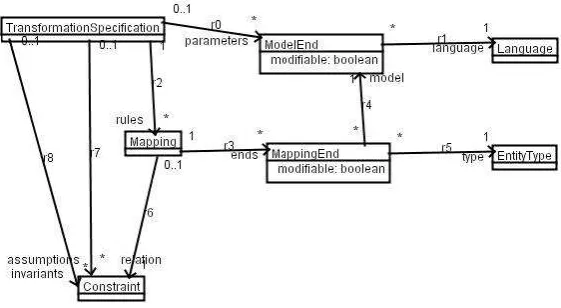
[image:9.595.144.425.521.675.2]We adapt the mapping metamodel of [25] to represent such transformation specifications (Figure 5).
Fig. 5.Transformation specification metamodel
(triple graph grammars) and QVT-R in [14] and for ATL in [13]: these techniques express the in-tended effect of transformations by a metamodel plus OCL constraints describing the poststate of the transformation. Transformations in hybrid and imperative languages should also be given pre and postcondition specifications, to provide a basis for their verification. In turn formal represen-tations of transformation specifications can be generated from represenrepresen-tations in this metamodel, in a range of formalisms such as B [36], Z3 [51] or Alloy [2], to support semantic analysis. The metamodel could be extended to include generalisation relations between mappings, as in ETL [28].
Therules.relation constraints express the postconditionsPostof the transformation: all of these
constraints should be true at termination of the transformation. Typically each mapping relation constraintCn∈Post has the form of an implication
SCond implies Succ
forall-quantified over elements (the source mapping endss:Si) of the source models. Theapplication
conditions ACond of the mapping are thenSCond and not(Succ), ie., the mapping is applicable
when its assumptions are true and when it is not already established. Analysis of thedeterminacy
anddefinednessof the mappings can be carried out by syntactic analysis of theirrelationconstraints,
as described in Section 5.
Theassumptions express the preconditionsAsm of the transformation. Theinvariants define
propertiesInv which should be true initially, and which should be preserved by eachcomputation stepof the transformation: they serve to restrict the possible implementations of the transformation to those which do maintainInv. The postconditions, preconditions and invariants can be expressed in the disjoint union of the languages parameters.language involved in the transformation, with pre-state versions of language elements also being used in the case of parameters which are both inputs and outputs.
A transformation τ preserves structures p ∈ τ.parameters which have p.modifiable = false, otherwiseτ may change the data of an actual structure supplied as the value for p. If a mapping end is modifiable, so is its structure:
modifiable=true implies model.modifiable=true
is an invariant ofMappingEnd. The entity type of a mapping end must also belong to the language of the model end of the mapping end:
type:model.language.entityTypes
is an invariant of MappingEnd. Target models have modifiable = true, source models are only modifiable if they are also target models.
[image:10.595.145.432.605.662.2]Systems of transformations can be represented by UML activity diagrams, in which the trans-formations are executable activity nodes and the structures or models they operate on are object (data) nodes. Eg., Figure 6 shows a sequential composition of two transformations. An object flow fromτ ton :T indicates thatn is a modifiable parameter ofτ.
Fig. 6.Sequential composition of transformations
Transformation implementations are defined by abehavior, such as a UML Activity, in which
RuleImplementation instances are the executable activity nodes. Each rule implementation is for
computation steportransformation step: the application of a specific rewrite rule or transformation rule to a specific matching location in a graph or to specific matching element(s) in a model. This is also modelled as a behaviour in Figure 7: each rule implementation will usually be based upon some iteration of the step for the mapping that it implements.
Fig. 7.Transformation implementation metamodel
This metamodel can be used to represent rules in hybrid or imperative languages, eg., GrGen [26], ATL [24], ETL [25] or Kermeta [17]. Instead of creating a metamodel for each different trans-formation language (ETL, ATL, GrGen, etc), we use the common implementation metamodel to express and reason about implementation-level properties, independently of languages. Mappings need to be defined between these languages and a suitable general behaviour representation, we consider that this is feasible because model transformation languages have many common aspects, such as lookup mechanisms using traces. We illustrate how such mappings can be defined in Sections 10 and 11.
The behavior of an implementationI of a transformationτwill determine the order in which the
δ∈RuleImplementation will be executed. Eachδin turn has an internal behaviour, usually defined
in terms of computation steps δr(ss) which attempt to establish the specification mapping r =
δ.appliesfor particular elementsssin the source domains of the mapping. Thusδ.computationStep=
δr.
For example, the constraint Rwould have individual computation steps δR(a) fora∈A, each step creates a new b ∈ B and sets b.y =a.x ∗a.x and addsb to a.br (and implicitly adds a to b.ar), so establishing the quantified formula ofR fora.
Such constraint applicationsδr(ss) are the computation steps both of the implementationsδof a specificCn ∈Postand of the overall implementationI of a transformationτ. Apartial computation ofI for τ is a finite sequence sq of computation steps of I, such thatsq has a form permitted by the behaviour ofI, and such thatInv holds in the initial structures (m1, ...,mq) supplied as input
parameters ofτ, andInv holds in the final state ofsq and after every initial subsequence ofsq.
A completed computation of I from initial structures (m1, ...,mq) supplied as the parameter
values ofτ, to terminal structure values (n1, ...,nq) for these parameters, will be denoted
(m1, ...,mq)−→τ,I (n1, ...,nq)
If parameter i is non-modifiable,ni =mi.
A completed computation from (m1, ...,mq) to (n1, ...,nq) for τ ∈TransformationSpecification whereI.specification =τ, consists of a finite sequencesqof computation steps ofI, such thatsqhas a form permitted by the implementation algorithm ofI,Inv is true initially and at all intermediate states (ie., after any initial subsequence ofsq), and where no further steps are permitted byI from (n1, ...,nq), and such that no shorter initial subsequence ofsq has this property.
For existing transformations, the computation steps and rule implementations may be defined using any means available in the transformation language (as in case studies 2 and 3 below). Alter-natively, for new transformations, the steps, rule implementations and the overall implementation can be derived systematically from the transformation specification (Section 8).
The notation
(m1, ...,mq)−→τ (n1, ...,nq)
means that there is a completed computation (m1, ...,mq)−→τ,I (n1, ...,nq) for some
implementa-tionI ofτ.
We use the following program-like activity language for the language-independent behaviour description of hybrid and imperative transformations.
The concrete syntax BNF of the language is as follows:
<statement> ::=<loop statement>|<creation statement>|
<conditional statement>|<sequence statement>|
<basic statement>
<loop statement> ::= “while”<expression>“do”<statement >
“invariant”<expression>“variant”<expression> |
“for”<expression>“do”<statement > <conditional statement>::= “if”<expression>“then”<statement >
“else”<basic statement > <sequence statement> ::=<statement>“;”<statement> <creation statement> ::=<identifier>“:”<type name>
<basic statement> ::=<basic expression>“:=”<expression>|“skip”|
“return”<expression>|“(”<statement>“)”|
<call expression>
This defines a subtype Statement(L) of Behavior, when based on the expressions Exp(L) of language L. The semantics of these statements is given by the weakest-precondition operator [ ] :
Statement(L)×Exp(L)→Exp(L), using standard definitions, as for the B Generalised Substitution
language [31]. For example (using standard mathematical notation for expressions on the RHS):
[obj.f := e]P ≡ P[(f ⊕ {obj 7→e})/f] for single object obj, writable feature f
[objs.f := e]P ≡ P[(f ⊕(objs× {e}))/f] for set objs,writable f
[x := e]P ≡ P[e/x] for variable or entity type x
[(x : E; S)]P ≡
∀x ·x :Object OBJ −objects ⇒ [E :=E ∪ {x};
objects :=objects∪ {x}; S]P variable x, concrete entity type E
[if E then S1 else S2]P ≡ (E ⇒[S1]P)∧(¬E ⇒[S2]P)
[S1; S2]P ≡ [S1]([S2]P)
[for x :e do S(x)]P ≡ [S(e1)]...[S(en)]P if e=Sequence{e1, ...,en}
[for x :e do S(x)]P ≡ ∧sq∈serial(e)[for x :sq do S(x)]P otherwise
Object OBJ is a denumerable type of all possible object references, objects maintains the set of
object references of all existing objects. In the clause for creation ofx:E, updatesF := F∪ {x}
for each supertypeF ofE will also be included.
In the last clause, a conjunction is taken over all the possible serialisations ofe at the start of the loop:
serial(s) ={sq : 1..s.size→s |ran(sq) =s}
for a sets.
For unbounded loops, we use the inference:
(I ∧E ⇒ [S]I) ∧
(I ∧ ¬E ⇒ P) ∧
(I ∧E ⇒ v ∈N) ∧
(∀γ:N·I ∧E ∧v=γ ⇒ [S](v < γ)) ⇒
[while E do S invariant I variant v]P
For operation calls,call-by-value-resultsemantics is used.
In the remainder of the paper we will consider transformations which are either separate-models transformations with one source and one target:τ:S →T, or update-in-place transformations on a single model:τ :S →S. The verification techniques we define can be used in the same way for transformations with multiple input and output languages.
For separate-models transformations, in order to relate properties of a source model to those expressible in a target model, we use the concept of alanguage morphismor interpretation. This is a mappingχ:S →T from the source languageS to a target languageT, consisting of a signature morphismχ:ΣS →Exp(T) of entity types ofS to set-valued expressions ofT, and features ofS to features or expressions denoting maps of the same arity and of corresponding types of T, and induced morphismsSen(χ) : Sen(S) → Sen(T) and Mod(χ) : Mod(T) → Mod(S) which use χ
to interpret sentences of S as sentences of T, and to interpret structures of T as structures for S. Sen(χ)(ϕ) is written as χ(ϕ) in the following. There is a category LAN G of languages and language morphisms, and a categoryPLAN Gof languages and partial language morphisms (where
χ:ΣS 7→Exp(T)).
3
Transformation verification properties
A large number of verification properties have been proposed for model transformations, eg., [14, 36]. In this section we formalise some key properties using the framework of Section 2, and in the following sections we identify techniques and technologies to establish these properties.
For separate-models transformations τ with one modifiable target parameter n : T and one preserved sourcem:S, completed computations ofτ will be of the form
(m,n0)−→τ(m,n)
wheren0 is a default initial model which is usually the emptyT structure∅4. We say thatn can
be produced from (m,n0) byτ if there is such a completed computation.
Correctness properties can either be considered for one specific implementationI ofτ, or for all possible implementations which maintain the invariantsInv.
Syntactic correctnessofτ can be formalised as:
(m,n0)|=Asm∪ΓS ⇒ n|=ΓT
for each structurem ofS, where n :T can be produced from (m,n0) by (any implementation of)
τ, andAsm are the assumptions ofτ. Ie., ifm is a model ofS, any structuren produced byτ from mshould be a model ofT. If restricted to a specific implementationI, syntactic correctness means that structures produced from models ofS byI should be models ofT.
τ is said to besemantically preserving relative to a language interpretation χ:S →T [36] if: m |= ϕ ⇒ n |= χ(ϕ) for n : T produced from m : S, n0 : T by (any implementation of) τ, and forϕ∈Sen(S). Preservation may only be required for properties in a subsetPres ofSen(S), and/or for (m,n0)|=Asm. Semantic preservation by a specific implementationI ofτis formulated similarly.
τis asemantic equivalenceifm|=ϕ ≡ n |=χ(ϕ) forn ∈Mod(T) produced fromm ∈Mod(S),
n0 byτ, and for ϕ∈Sen(S).5
4
The structure where each entity type ofT is interpreted by the empty set. 5
Semantic correctness of an implementation I of τ means that the implementation establishes the specified postconditionsPost ofτ: (m,n0)|=Asm ⇒ (m,n)|=Post forn :T produced from
m:S and n0 :T byI.
Model-level semantic preservation means that the internal semantics of source models is
pre-served, possibly under some interpretationζ, byτ. LetsemL:Mod(L)→Sem(L) be the semantics-assigning functions for models of languages L = S, L = T, and ζ : Sem(S) → Sem(T), then model-level semantics preservation means that:
ζ(semS(m))≈semT(n)
for some relation ≈ of equivalence on the semantic domain, and where (m,n0) |= Asm and (m,n0)−→τ (m,n) or (m,n0)−→τ,I (m,n). This can be alternatively expressed as a commuting-diagram property [39].
In many cases the semantics can be formalised withinLS andLT, so that model-level semantic preservation can be reduced to language-level semantic preservation relative to a suitableχ inter-pretation, or to invariant preservation of a formula expressing the commuting diagram property. For example, if the models are state machines, their sets of input event traces can be formalised in FOL as sets of sequences and preservation of such sets byτ can be expressed as preservation of a suitable invariant formulaϕ. Section 11 gives an example of such reasoning.
A transformation τ is confluent, if for every m : S, and n, n′ which can be produced by a completed computation ofτ from (m,n0),n ≃n′. Likewise for specific implementationsI ofτ.
τ (or an implementationI ofτ) isterminatingif for each modelm ofS, (m,n0)|=Asm, every partial computation ofτ (I) from (m,n0) has a completed computation extending it.
Similar formalisations can be given for update-in-place transformations. A transformation τ
operating on a single model of languageS can be considered to have computations
(m,m)−→τ (m,n)
where we implicitly retain the initial modelm:S in order to express the effect of the transformation by predicates relating the initial values of entity type extents and features (denoted byE@pre and f@pre in the transformation mapping relations) to their final values (denoted byE andf).
Syntactic correctnessof suchτ can be formalised as:
m|=Asm∪ΓS ⇒ n |=ΓS
for each structurem ofS, wheren :S can be produced fromm byτ, andAsm are the assumptions ofτ.
Semantic correctnessof an implementation I ofτ means thatI establishes the specified
post-conditions Post of τ: m |=Asm ⇒ (m,n)|=Post for n : S produced from m : S by I, where pre-state terms inPost are evaluated inm.
The definitions of model-level semantic preservation, termination and confluence are as for the separate-models case.
4
Transformation verification techniques
Four main distinct approaches to model transformation verification have been used or proposed:
1. Static analysis by syntactic analysis of the transformation source text, eg., to identify data-dependency relations between variables or rules [36].
2. Constructing counter-examples to properties, using model checkers or satisfaction checkers [2, 14, 12, 13].
3. Proving properties using automated or interactive theorem-provers [36, 20]. 4. Correct-by-construction synthesis of transformations from specifications [45, 38].
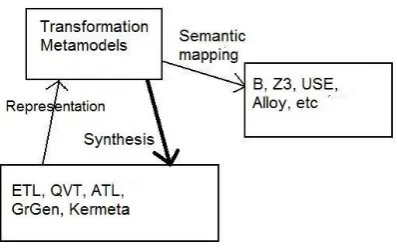
Our verification framework is based upon using the process of Figure 8 to express a range of dif-ferent transformation languages in the transformation specification and implementation metamod-els of Section 2 and then mapping these representations to verification formalisms. This approach means that only one semantic mapping needs to be defined and verified for each target formalism, rather than semantic maps for each different transformation language and target formalism.
Fig. 8.Verification process
We can distinguish between single-state formalisations, which only define a formal semantic model of one state of a transformation, usually a terminal state [13], and multi-state approaches which formalise the possible sequences of execution of the transformation [20]. The former can be applied to analyse syntactic correctness and other end-state properties, whilst the latter can be used to prove invariance of properties, termination and confluence.
Syntactic analysis is usually the least resource-expensive of the approaches, but may not be able to establish all properties. Counter-example analysis is a specification-based version of testing, and can detect flaws but not establish properties for all cases. Proof approaches in contrast can establish, in principle, correctness of a transformation for all possible valid input models, but such approaches require substantial effort. Finally, correctness-by-construction approaches can ensure correctness for transformations which are specified using restricted forms of transformation rules. They may also require proof effort to establish that necessary specification properties hold.
Manual or tool-supported proof of verification properties requires a clear organisation of ver-ification steps and allocation of these steps to appropriate tools. We have found the concept of
a transformation invariantpredicate Inv to be of key importance in connecting the properties of
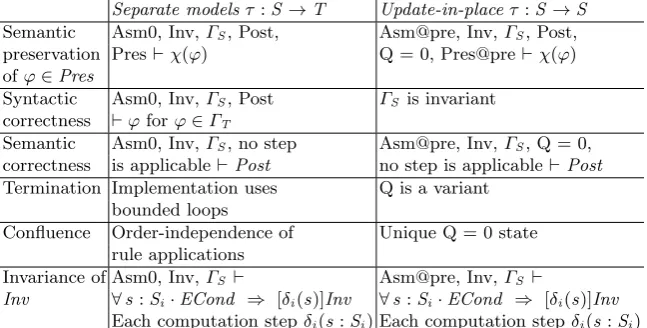
Table 4 summarises how particular properties can be derived using manual or tool-supported proof, using transformation invariants and variants.Asm0 denotes theAsm constraints which are predicates ofS only. For update-in-place transformations bothInvandPostmay relate the pre-state valuesf@pre,E@pre of features and entity type extents to their post-state values f,E.
Separate modelsτ :S→T Update-in-placeτ:S→S
Semantic Asm0, Inv,ΓS, Post, Asm@pre, Inv,ΓS, Post,
preservation Pres⊢χ(ϕ) Q = 0, Pres@pre⊢χ(ϕ)
ofϕ∈Pres
Syntactic Asm0, Inv,ΓS, Post ΓS is invariant
correctness ⊢ϕforϕ∈ΓT
Semantic Asm0, Inv,ΓS, no step Asm@pre, Inv,ΓS, Q = 0,
correctness is applicable⊢Post no step is applicable⊢Post
Termination Implementation uses Q is a variant
bounded loops
Confluence Order-independence of Unique Q = 0 state
rule applications
Invariance of Asm0, Inv,ΓS ⊢ Asm@pre, Inv,ΓS ⊢
[image:16.595.126.450.156.320.2]Inv ∀s:Si·ECond ⇒ [δi(s)]Inv ∀s:Si·ECond ⇒ [δi(s)]Inv Each computation stepδi(s:Si) Each computation stepδi(s:Si)
Table 4.Proof techniques for verification properties
In the last case,ECond is an execution condition expressing restrictions on when the computa-tion step can be executed in the transformacomputa-tion implementacomputa-tionI ofτ, eg., it can express that the relation of some preceding mapping is true. Inv must also hold in the initial state, based onAsm0 and ΓS for separate-models transformations, and Inv[v/v@pre] must hold based on Asm and ΓS for update-in-place transformations.
An alternative approach for proving confluence is direct reasoning that any two distinct trans-formation steps commute with each other, ie., [α; β]P ≡ [β; α]P for any predicateP.
These proof techniques can be related to the model-based formulations of the verification properties of Section 3 via the soundness condition linking ⊢ and |=. For example, for syntactic correctness, if the proof of line 2 of Table 4 for a separate-models transformation τ holds, and (m,n0)|=Asm∪ΓS, and
(m,n0)−→τ(m,n)
then (m,n)|=Asm0∪Inv∪ΓS∪Postby invariance ofInv, semantic correctness, and the preservation of the data ofS, so, by Table 4, (m,n)|=ΓT andn |=ΓT, as required.
Proof thatInv is invariant is carried out using inductive reasoning that each computation step of the transformation preserves Inv, if executed according to the transformation implementation algorithm. Additionally, Inv must be true initially. Likewise, the variant property of Q can be proved by cases over computation steps.
The general scheme of proof-based verification is therefore:
1. Prove invariance ofInv, and (if necessary) the variant property of Q.
2. Use these to deduce semantic preservation, syntactic correctness and semantic correctness. 3. Use syntactic analysis or properties ofQ to show termination and confluence.
We describe syntactic analysis techniques for our framework in Section 5, counter-example tech-niques in Section 6, proof techtech-niques in Section 7, and correctness-by-construction techtech-niques in Section 8.
5
Syntactic analysis of transformation specifications and
implementations
definedness and determinacy conditions of the transformation rules, and issues concerning their semantics, such as the need for a fixed-point implementation in the case of rules which potentially both write and read the same entity types or features in a model. Some performance bounds can also be estimated by static syntactic analysis [38].
Syntactic analysis has the advantage that no mapping to an additional formalism (such as B, Z3, etc) is necessary, hence there is no reliance on the correctness of such a mapping. In this section we will consider transformations represented in the metamodels of Figures 5 and 7. Regardless of the form of a transformation τ (ie., whether it is an update-in-place transformation or not), each of its mapping constraints should satisfy the following properties ofdefinednessanddeterminacy.
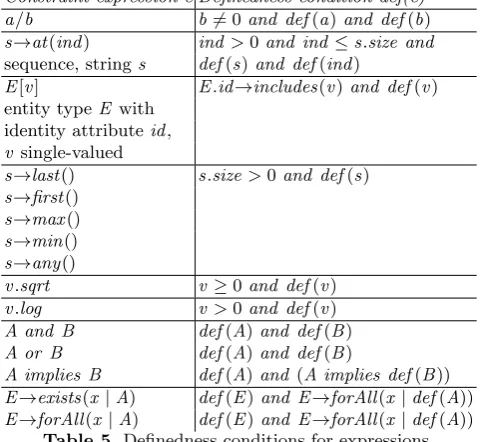
For each postcondition, precondition and invariant constraint of a transformation, the defined-ness condition is a necessary assumption which should hold before the constraint is applied or evaluated, in order that its evaluation is well-defined. Postcondition constraints should normally also satisfy the condition of determinacy.
[image:17.595.169.410.300.521.2]Examples of the clauses for the definedness function def : Exp(L) → Exp(L) are given in Table 5.
Constraint expression e Definedness condition def(e) a/b b̸= 0and def(a)and def(b)
s→at(ind) ind >0and ind≤s.size and
sequence, strings def(s)and def(ind)
E[v] E.id→includes(v)and def(v) entity typeE with
identity attributeid,
v single-valued
s→last() s.size>0and def(s)
s→first()
s→max()
s→min()
s→any()
v.sqrt v ≥0and def(v)
v.log v >0and def(v)
A and B def(A)and def(B)
A or B def(A)and def(B)
A implies B def(A)and (A implies def(B))
E→exists(x|A) def(E)and E→forAll(x |def(A))
E→forAll(x |A) def(E)and E→forAll(x |def(A))
Table 5.Definedness conditions for expressions
Examples of the clauses for the determinacy function det : Exp(L)→Exp(L) are given in Table 6.
More sophisticated syntactic analysis of a postcondition constraint can be carried out by con-sidering the data-dependency relationships between the language-elements that it relates.
The write frame wr(P) of a formula P ∈ Exp(L) is the set of features and entity types (ie.,
entity type extents) that it modifies, when interpreted as an action (an action stat(P) to establish P, Section 8). This includes object creation. The read frame rd(P) is the set of entity types and features read in P. The frames wr∗(P) and rd∗(P) give further precision by recording the sets of objects (expressions denoting instances of entity types) whose features are written or read in P. Table 7 gives some cases of the definitions of these frames.
In computingwr(P) we also take account of the features and entity types which depend upon the explicitly updated features and entity types ofCn, such as inverse association ends.
Constraint expression e Determinacy condition det(e) s→any() s.size= 1and det(s)
Case-conjunction Conjunction of
(E1implies P1)and ...not(Ei and Ej) (En implies Pn) fori̸=j, and each
(det(Ei)and (Ei implies det(Pi)))
A and B det(A)and det(B)
A or B false
A implies B det(A)and (A implies det(B))
E→exists(x |A) det(E)and E→forAll(x|det(A))
E→forAll(x |A) det(E)and E→forAll(x|det(A)) Additionally, order-independence of
[image:18.595.167.413.108.246.2]Aforx :E.
Table 6.Determinacy conditions for expressions
P rd(P) wr(P) rd∗(P) wr∗(P)
Basic expressione Set of features {} Set of pairs (obj,f){}
without quantifiers, and entity type of objects and
logical operators or names used features,obj.f,
=, :,E[], inP inP, plus
→includes, entity type
→includesAll, names inP
→excludesAll,
→excludes,
→isDeleted
e1 :e2.r rd(e1)∪rd(e2){r} rd∗(e1)∪rd∗(e2) {(e2,r)}
e2.r→includes(e1)
r many-valued
e1,e2 single-valued
e2.r→excludes(e1) rd(e1)∪rd(e2){r} rd∗(e1)∪rd∗(e2) {(e2,r)}
r many-valued
e1,e2 single-valued
e1.f =e2 rd(e1)∪rd(e2){f} rd∗(e1)∪rd∗(e2) {(e1,f)}
e1 single-valued
e2.r→includesAll(e1) rd(e1)∪rd(e2){r} rd∗(e1)∪rd∗(e2) {(e2,r)}
r,e1 many-valued
e2 single-valued
e2.r→excludesAll(e1) rd(e1)∪rd(e2){r} rd∗(e1)∪rd∗(e2) {(e2,r)}
r,e1 many-valued
e2 single-valued
E[e1] rd(e1)∪ {E} {} rd∗(e1)∪ {E} {}
E→exists(x |Q) rd(Q) wr(Q)∪ {E} rd∗(Q) wr∗(Q)∪ {E} (E concrete entity type)
E→exists1(x |Q) rd(Q) wr(Q)∪ {E} rd∗(Q) wr∗(Q)∪ {E} (E concrete entity type)
E→forAll(x|Q) rd(Q)∪ {E} wr(Q) rd∗(Q)∪ {E} wr∗(Q)
x→isDeleted() rd(x) {E} rd∗(x) {E}
x single-valued, of entity typeE
C implies Q rd(C)∪rd(Q) wr(Q) rd∗(C)∪rd∗(Q) wr∗(Q)
Q and R rd(Q)∪rd(R) wr(Q)∪wr(R)rd∗(Q)∪rd∗(R) wr∗(Q)∪wr∗(R)
[image:18.595.96.482.307.730.2]Creating an instancex of a concrete entity type E also addsx to each supertypeF of E, and these supertypes are also included in the write frames ofE→exists(x |Q) and E→exists1(x |Q) in the above table.
Deleting an instancex of entity typeE byx→isDeleted() may affect any supertype of E and any association end owned byE or its supertypes, and any association end incident withE or with any supertype of E. Additionally, if entity typesE andF are related by an association which is a composition at theE end, or by an association with a mandatory multiplicity at the E end, ie., a multiplicity with lower bound 1 or more, then deletion ofE instances will affectF and its features and supertypes and incident associations, recursively.
The read frame of an operation invocatione.op(pars) is the read frame ofe and of thepars cor-responding to the input parameters ofop together with the read frame of the postconditionPostop of op, excluding the formal parameters v of op. Its write frame is that of the actual parameters corresponding to the outputs of op, and wr(Postop)−v. wr(G) of a set G of constraints is the union of the constraint write frames, likewise forrd(G),wr∗(G),rd∗(G).
An example of these definitions is
rd(R) = {A,x}
wr(R) = {B,y,br,ar}
for the postcondition constraint Rof the example of Figure 1, and
rd∗(R) = {A,(a,x)}
wr∗(R) = {B,(b,y),(a,br),(b,ar)}
Using the definitions of read and write frames we can perform some analysis of constraints and transformation specifications using data-dependency analysis. This analysis is used to (i) identify possible flaws in the specification to the developer, and (ii) to determine the choice of design and im-plementation of the constraints and transformation for correctness-by-construction imim-plementation, in Section 8.
An important property of a postcondition constraint Cn is that its read and write frames are disjoint:
wr(Cn)∩rd(Cn) = {}
We refer to such constraints as type 1 constraints. Subject to further restrictions, they have an implementation as bounded iterations over their source model entity types. Our example constraint Rsatisfies this property, even though the transformation itself is an update-in-place transformation. For transformationsτ :S →T, whereS andT may be the same language, the general form of transformation specification postcondition constraintsCn we consider are implications:
Si→forAll(s|SCond implies Tj→exists(t |TCond and Pred))
or
Si→forAll(s|SCond implies Succ0)
whereSCondis a predicate over the source languageS elements only,S1, ...,Sn are the entity types
of S which are relevant to the transformation, Tj is some entity type of the target language T,
TCond is a condition inT elements only, eg., to specify explicit values fort’s attributes, andPred
refers to both t ands to specifyt’s attributes and possibly linked (dependent) objects in terms of s’s attributes and linked objects. TCond does not contain quantifiers,Pred may contain further
exists or forAll quantifiers to specify creation/lookup of subordinate elements oft. If thet should
be unique for a given s, anexists1 (one) quantifier may be alternatively used in the succedent of the constraint. In the second form Succ0 does not have an exists quantifier, and does not create target elements but may look up previously created elements and modify them.
A restricted form of constraint in which noforAllquantifier can appear inPredorSucc0 is called
aconjunctive-implicative formconstraint in [38], it has advantages in terms of comprehensibility and
analysability compared to general constraints (eg., which may have nested alternating quantifiers in Pred).
The standard implementation (Section 8) of a type 1 postcondition Cn is a bounded loop for s :Si do δi(s) iterating a computation stepδi(s :Si) defined as
if SCond then stat(Succ)
whereSucc is the succedentSucc0 orTj→exists(t|TCond and Pred) ofCn, andstatis as defined in Table 10. We assume that rule implementations using theseδi steps are used to implement the Cn in the following analysis.
We can classify transformation postcondition constraints Cn into several types, of increasing complexity:
– Type 0 constraints: no quantification over source language elements, instead only updates to specific objects are specified. For example:
Account[“33665”].balance= 0
to set the balance of a specific identified account. These are directly implemented by aRuleImplementation whose behaviour isstat(Cn).
– Type 1 constraints with 1-1 mapping of identities (structure-preservingconstraints).
– Type 1 constraints with merging of multiple source instances into single target instances, ie, with a many-1 mapping of identities.
– Type 2 constraints:
wr(Cn)∩(rd(Pred)∪rd(TCond))
is non-empty, but
wr(Cn)∩(rd(SCond)∪ {Si}) ={}
These constraints usually need to be implemented by a fixpoint iteration (instead of a bounded loop): the basic transformation stepδi(s) implementing one application ofCn is iterated over any applicable source domain elementss until no applicable source element remains.
– Type 3 constraints: these have
wr(Cn)∩(rd(SCond)∪ {Si})̸={}
These constraints also need to be implemented by a fixpoint iteration, and each transformation stepδi(s) may modify the sets of applicable source objects for subsequent steps, making proof of termination and confluence potentially more difficult than for type 2 constraints.
5.1 Analysis of type 1 constraints
For type 1 constraints, many of the verification properties (such as confluence, semantic correctness and termination) can be established by syntactic checks on the constraint to ensure that distinct applications of the constraint implementation cannot semantically interfere.
Given a type 1 constraintCn:
Si→forAll(s|SCond implies Tj→exists(t |TCond and Pred))
The only source data read in Cn should be data navigable from s. There should be no reference to any identity attribute ofTj in the succedentSuccofCn, except in an assignment to it of the identity attribute value ofs:t.tid =s.sid. Updates inTCond andPred should be local tot ors: only direct features oft or s should be updated. Updatest.f =e,e:t.f
ort.f→includesAll(e) to direct featuresf oft are permitted, in additiont can be added to
a set or sequence-valued expressione which does not depend on s or t: t :e. Likewise for s. Deletions or removals of elements from collections are not permitted.
These conditions can be generalised slightly to allow 1-1 mappings of Si identities to Tj identities.
Notice that Si is not equal toTj or to any ancestor of Tj, and that no feature is both read and written in Cn (by the type 1 property). Similar conditions apply for constraints with the Succ0 form succedent.
These conditions prevent one application δi(s1) of Cn from invalidating the effect of a pre-ceding δi(s2), s1 ̸= s2, because the sets wr∗ of write frames of the two applications (ie., of
SCond implies Succ for s1 and s2) are disjoint6 except for collection-valued shared data items
(such as Tj itself), and these are written in a consistent manner (both applications add elements) by the distinct applications. Such constraints are termedlocalisedtype 1 constraints.
The standard implementation of type 1 constraints is a fixed for-loop iterationfor s :Si doδi(s) of their rule implementations over the source domains (Section 8). The above conditions ensure that the execution of the individualδi(s) applications in any sequential order by this implementation will achieve the required logical conditionCnonce all applications have completed. Semantic correctness and termination therefore hold for the standard implementation of localised type 1 constraints.
For confluence of this implementation, we need the further conditions that theCn are determi-nate, ie.,det(Cn) istrue, and that additions of elements to any sequence are not permitted.
Theorem 1 If a type 1 constraintCnis syntactically restricted as described above, then its standard
implementation is confluent.
Proof By determinacy, each individual application δi(s) of Cn has a unique (up to isomorphism)
result from a specific starting state.
Two applications δi(s1) and δi(s2) of Cn for distinct s1, s2 in Si have disjoint wr∗ frames, except for collection-valued shared data items (such asTj itself), because these are based on dis-tinctTj objectst1 andt2 or on the distincts1 and s2. Hence the effects of δi(s1) andδi(s2) are independent on these write frames. If a set-valued expressioneis written inPred by a formulat :e
ore→includes(t), then the written (outermost) feature ofe is not read inCn, so its value cannot
affect applications ofCn. The order of addition oft1 andt2 toe does not make any difference to its resulting value, so such updates are order independent. Likewise with additions ofs1 ors2 to a set.✷
The example of the postcondition constraintRillustrates this case: thewr∗frames are disjoint
for executions of R’s computation step to distinct a1,a2 : A, except for the shared add-only collectionB.
Counter-examples to confluence when the conditions do not hold can easily be constructed. If elements ofSi are simply added to a global sequence:
Si→forAll(s|s:Root.instance.slist)
for a singleton entity typeRoot, with an ordered association end slist: seq(Si), then two different executions of the transformation could produce two different orderings ofslist. This is a localised type 1 constraint, and the standard for-loop implementation is semantically correct, but not con-fluent.
Likewise, if the mapping of identity attribute values is not 1-1, then the sameTj instance could be updated by values derived from two different source objects, with only the second update being retained:
S1→forAll(s|T1→exists(t|t.id =s.id/2 and t.y=s.x))
6
where all attributes are integer-valued.
In this example a T1 object t1 can be created for s1 :S1 with s1.id =t1.id = 0, but is then
selected (because of the ‘check before enforce’ principle, Section 8) as the target object matching s2 withs2.id = 1. Only the value ofs2.x is recorded int1.y at termination.
This constraint is not localised, and is a counter-example to semantic correctness of the standard (bounded loop) implementation of type 1 constraints: completed computations of this implemen-tation cannot satisfy the constraint ifSi elements with the sames.id/2 values have different s.x values. A fixpoint iteration could be used instead, but then termination could not be proved in such cases.
Assignment to features of objects other thant ands can violate confluence and semantic cor-rectness in a similar way, for example:
S1→forAll(s|T1→exists(t|t.r =T0[“1”]and t.r.att=s.x))
This type 1 constraint is not localised, since (T0[“1”],att) is in the wr∗ frames of different
ap-plications, and att is not modified by addition of elements, but by assignment. Again, there is no semantically correct implementation of this constraint, in general, and in practice type 1 non-localised constraints should be avoided in transformation postconditions.
The above results apply directly to conjunctive-implicative form constraints, where the locality properties of the constraint can be easily checked. For example, if source entity types S1 and S2
are mapped to corresponding target entity typesT1andT2, where there are one-many associations
r1 :S1→Set(S2) andr2 :T1→Set(T2) and unique name:Stringattributes of each entity type:
S2→forAll(s|T2→exists(t|t.name=s.name))
S1→forAll(s|T1→exists(t|t.name=s.name and t.r2 =T2[s.r1.name]))
In the second constraint, the expression T2[s.r1.name] returns all the existing T2 instances with
a name value in s.r1.name. Provided that all applications of the computation step of the first constraint are completed before any application of the computation step of the second constraint is attempted, this is a semantically correct transformation, and the standard implementation of each constraint is confluent, terminating and semantically correct according to Theorem 1.
However, a more usual style of transformation specification is the ‘recursive descent’ form, where subordinate parts of a source model element are transformed together with the element (eg., the use of thewhereclause in QVT-R, or the example of Section 10). For this example, this style would lead to a specification of the form:
S1→forAll(s|T1→exists(t|t.name=s.name and
s.r1→forAll(s2|T2→exists(t2|t2.name=s2.name and t2 :t.r2))))
This alternative form also satisfies the condition of disjoint wr∗ frames, even though there are
non-local assignment updates (eg., to t2.name), because it is impossible, due to the association multiplicities, for two distinct t,t′ to both contain the samet2 instance in theirr2 sets, therefore applications of the implementation of the above single rule to distincts,s′will update disjoint parts of the target model and will be non-interfering. We recommend that such specifications are rewritten into conjunctive-implicative form in order to improve the comprehensibility and verifiability of the specification. The efficiency of the implementation may also be higher [38].
A similar analysis can identify sufficient conditions for the confluence, termination and semantic correctness of type 1 entity and instance merging constraints [39].
Type 1 constraints that fail the internal non-interference restrictions can be analysed using the techniques for type 2 and 3 constraints in the following sections.
Analysis of syntactic correctness and semantic preservation for type 1 constraints can be achieved by internal consistency proof in B (Section 7). For these purposes it is useful to formulate an invariantInv for the constraint. Usually the inverse constraintCn∼:
Tj→forAll(t|TCond implies Si→exists(s|SCond and Pred))
5.2 Analysis of type 2 and type 3 constraints
A constraintCn of form
Si→forAll(s|SCond implies Tj→exists(t |TCond and Pred))
is termed a type 2constraint if
wr(Cn)∩(rd(Pred)∪rd(TCond))
is non-empty, but
wr(Cn)∩(rd(SCond)∪ {Si}) ={}
This means that the order of application of the computation stepsδi(s :Si) of the constraint to instancess :Si may be significant, and that a single iteration through the initial set ofSi elements in the source model may be insufficient to establishCn. A fixpoint computation may be necessary instead, with iterations of δi repeated untilCn is established.
A constraint is of type 3 if Si ∈ wr(Cn) or wr(Cn)∩rd(SCond) ̸= {}. Again in this case a fixpoint computation is necessary, with additional complexity because the set of source objects being considered by the constraint is itself dynamically changing.
A variant functionQ :S×T →Non the source and target model data can be used to establish
the termination, confluence and correctness of type 2 and type 3 constraints, and should be defined together with the constraint.Q should have the property that it is decreased by each computation stepδi of the constraint, and Q = 0 when the constraint is established.
Formally,Q is avariant functionforCn if:
∀ν:N·Q(smodel,tmodel) =ν ∧s∈Si∧SCond∧ ¬(Succ)∧ν >0 ⇒
[stat(Succ)](Q(smodel,tmodel)< ν)
and
Q(smodel,tmodel) = 0 ≡ {s∈Si|SCond∧ ¬(Succ)}={}
Succ abbreviates the constraint rhsTj→exists(t |TCond and Pred),smodelare expressions in the source model data,tmodel are expressions in the target model data. The proof of the variant prop-erty can assume that the invariants ΓS andInv of the transformation hold.Q will be syntactically defined as an expression in the union language S∪T. For example, a fixpoint implementation of the constraint Rwould have a variant
A→select(a|not(B→exists(b|b.y =a.x∗a.x and b:a.br)))→size()
ie., in mathematical notation:
card({a∈A| ¬(∃b:B·y(b) =x(a)∗x(a)∧b∈br(a))})
This decreases from card(A) at the start of the transformation to 0 at the end. The general fixpoint implementation ofCn has the form:
while not(Cn)
do δi(Si→select(s|SCond and not(Succ))→any())
variant Q
The variant function property of Q establishes termination of the fixpoint implementation of Cn: each application ofδi strictly reduces Q, andQ ≥0, so there can only be finitely many such applications. Semantic correctness also follows, since whenQ = 0, there are no remaining instances of Si which violate the constraint, ie, Cn holds true.