ALLMARK, Peter <http://orcid.org/0000-0002-3314-8947>, BHANBHRO,
Sadiq <http://orcid.org/0000-0003-0771-8130> and CHRISP, Tom
Available from Sheffield Hallam University Research Archive (SHURA) at:
http://shura.shu.ac.uk/7297/
This document is the author deposited version. You are advised to consult the
publisher's version if you wish to cite from it.
Published version
ALLMARK, Peter, BHANBHRO, Sadiq and CHRISP, Tom (2013). RESILIENT
ROTHERHAM? Project Report. NHS Rotherham. (Unpublished)
Copyright and re-use policy
See
http://shura.shu.ac.uk/information.html
Sheffield Hallam University Research Archive
RESILIENT ROTHERHAM?
Contracting NHS Organisation: NHS Rotherham
Project Duration: January-May 2013
Contents
Aim ... 3
Background ... 3
Methods ... 5
Results ... 6
I. What is resilience? ... 7
a) Resilience in physics ... 7
b) Resilience as a metaphor in social sciences and ecology ... 7
c) Chronic stress: as-you-were versus as-you-should-be resilience ... 8
d) How should you be?... 9
II. What is community resilience? ... 11
a) Of what, to what, to what endpoint? ... 11
b) Which are the resilient communities? ... 14
c) What are the characteristics of resilient communities? ... 18
d) Measurement of community resilience ... 19
III. Interventions to enhance community resilience ... 21
Discussion ... 22
Summary of paper ... 22
Measures to enhance community resilience ... 23
Criticisms of the focus on resilience ... 24
Implications for NHS Rotherham... 25
Appendix 2: Interventions to enhance community resilience... 29
Aim
The aim of this project is to answer three questions:
1) What is a resilient community?
2) How can the resilience of a community be assessed? 3) How can the resilience of a community be promoted?
Whilst the project is self-contained, it is foreseen as the potential initial stage of further work aimed at measuring and developing resilience in deprived Rotherham
communities.
Background
The Marmot Review highlighted the social gradient in health in the UK; the lower a person's social position, the worse his or her health.1 It recommended that the Government adopt six policy objectives aimed at reducing this inequality. However, these objectives have now to be delivered in a period of economic downturn and Government reductions in public spending. The UK's deprived communities thus face additional adversity from the economic downturn, welfare spending cuts and welfare reorganisation. Local Authorities and Public Health Services are faced with trying to protect and improve the health of these communities whilst to some extent withdrawing from them.
Resilience has been suggested as one approach to tackling this problem. A resilience approach is linked to the idea of seeing people and communities as having assets that can be drawn upon to achieve desired goals. This differs from a deficit-based
Resilience is also a concept that fits with the political agenda of the current (2013) UK Government to pull back the State and foster independence. One criticism of having a large Welfare State is that it encourages dependence in those who received it and discourages community virtues of charity and altruism. The present Government would prefer community welfare to be looked after by the community itself; this is sometimes described as the big-society agenda.2
Methods
Results
The results can be placed into two main categories, conceptual and empirical.1 The latter subdivides into observational and interventional studies; in other words, studies about observing and measuring community resilience and studies about enhancing or promoting it. These three categories align with the three questions leading this report (what is community resilient, how can it be measured, how can it be fostered).
However, there is cross-over between the studies. For example, the empirical papers generally have a conception of resilience underlying them even where this isn't
explicitly stated. Thus, the three types of paper are used in relation to all three questions in this report.
Category Number of papers
Conceptual 22
Observational 25
Interventional 05
Table 1: Categories of references
We report the results under three question-headings: what is community resilience; how can it be measured; and how can it be fostered?
1
I. What is resilience?
a) Resilience in physics
The term 'resilience' is of 17th century origin and was originally used in physics to denote the ability of an object to absorb and then release energy when deformed elastically.4 Take the example of three balls: rubber, crystal and cannon. A rubber ball is resilient; subject to a blunt force it will deform and then rebound to its original shape. A crystal ball will shatter in the same circumstances and is thus not resilient. The resilience of a cannon ball is less obvious; however, although it takes a great force to deform it elastically, once this has happened, it does not release the energy and resume its original shape. As such, in the technical language of physics a cannon ball is not resilient, although it is strong or deformation resistant.
b) Resilience as a metaphor in social sciences and ecology
'Resilience' seems to have begun use as a metaphor in the 19th century. The Oxford English Dictionary notes three now obscure metaphorical uses before setting out a fourth that is still used and is the one of interest in this report:4
"The quality or fact of being able to recover quickly or easily from, or resist being affected by, a misfortune, shock, illness, etc.; robustness, adaptability."
The OED gives four examples of its use ranging from 1857 to 2002; of these, three refer to individuals and one, from 1857, refers to a collective, the Scottish people. This metaphorical use was extended in the 1970s into the arena of ecology.5 6 An early example is the resilience of the seas to oil spills. In various areas of engineering the term has been used to describe products, production systems and computer networks. A computer system with reliable back-up memory is resilient. In the social sciences the term has been used in economics to describe supply chains and organisations,7 and in psychology, to describe the capacity to resist factors conducive to mental illness.5 8–17 For example, although trauma is associated with mental illness, most who
suffer trauma come through without such illness. The term has also been applied to communities to mean, roughly, the capacity of a community to rebound from events conducive to community dysfunction or breakdown.9 18–31
words, resilience is always of something, to something, to some endpoint. Table 2 compares some of the uses.
Of what? To what? To what endpoint?
Rubber ball Blunt force Form previous to blunt force
Ecosystem e.g. Oil spill Previous biodiversity Organisation e.g. Supermarket
supply-chain problem
Previous supply of goods to customers
Individual psychology e.g. Mugging Mentally healthy life Communities e.g. Earthquake Previous state of lifestyle
for community members
Table 2: Different uses of the term resilience
c) Chronic stress: as-you-were versus as-you-should-be resilience
Note that all the examples of stressors in the table are acute, short-term shocks to the system. As such, the resilience of the system (such as the ball or the individual person) is marked by its capacity to return to normal: the endpoint, in other words, is as-you-were.
However, in other literature the notion of resilience has been applied in relation to chronic problems, extended over time, such as a child growing up in an abusive household,32 33 or a community facing long-term poverty and unemployment.23 24 34–38 Here the as-you-were endpoint is unsatisfactory. The desirable endpoint for a child in an abusive household relates to what she becomes, not her starting point; it is not as-you-were but rather as-you-should-be. Roughly, we hope she becomes an adult with reasonable mental health who is able to function in society. It was the recognition that most individuals from apparently deprived backgrounds fared reasonably well as adults that was the origin of the use of the term 'resilience' in relation to people and of the asset-based approach to psychology .39 Much of the literature on individual and
community resilience is focused on chronic stressors, with resilience being seen as the capability to adapt or cope in challenging times.40 41
abusive household this seems reasonably straightforward; what she should be (amongst other things) is mentally well. But we would be less willing to judge an individual as resilient if she becomes a successful criminal, even though she might judge herself as such. Indeed, it seems likely that successful criminals would judge themselves as being resilient, having succeeded in amassing wealth against the odds.
Usually, however, the term 'resilience' is applied only to desirable examples; if an individual is described as resilient it usually denotes a good quality through which he or she is able to function well in adversity. Similarly, a resilient community is one that can come through a crisis well for its members. We tend to use other terms to denote the ability of individuals or things to carry on when we'd rather they didn't. For example, strains of bacteria that can withstand attempts to kill them are termed antibiotic
resistant rather than resilient. The ability of an individual or community to carry on with high levels of unhealthy behaviour in the face of pressure from public health
professionals might be called stubborn rather than resilient, as might the ability of an organisation such as the Mafia to resist the efforts of law enforcement. This is not to say that the term 'resilience' is never used pejoratively, just that it is usually not.
The key point to take from this discussion is that resilience to chronic stressors implies an endpoint of as-you-should-be rather than as-you-were; and thus describing
individuals as resilient in these cases requires making a value judgement of how they should be.
d) How should you be?
Clearly, making value judgements of an as-you-should-be kind is difficult and some would find it objectionable, implying an attitude of false superiority. However, in broad terms it seems reasonable to say that we seek to live well, to flourish, to have
wellbeing, and so on. And although there would be huge differences in people's picture of what such a life consists in, there are likely to be some common elements, such as having reasonably good health. A useful approach to the conceptualisation of living well is the Capabilities approach.
rising inequality or with lack of opportunity for groups in society, such as women or minority ethnic groups.
Sen's alternative to GNP is the Capability approach.42 With this approach, what matters in assessing an economy is people's opportunity for functionings, that is, what they can be and do. These opportunities for functioning are an individual's capability or capabilities. The to-be functionings are states such as being well nourished or not, being in a warm house or not, and being literate or not. The to-do functionings are activities such as travelling, voting, having a family life, having a rewarding job; all the things we might associate with living well.
Not all capabilities to-be or to-do are crucial to wellbeing; someone might never have the capability to drive a Ferrari but if he cannot be happy because of this, the fault lies with him, not with the economy that hasn't provided him that opportunity. So what capabilities are those without which most people cannot flourish? Sen is reluctant to provide a list, saying it is up to society to develop it. Another writer, Martha Nussbaum, provides a tentative list of ten capabilities: these include bodily health, bodily integrity and some level of control over your political and material environment.43
For our purposes, though, the crucial point is that the capabilities cannot be provided to an individual in complete isolation, to a Robinson Crusoe character. Human beings are dependent and interdependent social animals who can flourish a) only in
II. What is community resilience?
a) Of what, to what, to what endpoint?
Turning to the notion of community resilience we can use the three-question framework set out above; we should also ask whether the term applies to acute or chronic
stressors (or both); and if to chronic stressors, what is the as-you-should-be endpoint for a community?
In the table above we gave the example of an earthquake as a stressor to a community. This example is straightforward in its breakdown by the three questions.
Of what? The neighbourhood or location of the earthquake;
To what? The earthquake;
Endpoint? As-you-were; in other words, the community rebuilds and gets back to normal.
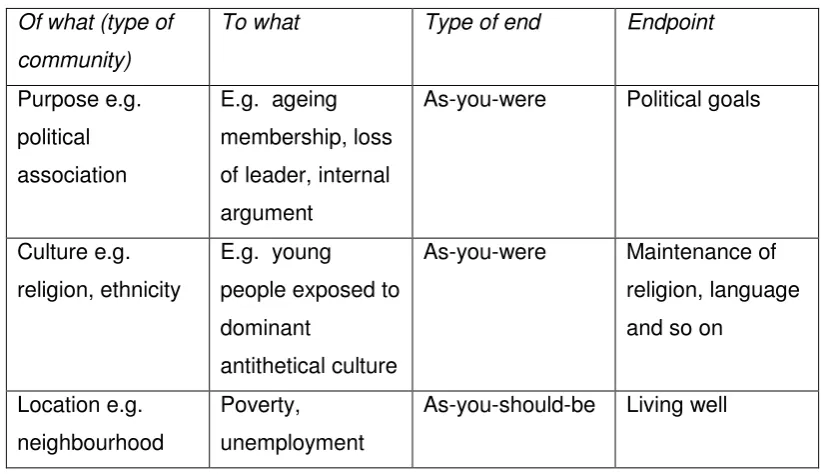
The breakdown by questions is more difficult in the case of chronic stressors, such as poverty and unemployment; here, though, is our attempt.
Of what? The notion of community is extensively discussed in the social policy and social science literature. A commonly-used categorisation is between communities of:
Location, such as a neighbourhood;
Culture, such as an ethnic group;
Purpose, such as a political association.
Some communities will be combinations of these. For example, a native-American rights group living in a reservation combines all three. By contrast, a neighbourhood might be filled with individuals who feel they have little in common with each other and do not feel a sense of belonging to the area. It is striking that much of the literature relating to resilient communities comes from the USA; in one example, Hispanic populations are noted as resilient to poverty.44
likely to share fewer of the ties of culture and purpose than are seen in US
neighbourhoods. In less multi-cultural cities and towns of the UK, the majority white population will often be such as to make neighbourhoods mono-cultural. However, without a shared difference from the wider community this mono-culture may not be associated with a feeling of homogeneity within the neighbourhood.
It follows that the ties between members of a neighbourhood may not be strong or important to its members; they might feel stronger ties to a community within or outside of the neighbourhood based, for example, on ethnicity. This makes it difficult to
understand community resilience at a neighbourhood level.
To what endpoint? Threats to communities of purpose are reasonably clear-cut; this is in part because the endpoints and therefore the threats to those endpoints are
reasonably clear. With communities of culture and, even more so, of location the question is less straightforward. We are concerned with chronic stressors, such as unemployment, poverty, crime and cuts in welfare rather than short-term external stressors, such as earthquakes. But identifying why these are stressors to a locality requires we know the purpose of a neighbourhood. What might this be?
As already noted, the endpoints of communities of purpose are reasonably clear; thus, for example, a political association has the endpoint of promoting the party's political interest. It is less clear with communities of culture although there might be a broad purpose, such as maintaining a religious viewpoint.
Of what (type of
community)
To what Type of end Endpoint
Purpose e.g. political association
E.g. ageing membership, loss of leader, internal argument
As-you-were Political goals
Culture e.g. religion, ethnicity
E.g. young
people exposed to dominant
antithetical culture
As-you-were Maintenance of religion, language and so on
Location e.g. neighbourhood
Poverty, unemployment
[image:14.595.119.530.87.324.2]As-you-should-be Living well
Table 3: Community stressors and endpoints
Thus a resilient community of location is one that is currently providing an environment in which members can live well given their circumstances and which can do so in the face of current or future stressors.
It is important to separate the ideas of a flourishing and a resilient community (of locality). In a flourishing community the members are generally living well; usually because it has resources people need, such as spaces for recreation, and social networks, such as bridging and bonding social capital (see Box 1).28 45
However, such a community is not resilient if it would be unable to maintain flourishing in the face of an external threat. As we shall see, however, in identifying resilient communities it is rare for approaches clearly to separate flourishing from resilience.
Box 1: Social Capital
Social Capital is the sum of the social networks that
b) Which are the resilient communities?
How then can we identify resilient communities? We need first to ask, resilient to what? And our reply is that in this report our concern is with poverty and associated problems. In relation to this, the most difficult to identify as resilient are those that are flourishing. Of a rich neighbourhood we can say little about how flourishing its members would be in the face of sudden economic catastrophe. As critics have noted, it is only the poor of whom resilience is asked. We shall return to this point in the discussion below. It is easier to identify resilient communities where they have faced the threat or stressor.
Source: CRESR (2013)
An interesting feature of this research was the identifying of the neighbourhood of Lodge Moor as resilient. This is a prosperous area with an older population.
Nonetheless, it is an outlier in the sense that its members are doing well in relation to the outcomes even given the already high level of prosperity. It would seem preferable to describe this community as flourishing rather than resilient. As such, the definition of resilient communities would apply only to those both in the positive outlier segment (as Lodge Moor is) and to the right of the graph (unlike Lodge Moor); in other words, communities that are both positive outliers and deprived.
quality, perceptions of social trust and cohesion, and availability of public space. The researchers called these measures the 'prime indicators' and suggested that these are measurable concepts, which provide a useful baseline for identifying resilient
communities. This model seems in principle a good one for identifying resilience as the resilience indicators are plausible contributors to the wellbeing of the poorest, that is, those who are required to be resilient.
A similar approach is seen in the Wellbeing and Resilience Measure (WARM)
produced for the Young Foundation. As the name implies, the measure is a complex one. It includes subjective measures of wellbeing and the identification of assets and of vulnerability in an area. In this model, resilience is conceived of as the sum of assets minus vulnerabilities, a picture shared with Zautra and Hall.
The flourishing/resilience distinction is less clearly maintained in Maybery et al.41 They develop a model of resilience, risk and well-being that examines community assets important for resilience for small, inland rural communities. The model depicts three types of resources: social assets, such as community relationships, clubs and churches; service agency assets, such as hospitals, doctors, schools and teachers; and neighbourhood and economic resources, such as employment opportunities and family income. Against these assets, the model depicts community risks such as economic disadvantages, poor physical infrastructure and a high level of crime.
In order to operationalize the model, the researchers developed a Community
Resources Questionnaire (CRQ) in consultation from community members. The CRQ was employed to map-out community resources and risks. Assuming the strong link between resilience and well-being and the researchers examined the Personal Well-being Index in small inland rural communities. Means and standard deviations were calculated across the communities for the categories of social assets, service agency assets, neighbourhood and community resources and community risks. However, in assuming the resilience and wellbeing link, the researchers do not clearly separate resilience from flourishing in the way we think is necessary. As such, they have the problem of potentially identifying prosperous and hugely flourishing outliers as being resilient. A similar lack of clarity is seen in Kretzman48 and Manzi.49 Both develop
tools for mapping out an area's assets but potentially confuse flourishing and resilience.
c) What are the characteristics of resilient communities?
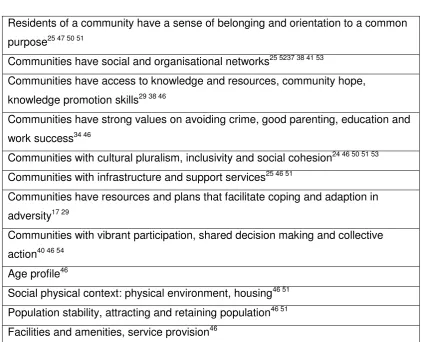
If we succeed in identifying the resilient communities, the next question would be: what are the characteristics by virtue of which they are resilient? In box 2 we have listed a number of characteristics attributed to resilient communities.
Residents of a community have a sense of belonging and orientation to a common purpose25 47 50 51
Communities have social and organisational networks25 5237 38 41 53
Communities have access to knowledge and resources, community hope, knowledge promotion skills29 38 46
Communities have strong values on avoiding crime, good parenting, education and work success34 46
Communities with cultural pluralism, inclusivity and social cohesion24 46 50 51 53 Communities with infrastructure and support services25 46 51
Communities have resources and plans that facilitate coping and adaption in adversity17 29
Communities with vibrant participation, shared decision making and collective action40 46 54
Age profile46
[image:19.595.104.526.151.493.2]Social physical context: physical environment, housing46 51 Population stability, attracting and retaining population46 51 Facilities and amenities, service provision46
Table 4: Characteristics of resilient communities
However, often it is not clear whether the communities are resilient because they have, say, vibrant participation or whether they have vibrant participation because they are resilient. This problem is another angle of the problem of distinguishing flourishing and resilience. Because the studies have not clearly distinguished one from the other, it is unclear whether the characteristics listed are of flourishing or of resilience.
Asking the members of the community seems a good starting point but there are two limitations. One is that community members might not necessarily know the factors that create community resilience; the second is that people will not be able to distinguish features of flourishing from features of resilience.
Other studies tried to identify features associated with resilience using methods other than asking the local population. For example, Mitchell compared 18 disadvantaged but resilient areas with the 36 disadvantaged and non-resilient areas. 51 They found, for example, that parts of the West Midlands had a relatively high concentration of BME communities in which men of Caribbean origin have a lower risk of cardiovascular mortality than the English and Welsh average, and those of South East Asian have lower rates of cancer mortality. The only difference between these areas and non-resilient ones that the researchers could identify was population stability. However, this finding needs to be read with caution as it might be that the actual cause was something not identified and measured by the researchers. However, community cohesion has been identified as an important factor to promoting resilience in other studies.
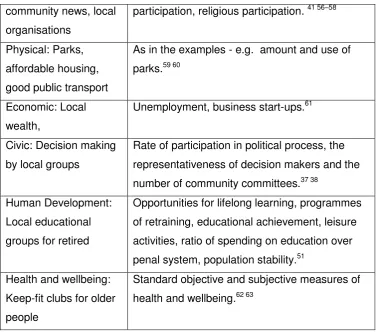
d) Measurement of community resilience
If a body takes measures to enhance community resilience then it would need to measure before-and-after resilience to evaluate its success. It is relatively easy to measure community resilience in relation to short-term, acute and external threats, such as earthquakes. Here, factors such as proportion of houses built to standard, numbers trained to deal with medical emergency, the availability of search equipment, could be totalled to give a community preparation or resilience score .55
As might be expected, this is not straightforward in relation to chronic stressors. Whilst there is some literature on measurement of community resilience to chronic stressors, it is confounded by the failure we have already noted, that of not adequately
distinguishing resilience from flourishing. Thus most, if not all, measures of resilience we found could be seen as measures of flourishing; indeed there is some cross over between these purported measures of resilience and measures of social capital.30
Infrastructure and
examples
Measures
community news, local organisations
participation, religious participation. 41 56–58
Physical: Parks, affordable housing, good public transport
As in the examples - e.g. amount and use of parks.59 60
Economic: Local wealth,
Unemployment, business start-ups.61
Civic: Decision making by local groups
Rate of participation in political process, the representativeness of decision makers and the number of community committees.37 38
Human Development: Local educational groups for retired
Opportunities for lifelong learning, programmes of retraining, educational achievement, leisure activities, ratio of spending on education over penal system, population stability.51
Health and wellbeing: Keep-fit clubs for older people
[image:21.595.99.478.68.400.2]Standard objective and subjective measures of health and wellbeing.62 63
III. Interventions to enhance community resilience
Discussion
This section begins with a summary. We then undertake a critical analysis of the concept of community resilience before setting out practical implications.
Summary of paper
The notion of community resilience is complicated in part because both terms have many aspects. We have distinguished three types of community: of purpose, such as a political association, of culture, such as religion and of locality, such as a
neighbourhood. Our primary interest in this report is with communities of locality. We have suggested a three-faceted model of resilience in which it is described as: of something, to something (a stressor), to an endpoint. Thus (local) community
resilience is: of a neighbourhood or locality, to a stressor, such as an earthquake, to an endpoint, such as back-to-normal.
The stressors faced by a community can be acute, such as an earthquake or the shutdown of a local employer, or chronic, such as long-term poverty and
unemployment. Community resilience is most easily seen in relation to acute stressors in part because both the stressor and endpoint are fairly clear. It is less clear with chronic stressors mainly because the endpoint cannot be back-to-normal.
We therefore suggested a distinction between as-you-were and as-you-should-be endpoints. An example of as-you-should-be resilience is where someone becomes a well-functioning adult despite abuse as a child. In relation to communities of locality, the as-you-should-be endpoint is roughly that they will provide places which enable rather than impede their members to live well, to flourish and to be happy. A local community is resilient to the extent that it does this in the face of stressors, such as poverty.
This problem links to a more general problem with the literature on measuring,
characterising and enhancing community resilience. This is that insufficient distinction is made between measures of how well people within a community are doing, i.e. their wellbeing, and of how resilient they are, i.e. their wellbeing given particular stressors. Thus most of the measures we identified in the literature as possible contributors to resilience were more like contributors to wellbeing. For example, measures to improve the built environment or social networks are better characterised as enhancing social capital and wellbeing rather than resilience. In practice, there seems likely to be a link between resilience and wellbeing. An individual or community without resilience to likely challenges would have precarious wellbeing
Measures to enhance community resilience
Our model of community resilience has two aspects: 1) of what - to what - to which endpoint; 2) as-you-were or as-you-should-be. This model provides the conceptual clarity that would make possible a focus on measures to enhance the resilience of a locality in relation to a stressor such as poverty. In order to fit with the resilience picture, such measures should as far as possible be based on the community's actual or potential assets. Take the following simple example:
Of what: Neighbourhood X;
To what: Chronic poverty;
Endpoint: People in neighbourhood living well (or relatively well in the circumstances; the focus could be on one particular aspect of this, such as eating well;
Local asset: Stable population includes many people who have always lived in poverty and who have fared reasonably well in relation to diet and have knowledge of how to prepare nutritious cheap meals;
Measure to enhance resilience: Locally produced cookbook;
Evaluation: Knowledge and use of cookbook after 6 months.
past, such as a childcare or library facility. Here the community might increase resilience by drawing on volunteers to run the facility. Another example of local resilience might be the setting up of food banks for those whose income is no longer sufficient to provide meals for their family. One difficulty here is making a clear
distinction between a measure that enhances resilience from a measure that reveals a community's resilience.
Criticisms of the focus on resilience
At this point concerns about the focus on community resilience surface. The problem with resilience is that it is about beating rather than changing the odds.64 This is fine in relation to natural or unavoidable disasters; a community located in an earthquake zone is well advised to develop measures to cope with future earthquakes. But should we say the same of poverty, austerity, cuts in welfare and so forth? Or should we say that the proper policy aim is to reduce poverty rather than increase the ability of the poor to cope?
Several authors detect a moralising tone in the desire to develop individual and community resilience. It is possible, perhaps even likely, that the attribution of
resilience to some individuals and communities will imply moral failings in the rest.45 64 Welshman gives a history from the 1880s to the 1980s of the way the poorest in the UK have been condemned morally as, social residuum, culturally poor, an underclass and so forth.45 The terminology of resilience and welfare dependency seems like its current manifestation.
Sen's Capability approach is a useful corrective here.42 43 Whilst resilience is clearly important in facing stressors, it is not a meaningful goal in itself. Individuals and
communities need to be resilient; but in order to live well they need much else besides. In increasing a community's ability to deal with a stressor, such as poverty or
unemployment, we should not lose sight of the fact that the stressor is bad. Reid notes that the resilience agenda has come alongside economic uncertainty; in being told we need resilience we are also being told that we should lose our attachment to economic security.65 This assumes that the economy must only function in an unfettered and uncontrolled way. This is disputed, for example, by those who view the protection of those who do least well as part of the role of Government.
(such as providing welfare rights advice or defending local amenities) rather than beating them (such as food banks). Nonetheless, at a local level, beating the odds might be the only option, at least in the short term. On Sen's account, poverty and unemployment preclude living well, but it is possible for some to live better in strained circumstances if you are resilient.
Implications for NHS Rotherham
This report set out with the primary aim of answering three questions:
1) What is a resilient community?
2) How can the resilience of a community be assessed? 3) How can the resilience of a community be promoted?
The attraction of the notion of resilience is, in part, political; it suits austere and uncertain times. It is also linked to the idea of individual responsibility, the need to prepare for adversity rather than expecting others to do it for you. Finally, it provides a different way of looking at a community; instead of looking for problems and deficits, we look for assets. In this sense, resilience is the flip side of vulnerability.
The interest for NHS Rotherham is primarily in the third question, the promotion of resilience. However, in order to promote the resilience of a community we need to know what resilience consists in and how to identify communities in need of such interventions (or not). The focus of NHS Rotherham is, of course, health. This makes it easier to define a resilient community using the three-question framework:
Of what: Neighbourhoods under stress and in need of increased resilience; identifying these would involve something like the outlier method described earlier;
To what: existing stressors associated with poor health (e.g. poverty) and forthcoming stressors likely to threaten health (e.g. NHS reconfiguration);
Endpoint: People in neighbourhood relatively healthy;
might be helpful in increasing resilience of elements within a neighbourhood. The literature has provided little explicit guidance here because most of the examples of measures to enhance resilience have been either aimed at dealing with
acute-emergency resilience or at developing wellbeing in a community rather than resilience. Despite this, it should be possible to create policy that draws upon existing community assets to help its members beat the odds in relation to their health.
Evaluation: standard measures of health could be used for this, such as disability-free expected life years.
Thus in relation to the third question, how resilience can be enhanced or promoted in Rotherham, the answer here is unfortunately but necessarily vague. However, the framework developed in this paper could provide the basis for politically astute promotion of community resilience regarding health. In relation to deprived
Appendix 1: Initial search strategy
Search strategy for resilient communities - 18/01/13
The following databases have been searched:
ASSIA (ProQuest)
Cochrane Library (Wiley)
CINAHL (EBSCO)
MEDLINE (EBSCO)
PsycINFO (ProQuest)
Scopus (Elsevier)
Sociological Abstracts (ProQuest)
Web of Science (Thomson Reuters)
MesH or theseaurus headings were applied where available.
Explanation of search terms used: / = MeSH Heading exp = exploded MeSH Heading; asterisk (*) denotes any character; ti = title word; ab = abstract word; N5 = adjacency within five words
1. resilien* N5 communit*:ti,ab. (318) 2. sustain* N3 communit*:ti,ab. (754) 3. resilien* N5 neighbourhood*:ti,ab. (1) 4. resilience, psychological/ (973) 5. communit*:ti,ab. (283,129) 6. neighbourhood*:ti,ab. (3559) 7. or/1-3 (1066)
8. or/5-6 (286,039) 9. 4 and 6 (126) 10. 7 or 9 (1457)
11. ecolog* (112,199) 12. disaster* (13,497) 13. coral* (10,418) 14. ecosystem* (54,407) 15. microbial* (249,001) 16. bacteri* (1,050,028) 17. emergenc* (268,770) 18. microbiolog* (775,677) 19. biolog* (1,992,734)
20. "climate change*":ti,ab. (9449) 21. exp. ecology/ (51,556)
22. exp. microbiology/ (101,746) 23. exp. ecosystem/ (69,074) 24. exp. disasters/ (56,017)
25. exp. disaster planning/ (10,014) 26. coral reefs/ (388)
28. exp. chrysophyta/ (71) 29. exp. biology/ (362,578) 30. exp. bacteria/ (1,000,360) 31. exp. climate/ (94,044) 32. exp. climate change/ (7662)
33. conservation of natural resources/ (26,155) 34. or/11-29 (3,950,342)
35. 5 not 25 (English Language) (908)
On non-health orientated databases* the following additional search facets were applied.
1. health:ti,ab. 2. wellbeing:ti,ab. 3. well-being:ti,ab. 4. "well being":ti,ab. 5. wellness:ti,ab. 6. well-ness:ti,ab. 7. exp. health/ 8. exp. well being/
Database Search numbers yielded
ASSIA* 171
CINAHL 427
Cochrane 26
Google 830,000,000
MEDLINE 908
PsycINFO* 553
Scopus* 205
Sociological Abstracts* 165
Web of Science* 607
Appendix 2: Interventions to enhance community resilience Name of
intervention
Details Success Comments
Thrive.66 Development and pilot of a community assessment framework known as a "toolkit for health and resilience in vulnerable environment (THRIVE). This toolkit facilitates communities to identify and nurture factors and features in the community environment, which promote positive and safe health outcomes for racial and ethnic minorities. The THRIVE assessment tool consists of 20 factors grouped in 4 clusters: built environment (streets design, public transportation and permitted uses of buildings), social capital (individual social networks, norms of reciprocity, and trust), services and institutions (availability and access to appropriate public and private services and
institutions) and structural factors (racial relations, employment and economic opportunities). THRIVE was developed from an iterative process including review of literature, interviews with practitioners and academics and an internal analysis.
This was piloted into three communities. The results were positive from all pilot sites,
1) It was not possible to conclude that the change was due to THRIVE and not, for example, to the funding received by the pilot sites to participate;
2) The assessment fails to distinguish resilience from flourishing.
Victorian Neighbourhood
The neighbourhood renewal initiative focused on tackling social determinants of health by renewal of the houses, streets and
An interim evaluation results show that 60%
Renewal Initiative.67
neighbourhood, in which deprived people live. More than $153 million has been allocated by the Office of Housing for the renewal of the disadvantaged houses. Over 2500 properties have been upgraded and improved and over 130 new
proprieties built through Neighbourhood Renewal Initiative. A public survey was conducted indicated that these changes are making a crucial difference to people's lives - improving the liveability of their homes and pride in the place they live.
Neighbourhood Renewal areas have experienced a decrease in property crimes, 90% decrease in crime against people and 86% reduction in crime related to drug use and vandalism
flourishing.
Linking Human System (LINC) Community Resilience model.68 69
In this model the term community encompass the natural support system: extended family, friends, neighbours, health care providers, clergy, employers, and co-workers. The
community resilience was defined as 'the community's inherent capacity, hope, and faith to withstand major trauma, overcome adversity, and to prevail, with increased resources, competence and connectedness'. The purpose of LINC model is provide a tool to identify and coach people from within the community, called "community links", to act as natural agents for change, relying on the family as the foundation of community. This model is proposed to apply in communities that have
This intervention has been used in many countries including United States,
Argentina, Kosovo and South Africa. The authors suggested this model is used to enhance community resilience. However, they did not provide
experienced adversity such as pandemics, natural disasters and poverty.
sufficient evidence to support the
effectiveness of the LINC model. Community
Action Model.70
This is a 5-steps model developed to tackle the social determinants of tobacco-related health inequalities through developing policy at grassroots level. Five steps include skill-based training, action research, analysis, policy and
implementation. Community action model involves a group of 5 to 15 community members as advocates. The success of this model is measured by policy development and implementation.
This model has been used in 37 projects, of these 28 successfully completed by
organising a variety of community initiated actions
This is not directly concerned with resilience although the authors use the term.
However, it is an asset-based approach; this is something we discuss below.
Prevention of exclusion. 71
A community based intervention to promote resilience in early childhood institutions in disadvantaged areas. This study considered resilience as 'the ability to manage crisis, difficult situations and developmental tasks'. A 'setting approach' was applied in this intervention focusing on different levels including early child-hood teachers' level (teachers received six training sessions on concept of resilience); child level (children took part in a structured training-course); parent level parents were involved in a weekly family consultation hour and attended a
The study results show positive changes in children especially concerning the development of self-esteem as compared to control group. Parents acknowledged that they were able to identify
parental course) and network level (developed co-operation and networking between early childhood institutions).
their own skills, making them feel more
confident
References
1 Marmot M. Fair Society, Healthy Lives: Strategic review of health inequalities in England post 2010. London: Department of Health 2010. www.marmotreview.org.
2 Taylor B, Mathers J, Atfield T, et al. What are the challenges to the Big Society in maintaining lay involvement in health improvement, and how can they be met? Journal of Public Health 2011;33:5–10.
3 Grant MJ, Booth A. A typology of reviews: an analysis of 14 review types and associated methodologies. Health Information and Libraries Journal
2009;26:91–108.
4 OED. Oxford English Dictionary. Oxford University Press. http://www.oed.com/ (accessed 10 Jun2013).
5 Bhamra R, Dani S, Burnard K. Resilience: the concept, a literature review and future directions. International Journal of Production Research
2011;49:5375–93.
6 Norris FH, Stevens SP, Pfefferbaum B, et al. Community resilience as a metaphor, theory, set of capacities, and strategy for disaster readiness.
American Journal of Community Psychology 2008;41:127–50.
7 Ponis ST, Koronis E. Supply Chain Resilience: Definition Of Concept And Its Formative Elements. Journal of Applied Business Research
2012;28:921–30.
8 Aisenberg E, Herrenkohl T. Community violence in context: risk and resilience in children and families. Journal of Interpersonal Violence
2008;23:296–315.
9 Concato J, Gill TM, Hardy SE. Resilience of community-dwelling older persons. Journal of the American Geriatrics Society 2004;52:257–62.
10 Landau J. Communities That Care for Families: The LINC Model for Enhancing Individual, Family, and Community Resilience. American Journal of Orthopsychiatry 2010;80:516–24.
11 Ong AD, Bergeman CS, Boker SM. Resilience comes of age: defining features in later adulthood. Journal of Personality 2009;77:1777–804.
12 P F, Oberlink M. The AdvantAge initiative: developing community indicators to promote the health and well-being of older people. Family and Community Health 2003;26:268–74.
13 O’Donnell D a, Schwab-Stone ME, Muyeed AZ. Multidimensional
14 Wexler LM, DiFluvio G, Burke TK. Resilience and marginalized youth: making a case for personal and collective meaning-making as part of resilience research in public health. Social Science & Medicine
2009;69:565–70.
15 Williams LK, Veitch J, Ball K. What helps children eat well? A qualitative exploration of resilience among disadvantaged families. Health Education Research 2011;26:296–307.
16 Bebbington PE, Sturt E, Tennant C, et al. Misfortune and resilience: a community study of women. Psychological Medicine 2009;14:347–63.
17 Ungar M. Nurturing Hidden Resilience in At-Risk Youth in Different Cultures. Journal of the Canadian Academy of Child and Adolescent Psychiatry 2006;15:53–8.
18 Chaskin RJ. Resilience, Community, and Resilient Communities: Conditioning Contexts and Collective Action. Child Care in Practice
2008;14:65–74.
19 Kulig JC. Community resiliency: the potential for community health nursing theory development. Public Health Nursing 1997;17:374–85.
20 Dunstan DA, Todd AK. A method of assessing the resilience of whole communities of children: An example from rural Australia. Child And Adolescent Psychiatry And Mental Health 2012;6:17.
21 Fernando G. Bloodied but unbowed: resilience examined in a South asian community. The American Journal of Orthopsychiatry 2012;82:367–75.
22 Mooney-Somers J, Maher L. The Indigenous Resiliency Project: a worked example of community-based participatory research. NSW Public Health Bulletin 2009;20:112–8.
23 Ungar M. Resilience across Cultures. British Journal of Social Work
2006;38:218–35.
24 Brown D, Kulig J. The concept of resiliency: theoretical lessons from community research. Health and Canadian Society 1996;7:29–50.
25 Buikstra E, Ross H, King CA, et al. The components of resilience— Perceptions of an Australian rural community. Journal of Community Psychology 2010;38:975–91.
26 Canvin K, Marttila A, Burstrom B, et al. Tales of the unexpected? Hidden resilience in poor households in Britain. Social Science & Medicine
2009;69:238–45.
27 Davis R, Cook D, Cohen L. A community resilience approach to reducing ethnic and racial disparities in health. American Journal of Public Health
28 Kraglund-Gauthier WL, Folinsbee S, Quigley BA, et al. Re-conceptualizing health and learning in terms of community resilience and enterprise.
Journal of Enterprising Communities: People and Places in the Global Economy 2009;3:405–14.
29 Paton D, Parkes B, Daly M, et al. Fighting the flu: developing sustained community resilience and preparedness. Health Promotion Practice
2008;9:45S–53S.
30 Poortinga W. Community resilience and health: The role of bonding, bridging, and linking aspects of social capital. Health & Place
2012;18:286–95.
31 Adger WN. Social and ecological resilience: are they related? Progress in Human Geography 2000;24:347–64.
32 Masten AS. Ordinary magic: Resilience processes in development.
American Psychologist 2001;56:227–38.
33 Masten AS, Best KM, Garmezy N. Resilience and development: Contributions from the study of children who overcome adversity.
Development and Psychopathology 1991;2:425–44.
34 Abdou CM, Schetter CD, Jones F, et al. Community perspectives: Mixed-methods investigation of culture, stress, resilience, and health. Ethnicity and Disease 2010;20:S241–S248.
35 Mykota DB, Muhajarine N. Community Resilience Impact on Child and Youth Health Outcomes: A Neighbourhood Case Study. Canadian Journal of School Psychology 2005;20:5–20.
36 McBeath B, Briggs HE, Aisenberg E. Examining the Premises Supporting the Empirically Supported Intervention Approach to Social Work Practice.
Social Work 2010;55:347–57.
37 Moen P. Women’s roles and resilience: Trajectories of advantage or turning points?: Cambridge University Press, New York, NY 1997. 133–56.
38 Ahmed R, Seedat M, Van Niekerk A, et al. Discerning community resilience in disadvantaged communities in the context of violence and injury prevention. South African Journal of Psychology 2004;34:386–408.
39 Pooley JA. Resilience: A Definition in Context. Australian Community Psychologist 2010;22:30–7.
40 Cadell S, Karabanow J, Sanchez M. Community, empowerment, and resilience: paths to wellness. Canadian Journal Of Community Mental Health = Revue Canadienne De Santé Mentale Communautaire
2001;20:21–35.
42 Sen A. The Idea of Justice. Harmondsworth: : Penguin 2010.
43 Nussbaum M. Creating Capabilities: The Human Development Approach. USA: : Belknap/ Harvard University Press 2011.
44 Zautra A, Hall J., Murray K. Resilience: a new definition of health for people and communities. In: Reich J, Zautra A, Hall JS, eds. Handbook of Adult Resilience. New York: Guildford 2010. 3–34.
45 Welshman J. Searching for social capital: historical perspectives on health, poverty and culture. The Journal of the Royal Society for the Promotion of Health 2006;126:268–74.
46 Platts-Fowler D, Robinson D. Neighbourhood resilience in Sheffield: Getting by in hard times. Sheffield: 2013.
http://www.shu.ac.uk/research/cresr/sites/shu.ac.uk/files/neighbourhood-resilience-sheffield.pdf Accessed 11th June 2013
47 Hall J., Zautra A. Indicators of community resilience. In: Reich J, Zautra A, Hall J., eds. Handbook of Adult Resilience. New York: Guildford 2010. 350–71.
48 Kretzman J. Asset-based strategies for building resilient communities. In: Reich J, Zautra A, Hall J., eds. Handbook of Adult Resilience. New York: Guildford 2010. 484–95.
49 Manzi T. Promoting responsibility, shaping behaviour. Housing Studies
2010;25:5–19.
50 Forschner B. A sense of community. Health Progress 1992;75(3):34–57.
51 Mitchell R, Gibbs J, Tunstall H, et al. Factors which nurture geographical resilience in Britain: a mixed methods study. Journal of Epidemiology & Community Health 2009;63:18–23.
52 Griffiths R, Horsfall J, Moore M, et al. Building social capital with women in a socially disadvantaged community. International Journal Of Nursing Practice 2009;15:172–84.
53 Mykota DB, Muhajarine N. Community resilience impact on child and youth health outcomes: A neighbourhood case study. Canadian Journal of School Psychology 2005;20:5–20.
54 Cattell V, Herring R. Social capital and well-being: generations in an East London neighbourhood. Journal of Mental Health Promotion 2002;1:8–19.
55 Sherrieb K, Norris FH, Galea S. Measuring Capacities for Community Resilience. Social Indicators Research 2010;99:227–47.
56 Forschner BE. A sense of community. Senior living communities must allow for mission, mutuality, and myth. Health Progress (Saint Louis, Mo)
57 Fernando MW. Sustenance for the sustainer: financing the urban
community health worker. Community Development Journal 1995;30:248– 56.
58 Murray M. Social capital formation and healthy communities: insights from the Colorado Healthy Communities Initiative. Community Development Journal 2000;35:99–108.
59 Dearry A, Fallon LRO, Srinivasan S. Creating healthy communities, healthy homes, healthy people: initiating a research agenda on the built environment and public health. American Journal of Public Health
2003;93:1446–50.
60 Evenson KR, Sallis JF, Handy SL, et al. Evaluation of Physical Projects and Policies from the Active Living by Design Partnerships. American Journal of Preventive Medicine 2012;43:S309–S319.
61 Jenssen JI, Koenig HF. The Effect of Social Networks on Resource Access and Business Start-ups. European Planning Studies 2010;10:37– 41.
62 Griffiths R, Horsfall J, Moore M, et al. Building social capital with women in a socially disadvantaged community. International Journal of Nursing Practice 2009;15:172–84.
63 Morita A, Takano T, Nakamura K, et al. Contribution of interaction with family, friends and neighbours, and sense of neighbourhood attachment to survival in senior citizens: 5-year follow-up study. Social Science &
Medicine 2010;70:543–9.
64 Seccombe K. “ Beating the odds ” versus “ changing the odds ”: Poverty , resilience , and family policy. Journal of Marriage and Family
2002;64:384–94.
65 Reid J. The disastrous and politically debased subject of resilience. In: Soderbaum F, Sorenson J, eds. Developmental Dialogue. Uppsala: Dag Hammarskjold Foundation 2012. 67–80.
66 Davis R, Cook D, Cohen L. Race, genetics, and health disparities. A community resilience approach to reducing ethnic and racial disparities in health. American Journal of Public Health 2005;95:2168–73.
67 Klein H. Health inequality, social exclusion and neighbourhood renewal: Can place-based renewal improve the health of disadvantaged
communities? Australian Journal of Primary Health 2004;10:110–9.
68 Landau J. Communities That Care for Families: The LINC Model for Enhancing Individual, Family, and Community Resilience. American Journal of Orthopsychiatry 2010;80:516–24.
70 Hennessey Lavery S, Smith ML, Esparza AA, et al. The community action model: a community-driven model designed to address disparities in health. American Journal of Public Health 2005;95:611–6.