modifies action opportunities during training
VILAR, Luis, ESTEVES, Pedro T., TRAVASSOS, Bruno, PASSOS, Pedro,
LAGO-PEÑAS, Carlos and DAVIDS, Keith
<http://orcid.org/0000-0003-1398-6123>
Available from Sheffield Hallam University Research Archive (SHURA) at:
http://shura.shu.ac.uk/9529/
This document is the author deposited version. You are advised to consult the
publisher's version if you wish to cite from it.
Published version
VILAR, Luis, ESTEVES, Pedro T., TRAVASSOS, Bruno, PASSOS, Pedro,
LAGO-PEÑAS, Carlos and DAVIDS, Keith (2014). Varying numbers of players in
small-sided soccer games modifies action opportunities during training. International
Journal of Sports Science and Coaching, 9 (5), 1007-1018.
Copyright and re-use policy
See
http://shura.shu.ac.uk/information.html
Sheffield Hallam University Research Archive
Varying Numbers of Players in Small-Sided
Soccer Games Modifies Action
Opportunities During Training
Luís Vilar1,2, Pedro T. Esteves3, Bruno Travassos4,
Pedro Passos2, Carlos Lago-Peñas5and Keith Davids6,7
1Universidade Europeia, Lisboa, Portugal
E-mail: [email protected]
2CIPER, Faculty of Human Kinetics, Technical University of Lisbon,
Portugal
3Faculty of Human Kinetics, Technical University of Lisbon, Portugal
4CIDESD, Department of Sports Sciences, University of Beira Interior,
Portugal
5Faculty of Sports Sciences, University of Vigo, Spain
6Centre for Sports Engineering Research, Sheffield Hallam University, UK
7FiDiPro Programme, University of Jyväskylä, Finland
ABSTRACT
This study examined the effects of the numbers of players involved in small-sided team games (underloading and overloading) on opportunities for maintaining ball possession, shooting at goal and passing to teammates during training. These practice constraint manipulations were assumed to alter values of key performance variables identified in previous research, such as interpersonal distances between players and time to intercept shots and passes. Fifteen male soccer players (age: 19.60±1.99 years) were grouped into three teams and played against each other in different versions of small-sided soccer games, in which the number of players was manipulated in three different conditions: 5 vs. 5, 5 vs. 4 and 5 vs. 3. Dependent variables were the values of interpersonal distance between an outfield attacker and nearest defender (ID), and the relative distance of a defender needed to intercept the trajectory of a shot (RDishot) or pass (RDipass). Statistical analyses revealed that mean ID values were significantly lower in 5 vs. 5 than in 5 vs. 4 and 5 vs. 3 conditions, and significantly lower in 5 vs. 4 than 5 vs. 3. They also revealed that mean values of RDishotwere significantly higher in 5 vs. 3 than in 5 vs. 5 conditions. Finally, results showed that the mean values of RDipasswere significantly higher in 5 vs. 3 than in 5 vs. 5. Findings revealed how task constraints in SSGs can be manipulated to vary values of key spatial and temporal performance variables
Reviewers: Jia Yi Chow (Nangyang Technological University, Singapore)
(interpersonal distance and time to intercept) to influence the nature of interpersonal interactions between competing players during practice. We observed that these manipulations tended to decrease opportunities for maintaining ball possession during training when equal numbers of attackers and defenders existed in SSGs, and led to more shots and passes emerging when the number of defenders was decreased relative to attackers.
Key words: Affordances, Association Football, Ball Possession, Constraints-Based Approach, Interpersonal Distance, Small-Sided Games, Soccer
INTRODUCTION
Successful performance in team sports like soccer is influenced by the ability of players to identify opportunities for actions from their spatial-temporal relationships with other players (both teammates and opponents) and key task constraints (such as the location of the sidelines, goal and ball) 1. For example, an ecological dynamics analysis of performance has
demonstrated how defenders decrease the values of interpersonal distanceto ball carriers to dispossess them and recover ball possession 2. To prevent this from happening and maintain
ball possession, teammates use information of this closing gap in distance between ball carriers and defenders to move towards the ball carrier and afford him more passing opportunities 3. Additionally, ball carriers have also been observed to regulate their passing
and shooting actions according to the time available for the opponents to reach the trajectory path of the ball to intercept a shot at goal or a pass 4, 5. Importantly, the study of the
emergence of different possibilities for ball carriers to maintain ball possession, pass to teammates and shoot at the goal may endue with significant implications for understanding the acquisition of movement and decision makings in team sports 6.
Based on these compelling research outcomes, proponents of an ecological dynamics approach to acquisition of movement and decision making skills in team sports have proposed pedagogical principles to maintain fidelity of action, that is, to maximize the transfer between behaviours in a training task with that of the competitive performance setting to which it is intended to generalize 7, 8. Key principles comprehend the inclusion of
affordances (i.e., possibilities for action), within learning environments, available for the players to explore and act and, therefore, maintaining strong couplings between processes of perception and action 9, 10. These principles help to educate the perception of learners during
action in simulated performance contexts, while they learn to explore affordances through movements 11. In light of these findings, it is important for pedagogists to understand how
learning environments can be designed to facilitate players in establishing functional relationships between themselves and their teammates and opponents, which may afford them opportunities to perform key actions when scoring/preventing goals or maintaining/recovering ball possession. The application of such pedagogical principles in sport is based on the constraints-led approach for teaching. In soccer, a constraints-led approach proposes that task constraints should be manipulated by coaches during practice to emphasize affordances that support successful performance of players 12. A viable way for
games to enhance learning opportunities 13. One advantage of SSCGs is that the variability
present in task design allows players to experience a variety of movement patterns that features competitive performance environments 14. Practice under ‘noisy’ learning
environments has been identified as an important pedagogical principle (in differential learning and ecological dynamics) that helps players to develop adaptive movement behaviours and successful decision making 15
Clearly, the benefits that arise from practice for players are highly dependent on the design of specific SSCGs. However, there have been very few attempts to examine how varying task constraints in SSCGs actually shape acquisition of movement and decision making skills in team sports. Previous research on SSGCs has tended to focus solely on effects of different task constraints on physiological performance measures (e.g., heart rate)
16, 17 and technical responses (frequency of actions performed) 18, 19. Rather than merely
investigating effects of SSCGs on individuals, it is also important to investigate how different task constraints can shape performance opportunities for players (i.e., affordances) during training. This point would be of foremost importance for coaches to understand how manipulating different task constraints (e.g., size of the pitch, number of players per side, modified rules of a practice game) can channel behaviours of players and teams towards new levels of performance.
A common constraint that coaches manipulate near the end of the match in small 5-aside soccer games (futsal) is for the losing team, when in possession of the ball, to substitute the goalkeeper for an extra outfield player, in order to create an overload on-field 20. Coaches
believe that the game strategy of overloading one extra outfield attacker over the number of defenders is an attacking ploy that might afford a higher number of goal scoring opportunities. However, this view has yet to be verified in empirical research and it is unclear how varying the numbers of players during performance sub-phases or during practice games can modify the emergence of action opportunities. In this sense, it is relevant to investigate effects of manipulating the relative number of outfield players in teams on the emergence of desired movement behaviours in SSCG.
Here we aimed to investigate how varying the relative number of outfield players of teams in SSCG might modulate opportunities for attackers to maintain ball possession, shoot at goal and pass to teammates. The different task constraints of numerical equality of teams, as well as overloads of one and two attackers, allowed us to examine its influence on values of attacker-defender interpersonal distance, and the relative distances needed to intercept shots and passes by the defending team. Based on previous research, we expected to observe that the defending players might show an increasing difficulty in closing off shooting and passing line trajectories for attackers, as an overload of attackers over defenders was progressively increased. This study was expected to provide empirical data for sport pedagogists to aid understanding of how SSCG design, such as manipulating numbers in practice games, would influence opportunities for action in trainees.
METHOD
This study was conducted within the guidelines of the American Psychological Association and a local university ethics committee approved the protocol.
DATA COLLECTION
Participants were randomly grouped into three teams of five players and played twice against each other (total of 6 trials). Task constraints of the small-sided soccer games were manipulated by altering the numbers of players involved per side. Each trial lasted five minutes and was played on a synthetic turf pitch of soccer sized 40x20m (official dimensions of FIFA rules for futsal). This experimental setting was repeated on three non-consecutive days (at the same time of day), in which the relative number of players of the teams was manipulated on each day. In the first condition, each team played with one goalkeeper and four outfield players (5 vs. 5); in the second condition a ‘floater’ (an individual with a different coloured shirt that played for the team in possession of the ball) ensured an overload for the attacking team (5 vs. 4); and in the third condition, two ‘floaters’ were used in a 5 vs. 3 overload. Movement behaviours during practice sessions were recorded with a digital video camera (25 Hz) located in the superior plane and positioned 45° to one of the goal field lines. The ninety (n=90) longest offensive sequences of play preceding a transition in a team’s ball possession (n=30 for each condition of the small-sided soccer games) were selected for further analysis. Digital video footage files were trimmed to begin at 10 s prior to loss of ball possession (i.e., a shot being intercepted or the ball leaving the field of play). This value was identified in pilot work and found to be the maximum common length of all playing sequences.
DATA ANALYSIS
The 2D positional virtual coordinates (i.e., in pixels) from the displacements of all players and the ball were acquired though a digitising procedure with the TACTO software package. This software has been reported to have a measurement error of less than 5% in tracking player displacements 21. This digitising procedure consisted of following with a mouse
cursor a working point located in the middle of the feet of each player 22. A bi-dimensional
direct linear transformation method (2D-DLT) was used to convert pixel coordinates into actual pitch coordinates (i.e., in meters). Data were filtered using a Butterworth low pass filter with a cut-off frequency of 6Hz 23.
The role of the attackers in each frame was defined by computing the distances of all outfield attackers to the ball. This procedure defined the A1 (nearest attacker to the ball or ball carrier), A2(2ndnearest attacker to the ball), A
3(3rdnearest attacker to the ball) and A4
(the furthest outfield attacker to the ball), in the video footage. The value for the interpersonal distance (ID) between each attacker and the nearest defender was also computed for each time frame and set as first dependent variable. The values of shooting interception points (IPs) were calculated by considering the shortest distance of all outfield defenders to an imaginary line between each attacker and the centre of the goal. To calculate the value of the distance of each defender to the IP, we considered an estimation of half of the value for shoulder-to-shoulder width (0.40m) and the radius of the futsal ball used in this experiment (0.10m) (2011). We also calculated the distance of each attacker to the interception point. The relative distance to intercept a shot (RDishot) was set as a second dependent variable calculated according to the following formula (see Figure 1):
RDishot = Smallest defenders’ distance to the shooting IP / Attacker’s distance to the shooting IP
distance to intercept a pass (RDipass):
RDipass= Smallest value of the distance to the passing IP of each defender / Ball carrier’s distance to the passing IP
In line with the previous formula, low values of RDishot and RDipass might capture minimal shooting and passing opportunities, respectively, since they would express a closer positioning of defenders to the ball flight path, in contrast with the attackers’ positioning. Alternatively, high values of RDishot and RDipass would express a closer positioning of attackers to the shooting and passing interception points, in contrast with the defenders’ positioning. All data were computed in MATLAB®R2009a software (The MathWorks Inc,
Natick, MA, USA).
Dependent variables were analysed using a two-way ANOVA, in which the relative number of players (5 vs. 5, 5 vs. 4 and 5 vs. 3 conditions) and the attackers (A1, A2, A3and A4) were between-participant factors. Note that for RDipass , there were only three passing possibilities for A1(passes to A2, A3and A4). The equality of variances assumption for the between-participant factor was assumed because groups were composed of an equal sample size 24. Observed significant effects were followed up using Bonferroni post-hoc tests. The
level of significance was set at p < .05. All statistical analyses were computed using SPSS®
[image:6.553.123.441.152.369.2]20.0 software (IBM SPSS Inc., Chicago, USA).
RESULTS
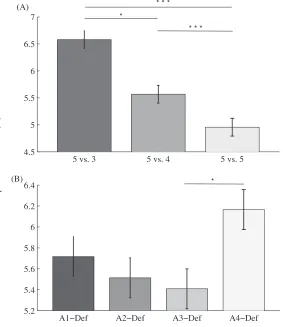
Statistical analyses of ID revealed a significant main effect for relative number of players, F(2,348) = 24.56, p < .001, h2= .12. Post hoc tests on relative number of players showed that
the mean values of ID were significantly lower in 5 vs. 5 (M = 4.96, SE = .17) than in 5 vs. 4 (M = 5.57, SE = .17, p < .001) and 5 vs. 3 (M = 6.58, SE = .17, p < .001). In addition, the mean values of ID were significantly lower for 5 vs. 4 than in 5 vs. 3 (p < .05). Statistical analyses revealed a significant main effect for attacker, F(3,348) = 3.08, p < .05, h2= .03.
Post hoc tests on attacker showed that the mean values of ID were significantly lower in A3 (M = 5.41, SE = .19), than in A4 (M = 6.17, SE = .19, p < .05). Finally, there were no significant main effects for relative number of players X attacker interactions, F(6,348) = .95, p > .05, h2= .02 (see Figure 2).
5 vs. 3 5 vs. 4 5 vs. 5
4.5 5 5.5 6 6.5 7 (A)
Interpersonal distance (m)
A1−Def A2−Def A3−Def A4−Def
5.2 5.4 5.6 5.8 6 6.2 6.4
(B) *
* * * *
[image:7.553.133.416.239.566.2]* * *
Figure 2. The influence of the ‘relative number of players’ (A) and ‘attackers’ (B) on the mean values of the interpersonal distance between outfield attackers and their immediate outfield defenders
Statistical analysis of RDishotrevealed a significant main effect for relative number of players, F(2,348) = 3.46, p > .05, h2 = .02. Post hoc tests on relative number of players
showed that the mean values of RDishotwere significantly higher in 5 vs. 3 (M = 3.08, SE = .41), than in 5 vs. 5 (M = 1.72, SE = .41, p < .05). Statistical analyses also revealed a significant main effect for attacker, F(3,348) = 16.00, p < .001, h2= .12. Post hoc tests on
attacker showed that the mean values of RDishotwere significantly lower for A1 (M = .61, SE = .48), than for A3 (M = 3.81, SE = .48, p < .001) and for A4 (M = 4.59, SE = .48, p < .001). In addition, the mean values of RDishotwere also significantly lower for A2 (M = 1.40, SE = .48), than for A3 (p < .01) and for A4 (p < .001). A statistically non-significant effect was observed for relative number of players X attacker interactions, F(6,348) = 1.57, p > .05, h2
= .03 (see Figure 3).
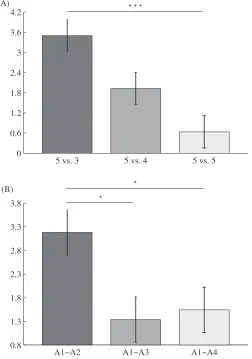
Statistical analysis of RDipass revealed a significant main effect for relative number of players, F(2,261) = 8.99, p < .001, h2 = .06. Post hoc tests on relative number of players
[image:8.553.172.406.244.535.2]showed that the mean values of RDipasswere significantly higher in 5 vs. 3 (M = 3.50, SE = .48), than in 5 vs. 5 (M = .63, SE = .48, p < .001). In addition, statistical analyses revealed a significant main effect for attacker, F(2,348) = 4.47, p < .05, h2 = .03. Post hoc tests on
Figure 3. The influence of the relative number of players (A) and attackers (B) on the mean values of the relative distance to intercept a shot
* p< .05, ** p< .01 and *** p< .001.
5 vs. 3 5 vs. 4 5 vs. 5
1.2 1.6 2 2.4 2.8 3.2 3.6 (A)
Relative distance to intercept a shot
A1−Goal A2−Goal A3−Goal A4−Goal 0
0.7 1.4 2.1 2.8 3.5 4.2 4.9 5.6 (B)
* * * * * *
* * *
attacker showed that the mean values of RDipasswere significantly higher for A2 (M = 3.18, SE =.48), than for A3 (M = 1.33, SE =.48, p < .05) and for A4 (M = 1.54, SE =.48, p < .05). A statistically non-significant effect was observed for relative number of players X attacker interactions, F(4,261) = 1.10, p > .05, h2= .02 (see Figure 4).
DISCUSSION
The aim of this study was to investigate the influence of the relative number of outfield players of teams in SSCGs in modulating opportunities for performers to maintain ball possession, shoot at goal and pass to teammates. We compared conditions of numerical equality and overloads of one and two attackers, to examine their influence on values of attacker-defender interpersonal distance, and their relative distances to intercept shots and passes.
5 vs. 3 5 vs. 4 5 vs. 5
0 0.6 1.2 1.8 2.4 3 3.6 4.2 (A)
Relative distance to intercept a pass
A1−A2 A1−A3 A1−A4
0.8 1.3 1.8 2.3 2.8 3.3 3.8 (B)
*
[image:9.553.161.413.155.514.2]* * * *
Figure 4. The influence of the relative number of players (A) and attackers (B) on the mean values of the relative distance to intercept a pass
Mainly, results revealed significant differences between conditions when using a 5 vs. 5 SSCGs design or using a 5 vs. 3 SSCGs design. This finding suggests that playing with one less defender (underload) might not impact greatly on the capacity of a defensive team to intercept the passes or shots at goal by players in the attacking team. This outcome may be due to the fact that, with less one defender than attackers, the defensive team tended to retreat on field, dropping deeper towards their own goal 20. Apparently, as a result of the underload
task constraint, interacting attackers and defenders increased their interpersonal distances values, allowing for greater opportunities for attackers to maintain ball possession. However, taking two defenders out of a SSCG (in a 5 vs. 3 design) appeared to induce significant changes in the attackers’ behaviours, leading them to create more opportunities for shots at goal. This may be due to the greater difficulty in defenders remaining between attackers and the centre of the goal to prevent scoring opportunities 25. This also might be a plausible
justification for defenders coupling their movement displacements more with the ball than with attackers when facing an underload of one player 20. Finally, a task constraint with a
numerical superiority of two attackers seemed to amplify opportunities for passing. Previous research showed that when defenders were further away from the passing line trajectory, more successful passes tended to occur 4. In 5 vs. 3 conditions, there were four passing possibilities
for the attacker in possession of the ball and only three defenders, making it harder for the defenders to simultaneously remain close to all possible ball trajectories. This spatial variation on field led to an increase in the attacking team’s affordances to perform passes.
Analysis showed that defenders positioned closer to the ball tended to maintain lower interpersonal distance values to their respective attackers. Conversely, defenders further away from the ball maintained higher interpersonal distance values to their respective attackers. This finding is in line with previous research showing that defenders tend to approach attackers who are closer to the ball giving more space to attackers further away from the ball, i.e., those who were less likely to be immediately involved in an offensive play
3. In addition, results showed that attackers further away from the ball had greater
possibilities for shooting at goal, but with less likelihood of receiving the ball. Conversely, attackers closer to the ball were more likely to receive the ball, with limited possibilities to shoot at the goal. This outcome may have been related to the intention of the 2nddefender to
remain close to the passing line (i.e., between the ball carrier and the furthest attacker), and simultaneously being close to the shooting line of the A2(between the 2ndattacker and the
goal). In turn, this tactic would allow the 4thdefender to move backwards in the field and
cover the defender in the dyad, marking in case of a successful dribble by the ball carrier 26.
However, passing opportunities may still exist when defenders remain between the ball carrier and other attackers (i.e., through aerial displacements of the ball).
This study highlighted some key pedagogical principles of the constraints-led approach for designing training environments in team games. Mainly, the manipulation of the relative number of players in SSCGs (underloading and overloading) seems to be an effective strategy to facilitate skill acquisition in team sports like futsal, while representing environmental properties of competitive performance. Coaches at earlier stages of learning should manipulate task constraints to promote an overload of two attackers over defenders. This strategy would acknowledge the perceptual and motor limitations of learners, since it would provide players in possession of the ball with more time to act and decide 27and also
In this article on futsal we showed that an overload of two defenders in the design of practice tasks is expected to be a reliable strategy for coaches to ensure action fidelity of performance 7. We illustrated how SSCGs can be a viable method to develop adaptive
movement decision-making behaviours since they promote a co-dependency between actions of players and the performance environment. This finding is in line with data reported by Travassos et al.8 who examined the effects of the number of action possibilities in a
passing task (from pre-determined solutions to emergent ones). Results showed that when players’ decisions were predetermined, or when they had fewer possibilities to pass the ball (i.e., two) they tended to perform more ‘mechanically’, which was not in line with the requirements of competitive performance. This evidence is a typical feature of traditional training methods in soccer, such as drill-based training tasks, which tend to decompose skills into smaller, manageable components for learning, allowing individuals to allocate finite attentional resources selectively to appropriate information sources 29. Small-sided games
are an example of how the constraints-led approach to acquisition of movement and decision-making skills may enable practitioners to enhance the capacity of players to perform in complex performance environments such as soccer 6. Future research should
consider the influence of different task constraints on the information supporting performance in other team games. In addition, researchers should also consider examining the influence of the relative number of players in SSCGs played by high-level performers.
CONCLUSION
The concepts of ecological dynamics framework are proposed here to provide a rationale for the learning dynamics of team sports through practice of small-sided and conditioned games
30. The process of enhancing information sources that players use to control performance in
soccer into learning environments, allows greater transferability of acquisitions from one setting to the other 9. The manipulation of the relative number of players in small-sided and
conditioned games is a viable method for pedagogists to attune the perception of individuals to specifying information sources and learning to calibrate such information to their own action capabilities 31.
ACKNOWLEDGEMENTS
The authors wish to thank Carlos Esteves, Gonçalo Cruz and Nuno Oliveira for helping collecting the data and digitizing the selected trials.
REFERENCES
1. Vilar, L., Araújo, D., Davids, K. and Button, C., The Role of Ecological Dynamics in Analysing Performance in Team Sports, Sports Medicine, 2012, 42(1), 1-10.
2. Duarte, R., Araújo, D., Gazimba, V., Fernandes, O., Folgado, H., Marmeleira, J. and Davids, K., The Ecological Dynamics of 1v1 Sub-Phases in Association Football, The Open Sports Sciences Journal, 2010, 3, 16-18.
3. Vilar, L., Araújo, D., Travassos, B. and Davids, K., Coordination Tendencies are Shaped by Attacker and Defender Interactions with the Goal and the Ball in Futsal, Human Movement Science, 2014, 33, 14-24.
4. Travassos, B., Araújo, D., Davids, K., Vilar, L., Esteves, P. and Correia, V., Informational Constraints Shape Emergent Functional Behaviours During Performance of Interceptive Actions in Team Sports, Psychology of Sport & Exercise, 2012, 13, 216-223.
6. Davids, K., Araújo, D., Correia, V. and Vilar, L., How Small-Sided Games Enhance Acquisition of Movement and Decision-Making Skills, Exercise and Sport Sciences Reviews, 2013, 41(3), 154-161.
7. Stoffregen, T., Bardy, B., Smart, L. and Pagulayan, R., On the Nature and Evaluation of Fidelity in Virtual Environments, in: Hettinger, L.J., Haas, M.W., eds., Virtual and Adaptive Environments: Applications, Implications and Human Performance Issues, Lawrence Erlbaum Associates, Mahwah, NJ, 2003.
8. Travassos, B., Duarte, R., Vilar, L., Araújo, D. and Davids, K., Practice Task Design in Team Sports: Representativeness Enhanced by Increasing Opportunities for Action, Journal of Sports Sciences, 2012, 30(13), 1447-1454.
9. Pinder, R., Davids, K., Renshaw, I. and Araújo, D., Representative Learning Design and Functionality of Research and Practice in Sport, Journal of Sport & Exercise Psychology, 2011, 33(1), 146-155.
10. Chow, J., Davids, K., Hristovski, R., Araújo, D. and Passos, P., Nonlinear Pedagogy: Learning Design for Self-Organizing Neurobiological Systems, New Ideas in Psychology, 2011, 29, 189-200.
11. Vilar, L., Araújo, D., Davids, K. and Renshaw, I., The Need for ‘Representative Task Designs’ in Evaluating Efficacy of Skills Tests in Sport: A Comment on Russell, Benton and Kingsley (2010), Journal of Sports Sciences, 2012, 30(16), 1727-1730.
12. Tan, C.W.K., Chow, J.Y. and Davids, K., ‘How Does Tgfu Work?’: Examining the Relationship between Learning Design in Tgfu and a Nonlinear Pedagogy, Physical Education and Sport Pedagogy, 2012, 17(4), 331-348.
13. Hill-Haas, S., Dawson, B., Impellizzeri, F.M. and Coutts, A.J., Physiology of Small-Sided Games Training in Football: A Systematic Review, Sports Medicine, 2011, 41(3), 199-220.
14. Chow, J., Davids, K., Button, C., Renshaw, I. and Araújo, D., Nonliner Pedagogy: A Constraints-Led Framework to Understanding Emergence of Game Play and Skills, Nonlinear Dynamics, Psychology, and Life Sciences, 2006, 10, 71-103.
15. Schollhorn, W.I., Hegen, P. and Davids, K., The Nonlinear Nature of Learning – A Differential Learning Approach, The Open Sports Sciences Journal, 2012, 5(Suppl 1-M11), 100-112.
16. Coutts, A.J., Rampinini, E., Marcora, S.M., Castagna, C. and Impellizzeri, F.M., Heart Rate and Blood Lactate Correlates of Perceived Exertion During Small-Sided Soccer Games, Journal of Science and Medicine in Sport, 2009, 112(79-84).
17. Rampinini, E., Impellizzeri, M., Castagna, C., Grant, A., Chamari, K., Sassi, A. and Marcora, S., Factors Influencing Physiological Responses to Small-Sided Soccer Games, Journal of Sports Sciences, 2007, 25(6), 659-666.
18. Katis, A. and Kellis, E., Effects of Small-Sided Games on Physical Conditioning and Performance in Young Soccer Players, Journal of Sports Science and Medicine, 2009, 8(3), 374-380.
19. Kelly, D. and Drust, B., The Effect of Pitch Dimensions on Heart Rate Responses and Technical Demands of Small-Sided Soccer Games in Elite Players, Journal of Science and Medicine in Sport, 2009, 12(4), 475-479.
20. Travassos, B., Araújo, D., McGarry, T. and Vilar, L., Interpersonal Coordination and Ball Dynamics in Futsal (Indoor Football), Human Movement Science, 2011, 30, 1245-1259.
21. Fernandes, O., Folgado, H., Duarte, R. and Malta, P., Validation of the Tool for Applied and Contextual Time-Series Observation, International Journal of Sport Psychology, 2010, 41, 63-64.
22. Duarte, R., Araújo, D., Fernandes, O., Fonseca, C., Correia, V., Gazimba, V., Travassos, B., Esteves, P., Vilar, L. and Lopes, J., Capturing Complex Human Behaviors in Representative Sports Contexts with a Single Camera, Medicina, 2010, 46(6), 408-414.
23. Winter, D., Biomechanics and Motor Control of Human Movement, 3rd edn., John Wiley & Sons, Inc., Hoboken, NJ, 2005.
24. Field, A., Discovering Statistics Using SPSS, 2nd edn., SAGE publications, London, 2005.
26. Vilar, L., Araújo, D., Davids, K. and Travassos, B., Constraints on Competitive Performance of Attacker-Defender Dyads in Team Sports, Journal of Sports Sciences, 2012, 30(5), 459-469.
27. Correia, V., Araújo, D., Craig, C. and Passos, P., Prospective Information for Pass Decisional Behavior in Rugby Union, Human Movement Science, 2011, 30(5), 984-997.
28. Newell, K., Motor Skill Acquisition, Annual Review of Psychology, 1991, 42, 213-237.
29. Davids, K., Kingsbury, D., Bennett, S. and Handford, C., Information-Movement Coupling: Implications for the Organization of Research and Practice During Acquisition of Self-Paced Extrinsic Timing Skills, Journal of Sports Sciences, 2001, 19(2), 117-27.
30. Davids, K., Araújo, D. and Shuttleworth, R., Applications of Dynamical Systems Theory to Football, in: Reilly, T., Cabri, J., Araújo, D., eds., Science and Football V Routledge: London, 2005, pp 547-560.