THE MASCULINIZATION OF EVERYONE? : A STUDY
OF A PROFESSION IN GENDER TRANSITION
Stella Perrott
A Thesis Submitted for the Degree of PhD
at the
University of St Andrews
2003
Full metadata for this item is available in
St Andrews Research Repository
at:
http://research-repository.st-andrews.ac.uk/
Please use this identifier to cite or link to this item:
http://hdl.handle.net/10023/14397
THE MASCULINIZATION OF EVERYONE?
A STUDY OF A PROFESSION IN GENDER
TRANSITION
STELLA PERROTT
A Thesis Submitted for the Degree of Doctor of
Philosophy at
UNIVERSITY OF ST ANDREWS
Department of Management
ProQuest Number: 10166261
All rights reserved INFORMATION TO ALL USERS
The quality of this reproduction is dependent upon the quality of the copy submitted. In the unlikely event that the author did not send a com plete manuscript and there are missing pages, these will be noted. Also, if material had to be removed,
a note will indicate the deletion.
uest
ProQuest 10166261
Published by ProQuest LLO (2017). Copyright of the Dissertation is held by the Author.
All rights reserved.
This work is protected against unauthorized copying under Title 17, United States C ode Microform Edition © ProQuest LLO.
ProQuest LLO.
789 East Eisenhower Parkway P.Q. Box 1346
ABSTRACT
This thesis is an exploration of how professional status is gained and sustained.
Sociologists, in taking for granted which occupations ai*e universally identified as
professions have concentrated their studies on elite occupations, primarily law
and medicine. Their attention has been focussed on the occupational,
organizational and behavioural characteristics of these professions, rather than the
personal or social characteristics of the incumbents. Consequently, although
acknowledging that class, gender and race can provide or limit the resources for
professionalizing, these personal attributes have not been considered central to the
understanding of the term profession.
The research is concerned with the relationship between professional status and
gender in probation during a period in its history when it faced considerable
threats. It traces the profession’s history and maps its rise and fall in relation to
its changing gendered composition, culminating in the government’s decision to
remove the prior qualification for practice in 1995 in order to attract ex-
servicemen into probation.
The reconstmction of probation into a credible profession is the substantive focus
of this study. The analysis of the reconstmction is through a gendered lens and a
discourse analytical approach is used to examine texts prepared by probation to
promote its cause. This thesis concludes that the status of an occupation is
directly related to its gendered construction and to be considered a ‘full’
Whilst masculine chaiacteristics continue to be necessary for influence and
success, the constant drift towai'ds the masculinization of everyone undermines
the contribution women can malce to organizations and services. In
retrospectively revealing the processes through which masculinization and
professionalization are discursively achieved, the study opens up the possibility
DECLARATION
I, Stella PeiTott, hereby certify that tliis thesis, which is approximately 77,000
words in length, has been wi itten by me, that it is a record of work carried out by
me and that it has not been submitted in any previous application for a higher
degree.
Date
Signature of candidate
I was admitted as a final year research student and candidate for the degree of
doctor of Philosophy in September 2002; the higher study for which this is a
record was completed in the University of St Andrews 2002 and 2003.
Date
Signature of candidate
I hereby certify that the candidate has fulfilled the conditions of the resolution and
Regulations appropriate for the degree of Doctor of Philosophy in the University
of St Andrews and that the candidate is qualified to submit this thesis in
application for that degree.
Date
Unrestricted
In submitting this thesis to the University of St Andrews I understand that I am
giving permission for it to be made available for use in accordance with the
regulations of the University Library for the time being in force, subject to any
copyright vested in the work not being affected thereby. I also understand that the
title and abstract will be published, and that a copy of the work may be made and
supplied to any bona fide library or research worker.
Date
CONTENTS
Abstract ü
List o f tables x
Acknowledgements xi
Chapter 1 Introduction
1
My naiTative 5
Definitions of key teiTns 8
Approach to this thesis 12
Structure of thesis 15
Chapter 2 Professional status
19
Origins of the professions 20
Trait approach 21
The professional project 33
Expert professionalism 40
Women’s exclusion from the elite professions 42
Deprofessionalization 52
Chapter 3 The rise and fall of the probation profession
61
Probation as vocation
62
Becoming a profession
65
Probation’s relations with government 73
Women in probation 88
Probation and gender - the 1990s. 100
Summary and conclusions 107
Chapter 4 Professionalization, discourse and gender
112
Resear ch aims 112
Discourse analysis 114
Professions and discourse 117
Approaching discourse 118
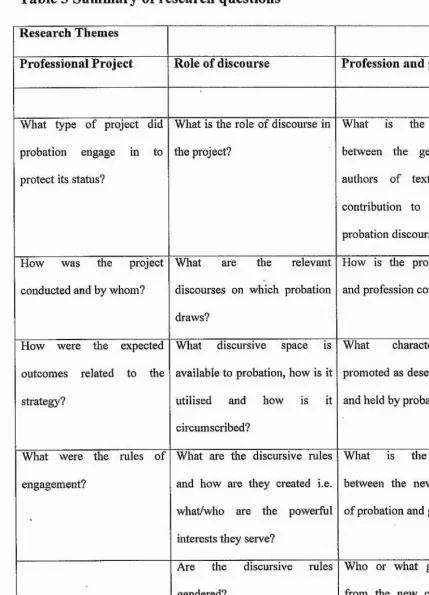
Research questions 13 2
Data collection and analysis 137
Research boundaries 148
Writing up the analysis 153
Chapter 5 Defending probation
155
The Dews Report
156
The government’s approach to gender change
160
The training debate 166
Invisible women
196
Chapter 6 Constructing probation as a masculine activity
207
The texts
207
The disappearance of social work
208
Masculinization 218
Summary and discussion
242
Chapter 7 Professions as compromise and concession
248
Professional project
249
Role of probation discourse
257
Professions and gender
265
Summary
284
Chapter 8 Gender status and the professions
286
Summarizing the argument
287
Theorizing profession - a new contribution
288
Implications for future research
298
Implications for practice
299
The utility of discourse analysis and its problems 301
Race and other research 304
Notes
Appendix 1 Sources 308
Appendix 2 Interview schedule of topics 312
Appendix 3 Glossary of terms 313
Tables
1 The rise and fall of probation 109
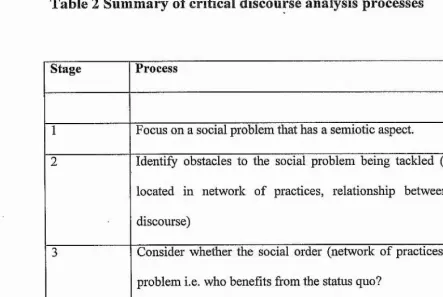
2 Summary of critical discourse analysis processes 119
3 Summary of research questions 136
ACKNOWLEDGEMENTS
Prof. Sandra Nutley, my supervisor, has provided great encouragement and
support, diligently and conscientiously. I also thank Prof. Tim May who provided
support in the early days of my research and Prof. Audrey Mullender without
whose encouragement I might never have embarked on this work. My thanks
also go to Dr. Fiona Spencer and Dr. Brigid Daniel who have read and
commented on earlier drafts.
I owe thanks to all those who agreed to be interviewed and to the many other
people in probation who have influenced me over years.
Finally, particular thanlcs go to Robin Davidson who has supported me thr oughout
Chapter 1: Introduction
In 1907 two former Coldstream Guards officers, Nelson and Batchelor, were the
first probation officers to be appointed. They were
'tall and slim, with military - style moustaches characteristic of that period:
indeed, their appearance seemed quite impressive - a quality that no doubt
helped them in their relationship with the courts' (Page 1992: 3-4).
As Guards officers Nelson and Batchelor began a long historical trend of
probation as a suitable career for men leaving military occupations, a trend that
was to continue right up to the start of the 1970s. Nearly sixty years and several
thousand recruits later, the demographic composition of the workforce had
changed radically and new probation recruits were, primarily, yoimg female
graduates in their first career. These young women had benefited from the
opening up of the professions to women and the massive expansion of higher
education from the 1960s onwards. The rise in the number of women was not
hailed by the government as a triumph for equal opportunities or viewed as a sign
of progression. It was a pattern they hoped to reverse. This thesis is about the
government's attempts, between 1994 and 1997, to remilitarize and remasculinize
probation and probation's attempts to resist the government's agenda whilst also
securing its professional status.
In determining to introduce more ex-military personnel into the probation service,
the Conservative government was not seeking to return to a tradition. It wanted to
find work for soon-to-be ex-servicemen due to be discharged from the army after
probation officers was a ‘soft’ sentencing option which could be toughened up if
provided by military men. The government therefore set about strengthening the
punishment elements of the probation task and remasculinizing the workforce. In
doing so, it determined to remove the social work qualification as a pre-requisite
for practice and to remove probation training from higher education. In 1995 the
government foimally announced its intention to replace university based social
work training with shorter ‘on the job’ training and, when making the
announcement, was explicit in its desire to see more ex-service men appointed as
probation officers. It considered the two-year Diploma in Social Work (DipSW)
course as unattractive for men entering their second careers and also unnecessary
in the light of their experience in the uniformed services.
The removal of a prior qualification for practice is unprecedented in the history of
the professions in the UK. Although the decision to do so was finally reversed by
the incoming Labour government in 1997, from 1995-1997 it appeared that the
government’s attempts at state sponsored deprofessionalization would be
successful. Understandably, those working in probation were dismayed at the
decision as were those responsible for probation training in the universities. Not
only were probation officers concerned about the loss of the qualification for their
profession but also many were not attracted to the idea of a probation service
made up of predominantly ex-service personnel. Cultural as well as gender
differences were very evident and there were concerns that ex-servicemen would,
without the period of acculturation that prior training provides, bring a value
system that was antithetical to the social work values held by the current
Conservative and, later, the Labour government of the need for a prior
qualification for practice.
Probation faced a number of other problems in the early 1990s. The government
repealed the more liberal aspects of The Criminal Justice Act 1991; threatened
privatization or ‘independentization’ of some probation services through the
transfer of responsibilities to the voluntary sector (Home Office 1990a);
threatened amalgamation with the prison service (Home Office 1991); and
expected probation to deliver tougher community sentences within a ‘prison
works’ philosophy. In setting out to re-shape the probation workforce to make it
more closely resemble those occupations that might be assumed to be more
willing to implement the tough punishment and control agenda, the government
wanted recruits from occupations that already had a strong tradition of control and
firm discipline.
Probation found that it was defending, not only training, but also, its very
existence and success appeared uncertain. In order to succeed and again occupy a
more central role in criminal justice policies, probation had to change radically
and reconstruct itself and its task differently. It is this reconstruction that is the
focus for this study. This thesis is the story of probation's defence of training and
its response to the government's plans. The underpinning narrative details how the
profession went about securing the status and credibility it had previously enjoyed
through discursive means. The analysis centres on the nature of profession, its
past and current meaning and how it is constructed and maintained and its
This thesis is also about gender, occupational masculinity and femininity.
Gendered occupational attributes are dynamic and operate across a number of
dimensions such as class, sexuality and race (Davis 1981; Frankenberg 1993;
Skeggs 1997) and will manifest themselves differently in different contexts and at
different times (Connell 1987, 1995). Attributes of masculinity and femininity
have been explored between nations (Hofstede 1998); as.individually located but
shared characteristics (Gilligan 1982); as characteristics of organisations (Mills
and Tancred 1992; Newman 1995; Parkin and Maddock 1995; Gherardi 1995); as
a means of organising work (lannello 1992); or as an ideology for (men's) practice
(Maclnnes 1998). The characteristics most frequently associated with (primarily
white) masculinity are toughness, power, authority, rationality, instrumentality
and objectivity. Those most often associated with femininity are relational,
nurturance, care, co-operation, expressiveness and pursuit of equality and it is
these characteristics to which I am referring when making broad statements about
masculinity and femininity. Notions of masculinity are changing in an
increasingly feminized or degendered age (Seidler 1997; Peterson 1998;
Maclnnes 1998; Faludi 1999). Yet, these characteristics persist as identifiers of
gendered behaviours, organizations and structures. Occupations traditionally
perceived to be 'men's' occupations tend to involve the expression of masculine
characteristics whilst 'women's’ occupations tend to be those associated with
female ones. Whilst men and women, individually and collectively, do not
necessarily behave according to the gendered roles attributed to their sex, there
are, overall, closer associations between men and masculinity and women and
My narrative
In undertaking this study I am not a disinterested observer. I remained a
probation officer from 1979 to 1996 and my qualification to practice was that of
social work. At the time of the government’s efforts to deprofessionalize
probation I was an Assistant Chief Probation Officer with responsibility for
preparing a county probation service’s response to the government’s proposals. I
and most of my colleagues interpreted the proposals as an attempt to both
deprofessionalize and to remasculinize probation. It was clear that
remasculinization by increasing salaries to those of other male dominated
professions was not an option for the government at a time when public
expenditure was capped and public sector wages were depressed. Without
deprofessionalization therefore, remasculinization was unlikely to be achieved.
In drafting my own local probation service’ response to the government proposals
and in promoting probation’s case for retaining training in higher education, I did
not suggest that the rise in the number of qualified women was indicative of a
successful training strategy. Nor did I suggest that it had led to an improvement in
service delivery. I did not mention gender at all. Instead the response focussed
on the need for highly skilled and educated practitioners, regardless of their sex.
At the time I reflected that in spite of women’s greater numbers in probation and
our growing numbers in the more senior positions, I did not feel able to defend
the position we had fought so long to achieve. Our growth seemed to have led to •
us losing our voices. It seemed that by joining the ranks of senior management,
women had been co-opted into a corporate voice rather that giving greater voice
I did not find it particularly surprising that a right wing government should wish
to remasculinize probation and it was consistent with its other policies over the
previous five or six years. I did, however, want to better understand my ovm
silence and that of my colleagues. I also wanted to know if the silence was
confined to senior managers, a group that was still male dominated, or if it was a
feature of the profession as a whole. It was these questions that prompted my
interest in pursuing this reseai'ch. I wanted to laiow if the construction of a
credible profession was related to gender, positional authority or institutional or
private voice. I wanted to know whether my observation about the loss of a
feminist voice was individual or widespread and I wanted to understand the
determinants of professional status. This study is therefore as much a journey in
search of a theory to aid understanding, as it is to provide an empirical analysis of
the construction of a credible profession and the relationship between this
construction and gender.
The key to my understanding of the construction of probation as profession
appeared to lie in my own silence contained in the,defensive texts I was drafting
for the service. It was in the silences that my personal views were located and
therefore not represented and, to me, those silences were louder than the texts I
was producing. I was seeking, therefore, the means to explore the silences and
to identify a method of textual analysis that could contribute to achieving an
understanding of what was not said but could have been said. And so it was to
Foucault that I turned when considering the methodology and in particular his
approach to the analysis of the social construction of madness (Foucault 1971).
‘experts’ such as psychiatry. Whilst he has been subsequently criticised for
merely supplanting one expert’s construction of madness with another’s, his own,
(Den-ida 1978), the value of his approach remains as a challenge to taken-for-
gi*anted constructions, constructions that constrain, categorise and determine
relationships between people.
In giving words to silence, I too am creating entities that previously did not exist
in texts. In deconstructing texts I am also reconstructing them in ways that also
categorise and determine relationships. By using the voice of the third person,
authors imply that the texts or their silences speak for themselves or have greater
authority of revelation than the construction the authors make. Yet, even with the
most rigorous analysis and reflexivity, the texts produced are as much a creation
of an author as some self evident 'truth' waiting to be revealed through research
(Foucault 1972). Just as I shall argue that a particular type of probation officer is
created thi'ough discourse, I too am creating particular understandings or entities
of profession and probation in this study. In order to open up for scrutiny my
approach to the study and to acknowledge my role in constructing this nanative
about probation, I have used the personal voice wherever possible. I use both the
active and passive voice as a further indicator of creative responsibility. The
different use of active and passive voice throughout tins study also differentiates
between actions undertaken by individuals, my self included, and the more
passive collective adoption of discursive rules where the relationship between the
speakers or writers and outcomes is less clear. Where it is clear* to me that
identifiable actors have caused particular effects then it will be stated as such but
generally used. This is not necessarily straightforward and the reader may
conclude that I attribute more influence to either individuals or the power of
discourse than can be argued from the texts. My intention in taking this approach
is to open up the possibility that cuiTent hegemonic constructions of profession
are just that; dominant constructions bound by time and circumstances and ones
that can be challenged when we understand the rules.
Definition of key terms
Central to my understanding of the making of the professions is an examination of
the literature on the professions. Whilst recognising that definitions must be, of
necessity, located at particular point in time and are foimed for particular
purposes, in studying the behaviour* of occupations a ‘rationale must be found for
the separation of certain occupations from others and for their specific behaviour’
(Torstendahl 1990: 1). Some professions may be more secure than others in their
grasp of the title profession; some professions may have significantly higher
status than others and the status may change over time and be viewed differently
by different groups. But,
If X means only to refer to those few occupations recognised by almost
everyone as profession, possessing very high prestige and a genuine
monopoly over a set of widely demanded tasks, while Y means to refer as
well to occupations which try to ameliorate their low prestige and weak
economic position by refening to themselves as professions, then each is
talking about incomparable categories and both the writers and the readers
The probation profession, on which I focus in this thesis, is not amongst the
prestigious professions and, at the time of the research, its status had been
declining since about 1990 or even earlier (see Chapter 3). Nevertheless, in its
training arrangements, structures and social organisation it is not dissimilar to
other professions. An exploration of the various terms used in the thesis is
therefore needed in order to explain why probation is placed within the category
‘profession’ but outside those which are considered elite professions.
Although the possession of a certain number of traits does not automatically mean
an occupation is considered to be a profession, the term profession has come to
mean ‘occupations based on advanced, or complex, or esoteric, or arcane
knowledge’ (Macdonald 1995:1). Gaining this knowledge requires training that is
both located in higher education and on the job, the former providing the theory
and the latter the practice. Furthermore the ‘education is a prerequisite to
employment’ (Freidson 1986: 59). In this thesis it is those occupations that
require education and training located in a university as a prior condition to
entry to which I refer when using the term profession. Some occupations such as
general management and marketing have university courses on the subject but
such study is not a pre-requisite for entry into the occupation and in this research I
am discounting such occupations as professions.
Many occupations, including general management and marketing mentioned
above, are frequently referred to as professions by the lay public and in the media,
in other words they have professional status. Professional status may be conferred
reasons or in the same circumstances. Freidson (1983) describes profession as a
‘folk’ concept and Atkinson (1983) as a ‘lay’ term, meaning different things to
different people at different times. For many people the term profession means
any high status middle class occupation yet
‘Doctors enjoy earnings that all but guarantee them upper-middle-class
status or higher by mid-career. Social workers and other less well paid
middle class professionals may find themselves living from paycheck to
paycheck - middle class in education, but not in income’ (Brint 1994: 66).
The notion of professions as social and economic elites therefore needs to be
questioned.
In spite of the low status of many of the professions, and the greater rewards that
can be achieved in other occupations, those occupations that have acquired the
label profession seem reluctant to abandon it. Furthermore, some occupations
such as management, which already have more social and economic status than
many professions, aspire to professional status and have developed appropriate
training and ‘esoteric’ knowledge as a means of achieving this end, thereby
suggesting that there is still status to be gained from being perceived to be a
member of a profession. Entrepreneurs or those with skills not learned at school
or college may be able to compete financially and socially but not necessarily in
the area the professions prize most, entry into training and therefore entry into the
professions. Because professionals have invested so much in their educational
resources, rather than their entrepreneurial, capital, artistic or physical resources
occupational mai'kets and therefore protect their own, even as they preside over
declining status and wealth.
The more egalitarian the opportunities for entry into the professions has become,
and, as the number of professions and the number of professionals working in
them have gi'own, the more hierarchical the social and economic status of
professions has evolved in order to distinguish the ‘fiilT or ‘elite’, from the ‘semi’
or ‘aspiring’. Not all the professions confer equal economic or social status and
there is a status hierarchy between professions and even within professions.
So, in this thesis then, I am using a number of tenns in specific ways - a
profession is an occupation which requires pre-entry training located in higher
education. Professional status may also be conferred on other occupations that do
not require pre-entry training but do require a good level of general education and
have high social status. Occupations in the media, financial dealing, and PR might
fall into this category. In the research I also refer to a ‘hierarchy’ of professions
and this refers to the status professions are able to enjoy in relation to other
professions. Within this conceptual framework probation is a profession but one
with low social and economic (i.e. professional) status.
If, to be described as a profession, requires a university level pre-entry
qualification, then the removal of that qualification or reducing its academic level
to an undergraduate level is an act of deprofessionalization. Probation, in spite of
all the claims made by professions about threats to their professional status, is the
decision was subsequently reversed suggests that deprofessionalization, in these
terms is not only rare but is also difficult to achieve. Far more common is the risk
or the reality of the loss of professional status, the downgrading of the esteem in
which a profession is held and the subsequent loss or stagnation of income levels
and other social and economic rewards. Where deprofessionalization has
occuned, and here I am only discussing the loss of a professional qualification
that occurred in probation from 1995-1997, the efforts taken by the occupation to
regain a professional qualification and professional status can be conceptualised
as reprofessionalization or part of a reprofessionalizing project.
The extent to which probation was or is a profession in its own right or a branch
of social work is contested and this is reflected in the various discourses. In this
thesis I treat probation as a distinct profession when examining those activities
undertalcen as part of the process of professionalizing. Probation has engaged in
its own professional project, has its own professional associations and has not
hitched its professionalizing activities to those of social work. However, I also
use the term ‘social work profession’ or ‘social work task’ when the probation
task is constructed as such in the discourse.
Approach to this thesis
The existing literature on the professions (see Chapter 2) has focused on
identifying either the common characteristics of professions (trait theory) or the
process by which such characteristics have been used as a resource for status
claims (professional project or power theories). This study considers in detail the
what characteristics equal profession, as trait theorists have done, this study seeks
to identify those characteristics and attributes of profession which probation
brought to the fore in its efforts to regain professional status. Put another way, it
sets out to examine those features which probation, as evidenced in its discourse,
believe ‘add up’ to profession.
Thus, the focus of this research is the changing probation discourse as a resource
for reprofessionalization. By discourse I mean any written, oral or pictorial
communication relating to a subject and in this study, I mean the textual
representations of and produced by probation for the purpose of
reprofessionalizing. Professional situations are influenced by a number of
discourses. Some compete and some may have more authority than others or be
more powerful. Discourses may overlap and can impact on others and transform
them. Discourses on crime, for example, are mediated through discourses on
mental health, youth, drugs, gender and so on. The way a topic is framed includes
or excludes other discourses and constrains options for conceptualising things in a
different way. These bounded ways of thinking then constrain practice to that
which can be contained within these fi'ames of reference. For example, the
creation of either an ‘offender’ to be refoimed or a ‘client’ to be helped thi'ough
the probation discourse brings with it different practices to which both the staff
and offenders/clients conform or against which they rebel; such is the normative
power of discourse.
In examining the characteristics of professions and the rules for their construction,
and the construction of probation as a profession. Almost all the existing
literature on the professions treat the texts produced by professions as
representative of something - events, values, opinions or accounts of activities.
In examining these texts the focus of that literature is on the veracity of
professional claims not on the contribution texts make to object creation (Etzioni
1969; Galanter 1983; Munghan and Thomas 1983). The approach taken in this
study is to analyse such texts to reveal how professions are discursively
constructed. This adds to our understanding of how professions make or achieve
their status claims rather than whether such claims are justified. In other words, I
examine the contribution the texts make to creating a new probation officer who
will merit professional status, rather than pass judgement on whether the claims
made by probation are justified.
The focus on probation is important not only because it is the only profession to
have been deprofessionalized (temporarily) but also because of the ambivalence
of some probation staff towards the professional project. Much of the existing
literature on the professions assumes that professional status is desirable and that
it will be actively pursued, or at least not rejected should it be bestowed upon an
occupation. However, probation was an occupation that resisted
professionalization even whilst it was becoming a profession (Page 1992) (see
also Chapter 3). Such a stance has been influenced by the fact that probation
works with marginalized groups, perhaps the most marginalized groups in our
society: those who are imprisoned, predominantly poor, and disproportionately
black and with fewer life chances than most. From this experience and their
critical discourse on professions. Thus, over the years probation has, at times,
shared many of the features of more recently developed occupations such as
domestic violence or HIV/AIDS workers which are not seeking to professionalize
and which eschew professional status (Dominelli and McLeod 1989; Deverell and
Sharma 1999).
Yet probation did professionalize and later, during the 1990s, undertook a re-
professionalizing project when its status was threatened. It therefore offers a
remarkable opportunity to examine more closely the professionalizing,
deprofessionalizing and reprofessionalizing cycle of a 'mature', if hesitant,
profession. It also offers an opportunity to examine the fortunes of a profession
as women came to predominate and the relationship between gender and
professional status.
Structure of thesis
My thesis is that professionalism and masculinism are closely related and that the
evidence from probation suggests that professionalization is masculinization.
There are three main stages in my argument. Stage one examines the existing
literature on how professions are created and the relationship between
professional status and gender. The second stage seeks to understand probation's
history through a gendered lens, charting its rise and fall as its gendered
composition changed. This stage also considers the government's response to the
profession's changing composition. The final stage analyses the relationship
between gender (masculinity) and profession as demonsti*ated by probation in the
In Chapter 2 I critically appraise the dominant theories of profession and reason
that our understanding of the professions is incomplete without a gendered
dimension. As the existing dominant theories have been developed through
empirical studies of the elite male professions, I question whether they are equally
applicable to women’s professions^ or remain relevant if the gender balance of a
profession changes. I show that studies of professions assume professions to be
those occupations with the highest social standing and rewards, relegating other
occupations with similar characteristics but lacking the high social and economic
rewards as 'semi', 'would be' or 'not yet' professions. I discuss the gendered
construction of profession in the literature and how female professions are
constructed as different to and lesser than those occupations more frequently
awarded the title profession.
Chapter 2 also considers the theoretical contribution derived from research on
women’s professions. This ascribes women’s exclusion from the elite professions
and their relegation to other occupational fields as the reason for their lower
status. These exclusionaiy theories take forward our knowledge about the
relationship between gender and the professions and they provide an historically
situated rationale for women’s current occupational status. However, exclusionary
theories, whilst acknowledging gender differences across professional
occupations, presuppose that profession is a gender-neutral construct. They
assume that if barriers to women’s advancement are removed, women’s
Chapter 3 focuses on probation. I trace the development of probation from its
early days as a ‘police court mission’ through its years as a profession with some
status, to its decline towards the end of the last century. I discuss its fortunes in
relation to its gendered composition drawing out the linkages between these two
phenomena. The chapter takes probation’s story up to the point of the
government’s decision to deprofessionalize it. Further discussion of this decision
and analysis of how this was expressed comes later in Chapter 5.
Chapter 4 outlines the methods of the research and the approach taken to
discourse analysis. In order to understand the discursive rules under which the
profession operated, I analyse documents prepared specifically as pait of the
reprofessionalizing project. I also consider documents prepared for other
purposes but which offer a contribution to that project. The research covers the
years 1987-1997, although some key documents produced after this are included.
There is a particular focus on the years 1994-1997 when reprofessionalizing
activities were at their peak.
Chapters 5 and 6 are devoted to the findings of this research, Chapter 5 begins
with the government’s view that its objectives for probation would be more
readily achieved with a more overtly male and masculine workforce and a less
professional one. In articulating the chai*acteristics of a desired probation officer,
the government identified characteristics generally associated with men, thereby
indicating that it was masculinity that they valued. In analysing how probation
responded to this challenge, this thesis focuses on the construction of probation in
its training discourse. Furthermore, I reveal the relationship between gender and
profession in the reconstruction of probation as a profession. I examine how,
discursively, the profession responded to the threats to its status and how it
presented to the external world as an occupation meriting professional status. I
analyse the construction of probation officers and the probation task, and also the
construction of offenders and victims of crime. I explore how these constructions
were presented to the various audiences the profession hoped to influence in their
campaign.
Chapter 7 analyses the findings and their implications they have for the existing
literature on and the study of the professions. I conclude that the relationship
between gender and the construction of a profession is clear but not simple. It
intersects with class and race and also is temporally bounded, reflecting current
expectations about gender and occupational opportunities.
Chapter 8 draws together the conclusions from the research and the contribution it
makes to existing knowledge. It also relates the research findings to recent
changes in the occupational landscape and draws out their implications for future
CHAPTER 2: Professional status
This reseai'ch is about the study of one profession’s attempts to improve its
occupational status during a period of decline, the focal point being probation’s
reconstruction of the profession and the professional task in order to do so. An
analysis of this constmction will reveal those elements and characteristics
probation promoted to support status claims. In this chapter I consider the
theories that might underpin this construction. I am concerned here with those
theories that offer explanations of how occupations come to be labelled
professions and acquire professional status. or how professions increase their
status. I set out the two major theories of professionalization and explore the
extent to which they, and their subsequent variations, adequately explain how
professional status is achieved and mamtained.
Acquiring professional status has been primarily attributed to either the
possession of a number of tr aits or characteristics - trait theory, or the successful
implementation of a professional project during which control over the education
and credentialing mechanisms is secured - project or power/process theory. In
this chapter I examine the contribution of these theories to both academic and lay
understandings of the term profession and the extent to which they inform
contemporary thinking about the professions and the organization of professional
labour'. My thesis is that profession is a gendered construction and in this chapter I
also explore the extent to which trait and project theories can be read across to
women’s professions or women’s occupations. I judge the applicability of the
theoretical work might assist in our understanding of the relationship between
professional status and gender.
Origins of the professions
The origins of the word profession as a type of occupation derive from the Anglo
Saxon use of the word to ‘profess’ as in to take a vow or to promise as part of
joining a religious order. This sense of joining a community or making a lifetime
coimiiitment to an organisation that requires certain behaviours and demeanours
continues today and for many people profession means a form of ‘vocation’.
A man who leaves a profession, once he is fully trained, licensed and
initiated, is something of a renegade in the eyes of his fellows: in the case
of the priest, even in the eyes of laymen (Hughes 1963: 657).
According to Cogan, ‘the earliest recorded use of the word profession to mean a
learned vocation was in 1541’ (Cogan 1953: 34), adding that (and quoting from
the 1933 shorter Oxford English dictionary) ‘as early as 1576 its meaning had
already been generalised to indicate “ any calling or occupation by which a person
habitually earns his living’” (Ibid.). It was not until the industrial revolution that
the professions became a distinct occupational class and the term came to be
widely used to describe those occupations (law, medicine, the church and the
aimy) suitable for the impecunious second sons of the aristocracy where the
qualification to practice was that of being a gentleman.
As the professions expanded with industrialisation more men, and later some
and the conduct expected of them, tliereby linking their social and economic
status with that of the ‘gentlemen’ who initially occupied these roles. Access to
the traditional professions was restricted to men tlnough legislation and control of
entry into the universities and, although women gained enti'y tluoughout the 20^’
Centuiy and their numbers have increased considerably in tire last twenty years,
the 'elite' professions are still dominated by men and professions dominated by
women have less status and economic rewards (EOC 2001).
Trait approach
Although the word profession has been in common usage since the industrial
revolution, it is a concept that remains highly contested and its meaning changes
over time. Valued occupational characteristics mutate as required skills and
employment patterns change and as occupations relate differently to other social
groups and structmes. Key to the lay person’s definition of a profession is an
occupation that they, as non-experts relying on experts, can trust (Freidson 1988;
Wrigley and McKevitt 1994). Wlien the professions were made up of
‘gentlemen’ it was claimed that they could be trusted simply because they were
gentlemen, thereby cementing the association between trustworthiness and social
class. As the numbers in the professions grew they included others from different
social classes who might not be ‘trustworthy’ by reason of class alone. The trust
relationship was then established through codes of etliics, tiaining in the skills
required for the job with the development of a distanced and 'objective',
The traits asserted by earlier sociologists to be those that distinguished the
professions from other occupations can be summarised as - the application of
specialised, abstract knowledge obtained tlirough long periods of training;
occupational control over training and licensing of practitioners; peer group
review, evaluation and discipline; an altruistic service or collective orientation;
and, the work determined by the occupation rather than the government or the
client. (Cogan 1953; Goode 1960; Greenwood 1957; Etzioni 1969). In Cogan’s
extensive suiwey of the literature on the various definitions of the professions he
acknowledged these as the dominant traits associated with profession but
concluded that
A profession is a vocation whose practice is founded upon an
understanding of the theoretical structure of some department of learning
or science, and upon the abilities accompanying such understanding. This
understanding and these abilities aie applied to the vital practical affairs of
man. The practices of the profession are modified by loiowledge of a
generalised natui-e and by the accumulated wisdom and experience of
mankind, which serve to correct the enors of specialism. The profession,
serving the vital needs of man, considers its first ethical imperative to be
altruistic service to the client (Cogan 1953: 48-49).
This suggests that it is the importance of the activity, the 'vital needs of man', that
distinguish professions from occupations. In rejecting both occupational licensing
and control as a determining trait of profession he acknowledges that those
occupations called profession were controlled from, within. Greenwood, on the
other hand, also includes authority as a deteraiining characteristic, authority
case and one that is endorsed and supported by the broader community. For
example, authority in relation to the individual patient is supported by the
widespread expectation that an individual will follow ‘doctor’s orders’ and the
doctor has the authority to ‘order’ in contrast to the homeopath or the nurse who
might merely advise.
Goode argued a two tiered approach to understanding professionalism. The first
tier of ‘core chaiacteristics’ being ‘prolonged specialized training in a body of
abstract loiowledge, and a collectivity or service orientation’ identified
occupations as professions (Goode 1960: 903). A second set of ten
characteristics, deriving fi'om the core characteristics as the occupation became
increasingly professionalized, were those that delineated the more elite
professions. These characteristics included licensure, professional autonomy and
control over training. He also included the chai'acteristic of the profession being a
‘terminal’ occupation in that people remained within the profession for life and
that members strongly identified with the profession. However he, later, said that
perhaps the only defining characteristic was that of trust (Goode 1969).
Key to the trait approach to the professions is the combination of an identifiable
body of knowledge coupled witli practical skills and exclusion of the unlicensed.
The combination of knowledge and skills without monopolistic control over who
can undertake the work of the occupation leaves an occupation exposed to the
occupational market where services can be purchased from any competent
practitioner. Technical knowledge is available fiom books and access to the
requirement of prior training in its practical application, and the absence of a high
degree of academic training, would suggest a craft rather than a profession.
Achieving a particular balance between the intellectual and the practical or the
primary route to achieving profession is not important (Hughes 1963).
The traits claimed as those inherent to professions were based on the
chaiacteristics of the ‘gentlemen’ who occupied professional roles. As these traits
were developed as indicators of profession during a period in histoiy when the
daughters, sisters and wives of gentlemen rarely worked for money, they reflected
dominant upper class male norms of the time.
Whilst sociologists, as I shall discuss fuilher below, have ceased to employ a
taxonomic approach to the professions, occupations continue to reference traits as
indicators of profession and major milestones on the route to professionalization.
Whether or not the traits associated with profession exist or aie significant factors
in determining occupational positions on a status hierarchy, they are treated by
many occupations as though they do. If occupations cannot persuade the
government that at least some of the traits identified by the proponents of trait
theory aie in place, the granting of professional autonomy seems unlikely. Traits
associated with profession serve an identity function for professions and ‘would
be’ professions and those who rely on their services.
The existence of a code of ethics and an avowed collective orientation, supported
by long periods of training amounts to a contract between the professional and the
implied; it might also be vague and somewhat difficult to enforce but it is a
contract none the less. Professionals, and their clients, do not always behave
according to the conditions of the contract, and the conditions of the contract may
not always be in the best interests of either the profession or the clients, self
regulation for instance. However, the contract, as implied by a professional
qualification, forms the working agreement imder which the exchange is
understood and enacted. Those tliat use personal professional services Icnow how
to behave when they visit a doctor, solicitor or social worker and they all share an
understanding about what a professional can and cannot do for them or to them.
The fact that breaches of this trust relationship aie so widely publicised - sexual
contact by professionals with clients, using clients funds for puiposes not agreed
by them or continuing to practice in ways that colleagues have shown to be
ineffective - indicates the level of expected trust both parties subscribe to.
Additionally, in creating a monopoly for professional services, the government
needs to be assured of the occupation first meeting certain criteria and
Both the institutional characteristics of its members as their fomial
education, must confirm to official criteria of profession. Cosmetic
changes on the institutional face which an occupation presents to the
world may not be enough for official recognition. (Freidson 1983: 29).
For the government, which contracts with professionals for services, particulaily
in the public sector, traits provide the sub-clauses needed to assure the delivery of
services as intended. So, whilst traits may be myths or presentational devices
professions either as milestones on route to profession or as targets to be achieved
in order to gain or maintain professional status.
Critics o f the tirait approach
Having, or so they thought, identified a number of traits to delineate the
professions from occupations, trait theorists were quickly discredited by academic
colleagues. During the 1960s and 1970s a more critical appraisal of the
professions led to dismissal by sociologists of trait theory (Wilensky 1964;
Freidson 1973; Roth 1974; Klegon 1978). Some disputed that trait theory was a
legitimate area for study and that trait theorists, in studying the ‘elite’ professions,
mainly law and medicine, uncritically identified these occupations as professions,
thus perpetuating their status and effectively excluding others. Or, as more tartly
put by Klegon,
Occupations may differ along such factors as status, degree of control,
organization, influence and so forth. However, just because an occupation
may become idealized and reified in the social consciousness, there is no
need for sociologists to do the same (Klegon 1978: 268).
The attributes of profession, both cultural and educational, could only be acquired
either in a university or as an ‘apprentice’ to another professional, access to both
being restricted to the middle classes (Freidson 1973; Rueschemeyer 1964).
Unsurprisingly then, the traits most valued by the professions ‘seem to be in fact
aspects of upper-class and upper-middle class life and sub-culture’
(Rueschemeyer 1964:30). Some academics considered professionalization as a
middle class version of unionisation, following a consensual rather than conflict
presentational devices to persuade the public of professional claims in order to be
awarded the status and rewards of profession (Mungham and Thomas, 1983;
Galanter, 1983, Wilding, 1982).
Critics of trait theory, whilst aclcnowledging its class base, have failed to notice
the gendered base of tlie resouices used to achieve trait accumulation, assuming,
just as trait theorists had before them, that to be professional was to be male.
Klegon, for example, in noting that
It is the relationship of an occupation to societal arrangements of power,
and the way in which those relationships affect the social meaning of an
occupation, that affect the ability of an occupation to obtain and maintain
professional occupational control (Klegon 1978: 273)
assumed that occupational resources, power and government interests were class
based but failed to even consider whether or not they might also be gendered.
Trait as a neglected area o f enquiry
Traits continue to have an important ideological function for the professions and
to have meaning for those that use professional services or pui'chase them on
behalf of others. It is therefore curious that there has been so little recent interest
by sociologists (apait from Freidson) in the functions that traits serve for those
who subscribe to them. It seems that Roth’s oft quoted statement below provided
such a strong criticism of those who explored the characteristics of professions
that to continue to seek to identify professional traits would be to immediately
Sociologists who focus on lists of attributes do not study this process, but
participate in it. They have become the dupe of established professions
(helping them justify their dominant position and its pay off) and arbiters
of occupations on the make, keeping score instead of observing and
interpreting the behaviour involved in the process of scoring (Roth
1974:17).
He goes on to lambaste trait theorists further by stating
Perhaps one reason why so many sociologists involved in occupational
studies fall into this trap is that they too are in an occupation on the make
and they have an interest in seeing how they can increase their score in
relation to other occupations (Ibid.)
The intention of Roth (and others - Johnson 1972, Klegon 1978, Wilding 1982,
for example) in making such acerbic comments may have been to discouiage
sociologists from uncritically accepting the elite professions’ list of traits as those
that count. In doing so trait analysis and trait promotion have become conflated.
Trait analysis has effectively been lost fiom the study of the professions. With it
has been lost the opportunity to consider the racial, class and gender
characteristics of those occupations that are able to achieve high social and
economic status and the relationship between social background and professional
status. Furthermore, if no chai'acteristics of profession exist, other than the ability
to persuade others to grant high status and rewards, then gender is relevant only as
a resource in the professionalizing project rather than as a characteristic of
profession. Given the very evident economic and status differentials between
failing to consider gender as a potential trait of profession, sociologists continue
to uncritically assume profession as a gender-neutral entity.
Roth himself demonstrates this by arguing that ‘engineering is a profession - we
all know that’ (italics in the original)(1974: 16), whilst social work is ‘one of
America’s most anxiously upwardly mobile occupations’ (Ibid.: 17). Roth’s
influential, rhetorical style immediately categorises male dominated engineering
as profession and female dominated social work as ‘semi’ profession arguing a
‘common sense’ or lay perspective, in other words inviting us to know that social
work is something lesser than a profession. Without irony, Roth then goes on to
state that ‘when uncritical commonsense definitions dominate the field, circular
and ad hominem arguments proliferate’ (Ibid.). In ‘knowing’ what is or is not a
profession, we make assumptions about the characteristics and traits of profession
and, whilst this is a feature of our understanding, it is a legitimate area for further
exploration. Far from supporting professions in the maintenance of their status
and rewards, if examined critically, trait analysis may contribute to an alternative
imderstanding of the way in which occupations become professions and gain or
lose social and economic standing.
A Derivative form o f trait theory
Wliilst, amongst sociologists, trait theory may hold little explanatory power for
the acquisition of professional status by certain occupational groups, a derivative
form is still used hy many to place professions on a status hierai'chy and, in
particular, when seeking to explain gendered status differentials. Interestingly,
traits as indictors of profession. The categorisation of women’s professions such
as teaching and nursing as ‘semi’ professions has been variously attributed to lack
of autonomy from the client and the government (Freidson 1970; Etzioni 1969;
Elliott 1972); lack of control over occupational boundaries and work (Larson
1977; Wilding 1982); control by other occupations (Freidson 1970); their
screening role prior to presenting cases to higher status specialist professionals
(Abbott 1981), or their location in ‘high devotion, low power’ professions
(Rueschemeyer 1983: 137). Others have argued that 'mediated' professions; i.e.
those that mediate between the individual and the state Johnson (1972), or
‘bureau’ professionals i.e. those professionals located in agencies (Parry and
Pany 1979), tend to have a lower status. Jamous and Peloille (1970) assert that
the ‘indeterminacy/technicality’ ratio or balance is what distinguishes professions
on a status hieraichy, and those wliich require a higher level of judgement
coupled with effective inteiwention methods will be more valued. More
recently, as social power has shifted increasingly towards the scientific
community, Brint suggests that the replacement of ‘social trustee professionalism’
with ‘expert professionalism’ (Brint 1994: 37) has led to increased status for those
with ‘theoretical reason and practical power’ (Ibid.: 40) i.e. scientists and
technologists.
Wliilst each of these arguments aie presented as being gender neutral by their
exponents, just as trait theorists before them, they have sought to identify
particular chaiacteristics of successful professions assuming the characteristics are
intrinsic to the nature of the job rather than derive from gendered roles. As Fox
the scientific population is, even now, a population that is overwhelmingly
male, in itself a consequence rather than a cause of the attribution of
masculinity to scientific thought (Fox Keller 1983:188).
Derivative trait theorists, in their search to explain status differentials,
acknowledge that women tend to be located in lower status professions and that
low status professions tend to be dominated by women. They do not, however,
question whether the status differentials directly result from the gender of the
occupants, from a gendered professionalizing process or a construction of
profession that is designed to attract men and exclude women. ,
In much the same way as trait theorists before them, derivative trait theorists
suggest that the intrinsic nature of the job determines the status of the occupants
rather than their prior class or social standing. Freidson comes closer to
aclcnowledging the relationship between high occupational status and gender
noting that:
This hierarchy, too is likely to be reflected in the social origins of the
workers. In the grossest comparison between physicians and pai'a medical
workers, the latter are to a disproportionate degree women and of the less
valued etlinic, racial and religious groups in the United States (Freidson
1988: 53).
Even so Freidson falls short of suggesting the reason for the status differential
Regardless of the theories sociologists have suggested for the low status of
women’s professions, the professions, themselves, act as though they believe
gender may be an important determining factor. Kiavetz outlines social work’s
efforts to recruit men ‘into the field as a means of upgrading the image’ by
developing group work and community work which were more attractive to men
(Kiavetz 1976: 422). Williams (C)(1995) also notes that social work, nursing,
teaching and librarianship have at various times attempted to attract men to these
professions in order to increase status but with only limited success whilst men
have risen tlirough the ranks quickly and through displaying traditional masculine
qualities.
If occupational status is closely associated with the pre-existing social status of
those entering the occupation, when the status of those in or entering an
occupation does not match the profile of those in high status occupations,
acquiring the traits of profession (the traditional ones or those more recently
identified) may achieve only limited, if any, success. Occupations might posses all
the signifiers of profession but may not necessarily be awaided the social and
economic status generally associated with the term and without considering the
gender, class and racial composition of an occupation as key vaiiables, such
comparisons only provide a rationale for gendered occupational divisions.
In much the same way that professional traits were identified by the beneficiaries
of an exclusive occupational system, traits identified to explain the lower status of
female professions have been identified by (primaiily) male academics. These
over feminine ones and they too, might be contributing to ensuring the
maintenance of the status of those professions already highly regarded.
The professional project
I now turn to the theoretical explanations of the process through which
occupations gain occupational control and persuade others that they should be
awarded professional status. Approaches to understanding professions that centre
on the development of the professions as political, economic and social elites,
view traits as resources for gaining market power rather than an attribute (Johnson
1972; Larson 1977; Parkin 1979; Wilding, 1982). Jolmson says that no
professional tiaits exist other than occupational control
professionalism then, becomes redefined as a peculiar type of
occupational control rather than an expression of the inherent nature of
particular occupations (Johnson 1972: 45)
and the professional ‘project’ is the means of gaining that control.
In discussing the process of professionalization, I am using the conceptual tool of
the professional project primaiily based on the work of Larson (1977). Whilst
some aspects of Larson’s theorising are problematic, especially in relation to
gender, the explanatory power of the professional project remains significant.
The professional project as a means of gaining occupational and social power
represented a paiadigmatic shift in thinldng about the professions and the
academic task became that of revealing the process of achieving professional
status rather than identifying the features that separated one type of occupation