FORM AND MEANING IN THE VOWEL-LENGTHENING PATTERNS
Warwick Danks
A Thesis Submitted for the Degree of PhD at the
University of St Andrews
2010
Full metadata for this item is available in Research@StAndrews:FullText
at:
http://research-repository.st-andrews.ac.uk/
Please use this identifier to cite or link to this item:
http://hdl.handle.net/10023/961
This item is protected by original copyright
The Arabic verb:
Form and meaning
in the
vowel-lengthening
patterns
Warwick Danks
Submitted 22 September 2009
for the degree of
words in length, has been written by me, that it is the record of work carried out by me and that it has not been submitted in any previous application for a higher degree.
I was admitted as a research student in September 2006 and as a candidate for the degree of Doctor of Philosophy in September 2007; the higher study for which this is a record was carried out in the University of St Andrews between 2006 and 2009.
date signature of candidate
I hereby certify that the candidate has fulfilled the conditions of the Resolution and Regulations appropriate for the degree of Doctor of Philosophy in the University of St Andrews and that the candidate is qualified to submit this thesis in application for that degree.
date signature of supervisor
In submitting this thesis to the University of St Andrews we understand that we are giving permission for it to be made available for use in accordance with the regulations of the University Library for the time being in force, subject to any copyright vested in the work not being affected thereby. We also understand that the title and the abstract will be published, and that a copy of the work may be made and supplied to any bona fide library or research worker, that my thesis will be electronically accessible for personal or research use unless exempt by award of an embargo as requested below, and that the library has the right to migrate my thesis into new electronic forms as required to ensure continued access to the thesis. We have obtained any third-party copyright permissions that may be required in order to allow such access and migration, or have requested the appropriate embargo below.
The following is an agreed request by candidate and supervisor regarding the electronic publication of this thesis:
Access to printed copy but embargo of electronic publication of thesis for a period of 5 years on the following ground: publication would preclude future publication.
(Approval of Faculties of Arts and Divinity Business Committee for embargo of electronic copy granted on 9 December 2009.)
The Arabic verb: Form and meaning in the vowel lengthening patterns
The research presented in this dissertation adopts an empirical Saussurean structuralist
approach to elucidating the true meaning of the verb patterns characterised formally by
vowel lengthening in Modern Standard Arabic (MSA).
The verbal system as a whole is examined in order to place the patterns of
interest (III and VI) in context, the complexities of Arabic verbal morphology are
explored and the challenges revealed by previous attempts to draw links between form
and meaning are presented. An exhaustive dictionary survey is employed to provide
quantifiable data to empirically test the largely accepted view that the vowel lengthening
patterns have mutual/reciprocal meaning. Finding the traditional explanation inadequate
and prone to too many exceptions, alternative commonalities of meaning are similarly
investigated. Whilst confirming the detransitivising function of the ta- prefix which
derives pattern VI from pattern III, analysis of valency data also precludes transitivity as
a viable explanation for pattern III meaning compared with the base form.
Examination of formally similar morphology in certain nouns leads to the
intuitive possibility that vowel lengthening has aspectual meaning. A model of linguistic
aspect is investigated for its applicability to MSA and used to isolate the aspectual
feature common to the majority of pattern III and pattern VI verbs, which is determined
to be atelicity. A set of verbs which appear to be exceptional in that they are not
attributable to atelic aspectual categories is found to be characterised by inceptive
meaning and a three-phase model of event time structure is developed to include an
Mavis Florence Danks (1922-1999)
and my late grandmother
Emma Louise Williams (1891-1982),
Contents
Acknowledgments vii
Notes on symbols, abbreviations and other conventions followed in examples ix
Chapter 1: Introduction 1
1.1 Saussurean structuralism 3
1.1.1 The linguistic sign 3
1.1.2 Language as a system 4
1.2 Beedham's method of lexical exceptions 6
1.2.1 Principles 6
1.2.1.1 Unexplained exceptions are indicative of incorrect analysis
6
1.2.1.2 From form to meaning 7
1.2.1.3 Synchronic basis 8
1.2.1.4 The Hegelian triad and scientific method 12
1.2.2 An attempt to apply the method 13
1.2.2.1 Phase 1: choose a formal construction 13
1.2.2.2 Phase 2: identify the problems, anomalies, contradictions, etc.
14
1.2.2.3 Phase 3: identify unexplained lexical exceptions
15
1.2.2.4 Phase 4: identify the properties of the exceptions
16
1.2.2.5 Phase 5: what might lead to the exceptions? 16
1.2.2.6 Phase 6: the semantic phase 17
1.3 A fresh approach 17
1.4 Further methodological considerations 19
Chapter 2: Verbal morphology and the lexicon 21
2.1 Arabic verbal morphology 22
2.1.1 Inflectional morphology 23
2.1.2 Derivational morphology 25
2.1.2.1 'Biliteral verbs' 25
2.1.2.2 Pattern I triliteral stems 26
2.1.2.4 Quadriliteral stems 31
2.1.2.5 Morphological connections 32
2.1.2.5.1 The putative 't' affix 32
2.1.2.5.2 Shared vowel melody 32
2.1.2.5.3 Alternative classification scheme 33
2.2 Distribution of verbal patterns in the lexicon 35
2.2.1 Data collection 35
2.2.1.1 Method 36
2.2.1.2 Lexical issues 38
2.2.1.2.1 Choice of dictionary 39
2.2.1.2.2 Homomorphous (homonymous) roots
39
2.2.1.2.3 Colloquialisms 41
2.2.1.2.4 Synchronic gaps, classicisms and semantic change
41
2.2.2 Comparison of data with existing sources 42
2.2.3 Quantitative analysis of the data 45
2.2.3.1 Productivity by root 45
2.2.3.2 Productivity by pattern 46
2.2.3.3 Co-occurrence of patterns 47
2.2.3.3.1 Overview 47
2.2.3.3.2 Chi-square test methodology 49
2.2.3.3.3 Chi-square and phi coefficient values for triliteral pattern co-occurrences
51
2.2.3.3.4 Quadriliteral pattern co-occurrences 55
2.3 Summary 56
Chapter 3: Alternative morphologies 58
3.1 Alternatives to the Arabic root as the primary basis of derivation
58
3.1.1 Word- and stem-based approaches 60
3.1.1.1 Is the concept of root necessarily excluded? 61
3.1.1.2 Specific arguments for a fully vocalised base 62
3.1.1.3 External evidence 69
3.1.1.3.2 Slip-of-the-tongue and word game metathesis
72
3.1.1.3.3 Hypocoristics 73
3.1.1.3.4 Diminutives in San'ani dialect 75
3.1.1.4 Conclusions 77
3.1.2 Matrices, etymons and radicals 78
3.1.2.1 Bohas's hypothesis 78
3.1.2.2 Assessment of the matrix/etymon model 83
3.1.2.3 Conclusions 85
3.2 Prosodic templatic morphology 85
3.2.1 Three morphemic tiers 86
3.2.2 Prosodic analysis 87
3.2.2.1 Syllable types in Arabic 87
3.2.2.2 Minimal stems 90
3.2.2.3 Further noun stems 91
3.2.2.4 Verbal stems 93
3.3 Summary 95
Chapter 4: Understanding Arabic verbal semantics: Form and meaning 97
4.1 The grammarian's dilemma 98
4.2 Specific approaches from the grammars 101
4.2.1 The 'reductionist' approach 101
4.2.2 The 'explicit specification' approach 107
4.2.3 The approaches compared 111
4.3 The linguist's contribution 111
4.3.1 Semitic comparative linguistics 112
4.3.2 The synchronic linguist's perspective 119
4.4 Summary 123
Chapter 5: Evaluating the pattern III – pattern VI semantic relationship 125
5.1 Selection of patterns III and VI 125
5.2 Mutuality and reciprocity 126
5.2.1 Data collection 126
5.2.2 Data interpreted 131
5.2.2.2 Pattern VI reciprocity 136
5.2.2.3 Pattern III – pattern VI correlation 140
5.2.2.4 Correlations with pattern I 142
5.3 Pattern III conativity 149
5.4 Summary 151
Chapter 6: Transitivity and valency 153
6.1 Defining transitivity in Arabic 153
6.1.1 Transitive verbs 153
6.1.2 Intransitive verbs 154
6.1.3 Ambitransitivity 156
6.1.4 Transitivity through a preposition 156
6.1.5 Multi-transitive verbs 158
6.2 Valency 160
6.3 Data collection 164
6.4 Data analysis 167
6.4.1 Valency and theta-prefix 167
6.4.1.1 A hierarchical approach to valency structure 168
6.4.1.2 Hierarchical exceptions 170
6.4.1.2.1 Unrelated meanings 171
6.4.1.2.2 Compliance with the hierarchy in at least one usage
172
6.4.1.2.3 Hierarchical challenges: other potentially explicable exceptions
175
6.4.1.2.4 Synonyms 180
6.4.1.2.5 Other exceptions 181
6.4.1.2.6 List of exceptions 182
6.4.1.3 Summary 183
6.4.2 Valency and the relationship with pattern I 184
6.4.2.1 Pattern I and pattern III valency 184
6.4.2.2 Pattern I and pattern VI valency 192
6.5 Summary 195
Chapter 7: The pattern III template: From form to meaning 196
7.2 Vowel lengthening and plurality 199
7.2.1 An introduction to verbal plurality 201
7.2.2 Mutuality and reciprocity as verbal plurality 206
7.2.2.1 Formal comparison of vowel lengthening in pattern III and broken nominal plurals
207
7.2.2.2 Is plurality a valid interpretation of mutual action?
210
7.2.3 Summary – plurality 213
7.3 The longāin Arabic morphology 214
7.3.1 Nominal templates with longā 217
7.3.1.1 Participles 217
7.3.1.2 Verbal nouns 224
7.3.1.3 Nouns of instrument 227
7.3.1.4 Nouns of occupation and intensity 229
7.3.2 Commonalities of meaning 231
7.3.2.1 Agency and patiency 232
7.3.2.2 Process and result 234
7.3.2.3 Temporal complexity 236
7.3.3 Summary – hypothesis of longāas an aspectual marker 237
Chapter 8: An aspectual model for Modern Standard Arabic 238
8.1 Defining aspect 238
8.2 The Arabic s-stem and p-stem verb forms: Tense or grammatical aspect?
240
8.3 Vendler's aspectual categories 246
8.4 Olsen's scheme 251
8.4.1 Overview 251
8.4.2 Application to MSA 256
8.4.2.1 States 257
8.4.2.2 Activities 261
8.4.2.3 Accomplishments 266
8.4.2.4 Achievements 274
8.4.2.5 Semelfactives 280
8.4.2.6 Stage-level states 284
Chapter 9: Aspectual categorisation of patterns III and VI 288
9.1 Data 288
9.1.1 Verbs of ACTIVITY and STATE 290
9.1.1.1 Corpus data counts – methodology 292
9.1.1.2 Results 294
9.1.2 Other categories represented 296
9.1.2.1 Verbs of surprise 296
9.1.2.2 Verbs of giving 302
9.1.2.3 Verbs of inception 307
9.1.2.4 Other verbs 310
9.1.2.4.1 Denominative and delocutive verbs 310
9.1.2.4.2 Potentially [+telic] verbs 312
9.1.2.4.3 Section summary 324
9.2 Summary 324
Chapter 10: Inceptive aspect 326
10.1 The case for a lexical aspect category of INCEPTIVE 326
10.2 Extension of Olsen's scheme for INCEPTIVES 337
10.2.1 Feature marking of the onset phase 344
10.2.2 Other feature marking combinations 346
10.2.3 Extended scheme for lexical aspect categories 350
10.3 Inceptive verbs in patterns III and VI 351
10.4 Summary 361
Chapter 11: The passive in patterns III and VI 362
11.1 Passive formation by vowel melody change 362
11.1.1 Corpus data evidence 364
11.1.2 Native speaker evidence 367
11.1.3 Conclusion 368
11.2 Passive participle formation 369
11.2.1 Dictionary evidence 369
11.2.2 Native speaker evidence 372
11.2.3 Corpus data evidence 375
11.2.4 Conclusion 376
11.4 Summary 377
Chapter 12: Conclusions 379
12.1 Overview 379
12.2 The characteristics of patterns III and VI 381
12.2.1 Form 381
12.2.2 Meaning 382
12.2.3 Relating form and meaning 383
12.3 Directions for further research 383
12.3.1 Nominal aspect 383
12.3.2 Aspect and passivisability 385
12.3.3 Inceptivity of state and of activity 386
12.3.4 Alternative verbal noun forms 386
12.3.5 Defining atelicity 387
12.4 Summary 391
Bibliography 393
Appendix I: Data tables 406
Appendix II: Semantic category labels 408
Appendix III: Native speaker questionnaires 410
III.1 Background 410
III.2 Procedure 410
III.3 Information and consent form 412
III.4 Questionnaire 414
III.5 Data summary 418
Acknowledgments
1
I would firstly like to thank my supervisors at the University of St Andrews: Christopher
Beedham (Dept. of German, School of Modern Languages) and Catherine Cobham
(Dept. of Arabic & Middle East Studies, School of History). Each of them has
contributed a unique perspective from their own discipline and has patiently listened
while I have attempted to explain some of the complexities of the other's field of
expertise. Their guidance has been much appreciated and their input never burdensome.
Thanks are also due to my colleagues within the School of Modern Languages and
especially the Linguistics teaching unit for their interest and encouragement.
Research – especially the discipline of writing it up – is often necessarily a
solitary pursuit, so I am indebted to friends and members of St Andrews University
Christian Union and St Andrews Free Church for providing me with such a supportive
and caring community during both my undergraduate and postgraduate studies. Not only
have I consumed copious quantities of coffee with many of them, but they have
convincingly shown interest in what I have been discovering, even when I have been
aware that I was entirely failing to explain any of it in terms the layman could
reasonably be expected to understand!
Thanks are also due to the Honeyman Foundation for their Studentship award, to
Dilworth Parkinson at Brigham Young University for assistance in accessing his
invaluable arabiCorpus, to Mari Broman Olsen of Microsoft for her encouragement as I
applied and developed her model of linguistic aspect, and to my anonymous native
Notes on symbols, abbreviations and other conventions
followed in examples
Arabic transliteration 2
Consonants
ء
'ض
Dب
bط
Tت
tظ
DHث
thع
عج
jغ
ghح
Hف
fخ
khق
qد
dك
kذ
dhل
lر
rم
mز
zن
nس
sه
hش
shو
wص
Sي
yVowels etc.
َــــ
aى
,
ا
āُــــ
uو
ūِــــ
iي
īًﺎـ
-anﺔَــ
-a, -atNOTES:
symbol-for-symbol substitution, allowing the transliterated text to be read aloud.
It is recognised that production of speech in MSA is subject to many idiolectal
variations and thus the transliterated text here employs minimal inflection except
where a vowel must be supplied preceding a joininghamza.
2. Consequently, grammatical cases are rendered only when explicitly pronounced
or where necessary to the argument and are glossed accordingly.
3. The combinations Damma-waw and kasra-yā (
Ϯѧ
ѧ
˵
ѧ
ѧ
˰
˰
˰
andϲѧ
ѧ
˶
ѧ
ѧ
˰
˰
˰
) have beenrepresented as ūand īrespectively, except where the weak consonant begins the
following syllable whenuwandiyare preferred.
4. In certain proper names containing the /g/ phoneme, the
ك
orج
from the Arabicorthography has been transliterated asg.
5. To reflect pronunciation in modern informal speech, tā' marbūTa (
ﺔَــ
) has beentransliterated simply as -a, except in construct or preceding an object pronoun
when it is represented as-at.
Citations and translations
Each example is given with appropriate citations except where:
1. it is a dictionary listing from Wehr (1994);
2. it is my own composition or rewording of a previously cited example.
Furthermore, all questionnaire examples (see Appendix III) and all translations of Arabic
Morphemic Glossing
1 first person NEG negation
2 second person NOM nominative
3 third person NPST non-past
ACC accusative OBJ object
APT active participle PASS passive
CMPR comparative PFV perfective
COLL collective PL plural
DEF definite POSS possessive
DIM diminutive PPT passive participle
DU dual PST past
F feminine Q question marker
FUT future REL relative
GEN genitive SBJ subject
IND indicative SBJV subjunctive
INDF indefinite SG singular
M masculine VN verbal noun
Notes:
1. As far as is reasonably practical, the conventions followed are those given inThe
Leipzig Glossing Rules(Bickel et al. 2008).
2. The table above contains some non-standard abbreviations used for ease of
glossing Arabic.
3. Due to the complex nature of Arabic morphology, including broken plurals,
discontinuous morphs and portmanteau morphs, it has not always been possible
to fully match morphs with glossed meanings. For example, in p-stem verb forms
and, for this reason, I make no attempt to gloss p-stem prefixes as separate
morphs. However, since the purpose of the gloss here is largely to clarify the
examples for non-Arabists, the practice I have followed should not be taken to
represent any particular view regarding which morph carries a specific burden of
meaning.
4. Active verbs have not been glossed as such and the typologically unmarked
categories of indicative mood, masculine gender and singular number are only
glossed where explicit in morphology.
Event Time Diagrams
|--- Bounded at start
---| Bounded at end
<--- Unbounded at start
---> Unbounded at end
0--- Implicit start
----|---- Internal phase boundary
|| Punctual phase
↑,↓ Locations of points in time
ET Event time
RT Reference time
ST Speech time
Privative feature marking (Olsen 1997)
[+feature] Marked for feature
[Øfeature] Unmarked for feature
Ø Unmarked for all features
Other abbreviations
(+ d.o.) Followed by direct object
(+ i.o.) Followed by indirect object
(s.o.) Someone
(s.th.) Something
[III] Roman numeral (with or without vowel): triliteral pattern (see
Chapter 2)
[QII] Q with Roman numeral: quadriliteral pattern (see Chapter 2)
[MUT][REC][SIM] Semantic category labels, with or without arithmetic symbols (see
Appendix II for complete listing)
[3A] Number-letter combination: valency structure code (see Table 41
on page 165)
{1} In discussion of valency: numbers designating items contributing
to valency
{YN?} In questionnaire examples: responses of individual informants (see
Chapter 1
Introduction
From our earliest times on the planet, we humans have searched for order in the world
around us, whether gazing at the night sky and defining the somewhat fanciful patterns
of the constellations or peering deep within the living cell to discover the elegant
double-helix structure of DNA. We recognise patterns in art, patterns in music and even patterns
in the physical sciences, such as the periodicity of the elements or mathematical
sequences. Moreover, that there is order, not a mere amorphous sea of chaos, leads us to
conclude that there is meaning to be found in the patterns we observe. Recognising the
beauty and regularity of the movements of the stars and the bodies of the solar system,
the Psalmist attributes divine meaning:
The heavens declare the glory of God; the skies proclaim the work of his hands.
Day after day they pour forth speech; night after night they display knowledge.
There is no speech or language where their voice is not heard. Their voice goes
out into all the earth, their words to the ends of the world. (Psalm 19:1-4, NIV)
Whether we agree with the Psalmist's assessment or not is irrelevant. What is
clear is that he has observed order and structure and proceeded to interpret it: he has
progressed from form to meaning. In recent times, the Human Genome Project has
mapped the entirety of human DNA, but now the discipline of bioinformatics is tasked
form and progressing thence to meaning.
Language is fundamentally an ordered phenomenon. By this I mean not to imply
that words or sentence components are necessarily ordered in a particular way, though
this is often true of specific languages. Rather I am more generally stating that language
is not chaotic, but possesses discernible patterns and reproducible structure. Were it not
so, there would be little point in me writing this paragraph, for in doing so I make a very
basic assumption. I assume that the language I employ is sufficiently close to that
codified variety we call English that it will be comprehensible to other users whose
language competencies also include that variety. That is, not only does the language I
share with my readers have the same form, but its lexicon and its grammatical
constructions have the same meanings for my readers as they have for me.
This study has been inspired by the relationship between linguistic form and
meaning which characterises the view of language expounded in the foundational
lectures on linguistics given in the early twentieth century by Ferdinand de Saussure at
the University of Geneva, subsequently published posthumously by his students as the
Cours de Linguistique Générale and consulted here in translation (Saussure 1966). If
language implies order, then the prescriptive grammarian identifies the order he discerns
within its patterns and imposes it, whereas the descriptive linguist classifies those
patterns and the Saussurean structuralist specifically relates the form evident within such
patterns to meaning. Furthermore, the research detailed in the following chapters results
from taking up the challenge of evaluating Beedham's (2005) method of lexical
exceptions, itself firmly rooted in Saussurean structuralism, as an appropriate tool with
Many critiques and expositions of Saussure have been published and may be
consulted, thus it is my intention here only to provide a brief restatement of the
principles which have been formative in my approach. Beedham's method will be less
familiar, thus I will seek both to summarise his methodology and to explain to what
extent it has or has not been applied in my own research.
1.1 Saussurean structuralism
Two fundamental themes of Saussurean structuralism will be seen to pervade this
present research: the indivisibility of the linguistic sign and the notion of a language as a
consistent and self-contained system.
1.1.1 The linguistic sign
Saussure (1966:66) defines the linguistic sign as 'a two-sided psychological entity … [in
which] … [t]he two elements are intimately united, and each recalls the other'. These
two elements are introduced initially as 'concept' and 'sound-image', but Saussure
(1966:67) proceeds in the original French to designate them signifié and signifiant, or
'signified' and 'signifier', on the basis that 'the last two terms have the advantage of
indicating the opposition that separates them from each other and from the whole of
which they are parts'. Without wishing to diminish the indivisibility which Saussure
establishes between these two facets of the linguistic sign, I prefer the respective
designations 'meaning' and 'form' followed by Beedham (2005) as more appropriate in
contemporary English.
the indivisible linguistic sign … does not of itself tell us whether we should start
with the signifiants – with form – and move from there to the signifiés – to
meaning – or do it the other way round and start with meanings and move from
there to forms. (Beedham2005:3)
However, I have already commented in my opening paragraphs that advances in diverse
fields of knowledge typically involve observation of form and proceed from there to
meaning. We shall return to the methodological implications of this in section 1.2.
The other noteworthy property of the linguistic sign as defined by Saussure
(1966:67ff.) is that it is arbitrary: there is no intrinsic or iconic connection between form
and meaning, such that the link only exists within a particular language community.
Thus, for example, according to our language background we may designate a canine
quadruped as dog, chien, or kalb, but there is no absolute sense in which any of these
forms from English, French and Arabic respectively is any more 'canine-like' than any
other. Whilst the arbitrariness of the sign appears a generally sound maxim, it may be an
oversimplification. Although Saussure (1966:69-70) recognises and addresses the issues
of onomatopoeia and interjections, he does not deal with the counterexample of
reduplication present in many languages and noted in sections 4.2.2 and 7.2.1.
1.1.2 Language as a system
It is somewhat ironic that what might be regarded as the ultimate statement of
Saussurean structuralism, that a language is 'un système où tout se tient', is actually not
attributable to Saussure but to Meillet (1893:318-319 in Koerner 1999:26). Nevertheless,
'[l]anguage is a system of interdependent terms in which the value of each term results
solely from the simultaneous presence of the others'.
Thus, according to Saussure, although the linguistic sign is in itself arbitrary, its
place within the system which is language is anything but arbitrary. Furthermore,
Saussure makes two observations which may seem obvious to the modern trained
linguist but are anything but trivial. Firstly, although he initially introduces the linguistic
sign by relating a word form to the concept it signifies and presents the language as a
system consisting of these interdependent signs, he includes not only words but equally
grammatical devices as integral and systematically dependent parts:
Within the same language, all words used to express related ideas limit each
other reciprocally … [However] [e]verything said about words applies to any
term of language, e.g. to grammatical entities. (Saussure 1966:116)
Thus in French (or English), for example, singular and plural stand in relation to one
another within the category of number, whereas in Sanskrit (or Arabic) singular and
plural also stand in relation to the further designation of dual number. This leads to the
second observation that each individual language is a system in its own right, within
which its various components may relate in ways which are quite unlike their apparent
counterparts in other language systems, or may simply be absent from those systems.
Among his other examples he cites the lack of tense as a deictic delineator of time in
Hebrew and the aspects of the Slavic verb as characteristics which are quite distinct from
his native French (Saussure 1966:116-117).
form within a language system, we should expect that form to have meaning associated
with it and, conversely, if a language makes a distinction of meaning we should expect to
see a corresponding distinction of formal expression. Moreover, because language is a
coherent system, every linguistic sign stands contrasted in both form and meaning with
those around it. Finally, whilst the specific language system is in itself consistent and
coherent, its categories and divisions of form and meaning do not necessarily align with
those encountered in other systems, introducing a cautionary note for the linguist who
may prejudice his conclusions about a language system by observing it through a lens
tinted with the characteristics of his own native language.
1.2 Beedham's method of lexical exceptions
Originally presented as 'a method of investigating grammar' in Beedham (1982:135ff.),
the 'method of lexical exceptions' is refined and explained more fully in Chapter 7 of
Beedham (2005). The research presented in this dissertation began as an attempt to apply
Beedham's method to Arabic, though it will become clear that I have departed in
significant ways from the prescribed methodology, such that I claim only that this work
is inspired by the method, not strictly an application of it. However, whilst some
specifics of Beedham's methodology have been sacrificed, the underlying principles
largely remain intact.
1.2.1 Principles
1.2.1.1 Unexplained exceptions are indicative of incorrect analysis
Saussure's view of language to its extreme:
According to Saussure a language is a structure or system. System implies
regularity implies rules …. If a language really is systematic it should not allow
exceptions at all, i.e. items which stand outside the system …. Yet exceptions …
arise to the extent that we, the grammarians, have got it wrong. We introduce
them from outside with rules that are not quite right. (Beedham 2005:153)
Thus he argues that correct formulation of grammatical rules will necessarily lead to the
elimination of (unexplained) exceptions. Essentially this is a strong restatement of the
Saussurean maxim of un système où tout se tient: for Beedham, there is no place for
exceptions in a language system.
1.2.1.2 From form to meaning
Again, Beedham states his position forcefully and unequivocally:
It is important to emphasise that one starts with form and goes from there to
meaning, not the other way round …. The linguist who starts with meaning is
doomed to be trapped in the analysis which produced that meaning.
(Beedham 2005:156)
Our starting point is to be some property which is formally expressed and hence
objectively observable and quantifiable, whether morphological or syntactic. For
be + V-ed, rather than from a meaning-based definition of the passive as equivalent to an
underlying active. His research on the strong verbs of English and German (Beedham
2005:107ff.) begins with the formal morphological distinction that they do not form their
preterite and second (past) participles1
regularly and asserts that this distinct expression
of form must be accompanied by distinct meaning, for which he then proceeds to search.
Thus, in emphasising the indivisibility of the sign (the form-meaning relationship), he
again presents a purist view of Saussure but furthermore chooses to 'align [himself] with
one side of the debate about whether to go from form to meaning or from meaning to
form' (Beedham 2005:6), namely that form is the structuralist's natural and logical
empirical starting point.
1.2.1.3 Synchronic basis
Beedham makes it clear that he works exclusively synchronically, viewing historical
considerations as a distraction: '[i]f you are concerned only with the modern language
there is no diachronic part to your work to be distracted by' (Beedham 2005:8). Again,
he is motivated by a high view of Saussurean structuralism which will not allow any
anomalous elements within the synchronic system, no matter their provenance or
however historically entrenched they may be. Thus while he admits that the '[i]rregular
verbs [of English and German] are a historical vestige … that does not stop the irregular
verbs from being rule-governed and meaningful synchronically' (Beedham 2005:112).
He is thus motivated by this belief to find the meaning associated with these irregular
verbs within their respective modern language systems.
1 Beedham (2005:175) 'follow[s] Jespersen (1924:283-284) in calling it the 2ndparticiple [in these
I am compelled to comment at this point that I believe Beedham to be an idealist.
The strong view of the Saussurean principles which he holds fast to and employs enables
him to pursue his goal of definitively relating meaning to form with a commendable
single-mindedness. However, whilst taking those same principles as a useful and
necessary foundation, I confess to less idealism and more of what I would like to regard
as realism. It is in the realm of synchronic integrity that my appeal to realism is most
evident. To justify this, I will return to Saussure.
We must recognise that Saussure himself was a historical linguist and that his
original lectures were delivered at a time when, with the exception of prescriptive
grammarians, linguists were, as he comments, 'completely absorbed in diachrony', and
he expresses the hope that '[l]inguistics, having accorded too large a place to history, will
turn back to the static viewpoint of traditional grammar but in a new spirit' (Saussure
1966:82-83). Whilst wanting to clearly delimit synchronic study from diachronic in
order to establish its validity as a discipline, Saussure (1966:74) is well aware that
language change cannot be ignored and comments that '[c]hange in time takes many
forms, on any one of which an important chapter in linguistics might be written'. He
continues:
Language is radically powerless to defend itself against the forces which from
one moment to the next are shifting the relationship between the signified and
the signifier. This is one of the consequences of the arbitrary nature of the sign.
(Saussure 1966:75)
analogy of the chess board, likening the state of the board at any stage of a game to a
static situation in a language system. Each possible state of the board is governed by the
predetermined rules of the game and progression from one state to the next involves
moving a single chess piece, though this move has an effect on the entire system. His
view of diachrony is valid in that he observes that for any given state of the board, the
succession of moves which brought it about is irrelevant. However, his analogy of
change breaks down in one respect. It represents the real development of language in
much the same way that a cinematographer captures real life: the movie camera cannot
record movement, the illusion of movement only being created when a succession of still
frames is projected consecutively. For Saussure, a chess piece moves and displaces
another such that no intermediate state exists, but I contend that the following
illustration, whilst perhaps fanciful, is more helpful.
Imagine a well-ordered dwelling. The occupant of the house has taken the trouble
to acquire all the items one needs to live comfortably and efficiently and has assigned
each object its place with care to maximise its effectiveness. If a new item is acquired it
presents no problem, so the brand-new DVD recorder, not previously required by the
household but now indispensable, takes its place naturally alongside the wide-screen
television and the recently added digibox with only minor adjustments to make some
space. Sometimes, however, room must be found for a newly acquired object by
displacing another. I remember as a child I was left a rather elegant upright piano by my
deceased cousin. Finding room for it was made all the more difficult because we already
possessed a perfectly serviceable piano, but rejecting the gift was unacceptable, so for
this period would have been hard-pressed to explain why a family with only one
(would-be) pianist needed two such instruments fulfilling the same function. Ultimately, the
original piano was evicted and the system returned to a stable state.
I believe that this picture better represents language change and I would draw
attention to the phrase 'from one moment to the next' in the preceding quote from
Saussure. This is essentially the problem for us as empirical synchronic linguists: we are
aiming at a moving target. Ideally each element has a unique place synchronically
defined within the system, but realistically readjustment of the system is a constant,
dynamic process which takes time, not one which moves stepwise from one state to the
next. The system is therefore better characterised as a stable equilibrium.2 Thus I do concur with the ideal of un système où tout se tient, but contend that in taking a
synchronic snapshot of a language at any point in time we are actually capturing a static
representation of a moving phenomenon. Therefore, for example, in explaining some
lexical exceptions, such as near synonyms with apparently redundant morphology which
emerge in Chapter 6, I take the view that we cannot expect the system to be completely
free of anomalies, but that we should expect that the system will always be readjusting
itself to resolve those anomalies by expelling or re-assigning them. Furthermore, true
synchronic study is also realistically unattainable for practical reasons: any language,
especially a major international variety like MSA, is in use over a geographically
widespread area by speakers with a wide range of ages and social backgrounds. I
consider that anomalies in our research resulting from these sociolinguistic factors are to
be expected and, to a degree, welcomed: a study which has too narrow a focus will be of
limited interest; thus restricting our research to the language of a small homogeneous
group of individuals is not an option. I will therefore treat a language as if it is a
self-consistent, homogeneous system, but will not be unduly surprised if a small number
of anomalies defies synchronic explanation.
1.2.1.4 The Hegelian triad and scientific method
Beedham's method seeks to challenge existing views and rules of grammar by examining
'problems, contradictions, flaws, exceptions, etc.' and thus to discover a fresh solution
which is free from these inconsistencies, a process which he frames as 'the Hegelian
triad of thesis, antithesis, and synthesis' (Beedham 2005:153-154). As an integral part of
the antithesis, lexical exceptions provide effective ammunition for attacking accepted
grammatical wisdom. Beedham (2005:155) also views exceptions as a practical means
of overcoming the infinity of language, allowing the researcher to concentrate on
constructions which do not occur instead of having to examine the limitless possibilities
of those that do.
In support of his method, Beedham (2005:155) furthermore states that 'lexical
exceptions … render theoretical linguistics an empirical science' and thus presents his
analysis of the passive as a scientific discovery. Whilst I applaud his intentions and
support any attempt to bring empirical scientific principles to bear on linguistic research
questions, to imply that this method, and it alone, can transform theoretical linguistics in
this way is surely an overstatement. However, its underlying principles of 'new
observations … new facts, which lead to new insights and new analyses' (Beedham
A branch of study which is concerned either with a connected body of
demonstrated truths or with observed facts systematically classified and more or
less colligated by being brought under general laws, and which includes
trustworthy methods for the discovery of new truth within its own domain.
(OED)
1.2.2 An attempt to apply the method
Beedham (2005:163-164) conveniently summarises his method in six distinct
phases. I will briefly restate each of these and use this framework to comment
upon how my own research detailed in the forthcoming chapters follows this
methodology or to what extent it departs from it.
1.2.2.1 Phase 1: choose a formal construction
Beedham specifies that the researcher should choose a construction which has a
sufficiently large number of lexical exceptions. Moreover, for purposes of comparison,
he requires study of the chosen construction in two or more languages in which the
researcher is fluent. The concept of fluency in Modern Standard Arabic is somewhat
nebulous in itself (see further discussion in section 2.2.1.2), but I will assume sufficient
competency in the language to have the required degree of intuitive insight. However,
my fluency in English and in other European languages will be of very little assistance
in the present research, since my chosen construction is morphological and thus
language-specific, or at least peculiarly Semitic. Whilst I have some familiarity with
Hebrew, and pan-Semitic comparison does provide some insight into the nature of the
lengthening verb patterns of Arabic which become the focus of my study from Chapter 5
onwards have no well-attested cognates in Hebrew. Thus, if I were to follow the
requirements of Beedham's methodology rigidly, I would conclude that since no
cross-linguistic element to the study is possible, it is not suitable for application of the
method.
However, it is my contention that while the benefits of insights from other
languages may be seen in Beedham's own work, it is not a fundamental underlying
principle that the method must be applied simultaneously in more than one language. I
will therefore work here with Arabic alone. I will, however, delay singling out one
particular morphological pattern as suitable for analysis until I have surveyed the verbal
system as a whole.
1.2.2.2 Phase 2: identify the problems, anomalies, contradictions, etc.
From the outset, I have in mind the confusing, often anomalous semantics of the Arabic
verbal patterns. This, in general terms, becomes the focus of Chapter 4. However, having
in mind the morphological complexities of the verbal system, and conscious of the
methodological principle of proceeding from form to meaning, I am led first to
comprehensively survey all verbs in the language according to their derivational patterns
and the interactions between those patterns (Chapter 2), and to attempt to gain a better
understanding of the morphological system (Chapter 3) which gives rise to verbal forms.
Having established the formal basis for the verb patterns, in Chapter 4 I explore the
semantic issues involved in characterising the various verbal patterns, surveying the
relationship for a specific verb pattern (in fact, for two related patterns) in the next
phase.
1.2.2.3 Phase 3: identify the unexplained lexical exceptions
In order to do this, I must formulate the thesis I wish to challenge. In Chapter 5, I collect
dictionary data for all verbs occurring in the vowel lengthening patterns, as Beedham
recommends, and establish that the dominant pattern III meaning is mutual (or implicitly
reciprocal) and, similarly, that pattern VI most often has explicit reciprocal meaning.
Thus in terms of Beedham's method, the thesis to be examined is that the vowel
lengthening patterns give rise to mutual or reciprocal meaning. Although no grammarian
would claim this to be a prescriptive rule, many identify it as the most characteristic
tendency of these patterns and it thus clearly merits closer scrutiny.
Note that I am proceeding from regularity of form to irregularity of meaning
directly, unlike Beedham's applications, in which the lexical exceptions display irregular
formal properties in morphology or syntax. However, since up to one third of all verbs in
the patterns concerned do not fit the thesis, even when both morphologically related
patterns occur together, rather than proceeding to examine the substantial set of
exceptions more closely, I conclude that the underlying basis of the thesis is flawed and
turn to a different property in search of consistent meaning.
In Chapter 6 the focus turns to the syntactic behaviour of the set of verbs in
question and especially the derivational meaning of the prefix which distinguishes
pattern VI from pattern III. The thesis is now that the ta- prefix is detransitivising.
found to be inadequate to explain the antithetical set which constitutes 40% of the
verbs.3 .
1.2.2.4 Phase 4: identify the properties of the exceptions
This phase concentrates on identifying formal properties, though Beedham recognises
that it may also be helpful to study the semantic properties of the exceptions. Concerning
detransitivisation, I intuitively observe in the course of compiling the data in Chapter 6
that ta- prefixation often causes a verbal argument to change from being a direct object
to an indirect object and that this phenomenon is common amongst the exceptions.
Although I do not formally compile a list of exceptions at this stage, I have identified a
property which allows me to theorise.
1.2.2.5 Phase 5: what might lead to the exceptions?
At this point, I depart significantly from Beedham: instead of concentrating now on the
exceptions themselves, I use what I have discovered about them to inform my view of
transitivity. Whereas Beedham looks at the set of exceptions and asks why they are
anomalous, I return to look at the entire population and ask how I can reformulate the
thesis to bring the exceptions into line and dispense with the anomaly. In this case, I
develop a hierarchical model of transitivity, which redefines what we mean by
detransitivisation in Arabic. In some respects, my departure from Beedham's
methodology is not that great: I have arrived at the same point as he does by a different
route and have succeeded in reformulating a grammatical rule to eliminate (most)
unexplained exceptions.
1.2.2.6 Phase 6: the semantic phase
Beedham now asks whether the meaning corresponding with the formal characteristic
which has been identified in the exceptions is applicable to the construction as a whole.
Although I have found a solution to the detransitivising prefix which is applicable to the
whole set of verbs I am interested in, this new view of transitivity proves to be of no
benefit in understanding the vowel lengthening component of their morphology. I am no
closer to discovering its meaning and must therefore reassess the methodology.
1.3 A fresh approach to the problem
Although I have presented my work thus far as a linear process in accordance with
Beedham's phases of research, in reality the manner in which it progressed was more
'organic'. Intuitive leaps do not happen to order and indeed may precede the completion
of data gathering and interpretation. Thus the investigations detailed in Chapters 5 and 6
represent my attempt to apply Beedham's method, which was a significant component of
my original research question, and are argued through to conclusions, even though it
became clear relatively early on that they would not deliver the understanding of the
form-meaning relationship which I was pursuing.
With no further rule to examine, I had no means to identify corresponding
exceptions in pursuit of my goal. However, returning to the principles of Beedham's
methodology rather than its practical outworking, I decided to investigate where else
lengthening. Chapter 7 thus begins by evaluating the formal similarities between verbal
pattern III (and its derivative) and broken nominal plurals and raises the possibility of
verbal plurality. I then move on to examine other nominal forms which contain the long
ā vowel. Intuitively, the connection with these nominal forms seemed promising and
suggested an aspectual meaning. I began to collect aspectual data, but soon realised that
before I could analyse that data quantitatively I had first to identify the specific aspectual
property which appeared to be shared by the majority of the verbs in patterns III and VI,
so that I could test for it empirically.
Chapter 8 details my search for a model of lexical aspect which could be
logically and consistently applied to MSA, which I discover in Olsen (1997). The
identification of the aspectual feature which characterises the majority of the verbs in the
vowel lengthening patterns is described in Chapter 9. I now find that I have a new
tentative thesis, based not on an existing rule of grammar but on my own observations,
that patterns III and VI are atelic. I therefore concentrate on the apparent exceptions,
eliminating many of them by careful application of the aspectual model with reference to
corpus examples and native speaker feedback. A few verbs are found to be structurally
anomalous and are explained accordingly. However, there remains a substantial set of
verbs which do not readily fit the atelic aspectual categories and thus constitute
exceptions to the thesis of atelicity. I draw a semantic link between these verbs in terms
of their shared sense of inceptivity. Formally, as demonstrated through corpus examples
in Chapter 10, what sets them apart is that they do not behave syntactically in
combination with the grammatical aspects in the manner we observe for other verbs.
category which incorporates these inceptive verbs. In doing so, I also explain a similarly
anomalous set of verbs in English, demonstrating that my analysis has cross-linguistic
applicability.
I have therefore arrived in Beedham's terms at a new synthesis which I formalise
in the concluding chapter: that the vowel lengthening verbal patterns have atelic
aspectual meaning. In my journey I have not always adhered to Beedham's methodology.
However, to the extent that I reached my conclusion by generating new data, making an
intuitive leap and employing lexical exceptions as a tool towards gaining a formal
understanding of what unites all instances of my chosen grammatical construction, I
have followed the spirit of Beedham's method. I should emphasise that I had no
preconceived notion that the answer to my search for meaning in these verbal patterns
would be aspectual. Moreover, I would conclude that my research has potential
application to passivisability in Arabic, as discussed in Chapter 11, was far from my
mind. It is perhaps fitting, however, that the research which unfolds in the chapters
which follow, founded on Saussure's principles and inspired by Beedham's methodology,
provides insight into the workings of aspect and the passive in a language so different
from the European languages in which Beedham's own research takes place.
1.4 Further methodological considerations
Before proceeding to examine langauge data, it will be helpful to clarify some matters of
methodology. It will be noted in the early chapters that my method begins with
collecting and analysing dictionary data, consistent with Beedham's own approach. The
research progresses and begins to concentrate on specific examples, it becomes
necessary to examine and verify the actual contemporary usage of certain verbs in some
detail and specifically in contexts which provide unambiguous eveidence.
Data are obtained in two ways: questionnaires which present a range of examples
to native speaker informants,4an approach also used by Beedham, and corpus examples of actual language. Native speaker input was found to have its own limitations,
especially as the number of informants was small and the volume of data which may
reasonably be tested on volunteers is limited. The responses obtained were not always
consistent and the feedback from informants that the examples are presented without
context is valid. However, questionnaires did provide the opportunity to test a small
number of verbs in a range of aspectual settings.
Thus, in order to verify contemporary usage of a wide range of verbs, I have
extensively consulted arabiCorpus, a web-based resource developed and maintained by
Dilworth Parkinson at Brigham Young University. I have principally used the corpus in
two ways: to obtain counts of verbs in order to present data which reflect their current
frequency and to identify specific examples in context which demonstrate aspectual and
other lexical properties of the verbs under investigation. Thus many of the examples
cited are from sources contained within arabiCorpus, though I also draw upon other
sources of actual modern Arabic usage including web pages located by searching for
specific strings in Google. In this way, I have been able to isolate examples which
contextually demonstrate verbal properties, the subtleties of which would be difficult to
elicit from native speakers using artificial sentences.
Chapter 2
Verbal morphology and the lexicon
As discussed in Chapter 1, the starting point in seeking to apply Beedham's method of
lexical exceptions is to look for irregularity in the language system, identifying
sub-classes of lexical items which do not conform to the normal rules or patterns. Arabic is
certainly a language of patterns: indeed, in common with other Semitic languages, it is
notable for the regularity of its morphology, in which the verbal patterns are the
keystone. Foreign learners of Arabic will attest to the observation that mastering the
verbs is key to learning the language and most Arabic scholars view the verbal system as
the framework around which the language is built, as the ordering of entries in Hans
Wehr's Dictionary of Modern Arabic (Wehr 1994) and other dictionaries confirms.
Arabic also strikes the linguist as a language rich in verbs, both numerically and
semantically. Even the constituent-order typology of Classical Arabic, which is strongly
VSO, points to the prominence of the verb. However, whereas Beedham (2005:107ff.)
singles out the irregular verbs of English, German or Russian as obvious candidates for
his method, the Arabist has no comparable set of verbs to examine. Simply put, there are
no irregular verbs in Arabic. I will discount as morphologically trivial and extremely rare
such apparent anomalies as example (1), a common verb subject to changes in certain
parts of its paradigm motivated purely by phonotactic convenience, in this case the
avoidance of an awkward, syllable-initial glottal stop following syllable-final /r/ leading
(1a)
ىأر
ra'ā
'he saw'
(1b)
ىﺮـﯾ
yarā
'he sees'
Thus, while it is proposed to examine the verbal system of MSA for exceptions, it
will not be morphologically irregular verbs which will form the basis of the study.
Instead, we must look to those verbs which are anomalous in other ways. The aim of the
present chapter is to explain and document much of the lexicological groundwork, thus it
will serve as an introduction to the morphological structure of the Arabic verb patterns
and examine how these formal patterns are realised and distributed in the lexicon. As
such, I will postpone critical examination of some of the assumptions until later
chapters: in particular, Chapter 3 will explore different approaches to Arabic
morphology, and Chapter 4 will concentrate on the semantics of the derived verbal
patterns.
2.1 Arabic verbal morphology
A brief overview of the verbal system of MSA is presented here for the benefit of
non-Arabists. Full paradigms may be consulted elsewhere: for example Reig (1983) presents
conjugations for 184 different example verbs. It is important to realise, however, that the
rules which cover the behaviour of the patterns when weak consonants, emphatic
phonemes, reduplication and the glottal stop (hamza) are present in all the attested
combinatorial possibilities, giving rise to phonotactically motivated changes, or
'morphophonological adjustments' (Holes 2004:110ff.). Thus, conjugations in the sense
of groups of verbs which are inflected differently, as in Latin or Greek for example, do
not exist in MSA.
2.1.1 Inflectional morphology
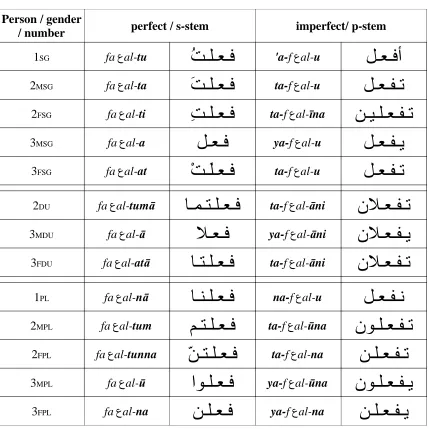
Table 1 demonstrates the main verbal inflections using the paradigmatic triliteral pattern
I verb
Ϟѧ
ѧ
˰
ό˰
ϓ
(faعala – 'to do').5Although I have included the labels 'perfect' and
'imperfect' for ease of reference to traditional grammars, the designations 's-stem' and
'p-stem' are preferred by Holes (2004) and have the merit of labelling the forms without
prejudging their meanings, referring respectively to suffixed and prefixed stems. It
should be noted that the so-called prefixed stem paradigm actually consists of the stem
inflected with both prefixes and suffixes, otherwise regarded as circumfixes (Bauer
2003:263-264) or 'discontinuous bound affixes' (Holes 2004:106). In fact, the paradigm
given in Table 1 only shows one set of p-stem affixes, modification to the suffixed
portion giving rise to two further paradigms traditionally designated subjunctive and
jussive.
Person / gender
/ number perfect / s-stem imperfect/ p-stem
1SG faعal-tu 'a-f عal-u
2MSG fa عal-ta ta-f عal-u
2FSG fa عal-ti ta-f عal-īna
3MSG fa عal-a ya-fعal-u
3FSG fa عal-at ta-f عal-u
2DU faعal-tumā ta-f عal-āni
3MDU fa عal-ā ya-fعal-āni
3FDU fa عal-atā ta-f عal-āni
1PL faعal-nā na-f عal-u
2MPL faعal-tum ta-fعal-ūna
2FPL faعal-tunna ta-f عal-na
3MPL faعal-ū ya-fعal-ūna
[image:43.595.85.515.104.533.2]3FPL faعal-na ya-fعal-na
Table 1: Perfect and imperfect inflectional paradigms (active)
Those unfamiliar with Arabic may wish to note that the least morphologically
complex form in the paradigms is the third-person, masculine singular of the perfect or
s-stem, represented in standard unvowelled orthography by the root letters alone.
Whereas speakers and scholars of Indo-European languages are most often used to
referring to verbs by their infinitives, no direct equivalent exists in Arabic and thus the
common with Wehr (1994), Wright (1967) and many others, when Arabic verbs are cited
as examples the English translation will be given in the infinitive. Only when a
distinction is necessary, such as in translating verbs in context, will the person, number,
gender and tense/aspect of the citation form be explicitly rendered. Attention should also
be drawn to the transliterations, in which the full classical pronunciations are given.
However, modern speakers of the standard language will often not pronounce all the
word-final short vowels and this will vary in context according to the onset of the word
which follows the verb, but also stylistically as a matter of register and idiolect.
2.1.2 Derivational morphology
2.1.2.1 'Biliteral' verbs
Although some authors, for example McCarthy & Prince (1990a), prefer to identify and
enumerate verbs derived from a separate class of biliteral roots, they will be treated here
as triliteral roots having the same second and third radical consonants (C2 = C3).
Al-Qahtani (2005:58-60) elaborates further upon why this assumption is reasonable
diachronically, citing phonological processes. Synchronic observation reveals that while
the citation form (s-stem, 3MSG) of the verb in (2a) differs formally from a triliteral verb
in which C2≠ C3, when a suffix having an initial consonant is added to the s-stem, such
as the first person singular in (2b), the familiar s-stem sequence is evident. This rule
applies throughout the s-stem and p-stem paradigms and it could therefore be argued that
identification of such verbs as biliteral is merely an artefact of choosing a paradigmatic
(2a)
ّﺐـﺣ
بﺮـﺿ
Habba(C2= C3) Daraba(C2≠ C3)
'he loved' 'he hit'
(2b)
ُﺖـﺒـﺒـﺣ
ُﺖـﺑﺮـﺿ
Hababtu Darabtu
'I loved' 'I hit'
Thus, for the purposes of this chapter, verbal derivational morphology will be
assumed, as is traditional, to be based upon triliteral and quadriliteral roots. The data
referred to in Appendix I are also arranged accordingly.
2.1.2.2 Pattern I triliteral stems
In Table 1 the triliteral pattern I paradigm verb
ﻞـ ﻌـﻓ
(fa عala) was used to exemplifyinflectional morphology. Other pattern I variants exist having different vowelling on the
middle radical in the s-stem. In verbs where this vowel is 'u' (
ﺔّﻤﺿ
-Damma), the p-stemmiddle radical vowel is also 'u' and, where it is 'i' (
ةﺮﺴﻛ
-kasra), the p-stem always has'a' (
ﺔﺤﺘﻓ
-fatHa). The possible combinations are shown in Table 2 with examples. Whilethere is clearly some systematicity relating the p-stem vowel to its s-stem counterpart,
opinions differ as to whether there is good synchronic evidence of syntactic or semantic
consistency to the different vowelling schemes, suggesting a meaningful classification
on this basis as per Wright (1967:I.30), or whether, as Badawi et al. (2004:60) claim,
sufficient to note their existence and to be aware that the vowelling may have some
syntactic and/or semantic significance. In tabulated data (see Appendix I), I have used
the labels Ia, Ii and Iu to distinguish triliteral pattern I verbs according to their s-stem
vowelling.
s-stem middle vowel
p-stem middle vowel
s-stem p-stem
a a dhahaba yadhhabu to go
a i Daraba yaDribu to hit
a u kataba yaktubu to write
i a shariba yashrabu to drink
u u Hasuna yaHsunu to be good
Table 2: Pattern I variants (active)
2.1.2.3 Derived or augmented triliteral stems
Grammars of Classical Arabic, for example Wright (1967), identify fourteen derived
triliteral patterns distinguished by Roman numerals II to XV, all of which exhibit
modifications beyond that of pattern I, which we have already met. This system of
numerical designations is generally favoured outside the Arab world, though many Arab
grammarians continue to refer to the patterns by their traditional labels, which consist of
the citation forms resulting from insertion of the consonants of the paradigm root
ﻞـﻌـﻓ
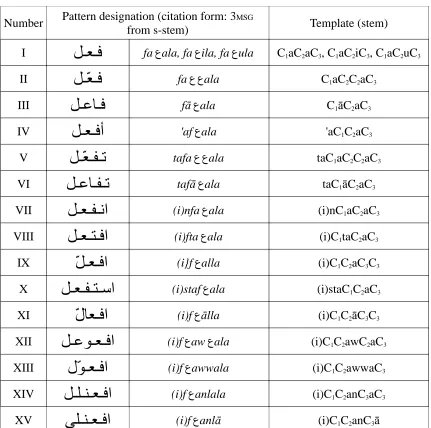
(f-ع- l) into the s-stem derivational templates. Table 3 presents all fifteen patterns,
representations of the stems are also provided. It should be noted that some forms are
effectively obsolete in MSA: Wehr (1994) does not identify any examples of patterns
XIII or XV, while XI, XII and XIV are also extremely rare in modern Arabic (see Table
10 on p.44). These patterns are therefore excluded from the analysis and discussion of
data which follows, in which reference to pattern IX is also limited. Although in
common use, pattern IX verbs are few in number and highly restricted semantically to
colours and defects. Note in Table 3 that '(i)' represents a vowel which may either be
regarded as present in the pattern but elided when pronounced postvocalically, or as an
epenthetic vowel supplied together with a leading glottal stop (hamza) to enable
pronunciation when no vowel precedes, since all syllables must begin with a CV
sequence and syllable-initial CC is disallowed. McCarthy & Prince (1990a:11-12)
discuss this further, treating this phenomenon as an epenthetic syllable which is not
properly part of the template. Comparison of these s-stem forms with their
corresponding p-stems, where the leading syllable of the s-stem is absent both in speech
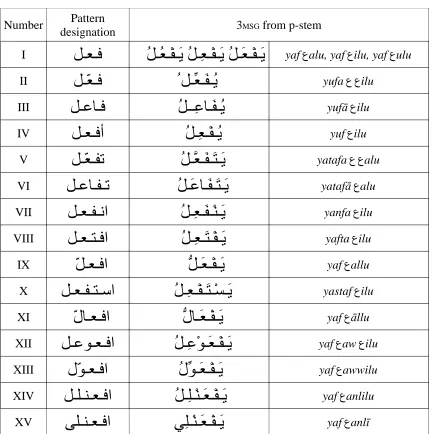
and in orthography, lends credence to their position. Compare, for example, pattern VII
in Tables 3 and 4. Attention is drawn in these tables to the vowelling of the augmented
patterns II – XV: unlike pattern I which exhibits three variants of the middle radical
vowel in both s- and p-stems, each of the augmented patterns has only one vowelling
scheme in the s-stem and one in the p-stem; also, whereas all augmented pattern s-stems
are vowelled throughout with 'a', p-stem vowelling, including that of the inflectional
prefix, varies from pattern to pattern. For sake of completeness, it must also be noted
that one form of expression of the passive in MSA involves predictable stem-internal
Number Pattern designation (citation form: 3MSG
from s-stem) Template (stem)
I
ﻞـ
ﻌـﻓ
faعala, faعila, faعula C1aC2aC3, C1aC2iC3, C1aC2uC3II
ﻞـّ
ﻌـﻓ
faععala C1aC2C2aC3III
ﻞـ
ﻋﺎـﻓ
fāعala C1āC2aC3IV
ﻞـ
ﻌـﻓ
أ
'af عala 'aC1C2aC3V
ﻞـّ
ﻌـﻔـﺗ
tafaععala taC1aC2C2aC3VI
ﻞـ
ﻋﺎـﻔـﺗ
tafāعala taC1āC2aC3VII
ﻞـ
ﻌـﻔ
ـﻧا
(i)nfa عala (i)nC1aC2aC3VIII
ﻞـ
ﻌـﺘـﻓ
ا
(i)ftaعala (i)C1taC2aC3IX
ء
ّﻞـﻌـﻓا
(i}fعalla (i)C1C2aC3C3X
ﻞـ
ﻌـﻔ
ـﺘـﺳا
(i)stafعala (i)staC1C2aC3XI
ء
ّلﺎﻌـﻓا
(i)f عālla (i)C1C2āC3C3XII
ﻞـﻋﻮـﻌـﻓا
(i)fعawعala (i)C1C2awC2aC3XIII
لّﻮـﻌـﻓا
(i)fعawwala (i)C1C2awwaC3XIV
ﻞـﻠـﻨـﻌـﻓا
(i)f عanlala (i)C1C2anC3aC3XV
ﻰﻠـﻨـﻌـﻓا
(i)f عanlā (i)C1C2anC3āNotes:
C1,C2 and C3(designated as f , عand l by Arab grammarians) represent any of the 28
consonants of MSA,(with some phonotactic and combinatorial limitations).
(i): epenthetic vowel.
[image:48.595.83.514.107.535.2]Other characters in template representations are fixed consonants and vowels as in transliterated text.