Designing the Unexpected: Endlessly Fascinating
Interaction for Interactive Installations
Lindsay MacDonald
1, John Brosz
1, Miguel A. Nacenta
2and Sheelagh Carpendale
11
University of Calgary, Canada
{macdonla, jdlbrosz, sheelagh}@ucalgary.ca
University of St. Andrews, Scotland
[email protected]
ABSTRACT
We present A Delicate Agreement, an interactive art installation designed to intrigue viewers by offering them an unfolding story that is endlessly fascinating. To achieve this, we set our story in the liminal space of an elevator, and populated this elevator with a set of unique characters. Viewers watch the story unfold through peepholes in the elevator’s doors, where in turn their gaze can trigger changes in the storyline. This storyline’s interactive response was created via a complex adaptive system using simple rules based on Goffman’s performance theory.
Author Keywords
Interaction design; interactive installation; interactive art; complex adaptive systems.
ACM Classification Keywords
H.5.m. Information interfaces and presentation (e.g., HCI): Miscellaneous.
General Terms
Human Factors; Design.
INTRODUCTION
When creating an interactive installation many challenges are apparent including such factors as attracting attention, engaging interest and sustaining interest. In this paper, we focus on the latter—sustaining interest—with the over-arching goal of creating endlessly fascinating interaction (EFI). Our focus on EFI frames our goal to provide observable actions that: (1) are interesting at any time; (2) are not repetitive; and (3) offer unfolding actions in which story lines are emergent. Also, we explore passive interaction, which offers the possibility of providing continual variation without requiring people to take actions beyond what they would normally do when viewing an installation. Our aim is to provide viewers with a dynamic experience that unfolds as they watch and is different for every viewer and for each time a viewer encounters the work. To establish stories of interest that resonate with a large part of possible viewers we set our piece in the context of the liminal space of an uncomfortable elevator ride. To create a
varying story line with the possibility of emergent sequences we borrowed ideas from complex adaptive systems (CAS). The characters within our story lines were designed employing art and social theory from Bang and Goffman. Together, these concepts allowed us to explore the possibility of passive interaction with endlessly fascinating unfolding stories.
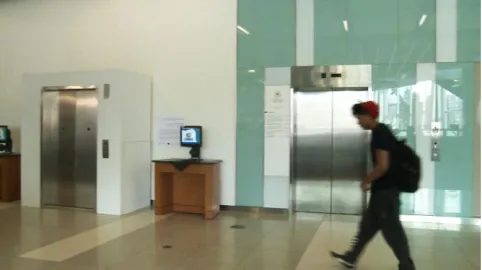
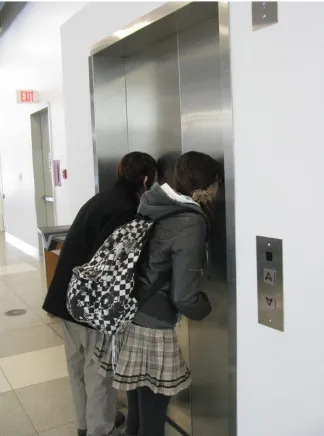
Our installation, A Delicate Agreement, offers the viewers a rich interactive narrative made up of encounters between the characters within the installation and, occasionally, with the viewer. Externally, it appears as a false elevator with a peephole in each door, allowing viewers to peer inside and observe the characters riding the elevator together and interacting with each other (see Figure 1). The combination of these elements constitutes our gaze-triggered interactive art installation that explores the concept of EFI.
The next section briefly covers related background from interaction design and interactive art installations and presents some well-known examples of complex adaptive systems. We go onto describe the conceptual basis of our work: its liminal setting; our passive interaction strategy; our interactive narrative structure and related social theory from Goffman; and our interaction challenges. Next, we discuss the physicality of our installation, and how we generate EFI using a CAS to offer continually varying interaction. We then discuss the exhibition of the piece and conclude the paper by noting our main contributions.
BACKGROUND
We draw from research on interactive technology in public spaces, interactive art and CAS to establish a background for this work.
© Owner/Authors 2015. This is the author's version of the work. It is posted here for your personal use. Not for redistribution. The definitive Version of Record was published in the Proceedings of the 9th International Conference on Tangible, Embedded and Embodied Interaction,
http://dx.doi.org/10.1145/2677199.2680603
[image:1.612.317.558.567.702.2]Cite as: Lindsay MacDonald, John Brosz, Miguel A. Nacenta and Sheelagh Carpendale. 2012. Designing the Unexpected: Endlessly Fascinating Interaction for Interactive Installations. In Proceedings of TEI '15. ACM, New York, NY, USA.
Interactive Technology in Public Spaces
Encouraging passersby in public spaces to engage with technology is a relevant issue that has been much discussed in the area of human-computer interaction (HCI) for public spaces. Müller et al.’s Looking Glass [18] attracts viewers’ attention by showing their reflections interacting with objects on large displays. In Proxemic Peddler, Wang et al. [27] make use of animations that change as the viewer’s proximity and physical orientation to a large display change in order to attract their attention. Brignull and Rogers [4] discuss the honey pot effect as a phenomenon of how even one person’s attention would attract other people to a large display. Hinrichs et al. [13] noted that different configurations of a large display, such as the degree to which interactions are visible, has an impact on the honey pot effect and can be another powerful way to attract people’s attention. Similarly, we engage passersby in public spaces by placing peepholes in the doors of the elevators, through which light and movement inside the elevator can be seen. Viewers looking through these peepholes did indeed trigger the honey pot effect.
Interactive Art Installations
Krueger’s Videoplace [16] sets up an active playful dynamic for viewers to explore how the piece will respond. Our work relies on less explicit interaction, requiring little beyond what the viewer is already doing to explore the installation. Hill’s Tall Ships engages people by enabling the exchange of gaze with projected videos of ghosts activated by pressure sensors [12]. This creates an uncomfortable social situation due to proximity of the life-sized projections to the interacting viewer. The ghosts are only capable of approaching the viewer, staring and walking away [12]. Based on similar experiences with other people, viewers get a sense that the ghosts are conveying a sense of longing through their gaze. In contrast, A Delicate Agreement does not force the viewer to exchange a prolonged gaze with the characters to directly control the characters’ movement. Instead, the viewer’s gaze is just one of the factors that influence the next action. However, a similarity with Tall Ships is the expectation that the viewer will reflect upon the presented situation and relate to the characters that live in the world of the piece by using their own experiences, and that the gaze will function as a vehicle to achieve this.
Gonsalves’ Chameleon [10] is a large scale installation that examines social relationships, trust and intimacy within the context of interactive technology, using neuroscience research and face-sensing technology. The piece consists of video portraits arranged around a gallery of individual actors performing various emotions, ranging from anger to sadness, tiredness to happiness. Gonsalves worked with an interdisciplinary collaborative team that included experts from neuroscience, HCI and affective computing to get the video characters in the piece to mimic empathy and emotional contagion [11]. Face-reading technology estimates the emotional state of the viewer and incorporates
that into software that controls the emotional reaction of the portraits. Chameleon is closely related to A Delicate Agreement in that both pieces only require passive interaction and feature a cast of characters that have software-constructed personalities. We take a different approach in our piece by using these ideas to structure emotional landscapes for our characters, going beyond establishing empathy to develop an interactive narrative.
Complex Adaptive Systems
Complex adaptive systems (CASs) are neither fully constrained as in linear systems nor fully chaotic. They are often said to be on the chaotic fringe in that they incorporate considerable freedoms yet do have rules which are followed [26]. One way in which these systems can operate is to have entities or agents that are merely locally aware. That is, these agents only know how they respond to a given set of situations. There is no overview or central control of the whole system, thus, sequences and storylines are flexible. Waldrop uses the example of an economy as a CAS, and describes individuals or households as being the agents [26:145]. We use this understanding of the term agent in our work – our agents are the characters in the elevator. Gell-Mann [8] describes how a CAS can create complex and diverse phenomena such as eco-systems, the operation of the immune system, and the behavior of investors in financial markets. Miller and Page [17] demonstrate the use of an agent-based CAS to model varied and interesting social systems including bees, theatre audiences, city formation, and many others.
Many systems exist where CASs have been used to create complex, interesting, and unpredictable outcomes. Conway’s Game of Life [7] employs three simple rules governing whether cells in a grid live, reproduce or die based on their local neighborhood and is able to produce extremely complex behaviors up to and including an operational Turing machine [1]. Boids [22] use three simple rules for separation, alignment, and cohesion to reproduce the realistic group movements of flocks and herds; this technique is widely used in the animation industry [21] and has been expanded upon to create interactive art [3]. Turk [25] used the reaction-diffusion process, noted as a CAS [15] to produce widely varied biological patterns matching those of zebras, giraffes, leopards, and many others.
We use a CAS to support interactions between our characters (or agents), the viewers’ gaze and the elevator in motion to produce complex, responsive, and emergent behaviors.
CONCEPT
To provide the appropriate context for our CAS we first describe liminality, and the exchange of expression and impression from Goffman’s performance theory.
Using a Liminal Setting
of them” [14:209]. Common examples of liminal spaces are doorways and hallways where one has left one room but not yet entered the next. We set the interaction of our piece in the liminal space of an elevator to be able to leverage the social awkwardness inherent in such places.
The liminal space of the elevator is an appropriate setting to examine the effects of gaze on interaction. Elevators offer a protracted moment of liminality when two strangers ride together, awkwardly waiting for the machinery to complete the transition from one floor to the next, moving towards their desired destinations. There are unspoken rules about what behavior is acceptable. If these rules are broken, the elevator ride can become uncomfortable. If a stranger casts their gaze in any direction other than towards the doors, this can threaten the delicate agreement that tacitly exists between the occupants of the elevator. The context of the elevator sensitizes the viewer, making small behavioral changes more noticeable while shedding light on the viewers’ awareness of the unspoken rules.
Short narratives that can unfold along these lines are, for example, a moment of mutual attraction and flirtation between two characters or, conversely, unwanted attention. Discord can occur when one character behaves inappropriately, such as writing graffiti on the wall or brandishing a weapon. Depending on each character’s personality, different responses can occur to these events, creating spontaneous and varied narratives that can engage and intrigue the viewer.
Using Passive Gaze Interaction
A theme in our work is the interplay between passive and active viewer interaction. Active interaction is the normal approach where people must do specific activities such as clicking with a mouse or typing on a keyboard. In contrast, passive interaction occurs when people viewing the piece are not required to do anything outside of what they would normally be doing [19]. We use the idea of incidental interaction [6], meaning that by the act of looking in through the peepholes in the elevator doors with the expectation to observe the interior of the elevator, viewers affect the course of the unfolding narrative happening in the elevator by means of the direction of their gaze. This interaction can become active if the viewer realizes that their gaze is affecting the behavior of the characters.
Interactive Narrative and Social Theory
To create our interactive narrative, we drew from Bang’s [2] discussion of open text. Here, he stipulates that open text, or interactive narratives, can have many plot climaxes compared to linear narratives, which have just one. Participants in interactive narratives are drawn into a state of contemplation when experiencing the work, reflecting on his or her own life experience in order to inform decisions made while interacting. Similarly, Goffman [9] indicates that one draws upon one’s experiences when interacting with other people in order to decide how to react or present oneself. In this way, expression can be bisected into that which is given,
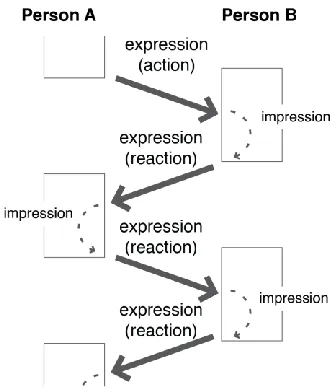
which can be controlled by the person expressing, and that which is given off, which is how the expression exists after leaving the character and how it is received by the other person. Impression, on the other hand, is the effect left by the expression on the other person. Goffman’s expression and impression exchange, illustrated in Figure 2, is used in the design of our characters’ interactions. Our goal was to model the behavior of the characters and their reaction to viewers on this existing sociological theory in order to make encounters in the space of the elevator more believable. Thus, this model of human interaction and behavior is applied to the exchange between a person and a character–or between two characters–in A Delicate Agreement.
Our artistic vision was to create mini action sequences that fit with a given character and could be combined with other characters’ sequences to create narratives. To produce the exponential number of spontaneous narratives possible in A Delicate Agreement, we harness combinations of characters, their behaviors, and the direction of the viewers’ gaze. Due to the fact that the elevator is traveling up and down the building and the characters do not remain on board for an extended period of time, the story can be divided into subplots or micro-stories as people enter and leave. Based on previous similar real life experiences, viewers choose where to look, triggering any number of new and different plot climaxes within a single viewing and interaction session and creating a unique experience each time the piece is revisited.
Interaction Challenges
[image:3.612.354.519.58.252.2]Art installations using interactive technologies are becoming increasingly prevalent both in galleries and in public spaces. People encountering these installations must discover how to interact with them to subsequently reveal the installation’s reaction. The reaction of the installation can serve to sustain the viewer’s attention, encouraging deeper exploration and appreciation of the content. However, in some cases, the viewer’s interaction with the installation can yield repetitive
Figure 2. An illustration showing Goffman’s theory of expression and impression, reflected in our software
results. Our goal for A Delicate Agreement is to extend possibilities for viewer interaction to make the experience endlessly fascinating. In summary our interaction challenges are that:
the observed reactions of the piece are both understandable and intriguing;
the viewer is not required to discover difficult or obscure actions to trigger a response;
the viewer does not need to be aware of the effect of their own interaction; and
the story that unfolds is non-repetitive, and endlessly fascinating.
We address the first challenge through our choice of setting– the liminal setting of elevators that is familiar to all of us and yet remains socially awkward. The next two challenges are addressed together through the use of passive gaze interaction. The last challenge—developing EFI—is addressed primarily through the creation of our CAS (see the next section). However, other factors in its creation include a combination of interactive narrative and ideas from social theory described in a later subsection.
REALIZING A DELICATE AGREEMENT
In this section, we first discuss the physical aspect of our installation and its gaze tracking interaction; then we present the design and implementation of our CAS.
Physical Form
[image:4.612.355.517.60.278.2]A Delicate Agreement is an interactive installation that explores the liminal time and space of an elevator ride. Viewers are presented with a false set of elevator doors (Figure 1 shows the exterior) augmented with a pair of peepholes that allow them to look into the interior of the elevator (Figure 3). Two LCD monitors are set inside the elevator behind the peepholes. The monitors display a composite stop motion animation of a cast of sixteen characters riding the elevator (Figure 4 shows six of these characters). From either peephole the viewer can see the interior of the elevator, up to two characters at a time as passengers, and an elevator display that indicates the floor the elevator is currently on (Figure 5). Each character has a set of pre-recorded photo sequences shot on a theatrical set in a photography studio that provides the appearance of the interior of the elevator. The photo sets for each character illustrate the range of possible behaviors that each character can perform. A character’s set of photos ranges from several hundred to several thousand still frames that are played in sequence as a stop-motion animation. Each elevator passenger, or character, has a programmed personality that enables them to act and react to the other characters’ behavior and the viewers’ gaze (see next subsection). Immediately behind each peephole is a custom-made eye-tracker. The eye-tracker was designed to: a) be invisible to the viewer so that interaction could be, at least initially, implicit; b) not require calibration; c) be reliable and able to run long periods of time; d) be inexpensive, so that the piece
[image:4.612.317.559.303.471.2]Figure 3. Two viewers looking into the interior of the elevator.
Figure 4. Six of the sixteen characters (L to R, Top to Bottom): Max, Nicole, Bert, Terry, Danny and Kathy.
[image:4.612.318.557.500.681.2]could be left unattended in public spaces. Each of the two eye-trackers consisted of a hot mirror (a mirror that only reflects infrared light), a low-resolution Logitech webcam, modified with a filter to be sensitive only to infra-red light (with its internal infrared-blocking filter removed), two sources of infrared light (LEDs) to generate corneal reflections, and a customized version of the ITU Gaze Tracker software [23] to perform the analysis, which was fed to the CAS software described below and run in the same machine (a Windows PC). The hot mirror, located at 45º from the line of sight, allowed us to place the camera and infrared light sources very close and perpendicular to the eye and therefore obtain a very large image of the pupil without making any of the machinery visible. Although this eye-tracker is not comparable in sample-rate or performance to commercial ones, it was able to satisfy our requirements which were comparatively simple. We merely needed to know which character a viewer was looking at and whether they were looking at the character’s head or torso.
The Character Engine (a Complex Adaptive System)
The underlying CAS that powers our piece is based on the idea that a few simple rules governing individual agents (characters) can produce a wide variety of emergent behavior. Neither the characters nor the overarching system need to know the full complexity possible. Each character merely needs to know its own rules for actions and reactions. By creating a CAS based on simple mechanisms we enable the generation of emergent narratives between the characters in the installation.
Our intention was to make it possible for interactive responses to emerge from the system. That is, we avoided specifying defined sequences of character actions, such as where if action A happens, then response B will follow. This type of sequential response would lead to a repetitive and predictable viewing experience. We chose to create a CAS in which characters know their own set of behaviors and know how they respond to simple changes in their environment. To do this we have defined the characters, their environment, and the events that will cause them to react.
The characters in the elevator
The elevator currently contains sixteen different characters (see six of them in Figure 4). Some of the characters are Nicole and Max, young university students; Kevin and Rose, teenagers; Alice, a little girl; Toby, a bike messenger; and Leo, a dangerous-looking man with a gun.
Each character has his or her own list of possible behaviors. A behavior is a sequence of photos that together provides a stop motion animation expressing an emotion or reaction. For example, Max—a generally friendly and happy character—cheerfully acknowledges other characters entering the elevator that glance over at him.
The characters’ interaction environment
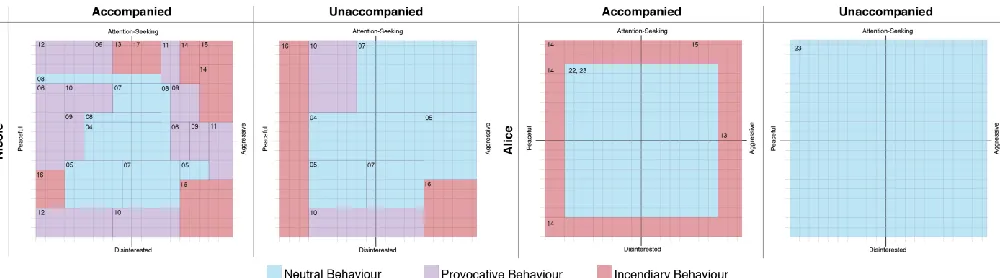
In our system, the characters’ interactions are determined by their emotions. Their emotions, in turn, trigger their behaviors. To model their emotional space, we use a coordinate system. This coordinate system encompasses each character’s personality, with enclosed regions marking behaviors (Figure 6). This was inspired by Zeeman’s relational graphic of a dog’s response to cusp catastrophe that is based on catastrophe theory research [28]. Zeeman’s graphic displays a coordinate space with rage as the X-axis and fear as the Y-axis where nine drawings of the profile a dog’s face are laid out in this grid pattern. The dog’s facial expression changes according to where his emotional response lies within this coordinate space. This coordinate space of changing emotions inspired our emotional coordinate space for each character. The axis of the space, however, need not be rage and fear; Nass [20] asserts that personality can be defined by two meaningful dimensions: extraversion and agreeableness.
[image:5.612.58.558.539.678.2]Our characters’ emotional behavior is represented as a 2D grid of states (personality grid) but based on Nass’ two dimensions. At a given moment a character’s emotional state (mood) is represented by a 2D coordinate in the grid. One dimension of the grid represents agreeableness (from peaceful to aggressive) while the other one represents extraversion (from disinterested to attention-seeking). The
grid is divided in areas of emotional state that result in behaviors; for a given range of extraversion and agreeableness the character will display a certain visual behaviour corresponding to a particular sequence of pictures. For example, when the character Nicole has an agreeableness value of 8 and an extraversion value of 1, she will express the behavior “disbelief” (Figure 6 leftmost).
Behaviors are not, however, limited to the selection of visual output. Behaviors also affect the emotional state of other characters in different ways. For example, the aggressive anger behavior of Leo causes other characters to become more aggressive (the exact calculation is described in the next subsection). This is the basic mechanism of interaction between characters: Leo’s anger behavior is his expression and triggers the other character’s impression. Therefore, the personality grids are a representation of the visual output of the character, and also hold their current state and describe the dynamics of how characters can influence one another. There are a total of 26 different behaviors, and each character possesses a subset of these, although different characters have behaviors associated to different areas of their personality grid. Examples include: neutral, attracted, angry, frightened, bored, and shocked. Each character has two personality grids: one for when they are alone in the elevator and one for when they are accompanied. Nicole’s emotional space (Figure 6, left) is representative of a more complex character as she has a large number of possible behaviors. In contrast, Alice has only five behaviors (Figure 6, right). The getting on/off the elevator or recognizing the viewer behaviors are not represented on the characters’ emotional spaces as these are triggered by the elevator’s state rather than by interaction with other characters.
Events & behavior changes
Characters experience a variety of different events. First the elevator has its own actions; it goes up and down, characters get on and off. Characters will only get on or off at specific floors. The elevator’s actions keep the story moving. If the elevator is empty it will pick up the character at the next floor in sequence.
Stepping through the character interactions, we start with a simple situation where a character is alone in the elevator and there is no viewer present. Under these situations the character will slowly move towards neutral behavior (emotional coordinate (0,0)) because there are no other characters present that can alter their mood. If another character enters the elevator, expression/impression exchange begins, where one character’s behavior will influence the other’s mood and vice versa. In our CAS, we build on small simple reactions that only required knowledge of the immediate context making it possible to design the interacting factors independently.
To implement this, every behavior for each character has an expression vector e. This relates how their current behavior changes the behavior of the other person in the elevator by
nudging them in a particular direction along both the x- and y- axes. Each character also possesses an impression filter i that scales their responses to other character’s expressions, allowing different characters to be more or less reactive. A character with i=(2,2) will be very reactive while a character with i=(0.5,0.5) will be less influenced by others’ expressions. Lastly, each character has a constant impression vector c that is added to all changes making some characters consistently move towards particular parts of their personality grids. This serves to allow for slight variations in behavior when characters are riding the elevator alone. Given a character with a particular emotional coordinate si, the character’s next coordinate is calculated by:
si+1 = s + i eo + c
where eo is the other character’s (if present) expression vector matching their current behavior.
To illustrate this, consider a scenario in which the characters Kevin and Rose are in the elevator together. Kevin’s current behavior, “obnoxious antagonism” has e=(10,2); i.e., this behavior expresses a great deal of aggressiveness (10) as well as a smaller amount of attention seeking (2). Similarly, let us say that Rose’s behavior is currently “Neutral” due to her emotional coordinate being at (0,0). Rose’s character has i=(.5,3) and c=(1,4). If Rose’s neutral behavior finishes its animation, her emotional state will be recalculated with:
si+1 = s + i eo + c = (0,0) + (.5,3) (10,2) + (1,4) = (6,10).
This change of emotional coordinate to (6,10) will place Rose in her “openly angry” behavior.
Visually, this plays out as Kevin turning up the speakers on his iPod and dancing around (his particular obnoxious antagonism stop-motion animation), which in turn causes Rose to get frustrated or angry at this obnoxious display. When he reaches the end of his image sequence for his behavior, Kevin will collect e from Rose’s updated behavior to determine which behavior to perform next. At the end of her behavior image sequence, Rose will use e from Kevin’s new behavior to determine her next behavior. This expression/impression exchange process, based on Goffman’s theory and shown in Figure 2, continues until one or both characters exit the elevator. The characters maintain their mood for a certain length of time while they stay on their destination floor in the building. If they re-enter the elevator within a certain period of time, they will likely perform the same behavior, affecting whomever they happen to be riding with.
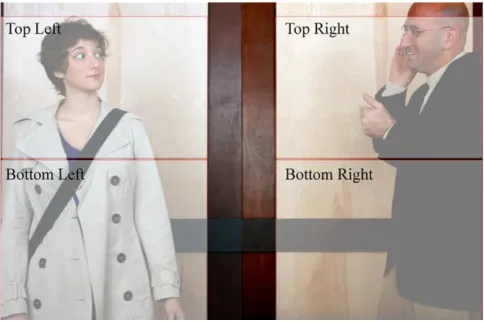
when either viewer is looking through a peephole. vst for the top of the character, vsb for the bottom of the character as well as vot and vob that are triggered when viewers look at the top and bottom respectively of the other character in the elevator. The emotional state update formula then becomes:
si+1 = s + i eo + c + v1 + v2
where v1 is either vst, vsb, vot, vob, if the viewer in the first peephole is looking at one of the aforementioned character regions or (0,0) if looking elsewhere or not present. Similarly v2 is the appropriate vector for the viewer, if any, looking through the second peephole.
In the event that the viewer is looking at the top of a character at the instance that the character is changing behaviors, the character will perform his or her acknowledgment of the viewer behavior (Figure 5). This special behaviour trigger is designed to bring awareness to the viewer that their presence is affecting the piece’s state.
DISCUSSION
The biggest point for discussion is: did we achieve EFI? Of course, that is an impossible notion to gauge. However, we can say that in the three times that A Delicate Agreement has been exhibited, people have not been able to trigger repeat performances. So while our unfolding story is undoubtedly not endless, it definitely has considerable variation. On the other hand, we have experienced emergent behavior. As an example, we intentionally included mild flirting sequences that could be triggered when the character was in a safe, relatively happy space in their emotional landscape. These sequences did add amusement and highlights to the story. However, it became apparent that all characters in our elevator had bisexual tendencies. During the creation time and times between exhibitions, the piece was operational for long periods of time in our lab, a large research group of approximately 40 to 50 people. There are still amusing anecdotes from this piece that people tell each other. While to a large extent our custom made passive gaze tracker served as intended, it did have trouble with people wearing glasses. People commented simultaneously that although
they felt that there was no response to them as viewers, they noted that some of the elevator characters had waved at them. This specific sequence requires gaze interaction to occur. This combined response does speak to the piece’s ability to walk the line between passive and active interaction. As creators, this piece challenges our notion of authorship, and intrigued us sufficiently that we explored possible ways of influencing the unfolding story. One simple method was to add new characters, as we did at one gallery’s request. A more complex approach was to work with each character’s emotional landscape. To enable this we wanted to have some idea of where, in emotional coordinates, characters frequently spent time. This led to an intensity visualization of their behavior over time. We visualized each character’s behavior through a simulation with a choropleth map (Figure 8). These maps allow us to see if a character was spending too much, or not enough, time in a given space. For example, from the maps it was apparent that Leo’s was frightening the other characters too much, and we were able to modify his expression vector to reduce his expressed aggression.
CONCLUSION
In this paper we have presented A Delicate Agreement, which we designed to provide endlessly fascinating interaction (EFI). We have shown how:
complex adaptive systems (CASs) can be used to provide a non-repetitive storyline;
how Goffman’s theory of expression/impression can be used to create rules in a CAS that offer convincing approximations of behaviors; and
the liminal setting of continued awkwardness in elevator rides can provide a story line intensifier.
[image:7.612.52.294.60.221.2]While other CASs have been built on spatial grids such as SELES, a landscape scale simulation environment [5], we used the grid concept but spatialized a series of common emotions and used Goffman’s theory to create rules for travel throughout this emotional grid. We also visualized the spatialized behavior frequencies to use as a tool for influencing the story line. Note that in our endlessly varying
Figure 8. Choropleth behavior visualization for Max and Leo. Aggressive behavior regions are red, provocative purple, and
[image:7.612.318.554.60.185.2]neutral blue. The more opaque the color, the more time the character has spent exhibiting that behavior. Figure 7. The four regions of the image that trigger response to
story line specific actions cannot be specified; however, their likelihood can be enhanced.
The possibilities for future work abound. We hope that we have opened the door for a new approach to designing interactive experiences.
ACKNOWLEDGMENTS
This research was supported in part by SSHRC, NSERC, SMART Technologies, AITF, SurfNet and GRAND.
REFERENCES
1. Adamatzky, A., ed. Collision-Based Computing. Springer, Berlin, 2002.
2. Bang, J. The meaning of plot and narrative. In The computer as medium. Cambridge University Press, Cambridge, New York, 1993, 209–220.
3. Boyd, J.E., Hushlak, G., and Jacob, C.J. SwarmArt: interactive art from swarm intelligence. Proc. of the 12th Annual ACM International Conference on Multimedia, ACM (2004), 628– 635.
4. Brignull, H. and Rogers, Y. Enticing people to interact with large public displays in public spaces. Proc. of INTERACT, (2003), 17–24.
5. Carpendale, M.S.T., Cowperthwaite, D.J., Tigges, M., Fall, A.J., and Fracchia, F.D. The Tardis: a visual exploration environment for landscape dynamics. Electronic Imaging ‘99, International Society for Optics and Photonics (1999), 110–119.
6. Dix, A. Beyond intention-pushing boundaries with incidental interaction. Proc. of Building Bridges: Interdisciplinary Context-Sensitive Computing, Glasgow University, (2002).
7. Gardner, M. Mathematical Games – The fantastic combinations of John Conway’s new solitaire game “life.” Scientific American, 1970, 120–123.
8. Gell-Mann, M. The Quark and the Jaguar: Adventures in the Simple and the Complex. Henry Holt and Company, New York, 1994.
9. Goffman, E. The Presentation of Self in Everyday Life. Doubleday Anchor Books, New York, 1959.
10. Gonsalves, T., Frith, C., Critchley, H., Picard, R., and El
Kaliouby, R. Chameleon. 2008.
http://www.tinagonsalves.com/chamselectframe.html (accessed 7/11/2014).
11. Gonsalves, T. Empathy and Interactivity: Creating Emotionally Empathic Circuits between Audiences and Interactive Arts. In R. Ascott, G. Bast, W. Fiel, M. Jahrmann and R. Schnell, eds., New Realities: Being Syncretic. Springer, Vienna, 2009, 136– 139.
12. Hill, G. Tall Ships. 1992. http://garyhill.com/left/work/tall-ships.html?q=569 (accessed 7/11/2014).
13. Hinrichs, U., Schmidt, H., and Carpendale, S. EMDialog: Bringing information visualization into the museum. IEEE Transactions on Visualization and Computer Graphics 14, 6 (2008), 1181–1188.
14. Johnston, S.I. Restless Dead: Encounters between the Living and the Dead in Ancient Greece. London, 1999.
15. Kondo, S. and Miura, T. Reaction-diffusion model as a framework for understanding biological pattern formation. Science 329, 5999 (2010), 1616–1620.
16. Krueger, M.W. Responsive environments. Proc. of the June 13-16, 1977, national computer conference, ACM (1977), 423– 433.
17. Miller, J.H. and Page, S.E. Complex Adaptive Systems: An Introduction to Computational Models of Social Life. Princeton university press, 2009.
18. Müller, J., Walter, R., Bailly, G., Nischt, M., and Alt, F. Looking glass: a field study on noticing interactivity of a shop window. Proc. of SIGCHI Conference on Human Factors in Computing Systems, ACM (2012), 297–306.
19. Nakatsu, R., Rauterberg, M., and Vorderer, P. A New Framework for Entertainment Computing: From Passive to Active Experience. In F. Kishino, Y. Kitamura, H. Kato and N. Nagata, eds., Entertainment Computing - ICEC 2005. Springer, Berlin, 2005, 1–12.
20. Nass, C., Moon, Y., Fogg, B.J., Reeves, B., and Dryer, D.C. Can computer personalities be human personalities? International Journal of Human-Computer Studies 43, 2 (1995), 223–239.
21. Parent, R. Computer animation: algorithms and techniques. Newnes, 2012.
22. Reynolds, C.W. Flocks, herds and schools: A distributed behavioral model. ACM SIGGRAPH Computer Graphics, ACM (1987), 25–34.
23. San Agustin, J., Skovsgaard, H., Mollenbach, E., et al. Evaluation of a low-cost open-source gaze tracker. Proc. of the 2010 Symposium on Eye-Tracking Research & Applications - ETRA ‘10, ACM Press (2010), 77.
24. Thomassen, B. The uses and meanings of liminality. International Political Anthropology 2, 1 (2009), 5–27.
25. Turk, G. Generating textures on arbitrary surfaces using reaction-diffusion. Proc. of the 18th Annual Conference on Computer Graphics and Interactive Techniques, ACM (1991), 289–298.
26. Waldrop, M.M. Complexity: The emerging science at the edge of order and chaos. Simon and Schuster, New York, 1992.
27. Wang, M., Boring, S., and Greenberg, S. Proxemic Peddler: A public advertising display that captures and preserves the attention of a passerby. Proc. of the 2012 International Symposium on Pervasive Displays, ACM (2012), 3:1–3:6.