Using contextual information in the evaluation of the effectiveness
of barriers restricting access to the main line at stations.
Urszula WRONSKA, Brendan RYAN
University of Nottingham, United Kingdom
Abstract: The use of fencing at railway stations to reduce the numbers of fatalities is a common safety intervention. This study examines the effectiveness of a mid-platform fencing programme as a means of preventing access to the track area. Two aspects of the programme are
considered: firstly the extent to which fencing has been fitted to provide a secure barrier to fast lines at the target stations; and secondly, investigation of incidents in which the physical barrier has been overcome by individuals. The study involved the analysis and collation of descriptive data, using station visits, interviews with industry staff, examination of reports on the incidents and data from the SMIS database. It was found that the desired level of restriction of access to the intended areas through fencing was not always provided. So far, there have been few examples where somebody attempted or succeeded in climbing over a barrier to access the track. Factors affecting the effectiveness of physical barriers are presented and some shortcomings in current collection of evidence through incident reporting are highlighted.
Keywords. Rail suicide prevention, evaluation, safety intervention, mid-platform fencing.
1. Introduction
Figures 1 and 2. Mid-platform fencing, separating a fast line platform from the slow line platform and a sliding gate in the mid-platform fencing
The use of a fencing approach is founded on good theory, employing the principle of restricting the access to the lethal means to lower the rates of suicide (Mann et al., 2005). There is evidence in the literature of the beneficial effect of platform screen doors at stations (Law et al, 2009). However, there have been no previous studies of the effectiveness of the use of mid-platform fencing as a safety intervention in this type of context. This study collects descriptive evidence as a means of evaluating the implementation and effectiveness of this type of fencing programme. This work is consistent with a theory based approach (Hills and Junge, 2010) to understand
whether the intervention has worked, why it has worked and under what circumstances it has worked. Two main questions are considered. Firstly, the level of restriction of access to the main line at a sample stations is described, considering variations in the type, implementation and maintenance of the barriers at different locations. Secondly, records of the incidents that have occurred at the stations in the sample are analysed, building on the approach to qualitative analysis of incidents in Ryan (in press), focusing on the point of access to the track and determining whether and how the barriers have been overcome.
2. Methods
2.1 The collection and analysis of site specific details.
Forty nine stations along three rail routes in Great Britain have been considered in this study. Preliminary data on the types of fencing that were implemented at these stations have been collected during station visits conducted as part of the RESTRAIL project (www.restrail.eu) in 2013-14. On completion of that project in 2014 the fencing programme at some locations was still in progress. For the purpose of the current study, follow up visits have been conducted in 2017 at fifteen of the stations in the sample, to investigate the current status of the fencing and collect additional evidence about any incidents that have occurred at the stations in the
intervening time period. During the visits notes and photographic evidence were collected on the type of the restriction, verifying the position of barriers in relation to fast line locations on plans of the stations. Staffing arrangements of the station were observed.
access through fencing. Thirteen participants were recruited, including station staff, station and area managers and members of British Transport Police. All were familiar with site-specific circumstances as a result of working at a location, managing or patrolling locations as a part of their work duties. Information collected during these interviews included site specific details of the types of the barriers and the dates when they were implemented, staffing levels, manned hours of the station and details of incidents since the fitting of the fencing.
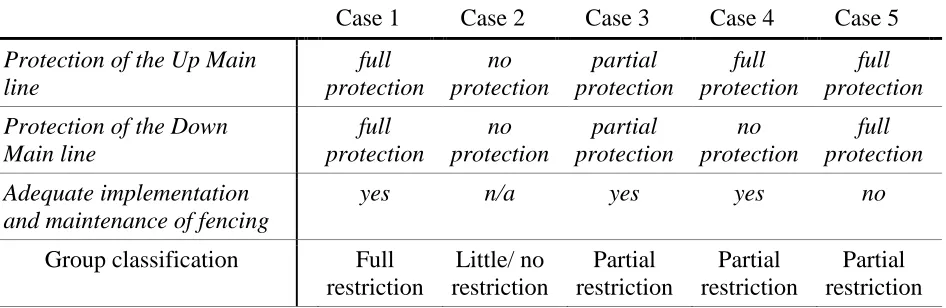
The findings from the station visits and interviews were collated with information that had been compiled in the earlier work in 2014. Each station was described using three criteria: the protection of the Up Main line, protection of the Down Main line and adequate implementation and maintenance of the barrier. Descriptions of these characteristics and their values are included in Table 1. Tale 2 shows how different combinations of circumstances at stations can be interpreted, in terms of the level of protection that is provided at the station (i.e. full or partial restriction of access).
Table 1 Criteria describing the protection of the Up/Down Main line at stations and the implementation and maintenance of the barrier.
(1)Protection of the Up Main line as well as (2) Protection of the Down Main line could take one of three following values:
full protection There is either mid-platform fencing or fencing running along the full length of the platform or other barrier which fully separates the areas from main line track from the rest of the station.
partial protection
Presence of a barrier on the platform, however there are gaps in the fencing, thus it is not continuous along the full length of the platform (e.g. due to incomplete fencing).
no protection Within the station environment areas adjacent to the main line can easily be accessed by the members of the public as there is no barrier in place or the barrier protects only short sections of the platform (e.g. at the platform ends).
(3)Adequate implementation and maintenance of the barrier could take one of three values:
yes There were no circumstances that could undermine the effectiveness of the implemented barrier
no Circumstances that could undermine the effectiveness of the implemented barrier were identified at the location (not connected with the standard operation of the gates e.g. leaving the gates unlocked when the station was unmanned)
Table 2 Criteria used to describe the level of restriction of access at stations.
Case 1 Case 2 Case 3 Case 4 Case 5
Protection of the Up Main line
full protection
no protection
partial protection
full protection
full protection
Protection of the Down Main line
full protection
no protection
partial protection
no protection
full protection
Adequate implementation and maintenance of fencing
yes n/a yes yes no
Group classification Full restriction
Little/ no restriction
Partial restriction
Partial restriction
Partial restriction
Each station was assigned to only one group (full, partial, little / no restriction). Where possible, the date when the fencing restriction was completed at the station was recorded. In some cases it was possible to establish only an approximate date when the measure was implemented.
2.2 The collection and analysis of incident-related data.
The second part of this study involved the review of fatalities that had occurred at the sample of stations in the time since the fitting of the fencing (in this study using data from the industry database SMIS for the period from 1/01/2010 to 01/02/2017). By classifying the stations in this way it was possible to identify the incidents at stations where a full or partial restriction to the main line was provided at the time of the incident. As the barriers are intended to protect the main lines, only incidents where the point of impact occurred on the main line were included within the scope of the study.
The following details from incidents were extracted from data fields and narrative fields in the database and recorded in a table: the location; date and time of the incident; the line where the fatality occurred; actions of the person preceding the incident; the point of impact with the train. Information about the circumstances of the suicidal act were supplemented with details from incident related reports provided by the BTP and Network Rail, including: BTP Post Incident Site Report (ISR) (available for 14 incidents), BTP Incident External Report (ER) (available for 4 incidents), Network Rail Fatality Follow Up Inspection Report (FFI) (available for 1 incident) and Suicide Event Station Review Form (SRF) (1 incident). These sources provided information on the point of access to the track, the actions of the person prior to the incident as well as detail on the suicide prevention measures present at the station at the time of the incident. At least one additional data source was therefore available for most of the incidents. No additional reports were available for one incident and one other case was included within the scope after the materials were requested and it is not known if additional records for this incident are available.
3. Results
3.1 The level of restriction of access to the main line at stations.
Table 3 Groups of stations recognised within the study sample, classified by the level of access to the main lines.
Level of restriction of access
(number of stations allocated to the group)
Type of barriers protecting the up/down main line at the stations
Full restriction (21) Full mid-platform fencing, full fencing, gate/doors
Partial restriction (16) Full mid-platform fencing, partial mid-platform fencing (with gaps), full fence (minor gaps), full fence (minor gaps) and gate/doors, distance
Little or no restriction (10)
No barriers, partial fencing (fence only at short sections along the platform)
Initially Partial restriction, upgraded to
Full restriction (2)
Partial mid-platform fencing, supplemented with further fencing several years later and therefore re-classified as full mid-platform fencing
There are some circumstances where full fencing or full mid-platform fencing has been classified within the partial restriction group, as a result of information that has been collected during this study. In the eight cases that are described in Table 4 there were problems with the
implementation of the fencing or the control of access to protected locations.
Table 4. Findings on the site-specific aspects which affected the performance of the fitted barrier.
Type of the barrier (number of locations
[location codes])
Implementation and maintenance of the barrier
Full mid-platform fencing (4 locations [1.h, 2.l, 2.r, 3.c])
Low staffing levels (station staffed 4h/day Mon-Fri) wouldn’t allow for an appropriate closure of the gates in mid-platform fencing. It is evident that the gates can be left open by passengers getting on or off the train at the restricted access platform at this location and these could stay open for long hours, undermining the impact of the fencing as a physical barrier (case 1.h).
Quality of the implemented fencing does not ensure that the restricted platform areas will not be accessed. The area can be accessed over the waist-high key clamp fence, the gates in the fencing were not robust enough and many of them do not close any more (station 2.l).
3.2 Examples of the incidents when the barrier has been overcome.
Nineteen incidents occurred within the sample of stations in the period after fitting of the fencing. More than half of the incidents took place at two hotspot locations (1.b. (8 incidents) and 1.n. (2 incidents)). Nine other incidents occurred at 9 individual locations. Nearly three quarters of the incidents in the sample occurred at the stations provided with partial restrictions. There were also events which occurred at locations where the protection of the main line at the time of the
incident was classified as full protection.
In a majority of cases (13 incidents) the recorded data enabled identification of the point of access as the restricted access platform (or area). In four further cases it was indicated that the access occurred from a platform, but it was not stated whether it was from a restricted platform or another platform. Contradicting information was provided from different sources on the point of access for two incidents.
It was possible to obtain unambiguous information on how the barrier had been overcome in a limited number of these cases (4 cases). Examples of descriptions of access include a person going through a gap in the barrier at a station with partial restriction of access, passing through the gates in mid-platform fencing where there was full restriction (though it was not indicated whether the gates were open or closed at the time), taking advantage of a situation where the barrier was not secured during the engineering works, or making use of a poorly located element of the station furniture to climb over the fence.
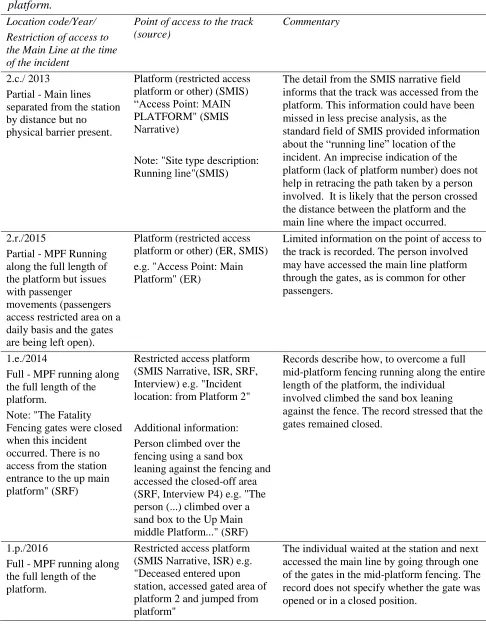
Table 5 presents a summary of recorded details for six locations where the incidents took place. Information is presented for two locations where partial restrictions of access have been
provided, two locations where full restrictions to access were fitted and two locations where the initial partial restrictions were upgraded to a fully protected line.
one of the station entrances, so the gates are kept open. According to the interview participant this is a result of poor planning at the implementation stage (Interview P10) (station 2.r).
Control of the access to the restricted area is not sufficient as the platform can be accessed from the underpass via a lift, which is operational at all times. A BTP report also indicates a problem with the gates being left open (IRS). Interview respondents suggested that at this station, this can be because a staff office is located on the restricted access platform and station staff go through the gates on a regular basis (case 3.c).
Full fence (minor gaps) (4 locations [2.b, 2.d, 2.f, 2.g])
Table 5. Selected incidents when a person accessed the main line via the restricted access platform.
Location code/Year/ Restriction of access to the Main Line at the time of the incident
Point of access to the track (source)
Commentary
2.c./ 2013
Partial - Main lines separated from the station by distance but no physical barrier present.
Platform (restricted access platform or other) (SMIS) “Access Point: MAIN PLATFORM" (SMIS Narrative)
Note: "Site type description: Running line"(SMIS)
The detail from the SMIS narrative field informs that the track was accessed from the platform. This information could have been missed in less precise analysis, as the standard field of SMIS provided information about the “running line” location of the incident. An imprecise indication of the platform (lack of platform number) does not help in retracing the path taken by a person involved. It is likely that the person crossed the distance between the platform and the main line where the impact occurred.
2.r./2015
Partial - MPF Running along the full length of the platform but issues with passenger
movements (passengers access restricted area on a daily basis and the gates are being left open).
Platform (restricted access platform or other) (ER, SMIS) e.g. "Access Point: Main Platform" (ER)
Limited information on the point of access to the track is recorded. The person involved may have accessed the main line platform through the gates, as is common for other passengers.
1.e./2014
Full - MPF running along the full length of the platform.
Note: "The Fatality Fencing gates were closed when this incident
occurred. There is no access from the station entrance to the up main platform" (SRF)
Restricted access platform (SMIS Narrative, ISR, SRF, Interview) e.g. "Incident location: from Platform 2"
Additional information: Person climbed over the fencing using a sand box leaning against the fencing and accessed the closed-off area (SRF, Interview P4) e.g. "The person (...) climbed over a sand box to the Up Main middle Platform..." (SRF)
Records describe how, to overcome a full mid-platform fencing running along the entire length of the platform, the individual
involved climbed the sand box leaning against the fence. The record stressed that the gates remained closed.
1.p./2016
Full - MPF running along the full length of the platform.
Restricted access platform (SMIS Narrative, ISR) e.g. "Deceased entered upon station, accessed gated area of platform 2 and jumped from platform"
Location code/Year/ Restriction of access to the Main Line at the time of the incident
Point of access to the track (source)
Commentary
1.n./ Two incidents in 2015
Partial - MPF fitted on the island platform,
restricting access to the up main line. Unrestricted access to Platform 1 adjacent to the down main line from the station road.
Note: “There is a gate on platform 1 that gives simple access to the railway. This is not closed as it allows those wishing access to the lift to do so.”(ISR)
Platform (restricted access or other) (in both cases ) (SMIS Narrative, ER)
e.g. ''…was seen to jump from the platform into the four foot where he was struck'' (SMIS Narrative)
Two incidents occurred on the main lines at station 1.n. in 2015. Due to imprecise indication of the point of access (missing platform number) it cannot be stated whether a person involved climbed over the MPF protecting the up main line. As both incidents occurred on the down main line, it is more likely that the line was accessed from the adjacent platform 1. This platform had no barrier provided and the line could have been accessed from the station road. After the incidents, in 2016, the access to this platform was limited by closing a gate and fitting a fence which prevented access to the platform from the station road.No more incidents occurred on the main line at this location within the period of the study.
1.b./ Four incidents in 2014
Three incidents in 2015 Partial - MPF fitted on a part of the platform length, but leaving access at the bottom of the stairs.
Note: "The planned additional mid-platform fencing and concertina gate mentioned above should be installed as a matter of urgency" (ISR 2015)
Restricted access platform (SMIS Narrative, ISR) In each of the four cases in 2014 and in one case in 2015 the exact platform from which the person accessed the line was indicated as platform 2 (adjacent to the main lines) e.g."Incident location: From platform 2" (ISR)
In two other cases which took place in 2015 the record only indicated that the line was accessed from the platform adjacent to the main line (ER, SMIS Narrative)
Additional information: In one case a person involved crossed the up main line and accessed the down main line where the impact occurred "Deceased jumped from Platform 2 which is the up fast line, ran across the up fast and jumped in front of a non-stopping down fast
Four incidents occurred in 2014 and three further in 2015 took place at station 1b. It is striking how in each of these incidents, the person involved accessed the line in a similar way, by accessing the main lines through the gap in the fencing (located close to the entrance to the platform). It is recorded how the person involved in one of the incidents ran across one of the main lines (up main) to access the line where the person was struck (down main).
In early 2016 the gaps were filled with fencing and a section of retractable fence. (Retractable fencing was used because issues with the crowding prevented fitting a full fence to be fitted at the location.) After this, the level of protection of the fast line at the station was classified as “full”. No incidents occurred in 2016 at the main lines at the location.
Location code/Year/ Restriction of access to the Main Line at the time of the incident
Point of access to the track (source)
Commentary
service."(ISR) the incident occurred during the weekend
gives an indication that the gate was not closed at the time. Information from the interview confirmed this account. 1.b./2017
Full - MPF fitted on a part of the platform length, gaps in between buildings filled with fencing and retractable fencing.
Restricted access platform (SMIS Narrative, ISR) e.g. Confirmed point of access, if known: Platform 1" (ISR), " Note: Site type description: Running line"(SMIS)
Additional information: "a secure gate to platform 1 which is closed Monday to Friday and only used at weekends, if works take place on platforms 3 and 4." (ISR) "... we had one at 1b. on the main line, in fact when the station was operating on the main lines"(a response at interview when asked about the incidents after the barrier was fitted at the station) (Interview P2)
4. Discussion and Conclusion
The analysis of descriptive data on the circumstances of suicides at the locations and the new classification of the level of restriction of access to the locations was essential in starting to evaluate the effectiveness of mid-platform fencing as a suicide prevention measure. There are many indications of success of the fencing as a prevention measure, where the fencing has been fitted as part of a well planned and executed programme of work and to date there have been no recent suicide events at these locations. Two of the examples from the current study showed that the level of restriction at the location has improved over time. At present, there have been no further incidents at these locations, but it is too early to state whether there has been a positive effect of the new fencing intervention. There are also examples, however, where the fencing does not appear to have been as effective as a prevention measure.
This study showed that fitting of a certain type of the barrier at a location does not guarantee the desired level of restriction of access to fast lines at a station. In order to understand the level of restriction, it is important to know much more about the fencing and how it operates at a particular location. This includes information on the type, location of the barrier, date of
barrier. These details can be obtained through consultation with staff and visits to the location. Classification of the level of restriction was important in determining whether the fencing had been fitted in the way in which it had been intended. In several cases the barrier did not work as had been intended (i.e. to protect against access to non-stopping trains). One example of this is where the restricted access platform was available for public use because of engineering work. It is assumed that no additional protective measures were used to prevent access to the main line when non-stopping trains were passing at this location. Other examples of issues with the implementation and maintenance of the fencing include gaps in the continuity of the barrier, alternative routes to the restricted area (e.g. via an operational lift), leaving the gates open, or having poorly located station furniture which enables climbing of the fencing. These
demonstrate that without detailed planning, maintenance and operational procedures, a barrier may be ineffective.
The study findings show that more information is needed in relation to a number of incidents, in order to fully understand how the person got access to the fast lines prior to the suicide event. Better information is needed on which platform was used for accessing the track area, whether people crossed railway lines, the status of the fencing and gates (e.g. open, closed), details of unusual circumstances and changes in station operation (e.g. due to engineering works). It is acknowledged that in some cases little is known of the circumstances of the incident, but more could be done to collate and interpret information from various sources to try to form a clearer conclusion on the events leading up to an incident and how well prevention measures such as fencing performed in inhibiting access to the track area..
Overall, the first indications from the evaluation study suggest that the fencing seems to be
effective where it has been fitted as it was intended (i.e. to provide full restriction of access to fast lines). However, in practice it has not always been possible to achieve this and there are
examples of situations where fatalities have occurred where partial or (what was assumed to be) full mid-platform fencing was fitted. More is needed at an operational level in the industry to be able to recognise when the intervention is not likely to be operating as it should be (either
through issues relating to design or implementation on a day to day basis or in unusual
circumstances). Further statistical analysis is on-going to explore the impact of the fencing and the associated restriction of access on the numbers of incidents across the wider sample of stations.
References
Hills, D. & Junge, K. (2010). Guidance for transport impact evaluations. The Tavistock Institute, London. Retrieved September 23, 2017 from
http://webarchive.nationalarchives.gov.uk/20110203142641/http://www.dft.gov.uk/pgr/evaluatio n/evaluationguidance/transportimpact/
Law, C.K., Yip, P., Chan, W., Fu, K.W., Wong, P., & Law, Y.W. (2009). Evaluating the effectiveness of barrier installation for preventing railway suicides in Hong Kong. Journal of Affective Disorders, 114(1-3), 254-262.
Mann, J., Apter, A., Bertolote, J., Beautrais, A., Currier, D., & Haas, A. et al. (2005). Suicide Prevention Strategies. JAMA, 294(16), 2064-2074.