Solving High School Timetabling Problems Worldwide
Using Selection Hyper-heuristics
Leena N. Ahmed, Ender ¨Ozcan, Ahmed Kheiri1
ASAP Research Group
University of Nottingham, School of Computer Science Jubilee Campus, Wollaton Road, Nottingham, NG8 1BB, UK
email: {itxln1, Ender.Ozcan, psxak1}@nottingham.ac.uk
Abstract
High school timetabling is one of those recurring NP-hard real-world
combinato-rial optimisation problems that has to be dealt with by many educational
insti-tutions periodically, and so has been of interest to practitioners and researchers.
Solving a high school timetabling problem requires scheduling of resources and
events into time slots subject to a set of constraints. Recently, an
interna-tional competition, referred to as ITC 2011 was organised to determine the
state-of-the-art approach for high school timetabling. The problem instances,
obtained from eight different countries across the world used in this competition
became a benchmark for further research in the field. Selection hyper-heuristics
are general-purpose improvement methodologies that control/mix a given set of
low level heuristics during the search process. In this study, we evaluate the
per-formance of a range of selection hyper-heuristics combining different reusable
components for high school timetabling. The empirical results show the
suc-cess of the approach which embeds an adaptive great-deluge move acceptance
method on the ITC 2011 benchmark instances. This selection hyper-heuristic
ranks the second among the previously proposed approaches including the ones
competed at ITC 2011.
Keywords: Adaptive Operator Selection, Adaptive Move Acceptance, Great
1Ahmed Kheiri ([email protected]) is, now, an Associate Research Fellow at the College
Deluge, Combinatorial Optimisation, Constraint Satisfaction, Educational
Timetabling
1. Introduction
Educational timetabling problem is classified as one of the hard
computa-tional problems (Broder, 1964), which are of interest to the researchers and
prac-titioners from the fields of operational research and artificial intelligence.
Educa-tional timetabling problem has many variants including examination timetabling,
university course timetabling and high school timetabling (Pillay, 2010b). The
focus of this work is on high school timetabling.
The solution to high school timetabling problem requires the scheduling of
events, such as courses and classes, and resources, such as teachers and
class-rooms to a number of specific time slots subject to a set ofhard andsoft
con-straints. The hard constraints must be satisfied, and the soft constraints
repre-sent preferences. A feasible solution to a given problem is the solution that
sat-isfies all the hard constraints. High school timetabling is a well-known NP-hard
combinatorial optimisation problem (de Werra, 1997; Even et al., 1976)
recur-ring at many educational institutes. There are many variants of high school
timetabling problem and they mainly differ due to many reasons, such as the
educational system in a given country.
High school timetabling was subject of a recent challenge, the third
Inter-national Timetabling Competition (ITC 2011) (Post et al., 2013), to encourage
researchers and practitioners to deal with the real-world complexities of the high
school timetabling problem without any simplification and support development
of automated state-of-the-art methods for high school timetabling. Those
real-world problem instances obtained across the real-world became a benchmark after
the competition. Many different approaches have been proposed, each solving
a particular problem, including simulated annealing (da Fonseca et al., 2014;
Zhang et al., 2010), tabu search (Bello et al., 2008) and evolutionary algorithm
2012). More on high school timetabling can be found in (Pillay, 2010a, 2012).
Hyper-heuristics are general purpose solution methodologies which perform
search over the space of heuristics rather than the solutions to solve hard
compu-tational problems (Burke et al., 2013). There are two general classes of
hyper-heuristics identified in the scientific literature; high level methodologies that
generateor selectlow level heuristics. The latter class is the focus of this study
(Burke et al., 2010). Bilgin et al. (2007) argued that the performance of a
se-lection hyper-heuristic varies depending on the choice of its components. In
this study, fifteen hyper-heuristics combining five different heuristic selection
components with three different move acceptance components are investigated
for high school timetabling using the ITC 2011 benchmark. The performance
of the best selection hyper-heuristic is analysed further and compared to the
previously proposed approaches including the ones competed at ITC 2011.
Section 2 overviews selection hyper-heuristics. Section 3 describes the third
International Timetabling Competition and selection hyper-heuristic
compo-nents that are employed for solving the high school timetabling problem from
the competition. Section 4 provides the empirical results. Finally, Section 5
presents the conclusions and remarks.
2. An Overview of Selection Hyper-heuristics
Heuristics are rule-of-thumb methods designed for a specific computationally
difficult problem and often cannot be reused to solve another problem. This
observation is also valid for meta-heuristics implemented for a specific problem.
Although there are many successful examples of (meta-)heuristics capable of
solving instances from a particular domain in the literature, their design require
extensive knowledge about the relevant problem domain (Bilgin et al., 2007).
On the other hand, hyper-heuristics have emerged as reusable general-purpose
search methodologies with reusable components that can be applied to a wide
range of problems (Cowling et al., 2001). The foundation of the current studies
stated that combining scheduling rules in production scheduling would make a
great improvement than using them individually. Their study can be credited for
putting the initial ideas forward and leading to the succeeding studies on
hyper-heuristics. Cowling et al. (2001) initially defined hyper-heuristics as “heuristics
to choose heuristics”. The authors claimed that hyper-heuristics operate at a
higher level of abstraction than meta-heuristics.
There are two main types of hyper-heuristics (Burke et al., 2010): (i)
method-ologies toselectheuristics and (ii) methodologies togeneratenew heuristics. The
former class, also known as selection hyper-heuristics, is the focus of this study.
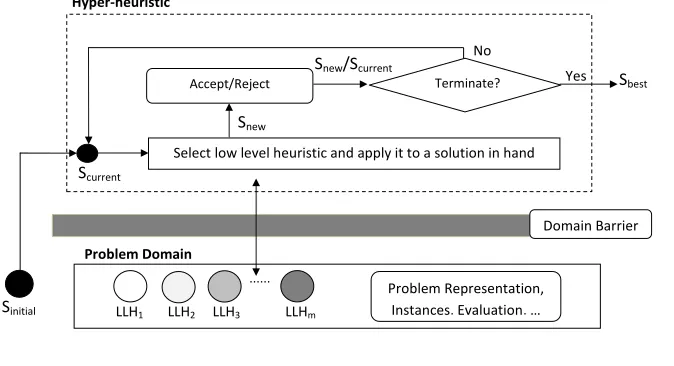
Often, selection hyper-heuristics operate on a single-point based search
frame-work which has two common consecutive stages, heuristic selection and move
acceptanceas identified by ¨Ozcan et al. (2008). An initial solution is improved
iteratively through passing into these two stages, consecutively. The heuristic
selection selects a heuristic from a set of pre-defined low level heuristics and
generates a new solution; the move acceptance decides whether to accept or
reject the new solution. If the solution is accepted, it replaces the original
so-lution. The process iterates until a set of termination criteria is satisfied as
demonstrated in Figure 1.
...
LLH1 LLH2 LLH3 LLHm
Problem Representation, Instances, Evaluation, …
Domain Barrier
Select low level heuristic and apply it to a solution in hand Accept/Reject Terminate?
Sinitial
Scurrent
Snew
Snew/Scurrent
Yes
No
Sbest Hyper-heuristic
[image:4.612.142.479.456.639.2]Problem Domain
In most of the selection hyper-heuristics, a domain barrier is featured (see
Figure 1). The domain barrier is a filter which prevents any problem
spe-cific information to be passed to the hyper-heuristic level (Burke et al., 2013),
thus it allows the reusability of the selection hyper-heuristic components.
Al-though the selection and the move acceptance methods are general and reusable,
Bilgin et al. (2007) stated that using different combinations of the two methods
yields to a different performance.
There is a large number of studies on heuristic selection and move acceptance
methods used within selection hyper-heuristics (Burke et al., 2013). In here, we
describe the relevant selection hyper-heuristic components which have been used
in this study. Most of the simple selection methods were tested by Cowling et al.
(2001), initially. Simple Random (SR) uses a uniform probability distribution
to randomly select one of the heuristics at each step. Random Descent (RD)
performs similarly to SR except that it applies the selected heuristic repeatedly
until there is no further improvement. Random Permutation (RP) generates an
initial permutation of the low level heuristics and applies one heuristic at a time
from that permutation at each step, sequentially. Random Permutation Descent
(RPD) orders the low level heuristics randomly similar to RP, but operates in
the same way as RD while applying a chosen low level heuristic.
Choice Function (CF) scores the low level heuristics based on a combination
of three different measures and the heuristic with the highest score is chosen at
each step. The first measuref1is calculated based on the previous performance
of each low level heuristic according to the following formula:
f1(LLHi) = ∑
n
αn−1In(LLHi) Tn(LLHi)
(1)
whereIn(LLHi) is the evaluation function change,Tn(LLHi) is the time taken
to apply LLHi in n previous invocation, and α is a value between 0 and 1.
The second measuref2 records the pair-wise dependencies between the
LLHk, the value off2is measured using the following formula:
f2(LLHk, LLHi) = ∑
n
βn−1In(LLHk, LLHi) Tn(LLHk, LLHi)
(2)
whereIn(LLHk, LLHi) is the evaluation function change, Tn(LLHk, LLHi) is
the time taken to applyLLHi followingLLHk innprevious invocation, andβ
is a value between 0 and 1. The third measuref3is the time passed (τ(LLHi))
since the last time the heuristicLLHi was invoked.
f3(LLHi) =τ(LLHi) (3)
The choice function ranks the heuristics based on a score given to each
heuris-tic. This score is calculated using the three above measures with the following
formula:
F(LLHi) =αf1(LLHi) +βf2(LLHk, LLHi) +δf3(LLHi) (4)
whereαandβ weight the first two measures to give intensification to the search
process of the heuristic, while δ weights f3 to give diversification. More on
choice function and its variants can be found in (Drake et al., 2012).
There are a number of deterministic and non-deterministic acceptance
meth-ods that are used as a move acceptance component within selection
hyper-heuristics. Cowling et al. (2001) described some of the simple deterministic
methods, including accepting all moves (AM) criterion which accepts all the
generated solutions, accepting only improving moves (OI) which accepts only
the improved solutions, and accepting improve or equal moves (IE) which
ac-cepts only the non-worsening solutions. Simulated Annealing (SA) move
accep-tance was used in (Bai and Kendall, 2005; Bai et al., 2007; Bilgin et al., 2007).
Simulated annealing accepts the worsening solutions with a probability given
by the following equation:
pt=e
− ∆f
∆F(1−t
T) (5)
where ∆f is the change in the evaluation function at time (step)t,T is the time
limit (maximum number of steps), ∆F is the range for the maximum change in
Kendall and Mohamad (2004) utilised Great Deluge (GD) as a move
ac-ceptance strategy for channel assignment problem in the industry of cellular
communication. Great deluge move acceptance accepts a worsening solution if
the cost of that solution is better than or equal to a specific cost value called the
level at each step. For the initial level, the value of the first generated candidate
solution is used, and the level at each step is then updated with a linear rate
using the following formula:
τt=f0+ ∆F×(1− t
T) (6)
whereτtis the value of the threshold level at time (step)t,T is the time limit
(maximum number of steps), ∆Fis the expected range for the maximum change
in the evaluation function, andf0is the final cost value.
¨
Ozcan et al. (2006) demonstrate and compare between four different
se-lection hyper-heuristic frameworks discriminating betweenmutational and hill
climbinglow level heuristics. The mutational low level heuristics perturb a given
solution mostly at random and act as a diversification component which enables
the search process to explore the other regions potentially leading to high
qual-ity solutions. The hill climbing heuristics always produce non-worsening
solu-tions. Figure 1 is the traditional framework which uses all low level heuristics
without any discrimination. The experimental results on a set of benchmark
functions showed that frameworks using mutational heuristics first and then
ap-plying a hill climbing similar to the process in iterated local search ( ¨Ozcan et al.,
2006) deliver better performance in the overall. More on hyper-heuristics can
be found in (Burke et al., 2013, 2003; Chakhlevitch and Cowling, 2008; Ross,
3. Selection Hyper-heuristics for High School Timetabling
3.1. The Third International Timetabling Competition - ITC 2011
The third international timetabling competition (ITC 20112) (Post et al.,
2013) was organised by the Centre of Telematics and Information Technology
at the University of Twente in Netherlands, to determine the state-of-the-art
approach among the modern approaches for the high school timetabling
prob-lem, allow researchers to try their techniques in real-world practical probprob-lem,
and to encourage the researchers and practitioners for further development of
algorithms in the area of high school timetabling. The competitors were given
an ANSI C library3, referred to as KHE, which was designed by Jeff Kingston
for implementing their algorithms to solve high school timetabling problems.
The competition consisted of three rounds. Since the time limit for the first
and third rounds of the competition was in months, the focus of this study is
the second round of ITC 2011 in which algorithms were required to operate as
time-contract algorithms, hence they had to terminate with a solution in a given
maximum amount of time. In the second round, the time limit was defined as
1000 nominal seconds based on the organisers’ machine. A tool was provided
for benchmarking of user machines. The competitors’ solvers were run by the
organisers for 10 times with different random seeds each for 1000 seconds on 18
hidden instances. The result for each run was ranked, and all the ranks were
averaged to determine the winner.
The problem instances for the competition were obtained from different
ed-ucational institutions across the world. A standard format for the definition
of the instances based on XML schema, referred to as XHSTT (XML for high
school timetabling) was used (Post et al., 2012, 2013), supported by KHE. The
problem instances of the ITC 2011 consisted of four components (Post et al.,
2013). The first component defines the instance times, which are individual
units of times during which the events take place. The second component is the
2ITC 2011 website: http://www.utwente.nl/ctit/hstt/ 3
resources which are entities that attend the events such as teachers, students,
and rooms. The third component is the events which represent the meeting
between resources. Each event has a specific time, duration and any number of
resources. Finally the fourth component is the constraints which are conditions
an ideal solution should satisfy. The ITC 2011 instances contain 15 types of
con-straints: assign resource, assign time, split events, distribute split events, prefer
resources, prefer times, avoid split assignments, spread events, link events, avoid
clashes, avoid unavailable times, limit idle times, cluster busy times, limit busy
times, limit workload. In this study, the selection hyper-heuristics are tested on
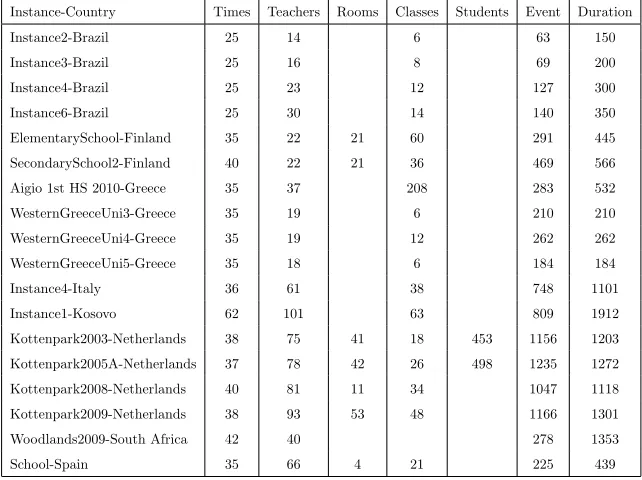
the instances used in the second round of the competition. Table 1 summarises
[image:9.612.145.466.357.597.2]the characteristics of the instances used in that round.
Table 1: Characteristics of round 2 instances used during ITC 2011 competition
Instance-Country Times Teachers Rooms Classes Students Event Duration
Instance2-Brazil 25 14 6 63 150
Instance3-Brazil 25 16 8 69 200
Instance4-Brazil 25 23 12 127 300
Instance6-Brazil 25 30 14 140 350
ElementarySchool-Finland 35 22 21 60 291 445
SecondarySchool2-Finland 40 22 21 36 469 566
Aigio 1st HS 2010-Greece 35 37 208 283 532
WesternGreeceUni3-Greece 35 19 6 210 210
WesternGreeceUni4-Greece 35 19 12 262 262
WesternGreeceUni5-Greece 35 18 6 184 184
Instance4-Italy 36 61 38 748 1101
Instance1-Kosovo 62 101 63 809 1912
Kottenpark2003-Netherlands 38 75 41 18 453 1156 1203
Kottenpark2005A-Netherlands 37 78 42 26 498 1235 1272
Kottenpark2008-Netherlands 40 81 11 34 1047 1118
Kottenpark2009-Netherlands 38 93 53 48 1166 1301
Woodlands2009-South Africa 42 40 278 1353
School-Spain 35 66 4 21 225 439
Each constraint contains a Boolean variable to indicate whether the
con-straint is hard or soft. The penalty for violating a hard concon-straint is much
(degree of violations) of a solution for a given problem instance is computed
using a minimising evaluation function (cost) which contains two components:
feasibility, andpreferences(objective). They are calculated using weighted sum
of hard and soft constraint violations for a given solution, respectively. The
weights are defined as input for each problem instance. To represent the quality
of a given solution, the two values of infeasibility and objective are
concate-nated in the form: infeasibility-value.objective-value, using “sufficient” number
of digits in the objective part. For example a solution of 12.000032, indicates an
infeasibility value of 12, and objective value of 32. A solution is considered
bet-ter than the other if it has a smaller infeasibility value or the same infeasibility
but less objective value (Post et al., 2013).
In the second round of ITC 2011, four teams submitted their solvers. The
team HySST (Kheiri et al., to appear) employed a multi-stage hyper-heuristic
approach that operates on a set of mutational and hill climbing heuristics, which
operate on a candidate solution with a direct representation. The proposed
approach switches between exploration and exploitation stages automatically
and use appropriate heuristics at each stage. Moreover, this solver embeds an
adaptive threshold move acceptance, controlling its parameter setting during
the search process enabling partial restarts whenever necessary. The HySST
solver has some system parameters which are tuned and fixed for high school
timetabling. The team HFT (Domr¨os and Homberger, 2012) designed an
evolu-tionary strategy which uses only mutation as a genetic operator as their solver.
The main characteristic of this solver is that it uses an indirect representation,
encoding solutions using a permutation of sub-events. Moreover, the HFT solver
uses a population size of 1, accepting improving moves only as the replacement
strategy. At each evolutionary cycle, the candidate solution in hand gets
de-coded and used to construct a complete new timetable, which is followed by
evaluation and replacement. The proposed algorithm can be considered to be a
basic random mutation hill climbing algorithm in the overall. The team Lectio
(Sørensen et al., 2012) used an approach based on adaptive large neighbourhood
many variables gets unassigned. The following stage uses an adaptive strategy
deciding which remove and insertion (reassign) type of move operators to
in-voke successively, producing a new solution. Then finally, a simulated annealing
with reheating method decides to accept or reject that new solution. Lectio
ap-plied parameter tuning using irace tool on nine system parameters of the solver
for an improved performance. The team GOAL (da Fonseca et al., 2014)
pro-posed a three stage approach using two different meta-heuristics for high school
timetabling. The first stage constructs an initial solution using the KHE library.
Then simulated annealing with reheating and iterated local search stages are
employed respectively to improve upon that initially generated solution. The
GOAL solver contains seven different neighbourhood operators, two of them
being representative of ‘large’ neighbourhoods, while the remaining are fairly
simple ‘small’ moves, such as swap or move events. The simulated annealing
with reheating utilises a subset of six neighbourhood operators, while iterated
local search utilises two of them. A neighbour operator is chosen based on a
prefixed probability and applied to a solution in hand at any step.
The results of the second round of the competition revealed that team GOAL
is the winner, team HySST ranked second, Lectio third and HFT fourth. Soon
after the competition, Kalender et al. (2013) applied a hyper-heuristic using a
greedy-gradient approach for selection and simulated annealing for move
accep-tance and applied it to the round 2 insaccep-tances of ITC 2011. The greedy-gradient
is a learning heuristic selection method that selects heuristics based on their
scores. The results showed the success of the approach performing better than
HySST using the same ranking method as used in the second round of the
competition.
3.2. Solution Method
The same problem domain layer in the framework proposed by Kheiri et al.
(to appear) is used for implementing a range of combinations of hyper-heuristic
components. The initial solutions are constructed using the heuristic provided
mix a set of nine low level heuristics, including seven mutational and two hill
climbing heuristics as briefly described below:
• MH1 consists of two independent perturbation operators which are in-voked successively. The first operator is inin-voked with a probability of
1% and splits a randomly chosen event taking longer than 1 period into
two events whose durations sum up to the duration of the original event.
Then the second operator is invoked, exchanging the start time of two
randomly chosen events regardless of their duration and whether this
ex-change causes any overlaps afterwards. For example, this heuristic could
choose a Mathematics meeting with a duration of two hours, splitting it
into one hour long two separate meetings and then swap the start time of
Geography and Biology meetings. Assuming the special case that
Geog-raphy with a duration of 2 time slots starts on Tuesday at the first time
slot and Biology with a duration of 3 time slots starts on Tuesday at the
third time slot, this heuristic will swap the start time of both meetings
even though they overlap.
• MH2chooses an event randomly, and reschedules it to a random time slot. For example, assuming that Biology meeting taking place on Tuesday at
the first time slot is chosen, this heuristic could reschedule this meeting
to the last time slot on Thursday.
• MH3exchanges the start time of two randomly selected events resolving overlaps that could occur after this operation. If the two randomly selected
events have the same duration, then the classical exchange operation will
be performed. The difference between the exchange operation in MH1
and MH3 becomes apparent only when swapping the start time of two
successive events with different durations. For example, assuming the
special case that Geography with a duration of 2 time slots starts on
Tuesday at the first time slot and Biology with a duration of 3 time slots
starts on Tuesday at the third time slot, MH3would move the start time
• MH4chooses a resource randomly assigned to an event, and reassigns it to another event. For example if Room1 is assigned to the History meeting,
after applying this heuristic, Room1 could be assigned to the Mathematics
meeting.
• MH5 randomly swaps two resources. For example, assuming that the Biology meeting is assigned to Room1, the Geography meeting is assigned
to Room2, and those resources are chosen, after applying this heuristic,
the Biology meeting gets assigned to Room2, while the Geography meeting
gets assigned to Room1.
• MH6 randomly chooses an event and an associated resource, then reas-signs a random resource to the event. For example, assuming that
Geog-raphy meeting is chosen and Teacher2 is assigned as the teacher of that
meeting, after applying this heuristic, Teacher5 could become the teacher
of that Geography meeting.
• MH7merges separate, but contiguous events of the same type. For exam-ple, assuming that Geography with a duration of two time slots is assigned
to the first time slot on Thursday, and another Geography meeting with
a duration of one period is assigned to the third time slot on Thursday,
after applying this heuristic, the two classes are merged into a single class
with a duration of three time slots starting from the first time slot on
Thursday.
• HC1merges events to reduce the cost of the solution by employing a first improvement hill climbing operator
• HC2 makes moves based on ejection chains to reduce the cost of the solution by changing the assignments of the resources
Both hill climbers make their moves according to a specific constraint, hoping
the solution improves upon the other types of constraints. This could produce
a net worsening in the final cost, but such worsening moves are rejected. More
The goal of this work is to compare the performance of different selection
hyper-heuristics embedding different reusable heuristic selection and move
ac-ceptance methods and report the best performing approach unlike the work
in (Kheiri et al., to appear). Each hyper-heuristic component exhibit different
characteristics some with learning and some without learning; some are
adap-tive methods and some are not. We investigate the performance of 15 selection
hyper-heuristics, formed by combining each selection method in{SR, RP, RD,
RPD, CF} with each acceptance method in {IE, SA, GD} over 18 problem
instances from the second round of the ITC 2011 competition.
SA and GD are adaptive move acceptance methods which are implemented
different than the versions described in Section 2. The ∆Fvalue in the simulated
annealing and great deluge move acceptance methods is set to 0.01% of the cost
of the best solution in hand, and to 1% if the best solution violates only soft
constraints, as suggested in (Kalender et al., 2013). Thef0value in great deluge
is set to 0.001% of the cost of the best solution in hand, and to 0.1% if the best
solution violates only soft constraints.
4. Computational Results
The experiments are conducted on the second round problem instances of
the ITC 2011 competition. A total number of fifteen selection hyper-heuristic
methods are investigated as described in Section 3. Each method is applied to
the same set of eighteen instances taking into account the rules of the ITC 2011
competition, that is, each method is run for ten trials with a time limit of 1000
nominal seconds for each instance. A benchmarking software tool provided
at the ITC 2011 website is used to obtain the equivalent time limit on our
local machines. The selection hyper-heuristics are evaluated with the aim of
determining the best algorithm that delivers the high quality solutions to the
high school timetabling problem instances. Then the performance of the best
4.1. Comparison of the Selection Hyper-heuristics
Table 2 summarises the results from fifteen selection hyper-heuristics, each
combining a heuristic selection method from{SR, RP, RD, RPD, CF} with a
move acceptance from{IE, SA, GD}over the ITC 2011 problem instances. Each
entry in the table provides the number of instances for which the corresponding
selection hyper-heuristic produces the best in terms of best-of-run or average
best, including ties, over the 10 trials. The table also gives the score for each
hyper-heuristic using the ranking strategy utilised in the second round of the
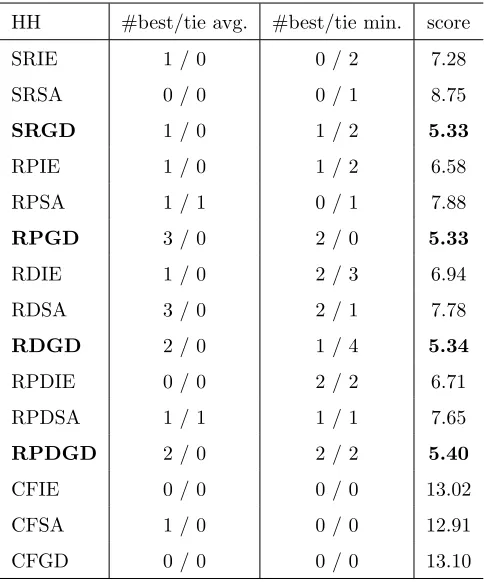
ITC 2011 competition. From Table 2, RPGD and RDSA generate the best
aver-age in three instances. RDGD generates the best and the minimum cost values
in five instances including four draws. RDIE also obtains the best results in five
instances including 3 draws. The ranking results put the selection methods{SR,
RP, RD, RPD} combined with{GD} in the top of the fifteen selection
hyper-heuristics that were tested. The results also show that the heuristic selection
methods with no learning (i.e., SR, RP) or learning with the shortest memory
(i.e., RD) perform better than the CF learning heuristic selection method
re-gardless of the move acceptance. RPGD and SRGD are the best approaches
based on their scores. On the other hand, considering the average results, RPGD
performs slightly better than SRGD producing the best average cost on three
instances, while SRGD is successful on one instance. Hence, the performance of
top ranking great deluge based selection hyper-heuristics are compared further.
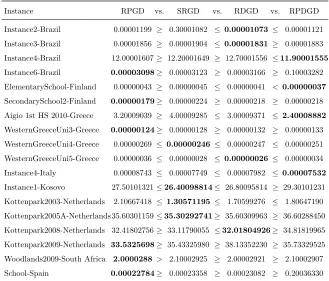
Table 3 summarises the results. The Mann-Whitney-Wilcoxon test is used
as a statistical test to perform pairwise comparison of results (costs) of 10 runs
from RPGD versus each hyper-heuristic in{SRGD, RDGD, RPDGD} at 95%
confidence level. Indeed, RPGD performs better than the other algorithms on
average considering that the number of instances for which it produces the best
average results is six (in bold in Table 3), which is more than any of the other
hyper-heuristic. The average performance difference between RPGD and the
other selection hyper-heuristics is not statistically significant for almost all
in-stances, as confirmed by the Mann-Whitney-Wilcoxon test. Although Table 2
SRGD on twelve instances and this performance difference is statistically
sig-nificant on the Woodlands2009-South Africa instance (Table 3). Hence, RPGD
is taken under consideration for further analysis and performance comparison
to previously proposed approaches.
4.2. An Analysis of RPGD
RPGD creates a random permutation of low level heuristics and applies each
one of them on the solution in hand one by one. For example, given five
heuris-tics, a random permutation of low level heuristics could be <LLH3, LLH2,
LLH4, LLH5, LLH1>. A circular list for the permutation is employed and
at each step, next low level heuristic from the list is chosen. For example,
as-suming<LLH3, LLH2, LLH4, LLH5, LLH1>, after the invocation of LLH1,
LLH3 is chosen as the next heuristic. In between the heuristic invocations,
the adaptive great deluge move acceptance is used for accepting or rejecting a
new solution. Mixing all low level heuristics regardless of their nature in this
manner, implicitly generates an algorithm similar to iterated local search
algo-rithm which is known to be an effective solver for combinatorial optimisation
problems (Louren¸co et al., 2010). RP does not employ perturbation and local
search as fixed order single step/stage processes. The perturbation and local
search components are fixed as the permutation of low level heuristics is decided
randomly. Hence, RPGD can be considered as a multi-stage hyper-heuristic in
which number of stages is decided randomly depending on the nature of
succes-sive low level heuristics in the random permutation. Exploration of the search
space is performed using a (set of) mutational heuristic(s) at a stage while
ex-ploitation takes place by the help of a (set of) hill climbing heuristic(s), invoked
afterwards. In the next exploration or exploitation process, a (set of) different
heuristic(s) is utilised from the list. For example, given five low level
heuris-tics, whereLLH1andLLH4are hill climbers, andLLH2,LLH3andLLH5are
mutational heuristics, the random permutation<LLH3, LLH2, LLH4, LLH5,
LLH1>automatically creates four stages. In the first stage, LLH3 and LLH2
used for local search (exploitation). Then, similarly,LLH5is used for
perturba-tion in the third stage, whileLLH1 is used as a local search component in the
following stage. This exploration and exploitation cycle repeats itself under this
fixed setting while solving a given instance until the hyper-heuristic terminates.
The experimental results indicate that the contribution of each low level
heuristic varies for the improvement of an initial solution within the given time
limit. Theutilisation rateof a low level heuristic is the ratio of the total number
of times a low level heuristic is invoked, to the total number of low level heuristics
invocations during the search process ( ¨Ozcan et al., 2008). The utilisation rate
is obvious for each low level heuristic for the RP heuristic selection. They are
all equally used, but then again it does not mean that they contributed equally
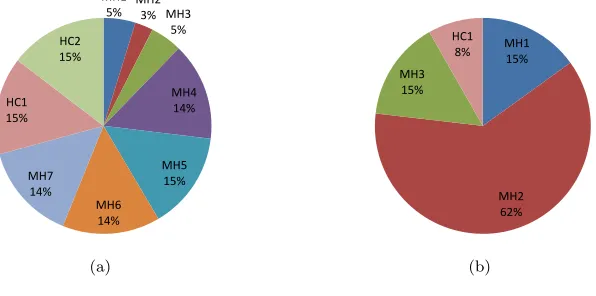
to improvement. Figure 2 depicts the improvement oriented average percentage
utilisation rate for the low level heuristics over 10 runs considering only the total
number of low level heuristics invocations that generated improvement for two
selected sample problem instances of WesternGreeceUni5-Greece and
Instance1-Kosovo. It has been observed that the hill climbing low level heuristics are more
successful, resulting with a high utilisation rate for WesternGreeceUni5-Greece
instance (Figure 2(a)). However, surprisingly, the mutational operators MH4,
MH5, MH6and MH7generate improvement almost as much as the hill climbing
operators. Moreover, the remaining mutational operators MH1, MH2 and MH3
yield poorer performance when compared to them. MH1-MH3are event oriented
random perturbation operators and they modify a given solution randomly by,
for example, swapping or changing the timing of events in the timetable, while
MH4-MH7 are resource oriented operators (see Section 3). The analysis clearly
show that the low level heuristics which perturb the resource allocations between
events in the timetable are likely to result with an improved solution. Although
MH1-MH3 do not seem to yield more improvements than other heuristics, they
act as diversification components, potentially leading to better solutions and
increasing the utilisation rate of the other low level heuristics, considering that
GD allows worsening solutions. For the rest of the problem instances, similar
il-lustrates the different behaviour of RPGD while solving this instance. Although
all low level heuristics are invoked, only the event oriented low level heuristics,
MH1-MH3 and HC1 generate improving solutions during the search process.
[image:18.612.159.457.189.337.2]MH1 5% MH2 3% MH3 5% MH4 14% MH5 15% MH6 14% MH7 14% HC1 15% HC2 15% (a) MH1 15% MH2 62% MH3 15% HC1 8% (b)
Figure 2: Average utilisation rate for the low level heuristics over 10 runs based on only
improving moves for (a) WesternGreeceUni5-Greece, and (b) Instance1-Kosovo
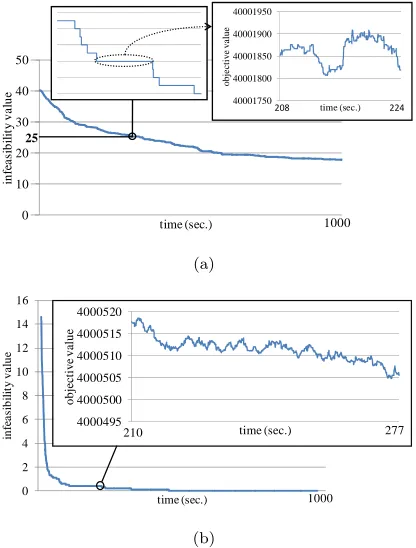
Figure 3 illustrates the progress of the infeasibility value and partially
ob-jective value in time averaged over 10 runs on two selected problem instances,
namely; Instance4-Brazil and WesternGreeceUni5-Greece, representative of the
remaining instances. RPGD either makes a gradual and slow improvement as
illustrated in Figure 3(a) or a large and rapid improvement as in Figure 3(b). In
any case, a solution is improved continuously over time. There are certain stages
during when the search process gets stuck at a local optimum. No change in the
infeasibility value has been observed for a period of time, when RPGD works on
repairing of the soft constraint violations. The use of adaptive strategy within
the great deluge move acceptance method changing the threshold is helping the
search process to jump to other potentially “good” regions in the search space
yielding further improvements in time. Figure 3(a) shows that the degree of
improvement that RPGD achieves is limited and still struggles resolving hard
constraints within the given duration. In Figure 3(b), the sudden drop in the
infeasibility value happens right at the beginning of the search process. After
solu-tion is satisfying all the hard constraints. After this point onward during the
search process, the improvement in the solution slows down while the algorithm
attempts to repair the soft constraint violations.
0 10 20 30 40 50 in fe a si b il it y v a lu e
time (sec.) 1000
25 40001750 40001800 40001850 40001900 40001950 o b je c ti v e v a lu e time (sec.) 104208 224 112
(a) 0 2 4 6 8 10 12 14 16 in fe a si b il it y v a lu e
time (sec.) 1000
[image:19.612.202.410.184.458.2]4000495 4000500 4000505 4000510 4000515 4000520 o b je ct iv e v al u e time (sec.) 210 277 (b)
Figure 3: Plots showing the improvement of cost in terms of infeasibility and objective values in
time averaged over 10 runs for the instances (a) Instance4-Brazil, and (b)
WesternGreeceUni5-Greece
4.3. Comparison of RPGD to the Best Known Approaches
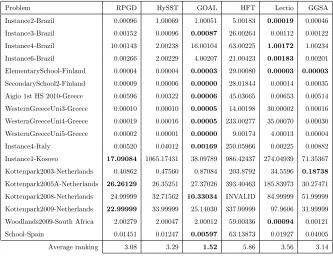
The performance of RPGD algorithm is compared to the performance of the
four finalists in the second round of ITC 2011 competition, GOAL, HySST,
Lec-tio, and HFT. Additionally, the greedy-gradient simulated annealing (GGSA)
approach proposed in (Kalender et al., 2013) is considered in the performance
comparison. The scoring of each method is based on the same ranking
the best cost values obtained by each approach in 10 runs for each instance.
HySST and GGSA use the same selection hyper-heuristic framework. HySST
cannot generate the best result on any of the instances among the algorithms
being compared, while GGSA generates the best result on
ElementarySchool-Finland and Kottenpark2003-Netherlands. RPGD wins on 9 instances against
HySST and they tie on 2 instances, while it is the winner on 10 instances
against GGSA. RPGD performs well on the problem instances from Greece,
Italy and Netherlands and its performance is superior on most of the large
problem instances. In the overall, GOAL still turns out to be the best
ap-proach for high school timetabling. RPGD obtains the new best known
re-sults on three instances: Instance1-Kosovo, Kottenpark2005A-Netherlands and
Kottenpark2009-Netherlands. Overall, RPGD ranks the second with a score of
3.08 among the previously proposed algorithms. However, the difference
be-tween RPGD and the third approach (GGSA) is only 0.06.
5. Conclusion
The goal of hyper-heuristic research is to provide automated intelligent
search methodologies that can be applied to a wide range of
computation-ally hard problems. The theoretical work on such methodologies is limited.
Lehre and ¨Ozcan (2013) recently demonstrated on some benchmark functions
that mixing multiple move operators, or acceptance methods yield more
effi-cient algorithms than using a single operator. In this study, a set of selection
hyper-heuristics combining five different selection methods, with three move
ac-ceptance methods are experimented and their performance is analysed for high
school timetabling. The results revealed that the selection method Random
Permutation (RP) when combined with and adaptive Great Deluge (GD) move
acceptance criterion performed better than the other selection hyper-heuristics
and ranked the second comparing to some previously proposed methods.
The experimental results confirm that the choice of selection hyper-heuristic
acceptance component is also a crucial element in the overall performance of a
se-lection hyper-heuristic. Adaptive move acceptance criteria perform better than
the deterministic or probability based move acceptance, such as simulated
an-nealing, under the single point based hyper-heuristic search framework for high
school timetabling. Combining an adaptive heuristic selection method with an
adaptive move acceptance does not necessarily result with a better performing
selection hyper-heuristic. The results indeed show that the internal
dynam-ics between adaptive components of a selection hyper-heuristic could cause the
search process to get stuck at a local optimum during the search process. The
reinforcement learning based adaptive heuristic selection method CF performs
the worst when combined with the adaptive move acceptance method GD for
high school timetabling, while RP, a heuristic selection method with no learning
performs the best when combined with the same move acceptance method.
Both the HySST (Kheiri et al., to appear) and proposed solver contain
adap-tive threshold move acceptance, however GD adapts itself to changes better in
the overall, generating better solutions to given instances. The move acceptance
component of HySST is not as general as GD, since it uses a set of discrete
threshold values which are tuned for high school timetabling and so it might
not perform well on other problem domains. Moreover, the heuristic selection
component of HySST is also not as general as RP and relies on the nature
of the low level heuristics distinguishing between mutational and hill climbing
heuristics. For example, if ruin and recreate or crossover type of operators
are introduced, there is no strategy within the heuristic selection component
of HySST to handle them properly. However, RP being a simple yet effective
strategy can handle any type of operator.
A hyper-heuristic controls the mixing of low level heuristics and their
pa-rameter setting. The success of RP on timetabling is worth to consider in the
future design of hyper-heuristics. Hence, we plan to apply this hyper-heuristic
on other problem domains, but more importantly we plan to investigate into
learning heuristic selection methods which orders chosen low level heuristics.
data science techniques, such as machine learning (Asta and ¨Ozcan, 2015) or
other metaheuristics, such as genetic programming Burke et al. (2009) can be
embedded into hyper-heuristics, constructing such strategies automatically for
improved performance.
The framework used during the experiments for high school timetabling is
forward compatible, meaning that new hyper-heuristic components developed in
the future can easily be tested on this problem domain. Moreover, new low level
domain specific heuristics can be designed and best performing selection
hyper-heuristics could be re-evaluated managing those low level hyper-heuristics. Moreover,
if crossover operators are implemented as low level heuristics, then adaptive
memetic algorithms or other memetic computing techniques (Neri and Cotta,
2012) could be utilised as population based approaches, further enabling the
development of hybrid approaches using hyper-heuristics as local search
com-ponents.
References
Asta, S., ¨Ozcan, E., 2015. A tensor-based selection hyper-heuristic for
cross-domain heuristic search. Information Sciences 299, 412 – 432.
Bai, R., Burke, E.K., Kendall, G., McCollum, B., 2007. A simulated annealing
hyper-heuristic methodology for flexible decision support. Technical Report
Technical Report NOTTCS-TR-2007-8. School of CSiT, University of
Not-tingham.
Bai, R., Kendall, G., 2005. An investigation of automated planograms using a
simulated annealing based hyper-heuristics, in: Ibaraki, T., Nonobe, K.,
Yag-iura, M. (Eds.), Metaheuristics: Progress as Real Problem Solver. Springer,
pp. 87–108.
Bello, G.S., Rangel, M.C., Boeres, M.C.S., 2008. An approach for the
Conference on the Practice and Theory of Automated Timetabling (PATAT
’08), pp. 1–6.
Bilgin, B., ¨Ozcan, E., Korkmaz, E.E., 2007. An experimental study on
hyper-heuristics and exam scheduling, in: Burke, E.K., Rudov´a, H. (Eds.), Practice
and Theory of Automated Timetabling VI, Springer Berlin Heidelberg. pp.
394–412.
Broder, S., 1964. Final examination scheduling. Communications of the ACM
7, 494–498.
Burke, E.K., Gendreau, M., Hyde, M., Kendall, G., Ochoa, G., ¨Ozcan, E., Qu,
R., 2013. Hyper-heuristics: a survey of the state of the art. Journal of the
Operational Research Society 64, 1695–1724.
Burke, E.K., Hart, E., Kendall, G., Newall, J., Ross, P., Schulenburg, S., 2003.
Hyper-heuristics: an emerging direction in modern search technology, in:
Glover, F., Kochenberger, G. (Eds.), Handbook of Metaheuristics. Kluwer,
pp. 457–474.
Burke, E.K., Hyde, M., Kendall, G., Ochoa, G., ¨Ozcan, E., Woodward, J.R.,
2010. A classification of hyper-heuristic approaches, in: Gendreau, M.,
Potvin, J.Y. (Eds.), Handbook of Metaheuristics. Springer US. volume 146
ofInternational Series in Operations Research and Management Science, pp.
449–468.
Burke, E.K., Hyde, M.R., Kendall, G., Ochoa, G., ¨Ozcan, E., Woodward, J.R.,
2009. Exploring hyper-heuristic methodologies with genetic programming, in:
Kacprzyk, J., Jain, L.C., Mumford, C.L., Jain, L.C. (Eds.), Computational
Intelligence. Springer Berlin Heidelberg. volume 1 ofIntelligent Systems
Ref-erence Library, pp. 177–201.
Chakhlevitch, K., Cowling, P., 2008. Hyperheuristics: recent developments,
Metaheuristics. Springer Berlin Heidelberg. volume 136 ofStudies in
Compu-tational Intelligence, pp. 3–29.
Cowling, P., Kendall, G., Soubeiga, E., 2001. A hyperheuristic approach to
scheduling a sales summit, in: Burke, E., Erben, W. (Eds.), Practice and
Theory of Automated Timetabling III. Springer Berlin Heidelberg. volume
2079 ofLecture Notes in Computer Science, pp. 176–190.
Domr¨os, J., Homberger, J., 2012. An evolutionary algorithm for high school
timetabling, in: Proceedings of the 9th International Conference on the
Prac-tice and Theory of Automated Timetabling (PATAT ’12), pp. 485–488.
Drake, J.H., ¨Ozcan, E., Burke, E.K., 2012. An improved choice function
heuris-tic selection for cross domain heurisheuris-tic search, in: Coello, C.A.C., Cutello, V.,
Deb, K., Forrest, S., Nicosia, G., Pavone, M. (Eds.), Parallel Problem Solving
From Nature (PPSN XII), Springer Berlin Heidelberg. pp. 307–316.
Even, S., Itai, A., Shamir, A., 1976. On the complexity of timetable and
mul-ticommodity flow problems. SIAM Journal on Computing 5, 691–703.
Fisher, H., Thompson, G.L., 1963. Probabilistic learning combinations of local
job-shop scheduling rules, in: Muth, J.F., Thompson, G.L. (Eds.), Industrial
Scheduling, Prentice-Hall, Inc, New Jersey. pp. 225–251.
da Fonseca, G.H.G., Santos, H.G., Toffolo, T.A.M., Brito, S.S., Souza, M.J.F.,
2014. GOAL solver: a hybrid local search based solver for high school
timetabling. Annals of Operations Research , 1–21.
Kalender, M., Kheiri, A., ¨Ozcan, E., Burke, E.K., 2013. A greedy
gradient-simulated annealing selection hyper-heuristic. Soft Computing 17, 2279–2292.
Kendall, G., Mohamad, M., 2004. Channel assignment optimisation using a
hyper-heuristic, in: Proceedings of the 2004 IEEE Conference on Cybernetic
Kheiri, A., ¨Ozcan, E., Parkes, A.J., to appear. A stochastic local search
algo-rithm with adaptive acceptance for high-school timetabling. Annals of
Oper-ations Research .
Lehre, P.K., ¨Ozcan, E., 2013. A runtime analysis of simple hyper-heuristics: to
mix or not to mix operators, in: Proceedings of the Twelfth Workshop on
Foundations of Genetic Algorithms (FOGA XII ’13), ACM, New York, NY,
USA. pp. 97–104.
Louren¸co, H.R., Martin, O.C., St¨utzle, T., 2010. Iterated local search:
frame-work and applications, in: Gendreau, M., Potvin, J.Y. (Eds.), Handbook of
Metaheuristics. Springer US. volume 146 ofInternational Series in Operations
Research and Management Science, pp. 363–397.
Neri, F., Cotta, C., 2012. Memetic algorithms and memeting computing
op-timization: a literature review. Swarm and Evolutionary Computation 2,
1–14.
¨
Ozcan, E., Bilgin, B., Korkmaz, E.E., 2006. Hill climbers and mutational
heuris-tics in hyperheurisheuris-tics, in: Runarsson, T.P., Beyer, H.G., Burke, E.,
Merelo-Guerv´os, J.J., Whitley, L.D., Yao, X. (Eds.), Parallel Problem Solving from
Nature (PPSN IX). Springer Berlin Heidelberg. volume 4193 ofLecture Notes
in Computer Science, pp. 202–211.
¨
Ozcan, E., Bilgin, B., Korkmaz, E.E., 2008. A comprehensive analysis of
hyper-heuristics. Intelligent Data Analysis 12, 3–23.
Pillay, N., 2010a. An overview of school timetabling research, in: Proceedings of
the 8th International Conference on the Practice and Theory of Automated
Timetabling (PATAT ’10), pp. 321–335.
Pillay, N., 2010b. A study into the use of hyper-heuristics to solve the school
timetabling problem, in: Proceedings of the 2010 Annual Research
Confer-ence of the South African Institute of Computer Scientists and Information
Pillay, N., 2012. Hyper-heuristics for educational timetabling, in: Proceedings
of the 9th International Conference on the Practice and Theory of Automated
Timetabling (PATAT ’12), pp. 316–340.
Post, G., Ahmadi, S., Daskalaki, S., Kingston, J.H., Kyngas, J., Nurmi, C.,
Ranson, D., 2012. An XML format for benchmarks in high school timetabling.
Annals of Operations Research 194, 385–397.
Post, G., Di Gaspero, L., Kingston, J.H., McCollum, B., Schaerf, A., 2013. The
third international timetabling competition. Annals of Operations Research
, 1–7.
Raghavjee, R., Pillay, N., 2012. A comparison of genetic algorithms and genetic
programming in solving the school timetabling problem, in: Fourth World
Congress on Nature and Biologically Inspired Computing (NaBIC 2012),
IEEE. pp. 98–103.
Ross, P., 2005. Hyper-heuristics, in: Burke, E.K., Kendall, G. (Eds.), Search
Methodologies: Introductory Tutorials in Optimization and Decision Support
Techniques. Springer. chapter 17, pp. 529–556.
Shambour, M.K.Y., Khader, A.T., Kheiri, A., ¨Ozcan, E., 2013. A two stage
approach for high school timetabling, in: Lee, M., Hirose, A., Hou, Z.G.,
Kil, R.M. (Eds.), Neural Information Processing. Springer Berlin Heidelberg.
volume 8226 ofLecture Notes in Computer Science, pp. 66–73.
Sørensen, M., Kristiansen, S., Stidsen, T.R., 2012. International timetabling
competition 2011: an adaptive large neighborhood search algorithm, in:
Pro-ceedings of the 9th International Conference on the Practice and Theory of
Automated Timetabling (PATAT ’12), pp. 489–492.
de Werra, D., 1997. The combinatorics of timetabling. European Journal of
Operational Research 96, 504–513.
Zhang, D., Liu, Y., M’Hallah, R., Leung, S.C.H., 2010. A simulated
timetabling problems. European Journal of Operational Research 203, 550–
Table 2: The performance comparison of the fifteen selection hyper-heuristics which are run
for 10 trials on all problem instances. The second column provides the number of instances for
which the corresponding selection hyper-heuristic produces the best average cost (including
ties). The third column provides the number of instances for which the corresponding selection
hyper-heuristic produces the best-of-trials cost (including ties). The last column provides the
score of each hyper-heuristic, which is computed using the same scoring scheme as in ITC
2011 for ranking different approaches.
HH #best/tie avg. #best/tie min. score
SRIE 1 / 0 0 / 2 7.28
SRSA 0 / 0 0 / 1 8.75
SRGD 1 / 0 1 / 2 5.33
RPIE 1 / 0 1 / 2 6.58
RPSA 1 / 1 0 / 1 7.88
RPGD 3 / 0 2 / 0 5.33
RDIE 1 / 0 2 / 3 6.94
RDSA 3 / 0 2 / 1 7.78
RDGD 2 / 0 1 / 4 5.34
RPDIE 0 / 0 2 / 2 6.71
RPDSA 1 / 1 1 / 1 7.65
RPDGD 2 / 0 2 / 2 5.40
CFIE 0 / 0 0 / 0 13.02
CFSA 1 / 0 0 / 0 12.91
Table 3: The average performance comparison of top four selection hyper-heuristics based
on the mean cost (quality) of resultant solutions over 10 trials. The pairwise statistical test
considering RPGD vs. each hyper-heuristic in{SRGD, RDGD and RPDGD} is based on Mann-Whitney-Wilcoxon. Given two hyper-heuristics RPGD vs X: > (<) indicates that
RPGD (X) performs significantly better thanX(RPGD), while≥(≤) indicates that RPGD (X) performs slightly betterX (RPGD). The best mean values for each instance are
high-lighted in bold.
Instance RPGD vs. SRGD vs. RDGD vs. RPDGD
Instance2-Brazil 0.00001199 ≥ 0.30001082 ≤ 0.00001073 ≤ 0.00001121
Instance3-Brazil 0.00001856 ≥ 0.00001904 ≤ 0.00001831 ≥ 0.00001883
Instance4-Brazil 12.00001607≥ 12.20001649 ≥ 12.70001556 ≤11.90001555
Instance6-Brazil 0.00003098≥ 0.00003123 ≥ 0.00003166 ≥ 0.10003282
ElementarySchool-Finland 0.00000043 ≥ 0.00000045 ≤ 0.00000041 < 0.00000037
SecondarySchool2-Finland 0.00000179≥ 0.00000224 ≥ 0.00000218 ≥ 0.00000218
Aigio 1st HS 2010-Greece 3.20009039 ≥ 4.00009285 ≤ 3.00009371 ≤ 2.40008882
WesternGreeceUni3-Greece 0.00000124≥ 0.00000128 ≥ 0.00000132 ≥ 0.00000133
WesternGreeceUni4-Greece 0.00000269 ≤ 0.00000246 ≤ 0.00000247 ≤ 0.00000251
WesternGreeceUni5-Greece 0.00000036 ≤ 0.00000028 ≤ 0.00000026 ≤ 0.00000034
Instance4-Italy 0.00008743 ≤ 0.00007749 ≤ 0.00007982 ≤ 0.00007532
Instance1-Kosovo 27.50101321≤26.40098814≤ 26.80095814 ≥ 29.30101231
Kottenpark2003-Netherlands 2.10667418 ≤ 1.30571195 ≤ 1.70599276 ≤ 1.80647190
Kottenpark2005A-Netherlands 35.60301159≤35.30292741≥ 35.60309963 ≥ 36.60288450
Kottenpark2008-Netherlands 32.41802756≥ 33.11790055 ≤32.01804926≥ 34.81819965
Kottenpark2009-Netherlands 33.5325698≥ 35.43325980 ≥ 38.13352230 ≥ 35.73329525
Woodlands2009-South Africa 2.0000288 > 2.10002925 ≥ 2.00002921 ≥ 2.10002907
Table 4: The performance comparison of RPGD to HySST, GOAL, HFT, Lectio and GGSA
over 10 trials showing the best cost, indicated as infeasibility-value.objective-value for each
instance. The best values are highlighted in bold.
Problem RPGD HySST GOAL HFT Lectio GGSA
Instance2-Brazil 0.00096 1.00069 1.00051 5.00183 0.00019 0.00046
Instance3-Brazil 0.00152 0.00096 0.00087 26.00264 0.00112 0.00122
Instance4-Brazil 10.00143 2.00238 16.00104 63.00225 1.00172 1.00234
Instance6-Brazil 0.00266 2.00229 4.00207 21.00423 0.00183 0.00201
ElementarySchool-Finland 0.00004 0.00004 0.00003 29.00080 0.00003 0.00003
SecondarySchool2-Finland 0.00009 0.00006 0.00000 28.01844 0.00014 0.00035
Aigio 1st HS 2010-Greece 0.00596 0.00322 0.00006 45.03665 0.00653 0.00514
WesternGreeceUni3-Greece 0.00010 0.00010 0.00005 14.00198 30.00002 0.00016
WesternGreeceUni4-Greece 0.00019 0.00016 0.00005 233.00277 35.00070 0.00030
WesternGreeceUni5-Greece 0.00002 0.00001 0.00000 9.00174 4.00013 0.00004
Instance4-Italy 0.00520 0.04012 0.00169 250.05966 0.00225 0.00882
Instance1-Kosovo 17.09084 1065.17431 38.09789 986.42437 274.04939 71.35367
Kottenpark2003-Netherlands 0.40862 0.47560 0.87084 203.8792 34.5596 0.18738
Kottenpark2005A-Netherlands 26.26129 26.35251 27.37026 393.40463 185.83973 30.27471
Kottenpark2008-Netherlands 24.99999 32.71562 10.33034 INVALID 84.99999 51.99999
Kottenpark2009-Netherlands 22.99999 33.99999 25.14030 337.99999 97.9606 31.99999
Woodlands2009-South Africa 2.00279 2.00047 2.00012 59.00336 0.00094 0.00121
School-Spain 0.01451 0.01247 0.00597 63.13873 0.01927 0.04005