
Combining Touch and Gaze for
Distant Selection in a Tabletop
Setting
Michael Mauderer
School of Computer Science, University of St Andrews [email protected]
Antonio Kr¨uger
German Research Center for Artificial Intelligence (DFKI) [email protected]
Florian Daiber
[image:1.792.181.425.307.483.2]German Research Center for Artificial Intelligence (DFKI) [email protected]
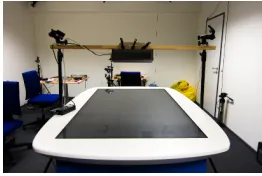
Figure 1: Overview of the used setup.
Copyright is held by the author/owner(s).
CHI 2013 Workshop on “Gaze Interaction in the Post-WIMP World”, April 27, 2013, Paris, France.
Abstract
Tabletop interaction with objects in and out of reach is a common real world as well as virtual task. Gaze as additional input modality might support this interactions on tabletops in terms of search, selection and
manipulation of distant objects. The aim of this work is to design and evaluate an interaction technique that relies on gaze and gestural touch input for the selection of distant objects. The proposed approach makes objects that are out of physical reach easily available to the user, and aims to provide an increased selection accuracy compared to single modality approaches. The paper contributes a setup that allows to track people with a static eye-tracker in front of a tabletop and investigates an interaction technique that makes use of the flicking gesture
augmented by gaze information to select distant objects.
Author Keywords
Gaze input; touch interaction; selection; flicking; gaze-supported interaction
ACM Classification Keywords
H.5.2 [Information interfaces and presentation]: User Interfaces. Input devices and strategies
General Terms
Introduction and Motivation
Multi-touch enabled tabletops are becoming increasingly popular as interactive information displays. Especially with larger tabletops there often is the need to interact with objects that are out of reach. In the past there have been di↵erent approaches proposed to solve this problem; some of them relying on gaze tracking. But using gaze alone has been shown to be problematic for this task due to the well knownMidas Touche↵ect [4]. This led to the use of additional input modalities to support gaze-based interactions. Following this approach, the aim of this work is the design and evaluation of an interaction technique that relies on gaze and gestural touch input. In particular the selection of distant objects on a large tabletop will be investigated. Since tabletops are often located in public spaces and meant to be easily accessible, eye tracking in this context should also be as unobtrusive as possible. Therefore a static eye tracker will be used; it does not need instrumentation of the user and it can be integrated in the environment. The proposed approach aims to combine the natural interaction of a simple gesture with the increased accuracy of additional gaze data.
Based on the previous considerations the contribution of this work is two-folded: First, we propose a solution for an interactive eye tracking-enabled tabletop setup usable for interaction studies. Secondly, an interaction technique for distant selection, which combines gaze and flicking gesture, is proposed and evaluated in an user study.
The remainder of this paper is organized as follows: First related approaches from gesture and gaze interaction are explored. Then the concept of gaze and flick selection and a prototype is presented. Afterwards, a study to evaluate the system is presented and the results are discussed. Finally, a conclusion and outlook on future work is given.
Related Work
For interaction with distant targets on tabletops a number of purely (multi-) touch based interaction techniques have been proposed. TheI-Grabber [1] uses the metaphor of a physical grabber to reach for objects. Gesture Select [3] combines an pointing gesture with drawing of markers for selection of annotated objects. Superflick [5] allows to slide virtual objects on the tabletop surface towards their target using a flicking gesture.
Design and Implementation
[image:3.792.34.165.112.200.2]The most common use-case for a static eye-tracker is to be placed beneath the vertical screen of a desktop computer (or an equivalent setup). Thus finding a configuration that allows the tracking of a large area on a horizontal tabletop surface is a complex task. For one,
[image:3.792.35.166.246.337.2]Figure 2: Tabletop setup with mounted eye tracker; seen from the front.
Figure 3: Tabletop setup with mounted eye tracker; seen from the side.
Figure 4: Schematic
representation of the information available from flicking and gaze. Linegrepresents the user’s gaze, linefthe flicking direction.
the geometry of the overall setup is very di↵erent. Instead of being positioned centered and in front of the tracked area, looking directly at it, the user is positioned at the side of the surface, which leads to a much lower angle of incident for his gaze. Also the active area of the tabletop is much larger than the common screen size. Because of these di↵erences to the standard setup, a special hardware solution had to be build to allow seamless eye-tracking during touch-based tabletop interaction. The solution proposed in this paper is to mount the eye-tracker head-first above the tabletop surface slightly below the user’s eye height (see Figures1to3). From there the user’s gaze can be tracked in a large area on the far side of the tabletop, without occluding the active surface area. In addition this setup could be extended to use multiple perpendicular eye trackers to track multiple users on di↵erent sides of the table.
ASession Desk1multi-touch table is used as interactive
tabletop. The dimensions of the active surface are
72cm⇥115cm. The height of the surface is100cm. The displayed image had a resolution of1280⇥800, providing about30ppi. The tabletop is sufficiently large to create a realistic scenario of the intended use case: The user is unable to reach all of the active surface without moving around the table. Also the viewing angles on the surface are as they would be expected to be in a real world scenario.
1http://www.archimedes-exhibitions.de/
For eye tracking we employed a Tobii X 602, a static
binocular eye tracker that produces data with a rate of
60Hz. This eye tracker allows relatively high freedom of movement for the user due to the use of 3D head tracking. There is a44⇥22⇥30cmhead movement box in which accurate tracking is supposed to be possible. This allows to track users reliable while free-standing and should permit some upper body movement during execution of gestures. The Tobii X 60 calibration is also highly configurable and allows almost arbitrary screen configurations, which allows for native support of the used setup.
The graphical interface as well as the touch interaction was implemented using libavg3. Eye-tracking data was
accessed through the Tobii SDK 3.0 RC 134.
The actual interaction by the user happens through the simple flicking gesture as described in [5]. The gesture mimics the interaction with a physical object that is slid across a plane surface. It is very simple, can be quickly executed and nonetheless provides additional information about the user’s intent. The gesture also implies a targeting process which will lead the user’s eye to the target. This facilitates the target acquisition by eye tracking without need for explicit eye interaction from the user. The gesture yields yields a linef in 3D space running through the table surface, which corresponds to thexy-plane. In addition from eye and gaze position at the time of selection an additional linegis computed. Ideally both these lines would individually intersect with
2http://www.tobii.com/en/eye-tracking-research/
global/products/hardware/tobii-x60x120-eye-tracker/
3https://www.libavg.de
4http://www.tobii.com/eye-tracking-research/
the desired target (see Figure4). Since this case can not be assumed, and the goal is to use both sources of information to yield more accurate results, the lineh, which minimizes the distance betweenf andg, is computed. Then the closest object (in 3D space) to that line is determined and selected.
Evaluation
Figure 5: Example of a flicking-task (F) trial.
Figure 6: Example of a gaze-task (G) trial.
Figure 7: Example of a combi-task (C) trial.
A study was performed to evaluate the combination of flicking and gaze for distant target selection in comparison to other selection techniques. The study was conducted using the apparatus described above. A within-subject design was used with three task conditions: Flicking-task (F), gaze-task (G) and combi-task (C). For better comparability ofC with the other tasks, it contained a balanced amount of trials using a single row of targets (Cl) or multiple rows (Cf). All tasks were presented in
counterbalanced blocks to prevent ordering e↵ects.
Participants
Overall18participants (six female), aged21to34
(M = 26.5, SD= 3.67), successfully participated in the experiment. 6 additional participants had to be excluded from evaluation due to tracking failure. All participants had normal vision and were right handed. The subjects’ height ranged between165cmand186cm(M = 176.63,
SD= 6.14).
Procedure
The experiment was conducted in sessions of about45
minutes. At the start of the session the subjects were asked to fill out a first questionnaire asking for general demoscopic data. Before the experiment started a multi-touch game was presented to familiarize the subjects with multi-touch interaction and our tabletop. The game was a puzzle game that incorporated the
flicking gesture and several other multi-touch techniques. Subjects were encouraged to try the di↵erent techniques and played for five minutes. Then the subjects were instructed about the experimental procedure and an initial
10-point calibration was performed for the eye tracker.
Each of the trial blocks started with a description of the selection technique, and if necessary a recalibration. A block consisted of10practice trials and40real trials. After every trial subjects received feedback about their selection; either positive, negative or neutral if the selection was wrong but close. All real tasks were awarded with a score of10,0, and 5for correct, close and wrong answers, respectively. The awarded score and the current overall score were displayed after each trial. The blocks were separated by five minute breaks.
Each task required the subject to select one distinct circle from a group of circles displayed at the far end of the table, as can be seen in Figures5to7. These circles varied in size, spatial arrangement and number between trials. The diameters varied between10px, 20px,30px
and40px. The items were always presented either in a single row (forF andCl) or a square field (forGand
Cf). This was done to accommodate the accordances of
Results
[image:5.792.44.149.124.305.2]In our evaluation we were especially interested in the correctness of the selections, therefore we evaluated the general rate of correct selections and the types of error that were made. The reported statistics were acquired using paired t-tests. All graphs show mean values; error bars indicate the standard error of the mean.
Figure 8: Error rates for each of the conditionsCf,G,F andCl.
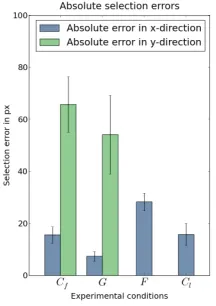
Figure 9: Absolute directional errors for each of the conditions
Cf,G,F andCl.
Error rates
The error rates achieved for selection in each task can be seen in Figure8. Significant di↵erences between error rates can be found betweenClandCf (F(34) = 5.11,
p <0.01). There is also an improvement ofCl overF
(F(34) = 2.28,p <0.05) and G(F(34) = 2.84,
p <0.01). No other significant e↵ects were found.
Directional errors
To further investigate the reasons for these results we looked at the type of selection error that was made. The selection errors are divided in y, the absolute error in
y-direction, and x, the absolute error in x-direction. The
result can be seen in Figure9. ForF andClno data for y is available, since in these condition only single rows
were displayed. The di↵erences between x for all of the
conditions, except betweenCl andCf, are significant
(FF,Cf(34)=2.93,p <= 0.01; FF,G(34)=5.72, p <= 0.01;FF,Cl(34)=2.44,p <= 0.05;FG,Cf(34)=
2.42,p <= 0.05). In order from best to worst: G, Cl/g
andF.
Observations
Subjects were observed to be using two di↵erent strategies for flicking: The first and most common way was to start the flicking gesture at the initial position of the throwable. The second strategy was to move the throwable
horizontally and start a purely vertical flicking gesture from there. We also observed that a few subjects showed
more upper body movement during the flicking gesture than expected. Instead of just moving their arm to execute the gesture, they heavily used their shoulder and upper body during flicking. After the experiment some subjects reported, that during flicking they rarely where looking at the target, but at the throwable instead.
Discussion
We found thatCl had a higher rate of correct selection
than flicking (F) or gaze selection (G). This shows that in principle it is possible to achieve the desired synergy e↵ect between multi-touch and gaze input. Unfortunately we did not find this improvement forCf. The main
di↵erence betweenCl and the worse performingCf lies in
the geometric arrangement of objects. Inspecting the directional error components we could verify that this is where there is a major di↵erence. The y-component, that is absent inCl, has an error rate that is much higher than
the x-component in both conditions. This high error rate for the y-direction might indicate some particular problem with our current setup. Possible explanations could be a general inaccuracy that occurs due to the large distance or movement of the subject. But this seems unlikely to be the only reason, since this would also a↵ect the
x-direction. More probably this e↵ect occurs due to the low viewing angles. Small eye movements and inaccuracies will translate to large changes in the projected position on the table surface, leading to poor accuracy in the
y-direction. These problems could be solved by increasing the accuracy of the gaze tracking, or by changing the setup to compensate for the viewing angle.
[image:5.792.42.150.358.511.2]subjects, it cannot be assumed that this approach would work well enough in a scenario ”in the wild” where the subjects are complete unaware of the eye tracking. To remedy this problem further data of gaze patterns of subjects, possibly completely unaware of the eye tracker’s role for interaction and una↵ected by restrictions placed upon them for the sake of accurate eye tracking, should be gathered and analyzed to determine an optimal algorithm to detect the targeted object. This task would preferably be handled in a experiment involving a mobile eye tracker and only a gaze independent flicking task, to gather uninfluenced data.
Conclusions and Future Work
In this work we present the design and evaluation of an interaction technique that relies on gaze and gestural multi-touch input for the selection of distant objects. We propose a multi-touch tabletop equipped with a static eye-tracker as a setup to track users in front of a tabletop and allow gestural and gaze-based interaction. An interaction technique that aims to improve the distant selection of objects by combining gaze and flicking gestures is proposed and evaluated in an user study.
The error in y-direction needs to be investigated as a next step. Furthermore other ways to track gaze data need to be evaluated. We plan a follow-up study with a mobile interactive eye-tracker to gather and analyze flicking and other gestural touch data to determine an optimal algorithm to detect the targeted object.
Acknowledgements
We thank Antti Oulasvirta for valuable feedback. This research project is partially supported by the Nuance Foundation.
References
[1] Abednego, M., Lee, J.-H., Moon, W., and Park, J.-H. I-grabber: expanding physical reach in a large-display tabletop environment through the use of a virtual grabber. InProceedings of ITS(2009). [2] Bader, T., Vogelgesang, M., and Klaus, E.
Multimodal integration of natural gaze behavior for intention recognition during object manipulation.
Proceedings of the ICMI (2009), 199.
[3] Bragdon, A., and Ko, H.-S. Gesture select: acquiring remote targets on large displays without pointing. In
Proceedings of CHI(2011).
[4] Jacob, R. J. K. What you look at is what you get: eye movement-based interaction techniques. In
Proceedings of CHI(1990).
[5] Reetz, A., Gutwin, C., Stach, T., Nacenta, M., and Subramanian, S. Superflick: a natural and efficient technique for long-distance object placement on digital tables. InProceedings of GI(2006). [6] Stellmach, S., and Dachselt, R. Look & touch:
gaze-supported target acquisition. InProceedings of CHI(2012).
[7] Stellmach, S., Stober, S., N¨urnberger, A., and Dachselt, R. Designing gaze-supported multimodal interactions for the exploration of large image collections. Proceedings of NGCA(2011), 1–8. [8] Turner, J., Bulling, A., and Gellersen, H. Combining
gaze with manual interaction to extend physical reach. Proceedings of PETMEI (2011), 33.
[9] Ware, C., and Mikaelian, H. H. An evaluation of an eye tracker as a device for computer input.
Proceedings of CHI (1986), 183–188.
[10] Zhai, S., Morimoto, C., and Ihde, S. Manual and gaze input cascaded (magic) pointing. In

![[R122.Ebook] Fee Download Love Warrior A Memoir By Glennon Doyle Melton.pdf](data:image/gif;base64,R0lGODlhAQABAIAAAP///wAAACH5BAEAAAAALAAAAAABAAEAAAICRAEAOw==)