Combinatorial capacities in primates
1
2
Klaus Zuberbühler
3
4
Institute of Biology, Department of Comparative Cognition, University of Neuchatel &
5
School of Psychology and Neuroscience, University of St Andrews
6
7
8
9
ABSTRACT 10
11
Do primates have syntax-like abilities? One line of enquiry is to test how subjects
12
respond to different types of artificial grammars. Results have revealed neural
13
structures responsible for processing combinatorial content, shared between
non-14
human primates and humans. Another approach has been to study natural
15
communication, which has revealed a wealth of organisational principles, including
16
merged compounds and sequences with stochastic, permutated, hierarchical and
cross-17
modal combinatorial utterances. There is solid experimental evidence that recipients
18
can attend to such combinatorial features to extract meaning. The debate is whether
19
animal communication can also be compositional, insofar as whether signallers
20
assemble meaningful units to create more complex utterances with novel meanings.
INTRODUCTION 22
Syntax is one defining feature of human language and part of our uniqueness, which
23
raises questions about its nature and evolution [1] [2]. In one view, syntax refers to the
24
ability “…to make infinite use of finite means” [3], a pragmatic approach by which
25
linguistic conventions function to achieve social goals [4]. In another view, syntax is
26
the ability to organise and represent mental content in a hierarchical, recursive way, a
27
computational system that generates internal representations [5]. Syntax is also about
28
recognition, which enables humans to discriminate legal from ill-formed sentences not
29
conforming to linguistic conventions and to apply them to form novel, legal utterances
30
[6].
31
The ontogeny of syntactic skills in humans is still debated, in part because it is difficult
32
to understand the underlying cognitive operations and to determine whether they are
33
language specific (see Mueller et al.; Gervain, this volume). An early view has been
34
that human infants possess an innate, universal grammar module that drives language
35
acquisition [7]. In a recent embodiment, this module is a single powerful operation,
36
‘merge’, which combines lexical/conceptual objects into unordered sets [8]. When
37
infants acquire language they use this innate operation, merely adjusting the
38
parameters to their respective language based on the input they receive. Alternative
39
models propose that grammatical competence cannot be reduced to one core operation,
40
but is acquired gradually, in conjunction with an asymptotically growing reference
41
library of speech utterances, accessed by both general-purpose and language-specific
42
rule-based systems that recognise legal combinatorial structures [9] [10]. With this,
43
language learners can go beyond the utterances they have heard and create unbounded
44
linguistic schemas [6] (p. 70). The debate thus amounts to whether syntactic
competence is acquired by manipulations of symbols or by general purpose, including
46
statistical learning not specific to language, but closely dependent on cognition and
47
memory for acoustic or other forms of input.
48
The purpose of this position piece is to provide an update on the combinatorial
49
competence of non-human primates. How extensive are combinatorial and
50
compositional phenomena in non-human primate communication and what is their
51
importance for understanding the evolution of syntax, a core intellectual capacity of
52
humans?
53
54
Recently, there has been resurgence of scepticism about the relevance of animal
55
communication studies for understanding language evolution, and especially syntax
56
[11], but this is mainly based on the controversial assumption that the only relevant
57
feature of syntax is generativity. An alternative hypothesis suggests that everyday
58
language use is not very generative at all, but based on accessing prefabricated phrases
59
from a vast stock. Although such utterances may be described in terms of their
60
syntactic structure, language users do not normally generate any of them, but deploy
61
them ‘wholesale’ in adequate situations. If this view is correct, then evolutionary
62
investigations of syntax should primarily focus on non-generative, combinatorial
63
systems, as frequently seen in animal communication.
64
65
66
ARTIFICIAL GRAMMARS 67
68
One way to study the nature and evolution of syntax is to investigate how subjects
a training phase during which stimulus sequences are presented, but without explicitly
71
highlighting the underlying organisational structure. Subjects are then exposed to a test
72
phase, during which they can apply any acquired ‘rule-based knowledge’ of the
73
structure to unfamiliar sequences. The technique has been used to investigate cognitive
74
capacities within and across species, and in humans it can be used to understand what
75
parts of the brain circuitry are involved in (artificial) grammar processing [13]. For
76
instance, rats that have learned simple order rules, such as XYX, XXY, or YXX, can
77
determine whether or not novel stimulus sequences comply to these patterns [14].
78
Various primate studies have used other paradigms, showing, for example, that
79
monkeys can learn to use patterns akin to morphological markers (e.g., English past
80
tense), indicating that the required perceptual and memory capacities have evolved
81
prior to language [15].
82
83
One particularly influential line of research has been to devise artificial grammars
84
along the ‘Chomsky hierarchy’ with increasing grammatical complexity [16]. Here,
85
monkeys have managed to learn regularities across adjacent and non-adjacent units
86
from finite-state grammars but failed to extract patterns at higher ‘phrase structure’ or
87
‘context-free’ grammars [17] [18]. However, an exclusive focus on primates for
88
evolutionary arguments can be dangerous, as demonstrated by a study with European
89
starlings that recognise patterns more complex than the ones with only adjacent
90
relationships (which tamarin monkeys can learn [19], [20]). Also, research with mixed
91
complexity artificial grammars has compared humans and monkeys to find that many
92
humans also struggle with non-adjacent relationships when adjacent relationships are
93
more salient [21].
94
Artificial grammar paradigms have been very effective in highlighting the brain
96
circuitry involved in processing sequences with different forms of dependencies. For
97
instance, EEG event-related potentials have been compared between macaques and
98
human infants and adults when responding to violations in artificial grammar
99
sequences [22] [23]. Furthermore, functional imaging has identified counterparts in
100
human and macaque brains for processing adjacent sequencing dependencies [24], an
101
initial stage of syntactic processing in some neurobiological models of language [25]
102
[26]. These studies have generally supported the notion of evolutionary continuity at
103
certain levels in combinatorial capabilities and of brain structures that support
104
cognitive domain-general processes not specific for language [27].
105
The weakness of artificial grammar studies is that they are typically based on stimuli
106
with no ecological or social relevance. Subjects are tested with simple sound
107
sequences, which require auditory pattern recognition but are devoid of meaning.
108
Although some linguistic theories stress that syntax should be investigated as divorced
109
from semantics [5], this is unlikely the case during natural acts of communication [28].
110
For evolutionary considerations, it is equally important to understand signal
111
combinations and compositions during natural social interactions.
112
113
114
NATURAL GRAMMARS 115
116
Duality of patterning
117
118
In human language, generativity is often highlighted as the pivotal feature, which is
phonemes (expressed to different degrees across languages) by which meaningful
121
combinations, i.e., morphemes or words, are generated in compliance with
language-122
specific combinatorial rules. Second, these phoneme combinations are then further
123
assembled into higher-order compositions, i.e., phrases or sentences. For
124
compositionality, a key point is that the meaning of a composition can be
125
systematically derived from its parts and the rules that combine them [29] (see Fitch,
126
this volume). Although the ‘duality of patterning’ (or ‘double articulation’)
127
interpretation of language has been a very useful heuristic, it is also a gross
128
simplification of reality because of the deep, hierarchically layered relationships in
129
sentences [30] [7] and, crucially, of questionable use for evolutionary studies of animal
130
signals. For example, linguists have long realised that phonemes are abstract constructs
131
that are difficult to ground in the acoustic reality of speech, and that they sometimes
132
carry natural meaning by being linked to mental concepts [31]. Moreover, there are
133
countless examples of linguistic structures at intermediate stages [32], such as patterns
134
in emerging sign languages, idioms, some affixes, which further undermines the notion
135
of duality.
136
137
Combinatoriality
138
Merged compounds 139
140
One of the first systematic studies on primate ‘syntax’ was on wedge-capped capuchins,
141
reported to merge four different call types into larger compounds [33]. No systematic
142
analysis of function has been made so the current interpretation is that compounds are
‘online’ readouts of conflicting motivations. Similar reports exist on gorilla close calls,
144
which can be given singly or as non-random compounds [34, 35].
145
146
Chimpanzees pant hoot calls may also qualify as compound calls, consisting of four
147
units; introduction, build-up, climax and let-down, always produced in this order (fig.
148
1). Although not yet studied systematically, the calls given as part of the four units
149
almost certainly contribute to other constructions in chimpanzee vocal behaviour or are
150
produced as standalone signals (P Fedurek, personal communication). In a study using
151
machine learning, it was demonstrated that the four units convey information on caller
152
identity, rank and age, and on the external event [36]. The different call types within
153
the four units can be repeated multiple times, but it is currently unknown whether this
154
has communicative function. Juveniles and females also give pant hoots, but they
155
sometimes omit units, as do adult males when they join others for a pant hoot chorus
156
[37]. There are trade-offs within units and within the compound, in compliance with
157
Menzerath’s law (the observation that as the size of linguistic constructs increases,
158
constituent size goes down, and vice versa [38]). Interestingly, the same phenomenon
159
has also been observed in vocal sequences of Gelada baboons [39], suggesting that
160
combinatoriality may further function as honest signals of physical condition.
161
162
-- Figure 1 --
163
164
Another well-studied combinatorial system is female Diana monkey contact calls. Here,
165
four vocal structures ('H', 'L', 'R', 'A' calls) can be given alone or as part of orderly
166
combinations ('HA', 'LA', 'RA'). ‘A’ calls function to signal identity; ‘H’, ‘L’, and ‘R’
167
calls refer to on-going events [40]. In playback experiments, R and L 'event' calls were
artificially merged with A 'identity' calls, to which subjects responded as if both event
169
and identity information were relevant [41].
170
171
Stochastic sequences 172
173
Animal songs, such as in passerine birds [42], humpback whales [43] or gibbons [44],
174
have been primary targets of sequence analyses. Singing is typically a male behaviour
175
for reproduction although, in monogamous species, singing can also be as duets and
176
functions in intergroup competition [45]. Although songs are often complex, they are
177
thought to be semantically vacuous and do not seem to advertise much beyond a
178
caller’s location, identity and vigour, such as to intimidate rivals or to attract partners.
179
However, sometimes song is produced to predators, such as in lar gibbons. Here,
180
predator-induced songs consist of the same units as regular duet songs, although they
181
are assembled in different ways [46].
182
183
Other examples of stochastic sequences are from chimpanzees, where about half of all
184
calls occur in combination with other calls, but also with drumming and gestures, often
185
in context-specific ways [47] [48]. Similar findings have been reported in bonobos,
186
with call combinations relating to caller movement [49] and different types of foods
187
[50].
188
189
Permutated sequences 190
191
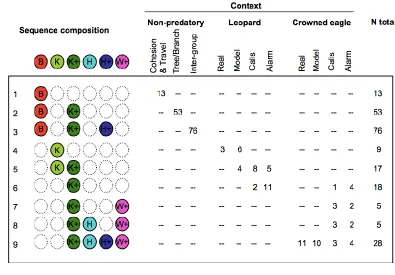
In some instances, call sequences show strong order effects, in which case they qualify
192
as permutations. Putty-nosed monkey sequences are one example (see before), but
similar patterns have also been reported in male Campbell’s monkeys, who combined
194
alarm calls into various sequences to refer to different events, such as travel, falling
195
trees, neighbouring groups, non-predatory animals, unspecific predatory threats,
196
crowned eagles and leopards [51] (fig. 2). Sequence composition follows a number of
197
rules, such as non-random transition probabilities, adding calls to existing sequences to
198
form novel ones, or combining two sequences to form a third one [51]. Playback
199
experiments have shown, for some of sequences, that they are communicatively
200
relevant [52].
201
202
-- Figure 2 ---
203
204
Amongst the New World primates, black-fronted titi monkeys have been studied well.
205
Here, both males and females produce sequences consisting of two main alarm call 206
types (A, B) that convey, in different parts of the utterance, information about predator 207
type (mammal, raptor) and location (ground, tree) [53]. B-calls appear as
context-208
specific acoustic variants (terrestrial predators vs. ground-related movements) with call
209
sequences to predators showing more regular sequential structure than ground-related
210
sequences [54]. The permutation hypothesis appears to be facing a challenge by recent
211
field work suggesting that predator type and location are encoded stochastically by
212
proportional differences in call combinations [54].
213
214
Hierarchical sequences 215
216
Another salient feature of signal sequences is the delivery rate (e.g., inter-call intervals,
217
call rates), and this can generate hierarchical structures. Differences in call rates have
been shown to refer to perceived urgency, as in male blue monkeys responding to
219
differences in threat posed by aerial predators [55] or male Campbell's monkeys
220
responding to predator vs. non-predator disturbances [56]. In some instances, signal
221
emission is clumped into bouts, which adds another perceptual dimension (fig. 3).
222
Diana monkeys, King Colobus and Guereza monkeys all use this feature to refer to
223
external events, with leopards triggering short bouts with small numbers of calls, and
224
eagles triggering long bouts with large numbers of calls [57-59], differences that are
225
recognised by recipients [60, 61].
226
227
-- Figure 3 --- 228
Cross-modal sequences 229
A number of studies have looked at cross-modal sequences, mainly call-gesture
230
combinations in apes. In chimpanzees, such combinations are relatively rare and
231
mainly occur during affiliative and agonistic interactions [48]. In bonobos they also
232
occur and one finding has been that gestures can function as semantic modulators of
233
vocalisations [62], revealing the social goal of an individual. In a related study,
234
bonobos were observed to use different signal combinations to clarify their sexual
235
intentions. For example, females used ‘screams’ and ‘hand reach’ most frequently
236
when using sex in appeasement functions, but ‘pout moans’ when using sex for social
237
bonding [63].
238
Another series of studies has shown that differences in signal combinations can reveal
239
something about the common ground between signallers and recipients. For example,
240
if orang-utans were made to believe that a human partner providing food did not
241
understand their requests, they adjusted gesture combinations accordingly [64].
Bonobos exposed to the same problem were more likely to repeat gestures if they
243
interacted with a familiar keeper but elaborated their gestures when interacting with an
244
unfamiliar one, as if taking into account differences in the shared interaction histories
245
[65].
246
Compositionality
247
Despite its weaknesses, ‘duality of patterning’ has been applied to animal
248
communication, with the conclusion that signal combinations are common but signal
249
compositions absent (e.g., [66]. A possible exception is the vocal system of pied
250
babblers, a social passerine that combines alert and recruitment calls into sequences
251
when encountering terrestrial predators. Recipients respond differently to sequences
252
than to component calls (presumed to have distinct meanings) and it has been argued,
253
controversially, that this qualifies as compositionality [67]. But for a sequence to be
254
(non-trivially) compositional, its meaning must be derived, in some way, from the
255
meaning of the two components and the two components cannot be interpreted
256
separately within the sequence [68]. In a related study on Japanese tits, this problem
257
has been addressed by using compositions of artificially inverted call sequences [69],
258
but this raises other issues relating to birds reacting to novelty and non-natural stimuli,
259
requiring further work (see Griesser et al., this volume).
260
261
The distinction between limited (trivial) and genuine (non-trivial) compositionality is
262
not straightforward. In English, the sentence “It’s humid” qualifies as trivial
263
compositionality because there is no need for a semantic operation: ‘It’s’ and ‘humid’
264
are separate utterances in the sentence. In contrast, the sentence “It’s very humid”
265
qualifies as genuine compositionality because it is not possible to analyse this as two
separate utterances. Instead, the meaning of ‘very humid’ is derived from the meanings
267
of ‘very’ and ‘humid’ (P Schlenker, personal communication).
268
269
A relevant example in primate communication is male putty-nosed monkeys
270
assembling two basic call types (pyows, hacks) into sequences with different meanings
271
[70]. Series of hacks indicate eagle presence, series of pyows are general alarms
272
(including leopard presence), while pyow-hack permutations (small numbers of pyows
273
followed by small numbers of hacks), given on their own or in combination with hack
274
or pyow series, predict forth-coming group travel [71]. Importantly, recipients
275
understand the differences in meaning of different combinations, as judged by their
276
behavioural reactions [72]. Strictly, the system does not qualify as compositional
277
because it is difficult to assign discrete meanings to individual pyows and hacks, and
278
because the meaning of pyow-hack combinations appears to be completely unrelated to
279
pyows and hacks, more akin to an idiom [66]. However, Schlenker et al. [73] have
280
proposed a (limited) compositional explanation by assuming that calls possess weak 281
meanings (pyow: general alarm; hack: non-ground movement, including by eagles) and 282
that call order obeys an urgency principle, such that calls referring to dangers come 283
first. Since pyows come before hacks, hacks cannot refer to eagle but to (less urgent) 284
non-ground movement. This, in turn, enables listeners to make pragmatic inferences, 285
i.e., that the caller has raised a general alarm and initiates non-ground movement. 286
287
Possibly a stronger case for compositionality is suffixation in Campbell’s monkey
288
alarm calls. Males give krak calls to leopards and hok calls to eagles, but both calls can
289
be merged with a suffix –oo to either krak-oo (wide range of disturbances) or hok-oo
290
(non-ground alerts). In playback experiments, both natural and artificially suffixed and
unsuffixed ‘krak’ calls caused reactions that suggested suffixation was meaningful,
292
which further implies that (limited) compositionality is an evolved function of primate
293
communication [74] (fig. 4). This is because the meanings of krak-oo and hok-oo are
294
plausibly derived from the meanings of krak/hok and the meaning of –oo, but -oo does
295
not form a separate utterance (analogous to ‘very’) but functions as an optional affix to
296
alarm calls [68].
297
298
-- Figure 4 --
299
300
CONCLUSIONS 301
302
Research on primate cognition has become a major force to enlighten the origins of
303
human uniqueness. The focus of this paper has been on the evolution of syntax, a core
304
capacity of the language faculty. Artificial grammar experiments suggest that primates
305
share certain combinatorial processing capacities with humans and utilise comparable
306
brain circuitry to analyse speech sounds and statistical regularities in artificial stimulus
307
sequences (e.g., Kikuchi et al, this volume). In natural communication, primates
308
produce and understand signal combinations as merged compounds, as well as
309
stochastic, permutated, hierarchical and cross-modal sequences. One outstanding
310
question is whether any of the reported combinations qualify as compositional.
311
Another outstanding question is whether human syntax evolved gradually from animal
312
combinatoriality or whether it appeared as a functional change from non-linguistic
313
operations during the more recent hominid evolution [75] (also see Fitch this volume).
314
If syntactic competence develops from learning and use, rather than from an innate
grammar module, then it may be sufficient to explain syntax as a by-product of the
316
massive brain expansion that took place from Homo habilis to early H sapiens over
317
little more than 1 million years, which have led to massively powerful acoustic storage
318
and pattern searching devices.
319
320
321
ACKNOWLEDGEMENT 322
I am grateful to Philippe Schlenker, Balthasar Bickel and Pawel Fedurek for their
323
comments and to the European Research Council (ERC grant GA 283871) and the
324
Swiss National Science Foundation for funding.
325
326
327
ANNOTATED REFERENCES 328
329
Arnold, K., & Zuberbühler, K. (2006). Semantic combinations in primate calls. Nature, 330
441(7091), 303-303.
331
332
Field study on a primate vocal system demonstrating experimentally the presence of
333
meaningful, permutated call sequences with limited compositionality. In particular, 334
free-ranging putty-nosed monkeys combine two vocalisations into different call 335
sequences linked to specific external events, such as the presence of a predator and 336
the imminent movement of the group. These findings indicate that non-human 337
primates can combine calls into higher-order sequences, which has been interpreted 338
as a case of limited combinatoriality [76]. 339
341
Evans, N., & Levinson, S. C. (2009). The myth of language universals: Language diversity
342
and its importance for cognitive science. Behavioral and Brain Sciences, 32(5), 429-+.
343
doi:10.1017/s0140525x0999094x
344
345
Landmark opinion paper challenging the commonly accepted notion of linguistic
346
universals amongst cognitive scientists. The authors argue that empirical research in
347
language typology has not supported the hypothesis that human languages can be
348
characterised by universal grammar and similar notions. Instead the current picture is
349
one of maximal linguistic diversity, fundamentally variable at all levels of sound,
350
meaning and syntactic organisation.
351
352
353
Fitch, W. T., & Hauser, M. D. (2004). Computational constraints on syntactic
354
processing in a nonhuman primate. Science, 303(5656), 377-380.
355
356
Laboratory experiment showing that non-human primates only master basic artificial
357
finite-state grammars within the Chomsky hierarchy, but fail ‘phrase-structure’ (or
358
‘context-free’) grammars. In particular, monkeys mastered regularities if sound
359
patterns were between neighbouring units but not patterns with more complex
360
sequencing dependencies.
361
362
363
Kershenbaum, A., Blumstein, D. T., Roch, M. A., Akcay, C., Backus, G., Bee, M.
364
A., . . . Zamora-Gutierrez, V. (2016). Acoustic sequences in non-human animals: a
tutorial review and prospectus. Biological Reviews, 91(1), 13-52.
366
doi:10.1111/brv.12160
367
368
Consensus view on the state of the art of animal call sequence research. Highlights the
369
need for a coherent theory and methodological framework of animal call sequences.
370
The paper also provides a tutorial to algorithmic approaches for analysing signal
371
sequences.
372
373
374
Suzuki, T. N., Wheatcroft, D., & Griesser, M. (2016). Experimental evidence for
375
compositional syntax in bird calls. Nature Communications, 7.
376
doi:10.1038/ncomms10986
377
378
Relevant evidence for compositionality in animal communication to date: Japanese
379
great tits use different notes solely or in combination with each other. In experiments,
380
receivers respond to ‘ABC’ (scan for danger) and ‘D’ notes (approach the caller), and
381
compound meaning from ‘ABC’ combinations but not from artificially
382
reversed ’DABC’ combinations.
383
384
Wilson, B., Kikuchi, Y., Sun, L., Hunter, D., Dick, F., Smith, K., . . . Petkov, C. I.
385
(2015). Auditory sequence processing reveals evolutionarily conserved regions of
386
frontal cortex in macaques and humans. Nature Communications, 6.
387
doi:10.1038/ncomms9901
388
389
Breakthrough study using neuroimaging data that demonstrates shared neurobiological
substrates in the frontal cortex for processing adjacent sequencing dependencies in
391
primate and human brains. Key regions in the human ventral frontal and opercular
392
cortex, associated separately with the initial stages of syntactic processes, were found
393
to have functional counterparts in the monkey brain. Results suggest that certain
394
ventral frontal neural systems, originally evolved to support domain-general abilities of
395
sequence processing, underwent a functional change towards syntactic functioning in
396
modern humans [26]. .
397
398
References
399
1. Mitani, J.C. and P. Marler, A phonological analysis of male gibbon singing behavior. Behaviour, 400
1989. 109(1-2): p. 20-45. 401
2. Robinson, J.G., Organisation of vocal communication in the titi monkey. Zeitschrift für 402
Tierpsychologie, 1979. 49: p. 381-405. 403
3. von Humboldt, K.W., Über die Verschiedenheit des menschlichen Sprachbaues und ihren 404
Einfluss auf die geistige Entwickelung des Menschengeschlechts. 1836/1935, Berlin: Druckerei
405
der Königlichen Akademie der Wissenschaften. 406
4. Wittgenstein, L., Philosophical investigations. 1st ed. 1953: Oxford, Blackwell. 407
5. Hauser, M.D., N. Chomsky, and W.T. Fitch, The faculty of language: what is it, who has it, and 408
how did it evolve? Science, 2002. 298: p. 1569-1579.
409
6. Tomasello, M., The usage-based theory of language acquisition. Cambridge Handbook of Child 410
Language, 2009: p. 69-87. 411
7. Chomsky, N., Three factors in language design. Linguistic Inquiry, 2005. 36(1): p. 1-22. 412
8. Bickerton, D., Syntax for Non-syntacticians A Brief Primer. Biological Foundations and Origin of 413
Syntax, ed. D. Bickerton and E. Szathmary. 2009. 3-+. 414
9. Evans, N. and S.C. Levinson, The myth of language universals: Language diversity and its 415
importance for cognitive science. Behavioral and Brain Sciences, 2009. 32(5): p. 429-+.
416
10. Kuhl, P.K., Human speech and birdsong: Communication and the social brain. Proceedings of 417
the National Academy of Sciences of the United States of America, 2003. 100(17): p. 9645-418
9646. 419
11. Hauser, M.D., et al., The mystery of language evolution. Frontiers in Psychology, 2014. 5. 420
12. Gomez, R.L. and L. Gerken, Infant artificial language learning and language acquisition. Trends 421
in Cognitive Sciences, 2000. 4(5): p. 178-186. 422
13. Petersson, K.M., V. Folia, and P. Hagoort, What artificial grammar learning reveals about the 423
neurobiology of syntax. Brain and Language, 2012. 120(2): p. 83-95.
424
14. Murphy, R.A., E. Mondragon, and V.A. Murphy, Rule learning by rats. Science, 2008. 425
319(5871): p. 1849-1851. 426
15. Endress, A.D., et al., Evidence of an evolutionary precursor to human language affixation in a 427
non-human primate. Biology Letters, 2009. 5(6): p. 749-751.
428
16. Chomsky, N., Three models for the description of language. IRE Transactions on Information 429
Theory, 1956. 2: p. 113-124. 430
17. Fitch, W.T. and M.D. Hauser, Computational constraints on syntactic processing in a 431
nonhuman primate. Science, 2004. 303(5656): p. 377-380.
432
18. Newport, E.L., et al., Learning at a distance - II. Statistical learning of non- adjacent 433
dependencies in a non-human primate. Cognitive Psychology, 2004. 49(2): p. 85-117.
19. Gentner, T.Q., et al., Recursive syntactic pattern learning by songbirds. Nature, 2006. 435
440(7088): p. 1204-1207. 436
20. Beckers, G.J.L., et al., Birdsong neurolinguistics: songbird context-free grammar claim is 437
premature. Neuroreport, 2012. 23(3): p. 139-145.
438
21. Wilson, B., K. Smith, and C.I. Petkov, Mixed-complexity artificial grammar learning in humans 439
and macaque monkeys: evaluating learning strategies. European Journal of Neuroscience,
440
2015. 41(5): p. 568-578. 441
22. Attaheri, A., et al., EEG potentials associated with artificial grammar learning in the primate 442
brain. Brain and Language, 2015. 148: p. 74-80.
443
23. Milne, A.E., et al., Evolutionary origins of non-adjacent sequence processing in primate brain 444
potentials2. Scientific Reports, 2016. 6.
445
24. Wilson, B., et al., Auditory sequence processing reveals evolutionarily conserved regions of 446
frontal cortex in macaques and humans. Nature Communications, 2015. 6.
447
25. Friederici, A.D., Language In Our Brain: The Origins of a Uniquely Human Capacity. 2017, 448
Cambridge MA: MIT Press. 449
26. Friederici, A.D., The brain basis of language processing: from structure to function. 450
Physiological Reviews, 2011. 91(4): p. 1357-1392. 451
27. Wilson, B., W.D. Marslen-Wilson, and C.I. Petkov, Conserved Sequence Processing in Primate 452
Frontal Cortex. Trends in Neurosciences, 2017. 40(2): p. 72-82.
453
28. Shettleworth, S.J., Cognition, evolution, and behavior 2ed. 2010, Oxford: Oxford University 454
Press. 455
29. Szabó, Z.G., Compositionality, in The Stanford Encyclopedia of Philosophy, E.N. Zalta, Editor. 456
2017. 457
30. Blevins, J., Duality of patterning: Absolute universal or statistical tendency?, in Language and 458
Cognition. 2012. p. 275.
459
31. Blasi, D.E., et al., Sound-meaning association biases evidenced across thousands of languages. 460
Proceedings of the National Academy of Sciences of the United States of America, 2016. 461
113(39): p. 10818-10823. 462
32. Collier, K., et al., Language evolution: syntax before phonology? Proceedings of the Royal 463
Society B-Biological Sciences, 2014. 281(1788). 464
33. Robinson, J.G., Syntactic structures in the vocalizations of wedge-capped capuchin monkeys, 465
Cebus olivaceus. Behaviour, 1984. 90: p. 46-79.
466
34. Hedwig, D., et al., Contextual correlates of syntactic variation in mountain and western gorilla 467
close-distance vocalizations: Indications for lexical or phonological syntax? Animal Cognition,
468
2015. 18(2): p. 423-435. 469
35. Hedwig, D., et al., Acoustic structure and variation in mountain and western gorilla close calls: 470
a syntactic approach. Behaviour, 2014. 151(8): p. 1091-1120.
471
36. Fedurek, P., K. Zuberbühler, and C.D. Dahl, Sequential information in a great ape utterance. 472
Scientific Reports, 2016. 6: p. 38226. 473
37. Fedurek, P., A.M. Schel, and K.E. Slocombe, The acoustic structure of chimpanzee pant-hooting 474
facilitates chorusing. Behavioral Ecology and Sociobiology, 2013. 67(11): p. 1781-1789.
475
38. Fedurek, P., K. Zuberbuhler, and S. Semple, Trade-offs in the production of animal vocal 476
sequences: insights from the structure of wild chimpanzee pant hoots. Frontiers in Zoology,
477
2017. 14. 478
39. Gustison, M.L., et al., Gelada vocal sequences follow Menzerath’s linguistic law. PNAS, 2016. 479
113: p. E2750-E2758. 480
40. Candiotti, A., K. Zuberbuhler, and A. Lemasson, Context-related call combinations in female 481
Diana monkeys. Animal Cognition, 2012. 15(3): p. 327-339.
482
41. Coye, C., K. Zuberbuhler, and A. Lemasson, Morphologically structured vocalizations in female 483
Diana monkeys. Animal Behaviour, 2016. 115: p. 97-105.
484
42. Catchpole, C.K. and P.J.B. Slater, Bird Song: Biological Themes and Variations, 2nd Edition. Bird 485
Song: Biological Themes and Variations, 2nd Edition. 2008. 1-335. 486
43. Payne, R. and s. McVay, Songs of humpback whales. Science, 1971. 173: p. 585-597. 487
44. Clarke, E., U.H. Reichard, and K. Zuberbühler, The Syntax and Meaning of Wild Gibbon Songs. 488
Plos One, 2006. 1(1). 489
46. Clarke, E., U. Reichard, and K. Zuberbühler, The syntax and meaning of wild gibbon songs. 491
PLoS One, 2006. 1(1): p. e73. 492
47. Crockford, C. and C. Boesch, Call combinations in wild chimpanzees. Behaviour, 2005. 142: p. 493
397-421. 494
48. Hobaiter, C., R.W. Byrne, and K. Zuberbuhler, Wild chimpanzees' use of single and combined 495
vocal and gestural signals. Behavioral Ecology and Sociobiology, 2017. 71(6).
496
49. Schamberg, I., et al., Call combinations, vocal exchanges and interparty movement in wild 497
bonobos. Animal Behaviour, 2016. 122: p. 109-116.
498
50. Clay, Z. and K. Zuberbühler, Bonobos extract meaning from call sequences. Plos One, 2011. 499
6(4). 500
51. Ouattara, K., A. Lemasson, and K. Zuberbuhler, Campbell's monkeys concatenate vocalizations 501
into context-specific call sequences. Proceedings of the National Academy of Sciences of the
502
United States of America, 2009. 106(51): p. 22026-22031. 503
52. Zuberbuhler, K., A syntactic rule in forest monkey communication. Animal Behaviour, 2002. 63: 504
p. 293-299. 505
53. Cäsar, C., et al., Titi monkey call sequences vary with predator location and type. Biology 506
Letters, 2013. 9(5). 507
54. Berthet, M., et al., Contextual encoding in titi monkey alarm call sequences. Behavioral 508
Ecology and Sociobiology, 2017. 72(1): p. 8. 509
55. Murphy, D., S.E.G. Lea, and K. Zuberbuhler, Male blue monkey alarm calls encode predator 510
type and distance. Animal Behaviour, 2013. 85(1): p. 119-125.
511
56. Lemasson, A., et al., Speed of call delivery is related to context and caller identity in Campbell's 512
monkey males. Naturwissenschaften, 2010. 97(11): p. 1023-1027.
513
57. Riede, T. and K. Zuberbuhler, The relationship between acoustic structure and semantic 514
information in Diana monkey alarm vocalization. Journal of the Acoustical Society of America,
515
2003. 114(2): p. 1132-1142. 516
58. Zuberbuhler, K., Referential labelling in Diana monkeys. Animal Behaviour, 2000. 59: p. 917-517
927. 518
59. Schel, A.M., S. Tranquilli, and K. Zuberbuhler, The Alarm Call System of Two Species of Black-519
and-White Colobus Monkeys (Colobus polykomos and Colobus guereza). Journal of
520
Comparative Psychology, 2009. 123(2): p. 136-150. 521
60. Schel, A.M., A. Candiotti, and K. Zuberbühler, Predator-deterring alarm call sequences in 522
Guereza colobus monkeys are meaningful to conspecifics. Animal Behaviour, 2010. 80(5): p.
523
799-808. 524
61. Zuberbühler, K., R. Noë, and R.M. Seyfarth, Diana monkey long-distance calls: 525
messages for conspecifics and predators. Animal Behaviour, 1997. 53: p. 589-604.
526
62. Genty, E., et al., Multi-modal use of a socially directed call in bonobos. Plos One, 2014. 9(1). 527
63. Genty, E., C. Neumann, and K. Zuberbuhler, Complex patterns of signalling to convey different 528
social goals of sex in bonobos, Pan paniscus. Scientific reports, 2015. 5: p. 16135-16135.
529
64. Cartmill, E.A. and R.W. Byrne, Orangutans modify their gestural signaling according to their 530
audience's comprehension. Current Biology, 2007. 17(15): p. 1345-1348.
531
65. Genty, E., C. Neumann, and K. Zuberbuhler, Bonobos modify communication signals according 532
to recipient familiarity. Scientific Reports, 2015. 5.
533
66. Arnold, K. and K. Zuberbuhler, Call combinations in monkeys: Compositional or idiomatic 534
expressions? Brain and Language, 2012. 120(3): p. 303-309.
535
67. Engesser, S., A.R. Ridley, and S.W. Townsend, Meaningful call combinations and compositional 536
processing in the southern pied babbler. Proceedings of the National Academy of Sciences,
537
2016. 538
68. Schlenker, P., et al., Formal monkey linguistics: The debate. Theoretical Linguistics, 2016. 42(1-539
2): p. 173-201. 540
69. Suzuki, T.N., D. Wheatcroft, and M. Griesser, Experimental evidence for compositional syntax 541
in bird calls. Nature Communications, 2016. 7.
542
70. Arnold, K., Y. Pohlner, and K. Zuberbühler, A forest monkey’s alarm call series to predator 543
models. Behavioral Ecology and Sociobiology, 2008. 62: p. 549-559.
544
72. Arnold, K. and K. Zuberbuhler, Meaningful call combinations in a non-human primate. Current 547
Biology, 2008. 18(5): p. R202-R203. 548
73. Schlenker, P., et al., Pyow-hack revisited: Two analyses of Putty-nosed monkey alarm calls. 549
Lingua, 2016. 171: p. 1-23. 550
74. Coye, C., K. Zuberbuhler, and A. Lemasson, Suffixation in Non-Human Primates: Meaningful 551
Sound Combinations in Free-Ranging Guenons. Folia Primatologica, 2015. 86(4): p. 263-264.
552
75. Fitch, W.T., The Evolution of Syntax: An Exaptationist Perspective. Frontiers in Evolutionary 553
Neuroscience, 2011. 3(9). 554
76. Schlenker, P., et al., Formal monkey linguistics. Theoretical Linguistics, 2016. 42(1-2): p. 1-90. 555
77. Ouattara, K., A. Lemasson, and K. Zuberbuhler, Campbell's Monkeys Use Affixation to Alter Call 556
Meaning. Plos One, 2009. 4(11).
Figures 560
561
[image:21.595.52.500.89.625.2]562
Figure 1. Information flow in chimpanzee pant hoots across the four vocal units, each
563
consisting of a variable number of acoustically distinct calls. The x-axis shows the time
564
(s), the y-axis frequency (kHz) (reprinted from [36]). Information flow determines the
565
time point in the sequence that was most associated with a given attribute of the caller.
566
In the introduction phase both ‘identity’ and ‘age’ were associated most strongly with
567
the middle of the phase. In the build-up phase, ‘age’ was apparent most strongly early
568
in the phase, while in the climax phase, ‘identity’ and ‘social status’ were apparent
569
early on. For the let-down phase, ‘context’ was apparent in very early stages.
570
572
Figure 2. Composition of call sequences by male Campbell’s monkeys in different
573
behavioural contexts. B = non-vocal booms produced by air-sacs, K = krak; K+ =
krak-574
oo; H = hok; H+ = hok-oo; W+ = wak-oo (see fig. 1). Depicted sequence composition
575
does not reflect call order, apart from boom calls, which are always given in pairs and
576
precede other calls; and apart from krak-oo calls, which tend to terminate call
577
sequences. ‘Alarm’ indicates leopard or eagle alarm calls given by sympatric Diana
578
monkeys.
579
581
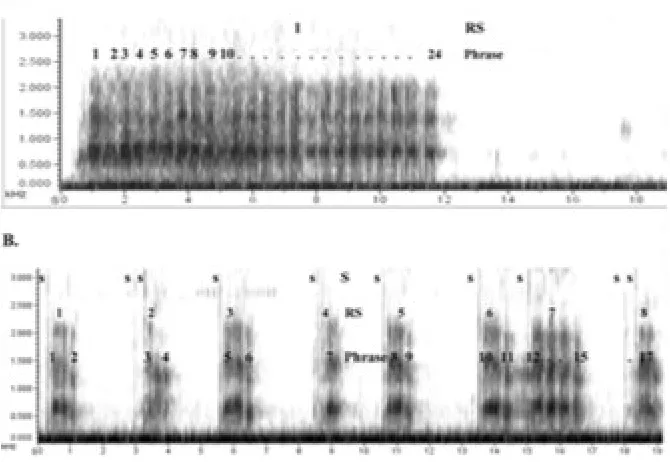
Figure 3. Spectrographic illustrations of the main structural differences characterising
582
the vocal responses of King Colobus monkeys to eagles and leopards. A: continuous
583
recording of an adult male responding to an eagle with a roaring sequence of 24
584
phrases. B: continuous recording of an adult male responding to a leopard, starting
585
with 6 snort-introduced two-phrase roaring sequences, followed by a snort-introduced
586
four-phrase sequence, followed by a single snort and another snort-introduced
one-587
phrase sequence. The x-axis represents time (s), the y-axis frequency (kHz). S stands
588
for snorts, RS for roaring sequence. Reprinted from [59].
589
590
592
Figure 4. Spectrographic illustrations of the different alarm calls produced by male
593
Campbell’s monkeys. (b) ‘krak’ call [K], a loud vocal utterance with a decreasing main
594
frequency band; (c) ‘hok’ call [H], a loud vocal utterance with no frequency
595
modulation; (e) ‘krak-oo’ call [K+], a ‘krak’ call followed by the ‘oo’ suffix; (f)
‘hok-596
oo’ [H+], a ‘hok’ call followed by the ‘oo’ suffix. Reprinted from [77].
597